💥Mains Ready By December. Smash Mains & Smash PYQ Admissions Open

GS Paper: GS2-13.Issues relating to development and management of Social Sector/Services relating to Health, Education, Human Resources.

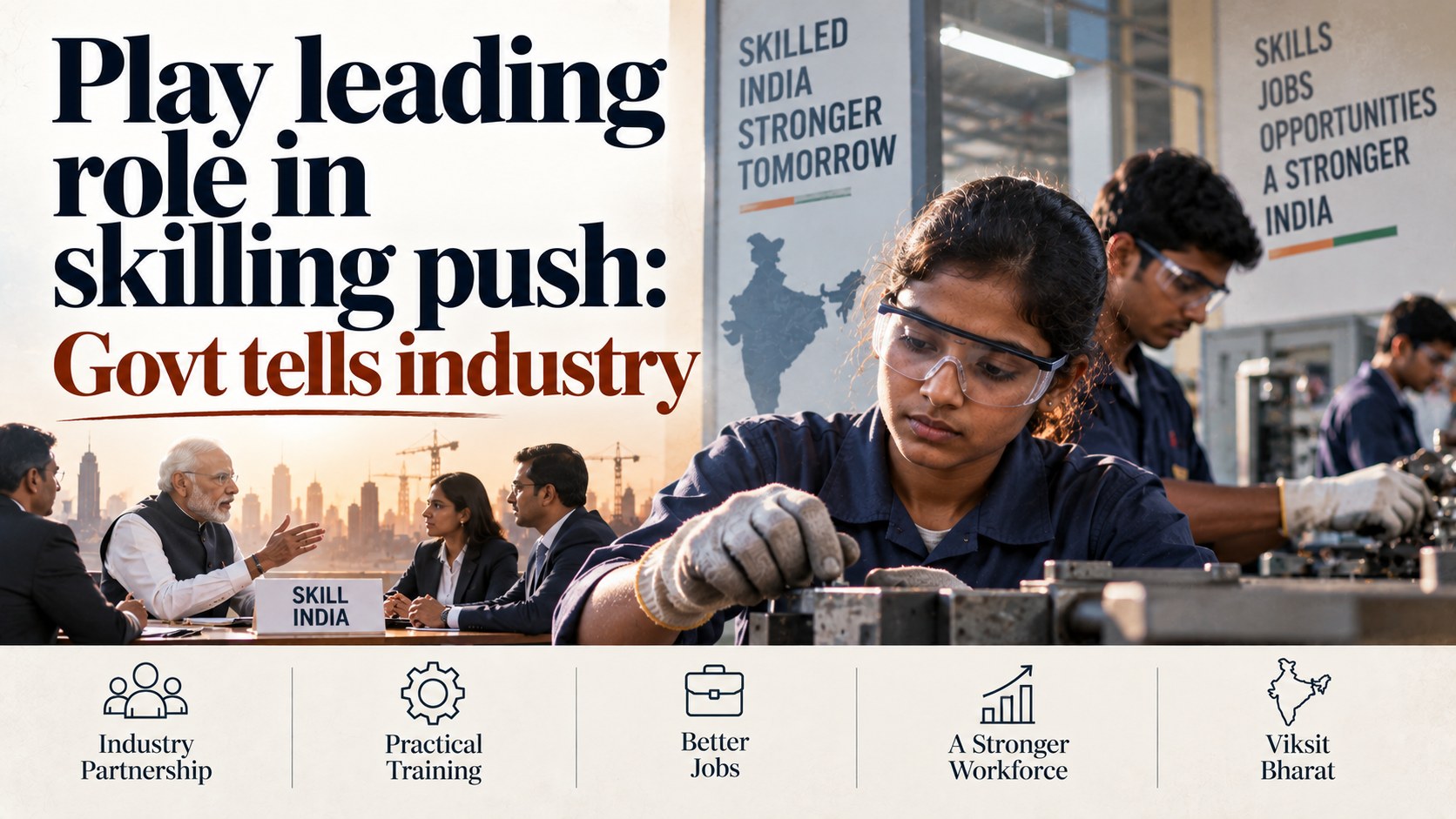
  • Play leading role in skilling push: Govt tells industry

    Play leading role in skilling push: Govt tells industry

    Why in the News

    The Ministry of Skill Development and Entrepreneurship has asked industry to take the leading role in the Pradhan Mantri Skilling and Employability Transformation through Upgraded ITIs (PM-SETU) scheme. The scheme’s own design already places industry there. Industry partners take a controlling 51 percent stake in the Section 8 companies (not for profit companies registered under the Companies Act, 2013, which cannot pay dividends to their members) that will manage clusters of Industrial Training Institutes (ITIs). The Centre and the States put up the bulk of the money. Industry’s 17 percent share qualifies as Corporate Social Responsibility (CSR) spending. Control over curriculum, technology and delivery therefore passes to a partner whose own contribution comes out of a statutory obligation rather than commercial risk capital.

    What is PM-SETU?

    1. What it is: A central scheme carrying an outlay of Rs 60,000 crore to upgrade government Industrial Training Institutes.
    2. What it funds: Upgraded laboratories, new machines and revised trade curricula at the institutes it covers.
    3. What it is measured on: Employability, since the stated purpose is the quality and relevance of vocational training rather than the number of training seats created.

    What does the ownership structure change?

    1. Industry holds control of the managing entity: Industry partners take a controlling 51 percent stake in the Section 8 companies that will manage ITI clusters.
    2. The state pays and industry decides: The Centre and the States provide the bulk of the funding, against an industry contribution of 17 percent.
    3. The industry share is a statutory obligation, not risk capital: That 17 percent is eligible under Corporate Social Responsibility, so the controlling partner can meet it from money the Companies Act, 2013 already requires it to spend.
    4. What moves into the partner’s hands: Curriculum design, technology adoption and the running of skill development pass to the industry partner.

    Why is industry being asked to lead?

    1. The demand side gets to write the syllabus: Placing curriculum and technology decisions with employers is meant to keep trade training aligned to the machines and processes actually in use.
    2. The immediate driver is the energy and manufacturing transition: The appeal was addressed to the power and utilities industry, whose workforce requirements are changing as generation and grid technology change.
    3. A working cluster is being held up as the model: ArcelorMittal’s leadership of the Vizag cluster has been cited as the benchmark for what the arrangement should produce.
    4. Institute workshops lag the shop floor: ITIs have long trained on equipment that industry has already replaced, which is the specific gap upgraded labs and employer set curricula are meant to close.

    Challenges to PM-SETU

    1. Most trades have no anchor employer: A cluster needs a large firm willing to hold a controlling stake and carry the management burden, which exists in steel or power and not across most trades an ITI teaches. Eg. Plumbing, welding and electrical work are served largely by contractors and micro enterprises, with no single firm able to lead a cluster.
      The Fix: Allow a sector skill council or an industry association to hold the controlling stake in trades where no single anchor firm exists.
    2. Corporate Social Responsibility money contracts in a downturn: A partner funding its share from CSR can redirect that spending in a year when its own hiring slows. Eg. The obligation is calculated at two percent of average net profits of the preceding three financial years, so it falls exactly when industrial demand falls.
      The Fix: Fix the industry contribution as a multi year commitment inside the cluster agreement, so a cluster’s operating budget does not track one partner’s profits.
    3. Control is granted without an outcome obligation: A controlling stake gives industry decision rights over publicly funded assets with no placement or wage commitment attached to those rights. Eg. The National Apprenticeship Promotion Scheme has repeatedly recorded engagement below its sanctioned targets, since participation carried no binding hiring commitment.
      The Fix: Tie renewal of a cluster’s management contract to verified placement and wage outcomes for its trainees.
    4. Clusters will form where industry already is: The model reproduces the existing gap between industrialised and lagging States, because the anchor employer is the precondition. Eg. Institutes in the north eastern States operate with far thinner employer presence than those in Tamil Nadu, Gujarat or Maharashtra.
      The Fix: Reserve a share of central funding for clusters in districts with no large anchor employer, with a public sector undertaking as the lead partner.
    5. The trained worker is a poachable asset: A Section 8 company cannot distribute surplus, so a firm’s only return is the workers it hires, and a competitor can hire them instead. Eg. A firm that trains a welder who then joins a rival bears the full cost and gets none of the benefit, which is the standard problem in employer funded training.
      The Fix: Publish cluster wise trainee supply data so participating firms recruit from a pool they collectively financed rather than each underwriting a rival’s hiring.

    Conclusion

    The scheme moves the state from provider of vocational training to financier of it. That works where a large employer wants the workers and is willing to run the institution, and the scheme has not said who takes charge in the trades where neither condition holds. The marker to watch is the first set of cluster agreements, and specifically whether any hiring or wage commitment is attached to the controlling stake.

    Back2Basics: Industrial Training Institutes

    1. What they are: Post school institutions offering trade level vocational training in engineering and non engineering trades, entered after Class 8, 10 or 12 depending on the trade.
    2. Who runs them: Government institutes are run by State governments alongside a large private sector, with standards set by the Directorate General of Training under the Ministry of Skill Development and Entrepreneurship.
    3. What a trainee gets: Trainees sit the All India Trade Test and are awarded the National Trade Certificate.
    4. Where they sit in the system: They form the country’s oldest and largest formal vocational training network, run under the Craftsmen Training Scheme since 1950.

    [2023, GS2, 15 marks] Skill development programs have succeed in increasing human resources supply to various sectors. In the context of the statement analyze the linkages between education, skill and employment.

  • [4th September 2026] The Hindu OpED: For newborns, the answer is hospital plus home

    [4th September 2026] The Hindu OpED: For newborns, the answer is hospital plus home

    Question (2024, GS2): “In a crucial domain like the public healthcare system, the Indian State should play a vital role to contain the adverse impact of marketisation of the system. Suggest some measures through which the State can enhance the reach of public healthcare at the grassroots level.
    Linkage: The proposed solution to move a portion of newborn care back to the home is a direct attempt to “enhance the reach of public healthcare at the grassroots level”. This question prompts candidates to suggest structural measures to decentralise care, relieving the burden on overloaded urban hospitals.

    Mentor Comment

    Three newborns died in an accidental fire at the government women’s hospital in Amravati, Maharashtra. That episode is placed alongside a list of clustered newborn deaths in government institutions since 2017, running from BRD Medical College in Gorakhpur and a government hospital in Ahmedabad through JK Lon Hospital in Kota, and on to district and medical college hospitals in Shahdol, Bhandara, Bhopal, Ambikapur, Nanded, Jhansi and Budaun. The argument drawn from that list is that these are a recurring pattern produced by the system, not a series of isolated accidents. The tension is that the policy success which moved birth out of the home is what has overloaded the units that receive the sick newborn, and the proposed answer is to move part of newborn care back to the home.

    What is home based newborn care?

    1. Trained community health workers deliver care where the baby is: They identify and manage neonatal infections at home, support breastfeeding and warmth, and manage low birth weight and preterm babies.
    2. It is already a package inside the public system: The Ministry of Health and Family Welfare adopted it in 2011, and roughly 8,00,000 Accredited Social Health Activists (ASHAs) have been trained on modules built from the Gadchiroli experience.
    3. It does not replace intensive care: A baby with severe prematurity, respiratory distress, shock, severe sepsis or serious birth asphyxia needs immediate facility based treatment.

    Why are newborn deaths clustering in government units?

    1. Overcrowding is the first reason: Institutional deliveries rose from 39 percent in 2005-06 to 90 percent in 2023-24 under the National Family Health Survey-6, and the absolute number of institutional deliveries rose from 109 lakh to 194 lakh. Admissions to public Special Newborn Care Units (SNCUs), the secondary level units that treat sick newborns, rose 28 percent in two years, from 11.3 lakh in 2021-22 to 14.45 lakh in 2023-24.
    2. The case mix has become sicker: Government hospitals now receive premature, low birth weight and sick newborns referred from peripheral facilities, alongside the normal deliveries they always handled.
    3. Infrastructure failure is the third reason: The Gorakhpur deaths of August 2017 were attributed by a district level inquiry to oxygen deprivation following an interruption in supply. Fires at Bhandara in January 2021, Bhopal in November 2021 and Jhansi in November 2024 show the electrical and fire risk in units running warmers, incubators and ventilators.
    4. Infection and staffing form the fourth: Inadequate nurse-to-baby ratios, equipment shortages and weak infection prevention practice let hospital acquired infection spread quickly through a crowded unit.

    What is the evidence that care at home works?

    1. A field trial cut neonatal mortality by 62.2 percent: The Society for Education, Action and Research in Community Health (SEARCH) ran the trial in rural Gadchiroli using trained community health workers, and published the result in The Lancet in 1999.
    2. Most small babies were managed without a bed: Between 1996 and 2003, 97 percent of low birth weight and preterm babies in Gadchiroli, including those above 1,800 g and beyond 34 weeks of gestation, were managed at home with a very low case fatality rate, published in the Journal of Perinatology in 2005.
    3. The delivery channel already exists nationally: India does not have to invent a system, so the binding constraint is training, supervision and support of the workers already deployed.

    What is the three part strategy proposed?

    1. Decongest the neonatal units: Strengthen home based care by ASHAs so that appropriate, stable newborns receive care at home rather than occupying a scarce SNCU bed.
    2. Staff and equip the units properly: Adequate numbers of doctors and nurses, appropriate nurse-to-baby ratios, functioning equipment, reliable oxygen and electricity with backup systems, and rigorous infection prevention.
    3. Make the units intrinsically safe: Fire detection and suppression systems, electrical and oxygen system safety measures, emergency evacuation drills and independent safety audits, all made mandatory rather than advisory.

    Challenges to home based newborn care

    1. The worker carrying the package is not an employee: An ASHA is an honorary volunteer paid through task linked incentives, so an expanded clinical role rests on availability that is not contractually owed. Eg. The fixed monthly incentive for routine tasks is Rs 2,000, with the remainder paid activity by activity.
      The Fix: Create a semi-formal cadre under the National Health Mission with a fixed salary component, insurance and pension attached to the newborn care role.
    2. Skill retention needs supervision that is not staffed: A worker trained once and never observed loses the clinical judgement the package depends on. Eg. The Auxiliary Nurse Midwives who supervise ASHAs also carry immunisation, antenatal and reporting duties at the same sub-centre.
      The Fix: Fund a dedicated supervisory post per cluster of workers with a fixed monthly schedule of observed home visits.
    3. Home care fails when referral fails: A baby that deteriorates at home needs transport and a bed within hours, and neither is guaranteed. Eg. A newborn deteriorating at night depends on a district ambulance network reached through the 102 service.
      The Fix: Link every worker to a live bed availability record for her referral unit and a guaranteed transport response window.
    4. The model was proven rural and remains rural: Urban newborns in slum and peri-urban households sit largely outside the package. Eg. Urban worker deployment norms are pitched at one worker per 1,000 to 2,500 slum population, and non-slum urban households fall outside that count.
      The Fix: Extend the package through urban primary health centres with a stated urban deployment norm and a defined household list.

    Conclusion

    Institutional delivery moved birth out of the home and saved both mothers and babies. It did not create the capacity to look after every newborn who arrives with the mother. The next phase has to divide the work, sending the sick newborn to a unit that is staffed and safe and keeping the stable newborn with a trained worker at home. The measure to watch is whether SNCU admissions fall and neonatal mortality keeps falling, since that combination is what separates decongestion from denial of care.

    Newborn and Child Health in India

    1. The mortality position: The Neonatal Mortality Rate stands at about 17 per 1,000 live births, the Infant Mortality Rate at about 25 and the Under-5 Mortality Rate at about 28 per 1,000 live births.
    2. Maternal mortality has fallen alongside it: The Maternal Mortality Ratio is about 80 per lakh live births.
    3. Immunisation coverage is high: Full immunisation coverage reached 93.5 percent under Mission Indradhanush 5.0.
    4. The disease mix has shifted: The share of communicable, maternal and neonatal conditions in India’s total disease burden fell to 33 percent, from 61 percent in 1990.

    Government Initiatives for Newborn and Child Health

    1. Janani Shishu Suraksha Karyakram: Provides free and cashless treatment to sick infants up to one year of age in government institutions, covering drugs, diagnostics and transport.
    2. Rashtriya Bal Swasthya Karyakram: Screens children for the four Ds, meaning defects at birth, deficiencies, diseases and developmental delays, with tertiary care for those identified.
    3. Mission Indradhanush 6.0: Targets 95 percent full immunisation coverage and tracks every pregnant woman and child through the U-WIN portal.
    4. Saksham Anganwadi and Poshan 2.0: Delivers supplementary nutrition aimed at reducing stunting and wasting among children under six.

    Key Facts about Newborn and Child Health

    1. National Newborn Week is observed from 15 to 21 November each year.
    2. The India Newborn Action Plan, 2014 set the goal of a single digit neonatal mortality rate by 2030.

    Challenges in Newborn and Child Health

    1. Specialist posts at the referral tier stay unfilled: A district newborn unit needs a paediatrician on its roster, and the sanctioned post is often vacant. Eg. Rural Community Health Centres carry a shortfall of about 80 percent against sanctioned specialist posts.
      The Fix: Build district paediatric cadres with a rural service obligation tied to postgraduate admission.
    2. Nursing supply is the binding constraint on every unit level standard: A nurse-to-baby ratio cannot be enforced where the nurses do not exist. Eg. India needs an additional 6.5 lakh nurses by 2030 to meet basic World Health Organization staffing norms.
      The Fix: Fund nursing school expansion in the districts with the highest birth volumes rather than in State capitals.
    3. Public health spending sits below its own policy target: Unit upgrades compete with every other demand inside a constrained health budget. Eg. Public health expenditure stands at about 1.9 percent of gross domestic product against the National Health Policy, 2017 target of 2.5 percent.
      The Fix: Ring-fence a newborn care line within National Health Mission allocations so unit safety upgrades are not crowded out.

    Back2Basics

    1. Janani Suraksha Yojana was launched in 2005 under the National Rural Health Mission, now the National Health Mission.
    2. It is a conditional cash transfer paid to promote institutional delivery among poor pregnant women.
      • Its benefits are differentiated between low performing and high performing States, and between rural and urban beneficiaries.
    3. The ASHA is its link worker, escorting the woman to the facility for a performance linked incentive.
  • More than 40 crore Indians are caught in a healthcare gap: panel

    Why in the News

    More than 40 crore Indians, over a quarter of the population, are covered neither by government health insurance nor by private cover, a Parliamentary Standing Committee on Health and Family Welfare has found. Its report, Affordability and Accessibility of Healthcare Facilities in Public and Private Sector, was presented to Parliament last month and carries 368 recommendations. The group it identifies sits above the eligibility line for fully subsidised cover and below the income at which private care is affordable. The committee’s conclusion is that insurance alone cannot close that gap, and that the fix lies in public capacity and in regulation of private prices.

    What is the ‘missing middle’ in health coverage?

    1. It is a group defined by exclusion from both systems: These households are too well off to rely on government subsidies and not financially secure enough to absorb the rising cost of private care.
    2. Its size is over a quarter of the population: More than 40 crore people fall into it, sitting between the poorest, who hold government protection, and the affluent, who can buy private care.
    3. The risk it faces is attrition, not catastrophe: The threat is the slow erosion of household income through medicines, consultations, tests and repeated treatment, rather than a single large hospital bill.

    Where do Indians actually seek care, and at what price?

    1. The private sector delivers most of the care: Over 60 percent of inpatient care and 70 percent of outpatient care is provided by private facilities, so households without financial protection meet private prices directly.
    2. Medicines are the single largest drain: They account for nearly 30 percent of current health expenditure.
    3. Chronic illness converts a cost into a recurring one: For a person with diabetes, hypertension or cardiovascular disease, medicines, consultations and diagnostic tests become a lifelong expense, and the non-communicable disease burden is climbing steadily.
    4. Childbirth shows the gap in one comparison: Average out-of-pocket spending is Rs 37,630 in private facilities against Rs 2,299 in public ones, more than sixteen times higher.

    What does the financing record show?

    1. Public spending sits below the policy’s own target: Government health expenditure is 1.43 percent of gross domestic product (GDP) against the 2.5 percent target set by the National Health Policy, 2017.
    2. Health’s share of the budget is shrinking: It fell from 6.12 percent of total government expenditure in 2021-22 to 4.89 percent in 2022-23, below the 5.02 percent recorded in 2019-20.
    3. The shortfall lands on households: Public capacity that is not built is care that is bought privately, which is what converts a spending decision into an out-of-pocket bill.

    Why does insurance alone not close the gap?

    1. Government cover is targeted at the poorest: Ayushman Bharat Pradhan Mantri Jan Arogya Yojana (PM-JAY) protects vulnerable households against hospitalisation costs, and the missing middle falls outside fully subsidised coverage.
    2. Private cover carries its own filters: A household that buys a policy still faces premiums, exclusions, waiting periods and co-payments.
    3. Both instruments insure the wrong event: Hospitalisation cover does not reach outpatient consultations, diagnostics and medicines, which is where this group’s expenditure actually accumulates.

    What has the committee recommended?

    1. A single regulatory floor for private providers: Nationwide implementation of the Clinical Establishments Act, so registration and minimum standards apply uniformly rather than State by State.
    2. Mandatory quality standards: Facilities would be held to a defined standard of services as a condition of operation rather than as a voluntary accreditation.
    3. Price transparency in private facilities: Rates for procedures, consultations and diagnostics would be published and displayed.
    4. Curbs on retail pharmacy practice: The report flags excessive trade margins and the non-prescription sale of antibiotics, and recommends stronger audits and enforcement.
    5. Stronger public healthcare infrastructure: The committee argued for building public capacity directly rather than relying on insurance to purchase care from private providers.

    Challenges to closing the missing middle

    1. A contributory product for this group has failed to launch before: The design has been proposed repeatedly and never converted into a national scheme with take-up. Eg. A NITI Aayog report in 2021 proposed extending PM-JAY to the missing middle on a contributory basis, and no national product followed it.
      The Fix: Collect the premium through an existing payment channel the household already uses, so enrolment does not depend on a separate voluntary transaction.
    2. The Clinical Establishments Act is not in force everywhere: Health is a State subject, so the central Act applies only where a State has adopted it. Eg. Large States including Karnataka, Tamil Nadu and Maharashtra regulate through their own statutes instead.
      The Fix: Tie a share of National Health Mission funds to adoption of a common minimum standard, whichever statute a State chooses to enforce it under.
    3. Transparency without a ceiling changes little: A published rate does not restrain a price where the patient is in no position to shop. Eg. Ceiling prices set by the National Pharmaceutical Pricing Authority cover scheduled medicines, and non-scheduled formulations sit outside that control.
      The Fix: Extend price capping to the high volume diagnostics and consumables that make up the bulk of a private bill.
    4. Cheap medicine supply is a fraction of the retail network: A generic price ceiling reaches a household only where a generic outlet exists. Eg. Jan Aushadhi Kendras number about 15,000 against roughly nine lakh retail pharmacies.
      The Fix: Mandate prescription by generic name and stock the full essential drug list at every public facility, so the public system itself becomes the cheap outlet.
    5. Human resources, not finance, cap public capacity: Money released for a facility does not produce the specialist who has to staff it. Eg. Rural Community Health Centres run with a shortfall of roughly 80 percent against sanctioned specialist posts.
      The Fix: Create a public health management cadre so clinical posts are not consumed by administrative duty.

    Conclusion

    The committee’s finding is not that coverage is absent. It is that coverage is built around hospitalisation. The expense that erodes household income is recurring and outpatient. Closing that requires a financing instrument that pays for consultations, diagnostics and medicines, and no such instrument operates at scale today. Whether the committee’s recommendations produce one, or produce another set of standards for private providers to display, is what the government’s action taken reply will show.

    Back2Basics

    1. The Clinical Establishments (Registration and Regulation) Act, 2010 provides for the registration and regulation of all clinical establishments, public and private, across recognised systems of medicine.
    2. Health is a State subject, so the Act operates in the Union Territories and in States that adopt it by resolution, and several States regulate under their own laws instead.
    3. It prescribes minimum standards of facilities and services as a condition of registration.
    4. It requires establishments to display their rates and to maintain and report records to the National Council for Clinical Establishments.

    Matching Previous Year Question

    “[2024, GS2, 15 marks] In a crucial domain like the public healthcare system, the Indian State should play a vital role to contain the adverse impact of marketisation of the system. Suggest some measures through which the State can enhance the reach of public healthcare at the grassroots level.”

  • Quality elementary teachers are vital to lives of children, nation-building: top court

    Why in the News

    The Supreme Court has added teacher education institutions and the National Council for Teacher Education (NCTE) as the sixth and seventh duty bearers of the right to free and compulsory elementary education. A Division Bench held that free and compulsory education for children aged six to fourteen has attained the status of an enforceable fundamental right, and that teacher education has not been given the attention it deserves. The ruling came on an appeal against a Delhi High Court order of 13 March 2023, which had held the NCTE’s Public Notice of 22 September 2019 to be arbitrary and illegal. That notice requires every teacher education institution to file an annual Performance Appraisal Report. The contest was over the source of the power: the notice was challenged on the ground that only the Council itself, and not its Executive Committee, could issue and implement it.

    What is the National Council for Teacher Education?

    1. A statutory regulator of the teacher supply chain: It is constituted under the National Council for Teacher Education Act, 1993 to achieve the planned and coordinated development of the teacher education system in the country.
    2. It regulates the institutions that train teachers: A teacher education institution is defined in Section 2(e) of that Act as an institution offering a course or training in teacher education.
    3. It sets the qualifications a teacher must hold: Section 23 of the Right of Children to Free and Compulsory Education Act, 2009 makes it the academic authority for laying down the minimum qualifications for appointment as a teacher.

    Who are the duty bearers of the right to elementary education?

    1. Five were already recognised: Judicial precedent had identified the government, the local authority, the neighbourhood school, the parents or guardians, and the teacher.
    2. Teacher education institutions become the sixth: The institutions defined in Section 2(e) now carry a duty toward the right, rather than only a licensing relationship with their regulator.
    3. The Council becomes the seventh: It is required to ensure that those institutions function effectively and efficiently and conduct their affairs with integrity.
    4. The addition changes what is justiciable: A duty bearer’s failure is actionable, so a lapse in the training of teachers is now capable of being pleaded as a failure of the right itself.

    What did the Court hold on the power to demand appraisal reports?

    1. The Public Notice is legal and valid: The Court upheld the requirement that institutions upload an annual Performance Appraisal Report, and set aside the High Court order that had quashed it.
    2. The Executive Committee acted within jurisdiction: The Court found ample empowerment in both the Council and its Executive Committee to call for the report.
    3. The power is incidental and ancillary: A regulatory measure of this kind flows from the duties and functions of a regulator even without a specific empowerment in the statute.
    4. The regulator is itself appraised: The NCTE undergoes a performance audit by the Comptroller and Auditor General of India (CAG), so requiring the same discipline from institutions it regulates follows from its own position.

    Why does the Court place teacher training at the centre of the right?

    1. No resource ranks higher than a student’s mind and character: The Court held that elementary school teachers carry the most important role in nation-building and are to be treated with respect and care.
    2. The entitlement is only as good as the person delivering it: A right to education delivered by an untrained teacher is formally satisfied and substantively empty, which is why the regulator of training is being read into the right.
    3. Accountability of institutions is the stated purpose: The Court recorded that it is necessary for the Council and its bodies to ensure accountability of educational institutions.

    Challenges to the National Council for Teacher Education

    1. Recognition ran ahead of capacity: Approval was granted to private institutions at a pace that outstripped any ability to verify what they actually taught. Eg. The Justice J.S. Verma Commission on Teacher Education reported in 2012 that a large number of private institutions were commercial rather than academic in character.
      The Fix: Tie continued recognition to a published appraisal score reviewed on a fixed cycle, so approval becomes renewable rather than permanent.
    2. Retrospective validation weakens the standard: Recognition granted after the fact rewards institutions that ran courses without approval. Eg. The National Council for Teacher Education (Amendment) Act, 2019 conferred retrospective recognition and permission on specified institutions.
      The Fix: Bar retrospective recognition outright and require approval to be in place before an academic session opens.
    3. Quality is measured only at the exit, and only by the State: The regulator holds no outcome data on the graduates its recognised institutions produce. Eg. Pass rates in teacher eligibility tests have generally stayed under a fifth of the candidates appearing.
      The Fix: Publish institution wise eligibility test pass rates, so the appraisal report carries an outcome measure rather than a compliance declaration.
    4. Enforcement rests on self reported filings: A report filed by the institution about itself carries no independent verification. Eg. The Council reaches institutions across every State through four regional committees.
      The Fix: Sample audit a fixed share of filed reports each year through State education departments, with recognition suspended on a false filing.

    Conclusion

    The Court has widened the set of actors who owe a duty under the right to elementary education. It has not created the instrument that measures whether that duty is being met. The appraisal report is now the only candidate for that role. Whether it becomes a published, comparable record of what an institution produces, or settles into an annual compliance filing, is what will decide whether the two new duty bearers carry a duty in substance.

    Back2Basics

    1. The Right of Children to Free and Compulsory Education Act, 2009 gives statutory effect to Article 21A, which was inserted by the Constitution (Eighty-sixth Amendment) Act, 2002.
    2. Section 12(1)(c) requires private unaided schools to reserve 25 percent of entry level seats for children from disadvantaged groups and weaker sections.
    3. It bars screening procedures and capitation fees at the point of admission.
    4. It requires a School Management Committee in every government and aided school, with three fourths of its members drawn from parents and guardians.

    [2018] Consider the following statements:

    1. As per the Right to Education (RTE) Act, to be eligible for appointment as a teacher in a State, a person would be required to possess the minimum qualification laid down by the concerned State Council of Teacher Education.

    2. As per the RTE Act, for teaching primary classes, a candidate is required to pass a Teacher Eligibility Test conducted in accordance with the National Council of Teacher Education guidelines.

    3. In India, more than 90% of teacher education institutions are directly under the State Governments

    Which of the statements given above is/are correct?

    (a) 1 and 2

    (b) 2 only

    (c) 1 and 3

    (d) 3 only

  • Health Ministry strengthens allied and healthcare education standards

    Health Ministry strengthens allied and healthcare education standards

    Why in the News

    The Ministry of Health and Family Welfare moved to strengthen education and professional standards for allied and healthcare professionals.

    Core Facts

    1. Governing law: Standards are set under the National Commission for Allied and Healthcare Professions Act, 2021.
    2. Apex body: The Act created the National Commission for Allied and Healthcare Professions (NCAHP), a statutory body that regulates education and practice in these fields.
    3. State tier: The Act also provides for State Allied and Healthcare Councils.
    4. Mandate: The Commission frames standards for education and curricula, and maintains a central register of practitioners.

    Static Context

    1. Enactment aim: The Act was enacted to regulate and standardise a large set of allied health professions.
    2. Coverage: The Act groups professions into defined categories such as medical laboratory science, radiology, physiotherapy and nutrition.
    3. Parent ministry: The Ministry of Health and Family Welfare administers the framework.

    Prelims Angle

    1. The governing law is the National Commission for Allied and Healthcare Professions Act, 2021.
    2. The apex regulator is the NCAHP, a statutory body.
    3. It works through State Allied and Healthcare Councils.

    Mains Angle

    1. GS2, issues in the health sector and human resources: A question can ask how professional regulation improves the quality of India’s health workforce.
    2. The delivery side: It can probe whether standard setting reaches the districts where allied professionals actually practise.
  • NTA looks for exam centres, seeks help from technical education body

    NTA looks for exam centres, seeks help from technical education body

    Why in the News

    The National Testing Agency (NTA) has begun assembling a network of government owned computer laboratories to run the National Eligibility cum Entrance Test, Undergraduate (NEET-UG) as a computer based examination. It has asked the All India Council for Technical Education (AICTE) to collect information from government institutions on their information technology infrastructure and available space. The move follows the government’s decision to shift NEET-UG out of pen and paper mode from next year, taken after a question paper leak forced the cancellation of the examination and a nationwide protest. The constraint the request exposes is physical rather than procedural. A nationwide computer based test needs a geographically distributed network of secure, connected centres, and that network does not yet exist in public hands.

    What is a Standard Testing Centre?

    1. A vetted venue rather than a hired hall: A Standard Testing Centre is a facility identified and developed in advance for computer based testing, instead of being arranged afresh for each examination cycle.
    2. The infrastructure it must carry: Institutions have been asked to report the number of functional computers and computer systems, their information technology systems, networking and internet connectivity, availability of power backup, and CCTV and related facilities.
    3. It must have usable spare capacity: Institutions have also been asked to report vacant space, since a centre needs room that is not already committed to teaching.
    4. Only government institutions qualify at this stage: The information has been sought only in respect of government colleges and institutions approved by AICTE.

    Why is NTA routing the search through the technical education regulator?

    1. AICTE approved institutions are the largest pool of public computer laboratories: Engineering colleges, polytechnic institutes, government university departments and other state run technical or management institutions all sit inside its approval network.
    2. The requirement is geographic spread, not raw seat count: The stated reason is the progressive migration of examinations to computer based mode and the need for a wider geographically distributed network of testing centres.
    3. The request travelled down the institutional chain: NTA wrote to AICTE on 5 August, and AICTE then wrote to Vice Chancellors of state run technical universities and to directors and principals of approved government institutions.
    4. The returns are dated and must be certified: Institutions must submit details that are accurate, complete and duly verified by the competent authority of the institution, by 15 September.

    What forced the shift to computer based testing?

    1. A paper leak invalidated the examination: The Union Education Ministry cancelled the NEET-UG entrance examination held on 3 May after the question paper leaked.
    2. The scale of the disruption: Around 22 lakh candidates had appeared in that examination.
    3. The political cost: The cancellation sparked nationwide protests and the Union Education Minister resigned.
    4. The stated remedy: The government has said NEET-UG will move from pen and paper mode to computer based testing from next year.
    5. The agency itself is being restructured: The search for centres runs alongside an ongoing overhaul of NTA, the nodal autonomous body that conducts NEET-UG and other entrance tests for higher educational institutions.

    Challenges to migrating NEET-UG to computer based testing

    1. The scale has no precedent in computer based testing: No Indian examination has run a computer based test for a cohort of this size in a single sitting, so the centre requirement is a multiple of anything currently operated. Eg. The Joint Entrance Examination (Main) already runs on computer, and it is spread across multiple sessions and days rather than one day.
      The Fix: Publish the shift and session design alongside the centre inventory, so candidates know in advance whether scores will be compared across papers.
    2. Multiple shifts require score normalisation, which is itself contested: Candidates sitting different question papers must be compared through a statistical adjustment rather than through raw marks. Eg. Percentile normalisation in the Joint Entrance Examination (Main) has repeatedly been challenged for producing rank differences between shifts.
      The Fix: Release the normalisation formula and shift wise difficulty data with the result, rather than only the final percentile.
    3. Rural and small town candidates face a familiarity gap: A test taken on a keyboard and screen advantages candidates with routine computer access, and NEET-UG draws heavily from districts where school computer laboratories are shared or non functional. Eg. The very shortage of government computer infrastructure that NTA is now mapping is the same shortage those candidates study under.
      The Fix: Fund a compulsory mock test on the actual examination software at the allotted centre before the examination day.
    4. The centre, not the press, is the historic weak point: Leaks and impersonation cases have originated at the examination venue, and a computer based test moves that risk to local network access and administrator privileges. Eg. The compromise that led to the May cancellation happened before candidates ever reached the hall.
      The Fix: Log and audit every administrator level action at a centre, with the log held by the agency rather than by the host institution.
    5. Host institutions are being asked to supply capacity without a funding line: A college that lends its laboratory absorbs power, staff time and lost teaching hours on examination days. Eg. The AICTE communication seeks an inventory of infrastructure and states nothing about what a host institution receives in return.
      The Fix: Attach a per candidate hosting grant to the Standard Testing Centre designation, paid against certified compliance with the infrastructure norms.

    Conclusion

    The decision to move NEET-UG onto computers has already been announced. The capacity to run it has not yet been counted. The agency is conducting an inventory now, which means the size of the network will be known only after the mode has been committed to. The point to watch is what those returns show. If the public system cannot supply enough certified centres, the test either returns to private venues, which is where the security problem originated, or it splits across shifts and sessions, which substitutes a scoring dispute for a leak.

    Back2Basics

    1. What it is: The All India Council for Technical Education is the national body for the planning and coordinated development of technical education in India.
    2. Statutory basis: It was set up in 1945 as an advisory body and given statutory status by the All India Council for Technical Education Act, 1987.
    3. Where it sits: It functions under the Department of Higher Education in the Ministry of Education.
    4. What it does: It grants approval to technical institutions and prescribes norms and standards for courses and infrastructure, across fields including engineering, technology, management, architecture, pharmacy and hotel management.

    Matching Previous Year Question

    “No direct PYQ traced in the provided files. Closest microtheme: Domestic Bodies/Agencies.”

  • Mental health must anchor public health

    Mental health must anchor public health

    Why in the News

    Mental health has been placed at the centre of India’s public health agenda as a determinant of every other health goal rather than as a separate specialty. India’s Viksit Bharat 2047 vision carries a Healthcare for All pillar built on strengthening Ayushman Bharat, expanding primary healthcare, reducing out of pocket expenditure and promoting preventive care.

    How wide is the gap between mental illness and mental healthcare?

    1. Prevalence: Mental illness affects one in seven Indians, with nearly 200 million people living with a diagnosable mental health condition.
    2. A rising share of total disease burden: The contribution of mental disorders to India’s total disease burden has doubled over the past three decades.
    3. The treatment gap: The national treatment gap stands at 84.5%, so more than four out of five people who need care do not receive it.
    4. Specialist density: India has 0.3 psychiatrists per 1,00,000 population.
    5. The shortage runs across the whole care team: Clinical psychologists, psychiatric social workers and psychiatric nurses are all in significant short supply, the result of decades of insufficient attention to the field.

    Why does neglecting mental health weaken physical health programmes?

    1. The risk runs both ways: Mental disorders significantly raise the risk of chronic disease, and chronic disease in turn raises the risk of mental illness.
    2. Most primary care patients are already affected: More than 60% of people attending primary care facilities have a diagnosable mental disorder.
    3. Specific comorbidities are worse: Rates of anxiety and depression are substantially higher among people living with diabetes, hypertension, tuberculosis and HIV/AIDS.
    4. The cost falls on disease control programmes: Ignoring mental health undermines efforts to control non communicable diseases and to reduce healthcare expenditure.

    What is the economic case for universal screening?

    1. The study: A 2025 modelling study by researchers from the Postgraduate Institute of Medical Education and Research (PGIMER) and the National Institute of Mental Health and Neurosciences (NIMHANS) examined integrating universal depression screening into India’s primary healthcare system.
    2. The estimated saving: It put net savings at ₹291 billion to ₹482 billion annually.
    3. The scale relative to the economy: That is equivalent to as much as 0.32% of GDP.
    4. The framing that follows: On those numbers mental health is a human capital investment and an economic growth strategy, not a social welfare issue alone.

    What delivery foundation already exists?

    1. Primary care conversion: More than 1.73 lakh sub centres and primary health centres have been converted into Ayushman Bharat Arogya Mandirs.
    2. Mental health sits inside the service package: Mental healthcare is included among the essential service packages those centres are meant to deliver.
    3. District coverage: The District Mental Health Programme now covers more than 90% of districts.
    4. A national tele service: Tele-MANAS (Tele Mental Health Assistance and Networking Across States), launched in 2022, has expanded across all States and Union Territories.

    What three priorities does scaling this foundation require?

    1. Make frontline workers the backbone of community mental healthcare: India’s one million Accredited Social Health Activists (ASHAs) form the world’s largest community health workforce, and with training and supervision they can identify, support and refer individuals with common mental disorders. Validated screening tools, digital learning platforms and performance linked incentives are the levers that would scale the model. Eg. Evidence from Madhya Pradesh and other States shows ASHAs already performing that role.
    2. Invest systematically in community based care: Trained community workers bridge the gap between awareness and treatment, particularly in rural and underserved populations, and these approaches improve access while reducing costs. Eg. Zimbabwe’s Friendship Bench, Atmiyata in India and programmes run by The Live Love Laugh Foundation all operate on this model.
    3. Complete the promise of financial protection: Extending outpatient mental health benefits under the Pradhan Mantri Jan Arogya Yojana would cover the continuous care that mental illness actually needs. Strengthening implementation of insurance parity under the Mental Healthcare Act, 2017 would make that care affordable for people currently going without it.

    Challenges to integrating mental health into primary care

    1. Stigma stops care seeking before any service is reached: A diagnosis treated as a family reputational risk rather than as an illness keeps the patient out of the system entirely. Eg. Tele-MANAS was built as an anonymous telephone service precisely because anonymity lowers a barrier that in person help seeking raises.
      The Fix: Fund sustained district level anti stigma communication through the same channels that already carry immunisation and tuberculosis messaging.
    2. District coverage is counted in districts, not in staff: Sanctioned psychiatrist, psychologist and psychiatric social worker posts at district level frequently remain vacant, so a covered district may still have no functioning team. Eg. District hospitals must recruit specialists against private practice pay, which is why the posts stay open.
      The Fix: Allow districts to contract trained mid level providers against unfilled specialist posts rather than carry the vacancy.
    3. The rights framework depends on authorities that were slow to appear: The Mental Healthcare Act, 2017 requires every State to constitute a State Mental Health Authority and to register mental health establishments, and several States were late in doing so. Eg. The Act’s advance directive and nominated representative provisions cannot be exercised without a functioning State authority.
      The Fix: Tie a State’s central mental health funding to a constituted and staffed State Mental Health Authority.
    4. Psychotropic medicines are not reliably stocked below district level: Treatment breaks when a patient stabilised at a district hospital cannot refill medication at the primary health centre. Eg. Antipsychotics and mood stabilisers sit outside the routine stock lists many sub district facilities actually maintain.
      The Fix: Place the core psychotropic list on the essential drug list procured for every Ayushman Bharat Arogya Mandir.
    5. Suicide prevention has no single accountable owner: Prevention needs police, education, agriculture and health departments to act together, and none of them is answerable for the outcome. Eg. The National Suicide Prevention Strategy, released in 2022, set a target of reducing suicide mortality by 10% by 2030 and relies on voluntary departmental convergence.
      The Fix: Give the strategy a named nodal authority in each State reporting against annual targets.

    Conclusion

    Mental health is not a missing programme in India. It is a programme that exists at scale and does not reach people. The binding constraint is who delivers care at the point a person first presents, and that is a workforce question before it is a financing question. Closing the gap therefore turns on whether frontline and community workers are trained, supervised and paid to do the work, and on whether the payment system follows the patient out of the hospital. Until those two move together, coverage will keep expanding without treatment expanding with it.

    Back2Basics

    1. What it is: Tele-MANAS is a national round the clock tele mental health service providing free counselling and psychiatric support by telephone, run under the Ministry of Health and Family Welfare.
    2. Origin: It was announced in the Union Budget for 2022-23 as the National Tele Mental Health Programme and launched in October 2022.
    3. How it is organised: It works in two tiers, with State level cells staffed by trained counsellors and a second tier of specialists and district programme resources for escalation.
    4. Nodal institution: NIMHANS is the nodal centre for the programme, with technical support from the International Institute of Information Technology, Bangalore.

    [2024] With reference to the ‘Pradhan Mantri Surakshit Matritva Abhiyan’, consider the following statements:

    1. This scheme guarantees a minimum package of antenatal care services to women in their second and third trimesters of pregnancy and six months post-delivery health care service in any government health facility.

    2. Under this scheme, private sector health care providers of certain specialities can volunteer to provide services at nearby government health facilities.

    Which of the statements given above is/are correct?

    (a) 1 only

    (b) 2 only

    (c) Both 1 and 2

    (d) Neither 1 nor 2

  • Red label for salt, sugar and fat is a good start

    Red label for salt, sugar and fat is a good start

    Why in the News

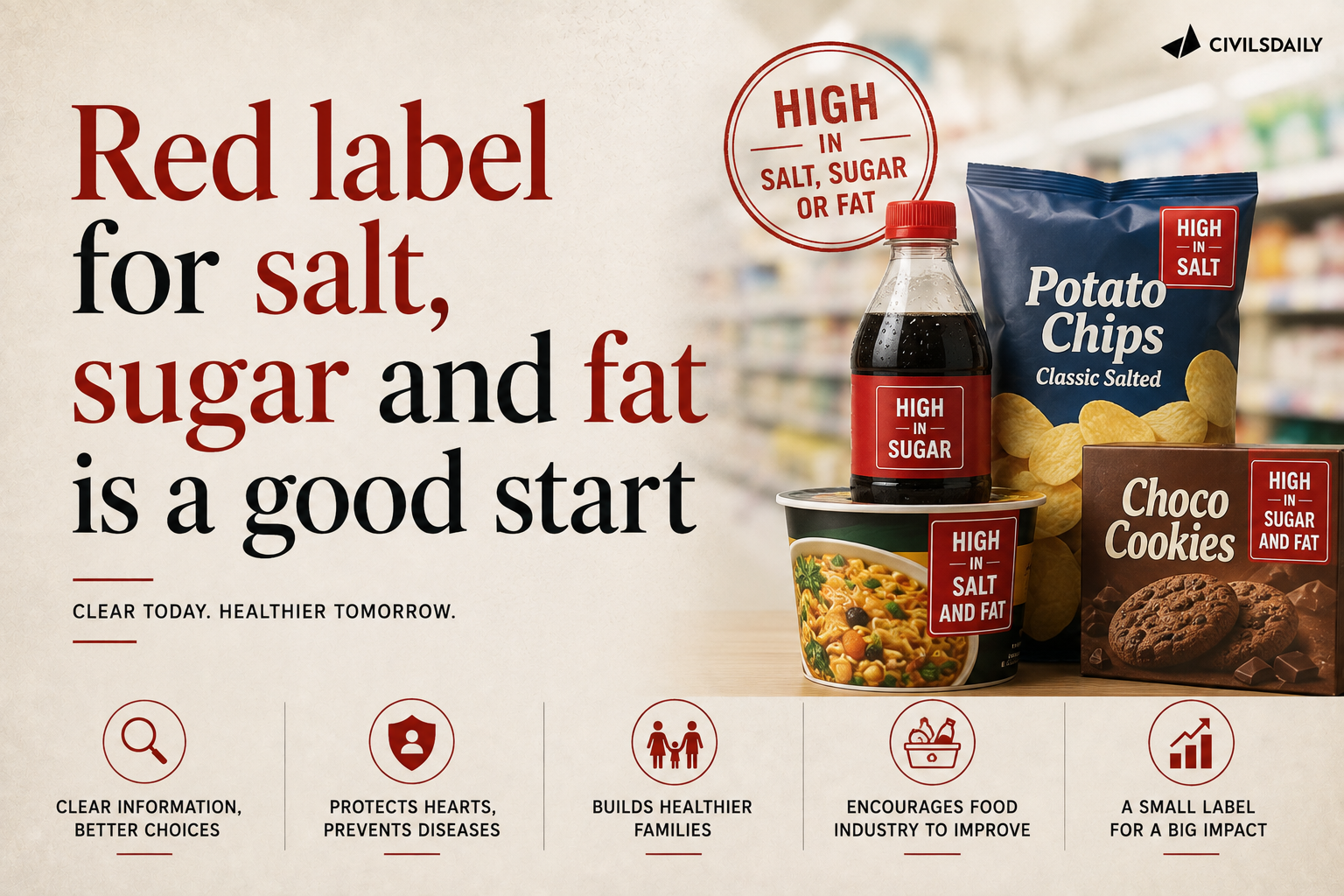
    The Food Safety and Standards Authority of India (FSSAI) has proposed front-of-pack warnings (mandatory cautions printed on the front face of a packet, not in the nutrition table on the back) in the form of red hexagonal labels on packaged food high in sugar, refined carbohydrates, salt and unhealthy fats.

    Can a warning label change what people actually eat?

    1. The case for scepticism: Eating behaviour is complex and shaped by gender, economic wherewithal, awareness and faith-based restrictions, so a label competes with several stronger determinants of choice.
    2. The evidence from Chile: Chile recorded a 24 per cent drop in sugary drink consumption after it introduced black octagonal warning labels on packages in 2016, which shows that a clear front-of-pack warning can shift consumption.
    3. Why the earlier star design failed: An earlier FSSAI proposal for a health star rating was criticised because stars are perceived as positive. Warning labels bearing stars have been associated with increased consumption of unhealthy foods, so clarity and legibility decide whether a label warns or advertises.

    Why can a label be only one part of the response?

    1. A double burden: The obesity epidemic exists alongside malnutrition, so a policy that only discourages excess consumption addresses one half of India’s nutrition problem.
    2. The broader public-health response: The label must sit inside three further measures, raising nutritional awareness, stronger regulation of junk food, and nudges towards healthier lifestyles.
    3. What a label can honestly claim: A red label on a packet will not by itself make people eat better. Its value lies in making it easier to tell healthy choices from harmful ones at the point of purchase.

    Challenges to the front-of-pack warning label proposal

    1. No notification or timeline yet: The proposal has not been notified and the implementation timeline is still awaited, so the regulator’s intent has no legal force. Eg. FSSAI’s 2022 draft for an Indian Nutrition Rating star label was never operationalised and has now been replaced by this proposal.
      The Fix: Notify the regulation with dated phases so manufacturers and consumers have a fixed compliance calendar.
    2. A threshold that misses single-nutrient products: The first of two intended phases applies the label only where a product is high in two or more unhealthy ingredients, which leaves out products high in just one. Eg. A sweetened biscuit that is high in sugar but within limits for salt and fat would carry no warning in phase one.
      The Fix: Trigger the label on any single nutrient of concern crossing its limit, as Chile’s per-nutrient octagons do.
    3. A font too small to warn: The proposed font size may be too small to be effective, so the label could exist on paper without being seen on the shelf. Eg. Chile fixes a minimum size for each octagon relative to the pack face so it cannot be shrunk into the design.
      The Fix: Prescribe a minimum label area as a share of the front panel rather than a point size alone.

    Conclusion

    A warning label sorts products, it does not by itself change appetite. The Chilean result shows the sort is worth doing when the mark is unambiguous. What decides the outcome now is the notification: the date it is issued, whether phase one keeps the two-ingredient threshold, and whether the font is large enough to be read. Those three details are what to watch when FSSAI publishes the final regulation.

    Back2Basics: Food Safety and Standards Authority of India

    1. Statutory basis: FSSAI is a statutory body established under the Food Safety and Standards Act, 2006, which consolidated earlier food laws into a single regulator.
    2. Ministry and location: It functions under the Ministry of Health and Family Welfare and is headquartered in New Delhi.
    3. Mandate: It lays down science-based standards for food articles and regulates their manufacture, storage, distribution, sale and import, including labelling and display rules.

    [2024, GS2, 15 marks] In a crucial domain like the public healthcare system, the Indian State should play a vital role to contain the adverse impact of marketisation of the system. Suggest some measures through which the State can enhance the reach of public healthcare at the grassroots level.”

  • Step up regulation

    Step up regulation

    Question (2024, GS2 – 15 Marks): “In a crucial domain like the public healthcare system, the Indian State should play a vital role to contain the adverse impact of marketisation of the system. Suggest some measures through which the State can enhance the reach of public healthcare at the grassroots level.”
    Linkage: The fact that non-government institutions account for 85–86% of AYUSH colleges is a stark example of the “marketisation” of healthcare education. The incentive of private players to “maximise student intake without matching increases in faculty and laboratory infrastructure” illustrates the precise “adverse impacts” of market-led growth that the state must step in to regulate.

    Mentor Comment

    Non-government institutions accounted for 86 per cent of Ayurveda colleges and 85 per cent of homoeopathy colleges in 2024, according to government data. Permitted seats rose by 43 per cent and total admission capacity by 25 per cent between 2021 and 2024. The Centre’s AYURGYAN allocation for AYUSH education, training, research, innovation and capacity building increased nearly sixfold over the same period, AYUSH being the group of systems covering Ayurveda, Yoga and Naturopathy, Unani, Siddha and Homoeopathy. Through that expansion the sector’s regulators have been denying permissions and grading colleges poorly. The tension is that private led growth carries an incentive to maximise student intake without matching increases in faculty and laboratory infrastructure, and the regulatory answer to it arrives one inspection at a time.

    How fast has AYUSH education expanded, and who is running it?

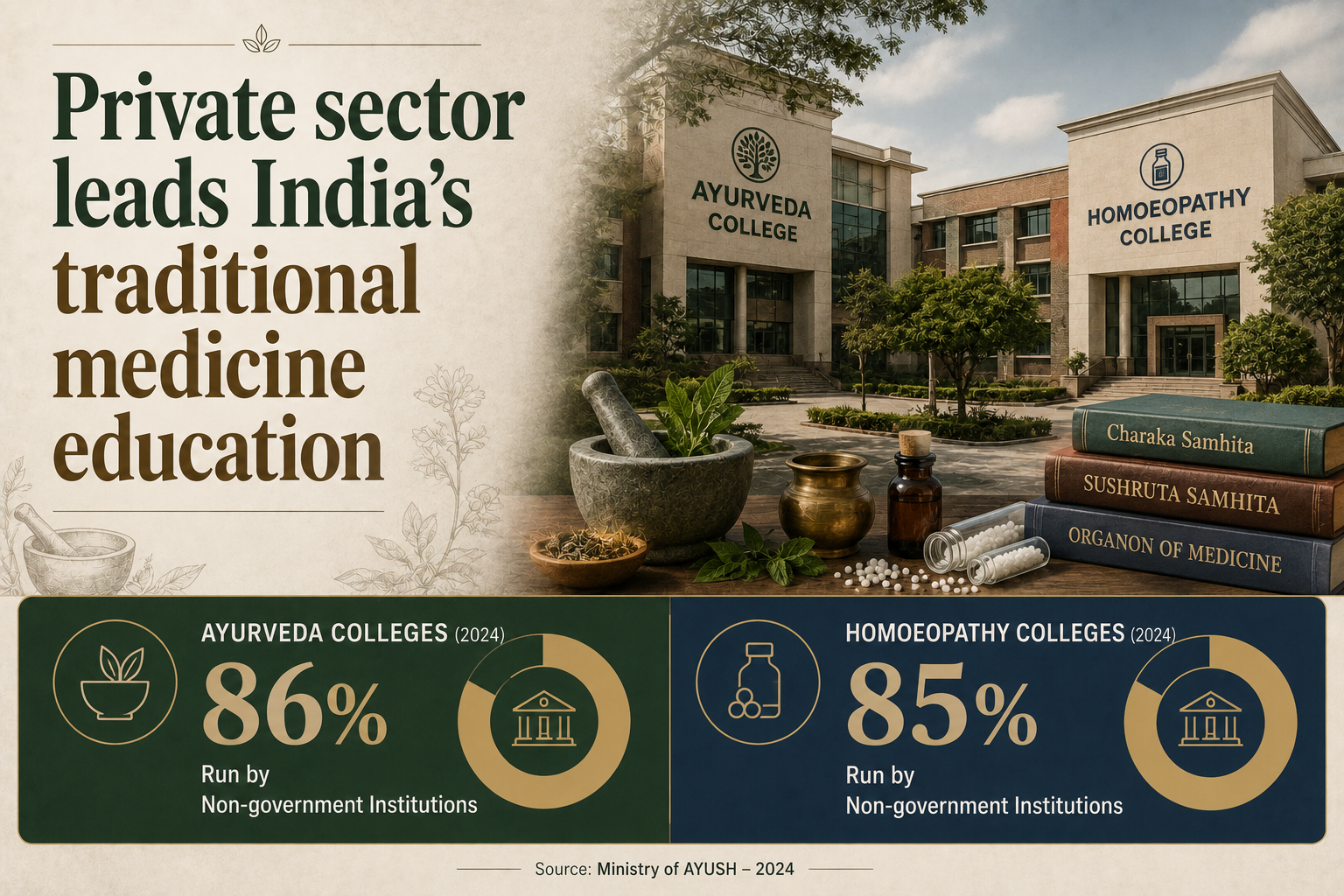
    1. The private sector runs the great majority of colleges: Non-government institutions accounted for 86 per cent of Ayurveda and 85 per cent of homoeopathy colleges in 2024.
    2. Seats grew faster than institutions: Permitted seats rose by 43 per cent and total admission capacity by 25 per cent between 2021 and 2024.
    3. Public funding rose alongside private capacity: The AYURGYAN allocation increased nearly sixfold over the same period.
    4. The private sector is leading the build out: The expansion of AYUSH medical education infrastructure is being driven by non-government institutions rather than by State run colleges.

    Why do the quality questions differ from those in allopathic education?

    1. The allopathic concern is narrower: Debate there has been confined to whether institutions adequately prepare students for evidence-based practice.
    2. AYUSH raises two questions at once: The first is the quality of training delivered, and the second is what students are being trained to practise.
    3. The evidence base is itself in question: Tougher quality control does not settle the separate question of the evidence backing AYUSH medicinal systems.

    Do the quality problems predate the current expansion?

    1. A 2005 audit found widespread deficiencies: The Comptroller and Auditor General found insufficient hospital beds, outpatient services or staff to be widespread among homoeopathy colleges.
    2. Bed occupancy ranged from 1 per cent to 71 per cent: The same audit recorded that spread across the colleges it examined.
    3. Faculty shortfalls exceeded half the requirement: A 2020 article in the Journal of Ayurveda and Integrative Medicine reported that many institutions fell short by more than 50 per cent of the teaching staff required by the standards then in force.

    What are the regulators finding now?

    1. The Ayurveda regulator has denied 17 permissions: As of 21 August the National Commission for Indian System of Medicine (NCISM) had listed 17 Ayurveda colleges, all private, whose permissions it had denied.
    2. Several denials were for obstructing the process itself: The stated reason in several cases was non-compliance with the inspection process.
    3. The homoeopathy regulator graded 41 per cent of colleges lowest: The National Commission for Homoeopathy placed that share at the bottom grade, including nearly half of all private institutions.
    4. The recorded failures are specific and repeated: They include inadequate or disputed faculty strength, failures in inspection requirements and student intake numbers, and allegations of fictitious faculty.

    What incentive does private led expansion create?

    1. Intake is the revenue lever: Expansion led by private institutions is accompanied by an incentive to maximise student intake while holding faculty size and laboratory infrastructure at existing levels.
    2. A court has recorded the practice: The Karnataka High Court in Hillside Ayurveda Medical College (2023) acknowledged that educational institutions are often guilty of admitting excess students for financial gains.
    3. The regulatory response is retrospective: Permission withheld after an inspection corrects a college that has already been built and has already admitted students.
    4. Causation is not yet established: It is premature to infer that the rapid expansion has amplified these problems, and the persistent non-compliance is established on its own.

    Challenges to regulating AYUSH medical education

    1. Faculty can be produced on paper: A college can satisfy a faculty norm on inspection day by listing teachers who do not actually teach there. Eg. Aadhaar linked biometric attendance was introduced in allopathic medical colleges precisely because faculty were being shown only for inspections.
      The Fix: Extend biometric and payroll linked faculty verification to every AYUSH college and publish the verified roll monthly.
    2. Approval and assessment sit with the same body: A regulator that grants permission to a college also rates it, so a poor rating is a verdict on its own earlier approval. Eg. Allopathic regulation separated the two, creating a distinct Medical Assessment and Rating Board under the National Medical Commission.
      The Fix: Split permission and rating into separate boards with published criteria, on the model already used in allopathic regulation.
    3. Seats are cheaper to add than laboratories: Where fees are capped, a college raises revenue by raising intake rather than by improving what it teaches with. Eg. Private professional education in India has produced capitation fee litigation running from T.M.A. Pai Foundation (2002) onward.
      The Fix: Link seat sanction to an audited per student cost of teaching and clinical infrastructure rather than to floor space and declared faculty strength.
    4. Clinical exposure is measured by beds, not patients: An attached hospital can meet a bed norm without meeting an occupancy norm, so a student can qualify with very little clinical contact. Eg. Minimum standard requirements for AYUSH colleges specify bed numbers, which a college can satisfy with wards that stay largely empty.
      The Fix: Make verified average bed occupancy and outpatient footfall a condition of annual permission renewal.
    5. Efficacy sits outside the regulator’s remit: A regulator can enforce faculty and infrastructure norms without settling whether the therapy being taught works. Eg. Research on Ayurvedic medicine is largely funded and evaluated by the Central Council for Research in Ayurvedic Sciences, a body under the same ministry that promotes the system.
      The Fix: Route efficacy trials for AYUSH therapies through independently assessed, pre-registered protocols outside the promoting ministry.

    Conclusion

    AYUSH education can expand meaningfully only when capacity growth is matched by quality assurance. Stronger faculty verification, independent assessment, outcome based accreditation and evidence based research can ensure that expansion delivers credible, high quality healthcare education.

    Back2Basics: National Commission for Indian System of Medicine

    1. Governing Act: Established under the National Commission for Indian System of Medicine Act, 2020 as the statutory regulator for Indian systems of medicine.
    2. Predecessor: It replaced the Central Council of Indian Medicine, which had regulated the sector since 1970.
    3. Jurisdiction: It covers education and practice in Ayurveda, Unani, Siddha and Sowa-Rigpa.
    4. Structure: It works through autonomous boards handling education standards, assessment and rating of institutions, and ethics and registration of practitioners.
  • Typhoid control needs more vaccine, less antibiotic

    Typhoid control needs more vaccine, less antibiotic

    Why in the News

    Typhoid cases in India are mounting without attracting the attention that influenza and swine flu currently draw, and every suspected case becomes a trigger for inappropriate or unnecessarily broad-spectrum antibiotic use. The disease is bacterial and vaccine preventable, yet it continues to be diagnosed imperfectly and treated empirically. The reason is the absence of a simple, reliable and accessible diagnostic test, which leaves the clinician with suspicion rather than confirmation. The tension is that the same empirical prescribing that substitutes for a diagnosis also generates the antimicrobial resistance in Salmonella typhi that makes future typhoid harder to treat, and it destroys the case data needed to see that resistance building.

    What is the typhoid conjugate vaccine?

    1. What it is: The typhoid conjugate vaccine (TCV) links the Vi capsular sugar coat of Salmonella typhi to a carrier protein. The conjugation produces a durable immune response, including in children under two, which the older unconjugated vaccine did not.
    2. India’s manufacturing position: India produced the world’s first World Health Organization (WHO) prequalified typhoid conjugate vaccine, Typbar-TCV, in 2017. Additional Indian products have achieved WHO prequalification since then.
    3. Where WHO places it: The WHO has prioritised introduction of the vaccine in countries carrying a high typhoid burden or high levels of antimicrobial resistance.

    Why does typhoid get treated without being diagnosed?

    1. A single Widal test settles nothing: The Widal test measures antibodies against Salmonella typhi, and one result is not sufficient to establish a diagnosis of acute typhoid.
    2. Endemicity corrupts the reading: In an endemic country such as India, background antibodies and previous exposure or vaccination make the result difficult to interpret. In routine practice a positive Widal result may still be treated as confirmation.
    3. The laboratory standard is only half sensitive: Blood culture remains the conventional laboratory standard. The latest WHO typhoid guidance puts the sensitivity of a single blood culture at only around 55 to 60 per cent.
    4. What the yield depends on: Sensitivity is influenced by the volume of blood collected and, critically, by prior exposure to antimicrobials.
    5. The vicious cycle this creates: A patient develops prolonged fever and takes an antibiotic before seeking care. The blood culture drawn afterwards returns negative, and the clinician responds to unresolved suspicion by escalating or changing the antibiotic.

    What does empirical treatment cost beyond the individual patient?

    1. Every course adds selection pressure: India already faces increasing resistance in Salmonella typhi, and each unnecessary antibiotic course creates additional selection pressure on the organism.
    2. Every missed case blanks the record: A patient treated without microbiological confirmation never enters the resistance data, so the surveillance that should guide prescribing is undermined by the prescribing itself.
    3. Breadth compounds the damage: The response to diagnostic uncertainty is a broader spectrum agent, which acts on organisms far beyond the one suspected.

    Why is a vaccine preventable disease being fought with antibiotics?

    1. The capability is not the constraint: The scientific and manufacturing capability exists and the vaccine exists. What remains inadequate is the scale and the rigour of its use.
    2. India is the case WHO describes: India is one of the countries where the combination of disease burden and resistance makes the case for typhoid vaccination compelling.
    3. Vaccination does not displace the basics: It cannot be treated as a substitute for clean water, sanitation, food safety or better diagnostics. It has to be one component of an integrated typhoid control strategy.

    What would an integrated typhoid control strategy require?

    1. Surveillance triggered by the case rise: Reports of increasing typhoid should themselves trigger strengthened surveillance. Hospitals and laboratories should systematically document suspected and culture confirmed cases, antimicrobial susceptibility patterns and prior antibiotic exposure.
    2. Diagnostic stewardship inside antimicrobial stewardship: Blood cultures should ideally be obtained before antibiotics are started, with adequate blood volume and appropriate laboratory practices.
    3. A test that works at the point of care: India needs investment in a better point of care or rapid diagnostic test for typhoid.
    4. A settled place for the vaccine: The position of the typhoid conjugate vaccine in the public health strategy needs to be revisited rather than left to individual prescribing decisions.

    Challenges to scaling the typhoid conjugate vaccine

    1. It sits outside the routine immunisation schedule: The vaccine is not part of the Universal Immunisation Programme, so uptake depends on the private market and on paying households. Eg. Coverage is concentrated in urban private paediatric practice rather than in the dense settlements where typhoid transmission is highest. Fix. Introduce it in a phased manner in high burden urban districts first, with the introduction decision anchored to culture confirmed case data.
    2. The vaccine does not cover the whole disease: Enteric fever is also caused by Salmonella paratyphi A, against which the conjugate vaccine gives no protection. Eg. A vaccinated patient presenting with prolonged fever still requires the same diagnostic workup. Fix. Fund development of a bivalent conjugate covering both organisms alongside scale up of the existing product.
    3. Introduction cannot be measured without a denominator: Without culture confirmed case counts there is no baseline against which to judge whether the vaccine reduced disease. Eg. Resistance data in India is heavily skewed towards tertiary hospitals rather than the community. Fix. Make enteric fever notifiable with mandatory laboratory reporting so introduction and impact are both measurable.
    4. Catch-up campaigns are the expensive part: A single dose given from six months of age is cheap, and a mass campaign across older cohorts is not. Eg. The cold chain and session load of a campaign compete directly with routine immunisation days. Fix. Attach the catch-up to existing school health programmes rather than running a parallel delivery system.

    Conclusion

    India has the vaccine and the manufacturing base to use it widely. What it does not have is a count of who actually has typhoid, because most cases are treated on symptoms and never confirmed in a laboratory. That missing count is exactly what would tell the government where to vaccinate first and whether it worked. The marker to watch is whether the typhoid conjugate vaccine enters the Universal Immunisation Programme, or stays held up waiting on data the country has not begun collecting.

    What is Antimicrobial Resistance?

    1. About: Antimicrobial resistance (AMR) occurs when bacteria, viruses, fungi and parasites evolve and stop responding to medicines that once treated them. It is often termed the silent pandemic.
    2. The One Health scope: Human medicine, animal husbandry and the environment form one reservoir, since resistant organisms move between them through food, water and waste.

    Laws and Rules Governing Antimicrobial Resistance

    1. Drugs and Cosmetics Act, 1940: The parent statute regulating manufacture and sale of medicines in India.
    2. Schedule H1: Requires a prescription and a sale register for listed antibiotics and second line drugs.
    3. Ban on irrational fixed dose combinations: The government banned 156 irrational fixed dose combinations in 2024, several being antibiotic cocktails with no scientific basis.

    Government Initiatives for Antimicrobial Resistance

    1. National Action Plan on AMR 2.0 (2025 to 2029): Sets sectoral targets across human health, animal health and the environment.
    2. Red Line Campaign: Marks prescription-only antibiotic packs with a red vertical stripe for buyer identification.
    3. Indian Council of Medical Research (ICMR) AMR Surveillance Network: Collects susceptibility data from tertiary care hospitals.

    Key Facts about Antimicrobial Resistance

    1. Consumption pattern: 59 per cent of antibiotics consumed in India in 2022 were in the WHO Watch category, meant to be used sparingly.
    2. Animal use ranking: India is the fourth largest consumer of antibiotics for animals, with an 82 per cent rise projected by 2030.
    3. Newborn burden: More than 50,000 newborn deaths a year in India are attributed to resistant sepsis.

    Challenges in Antimicrobial Resistance

    1. Antibiotics still move over the counter: Retail enforcement of the prescription requirement is weak, so a course is bought like a painkiller. Eg. The pill popping habit widened after the COVID-19 pandemic, with antibiotics taken for viral illness. Fix. Make the Schedule H1 register a digital point of sale entry so it can be audited rather than inspected.
    2. Manufacturing effluent seeds resistance in rivers: Untreated effluent from drug production enters water bodies and selects for resistant organisms outside any clinic. Eg. The Musi river near Hyderabad shows antibiotic levels a thousand times above safe limits. Fix. Tie public procurement preference to plants certified for zero liquid discharge.
    3. Farm use is a growth strategy, not a treatment: Antibiotics are given routinely in poultry and aquaculture to accelerate weight gain, not to treat disease. Eg. Shrimp samples have shown up to 100 per cent ampicillin resistance. Fix. Subsidise animal vaccines and enforce farm to fork traceability so residue traces to a producer.

    Matching Previous Year Question

    “[2020] What is the importance of using Pneumococcal Conjugate Vaccines in India? (1) These vaccines are effective against pneumonia as well as meningitis and sepsis. (2) Dependence on antibiotics that are not effective against drug-resistant bacteria can be reduced. (3) These vaccines have no side effects and cause no allergic reactions. Select the correct answer using the code given below: (a) 1 only (b) 1 and 2 only (c) 1 and 3 only (d) 1, 2 and 3 ANSWER: (b)”