💥Join UPSC 2027,2028 Mentorship (August Batch) + XFactor Notes & Microthemes PDF

GS Paper: India & Its Neighborhood – Relations

  • Pakistan- Sri Lanka Relations

    Pakistani PM is in Colombo on a two-day visit for ways and means to enhance trade and connectivity with Sri Lanka.

    What is the news?

    • Pakistan PM’s visit has attracted a fair amount of controversy because of a cancelled invitation to address the Sri Lankan parliament.
    • India too granted permission for using its airspace for the Pakistani PM’s aircraft.

    Try this question:

    Q.The triangulation in the ties between Sri Lanka, China and Pakistan is an emerging threat in the Indian Ocean Region. Discuss.

    Sri Lanka- Pakistan Relations

    • For Colombo, the visit holds much value. It comes at a fraught time for the government on the international stage.
    • Imminently, it is bracing to be hauled over the coals at the UN Human Rights Commission for withdrawing from resolution 30/1 of September 2015, under which it committed to carrying out war crime investigations.
    • To make matters worse, the Islamic world is appalled by Sri Lanka’s tight rules for the cremation and not burials of Muslims who have died of COVID-19.
    • The rule created a storm in Sri Lanka, with community leaders convinced that this is nothing but an extension of the state’s persecution of Muslims.

    Why Pakistan?

    (1) Trade ties

    • Pakistan is Sri Lanka’s second-largest trading partner in South Asia after India.
    • Sri Lanka and Pakistan have a free trade agreement dating back to 2005.
    • Pakistan’s top exports to Sri Lanka are textiles and cement.
    • Sri Lanka’s top exports to Pakistan are tea, rubber and readymade garments.

    (2) Cultural ties

    • In addition to trade cooperation, Pakistan invokes cricket and Buddhism, topics that most Sri Lankans share a deep connection with.
    • Over the last decade, Pakistan has also been projecting its ancient Buddhist sites to promote cultural ties with Sri Lanka.

    (3) Defence ties

    Defence ties are a strong pillar of Sri Lanka- Pakistan bilateral relationship.

    • During the 1971 war, Pakistan Air Force jets refuelled in Sri Lanka.
    • India pulled back the peacekeeping forces in 1990, it provided no active defence support to the Sri Lankan military.
    • Sri Lanka turned to Pakistan for arms, ammunition as well as training for its fighter pilots.
    • Gotabaya, who was defence secretary at the time, visited Pakistan in 2008 to make a request for emergency assistance with military supplies.
    • Earlier this month, Sri Lanka participated in Pakistan’s multi-nation naval exercise Aman.

    India’s observations and concerns

    • As Sri Lanka’s closest neighbour with strong, all-encompassing ties, even if these are sometimes problematic, India has not perceived Pakistan as a serious rival in Sri Lanka so far.
    • Sporadically, the Indian security establishment has voiced concerns about Pakistan’s role in the radicalization of people, especially in Eastern Sri Lanka.
    • Funds have poured in for new mosques from some West Asian countries, and the effect that this could have in India.

    Emerging threats from the ‘Triad’

    • There is now a new wariness about triangulation in the ties between Sri Lanka, China and Pakistan in defence co-operation, though it has not been publicly expressed.
    • In 2016, India put pressure on Sri Lanka to drop a plan to buy the Chinese JF-17 Thunder aircraft made in Pakistan and co-produced by the Chinese Chengdu Aircraft Corporation.
    • The most recent threat was from excluding India from the Colombo Terminal Project.
  • Places in news: Shahtoot Dam

    India and Afghanistan have signed an agreement to build the Shahtoot Dam in Kabul to provide drinking water facility in the Afghan capital.

    Try this question from prelims 2020:

    Consider the following pairs

    Sr. River Flows into
    1. Mekong Andaman Sea
    2. Thames Irish Sea
    3. Volga Caspian Sea
    4. Zambezi Indian Ocean


    Which of the pairs given above is/are correctly matched?

    (a) 1 and 2 only

    (b) 3 only

    (c) 3 and 4 only

    (d) 1, 2 and 4 only

    Shahtoot Dam

    • It is a proposed dam in the Kabul river basin, one of the five river basins in Afghanistan.
    • This project will provide drinking, irrigation and Environmental water for Kabul province.
    • The dam will provide potable water to more than 2 million residents of Kabul, in addition to the irrigation of 4000 hectares of land in the district of Charasiab and Khairabad.
    • The dam will also provide water for irrigation to nearby areas, rehabilitate the existing irrigation and drainage network and help in flood protection and management efforts.
    • The project is expected to produce electricity for the region.
  • India’s Myanmar dilemma

    The coup in Myanmar poses several challenges for India. For one, it poses a dilemma in India’s dealing with Myanmar’s military. Also, it has implications for the Rohingya issue and containing the insurgency in north-east India.

    Implications of the coup in Myanmar

    1) Political realignment and role of Aung San Suu Kyi

    • Threat of sanctions from the United States and the West in the wake of the recent coup could lead to unique political realignments in Myanmar.
    • As a result, the international community may not have any alternatives than Aung San Suu Kyi when it comes to pursuing the restoration of democracy in the country.
    • The democratic credentials of Aung San Suu Kyi, remain deeply diminished today due to her justification of the ill-treatment meted out to the Rohingya,
    • Yet the recent events have brought her right back into the centre of the international community’s political calculations in Myanmar.

    2) Implications for Rohingya issus

    • International community will have to condone the government’s past actions against the Rohingya in order to highlight Suu Kyi as an anchor of democracy in Myanmar.
    • The case against Myanmar’s conduct during her government’s tenure at the International Court of Justice (ICJ) will most likely be put on the backburner.
    • Increasing global support for Ms. Suu Kyi could potentially negative consequences for the persecuted Rohingya.

    3) China factor

    • In the short run, the coup stands to hurt the interests of China, India and even the rest of the international community, all of whom were able to do business with Myanmar in their own unique ways.
    • For China, the coup has complicated its larger regional economic plans in Myanmar.
    • However, the international community’s sharp reactions will likely force the Tatmadaw (Myanmar’s military) to turn to China.
    • International sanctions are unlikely to have a major impact on the country’s largely inward-looking junta and its Generals.
    • However, it Generals would still expect Beijing to give them
    • For China, the coup has complicated its larger regional economic plans in Myanmar.
    • On the positive side for Beijing, decisive western sanctions will force the military to get closer to China.
    • To that extent, China will be its biggest beneficiary of the February coup by default.

    India’s dilemma

    • India faces the most challenging dilemma on how to respond to the military coup in Myanmar.
    • The dual power centres of the military and the civilian government that existed in Naypyitaw until recently, suited India.
    • While India’s national interests clearly lie in dealing with whoever is in power in Myanmar, India would find it difficult to openly support the junta given the strong western and American stance.
    • On the other hand, it can ill-afford to offend the junta by actively seeking a restoration of democracy there.
    • While Ms. Suu Kyi was getting cozy with Beijing, it was the Myanmar military that had been more circumspect.

    India’s concerns

    • While a friendless Myanmar junta getting closer to China is a real worry for New Delhi, there are other concerns too.
    • For one, Myanmar’s military played a helpful role in helping India contain the north-eastern insurgencies.
    • Equally important is the issue of providing succour to the Rohingya in the wake of the military coup in Myanmar.

    Consider the question “Developments in Myanmar have several implications for the regional geopolitics. In light of this, examine the challenges India faces from the development in Myanmar.”

    Conclusion

    India is left with very few clear policy options. And yet, it must continue to maintain relations with the government in power in Myanmar while discreetly pushing for political reconciliation in the country. In the meantime, the focus must be on improving trade, connectivity, and security links between the two sides.

  • The way forward in Myanmar

    The article discusses the five lessons from past experiences as the international community frames its response to the military coup in Myanmar.

    Coup in Myanmar

    • After Aung San Suu Kyi’s National League for Democracy (NLD) swept the polls by winning almost 80% of the vote, Myanmar’s military staged a coup and declared a state of Emergency for a year.
    • Myanmar, which started a fragile transition to democracy 10 years ago after decades of brutal military dictatorship, is back in the hands of the Generals.

    Lessons for the international community

    1) Benefits of sanctions

    • The developments in Myanmar will invariably bring back the old debate around the prudence of sanctions.
    • Notwithstanding the western sanctions before 2010 [during military rule], China, Thailand and Singapore were the key trading partners of Myanmar.
    • The present reality is no different.
    • Singapore was reportedly the largest foreign investor in Myanmar in 2020, accounting for 34% of the overall approved investment.
    • Given that the military has been able to economically withstand sanctions by striking deals with Asian countries in the past, sanctions are unlikely to bring any major political change.

    2) Accountability for crime against humanity

    • As political changes got underway in 2010, many generals were on the radar of the international community for perpetuating a regime of human rights abuses, quietly vanished from the scene.
    • This bred a culture of impunity.
    • During the 2017 Rohingya crisis, senior military officials brazenly exploited social media to mobilise public support for brutality against Rohingyas.

    3) China’s influence

    • Three, a critical international player in Myanmar is China.
    • The international community, particularly the West, has to factor in China’s multi-layered influence on Myanmar.

    4) Revival of past international mechanisms

    • Many international mechanisms comprising Western and Asian countries that were formed to coordinate strategies on Myanmar were disbanded after the 2015 election.
    • That the changes in Myanmar were irreversible was the standard thinking.
    • Relevant actors should be brought on a common platform by reviving past mechanisms.

    5) Increasing the engagement with domestic stakeholders

    • The expectation that Myanmar will see a nationwide protest against the military after the coup should be examined with the geographical extent of Bamar, Myanmar’s largest ethnic group, who support the National League for Democracy.
    • The minorities in the country form around 35% of the population.
    • In the current scenario, the military will continue to exploit ethnic and religious fault lines.
    • Engagement with domestic stakeholders, including ethnic minorities, especially from the north, should be pursued by the international community.

    Consider the question “As military hinders Myanmar’s transition to democracy, what are the factors that should be considered by the international community as it form the response to the situation in the country.”

    Conclusion

    There is one consistent lesson, that no change is irreversible, particularly in a context where military leadership scripted the meaning of democracy, and domestic forces and geopolitics continuously fail to deter its actions and impulses to rule.

  • Sri Lanka pushes India out of Colombo Terminal Project

    After the strong opposition from within, the Sri Lankan government was forced to revoke a 2019 agreement with India and Japan to develop the strategic East Container Terminal (ECT) at the Colombo Port.

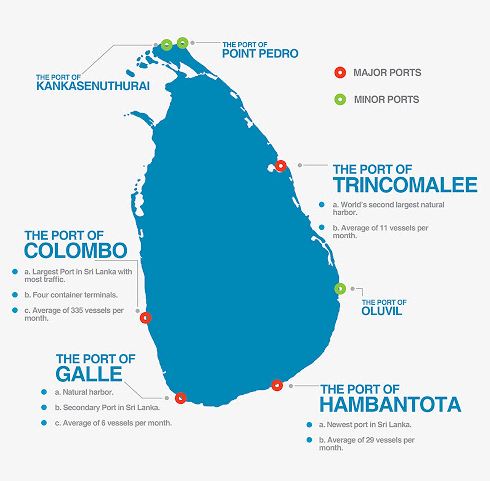
    Map Reading: Note all these major ports and try recalling their sequences in the clockwise and counter-clockwise direction.

    What is the news?

    • PM Mahinda Rajapaksa made a statement that the operation of the east terminal would be done by Sri Lanka Ports Authority on its own.
    • Its cabinet has approved a proposal to develop the West Terminal at the Colombo Port as a PPP with India and Japan, which is seen as a bid to compensate India.
    • It is unclear whether India would accept the latest proposal.

    What is the Project?

    • The tripartite agreement, signed by India, Sri Lanka and Japan, proposes to develop the ECT, which is located at the newly expanded southern part of the Colombo Port.
    • The ECT is located 3 km away from the China-backed international financial city, known as Port City, currently being built in Colombo.
    • A Chinese company was behind the controversial 2018 Hambantota port project, signed its first contract in the Port City last month.
    • It is also on the map of China’s Belt and Road Initiative (BRI).

    India’s reaction

    • A few weeks ago EAM S. Jaishankar visited Sri Lanka where he discussed the development of the stalled project.
    • India’s first response was that the island nation should not be taking a decision in a unilateral manner on an existing tripartite agreement.

    Compensatory offer to India

    • After the decision on revoking the 2019 agreement, SL has approved another proposal to develop the west terminal of the Colombo port with Japan and India.
    • Commercially, the west terminal offer is better for India as it gives 85% stake for developers of the West Terminal against the 49% in ECT.

    Sri Lanka expects India to rethink. Why?

    • Indian response to this compensatory offer is unclear since there was no formal communication by SL authorities.
    • Geo-politically, west terminal is almost the same India considers the security aspect and the necessity to have a port terminal in Sri Lanka.
    • There is no difference between East and West Terminals except for the fact that development of the ECT is partially completed while the development of the West Terminal has to start from scratch.

    SL version of the revocation

    • Incumbent PM Mahinda Rajapaksa said the pressure was immense on the President Gotabaya Rajapaksa to cancel the 2019 agreement.
    • The pressure was brewing so much that he was becoming so unpopular among the people.
    • As per the agreement signed by the former Maithripala Sirisena-Ranil Wickremesinghe administration, India and Japan together were to hold 49% stake in ECT.
    • What had finally made the government surrender before trade unions were the increasing support of many more sections in the society for the protests against privatization.

    The inevitable factor: China

    • This move can be easily interpreted as a reaction to Chinese communication to Sri Lanka.
    • China has reportedly instigated trade unions and civil societies against this project.

    Q.The threat of Chinese presence in South Asia can be tackled more effectively if India changes course in its dealings with its neighbours and becomes more sensitive to their concerns. Critically analyse.

    Outcome: Souring of the ties

    • For India, the strategic ECT project was important. Even the EAM has visited Colombo in January in this regard.
    • Critics of the Sri Lankan government anticipate many national and international impacts surrounding the latest decision on ECT.
    • Meantime, internationally an offended India can make life tough for Sri Lanka, isolating the tiny island nation, geo-politically and on the economic front.
    • The economic isolation will not help Sri Lanka at a time when the country is taking steps to revive the economy amid a pandemic.
  • BNO Visas for Hong Kong residents

    Hong Kong residents can apply for a new visa offering them an opportunity to become British citizens after Beijing’s imposition of a national security law last year.

    What is the news?

    • The move comes as China and Hong Kong have said they will no longer recognise the British National Overseas (BNO) passport as a valid travel document from Sunday, January 31.
    • Britain and China have been arguing for months about what London and Washington say is an attempt to silence dissent in Hong Kong after pro-democracy protests in 2019 and 2020.

    What is the British move for citizenship?

    • The scheme, which was first announced last year, allows those with BNO status to live, study and work in Britain for five years and eventually apply for citizenship.
    • BNO is a special status created under British law in 1987that specifically relates to Hong Kong.
    • Britain says it is fulfilling a historic and moral commitment to Hong Kong people after Beijing imposed the security law on the semi-autonomous city.
    • Britain says breaches the terms of agreements under which the colony was handed back to China in 1997.
    • The U.K. government forecasts the new visa could attract more than 300,000 people and their dependants to Britain.

    Chinese stance on the move

    • China says the West’s views on its actions over Hong Kong are clouded by misinformation and an imperial handover.
    • Beijing also said that it would no longer be recognising BN(O) passports, saying that the citizenship offer “seriously infringed” on China’s sovereignty.
    • It is unclear, however, how this could deter Hong Kongers from leaving since city residents are usually known to use Hong Kong passports while leaving for another country.
  • Foreign Minister suggests way forward for India-China ties

    External Affairs Minister S. Jaishankar has given useful insight on the future of India-China ties amid heating border tensions and has suggested the best way forward.

    Statements made by EAM are major breakthrough in itself. They are the most logical and amply reflect his perfect statesmanship.

    We can imbibe such statements in our answers as they hold extraordinary significance like any gospel.

    Key takeaways from EAM’s speech

    • 2020 was a year of exceptional stress in a relationship profoundly disturbed by the border crisis.
    • China’s actions last year had not only signaled a disregard of commitments to reduce troop levels” but also “a willingness” to breach the peace and tranquillity on the border.
    • For all the disagreements we had, the fact is the border areas still remained fundamentally peaceful with the last incident of a loss of life in 1975, prior to 2020.
    • Until now, India is yet to receive a credible explanation for the change in China’s stance or reasons for its amassing of troops.
    • Any expectation that can be brushed aside and life can carry on undisturbed despite the situation in the border is simply not realistic.

    China’s contentious moves

    • China did a unilateral attempt to redraw the LAC in several areas in eastern Ladakh
    • China’s issuing of stapled visas to Indian citizens from Jammu and Kashmir in 2010
    • Reluctance from China to deal with some of India’s military commands, Beijing had that same year refused to host the Northern Army Commander
    • China’s opposition to India’s membership of the Nuclear Suppliers Group and the U.N. Security Council as a permanent member
    • Blocking of U.N. listings of Pakistani terrorists, and
    • China Pakistan Economic Corridor, a flagship project under China’s Belt and Road Initiative, violating India’s sovereignty

    Gone is the past

    • Both sides had “painstakingly” worked to normalize relations after the post-1962 war freeze and the first prime ministerial visit in 1988.
    • For the border areas, he said, both had agreed a complete and practical set of understandings and agreements focused on border management, while negotiations were being conducted on the boundary dispute.
    • The advancement of ties, he said, was predicated on ensuring that peace and tranquillity were not disturbed, and the LAC was both observed and respected by both sides.
    • For this reason, it was explicitly agreed the two countries would refrain from massing troops on their common border, along with a detailed understanding of handling frictions that would arise.

    No progress over the years

    • Over the years, he said, there was no sign of progress of arriving at a common understanding of the LAC, while there was increasing construction of border infrastructure, especially in the Chinese side.
    • India had made efforts to reduce the considerable infrastructure gap since 2014, including through greater budgetary commitments and border road building.

    Way forward

    The External Affairs Minister suggested “three mutuals” and “eight broad propositions” as a way forward for the relationship.

    #Three mutuals

    Mutual respect, mutual sensitivities and mutual interests are the “determining factors”.

    #Major propositions

    (1) Adhering to commitment

    • The first proposition was that agreements already reached must be adhered to in their entirety, both in letter and in spirit.

    (2) Respect for LAC

    • Both sides also needed to strictly observe and respect the LAC, and any attempt to unilaterally change the status quo was completely unacceptable.

    (3) Maintaining peace and tranquillity

    • Peace and tranquillity in border areas was the basis for the development of the relationship in other domains. If that was disturbed, he said, the rest of the relationship would be too.

    (4) Broader partnership

    • The fourth proposition was that while both remain committed to a multipolar world, they should recognise that a multipolar Asia was one of its essential constituents.

    (5) Reciprocity

    • While each state had its interests, concerns and priorities, sensitivities to them could not be one-sided and relations were reciprocal in nature. As rising powers, neither should ignore the other’s set of aspirations.

    (6) Divergences management

    • While both sides had made a common cause on development and economic issues and common membership of plurilateral groups was a meeting point, there were divergences when it came to interests and aspirations.

    (7) Civilizational ties

    • The last proposition was that as civilizational states, India and China must always take the long view.

    (8) Cooperation and competition

    • Even before the events of 2020, the relationship had reflected a duality of cooperation and competition.
  • Myanmar’s Military Coup

    Myanmar’s military staged a coup detaining de facto leader Aung San Suu Kyi and declaring it had taken control of the country for one year under a state of emergency.

    Q.Despite its military coup, Myanmar is the key in linking South Asia to Southeast Asia and the eastern periphery becomes the focal point for New Delhi’s regional outreach. Analyse.

    What is the news?

    • The intervention came with rising tensions between the military, which ruled the country for nearly five decades, and the civilian government over allegations of fraud in November’s elections.
    • The military had signaled its intentions to seize power to settle its claims of irregularities in the polls, which Suu Kyi’s party won easily.

    How was the coup carried out?

    • The military detained the leaders of the governing NLD party and Myanmar’s civilian leadership, including Suu Kyi and President Win Myint, along with various ministers and even the opposition.
    • The military quickly seized control of the country’s infrastructure, suspending most television broadcasts and canceling all domestic and international flights, according to reports.
    • Telephone and internet access was suspended in major cities.
    • The stock market and commercial banks were closed, and long lines were seen outside ATMs in some places.
    • In Yangon, the country’s largest city and former capital, residents ran to markets to stock up on food and other supplies.

    Who is Aung San Suu Kyi?

    • Suu Kyi came to power as state councilor in 2016 after the country’s first fully democratic vote in decades.
    • Her ascension to leadership was seen as a critical moment in the transition of Myanmar, formerly known as Burma, to democracy from military dictatorship.
    • Suu Kyi, the daughter of the country’s independence hero General Aung San, spent more than 15 years under house arrest.
    • Her time in detention made her an international icon, and she was awarded the Nobel Peace Prize in 1991.
    • Since her release, her reputation has been tarnished by her cooperation with the military and her deadly campaign against the Rohingya, a Muslim ethnic minority group.

    India’s response to the takeover

    • India is “deeply concerned” with the return to military rule, which is a repeat of events thirty years ago.
    • It sees only option to engage, building on its outreach in recent years via the security and defence establishment.
    • India seeks a more pragmatic approach, engaging the military while pushing for more freedoms and democracy in Myanmar.

    Various issues concerning India

    • One important reason for the change is that India’s security relationship with the Myanmar military.
    • These days, it has become extremely close, and it would be difficult to “burn bridges” with them given their assistance in securing the North East frontiers from insurgent groups.
    • Apart from strategic concerns, India has cultivated several infrastructure and development projects with Myanmar, which it sees as the “gateway to the East” and ASEAN countries.
    • These include the India-Myanmar-Thailand Trilateral Highway and the Kaladan Multi-modal transit transport network, as well as a plan for a Special Economic Zone at the Sittwe deep-water port.
  • China builds a new village in Arunachal Pradesh

    Satellite images show that China has constructed a new village in Arunachal Pradesh, around 4.5 kilometres inside of the de facto border on the Indian side.

    Indian and Chinese soldiers have confronted each other in their deadliest clash in decades in Ladakh last year and the earlier one in Doklam. Now another front has been opened up by China in Arunachal.

    This year could face another ugliest standoffs and skirmishes.

    Location of the village

    • The village, located on the banks of the River Tsari Chu, lies in the Upper Subansiri district.
    • It is an area that has been long disputed by India and China and has been marked by armed conflict.
    • Sources in the defense ministry have said that Beijing has, for years, maintained an army post on this territory, and the various constructions by the Chinese have not happened suddenly.

    Background of the story

    • China’s June 1959 operation known as the Longju incident reportedly accused Indian troops of occupying some places in Tibet and colluding with Tibetan rebels.
    • In August same year, the PLA clashed with the Indian personnel of the 9 Assam Rifles.
    • Two Indian soldiers were killed in action and the issue was finally resolved through diplomatic channels. Both sides withdrew from the area on August 20, 1960.
    • And the Assam Rifles then did not re-occupy the post.
    • In the late 1990s however, China established a company level post 3 kilometers inside the Indian Territory. Since then, the area remains contested to this day.

    India and Arunachal

    • Arunachal Pradesh (called South Tibet in China) is a full-fledged state of India.
    • India’s sovereignty over the area is internationally recognized and its residents have not shown any inclination to leave India.
    • The majority of the international maps acknowledge the area to be an Indian Territory.
    • China has some (pre-) historical claims through its ownership of Tibet, but the people and geography primarily favor India.

    Back2Basics: Chinese claim over Arunachal Pradesh

    • When the new Peoples Republic of China was formed in February 1912 after the abdication of the Qing emperor, the Tibetans asserted their independence.
    • They forced the Chinese troops based in Lhasa to return to the mainland-via India. A year later, Tibet declared independence from China.
    • In order to ensure that the unrest did not spread to India and assert their boundaries, the ruling British convened a tripartite meeting at Shimla with Tibetan and Chinese delegates to define the border.
    • The meeting gave China suzerainty over most of Tibet, and the boundary defined in this treaty was later known as the McMohan line.

    Chinese reluctance

    • The essential dispute is over China’s refusal to acknowledge the McMohan Line as the border between the two nations, and staking claim to large tracts of land as a contiguous part of Tibet.
    • However, it laid claim to the entire state of Arunachal Pradesh.
    • In the 16th century, the most important heritage of the state – Tawang Monastery was built. This is one of the most important sites for Tibetan Buddhists.
    • China never recognized Tibet’s independence nor the 1914 Simla convention.
    • In 1950 China completely took over Tibet. Thus, according to their version, the Tawang region belongs to them.
    • It especially wants to hold on to the monastery as that is a leading center of Tibetan Buddhism in India.
  • Who are the persecuted Hazara Community of Pakistan?

    Pakistan’s Hazaras finally ended a protest and agreed to bury the bodies of 11 coal miners from the community killed by the IS.

    Genocide and Pakistan are the two inseparable metaphors. Pakistan’s treatment of its minorities is the least highlighted global violation of Human Rights. Hindus, Sikhs and Christians are the most persecuted communities.

    Who are the Hazaras?

    • Around 1773, the mountainous region of Hazarajat in modern-day central Afghanistan was annexed and made a part of the territories of the Afghan Empire under Pashtun ruler Ahmad Shah Durrani.
    • The Sunni Muslim majority under the Pashtun ruler resulted in further marginalization of the Shiite Hazara community, to the extent that in the 18th and 19th century.
    • They were forced to leave fertile lowlands in central Afghanistan and make the dry, arid mountainous landscape their new home.

    Their persecution

    • Persecution of the Shiite Hazaras is nothing new in Pakistan or neighbouring Afghanistan.
    • They have been frequently targeted by Taliban and IS militants and other militant groups in both countries.

    Causes of persecution: Ethnicity and Religion

    • Their unique identity, ethnicity and religion always made the Hazaras stand out among the other communities.
    • Hazaras speak Hazaragi, which is close to Dari Persian, the official language of modern-day Afghanistan.
    • The community also shares physical similarities with the Mongols and their speech, specific terms and phrases, reflect strong Central Asian Turkic influences.
    • This sets them apart from their neighbours in Pakistan and other communities within Afghanistan.

    An attempted ethnic cleansing

    • In the 19th century, the Hazara community constituted approximately 67 per cent of Afghanistan’s total population.
    • Since then, primarily due to violence, oppression and targeted massacres, that number has come down to a little as 10 to 20 per cent of the population now.
    • The attacks reached a crescendo in 2013 when three separate bombings killed more than 200 people in Hazara neighbourhoods of Quetta.
    • In the aftermath of this incident, the Shia community in Pakistan had erupted in anger over the Pakistani government’s lack of protection of its minorities.