💥Join UPSC 2027,2028 Mentorship (July Batch) + XFactor Notes & Microthemes PDF

GS Paper: GS1

  • Expansion of the Amery Ice Shelf


    There would be a 24% increase in the expansion of the Amery Ice Shelf (AIS) boundaries in Antarctica by 2021 and another 24 per cent by 2026 from its 2016 positions, the National Centre for Polar and Ocean Research (NCPOR) in Goa has predicted.

    Practice question for mains:

    Q. Discuss the interrelation between Cryosphere and Climate change in context to the melting ice shelves in the Antarctic region.

    Amery Ice Shelf (AIS)

    • The Amery Ice Shelf is a broad ice shelf in Antarctica at the head of Prydz Bay between the Lars Christensen Coast and Ingrid Christensen Coast.
    • It is part of Mac. Robertson Land.
    • The name “Cape Amery” was applied to a coastal angle mapped on February 11, 1931.
    • The AIS is one of the largest glacier drainage basins in the world, located on the east coast of Antarctica, at about 70ºS Latitude, 70ºE Longitude.
    • The AIS dynamics and mass balance help in understanding the changes in the global climate scenario.

    Significance of the study

    • NCPOR observations revealed a critical cooling of the sea surface temperature, resulting in an advancement of the ice shelf by 88 per cent in the past 15 years.
    • These changes would contribute in a major way to climate variability.
    • The study clearly demonstrated the future dynamism of ocean heat fluctuation and Antarctic Amery ice shelf mass shifting-extent.

    Back2Basics: Ice Shelves
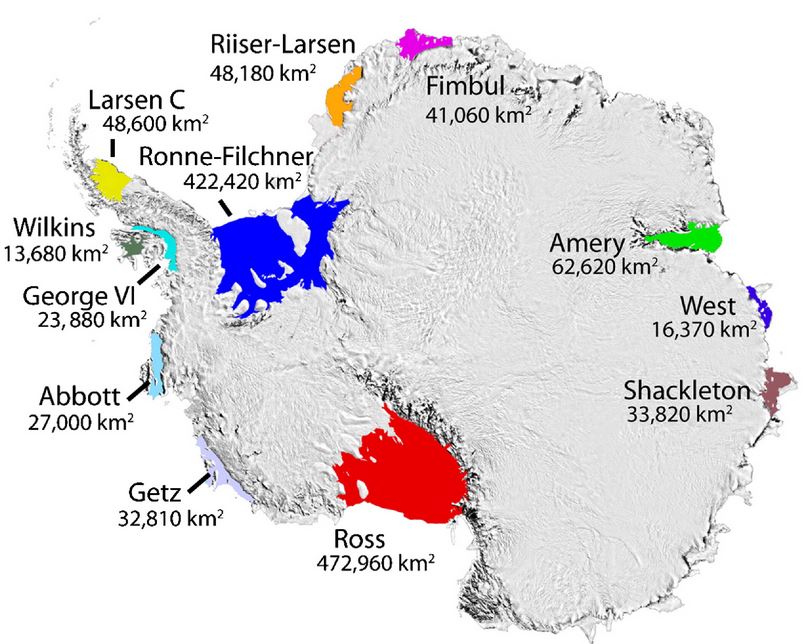
    • The floating sheets of ice called ‘ice shelves’ play a multi-faceted role in maintaining the stability of a glacier. Ice shelves connect a glacier to the landmass.
    • The ice sheet mass balance, sea stratification, and bottom water formation are important parameters for the balancing of a glacier. Latent and sensible heat processes do play important roles here.
    • The insulation of ice shelves from atmospheric forcing is dependent on a temperature gradient that the ocean cavity beneath the ice shelves provides.
    • It is the pressure exerted by the ice shelves upon the ocean cavity that determines this temperature gradient.
  • What is South Atlantic Anomaly?

    New data obtained by the European Space Agency (ESA) Swarm satellites has revealed the existence of a mysterious anomaly weakening the Earth’s magnetic field. Termed as ‘South Atlantic Anomaly’, it extends all the way from South America to southwest Africa.

    The term ‘South Atlantic Anomaly’ at its first sight looks similar to any climate/oceanic current related phenomena. But it’s not! This is where you can end up losing 2.66 marks in the prelims!

    What is South Atlantic Anomaly (SAA)?

    • The SAA is referred to the behaviour of Earth’s Geo-Magnetic field in an area between Africa and South America.
    • The SAA is an area where the Earth’s inner Van Allen radiation belt comes closest to the Earth’s surface, dipping down to an altitude of 200 kilometres.
    • This leads to an increased flux of energetic particles in this region and exposes orbiting satellites to higher-than-usual levels of radiation.
    • The effect is caused by the non-concentricity of the Earth and its magnetic dipole.
    • The SAA is the near-Earth region where the Earth’s magnetic field is weakest relative to an idealized Earth-centered dipole field.

    Weakening of the magnetic field

    • Over the last 200 years, the magnetic field has lost around 9% of its strength on a global average.
    • A large and rapid shrink has been observed in the SAA region over the past 50 years just as the area itself has grown and moved westward.
    • The weakening of the magnetic field is also causing technical difficulties for the satellites and spacecraft orbiting the planet.
    • The study conducted between 1970 and 2020, said that the magnetic field weakened considerably in a large region stretching from Africa to South America, known as the ‘SAA’.
    • This area has grown and moved westward at a rate of around 20 km per year.

    Its impact

    • The magnetic shield has an important role to play in keeping unwanted radiation away as well as helping determine the location of magnetic poles.
    • Even though unlike global warming or any weather change, this anomaly doesn’t directly impact human lives, it could actually bring on a change in the way we access technology.
    • The reversal and apparent shift, which could keep extending could actually impact satellite and telecommunication system, which means that some of the internet and mobile phone functioning which depend on satellite signals can possibly get disrupted.
    • It could also affect the mapping and navigation systems in smartphones.
    • The weakening of earth’s magnetic field could also impact migratory movement.
    • Birds, animals- all those who migrate with the change in season depend on the earth’s mapping to move about can find it a little difficult.
    • This is only a possibility, but we don’t know the extent of the damage till now.

    About the Van Allen Radiation Belt

    • A Van Allen radiation belt is a zone of energetic charged particles, most of which originate from the solar wind, that are captured by and held around a planet by that planet’s magnetic field.
    • The belts are located in the inner region of Earth’s magnetosphere. The belts trap energetic electrons and protons.
    • Earth has two such belts and sometimes others may be temporarily created.
    • Most of the particles that form the belts are thought to come from solar wind and other particles by cosmic rays.
    • By trapping the solar wind, the magnetic field deflects those energetic particles and protects the atmosphere from destruction.

    Also read:

    https://www.civilsdaily.com/news/shifting-north-magnetic-pole-forces-urgent-navigation-fix/


    Back2Basics: Swarm  Constellation

    • Swarm is a European Space Agency (ESA) mission to study the Earth’s magnetic field.
    • It is ESA’s first constellation of satellites for Earth observation.
    • The Swarm constellation consists of three satellites (Alpha, Bravo and Charlie) placed in two different polar orbits, two flying side by side at an altitude of 450 km and a third at an altitude of 530 km.
  • Festivals in news: Kheer Bhawani Mela

    In the UT of Jammu and Kashmir, the Annual Kheer Bhawani Mela in Tulmulla village of Ganderbal district has been cancelled by its religious trust.

    Match the pair based question can be asked from festivals as such. Recently, the following festivals were in the news: Ambubachi Mela, Thrisoor Puram, Meru Jatara, Nagoba Jatara etc.

    Try this:

    Q. Consider the following pairs:

    Traditions                                            Communities

    1. Chaliha Sahib Festival              —          Sindhis

    2. Nanda Raj Jaat Yatra                —          Gonds

    3. Wari-Warkari                               —          Santhals

    Which of the pairs given above is/are correctly matched ? (CSP 2017)

    (a) 1 only

    (b) 2 and 3 only

    (c) 1 and 3 only

    (d) None of the above

    Kheer Bhawani Mela

    • The festival witnesses lakhs of Hindu pilgrims from across the country largely the Kashmiri Pandit Community, who throngs the famous Ragyna Devi Temple which is popularly known as “Mata Kheer Bhawani”.
    • The festival falls on the auspicious day of “Zeshta Ashtami”.
    • The term kheer refers to rice pudding that is offered in the spring to propitiate the Goddess, which became part of the name of the temple.
    • The devotees have been asked to cooperate with the authorities and perform the worship of the Goddess at their homes only.
    • However, the holy rituals and Aarti of the Deity will be conducted as per the tradition which will be shared with the devotees via social media.

    Significance

    • Kheer Bhawani Mela is one of the biggest religious functions of Kashmiri Pandit Community.
    • It is believed and rather has been seen that the colour of the water in the spring around the Kheer Bhawani Temple changes its colour with the change in the circumstances of the Kashmir valley.
  • Purandara Dasa and his legacy

    The Department of Archaeology, Karnataka has commenced field research work regarding the birthplace of Purandara Dasa who is held as the father figure of Carnatic music.

    Recently there was a news on Lord Basaveshwara. Now comes the other popular saint.

    Vaishnavism and Shaivism are the two most profound strands of Bhakti Movement in Indian history. Enlist all the Bhakti Saints and their theistic philosophy and teachings. Try to spot the minute differences between them.

    Purandara Dasa

    • Purandara Dasa (1484 –1565) was a Haridasa, a renowned composer of Carnatic music, a great devotee of the Supreme Lord Krishna, a Vaishnava poet, a saint and a social reformer.
    • He was a disciple of the Dvaita philosopher-saint Vyasatirtha, and a contemporary of yet another Haridasa, Kanakadasa.
    • He was a composer, singer and one of the chief founding-proponents of South Indian classical music (Carnatic music).
    • In honour of his significant contributions to Carnatic music, he is widely referred to as the Pitamaha (lit. “father” or “grandfather”) of Carnatic music.
    • He is respected as an Avatara (incarnation) of the great sage Narada (a celestial being who is also a singer).

    Confusions over his birthplace

    • As ‘Purandara Vithala’ was the pen name of his compositions, it was widely believed that the mystic poet was born in Purandar (near Pune), Maharashtra.
    • However, many in Malnad claimed that he hailed from this region.
    • According to historians, Araga in Malnad was a buzzing commercial centre during the Vijayanagar rule, the period to which the poet belonged to.
    • Prior to his initiation to Haridasa tradition, Purandara Dasa was a rich merchant and was called as Srinivasa Nayaka.

    Back2Basics: Bhakti Movement

    • The Bhakti movement refers to the theistic devotional trend that emerged in medieval Hinduism.
    • It originated in eighth-century south India and spread northwards.
    • It swept over east and north India from the 15th century onwards, reaching its zenith between the 15th and 17th century CE.
    • It has traditionally been considered as an influential social reformation in Hinduism and provided an individual-focused alternative path to spirituality regardless of one’s birth or gender
    • The salvation which was previously considered attainable only by men of Brahmin, Kshatriya and Vaishya castes, became available to everyone.
  • Rail adukku pathiram Utensils of Tamil Nadu

    The rail adukku pathiram a traditional set of kitchen utensils in Tamil Nadu has become the gathered attention of all over the past few days.

    The traditional ‘rail adukku pathiram’ set of utensils are very unique in itself. However, one must note that it does NOT carry any GI tag and is completely out of use. Still, there is a possibility of it being asked in match the pair type questions asking – Q) Which among the following artefacts from Tamil Nadu carries a GI Tag?

    Rail adukku pathiram

    • The rail adukku pathiram consists of 14 vessels of different sizes, neatly placed in a compact manner inside the largest container.
    • The vessels were earlier used by families to carry groceries and cook food during train journeys.
    • These vessels were used to cook food for a mini-wedding. The interesting aspect is the compact size and easy to carry.
    • It has two vessels to cook vegetables, a sippal plate to boil rice, a frying pan, a sombu, a bronze pot to carry water and vessels of varying sizes to cook food.
    • Many in Tamil Nadu had forgotten about the existence of these multi-layered vessels until a video surfaced online recently.
  • Person in news: Ramkinkar Baij

    Ministry of Culture’s has organised virtual tour titled “Ramkinkar Baij | Journey through silent transformation and expressions” to commemorate his 115th Birth Anniversary.

    We can expect a description based question in prelims like-

    Q. “In 1925, he made his way to Kala Bhavana, the art school at Santiniketan and was under the guidance of Nandalal Bose. Encouraged by the liberating, intellectual environment of (Tagore’s) Santiniketan, his artistic skills and intellectual horizons blossomed, thus acquiring greater depth and complexity. One of the earliest modernists in Indian art, he assimilated the idioms of the European modern visual language and yet was rooted in his own Indian ethos.”

    Who is the imminent personality discussed?

    Who was Ramkinkar Baij?

    • Ramkinkar Baij (1906-1980), one of the most seminal artists of modern India, was an iconic sculptor, painter and graphic artist.
    • He was born in Bankura, West Bengal, into a family of little economic and social standing and grew by his sheer determination into one of the most distinguished early modernists of Indian art.
    • In 1925, he made his way to Kala Bhavana, the art school at Santiniketan and was under the guidance of Nandalal Bose.
    • Encouraged by the liberating, intellectual environment of (Tagore’s) Santiniketan, his artistic skills and intellectual horizons blossomed, thus acquiring greater depth and complexity.

    His works

    • One of the earliest modernists in Indian art, he assimilated the idioms of the European modern visual language and yet was rooted in his own Indian ethos.
    • His themes were steeped in a deep sense of humanism and an instinctive understanding of the symbiotic relationship between man and nature.
    • Both in his paintings and sculptures, he pushed the limits of experimentation and ventured into the use of new materials.
    • For instance, his use of unconventional material, for the time, such as cement concrete for his monumental public sculptures set a new precedent for art practices.
    • The use of cement, laterite and mortar to model the figures, and the use of a personal style in which modern western and Indian pre-classical sculptural values were brought together was equally radical.

    Popular recognition

    • Although his work was passed over for quite a while, gradually it began to get both national and international attention.
    • He was invited to participate in the Salon des Réalités Nouvelles in 1950 and in the Salon de Mai in 1951.
    • In the national honours began to come his way one after the other.
    • In 1970, the Government of India honoured him with the Padma Bhushan for his irrefutable contribution to Indian art.
    • In 1976 he was made a Fellow of the Lalit Kala Akademi.
    • In 1976, he was conferred the honorary Doctoral Degree of ‘Desikottama’ by Visva Bharati, and in 1979 an honorary D. Litt by Rabindra Bharati University.
  • Western Ghats yield 3 new plant species

    A team of scientists of the Botanical Survey of India (BSI) have reported the discovery of three new plant species from the evergreen forest patches of the southern end of the Western Ghats in Kerala and Tamil Nadu.

    One may get carried away from the heavy botanical names. But UPSC is known for asking ruthless questions.

    Q. Recently, our scientists have discovered new and distinct spices of banana plant which attains a height of about 11 meters and has orange – colored form of pulp. In which part of India has been discovered? (CSP 2016)

    a) Andaman Islands

    b) Anaimalai Forests

    c) Maikala Hills

    d) Tropical rainforest of North-East

    Which are the new species?

    The three new species found are:

    1) Eugenia sphaerocarpa of the Myrtaceae or Rose apple family

    • A good population of Eugenia sphaerocarpa is growing in the Kakkayam area of the Malabar wildlife sanctuary in Kerala above 800 m.
    • The specific epithet ‘sphaerocarpa’ denotes to the large, showy lemon-yellow spherical fruit.
    • The fruits of Eugenia species are known for their palatability and many of them are harvested from the wild with some under cultivation.

    2) Goniothalamus sericeus of the Annonaceae family of custard apple

    • A small number of Goniothalamus sericeus plants has been found in the Kanyakumari wildlife sanctuary in Tamil Nadu.
    • Mature flowers with characteristic greenish-yellow to beige petals are fragrant while the fruits are very showy and an attractive golden yellow in colour.
    • The specific epithet ‘sericeus’ refers to the presence of dense silky hair on the petals.

    3) Memecylon nervosum of the Melastomataceae (Kayamboo or Kaasavu in local parlance) family

    • A small population of Memecylon nervosum was also found at the same sanctuary at an altitude between 700-900 m with more that than 10 sub-populations located along the banks of a perennial rivulet.
    • The species have showy purplish-blue flowers and mauve to purplish-red fruits.
    • The specific epithet ‘nervosum’ alludes to the presence of prominently raised lateral and intramarginal veins on the lower surface of the lamina.
  • Super Cyclone Amphan and its threats

    The storm system in the Bay of Bengal, Amphan, developed into a super cyclone and is expected to make landfall along the West Bengal-Bangladesh coast very soon.

    Realted PYQ:

    Q. In the South Atlantic and South Eastern Pacific regions in tropical latitudes, cyclone does not originate. What is the reason? (CSP 2015)

    (a) Sea Surface temperature are low
    (b) Inter Tropical Convergence Zone seldom occurs
    (c) Coriolis force is too weak
    (d) Absence of land in those regions

    Super Cyclone Amphan

    • Cyclone Amphan is a tropical cyclone formed over the Bay of Bengal that has intensified and likely to turn into a “super cyclonic storm (maximum wind speed is 224 kmph)”.
    • It has been named by Thailand.
    • Amphan is the equivalent of a Category 5 hurricane on the Saffir-Simpson Hurricane Wind Scale.
    • By the time it makes landfall in West Bengal, Amphan is expected to tone down into a category 4 Extremely Severe Cyclonic (ESC) storm with a wind speed of 165-175 kmph and gusting to 195 kmph.

    What makes it a nightmare?

    • This is the first super cyclone to form in the Bay of Bengal after the 1999 super cyclone that hit Odisha and claimed more than 10,000 lives.
    • It is the third super cyclone to occur in the North Indian Ocean region after 1999 which comprises of the Bay of Bengal, the Arabian Sea and the northern part of the Indian Ocean.
    • The other two super cyclones were Cyclone Kyarr in 2019 and Cyclone Gonu in 2007.

    Recent cyclones in the region

    • From 1965 to 2017, the Bay of Bengal and the Arabian Sea collectively registered 46 ‘severe cyclonic storms’.
    • More than half of them occurred between October and December.
    • Seven of them occurred in May and only two (in 1966 and 1976) were recorded in April, according to data from the IMDs cyclone statistics unit.
    • Cyclone Phailin in 2013 and the super cyclone of 1999 — both of which hit coastal Odisha — have been the most powerful cyclones in the Bay of Bengal in the past two decades in terms of wind speed.
    • Last year, Fani, which was an ESC made landfall in Odisha and ravaged the State, claiming at least 40 lives.

    Back2Basics: Tropical Cyclones

    • Cyclones are formed over slightly warm ocean waters.
    • The temperature of the top layer of the sea, up to a depth of about 60 metres, need to be at least 28°C to support the formation of a cyclone.
    • This explains why the April-May and October-December periods are conducive for cyclones.
    • Then, the low level of air above the waters needs to have an ‘anticlockwise’ rotation (in the northern hemisphere; clockwise in the southern hemisphere).
    • During these periods, there is an ITCZ in the Bay of Bengal whose southern boundary experiences winds from west to east, while the northern boundary has winds flowing east to west.
    • This induces the anticlockwise rotation of the air.
    • Once formed, cyclones in this area usually move northwest. As it travels over the sea, the cyclone gathers more moist air from the warm sea and adds to its heft.

    What strengthens them?

    • A thumb rule for cyclones is that the more time they spend over the seas, the stronger they become.
    • Hurricanes around the US, which originate in the vast open Pacific Ocean, are usually much stronger than the tropical cyclones in the Bay of Bengal, a relatively narrow and enclosed region.
    • The cyclones originating here, after hitting the landmass, decay rapidly due to friction and absence of moisture.

    Grading of Cyclones

    • Tropical cyclones in the Bay of Bengal are graded according to maximum wind speeds at their centre.
    • At the lower end are depressions that generate wind speeds of 30 to 60 km per hour, followed by:
    1. cyclonic storms (61 to 88 kmph)
    2. severe cyclonic storms (89 to 117 kmph)
    3. very severe cyclonic storms (118 to 166 kmph)
    4. extremely severe cyclonic storms (167 to 221 kmph) and
    5. super cyclones (222 kmph or higher)
  • What is the Sample Registration System (SRS)?

    The Registrar General of India released its Sample Registration System (SRS) bulletin based on data collected for 2018.

    Since we are talking about birth rates and death rates, how about revising Demographic Transition Model. Can you recall 4 distinctive stages of Indian Demographic history?

    Sample Registration System (SRS)

    • The SRS is a demographic survey for providing reliable annual estimates of infant mortality rate, birth rate, death rate and other fertility and mortality indicators at the national and sub-national levels.
    • Initiated on a pilot basis by the Registrar General of India in a few states in 1964-65, it became fully operational during 1969-70.
    • The field investigation consists of a continuous enumeration of births and deaths in selected sample units by resident part-time enumerators, generally Anganwadi workers and teachers; and an independent retrospective survey every six months by SRS supervisors.
    • The data obtained by these two independent functionaries are matched.

    Highlights of the data

    Birth and death rates

    • According to the data released the national birth rate in 2018 stood at 20, and death and infant mortality rates stood at 6.2 and 32, respectively.
    • The rates are calculated per one thousand of the population.
    • Madhya Pradesh has the worst infant mortality rate in the country while Nagaland has the best.
    • Chhattisgarh has the highest death rate, while Delhi has the lowest.
    • Bihar continues to remain at the top of the list in the birth rate while Andaman and Nicobar are at the bottom.

    Infant mortality

    • The data shows that against the national infant mortality rate (IMR) of 32, Madhya Pradesh has an IMR of 48 and Nagaland 4.
    • Bihar has the highest birth rate at 26.2 and Andaman and Nicobar Islands has a birth rate of 11.2.
    • Chhattisgarh has the highest death rate at 8 and Delhi, an almost entirely urban state, has a rate of 3.3, indicating better healthcare facilities.
    • As far as IMR is concerned, the present figure of 32 is about one-fourth as compared to 1971 (129).
    • In the last 10 years, IMR has witnessed a decline of about 35 per cent in rural areas and about 32 per cent in urban areas. T

    Birth rate

    • The birth rate is a crude measure of fertility of a population and a crucial determinant of population growth.
    • India’s birth rate has declined drastically over the last four decades from 36.9 in 1971 to 20.0 in 2018.
    • The rural-urban differential has also narrowed. However, the birth rate has continued to be higher in rural areas compared to urban areas in the last four decades.
    • There has been about an 11 per cent decline in the birth rate in the last decade, from 22.5 in 2009 to 20.0 in 2018. The corresponding decline in rural areas is 24.1 to 21.6, and in urban areas, it is 18.3 to 16.7.
  • Toda Embroidery of the Nilgiris

    Many women and indigenous Toda artisans from the Nilgiris are producing thousands of stylish, embroidered masks for local residents, police, and sanitary workers.

    Recently, the Assamese Gamosa was in new. Now the Pukhoor Embroidery has made it into the list. Keep a note of all such handicrafts. We can expect a match the pair based prelim question.

    Toda Embroidery

    • The Toda Embroidery, also locally known as “pukhoor” is an artwork among the Toda pastoral people of Nilgiris, in Tamil Nadu, made exclusively by their women.
    • The embroidery, which has a fine finish, appears like a woven cloth but is made with the use of red and black threads with a white cotton cloth background.
    • Both sides of the embroidered fabric are usable and the Toda people are proud of this heritage.
    • This handicraft product is listed as a geographically tagged product and is protected under the Geographical Indications of Goods (Registration & Protection) Act (GI Act) 1999.

    Related facts

    • The local terms used to describe the embroidery work are ‘kuty’ or ‘awtty’ meaning “stitching” and ‘kutyvoy’ meaning the embroidered piece.
    • The materials used in this work are roughly woven white cloth, woollen black and red threads with use occasionally of blue threads and manufactured needles.
    • The designs developed relate to nature and the daily cycle of life.
    • The patterns used in Toda embroidery do not cover many floral motifs but generally cover celestial bodies (like Sun and Moon), reptiles, animals, and horns of buffaloes, made in crimson and black colours.
    • Rabbit ears are a constant depiction on the boundary of the embroidered cloth. Another common design in the form of black triangles in a box design is done in honour of their first priest.
    • Women who do embroidery consider their work as a “tribute to Nature”.
    • As a traditional garment, it is worn by both men and women at all ceremonial occasions and also at funerals. Elderly people of the community wear this cloth daily.