💥Join UPSC 2027,2028 Mentorship (July Batch) + XFactor Notes & Microthemes PDF

GS Paper: GS3-24. Various Security Forces and Agencies and their Mandate.

  • SLBM launch by INS Arihant

    slbm

    The indigenous ballistic missile nuclear submarine INS Arihant has successfully launched a nuclear capable Submarine Launched Ballistic Missile (SLBM) in the Bay of Bengal with very high accuracy.

    About INS Arihant

    • Launched in 2009 and Commissioned in 2016, INS Arihant is India’s first indigenous nuclear powered ballistic missile.
    • It is capable submarine built under the secretive Advanced Technology Vessel (ATV) project, which was initiated in the 1990s.
    • INS Arihant and its class of submarines are classified as ‘SSBN’, which is the hull classification symbol for nuclear powered ballistic missile carrying submarines.
    • While the Navy operates the vessel, the operations of the SLBMs from the SSBN are under the purview of India’s Strategic Forces Command, which is part of India’s Nuclear Command Authority.

    Its role in India’s nuclear triad

    • In November 2019, after INS Arihant completed its first deterrence patrol, the government announced the establishment of India’s “survivable nuclear triad”.
    • It completed India’s capability of launching nuclear strikes from land, air and sea platforms.
    • This places India in the league of the few countries that can design, construct and operate Strategic Strike Nuclear Submarines (SSBN).

    Significance of the test

    • The SLBM was launched from the country’s first indigenous Strategic Strike Nuclear Submarine INS Arihant.
    • The test is significant for the nuclear ballistic submarine, or SSBN, programme, which is a crucial element of India’s nuclear deterrence capability.

    Submarine Launched Ballistic Missiles (SLBMs)

    • The SLBMs, sometimes called the ‘K’ family of missiles, have been indigenously developed by Defence Research and Development Organisation (DRDO).
    • The family is codenamed after Dr APJ Abdul Kalam, the centre figure in India’s missile and space programmes who also served as the 11th President of India.
    • Because these missiles are to be launched from submarines, they are lighter, more compact and stealthier than their land-based counterparts.
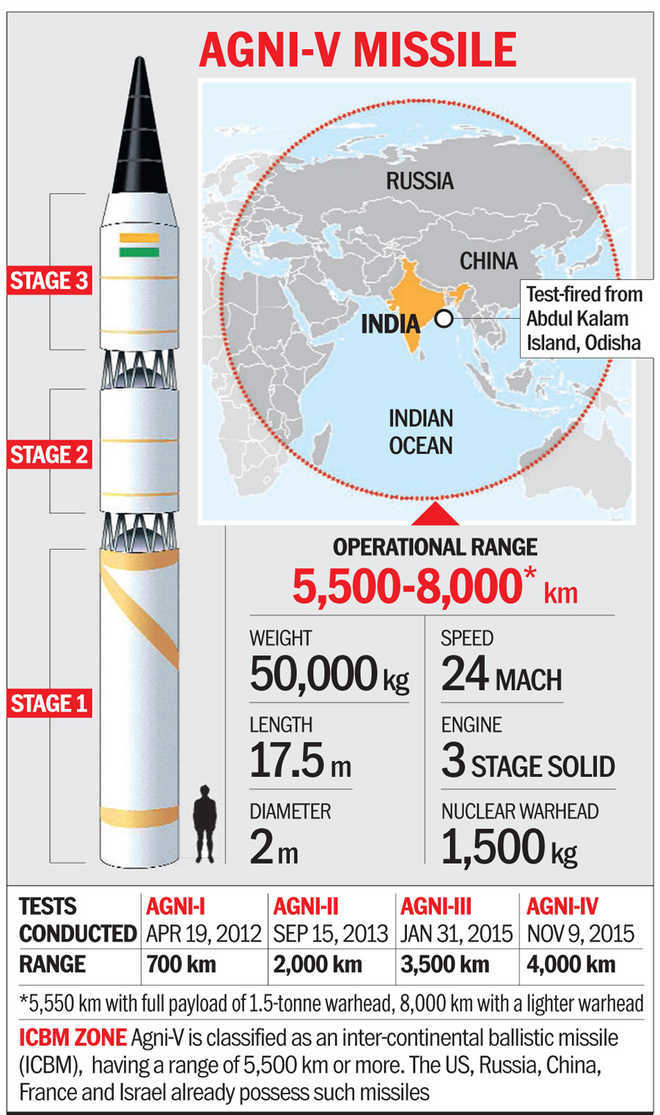
    • They are lighter compared to the Agni series of missiles which are medium and intercontinental-range nuclear-capable ballistic assets.

    Marine Version of SLBM: Sagarika

    • Part of the K family is the SLBM K-15, which is also called B-05 or Sagarika.
    • It has a range of 750 km.
    • INS Arihant can carry a dozen K-15 missiles on board. India has also developed and successfully tested K-4 missiles from the family, which have a range of 3,500 km.
    • It is also reported that more members of K-family — reportedly carrying the code names K-5 and K-6, with a range of 5,000 km and 6,000 km respectively — are under development.

    Strategic significance of the launch

    • The capability of being able to launch nuclear weapons submarine platforms has great strategic significance in the context of achieving a nuclear triad.
    • This is especially in the light of the “No First Use” policy of India.
    • The sea-based underwater nuclear capable assets significantly increases the second strike capability, and thus validates the nuclear deterrence.
    • These submarines can not only survive a first strike by the adversary, but can also launch a strike in retaliation, thus achieving ‘Credible Nuclear Deterrence’.

    Message to our hostile neighbours

    • The development of these capabilities is important in the light of India’s relations with China and Pakistan.
    • India’s capacity building on the nuclear powered submarines and of the nuclear capable missile which can be launched from them is crucial for nuclear deterrence.
    • China has deployed many of its submarines, including some that are nuclear-powered and nuclear-capable.

    Conclusion

    • In an era such as this, credible nuclear deterrence is the need of the hour.
    • The success of INS Arihant gives a fitting response to those who indulge in nuclear blackmail.


    UPSC 2023 countdown has begun! Get your personal guidance plan now! (Click here)

  • Report on Abuse of UAPA

    The People’s Union for Civil Liberties (PUCL) has released a report titled “UAPA: criminalizing dissent and state terror” on the alleged abuse of the legislation between 2009 and 2022, and demanded that the law be repealed.

    What is Unlawful (Activities) Prevention Act (UAPA)?

    • The UAPA is aimed at effective prevention of unlawful activities associations in India.
    • Its main objective was to make powers available for dealing with activities directed against the integrity and sovereignty of India
    • It is an upgrade on the Terrorist and Disruptive Activities (Prevention) Act TADA, which was allowed to lapse in 1995 and the Prevention of Terrorism Act (POTA) was repealed in 2004.
    • It was originally passed in 1967 under the then Congress government led by former Prime Minister Indira Gandhi.
    • Till 2004, “unlawful” activities referred to actions related to secession and cession of territory. Following the 2004 amendment, “terrorist act” was added to the list of offences.

    What are Unlawful Activities and Associations?

    • The UAPA lays down the definitions and rules for designating an organisation as an “unlawful association” if it is engaged in certain types of activities.
    • Under Section 3 of the UAPA Act, the government has powers to declare an association “unlawful”.
    • The government can then issue a notification designating such an organisation as a terrorist organisation, if it believes that the organisation is part of “terrorist activities.”

    (1) Unlawful Activites

    • Under section 2(o) of the UAPA, an unlawful activity in relation to an individual or association means – Any action taken by such an individual or association (whether by committing an act or by words, either spoken or written, or by signs or by visible representation or otherwise), –
    1. Works for the Cession of a part of the territory of India or the secession of a part of the territory of India from the Union
    2. Disclaims, questions, disrupts or is intended to Disrupt the sovereignty and territorial integrity of India; or
    3. which causes or is intended to cause Disaffection against India;
    • Related and ancillary acts, including financing, support or promotion of any such activities are also “unlawful activity”.

    (2) Unlawful Association

    The UAPA also defines an “Unlawful Association” under section 2(p) as meaning any association,–

    1. which has for its object any unlawful activity, or which encourages or aids persons to undertake any unlawful activity, or of which the members undertake such activity or
    2. which encourages or aids persons to undertake any such activity, or of which the members undertake any such activity

    Reported abuse of UAPA

    • The PUCL report studied data from the National Crime Records Bureau (NCRB) from 2015 to 2020.
    • It has found per-case conviction rate under the UAPA was 27.57% compared with 49.67% in Indian Penal Code (IPC) cases.
    • The per-arrestee conviction rate was just 2.8% against 22.19% in IPC cases.
    • This is far less to figure of the success of having UAPA.

    Cases registered under UAPA

    • During the check period, 5,924 cases were registered and 8,371 persons arrested.
    • The National Investigation Agency, on its website, had listed 456 cases of which 78% involved UAPA charges.

    Issues with UAPA

    • Burden of proof: With such high barriers of proof, it is now impossible for an accused to obtain bail, and is in fact a convenient tool to put a person behind bars indefinitely.
    • No interim bail: As a consequence of UAPA being applied, the accused cannot even get bail.
    • Traitor branding: This is being abused by the government, police and prosecution liberally: now, all dissenters are routinely implicated under charges of sedition or criminal conspiracy and under the UAPA.
    • Fake and framed cases: In multiple instances, evidence is untenable, sometimes even arguably planted, and generally weak overall.

    Key recommendations of the report

    • The report has sought:
    1. Repeal of the NIA Act and disbanding of the agency
    2. Release of all political prisoners (also who are on bail) and
    3. Action to provide reparations for those wrongfully accused and released by Courts


    UPSC 2023 countdown has begun! Get your personal guidance plan now! (Click here)

  • Carl-Gustaf M4 to be produced in India

    gustaf

    Swedish defense major SAAB announced plans to manufacture its Carl-Gustaf M4 weapon system in India.

    What is the Carl-Gustaf M4?

    • The Carl-Gustaf recoilless rifle is a man-portable, multi-role weapon system that allows dismounted soldiers to effectively deal with multiple challenges on the modern battlefield.
    • A proven performer in battle, the Carl-Gustaf M4 is said to be adaptable and flexible.
    • The Indian Army has been using the iconic Carl-Gustaf since 1976 and currently operates the Mk2 and Mk3 versions.

    Key features of Carl-Gustaf M4

    • Lightweight, robust, reliable, effective and easy to use
    • Tactical flexibility through a wide range of ammunition
    • Combat proven system
    • Ammunition: Anti-armour, anti-structure, anti-personnel, support

    Why in news?

    • In recent years, the Indian government has taken several steps to boost the defense manufacturing sector under the ‘Make in India’ and ‘Atmanirbhar Bharat’


    UPSC 2023 countdown has begun! Get your personal guidance plan now! (Click here)

  • Left wing extremism

    mao

    The Maoist movement is on the ebb on the Andhra Pradesh-Odisha boundary, with its cadre and militia strength heavily depleted.

    Who are the Maoists?

    • Maoism is a form of communism developed by Mao Zedong.
    • It is a doctrine to capture State power through a combination of armed insurgency, mass mobilization and strategic alliances.
    • The Maoists also use propaganda and disinformation against State institutions as other components of their insurgency doctrine.

    Maoists and Maoism in India

    • The Communist Party of India (Maoist) is a Marxist–Leninist–Maoist banned communist political party and militant organization in India.
    • It aims to overthrow the “semi-colonial and semi-feudal Indian state” through people’s war.

    Confused between Maoists and Naxalities?

    • Usually, people confuse themselves over Maoists and Naxalities and cannot exactly trace the difference between the two terminologies.
    • Media seems to be confused with the terms and uses Maoists and Naxalities quite inter-changeably.
    • This creates confusion in the readers’ minds over the actual meaning of individual terms.

    The actual difference between the terms is as follows:

    • The difference between Maoists struggle and the Naxalite movement is that both trace their origin to the Naxalbari uprising of 1967.
    • But while the Naxalite movement thrives on the original spirit of Naxalbari; the Maoist struggle is an outcome of the 1967 uprising.
    • Maoists work with an agenda and use weapons to achieve their aims.
    • Naxalism focuses on mass organisations while the Maoism relies mainly on arms.

    History and evolution

    • Russian Revolution: Naxalism in India, like any other leftist movement around the globe draws its ideological basis from the Russian revolution.
    • Overthrowing Tsarist Regime: Lenin successfully fought against the Czarist Rule through a combination of peasant movement and an armed struggle.
    • Marxian ideology of class struggle: The prime intent was to bestow power in the hands of the exploited and marginalized and enforce societal control over governance and nation building.
    • Neo-Marxism: After the success of the Lenin-led revolution in Russia, the intellectual class in many countries got inspired. Prominent amongst them were Fidel Castro and Mao Zedong.

    Root cause of origin in India

    • Corporate exploitation: Since Eastern India is rich in natural resources including forests, minerals and mines, tribal face exploitation and harassment from government and corporate bodies targeting to extract those resources.
    • Tribal alienation: Tribal communities have been systematically alienated from their traditional rights over natural resources after independence.
    • Livelihood losses: Tribal livelihood is at stake due to depletion of natural resource base.
    • Forceful displacement: Forceful displacement from their homeland destroys their traditional governance system.
    • Absence of governance: In such exploited areas, the absence of governance becomes a self-fulfilling prophecy since the delivery systems are extinguished through killings and intimidation.
    • Foreign provocations: Many of LWE outfits are supported by external forces inimical to India and the Maoists consider such alliances as strategic assets.

    Other factors:

    1. Oppression and HR violations by Security Forces e.g. AFSPA
    2. Violation of Constitutional Protections under PESA and FRA
    3. Prevalence of Acute Poverty

    Impact of LWE

    • Romanticism without a cause: Some sections of the society, especially the younger generation, have romantic illusions about the Maoists, arising out of an incomplete understanding of their ideology of Class –Struggle.
    • Extreme violence: Their doctrine glorifies violence as the primary means to overwhelm the existing socio-economic and political structures.
    • Destruction of governance mechanism: LWEs aims at creating a vacuum at the grassroots level of the existing governance structures by killing lower-level government officials, police personnel of the local police stations and the people’s representatives of the PRIs.
    • Radicalization of youths: After creating a political and governance vacuum, they coerce the local population to join the movement.
    • Urban-Maoism: Many extremists have facilitated mass-mobilization in semi-urban and urban areas through ostensibly democratic means often led by well-educated intellectuals.

    Outcomes of perpetrating LWE

    The Leftist organizations skilfully use state structures and legal processes to further the Maoist agenda and weaken the enforcement regime through:

    1. Recruitment of ‘professional revolutionaries’
    2. Raising funds for the insurgency
    3. Creating urban shelters for underground cadres
    4. Providing legal assistance to arrested cadres and
    5. Mass- mobilization by agitating over issues of relevance/ convenience

    Govt initiatives for LWE-affected areas

    • Aspirational Districts: The MHA has been tasked with the monitoring of the Aspirational districts programme in 35 LWE affected districts.
    • HRD measures: Building of schools under the Eklavya model.
    • Road Connectivity Project for LWE affected areas (RRP-II): This aims for improving road connectivity in LWE affected States. Under this, 9279 km of roads and 392 bridges are sanctioned.
    • Naxal Surrender Policy: It aims to wean away misguided youth and hardcore naxalites who have strayed into the fold of the naxal movement and cannot find a way back.
    • National Policy Action Plan: To address Left Wing Extremism approved in 2015, has development as one of the most important component.

    SAMADHAN doctrine: It encompasses the entire strategy of government from short-term policy to long-term policy formulated at different levels. SAMADHAN stands for-

    • S- Smart Leadership
    • A- Aggressive Strategy
    • M- Motivation and Training
    • A- Actionable Intelligence
    • D- Dashboard Based KPIs (Key Performance Indicators) and KRAs (Key Result Areas)
    • H- Harnessing Technology
    • A- Action plan for each Theatre
    • N- No access to Financing

    Way forward

    • Indian counterinsurgency has to work with a dual objective of defeating the insurgents militarily and fully quell the insurgent impulses.
    • This will need institutional overhauls.
    • States must do more to synergize their efforts by launching coordinated operations, thereby denying Maoists any space for manoeuvrability.
    • On parallel grounds, it is also important to segregate the population from the insurgents both operationally and ideologically.
    • The conflict over the distribution of resources can be mended with economic development.


    UPSC 2023 countdown has begun! Get your personal guidance plan now! (Click here)

  • [pib] Indian Navy participates in Exercise Kakadu hosted by Australia

    INS Satpura and a P8 I Maritime Patrol Aircraft of the Indian Navy reached Darwin in Australia on for participation in the multinational Exercise Kakadu – 2022, hosted by the Royal Australian Navy.

    Exercise KAKADU

    • Exercise KAKADU, which started in 1993, is the premier multilateral regional maritime engagement exercise hosted by the Royal Australian Navy (RAN) and supported by the Australian Air Force.
    • The exercise is held biennially in Darwin and the Northern Australian Exercise Areas (NAXA).
    • It derives its name from Kakadu National Park, which is a protected area in the northern territory of Australia, 171 km south-east of Darwin
    • During the exercise, professional exchanges in harbour and diverse range of activities at sea, including complex surface, sub-surface and air operations would enable sharing of best practices and honing of operational skills.

    India’s presence at the exercise

    • Indian Navy’s participation in KAKADU provides an excellent opportunity to engage with regional partners and undertake multinational maritime activities ranging from constabulary operations to high-end maritime warfare in a combined environment
    • It is aimed at enhancing interoperability and developing of common understanding of procedures for maritime operations gaining importance with the Indo-Pacific narrative.

    Also read:

    [Prelims Spotlight] Important Submarines and Naval Ships


    UPSC 2023 countdown has begun! Get your personal guidance plan now! (Click here)

  • Exercise Vostok-22

    Russia is holding Vostok exercises. However, India has only sent its army contingent of the 7/8 Gorkha Rifles, and will not take part in the maritime section of the two-part event.

    Vostok-2022

    • It is an annual, multilateral, strategic and command exercise hosted by Russia.
    • This year it will see the participation of more than 50,000 troops from 13 countries such as India, China, Algeria, India, Laos, Mongolia, Nicaragua, Syria and many more.
    • While the exercises in Vostok-2022 are routine, they are the first such multilateral exercises to be held since the Russian war in Ukraine began.

    Why in news now?

    • India has only sent its army contingent and will not take part in the maritime section of the two-part event.
    • This is because the maritime part of the exercises would be held in the Sea of Okhotsk and the Sea of Japan.
    • These are near the disputed South Kuril Islands.
    • India’s decision not to take part in the naval exercises is believed to be in deference to Tokyo’s sensitivities.

    What does India’s participation mean?

    By sending an army contingent to join Russian and Chinese troops in the exercises at this time, New Delhi is aiming to send a four-pronged message:

    1. Continuing relationship with Russia despite the Ukraine war: The Modi government has decided not to join the Western sanctions regime, or to curb oil imports and other economic engagement with Moscow.
    2. Signal balance and non-alignment in the current crisis: India has mostly abstained from votes at the United Nations seeking to criticise Russia.
    3. India also takes part in routine Indo-Pacific exercises: This is with its Western partners including the Quad, as well as in bilateral exercises, like the India-US Ex. Yudh Abhyas.
    4. Willingness to conditional engagement with China: The message the government continues to give is that it is willing to engage with China on a number of fronts, even as military talks at LAC (Line of Actual Control) remain stuck.

    Conclusion

    • There might be some discomfort for Indian soldiers in dealing with their counterparts at a time when they are facing each other off along the LAC.
    • But that’s a small price to pay if it means keeping India-Russia ties on an even keel.
    • India needs to start communicating its intent better.
    • Strategic communication is an art. It’s time to master it.


    UPSC 2023 countdown has begun! Get your personal guidance plan now! (Click here)

  • Why Nepal postponed Gorkhas’ recruitment under the Agnipath scheme?

    Nepal has postponed the recruitment rallies which were to be held in that country to recruit Gorkha soldiers for the Indian Army under the Agnipath scheme.

    Why has Nepal postponed Agnipath recruitment rallies?

    • Nepal is of the opinion that this new form of entry into the Indian military is not covered under the Tripartite Agreement signed between Nepal, Indian and UK governments in 1947, soon after Indian independence.
    • The government feels that the Agnipath scheme must be approved by it and for that political consultations with all parties in Nepal must take place.
    • This is move is visibly ‘inspired’ with inputs from China.

    What was the Tripartite Agreement between India, Nepal and UK?

    • Soon after Indian Independence on August 15, 1947, an agreement was reached by the governments of India, Nepal and the UK regarding the future of the Gorkha soldiers who were serving in the Indian Army.
    • As per the terms of this agreement four regiments of Gorkha soldiers – 2nd, 6th, 7th and 10th – were transferred to the British Army while the rest – 1st, 3rd, 4th, 5th, 8th and 9th – remained with the Indian Army.
    • A new Gorkha Regiment, the 11th Gorkha Rifles, was raised by India soon after Independence.
    • The agreement also provides for the terms and conditions of the Nepal-domiciled Gorkha soldiers in the Indian Army and for their post-retirement benefits and pensions.

    Significance of Gorkha Soldiers

    • Legend has it that Hitler’s very words were, “If I had Gurkhas, no army in the world could defeat me.”
    • An interesting historical aspect of Gorkha troops is that Pakistan, at the time of Independence, and China, soon after the 1962 war, had also requested Nepal for Gorkha soldiers.
    • However, this request was turned down by the Nepal government.
    • The largest body of Gorkha troops serves in the Indian Army while in the UK their presence has been reduced from four regiments to just two.

    Can Nepalese Gorkhas in foreign Armies be called mercenaries?

    • Mercenaries are understood as fighters who take part in a conflict for financial gain and usually are not parties to that conflict.
    • As per the definition of the 1949 Geneva Convention, gives the officially agreed definition of a mercenary.
    • It says that soldiers serving in sovereign armies are not considered mercenaries, and Gorkha soldiers cannot be called mercenaries.
    • In addition, Gorkha soldiers from Nepal serve side-by-side with Gorkha soldiers who are born and brought up in India.

    Have any changes been made in Gorkha unit recruitments over the years?

    • There have been attempts to reduce the dependence on Nepal for the Gorkha soldiers in the Indian Army,
    • To this effect, the composition has increasingly been attempted to be balanced between Indian and Nepal-domiciled troops.
    • Also, a pure Indian Gorkha battalion was raised in 2016.
    • This unit, 6th Battalion of the 1st Gorkha Rifles (6/1 GR), was raised in Subathu, in Himachal Pradesh.
    • Otherwise, the ratio of Nepalese-domiciled soldiers and Indian-domiciled soldiers in a Gorkha battalion ranges from 60:40 to 70:30, though this will change further in future.
    • A change was made in the recruitment rules for Gorkha Rifles recently when the Army decided that soldiers hailing from the Kumaon and Garhwal regions of Uttarakhand will also be eligible for serving in Gorkha Rifles.

    What is the socio-economic impact on Nepal of Gorkha soldiers serving in the Indian Army?

    • A major economic and social impact is felt in Nepal due to the Nepal-domiciled Gorkha soldiers serving in the Indian Army and much of it has to do with the remittances that they send home.
    • Kathmandu receives a sustainable source of remittances from Gorkhas working in foreign armies.
    • This has significantly contributed to social modernization in the isolated villages, while the financial remittances spurred entrepreneurship development thereby contributing to regional development.

    Why induct Gorkha soldiers?

    • Gorkha soldiers are tough. Living in the hills of Nepal makes them strong and resilient and they can stand war, climate and terrain better than most.
    • No one can match their swift movement in the mountainous terrain.
    • They are cheerful in disposition and nothing disturbs their equanimity.
    • They are loyal to the core and fearless in battle.
    • All this makes them amongst the best soldiers in the world and they are much sought after.
    • Historically, they have deep rooted connection and affinity for India definitely due to cultural assimilations.


    UPSC 2023 countdown has begun! Get your personal guidance plan now! (Click here)

  • What is India’s policy on the Rohingya?

    In a major boost to India’s policy on the Rohingya, the MHA would shift Rohingya refugees to flats meant for EWS in Delhi.

    Why in news?

    • This is seen as a response to the fundamentalists who claims that the NRC, CAA are against any particular community.
    • India respects & follows the UN Refugee Convention 1951 & provides refuge to all, regardless of their race, religion or creed.

    Who are the Rohingyas?

    • Rohingya, an ethnic group, mostly Muslim, hail from the Rakhine province of west Myanmar, and speak a Bengali dialect.
    • They comprise one million out of the 53 million people that live in Myanmar, forming the world’s largest stateless population in a single country.
    • Universally reviled by the country’s Buddhist majority, they have been oppressed by the government since the late 1970s when the government launched a campaign to identify ‘illegal immigrants’.
    • Serious abuses were committed, forcing as many as 250,000 Rohingya refugees to flee to Bangladesh.
    • The 1982 Citizenship Law in former Burma made the Rohingyas stateless people.
    • They have often been called the most persecuted minority in the world.
    • The 1.1 million Rohingya Muslims squeezed precariously into the northwest state of Rakhine, in mainly Buddhist Burma, bordering majority Muslim Bangladesh, are stateless and unwanted.

    Why are they stateless?

    • To qualify for citizenship, Rohingya applicants had to renounce their identity and accept being labelled as ‘Bengalis’ on all official documents.
    • They also had to prove that they could trace the presence of their family in Rakhine back three generations.
    • This is extremely difficult as many Rohingya lack documents or had lost them in 2012.

    Why did the Crisis happen?

    • Since World War II they have been treated increasingly by Burmese authorities as illegal, interloping Bengalis, facing apartheid-like conditions that deny them free movement or state education.
    • The army “clearing operations” sparked the mass exodus of Rohingyas in both October 2016.
    • In August 2017, were launched after insurgents known as the Arakan Rohingya Salvation Army (ARSA) attacked several paramilitary check posts.
    • Rohingya activists claim the insurgents are mainly young men who have been pushed to breaking point by relentless oppression.

    Security Implications

    • The Rohingya issue and its spill over impact on Myanmar`s western peripheral region and security implications figured in the discussions is not clear.
    • In all probability, the import of the ferment caused by the Rohingya migration, efforts of radical Islamists to influence some of the Rohingya youth, and the Pakistan attempts to capitalise on the situation.
    • Rising anger in the Muslim world about the plight of the Rohingya has compounded fears of home-grown militancy as well as support from international jihadists.
    • Illegal movement of people, combined with human trafficking and cross-border migration, can weaken Myanmar’s relations with its neighbour Bangladesh and its ASEAN partners.

    Where do the Rohingya live in Delhi?

    • The Rohingya live in hutments in the densely populated Kalindi Kunj and Madanpur Khadar areas in Delhi which are contiguous with Uttar Pradesh.
    • Officially, about 1,200 Rohingya have been identified as among the first batch to have arrived in Delhi in 2012.
    • After they protested outside the UNHCR (UN Refugee Agency) office in Delhi, they were provided with refugee cards.

    Total Rohingyas in India

    • In December 2017, the MHA informed Parliament that there are around 40,000 Rohingya in India, of which around 5,700 are in Jammu and also in Telangana, Punjab, Haryana, Uttar Pradesh, Delhi and Rajasthan.
    • Of these, only 16,000 are said to be registered with the UN refugee agency.
    • The MHA claimed that the exact number is not known as many of them enter the country.

    How is the Delhi government involved?

    • The Foreigners Regional Registration Office (FRRO), responsible for tracking foreigners and their visas, has been requesting space at a new location for the Rohingya from the Delhi government since 2021.
    • The FRRO is under the administrative control of the MHA.

    When did the Rohingya come to Delhi?

    • A/c to MHA, they first came to Delhi in 2012.
    • They were forced to leave Myanmar in large numbers after several waves of violence, which first began in 2012.
    • The Myanmar army revived the attacks in 2017 and lakhs took shelter in Bangladesh.
    • Around five lakh Rohingya fled to Saudi Arabia in 2012.

    What is the process of deportation?

    • According to the MHA, illegal immigrants are detected, detained and deported under provisions of the Passport Act, 1920 or the Foreigners Act, 1946.
    • Once a ‘foreigner’ has been apprehended by the police for staying illegally, without any document, he or she is produced before the local court.
    • The powers to identify and deport them have also been delegated to State governments and UTs.
    • If the accused is found guilty, they can be imprisoned for three months to eight years.
    • After completing their sentence, the court orders deportation.

    Have any Rohingya been deported?

    • Any foreign nationals who enter into India without valid travel documents are treated as illegal immigrants.
    • In 2018, seven Rohingya were deported to Myanmar.
    • It was the first time that Myanmar issued a certificate of identity to the seven Rohingya. They had been picked up in Assam in 2012.
    • Many Rohingyas have expressed their desire to return to their country and gave an undertaking that they were returning out of their free will.

    India’s stance on Rohingyas

    • Amid fears of fresh exodus of Rohingya from Myanmar, the MHA in 2017 cautioned all the States about infiltration from Rakhine State of Myanmar into Indian Territory.
    • It cited the burden on the limited resources of the country that aggravates the security challenges especially in the North-East.
    • It also said the rise in terrorism in the last few decades is a cause for concern in most nations and that illegal migrants are more vulnerable to getting recruited by terrorist organisations.

    What is India’s stand on refugees?

    • India is NOT a signatory to the 1951 UN Convention relating to the Status of Refugees and the 1967 Protocol.
    • All foreign undocumented nationals are governed as per the provisions of:
    1. The Foreigners Act, 1946
    2. The Registration of Foreigners Act, 1939
    3. The Passport (Entry into India) Act, 1920 and
    4. The Citizenship Act, 1955

    Way forward: A humane approach is needed

    • India must enact a National Asylum and Deportation Law. Since certain exoduses cannot be prevented due to international pressures.
    • We need a proper framework to make sure that refugees can access basic public services, be able to legally seek jobs and livelihood opportunities for some source of income.
    • The absence of such a framework will make the refugees vulnerable to exploitation, which is again detrimental to our own national security.
    • Our judiciary has already shown the way forward on this: In 1996, the Supreme Court ruled that the state has to protect all human beings living in India, irrespective of nationality since they enjoy the rights guaranteed by Articles 14, 20, and 21 of the Constitution to all, not just Indian citizens.
    • The enactment and enumeration of refugee rights will reduce our dependence on judge-centric approaches — or even worse, the whims of Home Ministry bureaucrats, police officers and politicians.

    Try this

    Q. In the absence of a uniform and comprehensive law to deal with asylum seekers, we lack a clear vision or policy on refugee management. In the context of this, examine the need for law to deal with asylum seeker and suggest the various aspects the law should cover. 


    UPSC 2023 countdown has begun! Get your personal guidance plan now! (Click here)

  • What is Taiwan’s ‘Porcupine Strategy’ to protect itself if China attacks?

    As the long-range, live-fire drills began with China’s Eastern Theatre Command firing several ballistic missiles, Taiwan said that it was “preparing for war without seeking war”. What is Taiwan’s strategy to fight back in case China attempts to occupy it by force?

    What is a Military Doctrine?

    • Military doctrine is the expression of how military forces contribute to campaigns, major operations, battles, and engagements.
    • It is a guide to action, rather than being hard and fast rules. Doctrine provides a common frame of reference across the military.

    Why do need such a doctrine?

    • It helps standardize operations, facilitating readiness by establishing common ways of accomplishing military tasks.
    • It decides what you buy, produce, or prioritize, all of which flows from deciding your best fighting foot.

    What is the ‘Porcupine Doctrine’?

    • This doctrine was proposed in 2008 by US Naval War College research professor William S Murray.
    • It is a strategy of asymmetric warfare focused on fortifying a weak state’s defences to exploit the enemy’s weaknesses rather than taking on its strengths.
    • It is about building defences that would ensure that Taiwan could be attacked and damaged but not defeated, at least without unacceptably high costs and risks.

    How does this work?

    It identifies three defensive layers in the porcupine approach.

    1. The outer layer is about intelligence and reconnaissance to ensure defence forces are fully prepared. Behind this come plans for guerrilla warfare at sea with aerial support from sophisticated aircraft provided by the US.
    2. The innermost layer relies on the geography and demography of the island.
    3. While the outer surveillance layer would work to prevent a surprise attack, the second one would make it difficult for China to land its troops on the island in the face of a guerrilla campaign at sea using “agile, missile-armed small ships, supported by helicopters and missile launchers”.

    Another tactic: Asymmetric systems of defence

    • Asymmetric systems are ones that are small, numerous, smart, stealthy, mobile and hard to be detected and countered and associated with innovative tactics and employments.
    • These asymmetric capabilities will be aimed at striking the operational centre of gravity and key nodes of the enemy.
    • The geographic advantages of the Taiwan Strait shall be tapped to shape favourable conditions to disrupt the operational tempo of the enemy, frustrate its attempts and moves of invasion.
    • Taiwan underlined its shift to an asymmetric approach by adopting the Overall Defence Concept (ODC) in 2018.

    Do you know?

    Indian armed forces follow the Cold Start Doctrine that involves joint operations between India’s three services and integrated battle groups for offensive operations. A key component is the preparation of India’s forces to be able to quickly mobilize and take offensive actions without crossing the enemy’s nuclear-use threshold.

    Need for such a strategy

    • China enjoys overwhelming military superiority over Taiwan.
    • Over the past decade, Beijing has developed far more accurate and precise weapon systems to target Taiwan.
    • China has been more vocal about its intention to “reunite” the island with the mainland, by force or coercion if needed.
    • The PLA has already achieved the capabilities needed to conduct an air and naval blockade, cyberattacks, and missile strikes against Taiwan.
    • PLA leaders now likely assess they have, or will soon have, the initial capability needed to conduct a high-risk invasion of Taiwan (following Russia’s path).

    How easy will it be for China?

    • Missile strikes, cyberattacks, air and naval blockade aside, undertaking a full-scale invasion across the Taiwan Strait, with attendant risks of anti-ship and anti-air attacks, could present challenges for China.
    • The PLA is estimated to have air and naval resources to carry out an initial landing of 25,000 or more troops, which could increase if it deploys civilian ships to meet its military objectives.
    • However, it will have to first select and secure a suitable beachhead from among the handful that is available.
    • Also, with small and agile weapons systems, Taiwan can turn its coastline into a kill zone that would deny China a walkover.
    • Beijing would have to rely on cyberattacks, missile strikes on Taiwan’s air bases and runways, and a blockade to choke it into surrendering.


    UPSC 2023 countdown has begun! Get your personal guidance plan now! (Click here)

  • Over 59 lakh cases pending in High Courts: Law Minister

    Over 59 lakh cases were pending in the High Courts until July 22, Law Minister said in a written reply in Rajya Sabha.

    What else?

    • There are serving women judges in various courts, including 4 in the Supreme Court and 96 in the High Courts, as of July 25.

     Indian Judiciary: A Backgrounder

    • Our Judicial system has been the nation’s moral conscience keeper.
    • It speaks truth to political power, upholds the rights of citizens, mediates between Centre-state conflicts, provides justice to the rich and poor alike, and on several momentous occasions, saved democracy itself.
    • Despite its achievements, a gap between the ideal and reality has been becoming clear over the years.
    • The justice delivery is slow, the appointment of judges is mired in controversy, disciplinary mechanisms scarcely work, hierarchy rather than merit is preferred, women are severely under-represented, and constitutional matters often languish in the Supreme Court for years.
    • As Justice Chelameswar said in his dissent in the NJAC judgment, the courts must reform, so that they can preserve.

    Challenges to the judicial system

    • Lack of infrastructure of courts
    • High vacancy of judges in the district judiciary
    • Pendency of Cases
    • Ineffective planning in the functioning of the courts
    • Delay in the delivery of judgements
    • Lack of transparency in appointments and transfers.
    • Corruption
    • Undertrials serving Jail
    • Outdated laws ex. Section 124A IPC

    What led to the underperformance of the Indian Judiciary?

    The primary factors contributing to docket explosion and arrears as highlighted by the Justice Malimath Committee report are as follows:

    • Population explosion
    • Litigation explosion
    • Hasty and imperfect drafting of legislation
    • Plurality and accumulation of appeals (Multiple appeals for the same issue)
    • Inadequacy of judge strength
    • Failure to provide adequate forums of appeal against quasi-judicial orders
    • Lack of priority for disposal of old cases (due to the improper constitution of benches)

    Recent developments:

    Proposal for the creation of National Judicial Infrastructure Corporation (NJIC)

    • The CJI has pitched to set up a National Judicial Infrastructure Corporation (NJIC) to develop judicial infrastructure in trial courts.
    • He indicated a substantial gap in infrastructure and availability of basic amenities in the lower judiciary.
    • There is a dearth of court halls, residential accommodation, and waiting rooms for litigants in trial courts, especially in smaller towns and rural areas.
    • Experience shows that budgetary allocation for state judiciary often lapses since there is no independent body to supervise and execute such works.
    • NJIC is expected to fill this vacuum and overcome problems related to infrastructure.

    Way forward

    • Creating NJIC: It will bring a revolutionary change in the judicial functioning provided the proposed body is given financial and executive powers to operate independently of the Union and the State governments.
    • Appointment reforms: There are many experts who advocate the need to appoint more judges with unquestionable transparency in such appointments.
    • Creating All Indian Judiciary Services: It would be a landmark move to create a pan-India Service that would result in a wide pool of qualified and committed judges entering the system.
    • Technology infusion: The ethical and responsible use of AI and ML for the advancement of efficiency-enhancing can be increasingly embedded in legal and judicial processes. Ex. SUPACE.
    • Legal education: This should be in alignment with the evolving dynamics of the law and must be propagated in trial and constitutional courts. This will improve the competence of the judicial system.
    • Alternate Dispute Resolution (ADR): ADR mechanisms should be promoted for out-of-court settlements. Primary courts of appeal should be set up.


    UPSC 2022 countdown has begun! Get your personal guidance plan now! (Click here)