💥UPSC 2026, 2027, 2028 UAP Mentorship (March Batch) + Access XFactor Notes & Microthemes PDF

Search results for: “”

  • What is India’s current policy of multi alignment? Advantages and challenges

    Multi alignmentContext

    • Forthcoming Shanghai Cooperation Organization (SCO) summit in Samarkand, Uzbekistan is leading India to multi alignment.

    Background

    • India’s journey of foreign policy from being the founder of non-alignment to the multi-alignment. In his book The India Way, External Affairs Minister S. Jaishankar offers a critique of India’s traditional policy of “non-alignment”, where he distinguishes between the “optimistic  non- alignment ” of the past, which he feels has failed, that must give way to more realistic “multiple engagements of the future”.

    Shanghai Co-operation Organization (SCO)

    • SCO is a Eurasian political, economic and security organization.
    • It is the world’s largest regional organization,
    • 40% of the world population
    • More than 30% of global GDP.
    • Members: 8-China, Kazakhstan, Kyrgyzstan, Russia and Tajikistan, Uzbekistan, India and Pakistan.

    Multi alignmentSCO SUMIIT, 2022

    • Host- Uzbekistan,
    • Uzbekistan will host a full house: 15 leaders including eight member states from four Central Asian States, China, India, Pakistan and Russia,
    • The observer states: Belarus, Mongolia and Iran (which will become member this year) —
    • Afghanistan is not invited
    • Leaders of guest countries -Armenia, Azerbaijan, Turkey and Turkmenistan

    What is non- alignment?

    • It’s a policy, a brainchild of Nehru. Non-alignment movement emerged after second world war.
    • Non-alignment means not having an alliance with any of superpower, either USSR or USA.  Decolonized nations of Asia and Africa was largely a part of this group.

    Multi alignmentIndia’s policy of non-alignment

    • At bandung conference in 1955 non-alignment movement started with India as one of the founding member.
    • With policy of non-alignment India refused to gravitate towards USA or USSR.
    • India was the leader of non-alignment.

    What is India’s current policy of multi- alignment? Advantages and challenges.

    • Since the start of his tenure from 2014, Prime Minister Narendra Modi have not attended any conference of non-alignment.
    • External Affairs Minister Dr. S. Jaishankar in his book, The Indian way have criticized the non-alignment.
    • In the words of Former Foreign Secretary Vijay Gokhale India is no longer the non-align nation.

    How it is a Multi alignment policy?

    • India to truly multi aligned or all aligned by being a part of every major grouping.
    • India is a part of BRICS and Prime Minister Modi is attending the SCO SUMMIT in Samarkand.
    • On parallel to rival groups India is also the part of Quad and Indo pacific economic framework.
    • India is buying the discounted Russian oil and reusing to buckle under pressure from west and USA.
    • S-400 purchase is happening and India have dodged the bullet of sanctions from USA.
    • India is choosing the bilateral Free trade agreement like with Australia and UAE and withdrew from groupings like RCEP and Most recently IPEF. This policy are is said to be in the economic interest of India.

    Advantages of Multi alignment

    • India no longer wants to repeat the mistake of missing out of P5 Security council (“Permanent membership in the Security Council was granted to five states based on their importance in the aftermath of World War II).
    • If any group work against your interest it is better to be part of group rather than remain outside and do nothing
    • With retreating USA and its collapsing hegemony world is moving towards multiple polar world order.

    Disadvantages

    • Major disadvantage of non-alignment is you no longer have influence over adverse policy of friendly country.
    • For example. Russia sells S-400 to India but it also sold the same weapon to china.
    • USA and India are strategically getting closer day by day but USA recently approved the sale of $450 million F-16 fighter jets to Pakistan.

    Conclusion

    • Multi alignment will serve India its best national interest.
    • So far India has managed the rival parties at world stage to secure its foreign policy objectives but with Russian aggression and Chinese assertion and divided world will pose a significant challenge to India’s multi alignment policy.


    Mains question

    Q. What do you understand by non-alignment and multi-alignment? Analyze the shift In India’s foreign policy from non-alignment to multi-alignment.

    UPSC 2023 countdown has begun! Get your personal guidance plan now! (Click here)

  • Teachers with a passion for the profession are foundational to the positive educational change

    teacherContext

    • Success of new education policy depends on how we recruit and assesss teachers.

    What is the issue?

    • Recruitment of well-qualified teachers into the schooling system is the first prerequisite to ensure that students receive quality education.
    • However, teacher recruitment processes in the country are not adequately streamlined. There are diverse recruitment processes across regions, school stages, and school types central, state, and private schools.
    • This, in turn, leads to multiple criteria and processes for hiring teachers, thereby bringing a wide disparity in teacher quality across institutions and regions.
    • Many of the processes are also sub-optimal in measuring the competency of a candidate.

    Teacher hiring mechanism in place

    • One of the most common and widely-taken tests to ensure eligibility for recruitment is the Teacher Eligibility Test (TET), conducted at both the state (STET) and central levels (CTET).
    • TET is the equivalent of the licensure tests that are undertaken by teacher candidates in various countries.
    • However, in India, the test is required only for government school teacher recruitment at the elementary stage (Class 1-8).

    teacherIssues in hiring mechanism

    • TET has been critiqued time and again for various reasons. These include low pass percentages, poor test quality, lengthy test papers and a serious lack of alignment with teacher preparation programmes.
    • The test was in the news recently because of the teachers’ recruitment scam in West Bengal.

    teacherWhat we need?

    • A coherent strategy: to tie together the various tests and processes such as TET, teacher recruitment tests, classroom demonstrations and teacher interviews. This will enable a holistic assessment of teacher competence.
    • Understanding what is competence: Framing a common understanding of what qualifies as teacher competence. Simply speaking, teacher competence can be understood as the core knowledge, skills, and dispositions expected of a teacher to effectively contribute to the teaching-learning process.
    • Multiple methods of assessment: To evaluate several other skills and dispositions, one requires multiple methods of assessment including classroom demonstrations and teacher interviews. These assessments could help gauge skills like effective dissemination of a concept and selection of appropriate resources and learning materials.
    • Teacher’s aptitude: Most importantly, such processes should help evaluate a teacher’s empathy towards students. Respecting learner diversity and skills in building a participative/democratic classroom culture are crucial requisites of a teacher. The recruitment process should assess the teacher’s aptitude in this respect.
    • A comprehensive competency framework: That details the skills a teacher should have. This could be derived from a teacher education curriculum rooted in policy perspectives of the day. For instance, in the case of the NEP, the curriculum could be geared towards imparting training in classroom practices that make learning joyful.

    Long-term benefits to adopting such a holistic model of teacher recruitment

    • Better parity: It will ensure better parity in the quality of teachers recruited across the country.
    • Equitable education: Will contribute to equitable education for students from diverse sections of society.
    • Credibility is ensured: The recruitment process will also become credible if it is rooted in a framework that outlines the core competencies of becoming a teacher.
    • Reduction in coaching centres: At the systemic level, this may also lead to a reduction in coaching centres as the assessment processes will be non-standardised and cannot be easily gleaned from coaching materials and guidebooks.

    Conclusion

    • Teachers with a passion for the profession are foundational to the positive educational change envisaged by the NEP. Setting up clear benchmarks of quality and well-designed recruitment processes hold the key to ensuring better teaching-learning outcomes.

    Mains question

    Q. What do you think on teacher’s quality today? Explain how dynamic teacher recruitment process will enhance teacher’s quality.

    UPSC 2023 countdown has begun! Get your personal guidance plan now! (Click here)

  • Centre’s push for NavIC System  

    navic

    The Union government is pushing tech giants to make smartphones compatible with its home-grown navigation system ‘NavIC’.

    What is NavIC?

    • NavIC, or Navigation with Indian Constellation, is an independent stand-alone navigation satellite system developed by the Indian Space Research Organisation (ISRO).
    • NavIC was originally approved in 2006 at a cost of $174 million.
    • It was expected to be completed by late 2011, but only became operational in 2018.
    • NavIC consists of eight satellites and covers the whole of India’s landmass and up to 1,500 km (930 miles) from its boundaries.

    Note: The numbers of satellites in this constellation is disputed. It is given as 7 and 8 on different sources. Total Nine satellites were launched out of which the very first (IRNSS-1A) is partially failed because of some issue in its Atomic Clock. Another and the last satellite had a launch failure. Hence the number 7/8.

    Why is the Centre pushing for NavIC?

    • Currently, NavIC’s use is limited.
    • It is being used in public vehicle tracking in India.
    • It helps providing emergency warning alerts to fishermen venturing into the deep sea where there is no terrestrial network connectivity, and for tracking and providing information related to natural disasters.
    • Enabling it in smartphones is the next step India is pushing for.
    • India’s 2021 satellite navigation draft policy stated the government will work towards expanding the coverage from regional to global to ensure availability of NavIC signal in any part of the world.

    How does NavIC compare?

    • The main difference is the serviceable area covered by these systems.
    • GPS caters to users across the globe and its satellites circle the earth twice a day, while NavIC is currently for use in India and adjacent areas.
    • Like GPS, there are three more navigation systems that have global coverage – Galileo from the European Union, Russia-owned GLONASS and China’s Beidou.
    • QZSS, operated by Japan, is another regional navigation system covering Asia-Oceania region, with a focus on Japan.

    Strategic significance of NavIC

    • India says NavIC is conceived with the aim of removing dependence on foreign satellite systems for navigation service requirements, particularly for “strategic sectors.”
    • Relying on systems like GPS and GLONASS may not always be reliable, India says, as those are operated by the defence agencies of respective nations.
    • It is possible that civilian services can be degraded or denied.
    • NavIC is an indigenous positioning system that is under Indian control.
    • There is no risk of the service being withdrawn or denied in a given situation.


    Try this PYQ:

    Q. With reference to the Indian Regional Navigation Satellite System (IRNSS), consider the following statements:

    1. IRNSS has three Satellites in geostationary and four satellites the geosynchronous orbits.
    2. IRNSS covers entire India and about 5500 sq. km beyond its borders.
    3. India will have its own satellite navigation system with full global coverage by the middle of 2019.

    Which of the statements given above is/are correct?

    (a) 1 only

    (b) 1 and 2 only

    (c) 2 and 3 only

    (d) None


    Answer: (Post it here.)


    UPSC 2023 countdown has begun! Get your personal guidance plan now! (Click here)

  • Register for a recorded session + Rs 7000 worth of Preparatory package for FREE | UPSC 2023 SEMINAR & get a PDF of the strategy- How to clear IAS 2023 in just 8 months with 5 hrs/day of study time? Session by IPS, Dilpreet; Rahul sir & Sajal sir

    Register for a recorded session + Rs 7000 worth of Preparatory package for FREE | UPSC 2023 SEMINAR & get a PDF of the strategy- How to clear IAS 2023 in just 8 months with 5 hrs/day of study time? Session by IPS, Dilpreet; Rahul sir & Sajal sir

    Session concluded successfully | Register for Rs 7000 worth of CivilsDaily’s Preparatory package and a 10% scholarship (FEE waiver) on all CD courses.


    Sajal sir revealing the strategy for the next 8 months

    UPSC 2022 Mains will be over by the end of this week. UPSC 2023 exam date is already out and Prelims is scheduled for May 28th, 2023. That’s just 8 months away. Understanding the criticality of time is of utmost importance. If you want to crack UPSC with a rank in 2023, everything that you do must be under a plan, a strategy.

    CivilsDaily IAS is conducting a Seminar for UPSC Exam 2023 with Sajal sir and UPSC Rankers


    Table of content

    1. Topic, date, venue
    2. Who can register for this Seminar?
    3. CivilsDaily’s Preparatory package worth Rs 7000 for FREE + 10% Scholarship
    4. 12 Important Points to be covered in Seminar
    5. About Sajal sir, Dilpreet sir
    It was a houseful session

    Topic for the Seminar:

    How to clear UPSC 2023 in just 8 months with 5 hrs/day of study time? Get a winning strategy by Sajal sir and UPSC Rankers
    (Detailed points and agenda below)

    Rahul Garg, Assistant Controller General of Accounts addressing the UPSC aspirants: An insightful session

    Date and Time:

    (Concluded successfully) 25th September 2022 (Sunday) at 1 pm
    Get recorded session register here.

    Venue:

    • Offline – CivilsDaily IAS, Delhi center
      • (Address: 1 LGF, Apsara Arcade, Karol Bagh, near Metro station gate number 7, Delhi)
    • Online- Zoom link will be emailed to you.

    (10% scholarship (FEE waiver) across all courses of CivilsDaily to Seminar attendees)

    FREE CivilsDaily’s Preparatory Package worth Rs 7000 + Personalized Mentorship session

    Post-seminar CivilsDaily will share a special Preparatory Package both for Offline and Online attendees. Details here

    You are also entitled to a personalized intensive mentorship session by a senior IAS mentor wherein you can avail a personalized study plan, schedule, and doubt resolution session.

    This is for you if you are:

    1. A UPSC beginner – confused about the syllabus, prioritizing subjects, making timetables & targets, or just getting started.
    2. A working professional or college student who will be attempting UPSC 2023 with a job. Facing a serious time crunch and mismanagement in UPSC preparation.
    3. A veteran or aspirant trying to improve your rank in UPSC 2023 attempt.

    Strategic planning will help you fully uncover your options, set priorities for them, and define the methods to achieve them.

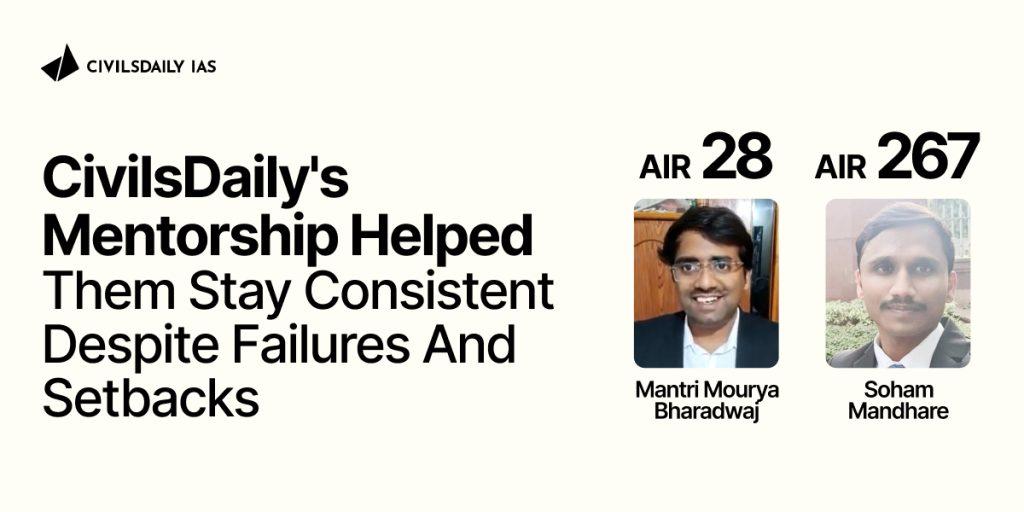
    Sajal Singh sir with his student Mantri Mourya Bharadwaj, AIR 28, UPSC 2021

    This is going to be an interactive 1-1 session with Senior mentors and UPSC Rankers. You will get ample time and opportunity to discuss with Sajal sir and Rankers. These points will be discussed.

    12 Important Points to be discussed in the Seminar

    1. Trend analysis of UPSC based on the previous 10 years’ CSE exam, Understanding the expectations of UPSC, and devising an evolving adaptive strategy for UPSC 2023 Prelims and Mains.

    2. What should be your approach for the next 8 months even if you have just started the preparation? Strategy for next 1 week, 1 month, 3 months, and like that, will be shared with you.

    3. How to cover the UPSC syllabus? The syllabus, and not the books, must be completed. Focussing on the essentials first. Eg. This year in Mains 2022 Modern History questions were missing, similarly, there were many firsts in Prelims 2022. How that affects your preparation and how you should prepare?

    4. You just need to invest effectively 5 hours per day for UPSC success. How to effectively manage preparation time? Make a timetable and set targets. Learn from the UPSC guru Sajal sir himself.

    5. Managing UPSC preparation with a serious time crunch; job – working professionals, college students, and family (especially for homemaker aspirants)

    6. Building a strong foundation: NCERT, current affairs, and standard books. How and which one to focus more on? Best sources for GS and Current Affairs.

    upsc 2023
    We’ll also discuss 3 layered mentorship in the Seminar.

    7. Breaking the inertia towards answer writing, and attempting mock tests. When and how to attempt tests and start mains answer writing?

    8. Do’s and Dont’s; and breaking the myths around UPSC. Eg. Aspirants from rural or non-engineering backgrounds are at a disadvantage.


    upsc 2023 exam date
    CivilsDaily’s mentorship: Acknowledged by The Hindu

    9. How to take notes and organize information/content for UPSC prelims and Mains answers? Making notes of case studies, schemes, examples, etc.
    Basically the skill of taking notes. What topics necessitate notes and which do not?

    10. UPSC Hacks and tricks like Tikdams that worked for UPSC rankers. A PDF will be shared with you all.

    11. Revision techniques that are common, standard, and used frequently. What exactly are they?

    12. How to take full advantage of the FREE CivilsDaily’s Preparatory Package and personalized mentorship session (FREE) that will follow?

    About Sajal sir

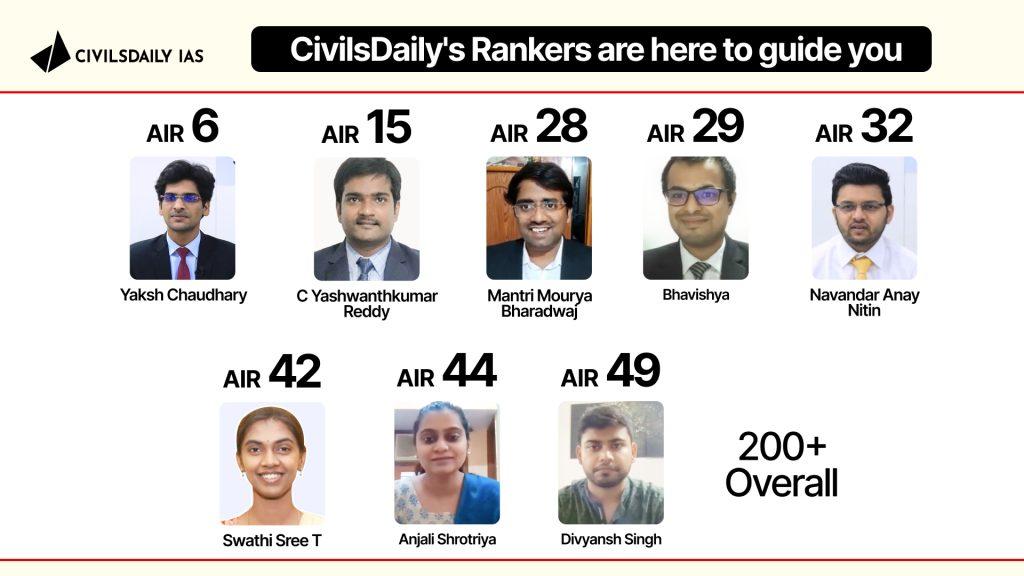
    Sajal sir has guided around 200+ rankers in UPSC 2021 exam and 600+ overall rankers have been mentored by him. From AIR 6, 15 to 28, 29, 32, 42, 44, 49, and it goes on and on.. He himself was a UPSC Mains Topper in 2017 and scored the highest marks in Mains.

    Sajal sir is known to make Economics and IR as easy as a cakewalk. He scored the highest marks in GS in the 2017 UPSC exam.

    Sajal sir with Anay, AIR 32 who was his mentorship student.

    About Dilpreet Singh

    CivilsDaily’s Super Mentor and IPS Officer Dilpreet Singh

    Dilpreet Singh was a CivilsDaily mentorship and Samachar Manthan student. He was a Mechanical Engineer who cleared PCS twice and was a working professional at the time of his UPSC attempt which landed him an AIR 237 and IPS.

    Dilpreet Singh is currently a Super Mentor as a part of the Super Mentorship Program with three layers of Mentoring for UPSC CSE 2023-24.


    What you’ll get as a part of the Special Preparatory Package?

    As a part of this:

    1. FREE Mentorship session with Senior IAS Mentor on strategy and approach for UPSC 2023. (You can schedule by clicking here as well)
    2. Samachar Manthan’s current week’s module and Mains Questions
    3. Prelims Weekly MCQ PDF
    4. Mains 250+ Value notes
    5. Current month’s Monthly Magazine

    Karishma Nair, AIR 14 was also Sajal sir’s student
    AIR 65, Pranav mentored under Sajal sir for UPSC 2020
    best coaching for upsc in delhi
  • Supreme Court’s basic structure doctrine in a new context

    basic structureContext

    • The basic structure doctrine constitutes a high watermark in the assertion of the Supreme Court’s judicial power in the teeth of a determined majoritarian regime.

    What is basic structure of Constitution?

    • The basic structure doctrine is one of the fundamental judicial principles connected with the Indian Constitution. The doctrine of the basic structure holds that there is a basic structure to the Indian Constitution, and the Parliament of India cannot amend the basic features.

    What is the significance of the basic structure in the Constitution of India?

    • The doctrine of basic structure is nothing but a judicial innovation to ensure that the power of amendment is not misused by Parliament. The idea is that the basic features of the Constitution of India should not be altered to an extent that the identity of the Constitution is lost in the process.08-Dec-2021

    Background

    • Courts are empowered under our Constitution to invalidate not only executive orders, but also legislative enactments that violate any part of the Fundamental Rights guaranteed in Part III of the Constitution (Bill of Rights).
    • But as to whether they are also empowered to adjudicate on the validity of constitutional amendments passed with the requisite special majority and following the procedure prescribed in Article 368 the Constitution is silent.

    basic structureHistorical developments on evolution of basic structure doctrine

    • Constitution provided a mechanism for parliament to amend the constitution in the form of article 368 but the nature and scope of this amending power was questioned in Supreme Court on multiple occasions. Supreme Court gave a series of judgement which ultimately culminated in probably the most landmark judgement Basic structure doctrine judgement.
    • Shankari Prasad Case
    • Sajjan Singh Case
    • Golakh Nath Case
    • Kesvananda Bharati Case
    • Minerva Mills case
    • I.R. Koelhi

    Constitutional Provisions

    1. 1st amendment and 9th schedule
    2. 24th amendment
    3. 42nd amendment


    His holiness, Kesavananda bharati, challenged before the supreme court, the validity of 29th CAA which inserted some laws in 9th schedule and affected property of his Hindu Mutt.

    What else was at stake?

    1. Supreme Court (R. C. Cooper case) had struck down bank nationalization act of 1969 which had nationalized 14 major banks for illusory compensation though it conceded parliament’s right to nationalise banks in national interest.
    2. Supreme Court had struck down abolition of privy purses which was a betrayal of solemn promise to erstwhile kings by Sardar Patel.

    Supreme Court could do all this as it had held in 1967 in Golaknath case that fundamental rights could not be abridged.

    Before returning back to Kesavananda, Let’s take a look at the relevant provisions of the constitution and Supreme Court interpretation of the same.

    • Art 13(2) – Any LAW abridging fundamental rights mentioned in part 3 shall be null and void to the extent of contravention
    • Art 368 -Procedure to amend the constitution.
    • Art 19(f) – freedom to acquire hold on and dispose off property.
    • Art 31 – right to property

    Both the rights were subject to reasonable restriction in public interest and restriction were subject to judicial review.

    Soon after the coming into force of the constitution, states enacted land reform acts #Zamindars challenged them. #Patna high court declared Bihar act as unconstitutional for violating right to property #interim parliament passed 1st CAA.

    1. ART 31B created 9th schedule. Laws inserted under it by constitutional amendment were immune to judicial review.

    Other provisions not imp for this article but imp for exams –

    1. Reasonable restrictions against freedom of expression under art 19.
    2. To nullify judgment in State of Madras v. Champakam Dorairajan and giving effect to art 46 (promoting educational and economic interests of weaker sections) amplified article 15 (3)

    Zamindars didn’t like it, not one bit. And here comes the 1st salvo

    Shankari Prasad v Union of India

    Challenged 1st CAA. What was the court’s judgment?

    1. Difference b/w constituent power and ordinary legislative power i.e. amendment not law for the purpose of article 13
    2. art 13 and 368 in conflict # apply DOCTRINE OF HARMONIOUS CONSTRUCTION # ART 13 not applicable to art 368

    Govt 1-0 Zamindars

    Govt passed 17th amendment and inserted more laws under 9th schedule ‘

    Zamindars fired another salvo-

    Sajjan Singh vs state of rajasthan

    Supreme Court sang Shankari prasad song again

    Govt 2-0 jamindars

    But Justice Mudholkar was of the view that the every Constitution has certain features which are basic in nature and those features cannot be changed.

    2 minority judgements…. utter confusion. And you can see seeds of basic structure were sown here.

    Zamindars fired 3rd salvo

    Golaknath v. State of Punjab

    11 judge bench overturned earlier 2 verdicts by a slender majority of 6-5

    Really? What was the logic given here?

    1. Nothing to suggest constituent power to be separate from legislative power and even if distinct, amending power not same as constituent power which is given only to constituent assembly i.e. amendment is law and subject to article 13
    2. Fundamental rights so sacrosanct and transcendental that they cannot be abridged even if whole parliament unanimously decided to abridge them.

    But it validated all previous land reform acts as nullifying them would create utter confusion

    Govt angry – Zamindars angry

    New landlords happy.

    Loss – loss to defendants as well as petitioner.

    Madam Indira was in power and she did not like this. Not one bit.

    Along came 24th amendment to neutralize GOLAKNATH JUDGEMENT

    1. Art 13 inapplicable to art 368
    2. Art 368 provided powers as well as procedure to amend the constitution
    3. Parliament by way of addition, variation or repeal can amend any provision of constitution
    4. President shall give assent to CA bills ( VERY VERY IMP FOR PRELIMS )

    But madam Indira wouldn’t just stop here as Cooper judgment (Bank nationalization ) also had to be neutralized.

    Smarting from this setback, Madam Indira (the parliament, herself) passed 24th CAA to neutralise GOLAKNATH judgement. But there was also a small matter of reversing Copper judgment in bank nationalisation case so parliament passed 25th CAA.

    1. Art 19f delinked from 31, in effect parliament deciding compensation amount payable instead of courts.
    2. Art 31c  -inserted under which – art 39b and c, most socialist of DPSPs (equitable distribution and prevention of concentration of wealth respectively) precede over 7 freedoms (art 19 ), equality (14), property (31)
    3. Parliament’s power to determine if policy is to give effect to 39b and c not subject to judicial review.

    29th CAA had put Kerala land reform act under 9th schedule and his holiness challenged the provisions and all hell broke loose.


    Now the 4th salvo

    basic structureKesvanada Bharati Case

    A 13 judge bench is constituted and what does it do!

    1. Overturned Golaknath i.e. amendment not law, fundamental rights amendable, no implied limit under art 368 i.e. CAA 24 constitutional
    2. Art 25 invalid to the extent it takes away judicial review i.e. 39 b and c above 14, 19 and 31 but subject to judicial review

    Most imp decision of all by slimmest of all 7-6 majority stated Parliament can amend any provision of the Constitution but the basic structure should not be destroyed, damaged or abrogated.

    What’s the logic?

    1. Expression amendment did not encompass defacing the constitution such that it lost its identity.
    2. In the garb of amendment parliament can not rewrite the constitution.

    Court gave relief to govt but reserved for itself power to review all amendment not just those that violate fundamental rights.

    Aftermath

    Indira Gandhi didn’t like the judgement one  bit. She (via the president) superseded 3 judges to appoint justice A.N. Ray as CJI.

    Knives had been drawn and the battle was gonna be very bloody –

    • Navnirman movement of JP (Jayprakash) had gathered steam, Indira was on the back foot and along came the judgement of Allahabad High Court convicting Indira of corrupt electoral practices. Election was declared null and void and  6 years ban to contest election was imposed on her.
    • Supreme Court stayed it and allowed her to remain PM but not to draw salary or speak or vote in parliament.
    • Darkest chapter in democracy’ 21 month emergency was declared on 25th June 1975 without even consulting cabinet (44th amendment made it mandatory for the president to have written advice of cabinet to declare emergency)

    Indira Gandhi wasn’t to sit quiet.

    CAA 39th – election of president, VP, PM and speaker beyond judicial review

    Clownish Rajnarayan challenged the CAA 39.

    Indira Gandhi v/s Raj Narain Case

    For the 1st time Supreme Court applied basic structure doctrine and considered free and fair election and rule of law to be part of basic structure. #amending act invalidated.

    Note here that 4 of the 5 judges on the bench had given dissenting judgment in Bharati case but still applied the same doctrine for Supreme Court judgment becomes law until overruled by bigger bench (art 141).

    Then how did Indira continue to be prime minister and contest election again and not get banned for 6 years?

    Supreme court accepted retrospective amendment to electoral law i.e. electoral malpractice of Indira was no longer a corrupt practice.

    Find out for fun the charges against Mrs. Gandhi for which she was convicted and what a popular British magazine had to say about the judgement.

    Along came the mini constitution i.e 42nd amendment act TO ELIMINATE IMPEDIMENTS TO THE GROWTH OF THE CONSTITUTION –

    1. PART 4a fundamental duties
    2. Socialist,secular and integrity word to preamble
    3. New DPSPs were added

    And for the purpose of this article amendment to article 368 nullifying basic structure doctrine by adding amendments can’t be challenged in courts and parliament possessing unlimited power of amendment

    1. All DPSPs to take precedence over all fundamental rights not just 39b and 39c.

    And Minerva Textile mills of Karnataka fired the 5th and the last salvo

    Minerva Mills v Union of India

    SC unanimously struck down amendment to article 368 holding limited amending power and judicial review to be part of basic structure.

    Court held that constitution is founded on the bedrock of balance b/w FRs and DPSPs. Goals set out by DPSPs have to be achieved without abrogation of means provided by FRs.

    What’s the logic?

    If a donee was vested with limited power, it could not be exercised to control that very power power and convert into unlimited one.

    Or

    If a genie grants u 3 wishes, it is understood u can not, as one of the wish, ask for unlimited number of wishes!

    Janta govt comes to power and 44th CAA deletes art 31 (b) right to property and 19 (f) freedom to acquire, hold and dispose of property as they were not considered part of basic structure

    Right to property now a constitutional right under art 300A.

    9th schedule and judicial review

    I.R.Coelho vs state of TN

    Supreme Court held that acts placed under 9th schedule after basic structure subject would be subject to judicial review to the extent of those acts violating basic structure of constitution.

    Impact of basic structure doctrine.

    It certainly saved Indian democracy from degenerating into authoritarian regime during those testing times but it has also given immense untold unbridled power to Supreme Court and made it the most powerful court in the world.

    As we would later see in the NJAC Verdict (let’s call it 4th judges case), Supreme Court applied this doctrine, many would say for wrong reasons to strike down the act and kept for itself the power to appoint brother judges. In the original constitution only fetters on the power of parliament was art 13.

    Relevance –  It was delivered at the time of single party rule both at the centre and most of the states. In the era of coalition politics no govt is going to wield so much power to destroy the constitution and then there is ever present danger of tyranny of unelected.

    But only legitimate way to overturn the verdict would be a 15 judge bench so don’t hold your breath for that.

    Now is the time for some thought questions

    #1. Consider these 2 statements –

    1. Any LAW that is ordinary law violating provisions of constitution would be declared null and void to the extent of contravention.
    2. Any LAW violating art 13 would be declared null and void

    Both statements are true…..If amendments were not law, what was the purpose of art 13 (2) other laws would anyway be declared unconstitutional!

    #2. Is basic structure doctrine relevant in the present political scenario where no single party is unlikely to enjoy majority in both the houses?

    #3. What should be the limits to amending power of parliament? Do u think for very substantial amendments instead of courts, people by way of referendum should determine whether amendment should go through or not?

    #4. Whatever happens to original intent theory that constitutional courts have to interpret constitution in accordance with the implied intentions of founding fathers and there is enough evidence to suggest founding fathers thoughtfully kept FRs sacrosanct to prevent their abrogation or as we would see in a later article how supreme court by creative interpretation virtually changed procedure established by law in art 21 to due process of law while founding fathers deliberately kept expression as procedure established by law.


    Conclusion

    • By restraining the amending powers of legislative organ of State, it provided basic Rights to Citizens which no organ of State can overrule. Being dynamic in nature, it is more progressive and open to changes in time unlike the rigid nature of earlier judgements.

    Mains question

    Q. What do you understand by basic structure of constitution? Trace evolution of basic structure in India.

    UPSC 2023 countdown has begun! Get your personal guidance plan now! (Click here)

  • 5G revolution and challenges

    5G revolution Context

    • Prime Minister Narendra Modi recently announced that 5G revolution deployment in India will commence sooner than expected.

    What is 5G technology?

    • 5G or fifth generation revolution  is the latest upgrade in the long-term evolution (LTE) mobile broadband networks.
    • 5G enables a new kind of network that is designed to connect virtually everyone and everything together including machines, objects, and devices.
    • It’s a unified platform which is much more capable than previous mobile services with more capacity, lower latency, faster data delivery rate and better utilisation of spectrum.

    How it evolved from 1G to 5G?

    • 1G: Launched in the 1980s. Analog radio signals and supported only voice calls.
    • 2G: Launched in the 1990s. Uses digital radio signals and supported both voice and data transmission with a Bandwidth (BW) of 64 Kbps.
    • 3G: Launched in the 2000s. With a speed of 1 Mbps to 2 Mbps it has the ability to transmit telephone signal including digitized voice, video calls and conferencing.
    • 4G: With a peak speed of 100 Mbps-1 Gbps it also enables 3D virtual reality.
    • 5G: with a speed of more than 1Gbps, it is capable of connecting entire world without limits.

    5G revolutionSalient features

    • Capability: 5G will provide much faster mobile broadband service as compared to the previous versions and will provide support to previous services like mission critical communication and the massive Internet Of Things (IoT).
    • Upgraded LTE: 5G is the latest upgrade in the long-term evolution (LTE) mobile broadband networks.
    • Speed: With peak delivering rate of up to 20 Gbps and an average of 100Mbps, it will be much faster as compared to its predecessors. The speed increment is partly achieved partly by using higher-frequency radio waves than previous networks.
    • Capacity: There will be up to 100 x increase in traffic capacity and network efficiency.
    • Spectrum usage: Will provide better usage for every bit of spectrum, from low bands below 1 GHz to high bands.
    • Latency: It’s expected to have lower latency with better instantaneous, real-time access of the data. The 5G, like 4G LTE, also uses Orthogonal Frequency Division Multiplexing (OFDM) but the new 5G NR (New Radio) air interface will enhance OFDM and provide better flexibility in data delivery.


    5G revolutionApplications of 5G technology

    • High-Speed mobile network: 5G will revolutionize the mobile experience with supercharged wireless network. Compared to conventional mobile transmission technologies, voice and high-speed data can be simultaneously transferred efficiently in 5G.
    • Entertainment and multimedia: 5G can provide 120 frames per second, high resolution and higher dynamic range video streaming without interruption. Audiovisual experience will be rewritten after the implementation of the latest technologies powered by 5G wireless. Augmented Reality and virtual Reality services will be better experienced over 5G.
    • Internet of Things: IoT applications collects huge amount of data from millions of devices and sensors and thus requires an efficient network for data collection, processing, transmission, control and real-time analytics which 5G network is a better candidate.

    Interesting facts about 5G

    According to researchers, about 1.5 billion people will have access to 5G by 2024.

    It may not seem like it at present, however, 5G will cover about 40% of the world.

    The security risks introduced BY 5G

    • Increased attack surface: With millions and even billions more connected devices, 5G makes it possible for larger and more dangerous attacks. Current and future vulnerabilities of the existing internet infrastructure are only exacerbated. The risk of more sophisticated botnets, privacy violations, and faster data extraction can escalate with 5G.
    • More IoT, more problems: IoT devices are inherently insecure; security is often not built-in by design. Each insecure IoT device on an organization’s networks represents another potential hole that an attacker can expose.
    • Decreased network visibility: With 5G, our networks will only expand and become more usable by mobile users and devices. This means much more network traffic to manage. But without a robust wide area network (WAN) security solution like Secure Access Service Edge (SASE) in place, companies may not be able to gain the network traffic visibility required to identify abnormalities or attacks.
    • Increased supply chain and software vulnerabilities: Currently and for the foreseeable future, 5G supply chains are limited. Vulnerabilities exist — particularly as devices are rushed to market — increasing the potential for faulty and insecure components. Compared to traditional mobile networks, 5G is also more reliant on software, which elevates the risk of exploitation of the network infrastructure.

    Challenges in rolling out 5G

    • Enabling critical infrastructures: 5G will require a fundamental change to the core architecture of the communication system. The major flaw of data transfer using 5G is that it can’t carry data over longer distances. Hence, even 5G technology needs to be augmented to enable infrastructure.
    • Financial liability on consumers: For transition from 4G to 5G technology, one has to upgrade to the latest cellular technology, thereby creating financial liability on consumers.
    • Capital Inadequacy: Lack of flow of cash and adequate capital with the suitable telecom companies (like Bharti Airtel and Vodafone Idea) is delaying the 5G spectrum allocation.

    Way forward

    • India should not miss the opportunity and should proactively work to deploy 5G technology. We should focus on strengthening our cyber infrastructure.
    • 5G start-ups that enable this design and manufacturing capabilities should be promoted. This will spur leaps in the coverage, capacity and density of wireless networks.

    Conclusion

    • The recent recommendation of the Telecom Regulatory Authority of India to the government to develop a national road map for India to implement 5G in the best possible manner should include cyber security concerns.

    Mains question

    Q. 5G is already transforming and enhancing connectivity. In this context Discuss India’s preparedness and cybersecurity challenges that needs to be taken care of for earlier roll out of 5G.

    UPSC 2023 countdown has begun! Get your personal guidance plan now! (Click here)

  • James Webb telescope : The most powerful space telescope

    James Webb telescopeContext

    • Much of the universe remains unknown. The James Webb telescope will hopefully provide a powerful window to help resolve some of the cosmos’s many mysteries.

    What is James Webb Space Telescope (JWST)?

    • It is a space telescope being jointly developed by NASA, the European Space Agency (ESA), and the Canadian Space Agency (CSA).
    • It has taken 30 years and $10bn to develop, and is being described as one of the grand scientific endeavors of the 21st Century.

    Where it is placed?

    • The James Webb Space Telescope will not be in orbit around the Earth, like the Hubble Space Telescope is – it will actually orbit the Sun, 1.5 million kilometres (1 million miles) away from the Earth at what is called the second Lagrange point or L2.

    Mission

    • It will be “a giant leap forward in quest to understand the Universe and our origins”, as it will examine every phase of cosmic history: from the Big Bang to the formation of galaxies, stars, and planets to the evolution of our own Solar System.

    james webb telescope Special features of JWST

    • Time machine in space: Powerful space telescopes, like JWST or the Hubble Telescope, are often called time machines because of their ability to view very faraway objects. The light coming from those objects, stars or galaxies, which is captured by these telescopes, began its journey millions of years earlier. Essentially, what these telescopes see are images of these stars or galaxies as they were millions of years ago. The more distant the planet or star, the farther back in time are the telescopes able to see.
    • Farthest from Earth: James Webb telescope will also be positioned much deeper into space, about a million miles from Earth, at a spot known as L2. It is one of the five points, known as Lagrange’s points, in any revolving two-body system like Earth and Sun, where the gravitational forces of the two large bodies cancel each other out.
    • Engineering marvel: JWST has one large mirror, with a diameter of 21 feet (the height of a typical two-storey building), that will capture the infra-red light coming in from the deep universe while facing away from the Sun.

    What is the goal of this telescope?

    • The telescope will be able to see just about anything in the sky.
    • However, it has one overriding objective – to see the light coming from the very first stars to shine in the Universe.
    • These pioneer stars are thought to have switched on about 100-200 million years after the Big Bang, or a little over 13.5 billion years ago.
    • James Webb telescope will be picking out groupings of these stars.

    james webb telescope Its significance

    • It is widely expected to unveil many secrets of the universe, particularly those related to the Formation of stars and galaxies in the early period the first few hundred million years after the Big Bang.
    • Some have called James Webb telescope  the “telescope that ate astronomy”.
    • It is said to look back in time to the Dark Ages of the universe.

    Conclusion

    • The universe is vast and most of it is unknown. We hope that the James Webb telescope, over its lifetime would provide us with a powerful window to help resolve some of the many mysteries of the cosmos and make it a little bit more comprehensible.

    Mains question

    Q. What is James Webb telescope experiment? Do you think it shades light on dark matter? Explain.  

    UPSC 2023 countdown has begun! Get your personal guidance plan now! (Click here)

  • What is National Automated Fingerprint Identification System (NAFIS)?

    The Union Home Minister has inaugurated the National Automated Fingerprint Identification System (NAFIS).

    What is NAFIS?

    • NAFIS is developed by the National Crime Records Bureau (NCRB) at the Central Fingerprint Bureau (CFPB) in New Delhi.
    • The project is a country-wide searchable database of crime- and criminal-related fingerprints.
    • The web-based application functions as a central information repository by consolidating fingerprint data from all states and Union Territories.
    • In April this year, Madhya Pradesh became the first state in the country to identify a deceased person through NAFIS.

    Utility of NAFIS

    • It enables law enforcement agencies to upload, trace, and retrieve data from the database in real time on a 24×7 basis.
    • It would help in the quick and easy disposal of cases with the help of a centralised fingerprint database.

    How does it work?

    • NAFIS assigns a unique 10-digit National Fingerprint Number (NFN) to each person arrested for a crime.
    • This unique ID will be used for the person’s lifetime, and different crimes registered under different FIRs will be linked to the same NFN.
    • The 2020 report states that the ID’s first two digits will be that of the state code in which the person arrested for a crime is registered, followed by a sequence number.
    • By automating the collection, storage, and matching of fingerprints, along with digitizing the records of fingerprint data, NAFIS will provide the much-needed unique identifier for every arrested person.
    • It will be included in the CCTNS (Crime and Criminal Tracking Network & Systems) database as both are connected at the backend.

    Is this the first time that such an automation project is being attempted?

    • Upon the recommendations of the National Police Commission in 1986, the Central Fingerprint Bureau first began to automate the fingerprint database.
    • It began with digitizing the existing manual records through India’s first Automated Fingerprint Identification System (AFI) in 1992, called Fingerprint Analysis & Criminal Tracing System (FACTS 1.0).
    • The latest iteration, FACTS 5.0, which was upgraded in 2007, was considered to have “outlived its shelf life”, according to a 2018 report by the NCRB and thus needed to be replaced by NAFIS.

    Since when has India relied on fingerprinting as a crime-fighting tool?

    • A system of fingerprinting identification first emerged in colonial India, where it was tested before it spread to Europe and beyond.
    • At first, it was used by British colonial officials for administrative rather than criminal purposes.
    • William Herschel, the chief administrator of the Hooghly district of Bengal, from the late-middle 1800s onwards, used fingerprinting to reduce fraud and forgeries.
    • It then aimed to ensure that the correct person was receiving government pensions, signing land transfer deeds, and mortgage bonds.
    • Anthropometry, the measurement of physical features of the body, was used by officials in India but was soon replaced with a system of fingerprints.


    UPSC 2023 countdown has begun! Get your personal guidance plan now! (Click here)

  • Strong nuclear diplomacy brings opportunities for India

    nuclear diplomacyContext

    • The return of nuclear weapons on the global platform. After 1998, India premised its strategy on building ‘credible minimum deterrence’. The time has come to reflect on what is ‘credible’ and redefine what ‘minimum’ might be to strengthen nuclear diplomacy.

    Definition of nuclear diplomacy

    • Nuclear diplomacy deals with prevention of nuclear war and peacetime proliferation. It also deals with the use of threat of nuclear warfare to achieve diplomatic goals.

    nuclear diplomacyTheme of article

    • India, one of the world’s nuclear weapon powers, ought to be paying a lot more attention to the international nuclear discourse that is acquiring new dimensions and taking a fresh look at its own civilian and military nuclear programmes.
    • Nuclear cooperation has brought a new dimension to India’s nuclear diplomacy in the 21st India’s status as a responsible nuclear power is predicated upon the civil relationships in the nuclear domain that it has established with major powers.

    What is credible minimum deterrence?

    • Credible minimum deterrence is the principle on which India’s nuclear diplomacy is based. It underlines no first use (NFU) with an assured second strike capability and falls under minimal deterrence, as opposed to mutually assured destruction.

    nuclear diplomacyWhy do countries proliferate nuclear weapons?

    • Proliferation models centred on security concerns or dilemmas dominate nuclear literature.
    • Nuclear weapons provide an overwhelmingly destructive force that increases a state’s relative power in comparison to its neighbours.
    • It provides a powerful tool in an anarchic system where superpowers dominate other nation-states sovereignty.
    • Hence weaponizing helps establish a deterrence to prevent war.

    Why relook is needed?

    • Possessing nuclear weapons can confer India increased leverage to conduct foreign policy in both regional and international contexts.
    • There are two ways in which the possession of nuclear weapons can affect a state’s conduct of foreign policy and diplomacy.
    • The first involves military and strategic signalling. This includes military-oriented functions of deterrence, coercion, and brinkmanship.
    • The second, deals with non-military affairs.

    Way forward

    • It should be noted that India’s quest to be a “responsible nuclear state” has given it considerable diplomatic capital in the West.
    • It would be unfortunate for India to squander such gain owing to the lack of carefully considered foreign policy that leverages its nuclear status for its national interest.

    Conclusion

    • India’s civil nuclear engagements with the global community have strengthened its position in the global civil nuclear order, there is a need for the country to push for greater engagements with more key suppliers and stakeholders to fulfill its military nuclear potential and assert its status as a responsible nuclear state.

    Mains question

    Q. India has been a nuclear weapons state for 22 years. Has this affected India’s foreign policy in a direct manner? Express your views in context of the return of nuclear weapons on the global platform.

    UPSC 2023 countdown has begun! Get your personal guidance plan now! (Click here)

  • Nationwide Crackdown on PFI

    pfi

    The National Investigation Agency (NIA) has launched a massive nationwide search operation in connection with anti-terror activities linked to the Popular Front of India-PFI.

    What is the Popular Front of India (PFI)?

    • The PFI was created in 2007 through the merger of three radicalists organisations in southern India, the National Democratic Front in Kerala, the Karnataka Forum for Dignity, and the Manitha Neethi Pasarai in Tamil Nadu.
    • A decision to bring the three outfits together was taken in November 2006 at a meeting in Kozhikode in Kerala.
    • The formation of the PFI was formally announced at a rally in Bengaluru during what was called the “Empower India Conference” on February 16, 2007.

    Agenda of the PFI

    • The PFI has projected itself as an organisation that fights for the rights of minorities, Dalits, and marginalised communities.
    • It has frequently targeted the alleged anti-people policies of the State even as these mainstream parties have accused one another of being in cahoots with the PFI to gather the support of Muslims at the time of elections.
    • The PFI has itself never contested elections.

    Parallel organizations to PFI

    • In 2009, a political outfit named Social Democratic Party of India (SDPI) evolved out of the PFI, with the aim of taking up the political issues of Muslims, Dalits, and other marginalised communities.
    • The SDPI’s stated goal is advancement and uniform development of all the citizenry including Muslims, Dalits, Backward Classes and Adivasis and to share power fairly among all the citizens.
    • The PFI is a key provider of ground workers for the SDPI’s political activities.

    Why is PFI under crackdown?

    (1) Links to terror outfits

    • Many volunteers of PFI are allegedly involved in terror funding, organising training camps, and radicalising people to join proscribed organisations.
    • It has been involved in carrying out social and Islamic religious work among Muslims on the lines of the work done by right-wing groups.
    • The PFI does not maintain records of its members, and it has been difficult for law enforcement agencies to pin crimes on the organisation after making arrests.

    (2) Promoting Radicalization

    • The outfit is hostile to the consolidation across the country and the rise of a single non-secular party as the nation’s pre-eminent political and ideological force.
    • The post-2014 political landscape and the self-alienation of minorities has further pushed sections of the community towards groups like the PFI.
    • The outfit is also said to have a large number of supporters in Gulf countries who contribute handsomely to its kitty, something which is under the scanner of investigating agencies.

    (3) Hostility against state mechanism

    • Starting out as an organisation primarily rooted in Kerala, Karnataka and Tamil Nadu, the PFI has spread its wings far and wide, with a presence in at least 18 states.
    • It has found particularly fertile ground in parts of Uttar Pradesh and Assam.
    • Authorities have accused the outfit of instigating and funding protests against the CAA and the National Register of Citizens.

    (4) Barbarism in the name of religion

    • The PFI has had the most visible presence in Kerala, where it has been repeatedly accused of murder, rioting, intimidation, and having links with terrorist organisations.
    • The Kerala government affidavit said PFI activists were involved in 27 cases of MURDER, mostly of CPM and RSS cadres, and that the motives were highly communal.

    UPSC 2023 countdown has begun! Get your personal guidance plan now! (Click here)

More posts