💥UPSC 2026, 2027, 2028 UAP Mentorship (March Batch) + Access XFactor Notes & Microthemes PDF

Search results for: “”

  • Register for recorded video + templates | Brainstorming and rough work – The 1st step to 150+ marks | FREE UPSC Essay Masterclass by Zeeshan sir | Read example inside.

    Register for recorded video + templates | Brainstorming and rough work – The 1st step to 150+ marks | FREE UPSC Essay Masterclass by Zeeshan sir | Read example inside.

    Special session with Zeeshan Hashmi sir concluded. | Register and get: VIDEO RECORDING + FREE ESSAY TEMPLATES, TEST + MENTORSHIP CALL


    For those who missed the amazing session by Zeeshan Hashmi sir on Brainstorming and rough work for UPSC Essay. Get the recording of the session and a super important webinar PDF.

    Get the full PDF in your email id.

    The Webinar was a great success and many important points were discussed

    Writing a good essay in the UPSC mains exam is a skill that must be perfected with practice. And before that one must know the nuances of the skill. There is a process to a great essay.

    A great UPSC essay starts with brainstormed random ideas, disjointed facts…chaos, formulated into a ‘blueprint’. That’s the first step before you actually start writing it.

    The moment you zero in on the topic from a particular section, you start thinking about various points, facts, concepts, quotes, etc. to be put into that essay. The first few minutes before you start your essay become chaotic.

    The process to brainstorm and make a blueprint through rough work will channel that chaos into something beautiful, a 150+ scorer essay.

    Develop a method to ‘brainstorming madness’ with Zeeshan Hashmi

    Webinar details: Following points and themes will be touched upon and discussed.

    Session concluded yesterday.

    The zoom link will be emailed to you.

    What you will get post-webinar?

    1. Best practices PDF by Zeeshan
    2. Two FREE UPSC essay tests
    3. Access to CivilsDaily Mains Bootcamp telegram group

    Example Topic: Life must be understood backwards but it must be lived forward.

    Students find it difficult to pen down relevant points/ideas. But when provided with templates, they find it relatively easy to think of new points/ideas.

    Zeeshan sir will share such templates and help you make one in the webinar.

    Example: PESTEL is a commonly known template.

    ‘L’ Stands for legal. Taking an example, Section 377 of IPC (Homosexuality), it imposes Victorian morality on Contemporary India. The Supreme Court of India has partially struck it down in consonance with the need of the time. Thus Indian Judiciary has kept the legacy of the law alive by not completely striking it down but suitably modifying it to meet the changing needs of the time.

    Note:- Above elaboration is ‘Analytical’ in nature and not just factual. The same rule needs to be followed in Essays. We pick content, dada, facts, figures, and examples that we have and link them to the main demand of the topic.


    Feedback on Zeeshan sir’s mentorship by AIR 65, Pranav (from Quora: https://qr.ae/pvH4yA)

    Similarly, many dimensions/points can be drawn from the ‘economic’ component of the template.

    1. Indian Constitution describes itself to be Socialistic but India is very much a free market economy
    2. LPG Reforms gave a huge impetus to the Tertiary sector
    3. Economic Planning has been reduced to an indicative exercise through the setting up of the NITI Ayog.

    Similarly, Zeeshan sir will discuss and share a template on brainstorming.

    About Zeeshan Hashmi sir

    Zeeshan sir is a senior IAS mentor at CivilsDaily and he has been mentoring UPSC aspirants and now rankers for more than 6 years now. He has an experience with 5 UPSC interviews (including IFoS). He will be taking up your questions in the webinar and would be connecting with you in the Telegram group as well.

    AIR 117, Nisha was Zeeshan sir’s student

    Zeeshan sir will be taking a LIVE webinar on coming Thursday. Through a LIVE Essay writing session, he will be teaching and helping you master the skills required to make a blueprint for UPSC essay.

    What The Hindu mentioned about Civilsdaily Mentorship

  • 28th July 2022| Daily Answer Writing Enhancement(AWE)

    Topics for Today’s questions:

    GS-1          Social Empowerment, Regionalism, Communalism & Secularism

    GS-2         Governance: Government policies and interventions for development in various sectors and issues arising out of their design and implementation.

    GS-3        Indian Economy, Inclusive Growth & Issues

    GS-4        Contributions of moral thinkers and philosophers from India and the world.

    Question 1)


    Q.1 Regionalism in India is a multi-dimensional phenomenon, at once geo-cultural, politico-economic and, above all, psychological. Discuss. (15 Marks)


    Question 2)

    Q.2 How populist policies and freebies affect the interest of the country? What are the factors that need to be considered while formulating the policies for welfare? (10 Marks)

    Question 3)

    Q.3 What is gross domestic product (GDP) ? What are the implications of weakened correlation between GDP growth and formal sector jobs? (10 Marks)

    Question 4)  

    Q.4 “I understand democracy as something that gives the weak the same chance as the strong.” ― Mahatma Gandhi. Explain. (10 Marks)


    HOW TO ATTEMPT ANSWERS IN DAILY ANSWER WRITING ENHANCEMENT(AWE)?

    1. Daily 4 questions from General studies 1, 2, 3, and 4 will be provided to you.

    2. A Mentor’s Comment will be available for all answers. This can be used as a guidance tool but we encourage you to write original answers.

    3. You can write your answer on an A4 sheet and scan/click pictures of the same.

    4.  Upload the scanned answer in the comment section of the same question.

    5. Along with the scanned answer, please share your Razor payment ID, so that paid members are given priority.

    6. If you upload the answer on the same day like the answer of 11th  February is uploaded on 11th February then your answer will be checked within 72 hours. Also, reviews will be in the order of submission- First come first serve basis

    7. If you are writing answers late, for example, 11th February is uploaded on 13th February , then these answers will be evaluated as per the mentor’s schedule.

    8. We encourage you to write answers on the same day. However, if you are uploading an answer late then tag the mentor like @Staff so that the mentor is notified about your answer.

    *In case your answer is not reviewed, reply to your answer saying *NOT CHECKED*. 

    1. For the philosophy of AWE and payment: 

  • SC upholds powers of arrest raid under PMLA for ED

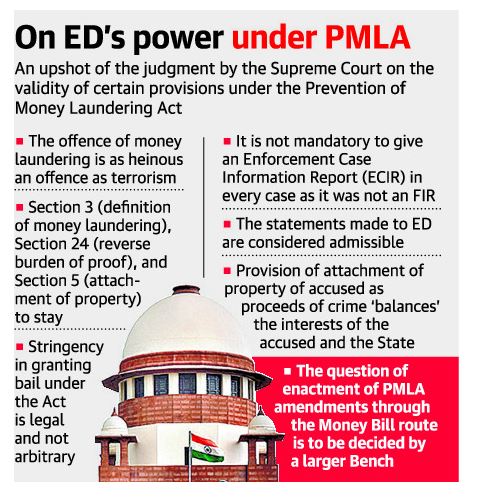
    The Supreme Court upheld the core amendments made to the Prevention of Money Laundering Act (PMLA), which gives the government and the Enforcement Directorate (ED) virtually unbridled powers of summons, arrest, and raids, and makes bail nearly impossible while shifting the burden of proof of innocence on to the accused rather than the prosecution.

    Did the judgement say?

    • The Supreme Court called the PMLA a law against the “scourge of money laundering” and not a hatchet wielded against rival politicians and dissenters.
    • Money laundering is an offence against the sovereignty and integrity of the country. It is no less a heinous offence than the offence of terrorism, the court noted.

    Why in news?

    • The verdict came on an extensive challenge raised against the amendments introduced in 2002 Act by way of Finance Acts.
    • The three-judge Bench said the method of introduction of the amendments through Money Bills would be separately examined by a larger Bench of the top court.

    What were the petitions?

    • Petitions were filed against the amendments, which the challengers claimed would violate personal liberty, procedures of law and the constitutional mandate.
    • The petitioners included many veteran politicians who all claimed that the “process itself was the punishment”.
    • There were submissions that the accused’s right against self-incrimination suffered when the ED summoned them and made them sign statements on threats of arrest.
    • But the court said these statements were recorded as part of an “inquiry” into the proceeds of crime.
    • A person cannot claim right against self-incrimination at a summons stage.

    About Enforcement Directorate (ED)

    • It goes back to May 1, 1956, when an ‘Enforcement Unit was formed in the Department of Economic Affairs.
    • It then aimed for handling Exchange Control Laws violations under the Foreign Exchange Regulation Act (FERA).
    • The ED today is a multi-dimensional organisation investigating economic offences under the Prevention of Money Laundering Act (PMLA), Fugitive Economic Offenders Act, Foreign Exchange Management Act and FERA.

    From where does the ED get its powers?

    • When proceeds of crime (property/money) are generated, the best way to save that money is by parking it somewhere, so one is not answerable to anyone in the country.
    • Therefore, there was a need to control and prevent the laundering of money.
    • The PMLA was brought in for this exact reason in 2002, but was enacted only in 2005.
    • The objective was to prevent parking of the money outside India and to trace out the layering and the trail of money.
    • So as per the Act, the ED got its power to investigate under Sections 48 (authorities under act) and 49 (appointment and powers of authorities and other officers).

    At what stage does the ED step in when a crime is committed?

    • Whenever any offence is registered by a local police station, which has generated proceeds of crime over and above ₹1 crore, the investigating police officer forwards the details to the ED.
    • Alternately, if the offence comes under the knowledge of the Central agency, they can then call for the First Information Report (FIR) or the chargesheet if it has been filed directly by police officials.
    • This will be done to find out if any laundering has taken place.

    What differentiates the probe between the local police and officers of the ED?

    Case study:

    • If a theft has been committed in a nationalised bank, the local police station will first investigate the crime.
    • If it is learnt that the founder of the bank took all the money and kept it in his house, without being spent or used, then the crime is only theft and the ED won’t interfere because the amount has already been seized.
    • But if the amount which has been stolen is used after four years to purchase some properties, then the ill-gotten money is brought back in the market.
    • Or if the money is given to someone else to buy properties in different parts of the country, then there is ‘laundering’ of money.
    • Hence the ED will need to step in and look into the layering and attachment of properties to recover the money.
    • If jewellery costing ₹1 crore is stolen, police officers will investigate the theft. The ED, however, will attach assets of the accused to recover the amount of ₹1 crore.

    What are the other roles and functions of the ED?

    • The ED carries out search (property) and seizure (money/documents) after it has decided that the money has been laundered, under Section 16 (power of survey) and Section 17 (search and seizure) of the PMLA.
    • On the basis of that, the authorities will decide if arrest is needed as per Section 19 (power of arrest).
    • Under Section 50, the ED can also directly carry out search and seizure without calling the person for questioning.
    • It is not necessary to summon the person first and then start with the search and seizure.
    • If the person is arrested, the ED gets 60 days to file the prosecution complaint (chargesheet) as the punishment under PMLA doesn’t go beyond seven years.
    • If no one is arrested and only the property is attached, then the prosecution complaint along with attachment order is to be submitted before the adjudicating authority within 60 days.

    Can the ED investigate cases of money laundering retrospectively?

    • If an ill-gotten property is acquired before the year 2005 (when the law was brought in) and disposed off, then there is no case under PMLA.
    • But if proceeds of the crime were possessed before 2005, kept in storage, and used after 2005 by buying properties, the colour of the money is still black and the person is liable to be prosecuted under PMLA.

    Under Section 3 of PMLA, a person shall be guilty of money-laundering, if such person is found to have directly or indirectly attempted to indulge or knowingly assist a party involved in one or more of the following activities:

    • Concealment; possession; acquisition; use; or projecting as untainted property; or claiming as untainted property in any manner etc.


    Also read:

    [Burning Issue] Enforcement Directorate (ED): Dreaded nightmare of Indian Politicians & Businessmen

    UPSC 2023 countdown has begun! Get your personal guidance plan now! (Click here)

  • Replacement Level Fertility achieved in India

    India has achieved replacement level fertility, with 31 States and UTs reaching a Total Fertility Rate (an average number of children per woman) of 2.1 or less, Union Minister of State for Health and Family Welfare has informed Parliament.

    What is Replacement Level Fertility?

    • Replacement level fertility is the level of fertility at which a population exactly replaces itself from one generation to the next.
    • In simpler terms, it denotes the fertility number required to maintain the same population number of a country over a given period of time.
    • In developed countries, replacement level fertility can be taken as requiring an average of 2.1 children per woman.
    • In countries with high infant and child mortality rates, however, the average number of births may need to be much higher.
    • RLF will lead to zero population growth only if mortality rates remain constant and migration has no effect.

    Benefits of achieving RLF

    • RLF helps ensure greater food security.
    • The reduced demand for food would in turn lessen agri- culture’s impact on the environment.
    • It would also likely lead to economic benefits through a “demographic dividend.”
    • Finally, achieving replacement level fertility would yield significant social benefits―especially for women.

    How did India achieve this?

    • Between 2012 and 2020, the country added more than 1.5 crore additional users for modern contraceptives, thereby increasing their use substantially.
    • India has witnessed a paradigm shift from the concept of population control to population stabilisation to interventions being embedded toward ensuring harmony of continuum care.

    Way forward

    • Although India has achieved replacement level fertility, there is still a significant population in the reproductive age group that must remain at the centre of our intervention efforts.
    • India’s focus has traditionally been on the supply side, the providers and delivery systems but now it’s time to focus on the demand side which includes family, community and society.
    • Significant change is possible with this focus, instead of an incremental change.


    UPSC 2023 countdown has begun! Get your personal guidance plan now! (Click here)

  • What is Household Consumption Expenditure Survey (HCES)?

    The Centre has kicked off the process for conducting the quinquennial Household Consumption Expenditure Survey (HCES) this month.

    What is the Household Consumer Expenditure Survey (CES)?

    • The HCES is traditionally a quinquennial (recurring every five years) survey conducted by the government’s National Sample Survey Office (NSSO).
    • It is designed to collect information on the consumer spending patterns of households across the country, both urban and rural.
    • Typically, the Survey is conducted between July and June and this year’s exercise is expected to be completed by June 2023.

    Why HCES?

    • The HCES is used to arrive at estimates of poverty levels as well as review key economic indicators like Gross Domestic Product (GDP).
    • The results of the survey are also utilised for updating the consumption basket and for base revision of the Consumer Price Index.
    • It helps generate estimates of household Monthly Per Capita Consumer Expenditure (MPCE) as well as the distribution of households and persons over the MPCE classes.
    • It is used to arrive at estimates of poverty levels in different parts of the country and to review economic indicators such as the GDP, since 2011-12.

    Why need this survey?

    • India has not had any official estimates on per capita household spending.
    • It provides separate data sets for rural and urban parts, and also splice spending patterns for each State and Union Territory, as well as different socio-economic groups.

    What about the previous survey?

    • The survey was last held in 2017-2018.
    • The government announced that it had data quality issues.
    • Hence the results were not released.


    UPSC 2023 countdown has begun! Get your personal guidance plan now! (Click here)

  • UN panel tells Hong Kong to repeal National Security Law

    Hong Kong’s controversial national security law should be repealed, experts on the UN Human Rights Committee said, amid concerns the legislation is being used to crack down on free speech and dissent in the former British colony.

    Why in news?

    • Chinese and Hong Kong officials have repeatedly used the NSL imposed by Beijing in 2020 to restore stability after the city was rocked for months by sometimes violent anti-government and anti-China protests in 2019.
    • The committee, which monitors the implementation of the International Covenant on Civil and Political Rights (ICCPR) by state parties, released its findings on Hong Kong following a periodic review.
    • The Hong Kong Special Administrative Region is a signatory to the ICCPR but China is not.

    About Hong Kong

    • A former British Colony and Autonomous Territory: Hong Kong is an autonomous territory, and a former British colony, in south-eastern China.
    • It became a colony of the British Empire at the end of the First Opium War in 1842.
    • Sovereignty over the territory was returned to China in 1997.
    • Special Administrative Region (SAR): As a SAR, Hong Kong maintains governing power and economic systems that are separate from those of mainland China.
    • The 1984 Sino-British Joint Declaration guarantees the Basic Law for 50 years after the transfer of sovereignty.
    • It does not specify how Hong Kong will be governed after 2047.
    • Thus, the central government’s role in determining the territory’s future system of government is the subject of political debate and speculation in Hong kong.

    What is this law all about?

    • Hong Kong was always meant to have a security law, but could never pass one because it was so unpopular.
    • So this is about China stepping in to ensure the city has a legal framework to deal with what it sees as serious challenges to its authority.
    • The details of the law’s 66 articles were kept secret until after it was passed. It criminalises any act of:
    1. Secession – breaking away from the country
    2. Subversion – undermining the power or authority of the central government
    3. Terrorism – using violence or intimidation against people
    4. Collusion–  with foreign or external forces

    What provisions do fall under the law?

    • The law came into effect at 23:00 local time on 30 June 2020, an hour before the 23rd anniversary of the city’s handover to China from British rule.
    • It gives Beijing power to shape life in Hong Kong it has never had before.
    • Its key provisions include:
    1. Crimes of secession, subversion, terrorism and collusion with foreign forces are punishable by a maximum sentence of life in prison
    2. Damaging public transport facilities can be considered terrorism
    3. Those found guilty will not be allowed to stand for public office
    4. Companies can be fined if convicted under the law
    5. This office can send some cases to be tried in mainland China – but Beijing has said it will only have that power over a “tiny number” of cases
    6. In addition, Hong Kong will have to establish its own national security commission to enforce the laws, with a Beijing-appointed adviser
    7. Hong Kong’s chief executive will have the power to appoint judges to hear national security cases, raising fears about judicial autonomy
    8. Importantly, Beijing will have power over how the law should be interpreted, not any Hong Kong judicial or policy body. If the law conflicts with any Hong Kong law, the Beijing law takes priority
    9. Some trials will be heard behind closed doors.
    10. People suspected of breaking the law can be wire-tapped and put under surveillance
    11. Management of foreign non-governmental organizations and news agencies will be strengthened
    12. The law will also apply to non-permanent residents and people “from outside [Hong Kong]… who are not permanent residents of Hong Kong“.

    What has changed in Hong Kong since the law was introduced?

    • Hundreds of protestors, activists and former opposition lawmakers have been arrested since the law came into force.
    • The arrests are an ominous sign that its crackdown on Hong Kong is only going to escalate.
    • Beijing has said the law is needed to bring stability to the city, but critics say it is designed to squash dissent.

    Why did China do this?

    • Hong Kong was handed back to China from British control in 1997.
    • But under a unique agreement – a mini-constitution called the Basic Law and a so-called “one country, two systems” principle.
    • They are supposed to protect certain freedoms for Hong Kong: freedom of assembly and speech, an independent judiciary and some democratic rights – freedoms that no other part of mainland China has.
    • Under the same agreement, Hong Kong had to enact its own national security law – this was set out in Article 23 of the Basic Law – but it never happened because of its unpopularity.

    How can China do this?

    • Many might ask how China can do this if the city was supposed to have freedoms guaranteed under the handover agreement.
    • The Basic Law says Chinese laws can’t be applied in Hong Kong unless they are listed in a section called Annex III – there are already a few listed there, mostly uncontroversial and around foreign policy.
    • These laws can be introduced by decree – which means they bypass the city’s parliament.
    • Critics say the introduction of the law this way amounts to a breach of the “one country, two systems” principle, which is so important to Hong Kong – but clearly, it is technically possible to do this.

    Must read:

    [Burning Issue] National Security Law debate in Hong Kong


    UPSC 2023 countdown has begun! Get your personal guidance plan now! (Click here)

  • Centre to amend Warehousing Act

    The Union Food and Public Distribution Ministry has suggested major amendments to the Warehousing (Development and Regulation) Act of 2007.

    Warehousing Act, 2007

    • The GOI has introduced a negotiable warehouse receipt system in the country by enacting the Warehousing (Development and Regulation) Act, 2007 (37 of 2007).
    • It has been made effective with effect from the 25th October, 2010.
    • The Negotiable Warehouse Receipt (NWR) system was formally launched on the 26th April, 2011.

    Why was this Act enacted?

    • To make provisions for the development and regulation of warehouses, negotiability of warehouse receipts, establishment of a Warehousing Development and Regulatory Authority (WDRA) and related matters.
    • The Negotiable Warehouse Receipts (NWRs) issued by the warehouses registered under this Act would help the farmers to seek loans from banks against NWRs.
    • It will avoid distress sale of agricultural produce.

    What is the amendment about?

    • The aim is to help farmers get access to the services of quality warehouses.
    • The amendment is:
    1. To make registration of godowns compulsory
    2. To raise the penalty for various offences and
    3. To do away the jail term as a punishment for the offences
    • Central government will have powers to exempt any class of warehouses from registration with the Authority.
    • At present, registration with the Warehousing Development and Regulation Authority (WDRA) is optional.
    • After the proposed amendment, which is yet to be cleared by the cabinet, registration of all third party warehouses throughout the country, will be undertaken in a phased manner.
    • The Act wants to establish a system of negotiable and non-negotiable warehouse receipt (NWR), which is now in electronic form.

    Issues

    • Farmers pressure groups fears that the amendments are for bringing back certain provisions of the repealed Farmers’ Produce Trade and Commerce (Promotion and Facilitation) Act through the backdoors.


    UPSC 2023 countdown has begun! Get your personal guidance plan now! (Click here)

  • Money Bill verdict holds the key: SC

    The court has left it open for a seven-judge Bench to decide whether the amendments to the PMLA could have been made to the PMLA through the Money Bill route.

    What was the case about Money Bill?

    • In November 2019, a five-judge Bench led by then CJI Ranjan Gogoi had referred to a larger Bench the issue and question posed in the Roger Mathew vs South Indian Bank Ltd. Case.
    • It inquired to whether amendments like these can be passed as a Money Bill in violation of Article 110 of the Constitution.
    • The petitioners had questioned the legality of the PMLA amendments which were introduced via Finance Acts/Money Bills.

    Correlation Money Bill

    • A Money Bill is deemed to contain only provisions dealing with all or any of the matters under clauses (a) to (g) of Article 110(1), largely including the appropriation of money from the Consolidated Fund of India and taxation.
    • In other words, a Money Bill is restricted only to the specified matters and cannot include within its ambit any other matter.

    What is a Money Bill?

    • A money bill is defined by Article 110 of the Constitution, as a draft law that contains only provisions that deal with all or any of the matters listed therein.
    • These comprise a set of seven features, broadly including items such as-
    1. Imposition, abolition, remission, alteration or regulation of any tax
    2. Regulation of the borrowing of money by the GOI
    3. Custody of the Consolidated Fund of India (CFI) or the Contingency Fund of India, the payment of money into or the withdrawal of money from any such fund
    4. Appropriation of money out of the CFI
    5. Declaration of any expenditure charged on the CFI or increasing the amount of any such expenditure
    6. Receipt of money on account of the CFI or the public account of India or the custody or issue of such money, or the audit of the accounts of the Union or of a state
    7. Any matter incidental to any of the matters specified above.

    Who controls such bills?

    • In the event proposed legislation contains other features, ones that are not merely incidental to the items specifically outlined, such a draft law cannot be classified as a money bill.
    • Article 110 further clarifies that in cases where a dispute arises over whether a bill is a money bill or not, the Lok Sabha Speaker’s decision on the issue shall be considered final.

    Difference between money and finance bill

    • While all Money Bills are Financial Bills, all Financial Bills are not Money Bills.
    • For example, the Finance Bill which only contains provisions related to tax proposals would be a Money Bill.
    • However, a Bill that contains some provisions related to taxation or expenditure, but also covers other matters would be considered a Financial Bill.
    • Again, the procedure for the passage of the two bills varies significantly.

    Issues with notifying a bill as Money Bill

    • The Rajya Sabha (where the ruling party might not have the majority) has no power to reject or amend a Money Bill.
    • However, a Financial Bill must be passed by both Houses of Parliament.
    • The Speaker (nonetheless, a member of the ruling party) certifies a Bill as a Money Bill, and the Speaker’s decision is final.
    • Also, the Constitution states that parliamentary proceedings, as well as officers responsible for the conduct of business (such as the Speaker), may not be questioned by any Court.


    UPSC 2023 countdown has begun! Get your personal guidance plan now! (Click here)

  • Universal Service Obligation Fund (USOF)

    The Union Cabinet has approved a project for providing 4G mobile services in thousands of villages across the country under the USOF.

    What do you mean by Universal Service?

    • In the modern world, universal service refers to having a phone and affordable phone service in every home.
    • It means, providing telecommunication service with access to a defined minimum service of specified quality to all users everywhere at an affordable price.
    • In 1837, the concept was rolled on by Rowland Hill, a British educator and tax reformer, which included uniform rates across the UK and prepayment by sender via postage stamps.

    What is USOF?

    • The Universal Service Obligation Fund (USOF) was formed by an Act of Parliament, was established in April 2002 under the Indian Telegraph (Amendment) Act 2003.
    • It aims to provide financial support for the provision of telecom services in commercially unviable rural and remote areas of the country.
    • It is an attached office of the Department of Telecom, and is headed by the administrator, who is appointed by the central government.

    Scope of the USOF

    • Initially, the USOF was established with the fundamental objective of providing access to ‘basic’ telecom services to people in rural and remote areas at affordable and reasonable prices.
    • Subsequently, the scope was widened.
    • Now it aims to provide subsidy support for enabling access to all types of telecom services, including mobile services, broadband connectivity and the creation of infrastructure in rural and remote areas.

    Funding of the USOF

    • The resources for the implementation of USO are raised by way of collecting a Universal Service Levy (USL), which is 5 percent of the Adjusted Gross Revenue (AGR) of Telecom Service Providers.

    Nature of the fund

    • USOF is a non-lapsable Fund.
    • The Levy amount is credited to the Consolidated Fund of India.
    • The fund is made available to USOF after due appropriation by the Parliament.


    UPSC 2023 countdown has begun! Get your personal guidance plan now! (Click here)

More posts