💥UPSC 2027,2028 Mentorship (April Batch) + Access XFactor Notes & Microthemes PDF

Search results for: “”

  • 80% Success Rate for Smash Mains 2020 Students & 85% of UPSC 2021 Mains Questions Are From Smash Mains 2021 !!|| [50 seats left] 1-on-1 Mentorship provided by Sajal sir (GS Topper 2017) to get 100 marks above cut off in Mains|| Smash Mains 2022 : New Batch || Invite only program || Register here

    80% Success Rate for Smash Mains 2020 Students & 85% of UPSC 2021 Mains Questions Are From Smash Mains 2021 !!|| [50 seats left] 1-on-1 Mentorship provided by Sajal sir (GS Topper 2017) to get 100 marks above cut off in Mains|| Smash Mains 2022 : New Batch || Invite only program || Register here

    With over 80% enrolled students in 2020 attending UPSC interviews, Smash Mains 2022 is back. Also, what we have noticed is about 85% of questions in UPSC Mains paper are from Smash Test Series.

    As an aspirant if you have taken many test series, but are unable to score above 100 marks and want to improve your scores before Mains 2022, then this program is for you!

    If coaches of sportspersons have themselves been players, then shouldn’t mentors of UPSC aspirants have cleared UPSC Mains themselves?

    It’s about time you find a Rahul Dravid or a Pullela Gopichand to mentor your Upsc preparation. Just practising test series without knowing the ways to present an answer is not the way to clear Mains. An ideal test series program should have 1-on-1 mentorship and guidance by veterans who have themselves topped the exams!

    Instead of getting demotivated and comparing yourself to other students, get mentorship support like Kunal Aggrawal IRS did when he could only score 75/250 marks in Mains mock tests.

    Why UPSC toppers are convinced that Smash Mains helped them succeed?

    A serving IPS officer, who had written the Mains exam again in 2021 to aim for IAS posting, gave us his feedback of our Smash Mains Test Series

    Read other answers over here.

    How has Smash Mains helped 2021-2022 Aspirants in Preparing for UPSC?

    What do aspirants need in their UPSC preparation journey? They need a senior who will give them moral support and the required logistics to prepare for the tough exam in a simplified manner.

    You can clear the exam only with confidence and consistency. And to achieve both, you require a personalised mentor. Many aspirants feel just attending classes or tests is not beneficial for them. So we tweaked our program to include mentorship both in our tests series and classes. Aspirants feel they can reach out to us anytime with their concerns and we are available to sort them out.

    Dear Students,

    For some of you prelims has never been a challenge for you. You have been missing the mains cut-off with a small margin (repeatedly). This means that there are some fundamental issues with your approach. You might be aware or not about this. But just realization is not enough, you have to work on its execution as well. And bringing that to fruition will be possible through a guided process under a meticulously designed plan.

    Smash mains is a highly personalized and intensive handholding program for the crème-de-la-crème (veterans) amongst UPSC aspirants (the intake is 50 students).

    Note: The Entry is Restricted to those who have appeared in UPSC interview in the past 2 years or have missed the mains cut off by a whisker.

    The focus is on identifying and highlighting the issues with your preparation (information / analysis / utilization). According to your strength and weaknesses, a tailor-made strategy is developed..

    My marks in UPSC 2017 GS Mains paper were:

    • GS Paper 1 – 132
    • GS Paper 2 – 125
    • GS Paper 3 – 130

    Key Takeways About Smash Mains 2022

    Every 3rd Ranker in Top 100 is from Civilsdaily|| MAINS MANTHAN 2021 ||  Register Now – Civilsdaily

    Every 3rd Ranker in the Top 100 of UPSC 2020 is a Civilsdaily Student.

    You don’t have to waste any more time finding the strategy (value added notes, test series or timetable ) for the next 3 months. You will get the guidance for it.

    You will gain access to Civildaily’s Samachar Manthan – For holistic and comprehensive coverage of Current Affairs.

    You will have exclusive membership to Smash Mains club in Habitat.

    One of our other Civilsdaily Student cleared the exams in 2020 to become an IPS Officer. He wrote the 2021 exam again as he aims for an IAS posting. This is what he said about our program

    Progression of Smash Mains 2022

    After completing the Mains Test series, you will have a one-to-one detailed and in-depth interaction. Final refinements are done to every answer. Value addition material, as well as pointers, will be provided here. We will work with you to ensure you have enough material for value addition. Our focus will be on providing tips that add the missing X factor to your answers.

    Why is Smash 2022 the best way to prepare for mains?

    Individual attention and approachability are the USPs of this program. Listen to what our Smash Mains 2020 student and topper Pooja Gupta (AIR 42) says about the program.

    Not putting Penguins among the Fowls – You already know how to write an average answer (you’re missing it by a few marks actually). You want to know how to increase your score from 90 to 110-115. The approach followed by other institutes in their Test series is the same for a veteran and a complete newbie and here lies the problem. Without personalized one-to-one interaction, it will be difficult for you to rectify these minute yet very important shortcomings.

    Evaluation is a strength of this program and we put it on a high priority. It shouldn’t be based on ‘model answers’ as there are 3-4 ways of approaching an answer. Only a seasoned player will be able to go beyond these model answers and be able to appreciate your approach (If it’s innovative) even if it differs from the model answers provided.

    Test copies get checked in a time-bound manner. The questions, answers and material provided are of the highest quality.

    Always on time and insightful discussions end with a reality check and motivation to perform better in the next test.

    Emphasis on execution and utilization of knowledge – Mains is not only about knowledge but the way you express the relevant knowledge in the most optimum manner.

    AIR 148 UPSC 2020 topper and our Civilsdaily student, Ponmani explains why answer writing with mentorship is necessary for Mains.

    We deliver what we promise.

    The Batch of Smash Mains Program will start soon.

  • The consequences of an ill-considered green strategy

    Context

    Europe’s push for renewable energy at the cost of conventional fuel may end up causing a global food crisis.

    Consequences of fuel shortage in Western Europe

    • Since August 2021, Western Europe has faced a problem with renewable energy – the wind doesn’t always blow when needed and the sun doesn’t always shine.
    • Commodity markets across the world operate on a balance of demand and supply — even seemingly “small” changes in either side of a few percentage points can push the prices up or down sharply.
    • High energy bills: Higher gas prices have pushed up energy bills for households and are expected to impact household spending and consumption as well.
    • High urea prices: Natural gas is used to produce urea – if gas prices go up, fertiliser also becomes expensive.
    •  Some poor and middle-income countries are already starting to face problems of fertiliser availability — there are reports from several Indian states as well. 
    • High food prices: The impact of expensive fertiliser will be felt some months down the line as expensive fertiliser and reduced harvests push up food prices.
    • India is relatively less affected as the share of natural gas in the country’s energy mix is low but will still face problems due to high food prices.
    • In 2007-08, when oil prices were high, there was a push to use “biofuels” led by the US and Europe.
    •  The effects of the 2008 food price crisis were felt around the world, especially by the poor.

    Lessons for India

    • Cheap and reliable energy sources should not be abandoned until the alternatives have been stringently stress tested.
    • India will be especially hard hit if oil prices spike as it imports close to 1.4 billion barrels of oil annually.

    Consider the question “What are the inherent dangers in rapid transition to the green energy? Suggest the way forward for India.”

    Conclusion

    A blind push to shut down traditional sources of energy and move to less reliable “clean” energy can have second and third order effects.

    UPSC 2022 countdown has begun! Get your personal guidance plan now! (Click here)

  • Govt tweaks spending norms for Contingency Fund of India

    The government has tweaked spending norms for Contingency Fund of India, allowing 40% of the total corpus to be placed at disposal of the Expenditure Secretary.

    What are the proposed changes?

    • Budget 2021-22 proposed to enhance the Contingency Fund of India from ₹500 crore to ₹30,000 crore through Finance Bill.
    • An amount equivalent to 40 per cent of the Fund corpus shall be placed at the disposal of the Secretary, Ministry of Finance, Department of Expenditure.
    • This would serve the purpose of meeting unforeseen expenditure.

    What is Contingency Fund of India?

    • Contingency is a negative event which may occur in future, like recession or pandemic.
    • The Constitution has a provision for a contingency fund. Its corpus is always kept intact.
    • Article 267 of the Constitution mandates formation of a corpus under Contingency Fund of India to deal with any emergency situation.
    • It is placed at the disposal of the President of India.
    • Government cannot withdraw funds from it without authorization of the Parliament.
    • And the corpus has to be replenished with the same amount later.

    Management of the fund

    • The fund is held by the Department of Economic Affairs on behalf of the President of India and it can be operated by executive action.
    • The fund can be increased through a Finance Bill when Parliament is in the session.
    • Or through Ordinance if the House is not in session and situation warrants.
    • Withdrawal from the fund takes place with the approval of the Secretary of Department of Economic Affairs, in terms of the Contingency Fund of India Act, 1950.
    • An amount equivalent to 40% of the corpus has now been placed at the disposal of the Expenditure Secretary.
    • All further Contingency Fund releases beyond this limit will require the approval of the Expenditure Secretary in addition to the Economic Affairs Secretary’s approval.

    Back2Basics:

    Consolidated Funds of India

    • The provision for this fund is given in Article 266(1) of the Constitution of India.
    • The government meets all its expenditure from this CFI.
    • It receives money from:
    1. Direct and indirect taxes Loans taken by the Indian government
    2. Returning of loans/interests of loans to the government by anyone/agency that has taken it
    • The government needs parliamentary approval to withdraw money from this fund.
    • Each state has its own Consolidated Fund of the state with similar provisions.
    • The Comptroller and Auditor General of India audits these funds and reports to the relevant legislatures on their management.

    Public Account of India

    • All other public money (other than those covered under the Consolidated Fund of India) received by or on behalf of the Indian Government are credited to this account/fund.
    • It is constituted under Article 266(2) of the Constitution.
    • This is made up of:
      1. Bank savings account of the various ministries/departments
      2. National small savings fund, defense fund
      3. National Investment Fund (money earned from disinvestment)
      4. National Calamity & Contingency Fund (NCCF) (for Disaster Management)
      5. Provident fund, Postal insurance, etc.
      6. Similar funds
    • The government does not need permission to take advances from this account.
    • Each state can have its own similar accounts.
    • CAG makes audit of all the expenditure from the Public Account of India.


    UPSC 2022 countdown has begun! Get your personal guidance plan now! (Click here)

  • What are Padma Awards?

    The central government has announced the names of Padma awardees for this year.

    What are Padma awards?

    • The Padma awards are the highest civilian honor of India after the Bharat Ratna.
    • They are announced every year on the eve of Republic Day.
    • The awards are given in three categories:
    1. Padma Vibhushan (for exceptional and distinguished service)
    2. Padma Bhushan (distinguished service of higher order) and
    3. Padma Shri (distinguished service)
    • The award seeks to recognize achievements in all fields of activities or disciplines where an element of public service is involved.

    Note: During the years 1978 and 1979 and 1993 to 1997, Padma awards were not announced.

    Who are the awardees?

    • The awards are given in certain select categories which include Art, Social Work, Public Affairs, Science & Engineering, Trade & Industry, Medicine, Literature & Education, Civil Service and Sports.
    • Awards are also given for propagation of Indian culture, protection of human rights, wild life protection among others.

    Its constitution

    • The PADMA Awards were instituted in 1954 along with Bharat Ratna.
    • At that time only Padma Vibhushan existed with three sub-categories – Pahela Varg, Dusra Varg and Tisra Varg.
    • These were subsequently renamed as Padma Vibhushan, Padma Bhushan and Padma Shri vide Presidential Notification issued on January 8, 1955.

    Particulars of the awards

    • The awardees do not get any cash reward but a certificate signed by the President apart from a medallion which they can wear at public and government functions.
    • The awards are, however, not a conferment of title and the awardees are expected to not use them as prefix or suffix to their names.
    • A Padma awardee can be given a higher award only after five years of the conferment of the earlier award.

    Terms of awarding

    • Not more than 120 awards can be given in a year but this does not include posthumous awards or awards given to NRIs and foreigners.
    • The award is normally not conferred posthumously.
    • However, in highly deserving cases, the Government could consider giving an award posthumously.

    Who is eligible for Padma awards?

    • All persons without distinction of race, occupation, position or sex are eligible for these awards.
    • However, government servants including those working with PSUs, except doctors and scientists, are not eligible for these awards.
    • The award seeks to recognize works of distinction and is given for distinguished and exceptional achievements or service in all fields of activities and disciplines.
    • According to Padma awards selection criteria, the award is given for “special services” and not just for “long service”.
    • It should not be merely excellence in a particular field, but the criteria has to be ‘excellence plus’.

    Who nominates the awardees?

    • Any citizen of India can nominate a potential recipient.
    • One can even nominate one’s own self. All nominations are to be done online where a form is to be filled along with details of the person or the organisation being nominated.
    • An 800-word essay detailing the work done by the potential awardee is also to be submitted for the nomination to be considered.
    • The government also writes to various state governments, governors, Union territories, central ministries and various departments to send nominations.

    Who selects the awardees?

    • All nominations received for Padma awards are placed before the Padma Awards Committee, which is constituted by the Prime Minister every year.
    • The Padma Awards Committee is headed by the Cabinet Secretary and includes Home Secretary, Secretary to the President and four to six eminent persons as members.
    • The recommendations of the committee are submitted to the Prime Minister and the President of India for approval.
    • The antecedents of the selected awardees are verified using the services of central agencies to ensure nothing untoward has been reported or come on record about them.
    • A final list is then prepared and announced.

    Is the recipient’s consent sought?

    • There is no provision for seeking a written or formal consent of the recipient before the announcement of the award.
    • However, before the announcement, every recipient receives a call from the Ministry of Home Affairs informing him or her about the selection.
    • In case the recipient expresses a desire to be excluded from the award list, the name is removed.


    Try this question from CSP 2021

    Q.Consider the following statements in respect of Bharat Ratna and Padma Awards

    1. Bharat Ratna and Padma Awards are titles under the Article 18(1) of the Constitution of India.
    2. Padma wards, which were instituted in the year 1954, were suspended only once.
    3. The number of Bharat Ratna Awards is restricted to a maximum of five in a particular year.

    Which of the above statements are not correct?

    (a) 1 and 2 only

    (b) 2 and 3 only

    (c) 1 and 3 only

    (d) 1, 2 and 3


    Post your answers here.


    UPSC 2022 countdown has begun! Get your personal guidance plan now! (Click here)

  • Corruption Perceptions Index (CPI), 2021


    The 2021 Corruption Perception Index by Transparency International places India 85th on a list of 180 countries, one position above last year.

    Corruption Perceptions Index (CPI)

    • The CPI is an index which ranks countries “by their perceived levels of public sector corruption, as determined by expert assessments and opinion surveys.”
    • The CPI generally defines corruption as an “abuse of entrusted power for private gain”.
    • The index is published annually by the non-governmental organisation Transparency International since 1995.
    • The index ranks 180 countries and territories by their perceived levels of public sector corruption according to experts and business people.
    • It uses a scale of 0 to 100 to rank CPI, where 0 is highly corrupt and 100 is very clean.

    What kind of corruption does the CPI measure?

    The data sources used to compile the CPI specifically cover the following manifestations of public sector corruption:

    • Bribery
    • Diversion of public funds
    • Officials using their public office for private gain without facing consequences
    • Ability of governments to contain corruption in the public sector
    • Excessive red tape in the public sector which may increase opportunities for corruption
    • Nepotistic appointments in the civil service
    • Laws ensuring that public officials must disclose their finances and potential conflicts of interest
    • Legal protection for people who report cases of bribery and corruption
    • State capture by narrow vested interests
    • Access to information on public affairs/government activities

    The CPI does NOT cover:

    • Citizens’ direct perceptions or experience of corruption
    • Tax fraud
    • Illicit financial flows
    • Enablers of corruption (lawyers, accountants, financial advisors etc)
    • Money-laundering
    • Private sector corruption
    • Informal economies and markets

    Highlights of the 2021 Report

    • The top-performing countries were Denmark, Finland and New Zealand — all having a corruption perceptions score of 88 — followed by Norway, Singapore and Sweden, all of them scoring 85.
    • In contrast, the worst-performing countries were South Sudan with a corruption perceptions score of 11, followed by Syria (13), Somalia (13, Venezuela (14) and Afghanistan (16).

    India’s performance

    • In 2021, India ranked 86th with the same CPI score of 40.
    • The report highlighted concerns over the risk to journalists and activists who have been victims of attacks by the police, political militants, criminal gangs and corrupt local officials.
    • Civil society organizations that speak up against the government have been targeted with security, defamation, sedition, hate speech and contempt-of-court charges, and with regulations on foreign funding.


    UPSC 2022 countdown has begun! Get your personal guidance plan now! (Click here)

  • Who are the Chakmas and Hajongs?

    In Arunachal Pradesh, the Chakma and Hajong people are feeling heat since the State government decided to conduct a special census in December 2021.

    What is the news?

    • The North-Eastern States have had a history of being paranoid about outsiders outnumbering the indigenous communities and taking their land, resources and jobs.
    • The threat from “non-locals” in a specific area has also been perceived to be from communities indigenous elsewhere in the region.
    • This has often led to conflicts such as the recent attacks on non-tribal people in Meghalaya’s capital Shillong or an Assam-based group’s warning to a fuel station owner in Guwahati against employing Bihari workers.

    Who are the Chakmas and Hajongs?

    • The Chakmas and Hajongs of Arunachal Pradesh are migrants from the Chittagong Hill Tracts of erstwhile East Pakistan, now Bangladesh.
    • Displaced by the Kaptai dam on the Karnaphuli River in the 1960s, they sought asylum in India.
    • They settled in relief camps in the southern and south-eastern parts of Arunachal Pradesh from 1964 to 1969.
    • A majority of them live in the Changlang district of the State today.
    • Mizoram and Tripura have a sizeable population of the Buddhist Chakmas while the Hindu Hajongs mostly inhabit the Garo Hills of Meghalaya and adjoining areas of Assam.

    Why was a special census of the two communities planned?

    • The Arunachal Government has cited to resolve the protracted issue of racial antagonism.
    • It seeks to rehabilitate the Chakma-Hajongs in other States.
    • The census plan was however dropped after the Chakma Development Foundation of India petitioned the PMO.

    Issues with the census

    • Chakma organizations said the census was nothing but racial profiling of the two communities because of their ethnic origin and violated Article 14 of the Indian Constitution.
    • It is against Article 1 of the International Convention on the Elimination of All Forms of Racial Discrimination, ratified by India.

    What is their citizenship status?

    • Members of the two communities had been settled in Arunachal Pradesh six decades ago with a rehabilitation plan, allotted land and provided with financial aid depending on the size of their families.
    • Although local tribes claim the population of the migrants has increased alarmingly, the 2011 census says there are 47,471 Chakmas and Hajongs in the State.
    • They are granted citizenship by birth under Section 3 of the Citizenship Act, 1955, after having been born before July 1, 1987, or as descendants of those who were born before this date.


    UPSC 2022 countdown has begun! Get your personal guidance plan now! (Click here)

  • Specie in news: Spot-billed Pelicans

    A nematode infestation has led to mass mortality of spot-billed pelicans (Pelicanus philippensis) at Telineelapuram Important Bird Area (IBA) in Andhra Pradesh.

    Spot-billed Pelicans

    • The spot-billed pelican (Pelecanus philippensis) or grey pelican is a member of the pelican family.
    • It breeds in southern Asia from southern Iran across India east to Indonesia.
    • It is a bird of large inland and coastal waters, especially large lakes.
    • The breeding population of these pelican species is limited to India, Sri Lanka and Cambodia.
    • In the non-breeding season they are recorded in Nepal, Myanmar, Thailand, Laos and Vietnam.

    Conservation status

    • IUCN status: Near Threatened
    • Wildlife (Protection) Act, 1972: Schedule IV (Hunting prohibited but the penalty for any violation is less compared to the first two schedules)


    UPSC 2022 countdown has begun! Get your personal guidance plan now! (Click here)

  • [Yojana Archive] Women Entrepreneurship

    UPSC 2022 countdown has begun! Get your personal guidance plan now! (Click here)

    A woman entrepreneur is the one who assumes dominant financial control (minimum financial interest of 51 percent of the capital) in an enterprise.

    Status of women entrepreneurs in India

    • According to the National Sample Survey, women entrepreneurs account for only 14% of all enterprises in India.
    • Women are founders of only 6% of the Indian Start-ups.
    • In terms of ownership of equity, business stakes held by women are highest in India’s manufacturing sector (mainly related to paper and tobacco products) even exceeding 50% .

    Various hurdles for women

    • Male dominant economy: Women have to work in the male-dominant world facing discrimination and social stigma.
    • Familial Constraints: Even though a lot of women have the potential as well as ambition to make it to the top in arenas that are usually dictated by a stark male presence.
    • Small scale: The majority of the businesses are self-funded and operate on a small scale.
    • Uncertain times: At the same time, uncertainty is an important concern for women. They fear failing, especially if the people are sceptical about their business capability.
    • Under-representation: Despite India’s rapid economic growth in recent decades, India still has very few women entrepreneurs.
    • Lack of Funds: It is not unheard of for women entrepreneurs to be denied basic enablers such as easy access to funds and sponsorships.
    • Lack of enterprise: With fewer female business founders, the pool of women who can mentor and advise fellow entrepreneurs is consequently smaller.

    These factors restrict women’s participation in the business sphere.

    Various Initiatives

    The Government of India has taken various steps towards women’s economic empowerment by way of initiatives like:

    1. Stree Shakti Package
    2. Udyogini Scheme
    3. Mahila Udyam Nidhi Scheme
    4. Stand Up India Scheme
    5. Mahila e-Haat
    6. Mahila Bank
    7. Mahila Coir Yojana
    8. Women Entrepreneurship Platform (WEP)

    Why need women entrepreneurs?

    There are various reasons why women Entrepreneurs are always required in the world of business.

    • Better management of finance: It is a fact that women can easily utilize the funds whether it is raised for home expenses or the business expenditure.
    • Access and Vigilance: The basic characteristic of an Entrepreneur is that they must stay high on the updated information related to science and technology which would be helpful in the business field.
    • Self-employment: As all women are doing study and capable to grab the job opportunities but due to less availability of positions in their field of interest they are facing unemployment.
    • Empowerment: Women have always a misconception in their minds that they cannot manage or run a business like other men.  
    • Breakthrough orthodox views: In this world of non-conventional business fields, women need to get up and stay strong to change the conventional thinking of segregating different sectors for women and men as well.
    • Narrow down the Gender Gap:  Women Entrepreneurship motivates women to inspire and run a business.
    • Better company culture: It has been observed that women-owned enterprises provide a well-developed and safe atmosphere within the company.  

    Way Forward

    • The key drivers of women entrepreneurship are investment in infrastructure and education, which predict a higher proportion of businesses started by women in India.
    • Better education and health that increase female labour-force participation, reduced discrimination and wage differentials that encourage more effort, and improved career-advancement.
    • The government can also provide interest-free loans to encourage women entrepreneurs, increase the subsidy for loans and make provisions of microcredit system to the women entrepreneurs.
    • Existing women entrepreneurs have an important role to play as they can reach out to other aspiring female entrepreneurs in their region.
  • How to Work Hard for UPSC-CSE without Burning Out?|| The More You Sweat & Practice, The Less You Bleed in the Battle|| Fill Samanvaya, Free 1-on 1 Couselling Session to Share Your Concerns with Mentors

    Writing the UPSC-CSE with 50%, 60%, 70% or even 85% syllabus coverage will not guarantee success for you. If you have only read half the syllabus, then there are aspirants against you who have revised 3X times, meaning they have done 300% preparation for the exam.

    So, ultimately hardwork alone is the factor that can help you clear UPSC-CSE. However, most of us are not used to studying hard for a competitive exam. The last time we have done so was in the 12th board exam. Switching back to the study mode, presents itself many challenges.

    You might have studied for UPSC 16-17 hours for one whole week, only not being able to follow through the next week. You might be experiencing a ‘burn-out’. Burnout is a situation where, you are so overwhelmed with physical and mental exhaustion that you want to give up. For some, it experiences as headaches and backaches and for others it sets in as depression and anxiety.

    Your health is your whole life, while UPSC-CSE is just a stage in your life. If you are not able to enjoy the process of working hard for UPSC-CSE, then it’s time to evaluate how you can simplify the process for yourself.

    Samanvaya Free 1-on-1 counselling session helps you do a SWOT Analysis With Respect to UPSC-CSE

    Knowing yourself is very important to do a year long exam like UPSC-CSE. Why do you want to be an IAS Officer, when you can apply for any other job? Which subjects are your strengths, which are your weaknesses? What part of the syllabus presents as an opportunity to score higher? What are the threats i.e How is your preparation compared to other aspirants?

    There are no one-size-fits all answer to these questions. What might be your strength, would be a weakness for another. If not preparing for CSAT is your threat, then the same need not be applicable for another aspirant. UPSC-CSE appears to be a competition against others, but at it’s core its a competition with yourself. It’s pushing yourself to be better than what you used to be before. Also, these are very important questions that one needs an answer to, not once but many times during their preparation. This week in Samanvaya Free 1-on-1 counselling session we will be helping aspirants with the same.

    What will be Addressed in Your Free 1-on-1 Counselling Session?

    1. How you can align your UPSC-Preparation in available time.

    2. Based on this, when would be the best time for you to attempt UPSC-CSE

    3. Basic to advanced booklist.

    4. What kind of Optional you must choose.

    5. How to prepare for Prelims & Mains in the same day?

    6. Any personal issues you are facing which you would like to share with us.

    7. Giving confidence and motivation boosters.

    8. Areas you should work hard and areas you can work smart.

    How does Samanvaya, Free 1-on-1 Mentorship help you clear UPSC 2023 in one shot?

    Our philosophy behind MENTORSHIP is to get you out of this Snooze cycle. This ensures that you are the BEST VERSION of yourself in this journey. If you are under the impression that mentorship is weekly calls you attend, then you are mistaken, my friend. Trust us, your mentor will be your ‘FRIEND, PHILOSOPHER AND GUIDE’.

    TO EACH THEIR OWN – Every aspirant is different. Their strengths and weaknesses are different. Their time availability is also different. Identifying this is important so you don’t end up making unrealistic targets and lose momentum. Your mentor will make sure you start slow but remain consistent to build your confidence. Making your schedule structured based on our experience of working with 2500+ students is our first priority. 

    TRACK YOUR PROGRESS – When you see yourself grow, it becomes easier to motivate yourself to push boundaries. Tracking your progress can happen in many ways like mentorship calls or chat sessions or by regular tests. The idea is to ensure that you don’t go off track in your preparation, and even if you do, we have your back.

    EVOLUTION – A constant guidance is important to bring consistency to your UPSC preparation. Guidance is not about clearing your doubts or asking you to study when you don’t. It is also about the evolution of your preparation. This is where you and your mentor work as a team. A constant effort to PLAN AND BUILD UP YOUR ABILITY to learn in a faster and more efficient way.RECEIVE PERSONAL GUIDANCE FOR UPSC (REGISTER HERE)

    TALK IT OUT – The biggest hurdle in achieving your highest level of consistency is the emotional part. Every now and then, you. surround yourself with negative thoughts, you feel scared and depressed. Instead of resolving these emotional issues, you avoid them as it seems like a waste of your precious time. You have to understand that ignoring emotional troubles does not solve them. What your doing is building an emotional time bomb that may burst a week before your mains or prelims! This is where your MENTOR AS A FRIEND comes in. All our mentors have been through this journey. We understand your fears and anxieties. So, TALK IT OUT.

    Don’t let inconsistency keep you away from your dreams.

    Fill up the SAMANVAYA form given below. Let us know your problems and we will find a solution to it, just like our students say ” TOGETHER WE CAN AND WE WILL”.

    How has Civilsdaily Mentorship, helped Aspirants become Toppers?

    The most difficult challenge faced by EVERY candidate is inconsistency. Be it inconsistency in studies, answer-writing practice, covering the syllabus, or revision, every candidate finds it difficult to cope with. But how do successful candidates manage to FIGHT Inconsistency so consistently?

    In UPSC 2020, Civilsdaily helped 80+ students secure ranks in their exams. In the top 100, every 3rd ranker was a Civilsdaily student.

     A very recent success story would be Vishwa Shah, student of Civilsdaily Mentor, Sukanya Ma’am. Vishwa has cleared the GPSC exam to become the Deputy Superintendent of Police in Gujarat. He has penned a thank-you note yesterday. Heartiest Congratulations to Vishwa!

    One of our other Civilsdaily Student, Shubham Nagargoje cleared the exams in 2020 to become an IPS Officer. Shubham was gracious enough to let us know how he felt about Civilsdaily Samanvaya Guidance under Parth sir.

    To know how all of them cleared the exam with our mentorship, visit the Unherd Podcast.

    Now that results are announced for UPSC 2021 Prelims, out of 15 out of 25 students of Santhosh Gupta sir have been recommended to Mains. One such student, Rahul expresses his gratitude and extends his appreciation.

    Most of our Mentors like Sudhanshu sir, Sajal sir, Santhosh sir, Pravin sir, Parth Verma sir and Sukanya Ma’am were UPSC aspirants themselves and have attended UPSC Mains more than five times and UPSC Interview more than twice. Hence their mentorship is always a blend of the best test series, comprehensive notes and current affairs knowledge.

    This image has an empty alt attribute; its file name is 50f70a4d-c239-44a5-b49b-9b93617a378f-461x1024.jpg

    All of them dedicate their time weekly to give 1-on-1 mentorship to every student where they discuss last week’s performance and next week’s approach.

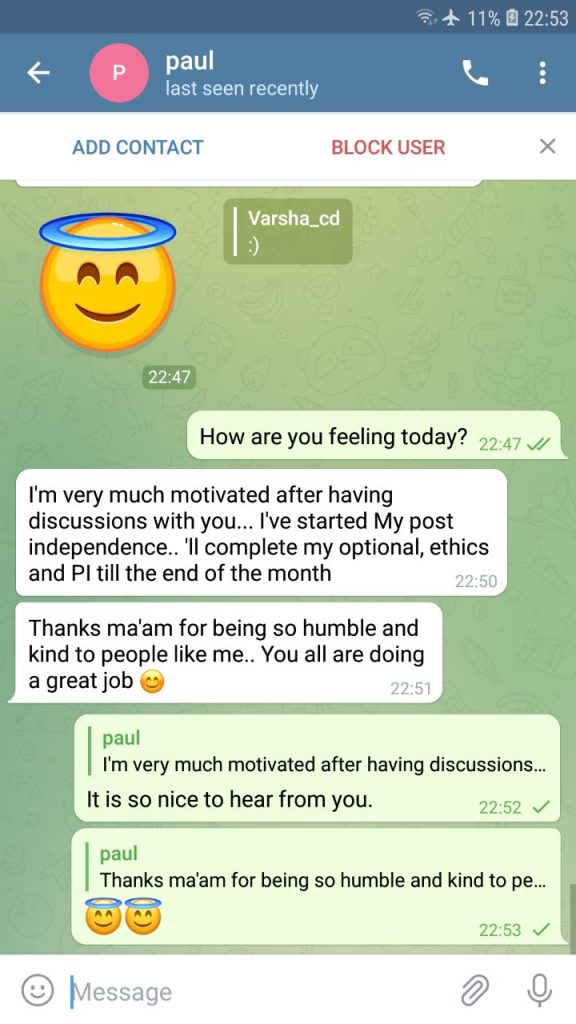
    Be it Telegram, Whatsapp or Habitiat channels, they are always available and clear student’s doubts in a turnaround time of 24 Hours.

    This image has an empty alt attribute; its file name is image-9-5.jpg

    Why Civilsdaily Mentors are the GPS for Your UPSC-CSE Preparation

    Remember there is always light at the end of the tunnel and if you want to get out of the tunnel you have to follow the direction of the light! Our mentors’ give you direction which is divided into daily modules. All you have to do is study and complete them on time.

    See the source image

    As every year passes by, we don’t get confident by the previous years’ performance and become laidback. Instead, we become more hungry to convert all our students into toppers.

    How are Current Civilsdaily Students Gearing up for UPSC-CSE 2022?

    Initially, our Civilsdaily student Smriti wasn’t confident about Prelims when she began her preparation. Though she had joined Civilsdaily in 2020, she started studying for UPSC-CSE back in 2019. At that time, Smriti had enrolled in multiple institutes. Though, most of these institutes had promised a personal mentor, she was unable to get in touch with them on a daily basis. Also those mentors never scheduled test-series on a weekly basis. Hence, despite preparing for a year, Smriti had scored only 35 marks out of 200 in her first test series by Civilsdaily.

    She then started writing 20-25 test series over the course of UAP 2021 and in her last test, her scores have drastically improved. She now scores in the range of 130-135 marks in prelims’ and 110+ in mains’ papers.

    In Smriti’s own words she describes her Samanvaya Mentorship Experience to be —

    Our parents provide us financial and emotional support, friends provide us moral support and the right mentor gives you logistic and logical support for UPSC. There are days when I felt I won’t be able to compete against lakhs of aspirants. That’s when my mentor, Ravi sir reminded me of my improvement and encouraged me that I can crack it with the same consistency. We need someone, who tells us we are performing well especially when we cannot see that ourselves. The mentorship at Civilsdaily helped me become mentally stronger as a person. In other institutes, mentors are allotted only for doubt resolution. But at Civilsdaily, I am getting end-to-end mentorship via value added notes, classes, test series and detailed evaluation.”

    Similarly our another Civilsdaily student, Ashish sums up his Samanvaya experience with Civilsdaily mentor, Pravin Sir, “Because of Pravin sir’s support, I am able to understand a topic in lesser time.”

    This image has an empty alt attribute; its file name is ashish.jpg

    This is how Pravin sir evaluates Ashish’s Mains Test Series every week. After every test series evaluation, Pravin sir schedules a 1 hour call to discuss how Ashish can improve his marks and the sources he can refer for key topics.

    It’s Your Turn Get the Free 40 Min Counselling Session By a CD Mentor

    Civilsdaily mentors are so dedicated, consistent and focused for your UPSC goal, that you will eventually become focused into turning your dreams to reality.

    This image has an empty alt attribute; its file name is a2d57403-4c49-462b-8459-b15e690ea928-1-461x1024.jpg

    At the core of Civilsdaily UPSC mentorship, lies the fact that each one of you will have a unique journey while preparing for the exam. Some will get through on the first attempt without much effort while others will take both more time and more effort.

    We want to understand you better to help you optimize your journey so you can focus on the right things and not waste time on the wrong ones. We are asking you to tap into the valuable experiences of mentors who underwent the same grind and realize the pitfalls and understand the shortcuts to make it.

    In the first counselling session, we will understand your weaknesses. We then help you to stick to one plan or strategy throughout your preparation. We will then follow up with you on a daily basis to check if you are right on track.

    This image has an empty alt attribute; its file name is photo1627364370-1024x1024.jpeg
    This image has an empty alt attribute; its file name is AAJ-.jpeg

More posts