💥Join UPSC 2027,2028 Mentorship (July Batch) + XFactor Notes & Microthemes PDF

Search results for: “”

  • [pib] Fortification of Rice

    The Cabinet Committee on Economic Affairs has approved supply of fortified rice in all States and Union Territories (UTs) by 2024 in a phased manner.

    What is the news?

    1. National Food Security Act (NFSA)
    2. Integrated Child Development Services (ICDS)
    3. Pradhan Mantri Poshan Shakti Nirman-PM POSHAN [erstwhile Mid-Day Meal Scheme (MDM)] and
    4. Other Welfare Schemes (OWS)

    Phases of implementation

    The following three phases are envisaged for full implementation of the initiative:

    1. Phase-I: Covering ICDS and PM POSHAN in India all over by March, 2022 which is under implementation.
    2. Phase-II: Phase I above plus TPDS and OWS in all Aspirational and High Burden Districts on stunting (total 291 districts) by March 2023.
    3. Phase-III: Phase II above plus covering the remaining districts of the country by March 2024.

    What is Fortification?

    • The Food Safety and Standards Authority of India (FSSAI) has explicitly defined fortification.
    • It involves deliberate increasing of the content of essential micronutrients in a food so as to improve the nutritional quality of food and to provide public health benefit with minimal risk to health.

    Types of food fortification

    Food fortification can also be categorized according to the stage of addition:

    1. Commercial and industrial fortification (wheat flour, cornmeal, cooking oils)
    2. Biofortification (breeding crops to increase their nutritional value, which can include both conventional selective breeding, and genetic engineering)
    3. Home fortification (example: vitamin D drops)

    How is fortification done for rice?

    • Various technologies are available to add micronutrients to regular rice, such as coating, dusting, and ‘extrusion’.
    • The last mentioned involves the production of fortified rice kernels (FRKs) from a mixture using an ‘extruder’ machine.
    • It is considered to be the best technology for India.
    • The fortified rice kernels are blended with regular rice to produce fortified rice.

    How does the extrusion technology to produce FRK work?

    • Dry rice flour is mixed with a premix of micronutrients, and water is added to this mixture.
    • The mixture is passed through a twin-screw extruder with heating zones, which produces kernels similar in shape and size to rice.
    • These kernels are dried, cooled, and packaged for use. FRK has a shelf life of at least 12 months.
    • As per guidelines issued by the Ministry of Consumer Affairs, Food and Public Distribution, the shape and size of the fortified rice kernel should “resemble the normal milled rice as closely as possible”.
    • According to the guidelines, the length and breadth of the grain should be 5 mm and 2.2 mm respectively.

    But why does rice have to be fortified in the first place?

    • India has very high levels of malnutrition among women and children.
    • According to the Food Ministry, every second woman in the country is anaemic and every third child is stunted.
    • Fortification of food is considered to be one of the most suitable methods to combat malnutrition.
    • Rice is one of India’s staple foods, consumed by about two-thirds of the population. Per capita rice consumption in India is 6.8 kg per month.
    • Therefore, fortifying rice with micronutrients is an option to supplement the diet of the poor.

    What are the standards for fortification?

    • Under the Ministry’s guidelines, 10 g of FRK must be blended with 1 kg of regular rice.
    • According to FSSAI norms, 1 kg of fortified rice will contain the following: iron (28 mg-42.5 mg), folic acid (75-125 microgram), and vitamin B-12 (0.75-1.25 microgram).
    • Rice may also be fortified with zinc (10 mg-15 mg), vitamin A (500-750 microgram RE), vitamin B-1 (1 mg-1.5 mg), vitamin B-2 (1.25 mg-1.75 mg), vitamin B-3 (12.5 mg-20 mg) and vitamin B-6 (1.5 mg-2.5 mg) per kg.

    Does fortified rice have to be cooked differently?

    • The cooking of fortified rice does not require any special procedure.
    • The rice needs to be cleaned and washed in the normal way before cooking.
    • After cooking, fortified rice retains the same physical properties and micronutrient levels as it had before cooking.

    What is India’s capacity for fortification?

    • At the time of the PM’s announcement last year, nearly 2,700 rice mills had installed blending units for the production of fortified rice.
    • India’s blending capacity now stands at 13.67 lakh tonnes in 14 key states, according to figures provided by the Ministry.
    • FRK production had increased rapidly from 7,250 tonnes to 60,000 tonnes within 2 years.

    How can a beneficiary distinguish between fortified rice and regular rice?

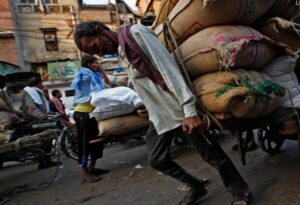
    • Fortified rice will be packed in jute bags with the logo (‘+F’) and the line “Fortified with Iron, Folic Acid, and Vitamin B12”.

    Advantages offered

    • Health: Fortified staple foods will contain natural or near-natural levels of micro-nutrients, which may not necessarily be the case with supplements.
    • Taste: It provides nutrition without any change in the characteristics of food or the course of our meals.
    • Nutrition: If consumed on a regular and frequent basis, fortified foods will maintain body stores of nutrients more efficiently and more effectively than will intermittently supplement.
    • Economy: The overall costs of fortification are extremely low; the price increase is approximately 1 to 2 percent of the total food value.
    • Society: It upholds everyone’s right to have access to safe and nutritious food, consistent with the right to adequate food and the fundamental right of everyone to be free from hunger

    Issues with fortified food

    • Against nature: Fortification and enrichment upset nature’s packaging. Our body does not absorb individual nutrients added to processed foods as efficiently compared to nutrients naturally occurring.
    • Bioavailability: Supplements added to foods are less bioavailable. Bioavailability refers to the proportion of a nutrient your body is able to absorb and use.
    • Immunity issues: They lack immune-boosting substances.
    • Over-nutrition: Fortified foods and supplements can pose specific risks for people who are taking prescription medications, including decreased absorption of other micro-nutrients, treatment failure, and increased mortality risk.

    Back2Basics: Public Distribution System (PDS)

    • The PDS is an Indian food Security System established under the Ministry of Consumer Affairs, Food, and Public Distribution.
    • PDS evolved as a system of management of scarcity through the distribution of food grains at affordable prices.
    • PDS is operated under the joint responsibility of the Central and State Governments.
    • The Central Government, through the Food Corporation of India (FCI), has assumed the responsibility for procurement, storage, transportation, and bulk allocation of food grains to the State Governments.
    • The operational responsibilities including allocation within the State, identification of eligible families, issue of Ration Cards and supervision of the functioning of FPSs etc., rest with the State Governments.
    • Under the PDS, presently the commodities namely wheat, rice, sugar, and kerosene are being allocated to the States/UTs for distribution.
    •  Some states/UTs also distribute additional items of mass consumption through PDS outlets such as pulses, edible oils, iodized salt, spices, etc.

    Mid-Day Meal Scheme

    • The Midday Meal Scheme is a school meal program in India designed to better the nutritional standing of school-age children nationwide.
    • It is a wholesome freshly-cooked lunch served to children in government and government-aided schools in India.
    • It supplies free lunches on working days for children in primary and upper primary classes in government, government-aided, local body, and alternate innovative education centers, Madarsa and Maqtabs.
    • The program has undergone many changes since its launch in 1995.
    • The Midday Meal Scheme is covered by the National Food Security Act, 2013.

    The scheme aims to:

    1. avoid classroom hunger
    2. increase school enrolment
    3. increase school attendance
    4. improve socialization among castes
    5. address malnutrition
    6. empower women through employment


    UPSC 2022 countdown has begun! Get your personal guidance plan now! (Click here)

  • What is Standing Deposit Facility (SDF)?

    The Reserve Bank of India (RBI) introduced the Standing Deposit Facility (SDF), an additional tool for absorbing liquidity, at an interest rate of 3.75 per cent.

    What is SDF?

    • In 2018, the amended Section 17 of the RBI Act empowered the Reserve Bank to introduce the SDF – an additional tool for absorbing liquidity without any collateral.
    • By removing the binding collateral constraint on the RBI, the SDF strengthens the operating framework of monetary policy.
    • The SDF is also a financial stability tool in addition to its role in liquidity management.
    • The SDF will replace the fixed-rate reverse repo (FRRR) as the floor of the liquidity adjustment facility corridor.
    • Both the standing facilities — the MSF (marginal standing facility) and the SDF will be available on all days of the week, throughout the year.

    How it will operate?

    • The main purpose of SDF is to reduce the excess liquidity of Rs 8.5 lakh crore in the system, and control inflation.
    • The SDF rate will be 25 bps below the policy rate (Repo rate), and it will be applicable to overnight deposits at this stage.
    • It would, however, retain the flexibility to absorb liquidity of longer tenors as and when the need arises, with appropriate pricing.
    • The RBI’s plan is to restore the size of the liquidity surplus in the system to a level consistent with the prevailing stance of monetary policy.

    Also read:

    What is Reverse Repo Normalization?

    UPSC 2022 countdown has begun! Get your personal guidance plan now! (Click here)


  • Who was Guru Nabha Dass?

    Punjab government has announced gazetted holiday on the birth anniversary of Guru Nabha Dass, a 16th century saint, taking it out from list of restricted holidays.

    Who was Guru Nabha Dass?

    • Guru Nabha Dass was born on April 8, 1537 at village Bhadrachalam on the bank of Godavari river in Khammam district, which falls in the present day Telangana.
    • He belonged to Mahasha also known as doom or dumna community, which is one of the Schedule Caste communities.
    • Since childhood, orphaned Guru Nabha Dass, whose original name was Narayan Dass, had an inclination towards spirituality.
    • Two religious gurus — Agar Dass and Keel Dass — who were passing through his village took the orphan child to a temple at Ghalta Dham, which is now main pilgrimage of Nabhadassias, at Jaipur.
    • People from this community are also known as Nabhadassias. They are known for making baskets and grain storage containers with bamboo.

    His legacy

    • Guru Nabha Dass wrote ‘Bhagatmal’ in 1585.
    • It has the life history of around 200 saints. He died in 1643.

    What is his connection with Punjab?

    • Guru Nabha Dass used to visit village Pandori in Gurdaspur district where people of Doom community live.
    • Some gurus of the community also used to live there.

    What made government announce gazetted holiday now?

    • Political parties can’t manage to ignore the sentiments of such a large community.
    • The community had been requesting the government to declare April 8 as a gazetted holiday since long.


    UPSC 2022 countdown has begun! Get your personal guidance plan now! (Click here)

  • All India Free Open Test on April 10th – Evaluate your Preparation before it’s too Late || Get Free Strategy Call After Test|| Hurry Up & Register Now

    All India Free Open Test on April 10th – Evaluate your Preparation before it’s too Late || Get Free Strategy Call After Test|| Hurry Up & Register Now

    First Nikaalo Prelims Open Test was an eye opener for many by highlighting your weak spots. Knowing WEAK AREAS in early stage of preparation can give you time to improve upon them. Hence, as promised we are conducting the 2nd All India Open Prelims Test under our mission Nikaalo Prelims 2022.

    GET READY TO EXPERIENCE THE COMPLETE EXAMINATION PATTERN!

    We are conducting both GENERAL STUDIES and CSAT test with high quality UPSC level questions along with Test Discussion.


    Click here to join Nikaalo Prelims Civilsdaily IAS Official space to Participate in the test discussion.

    Test date: 10th April 2022, Sunday

    TIME:

    GS 1: 9:30 am

    GS 2: 2:30 pm

    How our Prelims Test will help you?

    We at Civilsdaily understand the nuances of setting a paper. Through five cases explaining five questions, we’ll try to give you an idea about the varied difficulty level of prelims questions.

    These questions have been taken from the first test of Nikaalo Prelims All India Open Mock Test 2020 about Government Schemes and Policies.   

    CASE 1 – The oldest trick in the book. 

    DELIBERATELY CHANGING NAMES TO CONFUSE YOU. BE IT SCHEMES OR CONCEPTS. UPSC IS WELL KNOWN TO FLIP NAMES OF SIMILAR-SOUNDING SCHEMES AND CONCEPTS. LOOK AT THIS QUESTION. 

    Ques. Which of the following are the result areas of  STRIVE

    1. Improved performance of ITI.
    2. Improved and Broadened Apprenticeship Training.
    3. India International Skill Centers 

    Select the  correct answer from the  codes given below:

    a. 1 and 2 only

    b. 2 and 3 only

    c. 1 and 3 only

    d. 1 only

    Correct answer- 1 and 2 only

    In the above question, STRIVE has been used for SANKALP.  Both of them were announced at the same time for boosting Skill India Mission. It is very easy to get confused mark a wrong answer.

    CASE 2: Misleading names

    A LOT OF TIMES ESPECIALLY IN MATCH THE FOLLOWING TYPE OF QUESTIONS MISLEADING NAMES ARE USED. 

    Ques. Consider the following pairs:

       Schemes                          Objectives

    1. NIDHI: nurturing ideas and innovations into successful startups.
    2. SATYAM: rejuvenate research in yoga and meditation.
    3. MANAK: to help build a critical human resource pool for strengthening and increasing the research & development base.

    Which of the pairs given above are correctly matched?

    a. 1 and 2 only

    b. 2 and 3 only

    c. 1 and 2 only

    d. 1, 2 and 3

    Correct answer: 1, 2 and 3

    Misleading yet important names of initiatives under Ministry of Science and Technology have been used here. All pairs are correctly matched but it is very easy to get confused. 

    CASE 3: Are you rooted in society?

    UPSC has been playing with the expenditure figures and other such facts. It is done not only for the sole reason of checking your rote memory, but the ability to think in-depth about the issues faced by various sections. 

    Ques. With reference to ‘Kisan Urja Suraksha evam Utthaan Mahabhiyan (KUSUM) Scheme’, consider the following statements:

    1. The scheme provides for the installation of grid-connected solar power plants each of capacity up to 2 MW in the rural areas.
    2. The farmers will have to spend 50% of the total expenditure to acquire and install solar pumps.

    Which of the statements given above is/are correct?

    a. 1 only

    b. 2 only

    c. Both 1 and 2

    d. Neither 1 nor 2

    Correct answer: 1 only

    A very important scheme. The farmers have to tolerate only 10% of the total expenditure to acquire and install solar pumps. The Central Govt. will provide 60% cost while the remaining 30% will be taken care of by bank as credit. One must understand the inability of Indian farmers to spend 50% on solar pumps. This would have helped in eliminating options also.

    CASE 4: Going international.

    INTERNATIONAL COLLABORATION AND AID IN OUR SCHEMES AND POLICIES ARE RELEVANT. IF YOU EVER READ ABOUT THEM, KNOW THAT THE ISSUE IS OF CRITICAL IMPORTANCE FOR THE GOVERNMENT AND SOCIETY.

    Ques. With reference to Atal Bhujal Yojana, consider the following statements:

    1. It is a Centrally Sponsored Scheme with funding pattern of 50:50 between Government of India and states.
    2. This scheme is approved by the World Bank.

    Which of the following statements given above is/are correct?

    a. 1 only

    b. 2 only

    c. Both 1 and 2

    d. Neither 1 nor 2

    Correct answer: 2 only

    Here the Government of India’s collaboration with World Bank makes it important. Half of the financial contribution is from the World Bank in this initiative.

    Students must not ignore the contribution of international institutions especially if it is of such overwhelming nature.

    CASE 5: Core of the core

    YOU SHOULD BE ABLE TO REMEMBER THE BARE MINIMUM. THERE IS NO OTHER WAY IN SUCH QUESTIONS. YOU EITHER KNOW THEM OR YOU DON’T.

    Ques. Which of the following are the components of the National Social Assistance Programme (NSAP)?

    1. National Family Benefit Scheme (NFBS) 
    2. Annapurna.
    3. Indira Gandhi National Widow Pension Scheme (IGNWPS)

    Select the correct answer from the codes given below:

    a. 1 and 3

    b. 2 and 3

    c. 3 only

    d. 1, 2, and 3

    Correct answer: 1, 2 and 3

    The National Social Assistance Programme (NSAP) which came into effect from 15th August 1995, represents a significant step towards the fulfilment of the Directive Principles in Article 41 of the Constitution.

    It is a very important scheme under Ministry of Rural Development. Students are supposed to do flagship schemes of various ministries.

    WHAT IS NIKAALO PRELIMS?

    Mission Nikaalo prelims is a free fast-paced revision sequence to brush up your concepts for prelims. Major pillars of the programs are:

    1. Prelims SPOTLIGHT

    This initiative is meant to help you revise details and facts that can be asked in prelims. They are simplified, synthesized and prepared using most authentic sources. These can easily slip your mind or you can easily confuse these. Continuous Revision for the same is required. The themes picked up in the spotlight are not random but after analyzing and scrutinizing the PYQs of several years. Dare you to miss the updates!

    1. Static Subject Revision and Tests 

    Coverage and Relevance are the 2 Pillars of our Tests. Practicing tests is crucial part of Prelims preparation.

    3. Nikaalo Prelims Discussion on Civilsdaily IAS Official space

    All material, notes and doubt sessions will take place on Civilsdaily IAS Official Space.

    Click here to join Nikaalo Prelims Civilsdaily IAS Official space.

  • Target UPSC CSE 2023 – How to Get the Basics Right & Start the Preparation like a Topper? || Free Live Webinar By Rahul Sir|| Register Now

    Target UPSC CSE 2023 – How to Get the Basics Right & Start the Preparation like a Topper? || Free Live Webinar By Rahul Sir|| Register Now

    UPSC-CSE 2021 results have shaken the long held belief that the examination can only be cleared after multiple attempts. Most of the UPSC-CSE toppers like Satyam Gandhi (AIR 10), Ria Dabi (AIR 15), Yash Jaluka (AIR 4), Mamta Yadav (AIR 5) and Shashwat Tripurari (AIR 19) cleared the exam as fresh graduates in their very first attempt. How were they able to do it?

    If you watch their strategy videos, you can find a common pattern — they started 12-24 months in advance before the exam.

    One of the benefits of starting your preparation early is the time you would get to revise and practice test series upon completing the syllabus. Also, you would get ample time to pay attention to every subject. There are totally 9 papers in UPSC-CSE Mains and 2 papers in Prelims exams. Not to forget, the daily current affairs. Many aspirants need time to figure out how they can prepare in an understandable manner. That’s why starting your preparation eight months before the exam is not advisable.

    We understand how annoying it might be for you if you were to study in a certain way for months together and then realise that it doesn’t align with the UPSC-CSE way of doing things. So, what’s the best way to prepare?

    This is what Civilsdaily mentor Rahul sir would be discussing in the upcoming webinar.

    Webinar Details

    If you want to get the nuances of UPSC-CSE preparation right in the first go, then this free webinar is for you!

    Date: 9th April 2022

    Time: 8 PM onwards

    Key Takeaways of the Free Q&A Webinar

    1. What is the best book to refer for a topic in a subject? Based on 6 year paper analysis of UPSC-CSE.

    2. Recognise the UPSC demand. What types of test series are beneficial? What types of mock test series should be avoided?

    3. Ancient & Medieval History is becoming tougher every year. What shall be the ideal Strategy?

    4. Complete timeline of UPSC-CSE Preparation for a working professional.

    5. The art of making notes. What topics require notes and what topics don’t?

    6. Hard work in right direction vs Hardwork in wrong direction. Can only studying hard make you successful?

    7. Only two consolidated sources for Current Affairs. What are they?

    8. Normal, standard and frequent revision techniques. What are they?

    Rahul Sir will also hold a Q&A Session where beginners and veterans can clarify their doubts.

    Do not miss this opportunity to understand the nuances of UPSC preparation if you plan to appear in 2023.

  • (Imp) UPSC Interviews 2021 | As an interviewer will you recommend MK Gandhi for IAS?|Get your role play and situational questionnaire| Book your mock

    (Imp) UPSC Interviews 2021 | As an interviewer will you recommend MK Gandhi for IAS?|Get your role play and situational questionnaire| Book your mock

    Book your slot for UPSC Mock interviews (paneled by ex UPSC members) and get a dedicated mentor, on-call DAF analysis, DAF-based personalized questionnaire, and Situational questionnaire (FREE)

    UPSC Interviews for 2021 have begun and you will be facing much dreaded ‘Role play and Situational questions’ by the panel.

    While you know well that administration does not run on the whims and fancies of any individual administrator but is based on the authority vested in that post as per written schedules of power, there are other things you need to consider while answering these questions.


    Register and get your questionnaire

    As a part of Transcend Interview Guidance Program for UPSC 2021 we’ve prepared and compiled a high-quality comprehensive questionnaire. Register and Get it here

    This image has an empty alt attribute; its file name is WhatsApp-Image-2022-03-15-at-4.15.52-PM.jpeg

    Transcend Interview Guidance 2021: Program inclusion

    1. Mock interview and detailed analysis + feedback
    2. Most important issues coverage – current and structural
    3. DAF 2 curation
    4. Personalized mentorship
    5. DAF analysis and one-on-one sessions with mentors
    6. DAF based personalized questionnaire
    7. Situational and Roleplay questionnaire

    Do You Know That Civilsdaily Has a 75% Success Rate In UPSC Interview?

  • Criminal Procedures (Identification) Bill violates right against self-incrimination

    Context

    The Bill proposes to collect “measurements” of convicted persons, those who are arrested (or detained under preventive detention laws) or those who have executed bonds promising good behaviour.

    Dilution of right against self-incrimination

    • The Constitution, under Article 20(3), protects an accused from being compelled to give witness against himself.
    • This fundamental right has been diluted over the years.
    • In 2005, the Code of Criminal Procedure (CrPC) was amended to allow a magistrate to order any person to give their handwriting samples for the purpose of an investigation or proceeding.
    • In 2019, the Supreme Court, in Ritesh Sinha v. State of UP, held that such handwriting samples could include voice samples.
    • It relied upon its judgment in the Kathi Kalu Oghad case (1962) that held that giving palm impressions or footprints could not be called self-incriminatory because impressions were unchangeable, except in rare cases”.
    • Instead, it held that the Constitution bars the compulsory extraction of a statement — oral or written — from the accused, “which makes the case against the accused person at least probable, considered by itself”.

    Provisions in the Bill

    • While the databasing of convicted persons is not new, the new piece of legislation allows for taking information, including finger-impressions, palm-print impressions, footprint impressions, photographs, iris and retina scan, physical, biological samples and their analysis, behavioural attributes including signatures, handwriting or any other examination referred to in Sections 53, 53A of the CrPC.
    • It also mandates the National Crime Records Bureau to store, preserve and destroy the record of measurements at the national level as well as process and share them with any law enforcement agency.

    Issues with the Bill

    • Right against self-incrimination is unlikely to apply to technologies in use today.
    • Wide scope of under new technologies: The logic that was used in 1962 to interpret what would violate the right against self-incrimination is unlikely to apply to technologies in use today.
    • The Bill is vaguely worded and the nature of the processing, sharing, and dissemination of data it entails will most certainly involve the use of new and emerging technologies. 
    •  Their application to policing and the criminal justice system has new implications for the right against self-incrimination.
    • The compulsory submission of such information could have chilling effects after being subjected to new technologies – in other words, the past of an accused person might be enough to incriminate him.
    • Possibility of coercive data collection: The Bill proposes to collect “measurements” of convicted persons, those who are arrested (or detained under preventive detention laws) or those who have executed bonds promising good behaviour.
    • Only those arrested for petty offences that are punishable with less than seven years may not be obliged to allow the recording of measurements.
    • This rings a warning bell about coercive data collection, especially when seen in the light of the practices used to police oppressed communities.
    • For instance, under the Criminal Tribes Act, 1871, many nomadic and semi-nomadic communities were labelled hereditary criminals.
    •  Despite the Act being repealed in 1952, these denotified tribal (“Vimukta”) communities continue to be treated as criminals by birth through the “Habitual Offenders” provisions in state-level police regulations that allow local police stations to keep records of such persons residing in their area.
    • It condemns a section of the country’s population to several cycles of arrest, bail, and acquittal.
    • The new piece of legislation could make the practice of history-sheeting, undertaken when a person is merely alleged of a crime, and not convicted, even more coercive.
    • Long storage period and no clear process for destroying information: the “measurements” are to be stored at the national level for 75 years, with no clear procedure outlined for destroying the information.

    Conclusion

    The right against self-incrimination is at the heart of protection against police excess and torture. Record-keeping as mandated by the Bill violates this right. Parliament must make laws that protect against such blatant attacks on fundamental rights and freedoms, rather than enable them.

    UPSC 2022 countdown has begun! Get your personal guidance plan now! (Click here)

  • Russia suspended from UN Human Rights Council membership

    Russia’s membership to the Human Rights Council (UNHRC), to which it was elected in 2020, was suspended after the United Nations General Assembly (UNGA) vote.

    Why was Russia suspended from UNHRC?

    • Russia’s three-year term as member of the Council began on January 1, 2021.
    • With membership on the Council comes a responsibility to uphold high human rights standards.
    • It is this responsibility that Russia is alleged to have wilfully violated in Ukraine.

    India stayed absent. Why?

    • India questioned the process by which the move to suspend Russia took place given that it happened before the international probe into the massacre.
    • New Delhi’s point is that it should have been brought before the Human Rights Council first, and not the UNGA, sources said.
    • This is a signal to the West that due process has not been followed, something that Indian interlocutors can draw Moscow’s attention to.

    About UN Human Rights Council

    • The UNHRC is an inter-governmental body within the United Nations system, which is responsible for strengthening the promotion and protection of human rights around the world.
    • It addresses and makes recommendations on situations of human rights violations, and can discuss all thematic human rights issues and situations.
    • The UNHRC replaced the former UN Commission on Human Rights.
    • It was created by the UNGA on March 15, 2006, and the body met in its first session from June 19-30, 2006.

    Working of the Council

    In 2007, the Council adopted an “institution-building package” to set up its procedures and mechanisms. Among these were:

    1. Mechanism of Universal Periodic Review to assess the human rights situations in all UN Member States.
    2. It has Advisory Committee that serves as the Council’s think tank providing it with expertise and advice on thematic human rights issues.
    3. Its Complaint Procedure, allows individuals and organisations to bring human rights violations to the Council’s attention.
    4. The Council also works with the UN Special Procedures established by the former Commission on Human Rights, consisting of special rapporteurs, special representatives, independent experts etc.

    Membership of the Council

    • The Council, which meets at the UN Office in Geneva, Switzerland, is made up of 47 UN Member States who are elected by majority vote through a direct and secret ballot at the UNGA.
    • The membership of the Council is based on equitable geographical distribution.
    • African and Asia-Pacific states have 13 seats each, Latin American and Caribbean states have 8 seats, Western European and other states 7 seats, and Eastern European states 6 seats.
    • The members serve for three years and are not eligible for immediate re-election after serving two consecutive terms.

    Leadership of the Council

    • The Council has a five-person Bureau, consisting of a president and four vice-presidents, each representing one of the five regional groups.
    • They serve for a year each, in accordance with the Council’s annual cycle.
    • The Human Rights Council President of the 16th Cycle (2022) is Federico Villegas, who is the Permanent Representative of Argentina to the UN and other international organizations in Geneva.
    • He was elected president of the Human Rights Council for 2022 in December 2021.

    Meetings of the Council

    • The Human Rights Council holds no fewer than three regular sessions a year, for a total of at least 10 weeks.
    • These sessions take place in March (4 weeks), June (3 weeks) and September (3 weeks).
    • The Council met in its latest (49th) regular session from February 28 to April 1, 2022
    • If a third of the Member states requests, the Council can decide at any time to hold a special session to address human rights violations and emergencies.
    • Under the presidency of Nazhat S Khan of Fiji, the Council held a record five special sessions in 2021 — on Myanmar, the Occupied Palestinian Territory and Israel, Afghanistan, Sudan, and Ethiopia.


    UPSC 2022 countdown has begun! Get your personal guidance plan now! (Click here)