💥UPSC 2026, 2027, 2028 UAP Mentorship (March Batch) + Access XFactor Notes & Microthemes PDF

Search results for: “”

  • 14 July 2018 | Prelims Daily with Previous Year Questions and Answers

    Q.1) Consider the following statements about India’s, Repatriation of Prisoners Act in 2003:

    1. An offence committed abroad is also an offence in the home country and the sentence implemented upon transfer shall not be aggravated but may be deemed for further trial.
    2. It seeks to ease transfer process by leaving no obligations upon transferring and receiving states.

    Which of the given statements is/are correct?

    a)Both 1 and 2

    b)Only 1

    c)Only 2

    d)None of the above.

    Inspired by: Coming home to jail: on the Repatriation of Prisoners Act, 2003

    https://www.civilsdaily.com/news/coming-home-to-jail-on-the-repatriation-of-prisoners-act-2003/

    Q.2) Medipix is a-

    1. a)3D Computer Tomography Technique
    2. b)Ultrasound Spectroscope Technology
    3. c)X-Ray Technology
    4. d)3D Spectroscopy Imaging Technology

    Inspired by: [op-ed snap] The whole picture

    https://www.civilsdaily.com/news/op-ed-snap-the-whole-picture/

    Q.3) Consider the following statements about Proposed DNA Data Bank under DNA Based Technology (Use and Regulation) Bill, 2017:

    1. DNA Data will be held permanently but for repetitive offendors.
    2. There will be single storage database for all suspects, convicts etc.

    Which of the given statements is/are correct?

    a)Only 1

    b)Only 2

    c)None

    d)Both 1 and 2

    Inspired by: Proposed DNA bank will not store data permanently

    https://www.civilsdaily.com/news/proposed-dna-bank-will-not-store-data-permanently/

    Q.4) The National Green Tribunal is-

    1. Inspired from article 39A of the DPSP.
    2. It does not deal with matters related to damages to persons and property and for matters connected therewith.

    Which of the given statements is/are correct?

    Inspired by: NGT to hear pleas via videoconference

    https://www.civilsdaily.com/news/ngt-to-hear-pleas-via-videoconference/

    Q.5) With reference to Swachh Survekshan Grameen, 2018 , weightage to which of the following element is/are correctly matched?

    1. Direct Observation of sanitation in public places: 30%
    2. Citizen’s Feedback on sanitation parameters: 35%
    3. Service Level Progress on sanitation progress in the country as per SBMG- MIS: 35%

    Select the correct code from the following:

    a)All of the above

    b)1 and 2

    c)1 and 3

    d)2 and 3

    Inspired by: [pib] Ministry of Drinking Water and Sanitation Launches the Swachh Survekshan Grameen 2018

    https://www.civilsdaily.com/news/pib-ministry-of-drinking-water-and-sanitation-launches-the-swachh-survekshan-grameen-2018


    For Solutions – Click Here

    Prelims Daily Archive – Click here

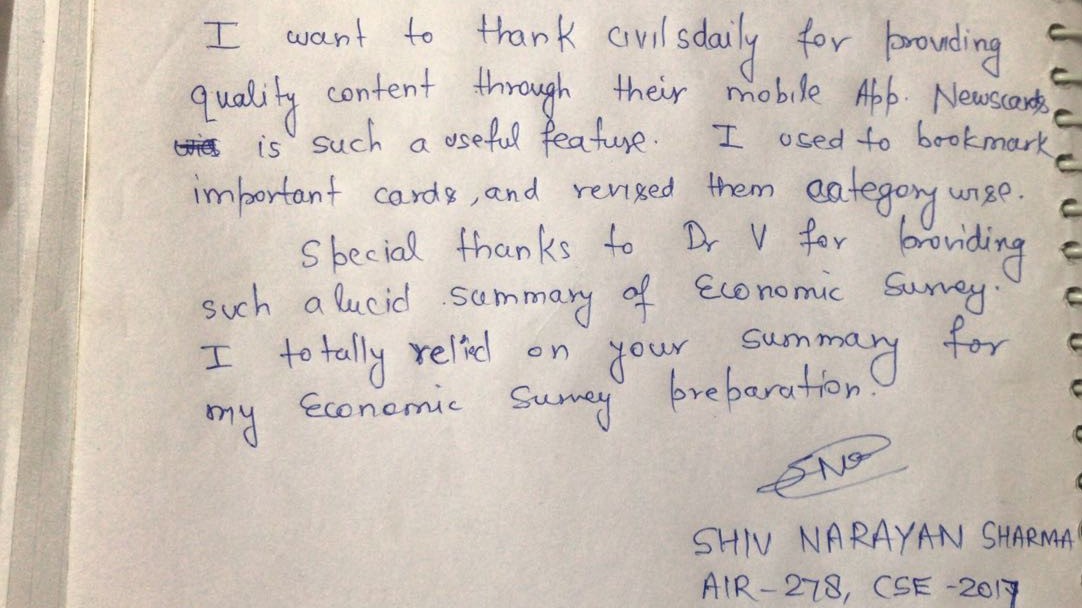
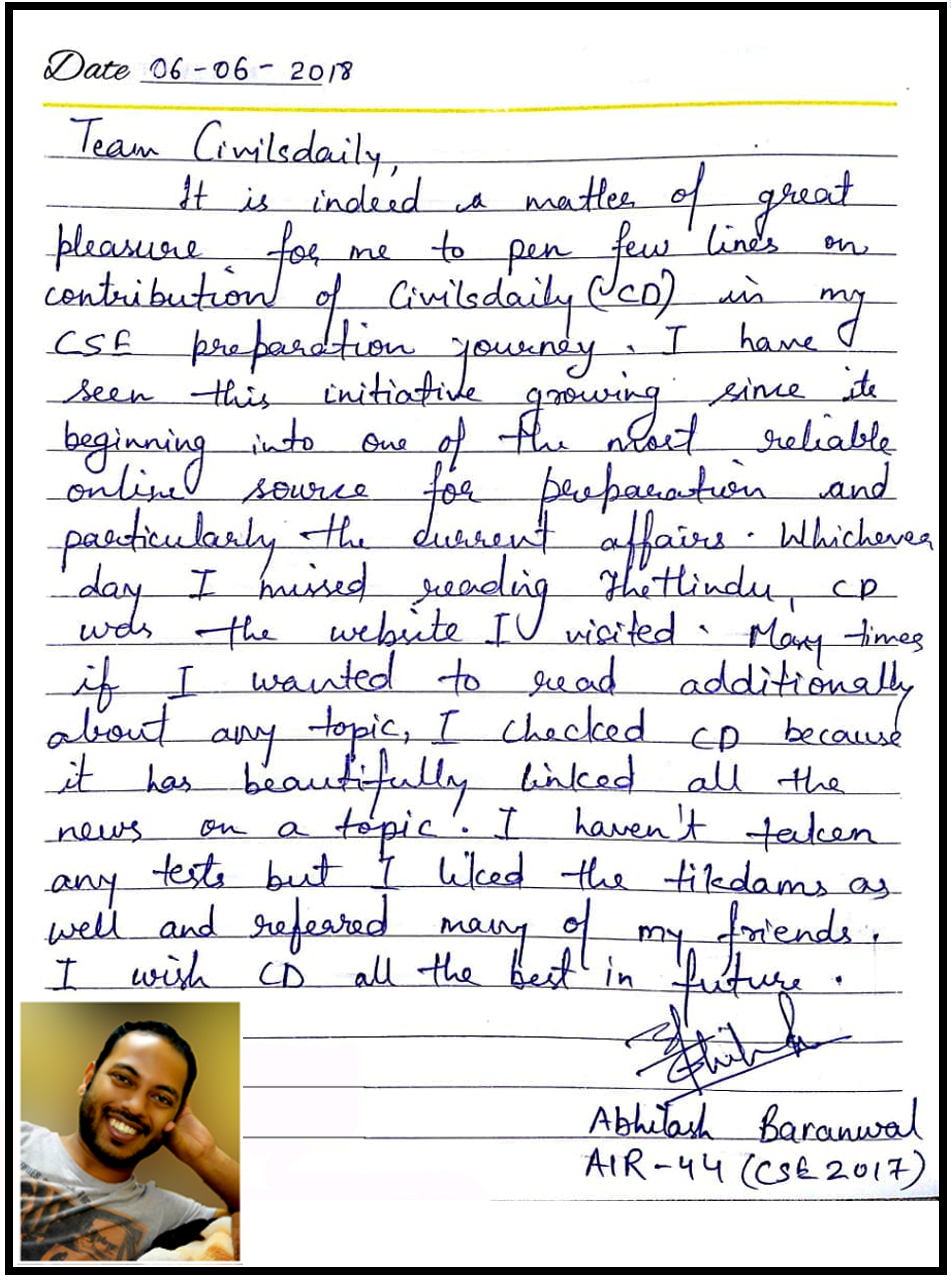
  • Topper Sessions and Testimonials

    2020

    Rank 2 UPSC CSE 2020 – JAGRATI AWASTHI recommends the rich quality of Civilsdaily IAS content for UPSC

    2017

    Rank 1 – DURISHETTY ANUDEEP recommends Civilsdaily as the primary source for current affairs in his personal blog 

    More here – https://www.civilsdaily.com/how-to-conquer-gs-in-upsc-mains-explained-by-anudeep-durishetty/

    Rank 2 – ANU KUMARI recommends Civilsdaily in her personal blog 

    Rank 56 – Dr.Suyash Chavan

    Mentions CD as the best app and best source for prelims.

  • How to conquer GS in UPSC Mains, Explained by Anudeep Durishetty (AIR-1, UPSC 2017)

    With 1000 marks spanning across four papers in Mains, GS feels like one giant, insurmountable mountain. The point of this article is to convince you that those fears are unfounded.

    I’ve written this post assuming someone who had already read the foundational books for GS Prelims. If you haven’t read them as yet, you should first read my post on GS Prelims. At the end of this article, I embedded download links to my complete GS notes and answer copies. There I had marked two particular answer booklets that accurately represent my writing style in Mains. I hope aspirants who are struggling with answer writing find them useful. I had also written previously about how to prepare for the Essay in this post.

    Marksheet

    As you start reading the books I mention here for GS mains, please keep the following points in mind:

    1. Along with these books, get a printout of the syllabus and read it carefully. Your final aim must be: for each topic mentioned in the syllabus, you should have enough content to write a 250-word answer.
    2. Go through the past five years’ question papers to understand the breadth and depth of questions UPSC usually asks. It’ll give you a good perspective of what’s important and what’s not.
    3. Use the internet extensively, especially for topics like Science and Tech. Your target must be to gain knowledge, be it through books or through the internet.
    4. For all subjects, you have to superimpose current affairs over it, especially for GS-2 and GS-3. For both these papers, current affairs form the nucleus. You will inevitably do a lot of reading on the internet, so use Evernote to organise and highlight content like this.
    5. Give adequate time for revision. Without it, you will not be able to recollect whatever you may have read. So please dedicate enough time to it, whether you are giving a mock test or the actual exam.
    6. Many aspirants commit one fundamental mistake: they read and revise, over and over, but never practice. Remember that the examiner checking your copy will have no idea about the number of books you’ve read or the number of hours you’ve slogged. Your answers are all that he has to judge you. So it makes sense to learn it, practice it and perfect it.
    7. Mains exam demands not only our memory and intelligence but also endurance. If you lack prior practice, writing relentlessly for 6 hours a day and do this for 5 days will cause both mental and physical fatigue. The only way to overcome it is to practice enough before the final exam.
    8. General Studies demands only a peripheral understanding of an expansive set of topics. So it’s important that you try to gain minimum sufficient knowledge over a diverse set of subjects rather than obsessively focussing on one topic. For instance, it doesn’t make sense to read World History for three months at the expense of all other subjects. Always maintain that fine balance between all the topics and don’t get imprisoned in one.
    9. In GS, there will be very few questions where you will have absolutely no clue. Even if you only have a vague idea, write those generic points. For instance, in last year’s GS-1 paper, for the question on Malay peninsula, I knew no specific fact except a vague idea that Singapore had a partition story similar to India. So I just wrote a generic answer comprising of problems such as ethnic strife, insurgency, and economic collapse. The examiner checking my copy might have given 2-3 marks for it, which I am sure any aspirant would gladly take.
    10. You must develop the skill to speed read a committee or an organisation’s report on your computer (reading online saves you a lot of time) and highlight important lines as you read along. In the second reading, this highlighted portion is what you need to revise. It should look something like this.
    11. In GS papers, map of India is your most effective tool for illustration. For example, I drew India maps and labelled relevant parts for questions on river linkage (GS-3), North-East insurgency (GS-3), Inland navigation (GS-1), India’s 18th-century fragmented polity (GS-1) etc. Practise it enough so that you are able to draw and label it under 60 seconds.
    12. If you are taking a test series, please give those tests with all the seriousness of the final UPSC exam. In the mock test, if you take 10-15 additional minutes to finish the paper, you are cheating no one except yourself. Observe strict time limits.
    13. You will never feel content with your Mains preparation and there is always a nagging tendency to just keep reading and procrastinate writing answers or skip an upcoming test. You have to overcome this reluctance through conscious effort. Suppose before a mock test if you were unable to finish the syllabus, you can postpone your test by a day or two, but don’t skip it altogether.
    14. Perfectionism is your enemy. If you keep referring to countless sources to make that “perfect notes”, if you keep postponing your mock tests in order to write “perfect tests”, this mentality will bring you to ruin. Getting a good score in Mains is about attempting all questions to which some answers are excellent, some good and many above average. So instead of waiting for that elusive perfection, start imperfect and then keep improving.
    15. When you are buying coaching material, always ask yourself: “what new is this material adding to my preparation?” If you can’t answer that question convincingly, then the material probably isn’t really useful.
    16. Just because I am AIR-1, it does not mean that my notes are the best or that this book list is the last word. If you have been studying some other material, that’s fine, too. To succeed in this exam, the source of material is not important. What’s important is you to understand the concepts, memorise the facts well and have a firm grip over the entire syllabus.


    Stiffer the climb, better the view.


    The list of books for GS Mains:

    GS 1

    Indian Art and Culture

    1. An Introduction to Indian Art – Class XI NCERT
    2. Chapters related to culture in Ancient and Medieval India NCERTs
    3. Centre for Cultural Resource and Training (CCRT) material
    4. Heritage Crafts: Living Craft Traditions of India -NCERT
    • For someone who is starting just now, this topic can overwhelm them. So I suggest beginners read this section after they get acquainted with other GS topics.
    • In Art and Culture, questions asked by UPSC in recent years are more analytical— which requires both the factual content and good analysis to answer the why and how. You can answer such questions well only when you understand the historical background in which such art was produced. This is why it’s important that you read NCERT XI Ancient India for it gives you that historical context.
    • For instance, don’t just memorise features of say, Sangam literature or Chola architecture, but understand the social, political, religious and economic context in which such grand art was produced. They will form the analysis part and will help you write great answers.
    • Make good use of the internet to watch both visual and performing arts to understand how they actually look in real life. You will be able to recollect such visuals more easily. They will help you write a decent answer for questions which you only have a vague idea about.
    • Wherever relevant, draw diagrams to illustrate your answers. For instance, you can draw a rough sketch to show the features of a Stupa, Dravida, and Nagara style architecture, Paleolithic art, Folk arts such as Warli, Harappan pottery etc. You don’t need to be a Michelangelo for this, but you must ensure that the fundamentals are correct. For example, in Warli art, human bodies are represented by triangles, heads by circles and hands by simple lines. Just get these basics right. Link to download diagrams is given at the end of the article.
    • Art and Culture requires a ton of memorisation and there’s really no shortcut to mastering it except through multiple revisions.

    Modern Indian History

    1. A Brief History of Modern India- Spectrum Publications
    2. India’s Struggle for Independence – Bipan Chandra (Read selectively for topics not covered in the Spectrum book)
    • Questions on Indian history are something that every serious aspirant will answer well, so you really cannot afford to let go of these questions. If you had done your prelims preparation for this topic well, that is good enough. You just need to practise answer writing.

    India’s Post Independence History

    1. India Since Independence by Bipan Chandra
    2. For certain topics, I made notes from this book. Download link is given at the end.

    World History

    • I prepared entirely for this topic from this outstanding book: Download
    • Since revising this big book before the exam was difficult, I prepared concise notes from it. I also practised maps to demonstrate major world historical events.
    • Link to download my notes and maps is given at the end of the article.

    Geography

    • The study plan is the same as for prelims, which I’ve explained here.

    Indian Society

    • This is a generic, nebulous topic with no style or structure. Questions are sometimes vague, philosophical and the challenge we face is not so much in lack of content as in presenting it concisely in 200 odd words. To understand the basics, read NCERT Sociology Std XI and XII. Make concise notes on each topic that includes: a crisp definition, latest statistics, govt schemes, criticism of these schemes; causes of issues such as communalism and regionalism, historical and current examples, their impact on our society, and your suggestions as the way ahead. (you can get these suggestions from the internet or ARC 2 or some committee report). In case if you find good coaching material for these topics, that’ll do as well.
    • For this topic, a generic answer with proper structure and subheadings that cover multiple dimensions is good enough to fetch you marks. You can find my notes at the end of the article.


    GS 2

    Polity, Governance and Social Justice

    Static Portion:

    1. Laxmikanth
    2. Polity Notes (this will provide analytical content. Download link is given at the end of the article)
    3. ARC 2 (One of the best reports ever written for the government. It’s been more than ten years since the reports were published, but the content is still priceless. Read complete reports, memorise only recommendations)

    Current Affairs:

    1. The Hindu
    2. The Big Picture on RSTV
    3. CivilsDaily current affairs material
    4. I also referred to Insights/ForumIAS current affairs material for topics not covered well by CivilsDaily
    5. PRS India for latest legislation
    6. All India Radio – Spotlight (used to listen during my commute to the office)
    • Open your answers with Constitutional articles. Question on Governor? Art 153 must be there in the first line. Question on Civil Services? Art 312 is where you begin. If there’s a technical term like ‘Parliamentary Sovereignty’, ‘Political democracy’ or ‘Social Audit’ — define them in your introduction telling the examiner what you understand by those terms.
    • Supreme Court judgements are very important. Make a list of important judgements (both historical and current) and quote them to substantiate your answer. For example, when you are answering a question on Free speech, quoting SC judgement in Shreya Singhal vs Union of India case will add tremendous value to your answers.
    • For a debatable topic, always write both sides of the issue even if not explicitly asked in the question. Example: A question might ask: Do you agree that Civil Services is in need of drastic reforms? For this, explain under a subheading why drastic reforms are needed. And in the next paragraph, counter by saying why drastic reforms are harmful. In the end, you can add the view of ARC 2/Hota/Surendranath committee to convey your view and end on a balanced note.
    • For miscellaneous topics like the comparison of Constitutions, RPA Act, SHG, e-Governance etc refer to any good coaching material to have 200-word worth content. Source latest examples and issues from newspapers and quote them in your answers.
    • Prepare thoroughly on Govt policies and bills. PRS India is an excellent resource for all the latest legislation in the offing and The Hindu for policy criticism. But the newspaper is patently leftist and they publish articles incessantly and nauseatingly ranting on policies they don’t like (Eg: Aadhar). But as someone aspiring to be a civil servant, you need to be more dispassionate. This is why you must actively pursue articles with a contrarian and balanced opinions like this and this.
    • Cram latest statistics pertaining to health, employment, education, poverty etc. Also apart from committees, you may quote authentic reports from reputed organisations such as Lancet, Transparency International, UNICEF, FAO etc to substantiate your point. I made notes on important statistics that can be used for all papers of GS and essay. Download link is given at the end of the article.
    • Conclusion: Wherever possible, end with a committee/ commission recommendation or observation. For instance, a question on Centre-State relations should invariably end with Punchhi Commission, a question on death penalty with Law Commission and a question on Indian Constitution with NCRWC. Referring to Sustainable Development Goals, Preamble, DPSP is also another good way to end your answers.

    International Relations

    • Any good book that adequately covers the historical aspect of India’s bilateral relations.
    • Current affairs: The Hindu, India’s World on RSTV, CivilsDaily or Insights or ForumIAS depending upon the topic.
    • Questions on IR will be almost, always be about the current happenings in the world. But before you run after the Hindu or some other latest magazine for this section, it’s important that you understand the historical background of India’s relationship with other countries. This is indispensable because every bilateral issue that you see in the news can be traced back to history. Once you understand this historical context, this topic becomes uncomplicated.
    • For example, let’s take India China relations. Don’t merely focus on Doklam crisis and troop positioning, but understand the larger context of our border dispute with China, the agreements we had signed starting with the Simla Accord of 1914. For India-Sri Lanka, don’t just concentrate that India voted for or against Sri Lanka at the UN, but understand how India always championed peace between the Tamils and the Sinhalese, the 1987 accord, its fallout, Sri Lankan civil war and what India did during these times. When you have that bigger picture in mind, each part of the puzzle becomes easier to fit in.
    • For miscellaneous topics like diaspora and international institutions, refer to any good coaching material.
    • Draw map wherever relevant. Example: for India-Iran relations, you can draw a rough map to show how the Chabahar port helps us to bypass Pakistan and reach Afghanistan. Act East policy can be demonstrated with arrows pointing from India and showing our specific relationship with Vietnam, Japan, South Korea, Singapore, Australia and ASEAN, MGC, BIMSTEC etc.,
    • Each bilateral relationship or a global grouping is multi-faceted. To make your answers comprehensive, always write a multidimensional perspective that includes: the strategic dimension, defence co-operation, technology, education, culture, diaspora, trade and investment, co-operation in global fora etc.

    GS 3

    Economy

    Static part:

    1. Standard resources I already mentioned in my prelims post
    2. Budget (any coaching material compilation)
    3. Economic Survey (gist)
    4. Niti 3-year Action Plan report (a good resource for policy recommendations that come in handy while you write conclusion)

    Current Affairs:

    1. The Hindu
    2. CivilsDaily
    3. I referred to Insights/ForumIAS current affairs material for topics not covered well by CivilsDaily

    Indian Agriculture, Land reforms, PDS, Food Processing, LPG, Infrastructure

    1. Mrunal.org
    2. Vision IAS
    3. The Hindu and CivilsDaily for current affairs
    • You need to remember that for GS-3, questions revolve around current affairs and there is no dearth of material. It may sound counter-intuitive, but the trick is to restrict yourself to material that’s good enough for you to write a 250-word answer for all topics. It’s very important that you don’t get sunk under the heap of current affairs and coaching material.
    • So for each topic mentioned in the syllabus, make concise notes from the resources mentioned above. I also found Niti Aayog’s 3-year Action Plan report really helpful for this paper. And just as I had mentioned for GS-2, statistics and committee reports are very important.

    Security

    • Vajiram and Vision IAS material
    • The Hindu and CivilsDaily for current affairs
    • Prepare crisp and clear definitions of technical terms such as cybersecurity, terrorism, organised crime, money laundering, left-wing extremism etc.
    • For questions on border security, draw India map to illustrate.

    Disaster Management

    • Fundamental reading: CBSE book
    • Prepare concise notes on NDMA (structure, functions, rules etc), international agreements such as Sendai Framework, latest current affairs from newspapers, internet and coaching material.
    • Draw diagrams to illustrate concepts like river embankment, land zoning, watershed management etc.

    Environment and Ecology

    • Shankar IAS book
    • The Hindu and CivilsDaily for current affairs
    • My handwritten notes (Download link given at the end)

    Science & Tech

    1. The Hindu
    2. Vision IAS Mains 365
    3. YouTube
    • This topic terrifies many aspirants, and for good reason. There’s no single book or resource to help one navigate this section and it all feels like one big haze. But there’s good news: the questions asked in S&T are mostly from current affairs and you are expected to have only a general understanding of the topics.
    • During my preparation, I used to note down in my book whatever scientific term or technology that’s frequently talked about in news. For instance, these days we repeatedly encounter terms such as Artificial General Intelligence, Blockchain, Machine Learning, Cryptocurrency, CRISPR-CAS9 in news and on the internet.
    • Note down all such scientific concepts that are in news and then scour the internet (especially Youtube) to understand them. There are many explainer videos on Youtube that explain the concept so well that even a school student can understand it. For instance, take this excellent video on blockchain technology. Once you see it, it’s impossible for you to miss a question on blockchain and its practical applications.
    • Apart from the above, you need to learn fundamental terms and technologies used in Space (PSLV, GSLV, Cryo Engine etc), Nanotech, Nuclear Research (Fast breeder reactor, Uranium enrichment, Nuclear fission and fusion etc.), Defence (Cruise missile, Ballistic missile, Stealth Bomber etc), Biotech (Gene editing, Stem Cells, GM food etc), Communication (LIDAR, RADAR, LiFi, 5G etc). Any comprehensive material of a coaching institute will be sufficient for this (I referred to Vajiram printed notes).
    • Whatever S&T topic you are learning, always focus on the concept, why is it in news, practical applications, potential threats, benefits far into the future etc. Just do this and you will easily handle this topic in the final exam.

    GS 4

    • 2nd ARC reports: Ethics in Governance, Promoting E-gov, RTI, Citizen-centric Administration, Personnel Administration. Read all ARC reports completely, memorise only recommendations.
    • For moral thinkers, Google them to read about their major contributions and for misc topics such as corporate governance, I referred to Vajiram printed material. I also prepared some notes for certain topics (download link at the end of the article)
    • I went through the syllabus and tried to define each term in clear words and simple sentences. I found this exercise very useful because these definitions inevitably formed the introduction to most of my answers. For all of ethics paper, the essence can be distilled as just this: a clear and simple definition of the term and a real-life example to illustrate the concept. You can draw flowcharts and schematics wherever apt.
    • It’s important to understand that each question is an opportunity to display your ethics. This will be best demonstrated by the actions you did or some other personalised/ real-life examples you quote. Reflect on your childhood, school life, college time, professional career etc and glean examples that are simple, unpretentious and at the same time bring out your ethical values clearly. For some questions, you can also quote historical examples from the lives of great leaders.
    • For case studies, my aim was not so much in writing ingenious, extraordinary solutions, but to write something that’s realistic and practicable and finish the paper no matter what.
    • I always started with Q1 and not with case studies because I could not see how one mark in Section B (case studies) is superior to one mark in Section A. I gave equal importance and dedicated equal time to both the sections.
    • Rest of the GS papers have 20 questions each, Ethics has only 14. But don’t let that number 14 fool you. I’ve always found GS-4 to be the lengthiest paper of all. Every question in Section A has many subparts that drain an inordinate amount of your time. In fact, if we go by the absolute numbers, we write more words in GS-4 than in other papers. So to manage your time well: Abide by the rule that you must complete at least 80 marks worth of questions in each hour, irrespective of whether you start with Section A or Section B.
    • Just before GS-4, you would have had written three stressful GS papers that would put your body condition under severe mental and physical strain. But it’s important to stay mentally tough during this crucial period and push your endurance limits so as to survive another 3 hours of relentless writing. Remember that it’s all in the mind— it can be your biggest enemy or your greatest strength.


    My Notes

    GS 1

    GS 2

    GS 3

    GS 4

    Misc

    Essay

    My GS Answer Copies

    GS 2

    GS 3

    GS 4

    Essay

    GS may look insurmountable at first, but remember that it’s always the small steps towards the summit that count. Through effective planning and adequate practice, anyone can conquer it.

    My best wishes.

    Until next time,
    Anudeep.


    Read the Blog here

  • Prelims 2018 Results Out : Check Here

    UPSC has declared the results for Civil Services Examination 2018.

    Check the result here : Click2Check

  • [Prelims Spotlight] National Green Tribunal, DNA Based Technology (Use and Regulation) Bill, 2017, East Asian Summit


    Here are  Back2Basics collections from today’s news items

    B2B #1: From news- NGT to hear pleas via videoconference

    National Green Tribunal

    1. The National Green Tribunal has been established in 2010 under the National Green Tribunal Act 2010.
    2. It draws inspiration from India’s constitutional provision of Article 21, which assures the citizens of India the right to a healthy environment.
    3. It aims for effective and expeditious disposal of cases relating to environmental protection and conservation of forests and other natural resources including enforcement of any legal right relating to the environment and giving relief and compensation for damages to persons and property and for matters connected therewith or incidental thereto.
    4. It has Original Jurisdiction on matters of “substantial question relating to environment” and & “damage to the environment due to specific activity” (such as pollution).
    5. It follows principles of Natural Justice

    B2B #2: From news- Proposed DNA bank will not store data permanently

    DNA Based Technology (Use and Regulation) Bill, 2017

    1. DNA technology is being increasingly relied upon in investigations of crime, identification of unidentified bodies, or in determining parentage.
    2. It seeks to establish regulatory institutions and standards for DNA testing, and supervise the activities of all laboratories authorised to carry out such tests.
    3. It prohibits the collection of any “bodily substance” from an arrested individual (for the purposes of a DNA test) without his/her consent, except if the individual is arrested for certain specific offences.
    4. The penalty for misuse of data remains a prison term of up to three years and a fine up to Rs 1 lakh, a reference to a minimum prison term of one month has been removed.
    5. The Bill seeks to set up two new institutions — a DNA Profiling Board and a DNA Data Bank.
    6. The Board, with 11 members, is supposed to be the regulatory authority that will grant accreditation to DNA laboratories and lay down guidelines, standards and procedures for their functioning.
    7. A national databank of DNA profiles is proposed to be set up, along with regional databanks in every state.

    Here’s a Factoid to brush up your concepts

    Name : East Asian Summit

    Brief Intro : The East Asia Summit (EAS) is a forum held annually by leaders of, initially, 16 countries in the East Asian, Southeast Asian and South Asian regions. Membership expanded to 18 countries including the United States and Russia at the Sixth EAS in 2011.

    Objective : It is formed to promote the objectives of regional peace, security, and prosperity. It has played an indicative role in the strategic, geopolitical and economic evolution of East Asia.

    Type : Summit/ Conference

    Category : Diplomacy

    Year : 2016

    Importance (wr. Prelims) : High

    Place : Laos

  • 13 July 2018 | Prelims Daily with Previous Year Questions

    Q.1) Sendai Framework is based on –

    a)Rehabilitation of Refugees

    b)Disaster Risk Reduction

    c)Repatriation of Children

    d)Extradition of Criminals

    Inspired by: [op-ed snap] Spirit Of Sendai

    https://www.civilsdaily.com/news/op-ed-snap-spirit-of-sendai/

    Q.2) Taper Tantrum was the term first used in the context of which of the following economies?

    1. a)USA
    2. b)Japan
    3. c)China
    4. d)European Union

    Inspired by: Rescuing the rupee: A peek into the RBI’s arsenal

    https://www.civilsdaily.com/news/rescuing-the-rupee-a-peek-into-the-rbis-arsenal/

    Q.3) Consider the following statements with respect to International Comparison Program (ICP):

    1. It was hosted by WTO.
    2. India emerged as the world’s third-largest economy in ‘2011’ from being the tenth largest in 2005 according to the report.

    Which of the given statements is/are correct?

    a)Only 1

    b)Only2

    c)Both 1 and 2

    d)None

    Inspired by: India became third largest economy in 2011

    https://www.civilsdaily.com/news/india-became-third-largest-economy-in-2011/

    Q.4) Consider the following statements with respect to farm loan waivers by some states in India:

    1. These have a dampening impact on rural credit institutions
    2. Waivers do not impact tax revenues.
    3. They vitiate credit culture and dis-incentivise borrowers to repay loans, thus engendering moral hazard

    Which of the statements given above is/are correct?

    a)Only 3

    b)1 and 3

    c)2 and 3

    d)1, 2 and 3

    Inspired by: RBI flags States’ fiscal stress

    https://www.civilsdaily.com/news/rbi-flags-states-fiscal-stress/

    Q.5) Mycology is the study of-

    a)Algae

    b)Fungi

    c)Mushrooms

    d)Pigments

    Inspired by: Pigment in Goa mushroom may help fight cancer

    https://www.civilsdaily.com/news/pigment-in-goa-mushroom-may-help-fight-cancer/


    Prelims Daily Archive – Click here

  • 13 July 2018 | High Relevance vs Low Relevance News , Govt. Posters for easy recall

    Reading News for UPSC is utmost important and rising number of questions year on year in UPSC Prelims is a testimony of this

    We are starting a daily series where we will analyze news covered in The Hindu, Indian Express and other newspapers which are important from exam perspective and which are not

    Important news would have been covered in our daily news coverage in form of newscards.

    Unimportant ones will be mentioned here and a short description regarding why it is not relevant for the exam

    Click on news headlines to read the full news

    High relevance news

    [op-ed snap] Spirit Of Sendai

    https://www.civilsdaily.com/news/op-ed-snap-spirit-of-sendai/

    Very good editorial highlighting vulnerabilities of India & Asia and how to mitigate disaster risks. Read and use points in Mains

    [op-ed snap] India needs to focus on water efficiency

    https://www.civilsdaily.com/news/india-needs-to-focus-on-water-efficiency/

    India is facing an acute water crisis and the editorial highlights the fact and suggests solutions. Useful for Mains

    Failure to educate girls could cost world $30 trillion a year: World Bank report

    https://www.civilsdaily.com/news/failure-to-educate-girls-could-cost-world-30-trillion-a-year-world-bank-report/

    Girls are still away from primary as well as secondary education. This is impacting their lifestyle as well as growth prospects. Know the reasons and solutions. Can be quoted in Mains.

    India became third largest economy in 2011: World Bank

    https://www.civilsdaily.com/news/india-became-third-largest-economy-in-2011-world-bank/

    With reports surfacing of India becoming world’s 6th largest economy, various debates on this tag’s utility and importance have started.

    World Bank report claims that India achieved a better feat in 2011 itself.  Read about ICP from the news as it can be asked in Prelims.

    Low Relevance News

    Homosexuality not an illness: Indian Psychiatric Society

    The Indian Psychiatric Society (IPS) has said it is “time to stop looking at homosexuality as a mental illness”, stating that the there is no scientific evidence that sexual orientation can be altered by any treatment

    Nothing important in news from UPSC perspective

    India to ease visa curbs for Bangladesh citizens

    India will sign a pact with Bangladesh to ease visa restrictions for citizens from the neighbouring country. The Memorandum of Understanding (MoU) on “revised travel arrangements” will be signed during Home Minister’s three-day visit to Dhaka

    No important points from exam perspective


    Govt. Poster for easy recall


  • [Prelims Spotlight] International Comparison Program (ICP), Ajivika


    Here are  Back2Basics collections from today’s news items

    B2B #1: From news- India became third largest economy in 2011: World Bank

    International Comparison Program (ICP)

    1. ICP is a partnership of various statistical administrations of up to 199 countries guided by the World Bank
    2. The main partners of this program are the World Bank, IMF, UN, ADB, OECD, CISSTAT, Eurostat, AfDB ESCWA, ECLAC, DFID, ABS, IDB, NMoFA who are also all part of the executive board
    3. The Program produces internationally comparable price and volume measures for gross domestic product (GDP)
    4. Its component expenditures are based on purchasing power parities (PPP’s)
    5. The International Comparison Program holds surveys collecting price and expenditure data for the entire range of final goods and services at intervals of some few years (the last two were separated by six years)
    6. The ICP tries to make different countries GDPs comparable by calculating them in PPP both currency converters and spatial price deflators
    7. The ICP has published its PPP results eight times so far – the first time for 1970 (a preliminary study for 1967 was also carried out) and the latest for 2011

    Here’s a Factoid to brush up your concepts

    Key words related to History : Ajivika

    Dynasty/era : Buddha period

    Meaning : A heterodox sect of the time of the Buddha

  • 12 July 2018 | High Relevance vs Low Relevance News , Govt. Posters for easy recall

    Reading News for UPSC is utmost important and rising number of questions year on year in UPSC Prelims is a testimony of this

    We are starting a daily series where we will analyze news covered in The Hindu, Indian Express and other newspapers which are important from exam perspective and which are not

    Important news would have been covered in our daily news coverage in form of newscards.

    Unimportant ones will be mentioned here and a short description regarding why it is not relevant for the exam

    Click on news headlines to read the full news

    High relevance news

    Telecom Commission approves net neutrality, new telecom policy

    https://www.civilsdaily.com/news/telecom-commission-approves-net-neutrality-new-telecom-policy/

    Net neutrality has been a hot topic for a long time and has been finally culminated by the government with a decision in favour of it. Read all details since policies are being asked in Mains.

    Govt. seeks help to end manual scavenging

    https://www.civilsdaily.com/news/govt-seeks-help-to-end-manual-scavenging/

    Read about MGISC. Can be asked in Prelims.

    World Population Day: What ails the Youth of India

    https://www.civilsdaily.com/news/world-population-day-what-ails-the-youth-of-india/

    Stress level is rising among youth and there is a rising concern about unemployment too. Note all these points and quote them in Mains answers as well as Essay paper.

    North India’s obsession with the male child remains unchanged

    https://www.civilsdaily.com/news/north-indias-obsession-with-the-male-child-remains-unchanged/

    Despite the government’s direct and indirect interventions, female foeticide has continued and Indian parents wish for a male child still remains the same.

    Note the points quoted in news.

    Low Relevance News

    SC slams Lieutenant Governor for ‘inaction’ against ‘mountains of garbage’

    The Supreme Court has said “mountains of garbage” in Delhi indicate that the city is facing a grave situation and slammed the Lieutenant Governor (LG) for not taking appropriate action on the issue of solid waste management

    Nothing important in news from exam perspective

    Aadhaar must for health mission cover

    The government has mandated the use of Aadhaar card for administering its massive Ayushman Bharat, or National Health Mission, that assures a ₹5 lakh health cover to 10 crore families

    Possessing an Aadhaar card isn’t mandatory to avail services, a proof of enrolment, or request for enrolment, is mandatory

    No important points from exam perspective.


    Govt. Poster for easy recall


  • [Prelims Spotlight] International Service for the Acquisition of Agri-Biotech Applications (ISAAA), Mahatma Gandhi International Sanitation Convention, Beti Bachao, Beti Padhao (BBBP), Aditya-L1

    Here are  Back2Basics collections from today’s news items

    B2B #1: From news- India’s genetically modified crop area fifth largest in world

    International Service for the Acquisition of Agri-Biotech Applications (ISAAA)

    1. ISAAA is a non-profit international organization that shares agricultural biotechnology, focusing on genetic engineering
    2. ISAAA documents approved GM crops worldwide and present them in a database available in the organization’s website
    3. The Global Knowledge Center on Crop Biotechnology is the information network of ISAAA
    4. The organization releases an annual publication on the global status of commercially approved genetically engineered crops
    5. The ISAAA receives funding from both public and private donors

    B2B #2: From news- Govt. seeks help to end manual scavenging

    Mahatma Gandhi International Sanitation Convention

    1. It will be held in Delhi from September 29 to October 2
    2. Ministers from over 70 countries will be invited and taken on a ‘Gandhi Trail’ in Gujarat
    3. The government will use the occasion to “showcase its performance” and “success story” in the Swachh Bharat programme in the past four years, which was launched on October 2, 2014, and have a face-to-face dialogue with the world leaders to share their experiences on sanitation programmes
    4. The Foreign Ministry will coordinate this mega exercise along with the Ministry of Drinking Water and Sanitation

    B2B #3: From news- North India’s obsession with the male child remains unchanged

    Beti Bachao, Beti Padhao (BBBP)

    1. It is a campaign of the Government of India that aims to generate awareness and improve the efficiency of welfare services intended for girls. The scheme was launched with an initial funding of ₹100 crore.
    2. It mainly targets the clusters in Uttar Pradesh, Haryana, Uttarakhand, Punjab, Bihar and Delhi.
    3. It aims to address the issue of declining Child Sex Ratio (CSR) through a mass campaign across the country targeted at changing societal mindsets & creating awareness about the criticality of the issue.
    4. The Scheme will have focused intervention & multi-sectoral action in 100 districts with low Child Sex Ratio.
    5. This scheme is a joint initiative of Ministry of Women and Child Development, Ministry of Health and Family Welfare and Ministry of Human Resource Development.
    6. These guidelines cover the key elements of the scheme including enforcement of Pre-Conception & Pre Natal Diagnostic Techniques (PC & PNDT) Act, awareness and advocacy campaign and multi-sectoral action in select 100 districts which are low on Child Sex Ration (CSR).

    Here’s a Factoid to brush up your concepts

    Name : Aditya-L1

    Details : It is India’s first solar mission. It will study the sun’s outer most layers, the corona and the chromospheres and collect data about coronal mass ejection, which will also yield information for space weather prediction. Significance of the mission: The data from Aditya mission will be immensely helpful in discriminating between different models for the origin of solar storms and also for constraining how the storms evolve and what path they take through the interplanetary space from the Sun to the Earth. Position of the satellite: In order to get the best science from the sun, continuous viewing of the sun is preferred without any occultation/ eclipses and hence, Aditya- L1 satellite will be placed in the halo orbit around the Lagrangian point 1 (L1) of the sun-earth system. What are Lagrangian points and halo orbit? Lagrangian points are the locations in space where the combined gravitational pull of two large masses roughly balance each other. Any small mass placed at that location will remains at constant distances relative to the large masses. There are five such points in Sun-Earth system and they are denoted as L1, L2, L3, L4 and L5. A halo orbit is a periodic three-dimensional orbit near the L1, L2 or L3.

More posts