We have been getting emails every single day to extend the discount till the prelims results are announced and provide more lectures. Hence we are upgrading the program further.
Apart from the static subject videos, now we will also provide Economic Survey & Budget Analysis Videos covering key concepts and important terms for Prelims 2019. Economic Survey analysis will be available from 2016 to 2018 covering trends in Indian Economy as well as key issues related to it.
That makes the total video lectures to be 75 hours.
We will be extending the discount till 2 weeks after prelims results keeping in mind interest of students who are awaiting prelims results to decide further course of action.
UPDATE #1
Demolish UPSC series
We are releasing 60+ Hours of Advanced Video Lectures on Static subjects – Polity, History, Geography, Economy
These cover the most important topics from prelims perspective
Basic knowledge will be helpful in understanding these though it’s not mandatory
CD remains committed to its students’ success. We are ready to go the extra mile to turn your dreams into reality.
The detailed schedule of test series with complete booklist to be followed can be seen here: Click2View
Here is the detailed schedule of lectures:
Importance of Economic Survey and Budget
Economic Survey and Budget are the 2 most important documents that you will go through in your exam preparation.
Economic Survey discusses all the major government initiatives with the explanation.
If we go by the trend, every year around 20 questions in prelims and 7-8 questions in mains are directly related to the Economic Survey and Budget.
Questions in prelims paper stress on important phrases, key analysis, and technical terms. Hence they have to be thoroughly studied.
Almost mandatory to imbibe actual phrases used in Economic Survey to frame answers for Main Examination. for example, if a Question is asked on Banking sector problems in the mains exam, you can always quote the 4R recommendations of the 2016th economic survey.
Adding the important and relevant facts and figures significantly enhance your marks in General Studies Paper-III.
Deep knowledge of the current policies and programs of the government also help an aspirant to write meaningful Essays in UPSC Civil Services Main Examination. For example, Wiping every tear from every eye “Twin balance sheet problem”, “translating potential into actuality” “ Chakravuyh challenge” etc.
According to the new trend economy and the environment is going hand in hand. So questions can come from that perspective also.
Many statistics and schemes are now being asked in Prelims
Watch the video to know how we ensure you get 120+ score in Prelims
The only TS that is supervised by top rankers and provides personalized attention to students. Check out the 7 points that make it the best in the market.
Follow the video below to understand what makes the TS unique. Our planning and execution remains perfect.
https://www.youtube.com/watch?v=QWUJ-nQWqkE
It goes without saying that Civilsdaily’s Flagship Test Series Program has created a name for itself. It is preferred among students in their advanced stages of preparation.
Here is what ABHILASH BARANWAL, AIR 44, CSE-2017 had to say about CD
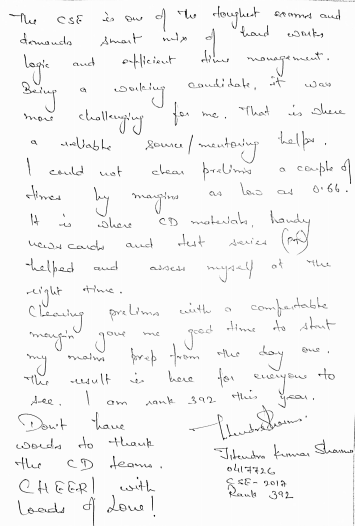
Here is what JITENDRA KUMAR SHARMA, AIR 392, CSE-2017 had to say –
This year, we have upgraded the program to make it the best offering in the market.
Introducing CD Prime TS 2019
1. One comprehensive program – Our TS is a full-fledged course in itself! With a mix and match of various kinds of questions and detailed explanation wherever need. It is a very effective way of both, starting a subject and revising one.
2. Telegram Groups moderated by to Toppers. Mentorship taken to a whole new level. You will be helped at every step of the way.
3. Introducing questions-types – Judging the quality of any TS is very subjective. While some will say its great, others will say its quality has decreased over time. That is why we have introduced the concept of question-types. They ensure consistency in quality. How? We have explained that in the end.
4. Dedicated monthly CA Tests – Exclusive focus on Current Affairs(CA) by having dedicated monthly CA tests. Besides, exhaustively preparing for CA questions, it has helped students precisely figure out what their weaknesses are.
5. Tikdams and mastering the art of intelligent guesses – Tikdam Technique is an innovation by Dr. V(AIR 20) and has helped students gain additional marks. Our TS is the only TS that puts a conscious effort to build student’s risk-taking appetite.
6. Subject and sub-subject Level Tagging – These tags will help you understand the importance of themes and revise other questions from them.
7. Two-tier quality check – Our questions pass through a rigorous true stage assessment criteria. The first being done by CD’s core content team with the final approval from a coterie of rankers.
What are questions types
Wherever applicable, we will try to stick to the format decided below. It standardizes questions to a decent extent.
A. Consolidation Questions
These questions consolidate information from different topics to help you see concepts holistically and also aid retention.
Eg. Consider this question. You would not have studied all the ‘Majorities’ together but under separate topics. This question will help you understand the concept in entirety.
Consider the following questions on the types of Majority
1. Special Majority of not less than 2/3 of the Members present and voting is required in the passage of a resolution under Art. 249 and Art. 312ONLY.
2. Impeachment of the President requires Not less than 2/3 of the Members present and voting along with Majority of the Total Strength of the House.
Which of the statements given above is/are correct?
a)1
b)2
c)Both
d)None
Explanation – A very detailed account of the types of Majority is given here https://www.civilsdaily.com/types-of-majorities/
Statement 1 is correct despite having ‘ONLY’ in it.
B. Comparative Questions
Comparative questions help you understand the relative differences between related topics. Consider the question below. Instead of asking a question on HC or SC separately, we have clubbed it together.
Consider the following statements with respect to the appointment of judges of High Court & Supreme Court
1. The minimum qualifications prescribed in the Constitution is same for judges of HC & SC.
2. While SC judges are appointed by the President, HC judges are appointed by the SC.
Which of the following is/are incorrect?
a) 1 only
b) 2 only
c) Both 1 and 2
d) None
Explanation – 3 qualifications are common to both judges of HC and SC
1. Citizen of India
2. Judge of HC for 5 years
3. Advocate in HC for 10 years
In case of judges of SC, there is an additional qualification – If he/she is a distinguished Jurist in the opinion of the President. Judges of HC are also appointed by the President. The controversy around appointments has been in news very frequently. Please read – https://www.civilsdaily.com/story/judicial-appointments-conundrum-post-njac-verdict/
C. Interactive Questions
These questions will ask you to go through a concept/related concepts and reply back with comments. This will help you re-visit the entire concept rather than simply answer one specific aspect of the topic.
Eg., consider the following question –
The conversion of Ammonia (NH3) to nitrite (NO2-) and then to nitrates (NO3-) is called
a) Nitrification
b) Ammonification
c) Assimilation
d) Denitrification
Answer A
Explanation
Nitrification
In this process, the ammonia is converted into nitrate by the presence of bacteria in the soil. Ammonia is oxidized to form nitrites by bacteria such as Nitrosomonas species. Nitrates are converted into nitrates by Nitrobacter. This conversion is very important as ammonia gas is toxic for plants.
Make a note of all the processes involved in the Nitrogen Cycle – nitrogen fixation, assimilation, ammonification, nitrification, and denitrification process.
Leave their definitions/organisms involved in the comments.
D. Star-marked/special questions
These are advanced questions that are not from standard sources but relevant for the exam. These questions will help you build additional knowledge without going through specialized books.
Eg. Questions on books by freedom-fighters, News not covered by the Hindu, IE, PIB but of very high importance in world affairs.
Besides these, questions indirectly related to CA will also be asked.
Do I need to join a TS for prelims at all?
Despite UPSC being unpredictable, prelims TS is the only program that can help you assess how your preparation is. Besides few questions that are directly asked from TS, it helps in developing a good understanding of how to prepare/what to prepare/what to prioritize and so on.
In today’s hyper-competitive exam scenario, it’s almost impossible to clear the exam without a good TS in hand.
Reading News for UPSC is utmost important and rising number of questions year on year in UPSC Prelims is a testimony of this
We are starting a daily series where we will analyze news covered in The Hindu, Indian Express and other newspapers which are important from exam perspective and which are not
Important news would have been covered in our daily news coverage in form of newscards.
Unimportant ones will be mentioned here and a short description regarding why it is not relevant for the exam
Read about the eighth schedule and Rajya Sabha from Polity textbook. News has very less info but these 2 topics become important due to appearing in news
Junk foods are having an adverse effect on lifestyle as well as the health of youngsters. Know about harms caused and what can be done to check the growing inclusion of fast foods in the diet.
The Union government has told the Supreme Court that it would leave it to the wisdom of its judges to decide the constitutionality of Section 377 IPC, which criminalises sexual activities “against the order of nature”, including homosexual activities
Q.1) Consider the following statements regarding the World Sanskrit Conference:
World Sanskrit Conference is being held in various countries across the globe every year
Delhi International Sanskrit Conference of 1972 is considered to be the first World Sanskrit Conference
Which of the above is/are correct:
a) 1 only
b) 2 Only
c) Both 1 & 2
d) Neither 1 nor 2
Q.2) Shanta Kumar committee recently seen in the news is related to:
a) Internal Security
b) Agriculture & PDS
c) Ease of Doing Business
d) Digital India
Q.3) India Tourism mart is proposed to be held in:
a) New Delhi
b) Chennai
c) Beijing
d) New York
Q.4) Consider the following statements regarding ‘Institution of Eminence’ recently seen in news:
This tag will ensure complete autonomy to the selected institutions
Each public Institution selected as ‘Institution of Eminence’ will get financial assistance up to Rs. 1000 Crore over the period of five years under this scheme
Which of the above is/are correct:
a) 1 only
b) 2 Only
c) Both 1 & 2
d) Neither 1 nor 2
Q.5) Ramayana Express recently seen in news will be covering tourism spots in:
The UNHRC was established in 2006, as part of the UN’s reform process, replacing the Commission on Human Rights.
Council members are elected by the General Assembly with three-year terms, with a maximum of two consecutive terms.
The headquarters of UNHRC is in Geneva, Switzerland
The members of the General Assembly elect the members who occupy the UNHRC’s 47 seats. The term of each seat is three years, and no member may occupy a seat for more than two consecutive terms
The General Assembly can suspend the rights and privileges of any Council member that it decides has persistently committed gross and systematic violations of human rights during its term of membership
The UNHRC investigates allegations of breaches of human rights in UN member states and addresses important thematic human rights issues such as freedom of association and assembly, freedom of expression, freedom of belief and religion, women’s rights, LGBT rights, and the rights of racial and ethnic minorities
Food Safety and Standards Authority of India (FSSAI)
It is an autonomous body established under the Ministry of Health & Family Welfare, Government of India.
The FSSAI has been established under the Food Safety and Standards Act, 2006 which is a consolidating statute related to food safety and regulation in India.
FSSAI is responsible for protecting and promoting public health through the regulation and supervision of food safety.
The FSSAI is headed by a non-executive Chairperson, appointed by the Central Government, either holding or has held the position of not below the rank of Secretary to the Government of India.
The Eighth Schedule to the Constitution of India lists the official languages of the Republic of India
The Government of India is under an obligation to take measures for the development of these languages, such that “they grow rapidly in richness and become effective means of communicating modern knowledge”
In addition, a candidate appearing in an examination conducted for public service is entitled to use any of these languages as the medium in which he or she answers the paper
The 22 languages which are listed in the Eighth Schedule are Assamese, Bengali, Bodo, Dogri, Gujarati, Hindi, Kannada, Kashmiri, Konkani, Maithili, Malayalam, Manipuri, Marathi, Nepali, Oriya, Punjabi, Sanskrit, Santali, Sindhi, Tamil, Telugu and Urdu
Here’s a Factoid to brush up your concepts
Name : Advance Area Defence (AAD) interceptor missile
Defence Forces : Army
Module Type : Missiles
Brief Intro : 1.Advanced Air Defence (AAD) is an anti-ballistic missile designed to intercept incoming ballistic missiles in the endo-atmosphere at an altitude of 30 km (19 mi). 2.AAD is a single-stage, solid-fuelled missile. 3.Guidance is similar to that of Prithvi Air Defence (PAD): it has an inertial navigation system, midcourse updates from ground based radar and active radar homing in the terminal phase
Reading News for UPSC is utmost important and rising number of questions year on year in UPSC Prelims is a testimony of this
We are starting a daily series where we will analyze news covered in The Hindu, Indian Express and other newspapers which are important from exam perspective and which are not
Important news would have been covered in our daily news coverage in form of newscards.
Unimportant ones will be mentioned here and a short description regarding why it is not relevant for the exam
No Indian university features in the top ranking of educational institutes globally. Steps are being taken to improve this situation. Note details of the proposed scheme. Can be asked in Pre as well as Mains.
Starting November, the Indian Railways will start a special train, ‘Shri Ramayana Express’, which will cover important destinations related to the epic in a 16-day journey. The tour will be spread across India as well as Sri Lanka
Nothing important in the news from UPSC perspective apart from above info.
Name: World Intellectual Property Organisation (WIPO)
Objective : To encourage creative activity, to promote the protection of intellectual property throughout the world
Members : 186 of the UN member states as well as the Cook Islands, Holy See and Niue are members of WIPO
Headquarters : Geneva, Switzerland
Year Founded : 1967
Name : Forest Carbon Partnership Facility(FCPF)
Objective : 4 objectives To assist countries in their REDD+ efforts by providing them with financial and technical assistance in building their capacity to benefit from possible future systems of positive incentives for REDD+. To pilot a performance-based payment system for REDD+ activities, with a view to ensuring equitable benefit sharing and promoting future large-scale positive incentives for REDD+. Within the approach to REDD+, to test ways to sustain or enhance livelihoods of local communities and to conserve biodiversity. To disseminate broadly the knowledge gained in the development of the Facility and the implementation of Readiness Preparation Proposals (RPPs) and Emission Reductions Programs (ERPs).
Q.2) Consider the following statements about National Testing Agency (NTA):
NTA will conduct NET, NEET, JEE (Mains) twice a year.
NET, a qualifying test for admission in higher educational institutions in the country, would be the first exam to be conducted by the newly formed body.
Which of the given statements are incorrect?
a) Only 1
b) Only 2
c) Both 1 and 2
d) None of the above
Inspired by: National Testing Agency to conduct NET, NEET, JEE (Mains) exams
Q.4) With respect to the National testing Agency (NTA), Which of the following statements is/are correct?
It is an agency which will conduct examinations for higher and secondary education in Online as well as Offline manner.
It will replace CBSE, AICTE and other agencies from conducting various exams and enable them to focus on their core areas and work on improving the quality of education
Select the correct code from the following options:
a) Only 1
b) Only 2
c) Both 1 and 2
d) None of the above.
Inspired by: National Testing Agency to conduct NET, NEET, JEE (Mains) exams
We have kept 6 sources for completing the entire syllabus and we urge our students to follow only what’s been prescribed. Try not to go overboard
Sources
Source
Source type
Why this one?
1. CD’s Economy Series 2. CD’s Economic Survey 3. CD’s Budget 4. Current Affairs & B2B @CD
Primary source: To be revised multiple times
These are made keeping the Civil Services Exam in mind and therefore are tailor made for your needs. Do Supplement with Current Affairs from CD’s news cards and stories
5. NCERT 12th Macroeconomics and introductory chapter of NCERT 12th Microeconomics
Basic book: To be read once
This is important to develop a basic understanding of Economic concepts
6. Sankar Ganesh
Reference book
To be referred for topics not given in the above sources or for supplementary understanding
Note while following the Plan
1. The mathematics involved need not be memorised but, the underlying concept behind the maths should be understood. However, the formulae for various types of budget deficits should be memorised 2. For every section, the sources if applicable should be read in the following order – NCERTs > CD’s Economy Series > Dr V’s lucid explainers with Examples (given as links) > Shankar Ganesh 3. Issues/terms frequently in news like GAAR, Quantitative Easing, Taper Tantrum, Gold should be made note of. 4. Make a note of the important and recently set-up committees wrt regard to Fiscal and Economic Reforms like Financial Sector Legislative Reforms Commission (FSLRC), Financial Action Task Force (FATF), Financial Stability and Development Council (FSDC), Nachiket Mor committee etc.
Daywise plan + Feedback questions with Explanations & Tikdams where applicable
Day 1
Introduction to Economics, Microeconomics & Macroeconomics
Gather a basic understanding of • What is economy, its types (eg closed/open economy) and characteristics • Difference between economy and economics • Macroeconomics & Microeconomics • Microeconomics – Production dilemma – Decisions/choices made at a company, household or an individual level • Sectors of Economy – Primary, Secondary, Tertiary Sectors • Capitalist, State, Mixed Economic Systems – the system in India and reasons for its adoption
Previous year’s MCQs to judge one’s level of understanding + Tikdams:
A “closed economy” is an economy in which:
a) The money supply is fully controlled
b) Deficit financing takes place
c) Only exports take place
d) Neither exports nor imports take place
Answer – d
Explanation – Closed to outsiders i.e no trade with outside world
• Differences between Inflation, Depression, Recession, Miscellaneous concepts like Speculation, Philip’s curve, deflation, disinflation, reflation, stagflation
• Types of Inflation – based on the rate of price increase – creeping, trotting, galloping,
• Types of Inflation – based on causes– Demand-pull, Cost-push, Structural
• What causes inflation in India and the Impact of Inflation on Indian Economy
• Inflation measurements like CPI, WPI, PPI, GDP deflator – their composition, base years, merits/demerits and who publishes them at what frequency.
• Concept of base year, recent changes and need for changes
Previous year’s MCQs to judge one’s level of understanding + Tikdams:
India has experienced persistent and high food inflation in the recent past. What could be the reasons?
1. Due to a gradual switchover to the cultivation of commercial crops, the area under the cultivation of food grains has steadily decreased in the last five years by about 30%.
2. As a consequence of increasing incomes, the consumption patterns of the people have undergone a significant change.
3. The food supply chain has structural constraints.
Which of the statements given above are correct?
a) 1 and 2 only
b) 2 and 3 only
c) 1 and 3 only
d) 1, 2 and 3
Answer -b
Explanation – 1st statement is easily wrong. 30% decline in area under food grain is too drastic to happen in 5 years and if it were so, everyone would know about it. Infact there is hardly any decline in area under cultivation of food grains. Eliminate 1, you have the answer
Day 6 + 7
Banking
• CD’s Economy Series – Chapter 4, 5 • www.civilsdaily.com/economics-monetary-policy-explained-with-examples/
Focus Area :
• Role and functions of RBI
• Monetary Policy measures by RBI and different benchmark rates eg Bank rate, repo rate, SLR, CRR, LAF, MSF
• Their utility and impact on money supply and the Economy
• Different types of Banks and their functioning– Commercial Banks, RRB’s, NABARD, Co-operative Banks, Development Banks, Merchant Banks, NBFC’s, RRBs etc.
• Banking reforms eg Nationalisation, Committees like Narsimhan Committees, Basel Norms etc., their need and impact
• Concepts – Financial Inclusion, Narrow Banking, Non-Performing Assets, Shadow Banks & Weak Bank & Bank Run
• Steps taken by the Govt and RBI in this regard. Eg: Jan Dan Yojana, Small banks and differentiated banks etc
Previous year’s MCQs to judge one’s level of understanding + Tikdams:
In the context of Indian economy which of the following is/are the purpose/purposes of ‘Statutory Reserve Requirements’?
1. To enable the Central Bank to control the amount of advances the banks can create.
2. To make the people’s deposits with banks safe and liquid.
3. To prevent the commercial banks from making excessive profits.
4. To force the banks to have sufficient vault cash to meet their day-to-day requirements.
Select the correct answer using the code given below:
a) 1 only
b) 1 and 2 only
c) 2 and 3 only
d) 1, 2, 3 and 4 only (2014)
Answer – a
Explanation – A statutory reserve is an amount of cash a financial institution, such as a bank, credit union, or insurance company, must keep on hand to meet the obligations incurred by virtue of accepting deposits and premium payments. The statutory reserves required of banks and credit unions are generally set by the nation’s central bank, and those required of insurance companies are set by statute or regulation by the national, state or provincial government or regulatory authority. Calculated in various ways, statutory reserves are required to ensure that financial institutions are capable of paying claims even in a calamitous situation.
Tikdam: 3rd can not be true. These are monetary policy intruments having nothing to do with banking profits.
• Steps taken by the govt to bring down the Fiscal Deficit Example: FRBM Act, NK Singh Panel Fiscal policy
• Finance Commission (14th FC and its important provisions) + difference in terms of reference of the 15th FC
• FRBM Act, steps by the Govt to improve financial health and stability
• Financial Stability and Development Council – objective and functions
• Financial Regulators – RBI, SEBI, IRDA, PFRDA – powers, functions, jurisdiction issues between the regulators
• Economic Reforms – lipberalization, privatization, globalization, SEZ’s, CEZ’s etc. • Govt’s financial resources – Tax and Non-tax revenues, Disinvestment, Borrowings (internal and external), User Charges.
Previous year’s MCQs to judge one’s level of understanding + Tikdams:
There has been a persistent deficit budget year after year. Which action/actions of the following can be taken by the Government to reduce the deficit?
1. Reducing revenue expenditure
2. Introducing new welfare schemes
3. Rationalizing subsidies
4. Reducing import duty
Select the correct answer using the code given below.
a) 1 only
b) 2 and 3 only
c) 1 and 3 only
d) 1, 2, 3 and 4
Answer – c
Explanation – A budget deficit is an indicator of financial health in which expenditures exceeds revenue. The term is most commonly used to refer to Government spending. Reducing revenue expenditure and rationalizing subsidies will reduce the expenditure of the Government Whereas, introducing new welfare schemes will increase Government expenditure and reducing import duty will reduce government revenue
Tikdam: 2 will increase exepnditure where as 1 and 3 will reduce the expenditure thus defict
• Direct Tax like Corporate Tax, Income Tax, Wealth Tax, Stock Market transactions
• Indirect Tax like Excise Tax, Customs, VAT, Service tax, GST
• Taxation Reforms – Direct Tax Code (DTC), General Anti-Avoidance Rule (GAAR), GST, Place of Effective Management (PoEM) and their critical analysis & issues with their implementation
• Balance of Payments (BoP) – meaning, causes and remedies
• ‘Invisibles’ in external sector and its effect on BoP
• Capital and Current Account & its constituents.
• Capital and Current Account Convertibility – reasons for the present state (partial capital accunt convertibility), committees associated eg HR Khan committee
• A general idea about MRTP Act, 1969; FERA, 1973; FEMA, 1999
• Current Account Deficit (CAD) – meaning, implications of high/low CAD. Measures taken by the Govt to reduce CAD
• Forex Reserves – constituents, utility
• Currency Exchange rate – its determination.
• Concept of appreciation, depreciation, devaluation of currency, etc and differences between them.
• Impact on Forex reserves due to these phenomenon
• Rupee appreciation/depreciation/devaluation and its impact on domestic and external market & on imports and exports.
• Concept of NEER, Real Effective Exchange Rate REER
• Concepts like Trade deficits, Savings, Investment, J-curve effect
• India’s Foreign trade Policy – recent initiatives taken
Previous year’s MCQs to judge one’s level of understanding + Tikdams:
Consider the following actions which the government can take:
1. Devaluing the domestic currency.
2. Reduction in the export subsidy.
3. Adopting suitable policies which attract greater FDI and more funds from FIIs.
Which of the above action/actions can help in reducing the current account deficit?
a) 1 and 2
b) 2 and 3
c) 1 and 3
d) 3 only
Answer – d
Explanation – Reduction in export subsidy would definitely harm as our exports would become costlier for other countries. Devaluing the domestic currency – imports become costlier, exports become cheaper so more exports, CAD come down eventually.
Day 16 – 18 : Cumulative Revision
Day 19
Planning
• CD’s Economy Series – Chapter 2
Focus Area :
Concetrate on
• Institutions involved in Planning in India – Planning Commission, Niti Aayog and their objective and critique of their role
• A general idea on how planning has evolved over the years (since Independence)
• Different plans and their focus areas
• How planning takes place at the State and National level
• Reasons for dissolution of Planning Commission
• Issues between Planning Commission and Finance Commission
Previous year’s MCQs to judge one’s level of understanding + Tikdams:
Consider the following statements regarding Indian Planning:
1. The Second FiveYear Plan emphasized on the establishment of heavy industries.
2. The Third FiveYear Plan introduced the concept of import substitution as a strategy for industrialization.
Which of the statements given above is/ are correct?
A. 1 only
B. 2 only
C. Both 1 and 2
D. Neither 1 nor 2
Answer – C
Explanation – Pure Factual question. You need to know which plan Second Plan (1956-1961): The second five-year plan focused on industry, especially heavy industry. Domestic production of industrial products was encouraged, particularly in the development of the public sector. The plan followed the Mahalanobis model, an economic development model developed by the Indian statistician Prasanta Chandra Mahalanobis in 1953. The need for foreign reserves was felt during the Fourth Five Year Plan (1969-1974). This facilitated growth in exports. Import substitution drew considerable attention. All these activities widened the industrial platform.
Day 20
Poverty, Inequality, and Unemployment
• CD’s Economy Series – Chapter 7
Focus Area :
• Indices for measuring poverty – their merits and limitations
• Concept of Poverty line (eg APL, BPL, Antyodaya)
• Various estimates and committees for estimation of poverty line and their merits and limitations eg Tendulkar, Rangarajan, Dadabhai Naoroji, World Bank’s estimates, etc
• Inequality and unemployment – causes, types and remedies
• Current affairs especially govt initiatives like Jan Dhan Yojna, PDS, Mudra Bank etc
Previous year’s MCQs to judge one’s level of understanding + Tikdams:
The Multi-dimensional Poverty Index developed by Oxford Poverty and Human Development initiative with UNDP support covers which of the following?
1. Deprivation of education, health, assets and services at household level.
2. Purchasing power parity at national level.
3. Extent of budget deficit and GDP growth rate at national level.
Select the correct answer using the codes given below.
a) 1 only
b) 2 and 3 only
c) 1 and 3 only
d) 1, 2 and 3
Answer – A
Tikdam: why would budget deficit and GDPgrowth rate matter for deciding the extent of poverty. Eliminate 3 and you get the answer
Day 21 + 22
Agriculture
• CD’s Economy Series – Chapter 6
Focus Area :
Note – Indian Agriculture is very important for Mains Exam
• State of Indian Agriculture, Interventions needed for improving the state of Indian agriculture & Land reforms
• Farm subsidies – need, mechanisms & types &negative impacts
• Other Govt Interventions
• Issues, working and drawbacks of MSP egime, buffere stocks and Public Distribution System (PDS)
• Targeted PDS, Antyodaya Anna Yojana (AAY), National Food Security Act
• Alternatives to PDS like Direct Benefit Transfers, (d) Agriculture Marketing
• Mechanism and issues in Marketing of Agricultural Produce – APMC Act, Model APMC Act, 2003, Private and Co-operative Sector in Marketing
Previous year’s MCQs to judge one’s level of understanding + Tikdams:
With reference to micro-irrigation, which of the following statements is/are correct?
1. Fertilizer/nutrient loss can be reduced.
2. It is the only means of irrigation in dry land farming.
3. In some areas of farming, receding of ground water table can be checked. Select the correct answer using the codes given below:
a) 1 only
b) 2 and 3 only
c) 1 and 3 only
d) 1, 2 and 3
Answer – C
Explanation – Only means of irrigation. Red flag. Pause and think. As if no irrigation was possible before this. what about canals in Rajasthan and gujarat. Eliminate 2
Day 22
Food processing & related industries
• CD’s Economy Series – Chapter 12
Focus Area :
• Need and Status of Food processing sector
• Govt’s initiatives to boost the sector and evaluation of these measures and way forward
Previous year’s MCQs to judge one’s level of understanding + Tikdams:
With what purpose is the Government of India promoting the concept of Mega Food Parks?
1. To provide good infrastructure facilities for the food processing industry.
2. To increase the processing of perishable items and reduce wastage.
3. To provide emerging and eco-friendly food processing technologies to entrepreneurs.
Select the correct answer using the codes given below:
a) 1 only
b) 1 and 2 only
c) 2 and 3 only
d) 1, 2 and 3
Answer – D
Day 23- 26 : Cumulative Revision
Day 27 + 28
International economic organizations
• CD’s Economy Series – Chapter 11
Focus Area :
Note: The recently joined members of these organisations and if India was an original member or not Bretton Wood Twins- World Bank, IMF
• Their purpose and beneficiary audience
• Reports published by WB and IMF
• Relevance of IMF and WB to the developing countries (especially India)
• SDR’s – what are they and why were they needed World Trade Organisation (WTO)
• Evolution and purpose and functioning (eg ‘one country one vote’ principle)
• WTO principles– Most Favoured Nation (MFN)- non-discriminatory Trade, General system of Preference (GSP) for developing countries and Preferential Trade Agreement (PTA), Free Trade Agreement (FTA) for economics integration
• Doha round – reasons for its stalling & Issue’s between developed and developing world
• WTO and India – benefits to India & issues faced
• Stages in economic integration – PTA > FTA > Customs Union > Monetary Union
• Safeguard mechanisms eg Sanitary and Phytosanitary agreement (SPS), Technical Barriers to Trade (TBT)
• WTO agreements
• Agreement on Agriculture(AoA) – Domestic support (Green Box, Amber Box, Blue Box), Export subsidies, Market access
• TRIPS and IPR Issues & IPR protection mechanisms like Copyrights, Trademark, Industrial Design, GI etc. Also note ay recently awarded GI tags
• General Agreement on Trade in Services (GATS)
• Protectionism and Import Substitution – meaning, mechanisms and differences
• Trade Agreements – countries with which India has (signed/looking to sign) trade agreements recently
• their objectives, recent summits & India’s role and stand on various involved issues eg India’s stand on TRIPS+ provisions in RCEP
• Benefits/ problems to India from these
Previous year’s MCQs to judge one’s level of understanding + Tikdams:
1. Regarding the International Monetary Fund, which one of the following statements is correct?
a) It can grant loans to any country
b) It can grant loans to only developed countries
c) It grants loans to only member countries
d) It can grant loans to the central bank of a country
Answer – c
2. With reference to the ÔTrans-Pacific PartnershipÕ, consider the following statements:
1. It is an agreement among all the Pacific Rim countries except China and Russia.
2. It is a strategic alliance for the purpose of maritime security only. Which of the statements given above is/are correct?
a) 1 only
b) 2 only
c) Both 1 and 2
d) Neither 1 nor 2
Answer – d
Tikdam –
1. Obviously any body would grant loan to only member country
2. The Trans-Pacific Partnership was signed by only 12 member nations of Pacific rim, not all the Pacific Rim countries except China and Russia. The members are: Australia, Brunei, Canada, Chile, Japan, Malaysia, Mexico, New Zealand, Peru, Singapore, the United States and Vietnam. It is not a strategic alliance. It is a trade alliance.
Tikdam: In news, all except China and Russia. There are umpteen number of island countries not in the pertnership. Only redflag. Infact it’s for trade
Day 29
Industrial sector
• CD’s Economy Series – Chapter 13
Focus Area :
• Industrial development in India & Industrial Policies & their effects on growth • PSU’s – Objectives of PSU’s and categorization
• Reforms – post LPG era- Disinvestment, New Companies Act, 2013, Corporate Social Responsibility (CSR)
• MSME’s, Small-Scale Industries (SSI), Village and Cottage Industries (VCI)- basis of classification, their utility and govt measures for their support
Previous year’s MCQs to judge one’s level of understanding + Tikdams:
In India, in the overall index of Industrial Production, the Indices of Eight Core Industries have a combined weight of 37.90%. Which of the following are among those Eight Core Industries?
1. Cement
2. Fertilizers
3. Natural Gas
4. Refinery products
5. Textiles Select the correct answer using the codes given below:
a) 1 and 5 only
b) 2, 3 and 4 only
c) 1, 2, 3 and 4 only
d) 1, 2, 3, 4 and 5
Answer – c
Day 30
Infrastructure
• CD’s Economy Series – Chapter 14
Investment models
• CD’s Economy Series – Chapter 15
Focus Area :
• Infrastructure Sector in India: Status, Growth and Infrastructure Linkage • Growth Drivers; • Government Policy InitiativesDevelop an understanding of • Investment Models: Public Sector Led Investment Model; Private Sector-Led Investment Model • Public-Private Partnership Model: Definitions; Need for PPP; Prerequisites. • Contracting, BOT, DBFO, Concessions, EPC, Swiss Challenge, HAM
Previous year’s MCQs to judge one’s level of understanding + Tikdams:
Which one of the following is a purpose of “UDAY”, a scheme of the Government? a) Providing technical and financial assistance to start-up entrepreneurs in the field of renewable sources of energy b) Providing electricity to every household in the countries by 2018 c) Replacing the coal-based power plants with natural gas, nuclear, solar, wind and tidal power plants over a period of time d) Providing for financial turnaround and revival of power distribution companies
Answer – d
Explanation – UDAY Scheme by the Ministry of Power – Ujjwal DISCOM Assurance Yojna. UDAY provides for the financial turnaround and revival of Power Distribution companies (DISCOMs), and importantly also ensures a sustainable permanent solution to the problem. Tikdam: Ujjwal DISCOM assurance Yojana. Solved if you know the full form
Day 31 – 35 : Cumulative Revision
Day 36 : Test
Day 37
Economic Survey 2016
• CD’s Economic Survey 2016 – Chapters 1-4
Day 38
Economic Survey 2016
• CD’s Economic Survey 2016 – Chapters 5-8
Day 39
Economic Survey 2016
• CD’s Economic Survey 2016 – Chapters 9-12
Day 40
Economic Survey 2016
• CD’s Economic Survey 2016 Vol 2 – Social infrastructure, Employment and Human Development
Day 41
Economic Survey 2017
• CD’s Economic Survey 2017 – Chapters 1-3
Day 42
Economic Survey 2017
• CD’s Economic Survey 2017 – Chapters 4-6
Day 43
Economic Survey 2017
• CD’s Economic Survey 2017 – Chapters 7-10
Day 44
Economic Survey 2017
• CD’s Economic Survey 2017 – Chapters 11-14
Day 45
Economic Survey 2018
• CD’s Economic Survey 2018 & Budget Series
Day 46
Economic Survey 2018
• CD’s Economic Survey 2018 & Budget Series
Day 47
Economic Survey 2018
• CD’s Economic Survey 2018 & Budget Series
Day 48
Economic Survey 2018
• CD’s Economic Survey 2018 & Budget Series
Focus Area :
Make note of the Key terms and their meaning, especially the recent ones. UPSC tends to pick up specific terms from the Economic Survey in both Prelims and Mains The suggestions to various problems of the economy should be taken as it is from Economic Survey along with relevant data for Mains Answer writing/ Interviews
Previous year’s MCQs to judge one’s level of understanding + Tikdams:
Which of the following best exemplifies the meaning of the economic term “Helicopter Hoover”?
a) FRBM Act
b) Demonetization
c) Helicopter drop of food packets in flood affected areas
d) None of these
Answer – b
The Economic Survey 2017 describes demonetization as a helicopter hoover as against helicopter dropping money in Quantitative Easing Caution: Many might select C because it mentions Helicopter. Know that “All that glitters is not Gold”. This is a tricky choice to misguide those in a hurry
This study plan limits itself to Physical Geography
We have kept 5 sources for completing the entire syllabus and we urge our students to follow only what’s been prescribed. Try not to go overboard
Sources
Source
Source type
Why this one?
1. 11th NCERT – Fundamentals of Physical Geography
2. 12th NCERT – Fundamentals of Human Geography
Primary source: To be revised multiple times. Students should highlight or make notes from these to keep their revision times anageable
• NCERT’s form the treasure trove of exam worthy information.
• Many direct questions have previously appeared in prelims from NCERT.
• The language is easy to understand and fundamental to conceptual clarity
• Especially concentrate on Indian Geography for Prelims as almost 75% questions are related to India
3. GC Leong
Primary source: To be revised multiple times. Students should highlight or make notes from these to keep their revision times anageable
• It is a brilliant book for physical geography and covers great depth in concepts which will help in Main exam
4. NCERT 6th-10th Geography
• Preliminary reading source to gather a wider understanding of the subject.
• Readings in the cumulative revisions would suffice.
• Caution: Ignore the maths part in this book
• Important for foundational understanding.
5. Orient Blackswan Atlas
• Note!!: Important to view maps daily and try and mark places which one finds during their reading of books or current affairs
• Most of Geography questions in prelims are are map based
• Maps make the subject easier to grasp and fun
Daywise plan + Feedback questions with Explanations & Tikdams where applicable
Day
1
Rapid basics build up
India map – States, their capitals and their neighbours
• NCERT Class 6th – Full
2
• India map – Major rivers of the Indus basin
• NCERT Class 7th – Full
3
• India map – Major rivers of Ganga Basin
• NCERT Class 8th – Full
4 + 5
• India map – Major rivers of Brahmaputra basin
• NCERT Class 9th – Full
6 + 7
• India map – Major rivers of the peninsular region
• NCERT Class 10th – Full
Focus Area :
• Concentrate on acquiring a basic understanding of topics
• Locate the places mentioned eg Palk Strait, states through which Tropic of cancer passes, etc
• For maps, mark the features with a pencil on your atlas and revise often
Previous year’s MCQs to judge one’s level of understanding + Tikdams:
Q. In India, How many States Share the coastline ?
A. 7
B. 8
C. 9
D. 10
Answer – C
Standard Explanation + Tikdams for MCQs : Map awareness is crucial for such questions
• Motion of the Earth – Rotation and Revolution – it’s impact on Day and Night and other phenomena
• Inclination of the Earth’s Axis – it’s effect on seasons
• Latitude and Longitude • Important Parallels and Meridians – the countries they pass through eg Equator, Prime meridian, etc
• General understanding of Solar Eclipse, Lunar Eclipse and Tides and their significance
• Earth’s crust
• The Structure of the Earth – different layers, their arrangement vertically, different discontinuities
• Rocks Classification– Igneous, Sedimentary, Metamorphic with examples.
Previous year’s MCQs to judge one’s level of understanding + Tikdams:
Consider the following factors:
1. Rotation of the Earth
2. Air pressure and wind
3. Density of ocean water
4. Revolution of the Earth
Which of the above factors influence the ocean currents?
(a) 1 and 2 only
(b) 1, 2 and 3
(c) 1 and 4
(d) 2, 3 and 4
Answer – B
Tikdam – Revolution doesn’t affect ocean currents but rotation does. Eliminate 4. Desnity also affects since denser water sinks. Therefore the answer has to be B
Day
11 + 12
Physical Geography – Climate
• World Map – Major physical features of Australia
• World Map – Major physical features of rest of Asia
• GC Leong – Chapter 19 – 22
17
Physical Geography – Climate types
• World Map – Major physical features of Africa
• GC Leong – Chapter 23 – 25
Focus Area:
Build conceptual clarity on
• Composition and Structure of Atmosphere various layers of atmosphere significance of each layer
• Heat Budget
• Greenhouse Effect and Global Warming & Ozone hole.
• Temperature Zones – Tropical, Temperate, Frigid ; their characteristics
• Global Pressure Belts- Low Pressure, High Pressure, Doldrums, Horse Latitudes
• The various Planetary Winds and their role in influencing climate
• Various atmospheric phenomenta like cyclones and anticyclones, jet streams, air-masses, their occurence and formation, properties and impact
• Concepts like Temperature Inversion, Albedo.
• Have a basic idea about major Climate Types – Tropical, Desert, Mediterranean, Taiga, Arctic (or Polar type)
• Their Distribution, climate and economic importance
Previous year’s MCQs to judge one’s level of understanding + Tikdams:
Consider the following
1. The winds which blow between 30° N and 60° S latitudes throughout the year are known as westerlies.
2 The moist air masses that cause winter rains in North-Western region of India are part of westerlies.
Which of the statements given above is/are correct?
a) 1 only
b) 2 only
c) Both 1 and 2
d) Neither 1 nor 2
Answer – b
2. During a thunderstorm, the thunder in the skies is produced by the: (2013)
1. meeting of cumulonimbus clouds in the sky
2. lightning that separates the nimbus clouds
3. violent upward movement of air and water particles
Select the correct answer using the codes given below.
(a) 1 only
(b) 2 and 3
(C) 1 and 3
(d) None of the above produces the thunder
Answer – d
3. Each day is more or less the same, the morning is clear and bright with a sea breeze; as the Sun climbs high in the sky, heat mounts up, dark clouds form, then rain comes with thunder and lightning. But rain is soon over.
Which of the following regions is described in the above passage?
a) Savannah
b) Equatorial
c) Monsoon
d) Mediterranean
Answer – b
Explanation-
1. Westerlies flow between latitudes 30-60 degrees North and 30-60 degrees South. The statement mentions 30N-60S. So it is wrong.
The western cyclonic disturbances are weather phenomena of the winter months brought in by the westerly flow from the Mediterranean region. They usually influence the weather of the north and north-western regions of India. They are a non-monsoonal precipitation pattern driven by the Westerlies.
Tikdam: read clearly – n to n , s to s noth N to S,
2. Self explanatory
3. Equatorial climate is characterized by consistently high temperatures (around 30 °C), with plentiful precipitation (150–1,000 cm), heavy cloud cover, and high humidity, with very little annual temperature variation. Wet equatorial regions lie within about 12° latitude of the Equator.
Tikdam: classical equatorial climate – no season (each day same), afternoon thudestrorm
Day 18 : Cumulative Revision
Day
19
Physical Geography – Oceans
• World map – Major Rivers & physical features of North America
• Ocean Currents (important) and factors influencing their movement – eg Winds, Temperatures, Salinity, Earth’s Rotation,
• Types- Warm and Cold Currents and their direction
• Their influence on the climate and vegetation as well as benefits and problems caused eg mixing of Warm and Cold currents helps fisheries but produce intense fogs
Previous year’s MCQs to judge one’s level of understanding + Tikdams:
What explains the eastward flow of the equatorial counter-current?
a) The Earth’s rotation on its own axis
b) Convergence of the two equatorial currents
c) Difference is salinity of water
d) Occurance of the belt of calm near the equator
What explains the eastward flow of the equatorial counter-current?
Answer – b
Explanation – The equatorial countercurrents are driven by a distinct surface wind pattern in the tropics. Strong westward trade winds result in westward surface flow in most of the tropical Atlantic and Pacific Oceans. However, several hundred mi. (km.) north of the equator the winds are much weaker, in comparison.
The stronger winds to the south pile up water where the winds are weak. As a result, the surface of the ocean can be up to 6 in. (15 cm.) higher and the thermocline (region of strongest decrease of temperature with increasing depth) as much as 328 ft. (100 m.) deeper than it is directly to the north.
The excess water flows eastward under the influence of the Earth’s rotation, giving rise to the equatorial countercurrents
20
Physical Geography – Volcanism and fluvial landforms
• World map – Major Rivers & physical features of South America
• GC Leong – Chapter 3, 5
21
Physical Geography – Glacial, Arid and Limestone landforms
• World Map – Major oceans and seas of the world
• their coastal countries
• warm and cold currents and their direction of flow
• GC Leong – Chapter 6, 7, 8
22
Physical Geography – Lakes, Coastal, Islands
• World map – Major volcanoes of the world; major river deltas
• GC Leong – Chapter 9, 10, 11
Focus Area:
Concentrate on
• Landforms associated with each exogenetic agent eg barchans in arid regions due to wind
• For map activity one should learn to recognise major physical features with a particluar continent/country. Eg Missisippi should spring USA to mind, Selvas should bring South America to mind
Previous year’s MCQs to judge one’s level of understanding + Tikdams:
Which one of the following pairs is correctly matched? Geographical Feature Region
(a) Abyssinian Plateau : Arabia
(b) Atlas Mountains : North-Western Africa
(c) Guiana Highlands : South-Western Africa
(d) Okavango Basin : Patagonia
Answer – b
Atlas mountain ranges are situated in the north western part of Africa. They extend almost 2000 km. They pass through Morocco, Algeria and Tunisia.
Tikdam: Abyssinia is the old name of Ethiopia.
Day 23+24 : Cumulative Revision
Day
25 + 26
Human Geography
• World Map – straits, isthumus, gulfs and bays
• 12th NCERT – Fundamentals of Human Geography – Chapters – 1-4 • 12th NCERT – India – People and Economy –
Chapter – 1-3
Focus Area:
Note: For Human Geography, the relevant data should be taken from current affairs and not from books as they are outdated
• Population problems, human development related issues and migration. Focus on India but be aware of world scenario
• This part is very dynamic so be abreast of current affairs
Previous year’s MCQs to judge one’s level of understanding + Tikdams:
Consider the following pairs :
Tribe State
1. Limboo (Limbu) : Sikkim
2. Karbi : Himachal Pradesh
3. Dongaria : Odisha
4. Bonda : Tamil Nadu
Which of the above pairs are correctly matched?
(a) 1 and 3 only
(b) 2 and 4 only
(c) 1, 3 and 4 only
(d) 1, 2, 3 and 4
Answer – A
Consider the following pairs: Community sometimes mentioned in the news In the affairs of
1. Kurd : Bangladesh
2. Madhesi : Nepal
3. Rohingya : Myanmar
Which of the pairs given above is/are correctly matched?
a) 1 and 2
b) 2 only
c) 2 and 3
d) 3 only Answer – C
Factual and current affairs related. You know or you don’t
Day
27 + 28
Human Geography
• World Map – major islands and their marginal seas of the Atlantic and Indian Ocean
– Pay attention to the North-South and East-West alignment of countries/islands/seas
• 12th NCERT – Fundamentals of Human Geography – Chapters – 5-7 • 12th NCERT – India – People and Economy – Chapter – 7-9
Focus Area:
Pay special attention to
• The classification of activities
• India’s resource wealth – India’s position globally in terms of production,
• Mineral resources and major mining/extraction areas
• Industrial regions, centres and advantages and problems in each sector
Previous year’s MCQs to judge one’s level of understanding + Tikdams:
In which of the following regions of India are shale gas resources found?
1. Cambay Basin
2. Cauvery Basin
3. Krishna-Godavari Basin
Select the correct answer using the code given below
a) 1 and 2 only
b) 3 only
c) 2 and 3 only
d) 1, 2 and 3
Answer – D
Explanation – Shale gas is the natural gas that is trapped within shale formations. ONGC sought permission for drilling 11 exploratory wells for shale oil and shale gas in Cambay basin at Mehsana, Ahmedabad and Bharuch districts of Gujarat, one well in Cauvery basin at Nagapattinam in Tamil Nadu and five wells in KG Basin at East and West Godavari districts of Andhra Pradesh. Other regions in India where shale gas resources are found – Cauvery, Ganga & Assam and Assam – Arakan ; Gondwana basin (including Damodar )
Day
29 + 30
Human Geography
• World Map – major islands and their marginal seas of the Pacific Ocean + Antactica
– Pay attention to the North-South and East-West alignment of countries/islands/seas
• 12th NCERT – Fundamentals of Human Geography – Chapters – 8-10 • 12th NCERT – India – People and Economy – Chapter – 10-12, 4
Focus Area :
Pay special attention to • Issues related to transport sector – the ranks of various types in usage, infrastructure and their specific problems
Previous year’s MCQs to judge one’s level of understanding + Tikdams:
What is the correct sequence of occurrence of the following cities in South-East Asia as one proceeds from south to north?
1.Bangkok
2.Hanoi
3.Jakarta
4.Singapore
Select the correct answer using the code given below.
A. 4-2-1-3
B. 3-2-4-1
C. 3-4-1-2
D. 4-3-2-1
Answer – C
Explanation : See map.
Tikdam – Basic awareess tells that Jakarta (Indonesia) has to be the southernmost. Leaves us with 2 options B & C
Day 31 + 32+ 33 – Revision of Human Geography
Day 34+35+36 – Cumulative Revision from day 9 except Human Geography + Maps full revision