how can i use this website in current affairs preparation please tell me
Search results for: “”
-
26 August 2017 | Prelims Daily with Previous Year Questions & Tikdams
Q.1) Prasar Bharati includes which of the following broadcasters?
1. Doordarshan
2. All India Radio
Select the correct answer using the codes given below.
a) Both are correct
b) 2 only
c) 1 only
d) Neither 1 nor 2Q.2) Consider the following statements regarding ‘the Indian Regional Navigation Satellite System (IRNSS)’:
1. Its operational name is NAVIC.
2. The Orbital height the satellites in this system is around 36,000 km.
Which of the following statements given above is/are correct?
a) Both are correct
b) Neither 1 nor 2
c) 1 only
d) 2 onlyQ.3) Consider the following statements regarding the ‘Pancheshwar Dam Project’:
1. It is a joint venture between India and Nepal.
2. It is being built on Sharda River.
Which of the statements given above is/are correct?
a) 1 only
b) 2 only
c) Both are correct
d) Neither 1 nor 2Q.4) Regional Connectivity Scheme (RCS) is related to
a) Airlines
b) National Highways
c) Railways
d) WaterwaysQ.5) If the other factors remains unchanged, then what will be the possible effect of ‘Devaluation’ on ‘Trade Deficit’?
a) It will increase
b) It will decrease
c) It will increase upto a threshold point and then decrease
d) It will decrease upto a threshold point and then increaseQ.6) Consider the following statements : (CSE: 2015)
1. The winds which blow between 30° N and 60° S latitudes throughout the year are known as westerlies.
2. The moist air masses that cause winter rains in North-Western region of India are part of westerlies.
Which of the statements given above is/are correct?
a) 1 only
b) 2 only
c) Both 1 and 2
d) Neither 1 nor 2Q.7) With reference to ‘Indian Ocean Rim Association for Regional Cooperation (10R-ARC)’, consider the following statements : (CSE: 2015)
1. It was established very recently in response to incidents of piracy and accidents of oil spills.
2. It is an alliance meant for maritime security only.
Which of the statements given above is/are correct?
a) 1 only
b) 2 only
c) Both 1 and 2
d) Neither 1 nor 2Q.8) Which one of the following movements has contributed to a split in the Indian National Congress resulting in the emergence of ‘moderates’ and ‘extremists?(CSE: 2015)
a) Swadeshi Movement
b) Quit India Movement
c) Non-Cooperation Movement
d) Civil Disobedience Movement
IMPORTANT STUFF:
1. Daily newscards have been enriched with back2basics and note2students – Make notes daily
2. Join Full Year Prelims TS – prelims.civilsdaily.com
3. Solutions will be uploaded at 11.30 p.m. Click here for Solutions
4. For attempting previous Prelims Daily Questions – Click here
-
26 August 2017 | Pub Ad | Daily Answer Writing Session
Attempt the questions by posting your answers in comments below.
Q1.Present your views on inclusion or otherwise of PM within the ambit of the Lokpal?(15marks)
Q2. What is Agile governance? How it is project management technique and a new governance model? Distinguish how it is different from good governance?(20 Marks) -
Foreign Policy Watch: India-Nepal
Brief History of Kingdom Of Nepal
Gorkha rule
- After decades of rivalry between the medieval kingdoms, modern Nepal was reunified in the latter half of the 18th century, when Prithvi Narayan Shah, the ruler of the small principality of Gorkha, formed a unified country from a number of independent hill states. Prithvi Narayan Shah dedicated himself at an early age to the conquest of the Kathmandu Valley and the creation of a single state, which he achieved in 1768.
- The country was frequently called the Gorkha Kingdom. It is a misconception that the Gorkhali took their name from the Gorkha region of Nepal; actually, the region was given its name after the Gorkhali had established their control of these areas.
- After Shah’s death, the Shah dynasty began to expand their kingdom into much of South Asia. Between 1788 and 1791, during the Sino-Nepalese War, Nepal invaded Tibet and robbed Tashilhunpo Monastery in Shigatse. Alarmed, the Qianlong Emperor of the Chinese Qing Dynasty appointed Fuk’anggan commander-in-chief of the Tibetan campaign; Fuk’anggan defeated the Gorkhali army and halted their northward expansion.
- After 1800, the heirs of Prithvi Narayan Shah proved unable to maintain firm political control over Nepal. A period of internal turmoil followed.
- Rivalry between Nepal and the British East India Company over the princely states bordering Nepal and British-India eventually led to the Anglo-Nepalese War (1814–16), in which Nepal suffered a heavy defeat. The Treaty of Sugauli was signed in 1816, ceding large parts of the Nepali territories of Terai, (nearly one-third of the country), to the British.
Rana rule
Jung Bahadur Rana was the first ruler from this dynasty. Rana rulers were titled “Shri Teen” and “Maharaja”, whereas Shah Kings were “Shri Panch” and “Maharajdiraj”. Both the Rana dynasty and Shah Dynasty are Rajput caste in the Hindu tradition. Jung Bahadur codified laws and modernized the state’s bureaucracy.
In the coup d’état of 1885, the nephews of Jung Bahadur and Ranodip Singh (the Shumsher J.B., S.J.B. or Satra Family) murdered Ranodip Singh and the sons of Jung Bahadur, stole the name of Jung Bahadur and took control of Nepal. Nine Rana rulers took the hereditary office of Prime Minister. All were styled (self proclaimed) Maharaja of Lamjung and Kaski.
20th century
- In December 1923 Britain and Nepal formally signed a “treaty of perpetual peace and friendship” superseding the Sugauli Treaty of 1816 and upgrading the British resident in Kathmandu to an envoy.
- Slavery was abolished in Nepal in 1924.
Revolution of 1951
The revolution of 1951 started when dissatisfaction against the family rule of the Ranas had started emerging from among the few educated people, who had studied in various South Asian schools and colleges, and also from within the Ranas, many of whom were marginalized within the ruling Rana hierarchy.
Many of these Nepalese in exile had actively taken part in the Indian Independence struggle and wanted to liberate Nepal as well from the autocratic Rana occupation. The political parties such as The Prajaparishad and Nepali Congress were already formed in exile by leaders such as B. P. Koirala, Ganesh Man Singh, Subarna Shumsher Rana, Krishna Prasad Bhattarai, Girija Prasad Koirala, and many other patriotic-minded Nepalis who urged the military and popular political movement in Nepal to overthrow the autocratic Rana Regime. Thus Nepali congress formed a military wing Nepali Congress’s Liberation Army Among the prominent martyrs to die for the cause, executed at the hands of the Ranas, were Dharma Bhakta Mathema, Shukraraj Shastri, Gangalal Shrestha, and Dasharath Chand.
This turmoil culminated in King Tribhuvan, a direct descendant of Prithvi Narayan Shah, fleeing from his “palace prison” in 1950, to newly created country called India, touching off an armed revolt against the Rana administration. This eventually ended in the return of the Shah family to power and the appointment of a non-Rana as prime minister.
A period of quasi-constitutional rule followed, during which the monarch, assisted by the leaders of fledgling political parties, governed the country. During the 1950s, efforts were made to frame a constitution for Nepal that would establish a representative form of government, based on a British model.
Royal coup by King Mahendra
- Declaring parliamentary democracy a failure, King Mahendra carried out a royal coup 18 months later, in 1960. He dismissed the elected Koirala government, declared that a “partyless” Panchayat system would govern Nepal, and promulgated another new constitution on December 16, 1960.
- Subsequently, the elected Prime Minister, Members of Parliament and hundreds of democratic activists were arrested. (In fact, this trend of arrest of political activists and democratic supporters continued for the entire 30-year period of partyless Panchayati System under King Mahendra and then his son, King Birendra).
- The new constitution established a “partyless” system of panchayats (councils) which King Mahendra considered to be a democratic form of government, closer to Nepalese traditions. As a pyramidal structure, progressing from village assemblies to a Rastriya Panchayat (National Parliament), the Panchayat system constitutionalized the absolute power of the monarchy and kept the King as head of state with sole authority over all governmental institutions, including the Cabinet (Council of Ministers) and the Parliament.
- One-state-one-language became the national policy in an effort to carry out state unification, uniting various ethnic and regional groups into a singular Nepali nationalist bond. The Back to the Village National Campaign, launched in 1967, was one of the main rural development programs of the Panchayat system.
- King Mahendra was succeeded by his 27-year-old son, King Birendra, in 1972. Amid student demonstrations and anti-regime activities in 1979, King Birendra called for a national referendum to decide on the nature of Nepal’s government: either the continuation of the panchayat system along with democratic reforms or the establishment of a multiparty system. The referendum was held in May 1980, and the panchayat system won a narrow victory. The king carried out the promised reforms, including selection of the prime minister by the Rastriya Panchayat.
Multiparty parliament
People in rural areas had expected that their interests would be better represented after the adoption of parliamentary democracy in 1990. The Nepali Congress with the support of “Alliance of leftist parties” decided to launch a decisive agitation movement, Jana Andolan, which forced the monarchy to accept constitutional reforms and to establish a multiparty parliament. In May 1991, Nepal held its first parliamentary elections in nearly 50 years. The Nepali Congress won 110 of the 205 seats and formed the first elected government in 32 years.
Civil strike
- In 1992, in a situation of economic crisis and chaos, with spiraling prices as a result of the implementation of changes in policy of the new Congress government, the radical left stepped up their political agitation. A Joint People’s Agitation Committee was set up by the various groups. A general strike was called for April 6.
- Violent incidents began to occur on the evening before the strike. The Joint People’s Agitation Committee had called for a 30-minute ‘lights out’ in the capital, and violence erupted outside Bir Hospital when activists tried to enforce the ‘lights out’. At dawn on April 6, clashes between strike activists and police, outside a police station in Pulchok (Patan), left two activists dead.
- Later in the day, a mass rally of the Agitation Committee at Tundikhel in the capital Kathmandu was attacked by police forces. As a result, riots broke out and the Nepal Telecommunications building was set on fire; police opened fire at the crowd, killing several persons. The Human Rights Organisation of Nepal estimated that 14 persons, including several onlookers, had been killed in police firing.
- When Promised Land reforms failed to appear, people in some districts started to organize to enact their own land reform and to gain some power over their lives in the face of usurious landlords. However, this movement was repressed by the Nepali government, in “Operation Romeo” and “Operation Kilo Sera II”, which took the lives of many of the leading activists of the struggle. As a result, many witnesses to this repression became radicalized.
Nepalese Civil War
In February 1996, the Communist Party of Nepal (Maoist) started a bid to replace the parliamentary monarchy with a people’s new democratic republic, through a Maoist revolutionary strategy known as the people’s war, which led to the Nepalese Civil War. Led by Dr. Baburam Bhattarai and Pushpa Kamal Dahal (also known as “Prachanda”), the insurgency began in five districts in Nepal: Rolpa, Rukum, Jajarkot, Gorkha, and Sindhuli. The Communist Party of Nepal (Maoist) established a provisional “people’s government” at the district level in several locations.
On June 1, 2001, Prince Dipendra went on a shooting-spree, assassinating 9 members of the royal family, including King Birendra and Queen Aishwarya, before shooting himself. Due to his survival he temporarily became king before dying of his wounds, after which Prince Gyanendra (Birendra’s brother) inherited the throne, according to tradition. Meanwhile, the rebellion escalated, and in October 2002 the king temporarily deposed the government and took complete control of it. A week later he reappointed another government, but the country was still very unstable.
In the face of unstable governments and a siege on the Kathmandu Valley in August 2004, popular support for the monarchy began to wane. On February 1, 2005, Gyanendra dismissed the entire government and assumed full executive powers, declaring a “state of emergency” to quash the revolution. Politicians were placed under house arrest, phone and internet lines were cut, and freedom of the press was severely curtailed.
The king’s new regime made little progress in his stated aim to suppress the insurgents. Municipal elections in February 2006 were described by the European Union as “a backward step for democracy”, as the major parties boycotted the election and some candidates were forced to run for office by the army.
In April 2006 strikes and street protests in Kathmandu forced the king to reinstate the parliament. A seven-party coalition resumed control of the government and stripped the king of most of his powers. As of 15 January 2007, Nepal was governed by an unicameral legislature under an interim constitution. On December 24, 2007, seven parties, including the former Maoist rebels and the ruling party, agreed to abolish the monarchy and declare Nepal a Federal Republic. In the elections held on 10 April 2008, the Maoists secured a simple majority, with the prospect of forming a government to rule the proposed ‘Republic of Nepal’.
Federal Democratic Republic
On May 28, 2008, the newly elected Constituent Assembly declared Nepal as Federal Democratic Republic, abolishing the 240-year-old monarchy. The motion for abolition of monarchy was carried by a huge majority; out of 564 members present in the assembly, 560 voted for the motion while 4 members voted against it.
Finally, on June 11, 2008, King Gyanendra left the palace. Ram Baran Yadav of the Nepali Congress became the first president of the Federal Democratic Republic of Nepal on July 23, 2008. Similarly, Pushpa Kamal Dahal, popularly known as Prachanda, of the Unified Communist Party of Nepal (Maoist) was elected as the first Prime Minister on August 15, 2008, defeating Sher Bahadur Deuba of the Nepali Congress Party.
After failure to draft a constitution before the deadline, the existing constitution constituent assembly was dissolved and new interim government was formed under prime-minister-ship of Supreme Court judge. The election was held and Nepali Congress won the election largest votes but still failed to get a majority.
A conclusion was reached to form a coalition government between UML and Nepali Congress and Sushil Koirala of Nepali Congress was elected as Prime-minister with support from UML.
Importance of Nepal for India
Nepal importance for India can be classified under following heads:
POLITICAL
- Important cog in the pursuit of regional integration & cooperation viz. bay of Bengal initiative for multi-sectoral technical & economic cooperation(BIMSTEC),Bangladesh, Bhutan, India, Nepal(BBIN) initiative.
- Vindicate the prudence of Gujral doctrine & exhort the continuance of the same vis-à-vis other neighbors.
- Comprises large sections of Madhesi population which has familial & ethnic ties with states of Bihar, UP. Thus any mishap on either side has significant political repercussions
SECURITY
- Both nations share an open & porous border which makes India extremely vulnerable to any major agitations, revolts that can lead to huge influx of people.
- other threats emanating from open border-insurgency, trafficking, counter-fiet currency flow, drugs smuggling
- Nepal shares a long open border with India. There is alleged link between Naxalits and Maoist in Nepal thus coordination with Nepal is important to check the spread of naxalism in the red corridor.
- To counter terrorist activities close to border areas: Many hard core terrorists had been apprehended in Nepal close to India’s border.
STRATEGIC
- Nepal is a buffer state between India and china. Buffer state is a small neutral country situated between two larger hostile countries and serving to prevent the outbreak of regional conflict.
- By virtue of 1950 treaty provisions, India & Nepal jointly man Nepal-Tibet border.
- Significant Gorkha regiments of Indian army trace their roots to Nepali Gorkha ethnicity.
ECONOMIC
- India is the largest exporter of petroleum products, thus Nepal forms one of the reliable export markets
- India is the largest destination of Nepalese migrant which over a period of time has assimilated in our social milieu & are contributing to the Indian economy
- Numerous Himalayan rivers flowing into the Nepal presents significant opportunity for joint power project development for hydropower generation. This can bring economic prosperity to border states like Bihar,UP
CULTURAL
- Important Landmarks of Buddhism(eg lumbini) is located in Nepal which foregrounds its cultural significance to India.
- Nepal constitutes a significant pillar in furthering its diplomatic outreach in south Asia by completing Buddhist circuit that covers lumbini-bodh gaya-sarnath-kusinagar In all, Nepal shares a multidimensional relationship with India whose degree of success is significant for India’s rise in the region & large
Background of Indo-Nepal Relations
Indian strategists and policy makers consider Nepal as critical to India’s security. The British Indian Empire saw Nepal as the buffer with China and after 1947 India continued with that policy. Any signs of close ties between Nepal and China are anathema to New Delhi.
While Nepal and India have close historical, religious and cultural ties, Nepal’s strategic ties with India date back to the Treaty of Sugauli of 1816 which was signed between the Nepalese monarch and the British East India Company.
As per the treaty, large parts of the Nepalese kingdom (including parts of present day Uttaranchal, Himachal Pradesh and Sikkim) were annexed by the British empire, a British resident was stationed at Kathmandu, Nepal agreed to refer to the British with respect to its foreign policy and Gorkhas were recruited in large numbers by the British for military service. Nepal regained some of the lost territory when the monarch helped the British during the 1857 uprising. However, even today Nepal lays claim to certain parts of Indian territory, like Kalapani, along the India-Nepal border.
1950–1970
In the 1950s, the Rana rulers of Nepal welcomed close relations with India. Rana rule in Nepal however collapsed within 3 months of signing the PFT. As the number of Indians living and working in Nepal’s Terai region increased and the involvement of India in Nepal’s politics deepened in the 1960s and after, so too did Nepal’s discomfort with the special relationship. India’s influence over Nepal increased throughout the 1950s.
The Nepalese Citizenship Act of 1952 allowed Indians to immigrate to Nepal and acquire Nepalese citizenship with ease—a source of huge resentment in Nepal (This policy was not changed until 1962 when several restrictive clauses were added to the Nepalese constitution).
Also in 1952, an Indian military mission was established in Nepal. At the same time, Nepal’s dissatisfaction with India’s growing influence began to emerge, and overtures to China were initiated as a counterweight to India.
Treaty of Peace and Friendship, 1950:
Background of the treaty
The Himalaya Nation of Nepal borders northern India in the south, east and west. During British rule in India, Nepal’s ties with the British Government were governed by the 1816 Treaty of Sugauli that was replaced by the 1923 “Treaty of perpetual peace and friendship”. After the independence of India in 1947, the two nations sought to forge close strategic, commercial and cultural relations.
The rise of Communist China in 1949 and the subsequent invasion of Tibet heightened security concerns in both India and Nepal — while India had maintained good relations with Tibet, the Rana rulers of Nepal feared that China would support the Communist Party of Nepal and sponsor a communist revolution overthrowing their autocratic regime. With heightening concerns over the security threat to India presented by Communist China, which was seen as seeking to projecting power and influence over Nepal, Sikkim and Bhutan and border disputes with India, the latter sought to strengthen its “Himalayan frontier” by forging an alliance on defense and foreign affairs with the Rana rulers of Nepal
Key Provisions of the treaty
The India-Nepal Treaty of Peace and Friendship was signed by the last Rana Prime Minister of Nepal, Mohan Shamsher Jang Bahadur Rana, and the Indian Ambassador to Nepal, Chandreshwor Narayan Singh on 31 July 1950 and came into force the same day. It has ten articles.
- The treaty provides for everlasting peace and friendship between the two countries and the two governments agree mutually to acknowledge and respect the complete sovereignty, territorial integrity and independence of each other.
- As per Articles 6 and 7, the two governments agree to grant, on a reciprocal basis, to the nationals of one country in the territories of the other, the same privileges in the matter of residence, ownership of property, participation in trade and commerce, movement and other privileges of a similar nature. This enables Nepali and Indian citizens to move freely across the border without passport or visa, live and work in either country and own property or conduct trade or business in either country. There are a large number of Indians living, owning property and working or doing business in Nepal as a beneficial aspect of the treaty for India. Reciprocally, many Nepalese live, own property and conduct business freely in India.
- For centuries, Nepal remained in self-imposed isolation. After the 1860 treaty with the East India Company, Prime Minister Jung Bahadur Rana of Nepal allowed Indians to purchase and sell land in Nepal’s Terai. After the ascent of Mt. Everest by Edmund Hillary and Tenzing Norgay, Nepal completely lifted its ban on foreigners.
- The King of Nepal enacted the Citizenship Act of 1952 that allowed Indians to emigrate to Nepal and acquire Nepalese citizenship. But as more and more Indian immigrants from Bihar started acquiring Nepalese citizenship, most Nepalese became resentful of this provision.
- It was clearly provided in the Treaty that, “neither government shall tolerate any threat to the security of the other by a foreign aggressor,” and the two countries promised to “consult each other and device effective counter-measures” in case of any threat from a third country. Nepal would ordinarily purchase war equipment from India.
- The treaty provided that Nepal would consult India before buying war material from any other country. After such consultation Nepal would “import from or through the territory of India, arms, ammunitions, or warlike material and equipment necessary for the security of Nepal.” Indo-Nepalese relations have been based on this treaty.
Following the 1962 Sino-Indian border war, the relationship between Kathmandu and New Delhi thawed significantly. India suspended its support to India-based Nepalese opposition forces which India had been doing in violation of 1950’s PFT, which clearly stated ‘not to allow any country’s soil to be used against the other’.
The defeat of Indian forces in 1962 provided Nepal with the breathing space and Nepal extracted several concessions, including transit rights with other countries through India. In exchange, through a secret accord concluded in 1965, similar to an arrangement that had been suspended in 1963, India won a monopoly on arms sales to Nepal.
In 1969 relations again became stressful as Nepal challenged the existing mutual security arrangement and asked that the Indian security checkposts and liaison group be withdrawn. Resentment also was expressed against the Treaty of Peace and Friendship of 1950. India withdrew its military checkposts and liaison group, although the treaty was not abrogated.
1970–1980
Tensions came to a head in the mid-1970s, when Nepal pressed for substantial changes in the trade and transit treaty and openly criticized Sikkim’s 1975 annexation by India. In 1975 King Birendra Bir Bikram Shah Dev against the backdrop of Indian annexation of Nepal’s close neighbor ‘The Kingdom of Sikkim’ proposed Nepal to be recognized internationally as a ‘Zone of Peace’ where military competition would be off limits.
Nepal’s proposal received support from China and Pakistan but not from India In New Delhi’s view, if the king’s proposal did not contradict the 1950 treaty that the-then Indian government had signed with the Rana rulers of Nepal, it was unnecessary; if it was a repudiation of the special relationship, it represented a possible threat to India’s security and could not be endorsed. In 1984 Nepal repeated the proposal, but there was no reaction from India. Nepal continually promoted the proposal in international forums and by 1990 it had won the support of 112 countries including the USA, the UK, and France.
In 1978 after the formal acknowledgement of the Himalayan Kingdom of Sikkim being an Indian state by Nepal, India agreed to separate trade and transit treaties, satisfying a long-term Nepalese demand. However, much to the annoyance of Nepalese government and in continued violation of the 1950s PFT, India consistently allowed the opposition parties of Nepal to use Indian soil to launch agitation against the Nepalese government and refused to endorse Nepal as a Zone of Peace.
In 1987 India urged expulsion of Nepalese settlers from neighboring Indian states that led to expulsion of thousands of Nepali-speaking people from Meghalaya, and Nepal tried to retaliate by introducing a work permit system for Indians working in Nepal but the Nepalese government failed to implement the provision because of the protest from Madheshis.
In 1988, when two treaties were up for renewal, Nepal refused to accommodate India’s wishes for a single trade and transit treaty stating that it violates the principle of freedom to trade. Thereafter, both India and Nepal took a hard-line position that led to a serious crisis in India–Nepal relations.
Nepalese leaders asserted the position that as per the UN charter, transit privileges were “a fundamental and a permanent right of a land-locked country” and thus India’s demand for a single treaty was unacceptable. So, after two extensions, the two treaties expired on 23 March 1989, resulting in a virtual Indian economic blockade of Nepal that lasted until late April 1990.
As time passed Indian economic sanctions over Nepal steadily widened. For example, preferential customs and transit duties on Nepalese goods entering or passing through India (whether imports or exports) were discontinued. Thereafter India let agreements relating to oil processing and warehouse space in Calcutta for goods destined to Nepal expire. Aside from these sanctions, India cancelled all trade credits it had previously extended to Nepal on a routine basis.
To withstand the renewed Indian pressure, Nepal undertook a major diplomatic initiative to present its case on trade and transit matters to the world community. The relationship with India was further strained in 1989 when Nepal decoupled its rupee from the Indian rupee which previously had circulated freely in Nepal.
India retaliated by denying port facilities in Calcutta to Nepal, thereby preventing delivery of oil supplies from Singapore and other sources. In historian Enayetur Rahim’s view, “the economic consequences of the dispute… were enormous. Nepal’s GDP growth rate plummeted from 9.7% in 1988 to 1.5% in 1989. This had a lot to do with the decreased availability of goods. Shortly after the imposition of sanctions, Nepal experienced serious deficiencies of important goods such as coal, fuel, oil, medicine and spare parts. Nepal also suffered economically from higher tariffs, the closure of border points and the tense political atmosphere.
From one of the most thriving economies in Asia, Nepal was now quickly finding itself in the league of World’s poorest nation.” Although economic issues were a major factor in the two countries’ confrontation, Indian dissatisfaction with Nepal’s decision to impose work permits over Indians living in Nepal and Nepal government’s attempt to acquire Chinese weaponry in 1988 played an important role.
India linked security with economic relations and insisted on reviewing India–Nepal relations as a whole. After failing to receive support from wider international community, Nepalese government backed down from its position to avoid the worsening economic conditions.
Indian government, with the help of Nepalese opposition parties operating from India, managed to bring a change in Nepal’s political system, in which the king was forced to institute a parliamentary democracy. The new government, led by pro-India parties, sought quick restoration of amicable relations with India.
1990s
The special security relationship between New Delhi and Kathmandu was re-established during the June 1990 New Delhi meeting of Nepal’s prime minister Krishna Prasad Bhattarai and Indian prime minister V.P. Singh, after India ended its 13-month-long economic blockade of Nepal. During the December 1991 visit to India by Nepalese prime minister Girija Prasad Koirala, the two countries signed new, separate trade and transit treaties and other economic agreements designed to accord Nepal additional economic benefits.
Indian-Nepali relations appeared to be undergoing still more reassessment when Nepal’s prime minister Man Mohan Adhikary visited New Delhi in April 1995 and insisted on a major review of the 1950 peace and friendship treaty which Nepal believed was enabling an ongoing demographic shift in Nepal’s Terai region.
In the face of benign statements by his Indian hosts relating to the treaty, Adhikary sought greater economic independence for his landlocked nation while simultaneously striving to improve ties with China.
In June 1990, a joint Kathmandu-New Delhi communique was issued pending the finalisation of a comprehensive arrangement covering all aspects of bilateral relations, restoring trade relations, reopening transit routes for Nepal’s imports, and formalising respect of each other’s security concerns.
Essentially, the communiqué announced the restoration of the status quo ante and the reopening of all border points, and Nepal agreed to various concessions regarding India’s commercial privileges. Kathmandu also announced that lower cost was the decisive factor in its purchasing arms and personnel carriers from China and that Nepal was advising China to withhold delivery of the last shipment.
21st century
In 2005, after King Gyanendra took over, Nepalese relations with India soured. However, even after the restoration of democracy, in 2008, Prachanda, the Prime Minister of Nepal, visited India, in September 2008 only after visiting China, breaking the long held tradition of Nepalese PM making India as their first port-of-call. When in India, he spoke about a new dawn, in the bilateral relations, between the two countries. He said, “I am going back to Nepal as a satisfied person. Iwill tell Nepali citizens back home that a new era has dawned. Time has come to effect a revolutionary change in bilateral relations. On behalf of the new government, I assure you that we are committed to make a fresh start.”
In 2006, the newly formed democratic parliament of Nepal passed the controversial citizenship bill that led to distribution of Nepalese citizenship to nearly 4 million stateless immigrants in Nepal’s Terai by virtue of naturalisation. While the Indian government welcomed the reformed citizenship law, certain section of Nepalese people expressed deep concerns regarding the new citizenship act and feared that the new citizenship law might be a threat to Nepalese sovereignty. The citizenship bill passed by the Nepalese parliament in 2006 was the same bill that was rejected by Late King Birendra in 2000 before he along with his entire family was massacred. Indian government formally expressed sorrow at the death of Late King Birendra of Nepal.
In 2008, Indo-Nepal ties got a further boost with an agreement to resume water talks after a 4-year hiatus. The Nepalese Water Resources Secretary Shanker Prasad Koirala said the Nepal-India Joint Committee on Water Resources meet decided to start the reconstruction of the breached Koshi embankment after the water level went down. During the Nepal PM’s visit to New Delhi in September the two Prime Ministers expressed satisfaction at the age-old close, cordial and extensive relationships between their states and expressed their support and co-operation to further consolidate the relationship.
The two issued a 22-point statement highlighting the need to review, adjust and update the 1950 Treaty of Peace and Friendship, amongst other agreements. India would also provide a credit line of up to 150 crore rupees to Nepal to ensure uninterrupted supplies of petroleum products, as well as lift bans on the export of rice, wheat, maize, sugar and sucrose for quantities agreed to with Nepal. India would also provide 20 crore as immediate flood relief.In return, Nepal will take measures for the “promotion of investor friendly, enabling business environment to encourage Indian investments in Nepal.”
In 2010 India extended a Line of credit worth US$50 million & 80,000 tonnes of foodgrains. Furthermore, a three-tier mechanism at the level of ministerial, secretary and technical levels will be built to push forward discussions on the development of water resources between the two sides. Politically, India acknowledged a willingness to promote efforts towards peace in Nepal. Indian External affairs minister Pranab Mukherjee promised the Nepali Prime Minister Prachanda that he would “extend all possible help for peace and development.”
Issues and Concerns:
Political
- Anti-India feeling in Nepal is largely politically motivated and has been present since the re-installation of monarchy in 1951. The monarchy used anti-Indianism as a rallying point, both to create a popular support-base for itself and to generate a sense of national unity amongst the people. The Nepalese monarchy viewed India’s latent support for democracy with suspicion, even though it benefited immensely from such policies, because they led to removal of the Ranas. In fact, over the years, both the monarch and the democratic forces have looked at India with suspicion, given their own interests. China has been seen as a potential support and as a countervailing force vis-à-vis India.
- Interestingly, the anti-India feeling among certain ethnic groups in Nepal emanates from the perception that India is still backing the monarchy clandestinely. On several occasions, both the right- and leftwing political forces in Nepal (the royalists, communists and the Maoists) have generated anti-Indian sentiment for their own political benefit.
- Since the 1990s, these elements have been frequently using the Treaty of Peace and Friendship between India and Nepal signed in 1950, as well as the Kosi, Gandaki and Mahakali Treaties, the alleged border encroachments by India, poor treatment of Nepalese workers in India, and unresolved trade issues to foment anti-India feeling for their political benefit. Even many Kathmandu-based intellectuals and journalists indulge in anti-India rhetoric to get monetary benefits from external agencies known for their adversarial position towards India.
- Interestingly, this trend has reached new heights since the decline of monarchy in 2006 and emergence of the Communist Party of Nepal- Maoist (CPN-M) as the largest party in the Constituent Assembly (CA) elections in 2008. While this phenomenon was earlier confined to the elites in Kathmandu, it is now also being reflected in rural areas. Some Nepal army officers and the royalists believe that India is responsible for the end of the monarchy and the rise of the Maoists.
- Senior officers in the Nepal Army point to the fact that India’s refusal to supply arms in 2005 after the royal coup d’état indirectly strengthened the Maoists.
- On the other hand, the Maoists accuse India of not letting them come to power and also hold it responsible for the political instability in Nepal and delay in the drafting of the Constitution. The most popular narrative in Nepal at present is that Indian bureaucrats, including those from RAW and IB, are responsible for the political instability in Nepal.
- The treaty of Peace and Friendship is called unequal by most Nepalese as Nepalese law does not permit an open border and Indians, by law, should not be able to buy lands and properties in Nepal or carry out businesses in their names.
- They claim that the 1950 treaty was signed by undemocratic rulers of Nepal and can be scrapped by a one-year notice. The treaty has been unpopular especially among Pahari segments of Nepal, who often regard it as a breach of its sovereignty.
- Nepal was a greater sovereign country before the East India Company’s impact on its freedom; the lands which were given to the East India Company according to the Sugauli Treaty must be returned to Nepal, because after the freedom proclamation in India, Nepalese lands should also be handed over Nepali people. Beneath this, agreements were manipulated in the favor of antidemocratic autocratic rule of Nepal where the power of the Nepali people is fragmented
Economic
- Economic factors also add to the growing anti-Indianism. This phenomenon is especially noticeable in the rural areas. Every day, thousands of unskilled labourers from mid-western Nepal cross the Indian border in search of jobs and are harassed in various ways (inhuman living conditions, lower wages than their Indian counterparts,ill-treatment by employers, generalization of Nepalese as gatekeepers, and misbehavior by security force [SF] personnel while crossing the border and at airports).
- When they share these experiences with their fellow villagers, it inevitably gives rise to a negative perception of India. In fact, many retired Gurkha soldiers from rural areas also narrate instances of harassment by Indian officers for retirement benefits. These voices were perhaps muted during the monarchy. However, with the emergence of the Maoists, who are perceived as a strong ‘pro-people’ party with the courage to stand up to India, these views are being expressed more openly. Another factor could be opening up of alternative job markets, other than India, for the Nepalese population.
- This has, to some extent, emboldened the Nepalese people to express their views openly against India. India’s decision, in March 1989, to close all the border transit points except four in response to Chinese arms supplies is often cited as an example of Indian high-handedness. As far as bilateral economic relations are concerned, firstly, the growing trade imbalance between the two countries has led some political leaders, economists and traders to allege that this is a deliberate strategy by India to keep Nepal poor.
- Despite a revised trade treaty in 2009 between two countries, Nepalese traders have often complained that India has not complied with the list of Nepali-manufactured goods that were given duty-free access on a non-reciprocal basis in accordance with the trade treaty in 1996. Nepal’s other major concern has been the non-tariff barriers on sanitary and phyto-sanitary measures (SPS) imposed by India.
- Secondly, Nepal is unable to export pharmaceutical products because these companies are denied registration in India.
- Thirdly, India does not allow Nepali entrepreneurs to send their machineries for repair and maintenance after three years of their import.
- Fourthly, Nepalese exporters are concerned about the restrictions on the export of industrial by-products, poor infrastructural facilities at the borders, congestion and delay while importing cargo from Kolkata port, and India’s decision regarding the double seals on Nepali cargo coming via Kolkata port.
The Issue of Water and Hydropower Cooperation
Water has been a contentious issue between the two countries because of the controversies surrounding the water treaties on Kosi, Gandak and Mahakali . As a result, Indian investors in the hydropower sector in Nepal face problems on several counts.
There is a sentiment in Nepal that India has cheated Nepal in those treaties and Nepal’s natural resources have been sold out without taking into account its interests. Deepak Gyawali has observed that in the case of Kosi and Gandak treaties, Nepal can do nothing as all management powers have been retained by the Indian side. Despite the chronic power/electricity shortage, large sections of Nepalese, including Kathmandu-based intellectuals, are not satisfied with the level of investment made by India in the
hydro-power sector. The Nepalese perceive that the benefits from these investments may not accrue to them.
Social
Familiarity breeds contempt. Due to strong cultural linkages, certain sections in Nepal feel insecure about the demand for a separate Madheshi region. The Madheshis are commonly regarded as people of Indian origin and hence regarded as a pro-Indian constituency in Nepal.
There is a suspicion amongst the Pahadis and major political leaders in Nepal that India is out to balkanise Nepal. Reportedly, during 2002-2004, India attempted to give a political colour to Madheshi grievances which encouraged Madheshis to organise themselves politically.
As part of this initiative, the Nepal India Friendship Association was reportedly formed with the active support of India and some development projects funded by India were diverted to the Terai region to nurture this constituency. The Madheshis, on the other hand, believe that India’s policy towards Nepal is Kathmandu centric.They accuse India of neglecting the Madheshi movement. Upendra Yadav stated in a published Interview: India, especially South Block and the Indian Embassy, have been against the Madhesh and MJF. They created the TMLP [Tarai-Madhesh Loktantrik Party] to weaken us. In fact, one of the reasons the pre election alliance did not happen was because India was trying to boost up TMLP
Role of External Forces
The role of external powers in fomenting anti-India feelings in Nepal has not been investigated so far. There are reports that both China and Pakistan are providing financial support to media houses who add fuel to the anti-India fire in Nepal. Pakistan has made its presence felt in Nepal since the 1960s and its intelligence agencies have used Nepalese territory to export terror to India, taking advantage of the open border between India and Nepal. Therefore, Pakistan’s ability to foment anti-Indianism through sponsorship should not be underestimated. Some Madheshi leaders indicated to the author that due to growing anti-India feelings in the Madheshi region, China, US and other countries have been trying to build their constituencies in the region.
Some analysts in Nepal admitted that the Nepalese often shared their resentment against India with officials from the Western embassies in Kathmandu.
There is a common view in Nepal that India’s insensitivity or overreaction to Nepal’s assertions of sovereignty (even when they do not affect legitimate Indian interests) has fuelled anti Indianism over the years.
Geographical Issues: The Case of Open Borders
- The 1950 Treaty and the unsettled border disputes at Kalapani and Susta have contributed substantially to the anti-Indian sentiments in Nepal. The issue of open borders has also been a point of debate in Nepal in recent years.
- A large section of people in Nepal believe that the open border is a historically unique arrangement. It symbolises the deep trust and friendship between the two countries. The livelihood of thousands of economically backward people on both side of border depends on the open border. Contrary to the belief in India, the Nepalese people argue that the India is benefiting more from it than Nepal. The fact remains that the Nepalese farmers benefit from the cheaper agricultural inputs and household products from India while the Indians benefit from better medical facilities and cheaper education in medical colleges across the Nepalese border.
- Given the socio-cultural linkages, the open border helps in cementing ties between peoples of the two countries. The open border and 26 transit points reduce the time and cost of the transportation of goods from India to Nepal.
- Thousands of Nepalese workers, who send remittances to Nepal, cross the border without any documents at any point of the border in search of jobs. Quoting a survey report conducted by the World Food Programme (WFP) and the EU, some commentators point out: ‘Thirty nine per cent of Nepal’s total households with one or more migrants have India as their destination.
- On the Indian side, availability of Nepalese labour takes care of the labour scarcity in different parts of India. Considering these challenge, both the countries have formed a joint Border Monitoring Committee and deployed their security forces along the borders.
- However, given the political instability in Nepal, these mechanisms are not sufficient. The infrastructure for patrolling and management of the border is very poor. The joint patrolling arrangement is not operational at this moment. Both sides believe that there should be some regulation of the border but there are also other views.
- One section in Nepal, including the Maoists, argues that the open border has been responsible for the underdevelopment of Nepal and that it should be closed. On the contrary, people living in the border districts of Nepal feel that it should be regulated and kept open.
Psychological
There is also a psychological factor at play the asymmetry in size between the two countries. Nepal feels vulnerable and insecure because it is landlocked, and its sense of insecurity is ironically fuelled by the very cultural affinities which are also touted as a great asset in the relationship. Trailokya Raj Aryal argued in an analytical piece in Republica on April 25, 2010: ‘With so many similarities between Nepal and India, naturally, Nepal had no other options but to contrast itself with India.
Recent development in bilateral relations
The Recent Visit of Prime Minister Narendra Modi
- In a first in the last 17 years, Prime Minister Narendra Modi’s two day visit to Nepal, marked a new beginning in Indo-Nepal relations. Publicity of the visit to Nepal was taking a momentum after Sushma Swaraj, the Foreign Minister of India, visited Nepal as a preparation for the schedule.
- The reception event itself in the international airport could be perceived as a revealing example of how much enthusiastic the Nepalese Parliamentarians and political leaders were towards their guest. Against the international protocol, Sushil Koirala, the Prime Minister of Nepal, came to airport himself to receive his Indian counterpart.
- The Prime Minister of India expressed his commitment to Nepal’s development and promised to take all necessary steps to take the relations to a new height. Moreover, with repeated emphasis on sovereignty and assurance of non-interference in internal affairs of Nepal, a successful attempt was made to make it clear, both in words and spirit, about India’s intention and dispelling the image of the country as a hegemonic power to a certain extent.
- The willingness of India to revise the 1950 Treaty of Peace and Friendship was showcased and clearly stated and a statement to this effect was made that India is ready to consider suggestions from government of Nepal, if any, to review the treaty.
- Nepal considers the treaty, unequal, and in the past, has raised the issue of revision of treaty and tried to place it as a key agenda in bilateral talks, but without any suggestions. Nepal’s reservation to the 1950 Treaty is primarily based on the premise that the treaty weakens its ability to practice, sovereign foreign and security policy. Now it is for Kathmandu, to take up the offer and undertake necessary action to initiate the negotiations for a change.
- The Prime Minister extended his support to Nepalese constitution makers and political leaders and conveyed best wishes of the government and people of India to the Nepalese leadership and people for their commitment to promulgate the new constitution by early next year. Nepal is facing constitutional crisis since the Constituent Assembly was dissolved without drafting a new constitution in 2012. It was hoped that the Constituent Assembly would draft a constitution to support federal and democratic political structure and promote equality in the country.
- The address by the Indian Prime Minister to the Constituent Assembly of Nepal was appreciated by Nepalese leaders, across the political spectrum. Interestingly, Pushpa Kumar Dahal alias Prachanda, chairman of the United Communist Party of Nepal-Maoist (UCPNM), who has been a strong critic of India, praised Prime Minister Modi for his touching, inspiring and encouraging speech and expressed confidence that, a new chapter has begun in Indo Nepal relations.
- A joint statement issued at the end of the visit clearly underlined the need to explore ways to enhance economic and trade cooperation. The Indian Prime Minister outlined the new concept of HIT-to help Nepal through development of Highway, Information technology and Transmission lines for electricity (H. I. T.).
- The dilapidated condition of roads in Indo-Nepal frontier region, huge gap of demand and supply of electricity in bordering states and poor and pathetic state of communication networks in Nepal and border areas of Indian side need steps to improve the condition of roads, information ways and electricity on a priority basis. Nepal has approximately 83,000 megawatts (MW) of potential hydroelectricity capacity, out of which about 40,000 MW is technically and economically feasible, offering significant export potential and, obviously, a great opportunity to gain huge sum of foreign exchange.
- Concerned over stalled projects, it was urged by the Indian side that the 5600 MW Pancheswar multipurpose project on Mahakali River should be initiated quickly. According to a joint statement issued at the end of the visit both sides expressed desire for early conclusion of other three Project Development Agreements (PDA), namely Arun III, Upper Marsyangdi and Tamakoshi III.
- The joint statement reaffirmed the commitment of the respective governments, not to allow their territories to be used against each other. Despite repeated assurances, both sides have not succeeded to reduce the misuse of open border by transnational criminals.
- To reduce the trans-border crime, both countries need to develop an effective joint border management system. Situation along the border can be improved through constant vigilance, joint patrolling and creation of joint task force to combat the transnational crimes.
- Aiming to improve cross border trade and transit, both countries are planning to construct border railways along all five agreed border points and the four Integrated Check Posts (ICP’s). According to the Joint statement, two Prime Ministers directed competent officials to expedite construction of cross border railway. This is a welcome step which must be appreciated. Improved infrastructures of roads and railways in Indo-Nepal frontier region would complement India’s vision of greater economic engagement with Nepal.
Comment
The visit opened a fresh chapter in Indo-Nepal relations. By endorsing the idea of federal and democratic republic, the Indian Prime Minister dispelled fears in Nepal that the new government in India might work for the restoration of monarchy. His momentous speech in Nepal’s Parliament won the hearts and minds of Nepalese.
Both countries endorsed new developmental projects, showed their willingness to improve the peace and security at border, promised to improve border infrastructure, and expressed concern over the slow pace of implementation of many projects. In fact, a momentum has already been generated in Indo-Nepal relations and it must be continued with better follow up and implementations
Nepal Earthquake & India’s assistance
- When a devastating 7.8 magnitude earthquake struck Nepal, the Government of India swiftly dispatched National Disaster Response Force (NDRF) teams and special aircrafts with rescue and relief materials to Nepal.
- The total Indian relief assistance to Nepal amounted to approx. US$ 67 million.
- At an International Donors’ Conference organized by the Government of Nepal in Kathmandu on 25 June 2015 towards post-earthquake reconstruction, India announced Indian assistance of US$ 1 billion to Nepal, one-fourth of which would be as grant.
Nepal PM visit to India
Nepal’s Prime Minister K.P. Sharma Oli paid his first state visit to India. In accordance with tradition, Mr. Oli made India his first destination abroad after becoming Prime Minister in October 2015. India and Nepal signed seven agreements.
List of the agreements
- MoU on utilisation of USD 250 million grant component of Government of India’s assistance package for post-earthquake reconstruction assistance to Nepal:
- The MoU includes four sectors — housing, health, education and cultural heritage have been identified. MoU on strengthening of road infrastructure in Tarai area of Nepal:
- MoU between Nepal Academy of Music and Drama and Sangeet Natak Academy∙ This MoU aims to enhance relations between India and Nepal in the field of performing arts through∙ exchanges of experts, exponents, dancers, scholars and intellectuals.
Letters of Exchange on Transit Routes:
- Transit between Nepal and Bangladesh through Kakadbhitta-Banglabandh corridor aims at simplification of modalities for traffic of goods between Nepal and Bangladesh while transiting through India, through the Kakadbhitta (Nepal) and Banglabandha (Bangladesh) corridor.
- Operationalisation of Vishakhapatnam Port would provide transit facilities for Nepal through the Vishakhapatnam port.
- Inauguration of Muzaffarpur-Dhalkebar transmission line
- Establishment of Eminent Persons Group
- At the third meeting of the India-Nepal Joint Commission held at Kathmandu in July 2014, it was decided to establish an Eminent Persons Group (EPG). Its mandate would be to comprehensively review bilateral relations and recommend measures including institutional frameworks to further enhance bilateral ties.
Significance of visit
In August 2015, Nepal adopted new constitution since then there is continuous blocked at the indo-Nepal border by Madhesi. Nepal-India tensions spiked last year with the promulgation of a constitution that was perceived as non-inclusive of ethnic Madhesi and Tharu groups.
The Nepal government accused India for imposing the blockade that led to a severe humanitarian crisis in Nepal. The Nepali government alleged that the Indian government had encouraged the blockade to apply leverage on Kathmandu to pursue constitutional reform.
India refuted those allegations, stressing that the border tensions were caused by the Madhesi parties and were the outcome of internal protests in Nepal. India also accused Nepal of stoking ‘anti-India’ sentiment and has been irritated about Nepal’s attempt to use the ‘China card’.
Nepal PM visit in such circumstance had provided opportunity to both sides to minimize misunderstanding.
During the visit India conveyed that Kathmandu should urgently resolve the issue to create a sense of “security and harmony” in the Terai region and ensure “uninterrupted commerce.”
Peace and stability in Nepal is vital for India’s economic development and security. Prolonged conflict in∙ Nepal will have spillover effect especially in Bihar and Uttar Pradesh that share open border with Nepal.
Anti-India feeling in Nepal may provide opportunity for china to exploit the volatile situation.
NEPAL: ADOPTION OF NEW CONSTITUTION
Nepal adopted its first democratic Constitution, a historic step for a nation that has seen war, a palace massacre and devastating earthquakes since a campaign to create a modern state began more than 65 years ago.
Important features of constitution:
- The constitution defines Nepal as a secular country, despite widespread protests for it to be declared a Hindu state.
- Federal system: It creates seven states in a secular, federal system. Nepal’s constitution divided the country into seven provinces. o Kathmandu, the capital district, lies in province No. 2 and except this all other provinces have three geographical divisions, mountain region, hilly region and southern plains.
- “Nepal’s new constitution has been based on the “entitlement approach” to rights.
- It guarantees fundamental rights as well as the right to food, right to education and right to protection from environmental degradation. In a move loaded with meaning, the constitution gives right of protection from human trafficking.
- The needs of marginalised communities, including the Dalits, the disabled and those from the LGBT community, are addressed.
- Confirming social and economic rights as fundamental
- Rejecting the death penalty
- Amendments can be adopted with relative ease over the next two years and four months, as the Constituent Assembly enjoys a kind of afterlife as a Parliament.
Discontent over the new constitution
- At a time when Nepal should be celebrating its most awaited Constitution, people in the southern plains (known as Madhesis) who constitute almost half the population, are revolting against it. The Constitution, aimed at establishing lasting peace, has instead triggered fresh conflicts as it is being shunned by the marginalised communities such as Madhesis, Tharus, Janajatis, Dalits and women. The Government of Nepal has mobilised the Army as well as the Armed Police Force and has declared a curfew in several parts of the southern plains as the conflict has escalated and resulted in the tragic death of more than 40 people.
Madhes and Madhesis
- Madhes refers to the low-lying land in Nepal bordering India. It consists of about a quarter of the country’s total land area, stretching horizontally for about 885 km from the Mahakali River in the west to the Mechi River in the east, with a width varying from four to 52 km. It also includes the lower reaches of the Himalayas, known as the Siwalik range, with its valleys in certain areas in the north (the inner Madhes).
- The Madhes region, alternately called the Terai, is now home to half the country’s population, although the Madhesis residing in the region are only one third of the total population.
- The American scholar Fredrick H. Gaige projects the importance of Madhes thus: it contains 87 per cent of forest resources and generates 75 per cent of land revenue, 93 per cent of excise duty and 70 per cent of customs duty. In effect, Madhes generates about 77 per cent of the public revenue of the state.
- The Madhesi question underlying the politics of victimhood is complicated: Given the diverse demographics of the Terai, is Madhes a geographical entity or an ethnic entity?
- The Tharus, the largest group of original settlers, are some 16 lakh in number. Other hill castes who have been living here for several generations are around 60 lakh. Those who are referred to as Madhesis number around 56 lakh (2011 Census). Tharus do not like to be called Madhesis, and those of Hill origin are still identified as Pahadis. The Madhesis have castes and ethnicity similar to Bihar and eastern UP, with frequent inter-marriages between families on either side of the border.
- The Madhes has historically been part of the larger Mithila region. Most of the affluent of the Terai are educated in India, and the democracy on the other side of the border has kept levels of political awareness high. Most of the 11 Indian ambassadors to Nepal since 1990 have been from Bihar — and about half of them belong to a sizeable caste in Nepal’s Terai. Their interest, and visible concern, in the region’s politics has attracted suspicion in Kathmandu.
Integration Efforts
- Efforts have been made over time to integrate Madhes in processes of policy formulation. In 1947, just before India became independent, Prime Minister Padma Shumsher suggested four representatives from the Terai in the Constitution Reforms Committee. From the 50s onward, some ministerial or key constitutional posts have gone to Madhesis. Bhadrakali Mishra, whose cousin Shyam Nandan Mishra was India’s External Affairs Minister in 1978, was a minister in Nepal in 1951 and, in the early 80s, chief of the King’s advisory body. He was succeeded by Parshunarayan Choudhary, a Tharu.
Political Struggle
- The question of Terai rights was raised first by Bedananda Jha in the early 60s, but his movement ended with his co-option in the power centre. He became a Minister and Nepal’s ambassador to India in the late 70s.
- After the advent of democracy in 1990, leaders like Gajendra Narayan Singh demanded a fair share to Madhes. Since 2007, more regional parties, aggressive and vocal, have come into the picture. The Madhes-centric leaders were discredited after failing to push their agenda during their time in power in 2008. They started to press for greater autonomy as per the March 2007 agreement only after they had fallen out with the major parties over power-sharing in late 2014.
The Present Crisis
- A new Constitution was promulgated in Nepal on 20 September 2015. It has failed to satisfy the Madheshis and Tharus who constitute 70 per cent of the Terai population, who regard the formation of seven federal provinces as per the Constitution as grossly unfair to them.
- Initially, six provinces were proposed; but later, the number was increased to seven. Yet, such proposals have failed to calm the Tharus and the Madhesis. Rather, they only instigated violent protests around the country and the only Madhesi party that had supported the 16-point agreement, the MJF-D, had to reverse its stance.
- Unfazed by such opposition, Nepal’s top leadership chose to move ahead with the constitution making process by ignoring the disgruntled forces.
- The promulgation of the Constitution on September 20 further inflamed the Madhesis and Tharus and their agitation has gathered further momentum since then. The voices for a separate Madhes are now getting stronger by the day and gaining a firm hold among the youth.
- The new Constitution has a provision for a 165-member Parliament, but the constituencies have been demarcated in such a way that the people of the hill and mountain region would get 100 seats, despite the fact that their share in Nepal’s total population is less than 50 per cent. On the other hand, the Terai region constituting over half of the country’s population has been allocated only 65 seats.
- Because of the insensitivity shown towards the demands of the Madheshi parties, a call was given by the Unified Democratic Madheshi Front and Tharuhat/Tharuwan Joint Struggle Committee for an indefinite strike in Terai beginning August 8. Security Forces personnel used excessive force to suppress the agitation. Even the army was mobilized for this purpose. But the situation deteriorated fast. During the last month and half of protests, over 46 people, including 10 security personnel, have been killed. Besides, hundreds of protesters have been injured. Almost all the Terai districts have turned into war-like zones.
- If the Government of Nepal does not make a sincere effort to reach out to the people and the discontented parties and address their genuine demands and resolve the problem amicably, it may lead to disastrous consequences. The implementation of the Constitution can be possible only by generating a consensus to accommodate dissent rather than by shutting out differences through majoritarian bullying.
Demands of Madhesis
The major demands that are being raised by the Madhesis that have not been accommodated in the new Constitution are:
- Group the 20 districts of Madhes in two federal provinces. The present federal structure separates five Madhes districts (Kanchanpur, Kailali, Sunsari, Jhapa and Morang) from Madhesh provinces and merges them with other proposed neighbouring provinces.
- Delineate electoral constituencies based on population, geography and special characteristics which were accepted by the Interim Constitution after the Madhesh Movement of 2008.
- Incorporate the right to participate in state structures on the basis of principles of proportional inclusion, which was accepted by the Interim Constitution. Similarly, seats in the national assembly should be allocated on a proportional basis. Since Madhes has 51 per cent of the population, out of the proposed 165 electoral constituencies being proposed for direct elections, 83 should be allocated to the provinces in the Madhes region.
- Interim Constitution had provided for re-demarcation of electoral constituencies every 10 years, as per the census; the new constitution has increased it to 20 years. The Madhesi parties do not approve of this change.
- Citizenship should be passed on through the name of the mother as well. There should be no discrimination based on citizenship acquired by descent or naturalisation. The new Constitution states that only citizens by descent will be entitled to hold the posts of President, Vice-President, Prime Minister, Chief Justice, Speaker of Parliament, Chairperson of National Assembly, Head of Province, Chief Minister, Speaker of Provincial Assembly and Chief of Security Bodies.
India’s Cold Response
- India neither ‘welcomed’ nor ‘congratulated’ Nepal on this occasion. Rather, there was a press release titled “Statement on the situation in Nepal”, which stated: “We note the promulgation in Nepal today of a Constitution.
- We are concerned that the situation in several parts of the country bordering India continues to be violent …We urge that issues on which there are differences should be resolved through dialogue in an atmosphere free from violence and intimidation, and institutionalized in a manner that would enable broad-based ownership and acceptance.”India’s cold response indicated that Nepal’s southern and most important neighbour was not happy with the way the Constitution was drafted. India has been following a ‘hands-off’ policy, i.e., not interfering in the Constitution drafting process and encouraging a ‘Nepali grown model’ to generate consensus, ever since the process was set in motion in May 2010.
- However, in the immediate aftermath of the finalisation of Nepal’s Constitution and especially with the increase in violence and political asylum seekers entering Indian Territory, India has found itself embroiled in Nepal’s domestic issues. As informed observers have noted, Nepal’s political leadership has ignored India’s concerns and suggestions which have been periodically shared ever since Prime Minister Modi visited Nepal in August 2014.
- In this backdrop, the Indian reaction appears quite natural because prolonged conflict in Nepal is certainly not in India’s interest. Anticipating a Sri Lanka like situation on its northern border and genuinely concerned about the durability of the Constitution which has already become embroiled in controversy, India did not welcome Nepal’s new Constitution.Second, India has felt that it has been let down by Nepal’s leadership. Apparently, top Nepalese leaders — including K. P. OIi, Prime Minister Sushil Koirala, P. K. Dahal (Prachanda) and Sher Bahadur Deuba — had, during private meetings with Modi and other senior Indian officials, assured them that the Constitution would be promulgated on the basis of consensus. In fact, India had all along hoped that Nepalese leaders would keep their promise. When that did not happen, it was but natural for the Indian government to feel betrayed.Thirdly, although many Nepalese commentators linked India’s reactions to its traditional support to the Madhesi cause over the years, the aversion of the present government to the word secularism in Nepal’s constitution and its apprehensions about the spill-over effect of the Terai violence on the upcoming Bihar elections, the fact of the matter is that the Indian foreign office has been particularly worried about the growing ‘united front’ among the left political parties of Nepal — especially between the Maoists and the Communists —against India, backed by external powers opposed to Indian influence in Nepal. India had already apprehended such an alignment of forces against it when it was kept in the dark about the 16-point deal signed in June 2015 among the top four political parties.India had reflexively interpreted this development as a major strategic challenge for it in its Himalayan backyard. Its suspicions were further confirmed when the three-party alliance ignored India’s suggestions about preparing a broad-based document by accommodating the demands of the marginalised groups. Even India’s suggestions during Foreign Secretary Jaishankar’s visit to Nepal on September 18, to delay the Constitution making process by 10 to 15 days and initiate dialogue with the agitating groups, was rejected by the top leaders.Deepening distrust
- Trust deficit and mutual suspicion between India and Nepal have deepened further after India issued its third note on Nepal on September 21, which said: “We are deeply concerned over the incidents of violence… Our freight companies and transporters have also voiced complaints about the difficulties they are facing in movement within Nepal…” This note gave rise to fears in Nepal that India might resort to an economic blockade like it had done earlier in 1988-89. Anti-India elements took full advantage of the growing fear of Indian retribution in Nepal. Most significantly, India was surprised to see the level of anti-India sentiments posted on Nepalese print, electronic and social media.The Indian reaction has, in the meanwhile, led to notes of caution by some of the major international actors. China, which had welcomed and congratulated Nepal over the new Constitution, has now suggested to Nepalese leaders that they should make the Constitution broad based so as to accommodate the voices of the marginalised groups.
- A press briefing by the Chinese foreign office on September 21 stated: “China sincerely hopes that all political parties in Nepal can bear in mind the fundamental interests of their country and the people, address the differences through dialogue and consultation, realize enduring development of the country and bring happiness to the people.” The observation by the United States was also along similar lines.
- Given the fact that India shares an open border with Nepal, the consequences of violence and instability in the Terai would have consequences for India’s security and may threaten the security of Indian businessmen and traders who are engaged in business in Nepal. Moreover, cross border ethnic linkages and familial ties makes India an interested party. While Nepali political leaders blame India and Indian ‘interference’ and try to arouse anti-Indianism, the same political leaders use New Delhi to further their political ambitions and do not hesitate to take New Delhi’s help to entrench themselves in power. If Nepal does not want India’s involvement, it needs to not only ensure that developments in the Terai do not have a spill over effect but also stop courting the Indian establishment to gain political power.
India Government Response
According to the government, there are three major problems with the Constitution which prevents India from warmly welcoming the document.
- The federal-provincial demarcation is perceived to be unfair to the people of the Terai region;
- Secondly, the constituency delimitation is skewed against the Madhes population as half the population, that is the Pahadi (Hill) community gets 100 seats but the other half consisting of the Madhesi and the Janjatis get only 65 seats. Finally the ‘proportional inclusion’ clause, for reservation includes many forward castes of the Pahadi region, which negates the principle of affirmative action.
- India also feels let down that many of the commitments given by Nepal during the framing of the 2007∙ interim Constitution have been forgotten.
Amendment to constitution: Present Situation
The Constituency Delimitation Commission (Article 286) shall consider population the first priority and geography the second while fixing 165 electoral constituencies (Article 84) as per the federal laws. o It also covers Article 42 to ensure more inclusive social justice.
However, the amendment process did not include the main demand of the Madhesis for the creation of two separate Madhesi provinces on the plains of Nepal.
India’s response–
India has described the first amendment of the Nepali Constitution as welcome development and hoped that other outstanding issues will be similarly addressed in a constructive spirit.
Madhesi’s View – The United Democratic Madhesi Front rejected a constitutional amendment passed by the Parliament to resolve the ongoing political crisis..
Growing proximity between Nepal & China: An Analysis
Nepal has just come out of its two greatest crises namely natural crisis in the form of earthquake & constitutional crisis. Both the events have shaken the roots of Himalayan country.
However, two events had contrastingly affected the India-Nepal relations. Cooperation & timely support during the earthquake proved India’s worth for Nepal & its irreplaceable geostrategic position. However, forming of new constitution & its implementation created a tense scenario between the two nations & overshadowed the Indian rescue efforts during earthquake.
In both the events China took advantage to deepen its ties with Nepal & put India on the strategically disadvantageous position, whereas, Nepal also seems to play the China card with India on India’s suggestions for the demands of Terai people and constitutional reforms i.e. for more representation of Terai people in parliament, provincial territory demarcations and issues related to citizenship rights.
Now it is necessary to analyze the current situation whether growing proximity of China & Nepal is a real threat for India or it’s just an overemphasized perception and if it’s a new reality in triangular relations how India is going to be affected by it.
Evolution of China Nepal relations:
For it a brief overview of these triangular relations would help to focus the areas of analysis & discussion. India and Nepal are not only linked due to the proximity of land, but it is the cultural affinity that binds the two nations. The common linguistic and ethnic identities, Hindu religious practices, similar festivals, affinity of food, resemblance of dresses, and the overall way of thinking, all make inseparable ties between India and Nepal.
While China-Nepal relations dwell into the border conflicts that resulted in Nepal-Tibet-China war (1789-1792) over territorial dispute. Further advancement in time will give even grimmer picture of Nepal-Tibetan war of 1855 that was concluded in 1856 with the Treaty of Thapathali with the special status of China as a mediator.
Thereafter, by the early 19th century, Nepal broke all relations with China. Can such hostile relations shake the foundation of two thousand year old ties between India and Nepal? Not really, unless we see the developments of Nepal-China relations in the present times and reassess the grounds on which the current relations are established.
Nepal and China resumed diplomatic relations in the mid 1950s. The basis of signing the Treaty of Peace and Friendship in 1960 was Nepal’s recognition of Tibet as a part of China and a resolution to the long-standing border problem. Thereafter, China has constantly spread its sphere of influence on the Himalayan Kingdom by expanding greater economic linkages and extending substantial military assistance to Nepal. In the 1970s, when King Birendra of Nepal proposed Nepal as a “zone of peace” between India and China, India did not show keen interest, while China was quite supportive. These and many such issues created a rift in Nepal-India ties; while at the same time China has been pro-active to support and aid Nepal.
Why China is keen to increase the proximity now & its efforts in this direction:
Although Nepal and India have an open border and free mobility of populace across borders; it is China that is increasingly working to take over India’s position of the largest trading partner of Nepal. As India is largest economy of south Asia & has been emerging as a leader of south Asian countries, China wants to contain the India’s growing power & status which may become a threat to Chinese dream of becoming the superpower.
- In 2011-2012, India-Nepal trade was USD 3 billion and the total volume of trade between Nepal and China amounted to USD 1.2 billion. To enhance these ties, China has offered zero-tariff treatment to 60 per cent products of Nepal.
- When there was blockade of fuel & necessary supplies on India-Nepal border due to protest by Madhesi, Beijing gave 1.3 million litres of petrol to Nepal as a grant, with the promise of following up after a commercial arrangement was signed between companies on the two sides.
- In 2014, China overtook India as the biggest source of Nepal’s foreign investment. Nepalis see Chinese aid as positive because of its focus on infrastructure development, an area in which Chinese seem to have done a good job.
- China’s open diplomatic policy in Nepal remains to exploit the resources of Nepal and take advantage of Indian market. Hence, it has completed 22-km road in central Nepal connecting its southern plains with Kyirong, county of Tibet, making the shortest motorable overland route between China and India.
- China also has deeper motives than just business cooperation. The Tibetan community in Nepal is a serious concern for the Chinese authorities. In particular, the clandestine operations that have its roots in Nepal pose greater challenges for the unity of China’s southern periphery. In April 2008, China could use its influence on Nepalese administration to crackdown on Tibetan activities. Hence, it is not wrong to posit that China’s business ties are redefining the power equations with that of Nepal.
- Simultaneously there is added emphasis on boosting cultural exchanges. There are now almost 19 China Study Centers (CSC) and Confucius Institutes in Nepal to promote Chinese language and culture.
- Beijing has announced Nepal as an “official destination” for its nationals. The town of Pokhara became a hot attraction after Chinese online guidebooks described it as one of the top ten places “to see before you die”. Signboards in Mandarin are now a common sight in Pokhara. More than a dozen hotels in the town have Chinese owners.
- The aim now is to have a comprehensive cooperation that serves mutual development and prosperity with the promotion of trade and tourism, joint border management, development of hydropower projects, building infrastructure for greater connectivity, and bringing in overall socio-economic growth of Nepal.
Why Nepal is increasing its interests in China?
- For Nepal, China serves as a potential supplier of goods and assistance that it badly needs in order to recover its economy. Almost half the population of Nepal is unemployed and more than half is illiterate. At the same time, more than 30 per cent of the people in Nepal live in abject poverty. To deal with its internal problems, Nepal surely has serious business to engage with China to overcome its poverty & unemployment.
- Another factor to increase the interest is China card which most of the south Asian counties are playing with India to gain the mileage in negotiations & counter India’s Big Brother approach.
Why China cannot replace India?
- Most strong argument in this is the deep linguistic & cultural similarity, religious affinity, historical ties & geographical proximity and family connections between Nepal and India — whose trade or economic ties with China alone cannot entirely overwhelm. People-to-people contacts of India & Nepal is way ahead than contact on Chinese side.
- China-Nepal relations are also limited as of now by certain practical problems. Even if Nepal Oil Corporation and Petro China Company Ltd. were to sign an agreement, the issue of dual taxation in Tibet which raises the cost of fuel — remains unresolved. While the Indian refinery of Barauni is only 374 km away, the nearest Chinese refinery is more than 2,000 km from Nepal. Assuming China sees no reason for a massive oil subsidy to Nepal, this distance alone will make Chinese fuel more expensive than Indian.
- Another factor is difficult border terrain between China & Nepal. Routes are frequently obstructed by landslides so keeping the routes open & maintenance of it a difficult & expansive task.
Areas of Common Interest & Way forward:
- Both China and India would like Nepal to have a constitution and political stability. China’s security concerns are related to stability in Tibet & India’s security concern include smuggling of fake currency, drugs & terrorism so India and China have realized that only a stable Nepal can take care of their security concerns.
- China proposed the establishment of an economic corridor among the three countries to promote trilateral cooperation and common prosperity. Nepal can become a stage for mutually beneficial cooperation between China and India, rather than an arena for competition.
- However, India should take care the special relation that it has with Nepal by focusing on resolving issues through negotiations, development activities & investment in Nepal to reduce the trade distortion for which Nepalese are accusing India.
- In this direction Nepal and India had agreed to form the Eminent Persons Group (EPG) with four members each from Nepal and India and set up secretariats in respective countries mandated to look into Nepal-India ties in totality and reviewing all bilateral treaties.
- The panel will also make necessary recommendation to the respective countries about the measures to be taken to review or adjust or replace all bilateral treaties, including the Peace and Friendship Treaty of 1950 and others. The panel will visit both sides for necessary consultations and study.
- The panel will make specific suggestions to settle the outstanding issues and other concerns of both sides, will give non-government and people’s level perspective to both sides that is required to revisit the bilateral relations. Apart from this India should also refrain from the acts which pose him as a Big Brother in the region & work to resolve the issues through diplomacy & mutual cooperation.
Recommendations to Improve Relations
It is obvious that every country has its own interests and it tries to pursue the policy which serves its interests. But, when it comes to the matter of a stable relationship between any two countries, both need to find convergence of interests.
Some recommendations for improving the relationship, which will also help in addressing the main issues being examined in this chapter, are listed below.
- India needs to formulate a comprehensive and long-term Nepal policy. Shaping of perceptions should be an integral part of this strategy. Instead of playing favourites amongst the political parties, India should engage with all of them and with other stake India’s Neighbourhood holders like the Army and civil society.
- It needs to be recognized that Nepal will have to be helped to grow along with India lest it should be a drag on India’s own growth.
- India has to resist the temptation to micro-manage Nepalese politics. It is too messy to do so and the outcome will be just the opposite of the one that it desires. It will take considerable time for Nepal’s democracy to stabilise and its leaders to start thinking of the country before them. They have to be allowed to make mistakes and learn.
- Conventional security certainly cannot be the sole basis of India- Nepal relations. Therefore, the 1950 Treaty should be revisited to not only address Nepal’s concerns but also to include India’s concerns about non-conventional threats that have emerged in recent years.
- One cannot erase the anti-India sentiment in Nepal; however, this can be minimised considerably.
- Firstly, India has to identify the anti-India forces and engage them. These elements are also present within the Nepal Army.
- It is perceived in Nepal, as the author gathered from his interlocutors during his fieldtrip, many top officers of Army are, perhaps, not very happy with India’s arms supplies because the arrangement does not allow them to make money. Secondly, India should try to correct the perception through a Track- II dialogue with Nepal, which should extend beyond Kathmandu. India’s 26 pension paying camps across Nepal should be utilised for this purpose. A special emphasis should be given to the Terai region to counter Chinese influence in the region. Thirdly, India should highlight its developmental activities in Nepal.
- Surveys by academic and non-governmental organisations should be commissioned to identify projects both small and large which most people want to be implemented. Only those projects which find public acceptance must be taken up. New Delhi need to connect to Kathmandu via rail and run special trains till Raxaul or Gorakhpur (Nautanwa-Sunouli) for people visiting Nepal. That will generate goodwill for India and strengthen people-to-people contacts further. The train can be named the ‘Nepal-India Maitri’ train.
- There is a need to shape the perceptions of the people of Nepal regarding the benefits to be gained by them from joint hydropower projects. Efforts must be made to dispel unreasonable Fears/suspicions about India’s intentions. The welfare and development orientation of the projects need to be highlighted.
- Transparency levels about project details have to be improved in order to allay peoples’ misconceptions. Last, but not least, keeping Nepalese sensitivities in mind, India must be ready to revise/ modify some of the existing contentious water treaties with Nepal. For future hydro-power treaties, funding from multinational agencies and involvement of companies from third countries as lead developers may help.
- In case of hydro-cooperation, it should make a beginning with low-risk, quick-yield, less-controversial projects. Gradually, medium-size hydro-electric projects can also be started. Participation of the private sector in hydro-power development and power trading should be encouraged, and finance can be mobilized jointly by involving the private sectors of both countries.
- Closing the border is an impractical proposition due to the nature of the terrain and the likely, adverse, public reaction on both sides of the border. However, given the emerging security situation, there is a need for regulation of the border due to the prevailing political and economic situation in Nepal and the costs involved. Nepal may not fulfil India’s expectations on the joint-patrolling issue. Therefore, the capacity of the Sashastra Seema Bal (SSB) needs to be enhanced for effective patrolling and regulation. Special attention should be given to the intelligence-gathering capacity related to border issues of security forces in the region.
- In terms of infrastructure, there is an urgent need for developing motorable border roads in most, if not all sectors, to facilitate bike patrolling by the SSB; India could also reduce the distance between SSB posts (presently there is one post at every 10-15 km), provide lighting facilities in sensitive areas, watch-towers every kilometre, and fencing of some sections of the border which are not being used for cultural, economic and social purposes. An adequate number of border posts with well-regulated markets and public services need to be developed. Given the heavy transaction at Bhairwa, there is an urgent need of a world-class Integrated Check Post (ICP) there and on other important trading routes/ points between both the countries.
- Many people on both sides of the border do not have proper documents to prove nationality. As is the case on the Nepal-China border, where locals have border passes, a similar system can be introduced on the Indo-Nepal border also.
- Reciprocity in all matters will not work. Nepal would expect India to be generous while retaining its right to criticize India. Prickliness on our part will have to be replaced by large-heartedness and accommodation.
- The greatest change has to seen in the behaviour of our diplomats and officials who deal with officials and people of Nepal on a regular basis.
- India should undertake capacity building programmes— commando training, intelligence gathering, supply of terrorist tracking modern equipments, etc.—with the Nepal armed and civil police for aviation security and for dealing with trans-border criminals.
- Besides continuing to undertake big projects which are in the pipeline, e.g., hydro-power projects, transmission lines, construction of roads and bridges, etc., there is immediate need to give a fresh look at the likely dividends from cooperation in new sectors. From the business point of view, growth of small and medium enterprises (SMEs) in Nepal has better prospects for balanced growth that can favourably impact on the middle and lower population strata.
- Extension of educational facilities on the Indian pattern should be considered as a long-term strategy.
- This will help mould young minds to be inclined towards India in the long run. Both academic and vocational institutions should be facilitated.
- Despite the Maoists success in 2008, China is yet to take them into confidence due to their long association with India during their armed struggle period. Therefore, India’s engagement with Maoists at this moment will keep them away from China. India must engage all the factions of Maoists at the political level to get them away from China. Along with engaging the Maoists, India should reengage with the Nepal Army.
- Since 2005, the relationship between India and the Nepal Army has not been warm. India needs to Strengthen its defense cooperation with Nepal and also address the factors responsible for eroding of the relationship.
-
25 August 2017 | Pub Ad | Daily Answer Writing Session
Attempt the questions by posting your answers in comments below.
Q1. Three features characterize Simon’s original view of bounded rationality : search for alternatives, satisfying, and aspiration adaptation.” Elucidate. [CSM 2012/200 words]
Q2. In what way is Weber’s ‘legal-rational’ model of bureaucracy seemingly ‘irrational’? (15 marks/150 words)
-
25 August 2017 | Prelims Daily with Previous Year Questions & Tikdams
Q.1) N. Srikrishna committee is related to
a) Arbitration
b) Anti-Terrorism
c) Merger of Public Sector Banks
d) Divestment of Public Sector UnitsQ.2) Which of the follwoing comprises ‘All India Services’?
1. Indian Administrative Service (IAS)
2. Indian Forest Service (IFoS)
3. Indian Police Service (IPS)
4. Indian Foreign Service(IFS)
Select the correct option using the codes given below.
a) 1, 3 and 4 only
b) 1, 2, 3 and 4
c) 1 and 3 only
d) 1, 2 and 3 onlyQ.3) Which of the following are the by-products of the Sugar Industry?
1. Molasses,
2. Beet pulp,
3. Bagasse fiber
Select the correct option using the codes given below.
a) 1 and 2 only
b) 1, 2 and 3
c) 2 and 3 only
d) 1 and 3 onlyQ.4) Which of the following statements regarding the term ‘Demographic dividend’ is correct?
a) It occurs when the proportion of working people in the total population is high.
b) It occurs when the proportion of Above Poverty Line people in the total population is high.
c) It is the division of population on the basis of resources available to them.
d) None of the aboveQ.5) Consider the following statements regarding the Mandal Commission and the OBCs:
1. Mandal Commission was established in 1979.
2. There is no mention of OBCs in the Indian Constitution, at the time of its implementation.
Which of the statements given above is/are correct?
a) Both are correct
b) 1 only
c) 2 only
d) Neither 1 nor 2Q.6) The Genetic Engineering Appraisal Committee is constituted under the
a) Food Safety and Standards Act, 2006
b) Geographical Indications of Goods (Registration and Protection) Act, 1999
c) Environment (Protection) Act, 1986
d) Wildlife (Protection) Act, 1972Q.7) In the Mekong-Ganga Cooperation, an initiative of six countries, which of the following is/are not a participant/ participants?
1. Bangladesh
2. Cambodia
3. China
4. Myanmar
5. Thailand
Select the correct answer using the code given below.
a) 1 only
b) 2, 3 and 4
c) 1 and 3
d) 1, 2 and 5Q.8) ‘Basel III Accord’ or simply ‘Basel III’, often seen in the news, seeks to
a) develop national strategies for the conservation and sustainable use of biological diversity
b) improve banking sector’s ability to deal with financial and economic stress and improve risk management
c) reduce the greenhouse gas emissions but places a heavier burden on developed countries
d) transfer technology from developed countries to poor countries to enable them to replace the use of chlorofluorocarbons in refrigeration with harmless chemicals
IMPORTANT STUFF:
1. Daily newscards have been enriched with back2basics and note2students – Make notes daily
2. Join Full Year Prelims TS – prelims.civilsdaily.com
3. Solutions will be uploaded at 11.30 p.m. Click here for Solutions
4. For attempting previous Prelims Daily Questions – Click here
-
Part 3 | Important Cash Crops and Plantation Crops in India
A) Important Cash Crops
Under cash crops, those commercial crops are included which are produced by farmers mainly to earn money. The cash crop is often not consumed by the farmer himself. Some important cash crops have been discussedbelow in detail:
1. Sugarcane
- Geographical Conditions of Growth:
- It is a tropical as well as sub-tropical crop.
- Sugarcane in North India is of the sub-tropical variety and has low sugar content. Also sugar factories have to remain shut in winter seasons in North India. Also, sugarcane juice begins to dry up because of the long dry season in north India.
- Sugarcane in South India is of the tropical variety and high sugar content and high yield.
- It grows well in hot and humid climate with a temperature of 21°C to 27°C and an annual rainfall of 75-100cm.
- Medium and heavy soils where irrigation facilities are available are ideal for its cultivation.
- It can be grown on a variety of soils and needs manual labour from the time of sowing to harvesting.
- It is a long maturing crop planted between February and April. Harvesting begins in October and November.
- It is a soil-exhausting crop and thus needs regular application of manure or fertilisers.
- It is a tropical as well as sub-tropical crop.
- Important Producing Areas:
- India is considered the original homeland of sugarcane and has the largest area under sugarcane in the world.
- India is the second largest producer of sugarcane only after Brazil.
- The major sugarcane producing states are Uttar Pradesh, Maharashtra, Karnataka, Tamil Nadu, Andhra Pradesh, Bihar, Punjab and Haryana.
2. Cotton
- India is believed to be the original home of the cotton plant.
- It is also one of the most important industrial crops of India.
- Geographical Conditions of Growth:
- Cotton grows well in the drier parts of the black cotton soil of the Deccan plateau. It can also be grown on alluvial and red soils.
- It requires high temperature (20-35°C), light rainfall (50 to 80cm) or irrigation, 210 frost free days and bright sunshine for its growth. Clear sky during the picking season is ideal.
- It is a Kharif crop and requires 6-8 months to mature.
- Important Producing Areas:
- India is the fourth largest producer of cotton in the world. China, USA and Pakistan grow more cotton than India.
- Cotton is cultivated in about 45% of the total sown area in the country.
- The major cotton producing states are Maharashtra, Gujarat, Madhya Pradesh, Karnataka, Andhra Pradesh, Tamil Nadu, Punjab, Haryana and Uttar Pradesh.
- Important Varieties: India produces both short staple (Indian) cotton and long staple (American) cotton. American Cotton is called ‘Narma’ in the north-western part of the country.
3. Jute
- It is also known as the golden fibre and is India’s major cash crop.
- Jute fibre is obtained from the inner bark of the jute plant.
- It is used in making gunny bags, mats, ropes, yarn, carpets and other artefacts. Jute cultivation in India has recently suffered due to reduced demand as a result of increasing competition with artificial fibre and packaging material.
- Geographical Conditions of Growth:
- It is a soil-exhausting crop like sugarcane and lowers soil fertility rapidly. It thus grows well on the well drained fertile soils in the flood plains where the soils are renewed every year.
- High temperatures (24°C to 35°C), heavy rain (125 – 200cm) and low plain land are favourable conditions for the cultivation of jute.
- Important Producing Areas:
- West Bengal (largest producer in India), Bihar, Assam, Orissa and Meghalaya.
- India is the largest producer of jute in the world.
- Important Varieties: Mesta
4. Tobacco
- Tobacco was brought to India by the Portuguese.
- Uses: Its leaves are used in making cigarettes, cigar, beedi etc. Its stem is used as potash fertilizer and its powder as an insecticide.
- Geographical Conditions of Growth:
- It requires temperatures of 15°C to 40°C and rainfall of about 50cm or irrigation facilities. More than 100cm of annual rainfall and frost is harmful for the crop.
- Fertile soils with good drainage are ideal as it is an exhaustive crop
- Important Producing Areas:
- Gujarat, Andhra Pradesh, Karnataka, Tamil Nadu and Bihar.
- More than 1/3rd tobacco of the country is produced by Andhra Pradesh alone.
- Important Varieties: Nicotina Tabacum and Nicotina Rustics. Virginia tobacco used for making cigarettes and Dale Crest varieties are grown in Andhra Pradesh.
5. Oilseeds
- Main oilseeds produced in India include groundnut, mustard, coconut, sesasmum (til), soyabean, castor seeds, linseed, and sunflower.
- Uses – Most of these are edible and used as cooking mediums. Some of these are also used as a raw material in the production of soaps, ointments and cosmetics.
- Geographical Conditions of Growth:
- Most oilseeds are grown as dry crops or in association with other crops e.g. mustard is grown with wheat.
- Important Producing Areas:
- India is the largest producer of oilseeds in the world. About 20% of the world’s oilseed producing area is in India.
- Different oilseeds are grown covering approximately 14% of the total cropped area of the country.
- Major oilseed producing areas are the plateau of Malwa, Marathwara, Gujarat, dry areas of Rajasthan, Telangana and Rayalseema regions of Andhra Pradesh.
- Madhya Pradesh ranks first (31%) in the total oilseeds production and is followed by Rajasthan and Gujarat.
- The smaller oilseeds are grown mainly in the north (Gujarat, MP, Rajasthan, Punjab and Haryana) and the larger seeds in the south mainly Kerala, Tamil Nadu, Andhra Pradesh and Karnataka. A list of particular oilseeds and their producing states:
- Coconuts – The southern coastal region in the states of Kerala, Tamil Nadu and Andhra Pradesh.
- Castor seed – Gujarat
- Linseed – Chhattisgarh
- Soya beans – Madhya Pradesh
- Mustard and rapeseeds – Rajasthan
- Sunflower – Karnataka, Maharashtra and Andhra Pradesh
B. Important Plantation Crops
1. Tea
- It is an important beverage crop introduced in India initially by the British.
- Geographical Conditions of Growth and Production:
- The tea plant grows well in tropical humid and subtropical humid climates endowed with deep and fertile well-drained soils, rich in humus and organic matter.
- 150cm summer rain and 21°C to 27°C daily temperature are needed for its cultivation.
- Tea bushes require warm and frost-free climate all through the year.
- Frequent showers evenly distributed over the year ensure continuous growth of the tender leaves.
- Tea is often cultivated on the hill slopes so that there is no waterlogging in its roots.
- Its leaves are to be plucked several times in a year, so availability of abundant and cheap labour is essential for its cultivation.
- Important Producing Areas:
- Assam, hills of Darjeeling and Jalpaiguri districts, West Bengal, Tamil Nadu and Kerala. Apart from these, Himachal Pradesh, Uttaranchal, Meghalaya, Andhra Pradesh and Tripura are also tea producing states in the country.
- India is the leading producer as well as exporter of tea in the world. 28% tea of the world is produced here.
2. Coffee
- Geographical Conditions of Growth:
- Coffee is a tropical plantation crop.
- 16° – 28°C temperature, 150-250cm rainfall and well-drained slopes are essential for its growth.
- It grows on hilly slopes at the height of 900-1800m.
- Low temperature, frost, dry weather for a long time and harsh sunshine are harmful for its plants.
- Coffee plants grow better in the laterite soils of Karnataka in India.
- Important Producing Areas:
- India contributes about 4% of the world’s total coffee production. It ranks 6th in the world in coffee production.
- The coffee plant was grown for the first time on the Baba Budan Hills (Karnataka) in India.
- At present, more than half of the total coffee production in India is produced by Karnataka alone, followed by Kerala and Tamil Nadu.
- Important Varieties: The Arabica variety initially brought from Yemen is produced in the country.
- Geographical Conditions of Growth:
-
Part 1 | An Introduction
Agriculture and the Indian Economy:
Agriculture plays a vital role in India’s economy. 54.6% of the population is engaged in agriculture and allied activities (census 2011) and it contributes 17.4% to the country’s Gross Value Added. Besides, agriculture is an important source of raw material for industrial production and serves as a huge market for industrial products.
“It is in the agriculture sector that the battle for long term economic development will be won or lost.”- Gunnar Myrdal
Before we study this important sector, let’s look at some basic terms and statistics:
Some Important Terms and Statistics:
- Total Geographical Area of India:
As per the land use statistics 2012-13, the total geographical area of the country is 328.7 million hectares. The latest figures of geographical area of the State/Union Territories are as provided by the Office of the Surveyor General of India.
- Total Reporting Area for Land Utilisation Statistics:
The Reporting area stands for the area for which data on land use classification are available. As per the land use statistics 2012-13, the total reporting area is 305.9 million hectares. [Difference between the total geographical area and reporting area is on account of mapping issues due to difficult terrain + disputed land between India-Pak & India- China]
- Net Sown Area:
This represents the total area sown with crops and orchards. The area sown more than once in the same year is counted only once.
Net Sown Area in India: 139.9 million hectares (42.57% of the total geographical area)
- Gross Cropped Area
This represents the total area sown once and/or more than once in a particular year, i.e. the area is counted as many times as there are sowings in a year. This total area is also known as total cropped area or total area sown.
Gross Cropped Area in India: 194.4 million hectares (59.14% of the total geographical area)
- Cropping Intensity
It is the ratio of the Total Cropped Area (or the gross cropped area) to the Net Area Sown.
Cropping Intensity in India = (Gross Cropped Area ÷Net Area Sown) * 100
= (194.4 ÷ 139.9) * 100
= 138.9%.
Therefore, more the use of arable land during a year more is the cropping intensity. Cropping Intensity depends on a number of factors:
- Natural factors – More in areas with high temperatures and rainfall, cultivation is not possible in areas of cold climates/frost etc.
- Socio-economic factors – Often the lands near towns have more cropping intensity because of higher demand of fruits, vegetables, flowers etc in urban areas.
- Institutional Factors – Availability of irrigation facilities, good quality seeds, fertilizers etc also impacts the cropping intensity of a region. Eg. Higher cropping intensity in Punjab because of better infrastructural and institutional facilities.
- Fallow land
Fallow land includes the land out of cultivation for one to five years.
- Culturable Waste:
It includes the areas which can be brought under cultivation by efforts.
Determinants of Agriculture
The following factors determine the cropping pattern, yield of crops and overall agricultural development:
- Physical factors – Topography, Climate and Soil
- Institutional factors – Land holding size, land tenure
- Infrastructural factors – Irrigation, Electricity, Credit, Roads, Storage, Marketing
- Technological factors – High Yielding Variety (HYV) seeds, fertilisers, insecticides, pesticides, farm machinery.
Types of Farming:
Agriculture is an age-old economic activity in our country. Over the years, cultivation methods have changed quite significantly depending on the above-mentioned factors. Farming varies from subsistence to commercial type.
Following are the 8 major farming systems practised in India:
Subsistence Farming
- Shifting Agriculture
- Plantation Agriculture
- Intensive Farming
- Dry Agriculture
- Mixed and Multiple Agriculture
- Crop-Rotation
- Terrace Cultivation
To read about these farming systems in detail, click here!
Cropping Seasons in India:
India has the following three cropping seasons:
1. Rabi:
- Rabi crops are sown in winter (from October to December) and harvested in summer (from April to June).
- Major rabi crops are wheat, barley, gram, peas, mustard etc.
- Though these crops are grown in large parts of India, states from the north and north-western parts such as Punjab, Haryana, Uttar Pradesh, Himachal Pradesh, Haryana, Jammu and Kashmir are important for the production of wheat and other rabi crops. This can be attributed to:
- The availability of precipitation in the winter months due to the western temperate cyclones.
- The success of green revolution in these areas.
2. Kharif:
- Kharif crops are sown with the onset of monsoon in different parts of the country and are harvested in September to October.
- The major Kharif crops are rice, jowar, bajra, maize, jute, groundnut, cotton, arhar, moong, urad, soyabean etc.
3. Zaid:
- In between the rabi and Kharif seasons, there is a short season during the summer months known as the Zaid season.
- Vegetables, watermelon, musk melon, cucumber, fodder crops etc. which are grown with the help of irrigation fall under this category.
Important Crops:
Variations in the physical environment and preferences for various types of food in India have resulted in a large number of crops being grown. In the next article, we will look at the chief crops grown in India, the geographical conditions required for their growth and their important producing areas.
Note4students:
Pay special attention to the geographical conditions required for the growth of each crop (i.e. soils, temperature conditions, rainfall requirements etc). Correlate these with the climatic regions and soil distribution in India (as discussed in the previous articles). It would help in memorization of the important producing areas and other details.
-
Part 3 | Irrigation Application Methods
Irrigation water is generally applied to crops by:
- Flooding on the field surface
- Applying beneath the soil surface
- Spraying under pressure
- Applying in drops in the crop root zone
The application method must ensure a uniform distribution of water along the cropped field as well as in the root zone of the crop with high application efficiency. The ratio of water stored in the root zone to that delivered to the field should be maximum. There should be minimum or no wastage of water either through surface run-off or deep percolation below the root zone of a crop.
Several water application methods are practised to suit different soil types, water supply and its quantity, the topography of the land, crops to be irrigated and costs.
Surface Application Methods:
- In this method, water is applied to the crop by flooding it on the soil surface.
- This method requires proper land grading for the flow of water over the land surface.
- More than 95% of the irrigated area in India is under surface irrigation.
- Merits:
- It is simple in layout and operation.
- The amount of manual labour required is minimum.
- It does not obstruct the use of machinery for land preparation, cultivation, harvesting, etc.
- Demerits:
- The overall irrigation efficiency is low. The worldwide average irrigation in canal command areas shows an overall efficiency of as low as 28%.
- It may result in water=logging and soil salinization besides the huge amount of water losses.
-
Surface Irrigation methods may be broadly classified as:
- Border Method:
- Borders are formed by dividing the field into a number of strips which are separated by ridges.
- The strips are generally levelled along the width but may or may not have slope along the length.
- An irrigation channel runs along the upper end of the borders.
- The water is diverted from the channel into the strips. The water flows slowly towards the lower end, wetting the soil as it advances. Extra water is generally removed from the strip by means of a collecting drain. It is provided at the other end.
- This method is suitable in the fields where the soil is sufficiently capable of absorbing the water.
- Furrow Method:
- Furrow irrigation is adaptable to a great variation in slope, crops and topography.
- When the crops are grown and planted in rows this method is the best suited. In this method, unlike flooding, only a part of the field is wetted. The area wetted varies from 1/2 to 1/5 of total area over which crops are grown.
- Close growing crops, on slopes and soils that develop crust after being wet, may be irrigated with small furrows which are called corrugations or rills.
 Source
-
Source
- The main design parameters of furrows are
- Longitudinal slope
- Inflow stream design
- Furrow spacing:
- Furrow spacing should be such that the lateral water movement of the moisture wets the ridges by the time irrigation is complete. The lateral movement from the furrows depends on the soil type.
- Furrow spacing is determined by agronomic requirements of row-to-row spacing and machinery to be used for planting and cultivation.
- Furrow length: Longer furrows = more percolation and less run-off
- Benefits of this method:
- In this method plants in their early tender age are not damaged by the flow of water.
- The land between the rows of plants is utilised to construct furrows, therefore useful irrigable land is not wasted.
- As the area wetted is just 1/2 to 1/5 of the cropped area of the field, puddling and crusting of the soil is minimum.
- Border Method:
-
-
- Check basin:
- It consists of running water into relatively level plots surrounded by small ridges.
- The length of the plot is generally less than 3 times the width.
- The main and lateral channels irrigate The main channel is aligned along the upper end of the field and checks are made on the either side of the lateral channels.
-

Source
-

Source
- The check basins are especially suitable for heavy soils with low infiltration rate or highly permeable sandy soils.
- The key to attaining high irrigation efficiency in the design of the check basin is to spread water over the entire basin as rapidly as possible.
- Therefore, the use of large inflow stream reduces water spread time over the basin.
- Check basin:
-
Sprinkler and Micro-Sprinkler Application:
- Sprinklers:
- This system sprinkles water in a manner similar to rainfall so that run-off and deep percolation losses are avoided and the uniformity of application is quite high.
- The system consists of sprinkler heads or nozzles, which are mounted on risers in lateral lines taken from the main line, which is further connected to a pumping unit.
-
 Source
Source
- This system of irrigation is suitable when:
- The soil is too porous for good distribution by surface irrigation.
- The fields have an uneven surface.
- The soil is easily erodable.
- The water supply is just sufficient for crop growth.
- Merits:
- Sprinklers can be used on all soil types of any topography.
- It entails increased irrigation frequency which has a positive effect on crop yield.
- In this method, a water saving of 30% to 50% is reported in comparison to the surface method of irrigation
- Thus by introducing sprinklers, an additional area ~ up to 50% can be brought under irrigation besides increased crop yields
- The overall efficiency of the system is above 80% and no land is wasted on making bunds and channels, and about 40-50% of saving in labour as compared to surface irrigation.
- Only 2 to 5% water is lost through evaporation.
- Demerits:
- Expensive
- Requires continuous maintenance and skill for installation and operation
- The high energy requirement for operation as sprinklers operate at water pressure ranging from 1 to 10 kg/sq cm.
- Wind interferes with the distribution pattern. It reduces the spreading rate and in turn the efficiency. Under high temperatures and strong winds heavy evaporation loss takes place thereby offsetting the saving in water.
- Micro-sprinklers:
- It sprinkles around the root zone with small sprinklers that work under low pressure.
- In this method, water is applied only to the root zone area unlike to the entire field as in the case of sprinkler irrigation method.
- This method is highly suitable for orchard crops and vegetable crops.
Drip Application
- In this method, the application of water is precise but slow as discrete drops, continuous drops, tiny streams or miniature sprays through mechanical devices, called emitters or applicators located at selected points along water delivery lines.
- This is useful in areas with water scarcity and salt problems.
- Drip irrigation system consists of main pipe, sub-mains, lateral valves, drippers or emitters, a riser valve, vacuum breakers, pressure gauges, water metres, filters, fertiliser tanks etc.
- These are designed to supply water at desired rates (1 to 10 litres/hour) directly to the soil.
- Low pressures ranging from 0.35 to kg/sq cm are sufficient for drip system
-

Source
- Merits:
- Water saving
- Enhanced plant growth and yield
- Saving of labour and energy
- More suited to poor soils
- Controls weed growth
- Easy operations
- Fertilisers or other chemical amendments can be efficiently applied to individual or separate plants using drip irrigation.
- Flexibility in operation
- No soil erosion
- Requires less land preparation
- Minimum disease and pest problems
- This method has been found to be of great value in reclaiming and developing desert and arid areas.
- Demerits:
- Expensive
- Technical Limitations
- Requirement of high skills for design, installation and operation
-
Part 2 | Multipurpose River Valley Projects
Multipurpose River Valley Projects
Dams were traditionally built to impound rivers and rainwater that could be used later to irrigate agricultural fields. Today, dams are built not just for irrigation but for:
- electricity generation,
- water supply for domestic and industrial uses,
- flood control,
- recreation,
- inland navigation,
- fish breeding etc.
Hence dams are now referred to as multipurpose projects where the many uses of the impounded water are integrated with one another. For example, in the Satluj-Beas river basin, the Bhakra Nangal project water is being used both for hydel power production and irrigation. Similarly, the Hirakud project in the Mahanadi basin integrates conservation of water with flood control.
Multipurpose projects, launched after independence with their integrated water resources management approach, were thought of as the vehicle that would lead the nation to development and progress. But in the recent years, multipurpose projects and large dams have come under great scrutiny for a variety of reasons:
- Regulating and damming of rivers affects their natural flow causing poor sediment flow and excessive sedimentation at the bottom of the reservoir, resulting in rockier stream beds and poorer habitats for the rivers’ aquatic life.
- Dams also fragment rivers making it difficult for the aquatic fauna to migrate, especially for spawning.
- The reservoirs that are created on floodplains also submerge the existing vegetation and soil leading to its decomposition over a period of time.
- In geologically unstable areas, development of large dams can destabilise the land. The 2013 Uttarakhand Floods triggered a debate on whether the hydropower projects operational in Uttarakhand were responsible for the floods that killed more than 1000 people.
- Inter-state water disputes are also becoming common with regard to sharing the costs and benefits of the multipurpose projects.
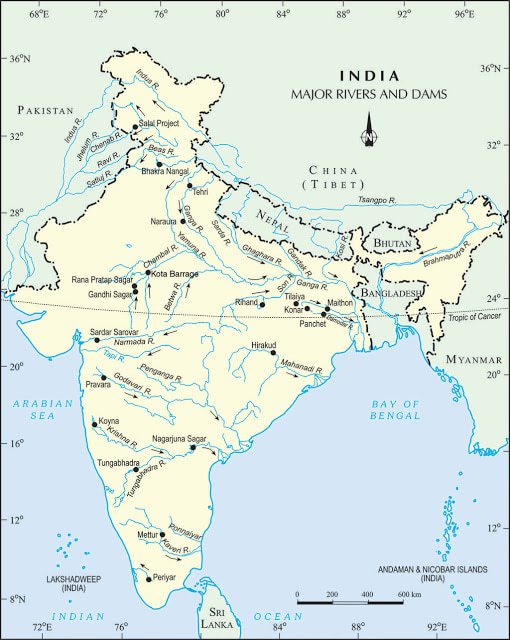 Source
A List of Important River Water Projects in India:
Project River Related State Bansagar Project Son Bihar Uttar Pradesh
Madhya Pradesh
Bargi Project Bargi Madhya Pradesh Beas Project Beas Haryana Punjab
Rajasthan
Bhadra Project Bhadra Karnataka Bhakhra Nangal Project Sutlej Punjab, Himachal Pradesh ,
Haryana,
Rajsthan
Bheema Project Pawana Maharashtra Chambal Project Chambal Rajasthan Madhya Pradesh
Damodar Ghati Project Damodar Jharkhand West Bengal
Dulhasti Project Chinab Jammu & Kashmir Durga Barrage Project Damodar West Bengal Jharkhand
Farakka Project Ganga, Bhagirathi West Bengal Gandak Project Gandaki Bihar, Uttar Pradesh Ganga Sagar Project Chambal Madhya Pradesh Ghatprabha Project Ghatprabha Karnataka Girna Project Girna Maharashtra Hansdev Bango Project Hansdev Madhya Pradesh Hidkal Project Ghatprabha Karnataka Hirakud Project Mahanadi Orissa Idduki Project Periyar Kerala Indira Gandhi Canal Project Satlaj Rajasthan Punjab
Haryana
Jawahar Sagar Project Chambal Rajasthan Jayakwadi Project Godawari Maharashtra Kakrapara Project Tapti Gujrat Kangsawati Project Kangsawati West Bengal Kol Dam Project Sutlaj Himachal Pradesh Kosi Project Kosi Bihar & Nepal Koyana Project Koyana Maharashtra Krishna Project Krishna Karnataka Kunda Project Kunda Tamilnadu Let Bank Ghaghra Canal Ganaga Uttar Pradesh Madhya Ganaga Canal Ganaga Uttar Pradesh Mahanadi Delta Project Mahanadi Odisha Malprabha Project Malprabha Karnataka Mandi Project Vyas Himachal Pradesh Matatilla Project Betwa Uttar Pradesh Madhya Pradesh
Mayurakshi Project Mayurakshi West Bengal Minimato Bango Hasdeo Project Hasdeo Bango river Madhya Pradesh Muchkund Project Muchkund Odisha Andhra Pradesh
Nagarjunsagar Project Krishna Andhra Pradesh Nagpur Power Project Koradi Maharashtra Narmada Sagar Project Narmada Madhya Pradesh Gujarat
Nathpa Jhakri Project Sutlaj Himachal Pradesh Panam Project Panam Gujarat Panama Project Panama Gujarat Panchet Project Damodar Jharkhand West Bengal
Pong Project Beas Punjab Poochampad Project Godawari Andhra Pradesh Purna Project Purna Maharashtra Rajasthan Canal Project Sutlej, Vyas, Ravi Rajasthan Punjab
Haryana
Ramganga Project Ramganga Uttar Pradesh Rana Pratap Sagar Project Chambal Rajsthan Ranjeet Sagar Project Ravi Punjab Rihand Project Rihand Uttar Pradesh Salal Project Chenab Jammu & Kashmir Sardar Sarovar Project Narmada Madhya Pradesh Maharashtra
Rajasthan
Sarhind Project Sutlaj Haryana Sharawati Project Sharawati Karnataka Sharda Project Sharda, Gomti Uttar Pradesh Shivsamundram Project Kaveri Karnataka Sutlaj Project Chinab Jammu & Kashmir Tawa Project Tawa Madhya Pradesh Tehri Dam Project Bhagirathi Uttarakhand Tilaiya Project Barakar Jharkhand Tulbul Project Chinab Jammu & Kashmir Tungbhadra Project Tungbhadra Andhra Pradesh. Karnataka
Ukai Project Tapti Gujarat Upper Penganga Project Penanga Maharashtra Uri Power Project Jhelum Jammu & Kashmir Vyas Project Vyas Rajasthan Punjab
Haryana
Himachal Pradesh