💥UPSC 2026, 2027, 2028 UAP Mentorship (March Batch) + Access XFactor Notes & Microthemes PDF

Search results for: “”

  • 5 Oct 2016 | GS2 | There are many regulatory bodies in India, such as SEBI, TRAI etc. Why are they necessary? Discuss issues relating to their independence given that the government appoints their heads and there may be a conflict of interest.

    GS2 (Statutory, regulatory and various quasi-judicial bodies)

    There are many regulatory bodies in India, such as SEBI, TRAI etc. Why are they necessary? Discuss issues relating to their independence given that the government appoints their heads and there may be a conflict of interest.

    Best answer

    Ashutosh Namdeo wrote the best answer for this question and got a score of 4.5/10 (if the best answer is an image, it cannot be uploaded here, hence scroll down to see those). The answer is being reproduced below for everyone’s convenience. Of course these answers can always be improved. (Best answer  of a particular only involves those given on that day, later answers may not have been checked)

    Legislators India acknowledging the importance of regulation has enacted many law establishing regulator for various sectors. Regulation serve following purposes–
    a)it makes governance comprehensive
    b)protects consumer interest in case of monopoly or otherwise
    c)ensure growth path is sustainable
    d)resolution of dispute between companies
    e)issue guidelines in sync with global best practices
    f)facilitate mergers and acquisitions
    g)governance of entity during the transition period in case of default of entity
    Many regulators such as SEBI, RBI, TRAI, FSSAI etc. have been established in India
    Vigilance of sebi has been lauded by many in recent Sahara case. RBI has been playing a key role in containing the inflation and restructuring of banks. Competition commission of India has effectively carried out its mandate, recently it imposed penalty on cement companies for attempting cartelisation. FSSAI approval of food product is assurance of their safety.Independence of regulator—
    a)no political interference
    b)prompt decision making, effective management
    c)better monitoring and targeting of guidelines
    However too much freedom to regulator can backfire in following ways–
    a)conflict between regulator and executive thus burdening already burdened judiciary
    regulator going out of its jurisdiction
    b)Regulator may seek favour from particular entity
    c)security of nation may be compromised
    d)regulator will not be liable to respond to immediate public crisis as it may continue to follow its long term strategy in such a situation
    There is a need to strike a balance as a regards the powers of regulators

  • 5 Oct 2016 | GS1 | India is a land of diversity. People speak different languages, have different beliefs etc, but are still united as Indians. What are the factors responsible for this unity?

    GS1 (Consolidation within the country)

    India is a land of diversity. People speak different languages, have different beliefs etc, but are still united as Indians. What are the factors responsible for this unity?

    Best answer

    Shashank Pander wrote the best answer for this question and got a score of 4/10 (if the best answer is an image, it cannot be uploaded here, hence scroll down to see those). The answer is being reproduced below for everyone’s convenience. Of course these answers can always be improved. (Best answer  of a particular only involves those given on that day, later answers may not have been checked)

    Winston Churchill once said that India because of its Multi culturalism India would not be able to remain integrated as a nation. However, 69 years post independence the nation and the unity survives despite linguistic, religious, ethnic, and social diversity, mainly because:
    1. Cross dependence of any parameter of diversity: It is very difficult to demarcate where religious, linguistic or ethnic boundaries start or end. A Muslim in Tamil Nadu finds linguistic fraternity with the locals, while a Christian in Meghalaya has religious concurrence with Kerala. Thus, sub nationalities could not be formed.
    2. Historical: India has had a definite geographical existence and since centuries the various strands of society have forged a common sociological and existential presence. -> difficult to divide along any lines.
    3. Geographically, it has a separate entity marked from Himalayas to Peninsula -> lesser divergence.
    4. Economic interdependence is perhaps the most unique feature. The carpenters in Bhadohi, the Banarasi saree workers in Varanasi are Muslims although the owners are upper caste Brahmins. Such interdependence is difficult to be broken.
    5. Linguistic states that were marked in 1956 has given a sense of common allegiance to the Nation, as people could assert themselves using their linguistic nationalism. It has strengthened the nation concept.
    6. Democracy: It does not allow anger to former as people have their right that can be exercised.
    7. Constitutional provisions like Article 15/16, Arricle 25-30 and the concept of positive “secularism”.
    8. The cosmopolitan culture among the youths has also diffused the foundries to a large extent.
    9. The ethos of “Sarva Dharma Sambhava”, “Ek Bharat, Shreshta Bharat” and general principles of inclusiveness of Indian culture have also helped maintain the unity in diversity.

    However, with the advent of indicvidualistic lifestyles and virtual world presence, it has put strain on the age old fraternity led and community living principles. In such challenging times, it becomes important to address the issues of any region/religion/community in timely manner and prevent any marginalisation.

  • 5 Oct 2016 | Prelims Daily: CA Questions with Tikdams & Tidbits

    Dear students,

    When you submit your answer, if possible, give some reasoning & more info. along with the ABACAA format. Elaborate on what you know. This helps the whole community to know more and learn more!


    Q.1) Consider following statements with reference to Monetary policy committee.

    1. Government amended the RBI Act to hand over the job of monetary policy-making in India to a newly constituted Monetary Policy Committee (MPC).

    2. MPC is entrusted with the task of fixing the benchmark policy interest rate (repo rate) to contain inflation within the specified target level.

    3. RBI set up an Expert Committee under N.S.Vishwanathan to revise the monetary policy framework.

    Which of the statements given above is/are correct?  

    a) 1 and 2 only

    b) 3 only

    c) 2 and 3 only

    d) 1, 2 and 3 only


    Q.2) Recently, Japanese researcher won the Nobel Medicine Prize. Consider the following statements with regard to this.

    1. Yoshinori Ohsumi won Nobel prize for his pioneering work on autophagy.

    2. Autophagy is a process whereby cells eat themselves which when disrupted can cause Parkinson’s and diabetes.

    3. A Nobel laureate Christian de Duve coined the term ‘autophagy’.

    Which of the statements given above is/are correct?  

    a) 1 and 2 only

    b) 3 only

    c) 2 and 3 only

    d) 1, 2 and 3 only


    Q.3) Consider following statements with regard to Global Initiative of Academic Networks (GIAN).

    1. GIAN aims at tapping the talent pool of scientists and entrepreneurs to engage with the institutes of higher education in India.

    2. GIAN initiative launched by Ministry of Science and Technology.

    Which of the statements given above is/are correct?  

    a) 1 only

    b) 2 only

    c) Both 1 and 2

    d) Neither 1 nor 2


    Q.4) Colombia is frequently in the news. It shares borders with

    1. Venezuela

    2. Panama

    3. Ecuador

    4. Bolivia

    5. Peru

    Select the correct answer using the codes given below.

    a) 1,2 and 4

    b) 2, 4 and 5

    c) 1, 2, 3 and 5

    d) 1,2,3 and 4 only


    Q.5) Recently, The International Buddhist Conclave-2016, opened its sessions in

    a) Bodh Gaya

    b) Nalanda

    c) Sarnath

    d) Lumbini


    IMPORTANT STUFF: 

    1. These questions are mostly derived from our daily newscards. Reading daily news from Civilsdaily’s App (click here) or website + solving these questions will help you reinforce the basics.

    2. For a comprehensive preparation of IAS Prelims 2017 – consider joining one of the three Prelims Modules by CD – prelims.civilsdaily.com

    3. Solutions of today’s Prelims Daily – Click here

    4. For attempting previous Prelims Daily Questions – Click here

    5. What are tikdams? Read this, this and this

  • First timers to IAS Prep? Prepare Indian Agriculture for GS Mains with me!

    I will maintain a link list of all post written under this theme, here – 

    #1. Indian Agriculture 101 – What’s NPF, PMKSY, CCEA and CACP?

    #2. Indian Agriculture 102 – India’s Green Revolution and National Food Security Mission

    #3. Indian Agriculture 103 – What is Rashtriya Krishi Vikas Yojna (RKVY) and is it any good?

    #4. Indian Agriculture 104 – Everything that you need to know about Drought Management in India

    #5. Irrigation In India: Issues & Developments – Read the backgrounder on Neeranchal Watershed Project

    #6. 8 Types of Farming in India


    Hello,

    Indian Agriculture, as we all would agree is a topic that haunts us all (second only to Environment & Biodiversity). Here is an attempt to understand the economics, policy making etc. of this very, very important sub-segment of Indian Economics for GS Mains.

    I find that most of the newbies have no idea about how to cover this portion which involves – schemes by ministries, economics around it, op-eds and cross examinations of success and failures.

    I will be using a standard source – The Annual Report of Ministry of Agriculture [Pdf here].

    There is absolutely no need to go for Indian Economy reference books or wait for that big fat India Year Book to come out to understand Indian Agriculture. In fact, Dr. V strongly advices against using the IYB!

    The Ministry’s report is an amazing piece of art! I won’t be covering it linearly but would be touching upon the IAS Pre and Mains aspects of the syllabus to extract maximum juice for all of us. We will discuss things like difference between CECA and CACP, reason behind new crop insurance schemes and will cover things in tidbits format for an easy recall.


    PS: All Blogs are accessible from Web and App

    PPS: Please do leave your comments on the blog. Participate in the questions which are posed between the lines and let me know if you liked what you read.


  • Indian Agriculture 101 – What’s NPF, PMKSY, CCEA and CACP?

    We know that  54.6% of India’s population is engaged in agriculture and allied activities (census 2011) and it contributes 17.4% to the country’s Gross Value Added.

    That’s the very first line we read in any policy document/ economic survey chapter related to Agriculture and to an uninitiated, this strikes as an ironical play of numbers.

    More than half of our population is engaged in something which adds less than 20% value to our country’s economy? Why don’t we just outsource our food supplies to other nations and educate the next gen farmers to write code and sell IT software so that we make more money!

    If I tell you that, the %age share kept on decreasing year over year – you would be amused still.


    Don’t worry. A fall in the share of the agriculture and allied sector in GVA is an expected outcome in a fast growing and structurally changing economy. This means that we as a country have more avenues of value creation. Which is good, right?

    Before we go on further, you may wonder what these allied activities are?

    The allied industries are all the small and medium enterprises that depend directly or indirectly on the activity of Agriculture.

    When you think of paddy crop – you don’t just think of paddy but also of the labour it employs, the fertilizer industry which it calls for, the sales agencies, the pesticides folks etc. All these come into allied industry.

    Got it? Now chew on this and prepare yourself for a Prelims MCQ on allied industry!


    At this point, we have a vague idea that monsoons being a notorious variable in the agriculture space, most of the times we aren’t able to meet our targets, farmers go in distress, reality bites when we see videos of farmer suicides and we salute people like Nana Patekar & co. who go out of their way to allay the concerns of their families. We wonder about govt. schemes, insurance policies, family welfare programs and why they are not in play etc. etc.

    But being an aspiring bureaucrat, you need to know your basics first.

    National Policy for Farmers (NPF), 2007

    Major aims: To improve economic viability of farming and increase net income of farmers. This is like the umbrella policy. It’s a national level scheme and many of the existing schemes which you hear about in papers etc. are being run under this.

    I never knew that Pradhan Mantri Krishi Sinchayee Yojana (PMKSY), Kisan Credit Card, Pradhan Mantri Fasal Bima Yojana (PMFBY) etc etc. are all part of this. You tend to miss on such information but now you know.

    Can you imagine the expanse of this National Policy?

    No one is going to ask you to list down its policy objectives, but this is a great way of stepping into a senior bureaucrat’s shoes and understand the gamut of activities he/ she needs to keep in his/her mind while drafting a policy document.

    As we start this series and write more chapters, we will be covering the Prelims and Mains worthy aspects of these 14 policy objectives. When you are done, you can come back, read each line and recall what we covered.

    Policy provisions in NPF-2007 include:

    1. Asset reforms in respect of land, water, livestock, fisheries and bio-resources;
    2. Supply of good quality seeds and disease-free planting material, Issue of soil health passbooks to the farmers and integrated pest management system;
    3. Region and crop specific implements and machinery;
    4. Support services for women;
    5. Timely, adequate and easy reach of institutional credit at reasonable interest rates and farmer-friendly insurance instruments;
    6. Support services and inputs like application of frontier technologies; agricultural bio-security system;
    7. Use of Information and Communication Technology (ICT) and setting up of farm schools to revitalize agricultural extension;
    8. Coverage of farmers under a comprehensive national social security scheme;
    9. Effective implementation of Minimum Support Price (MSP) across the country and establishing community foodgrain banks;
    10. Development of agricultural market infrastructure and terminal markets for agriculture;
    11. Curriculum reforms in agricultural universities;
    12. Special categories of farming like organic farming and contract farming;
    13. Rural non-farm employment initiative for farm households; and
    14. Integrated approach for rural energy

    100 bucks say that you overlooked these 14 points! But think for a moment – in any mains or essay question based on agriculture – these themes are going to recur. This is a national level policy instituted in 2007 and it is still in play, which means that these idealistic goals have still not been achieved. That’s 14 points for you to rattle off to anyone who asks you about the “agricultural issues that need our attention!”


    Moving on, the first chapter of the annual report mentions some important schemes, committees, jargons etc which need our attention. Let’s understand them in tidbits before we move on.

    [Tidbits] Pradhan Mantri Krishi Sinchayee Yojana (PMKSY)
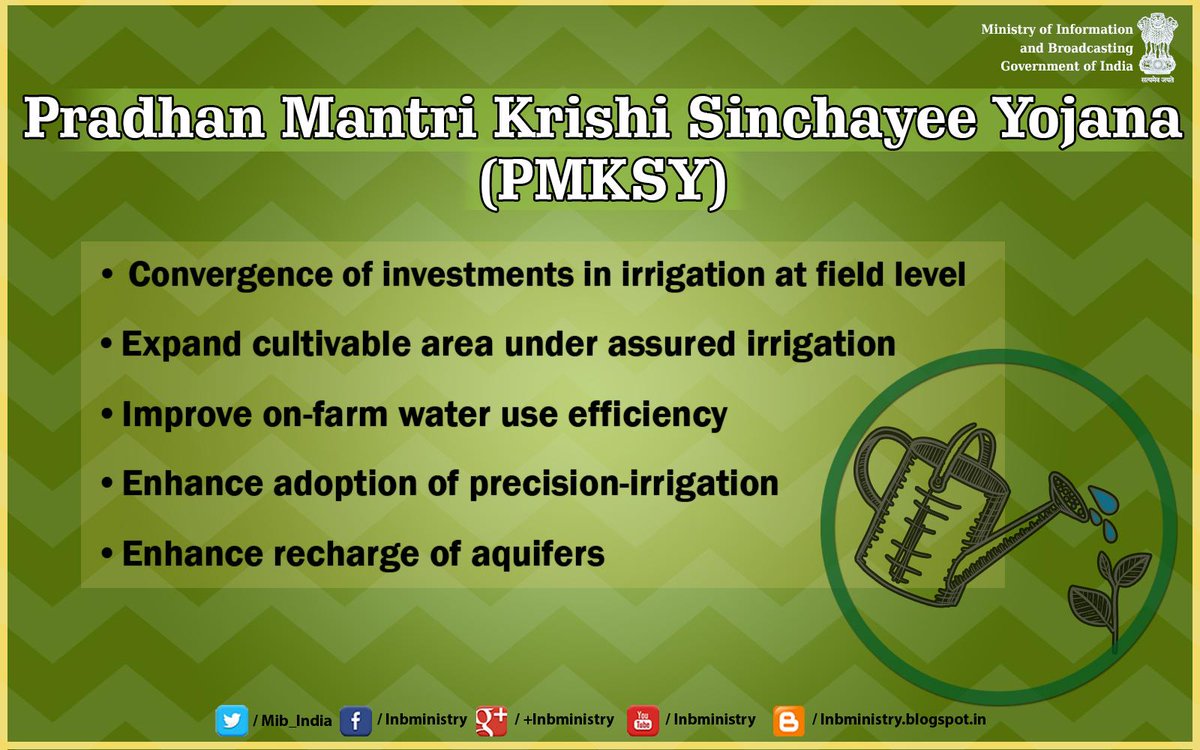
    source
    • The scheme has been approved with an outlay of Rs. 50,000 crore for a period of 5 years
    • What’s an outlay? 
    • Cabinet Committee on Economic Affairs (CCEA) gave approval to that outlay. CCEA is chaired by PM
    • Ministries involved? 
      • Ministry of Rural Development
      • MoWR RD & GR
      • Ministry of Agriculture

    Usually when multiple ministries are involved – it’s a case of amalgamation of a lot of schemes into one. For instance, here – PMKSY has been formulated amalgamating ongoing schemes:

    • Accelerated Irrigation Benefit Programme (AIBP) of the Ministry of Water Resources
    • River Development & Ganga Rejuvenation (MoWR,RD&GR)
    • Integrated Watershed Management Programme (IWMP) of Department of Land Resources (DoLR)
    • On Farm Water Management (OFWM) of Department of Agriculture and Cooperation (DAC)

    You want to read more on this – Achieving the goals of- Per drop more crop & Har khet ko paani

    [Tidbits] Kisan Credit Card

    source

    Answer this question –

    In India, which of the following have the highest share in the disbursement of credit to agriculture and allied activities?

    • Commercial Banks
    • Cooperative Banks
    • Regional Rural Banks
    • Microfinance Institutions

    KCC is implemented by Commercial Banks, Cooperative Banks and Regional Rural Banks. I hope you know that Commercial Bank includes the Public Sector Banks in its definition.

    [Tidbits] Crop Insurance in India

    We will study this in great detail later but very, very quickly:

    • The existing crop insurance schemes have recently been reviewed – This is important to note otherwise we keep reading outdated stuff and confuse among the many names and schemes!
    • Earlier we had National Crop Insurance Programme (NCIP) and it had many schemes under it:
      • Modified National Agricultural Scheme (MNAIS)
      • Weather Based Crop Insurance Scheme (WBCIS)
      • Coconut Palm Insurance Scheme (CPIS)
    • Now forget all the above because the flavour of the day is – Pradhan Mantri Fasal Bima Yojana (PMFBY)

    source

    “This is a historic day. I am confident that this scheme, which is inspired by the consideration of farmers’ benefit, will bring about a major transformation to the lives of farmers,” – PM’s Tweet

    There are a few significant features about the new scheme and this will make it both – farmers’ friendly and a game-changer in the long run. How does this scheme overcomes the shortcomings of previous scheme? What makes it a game changer? Read this blog to understand in detail – Pradhan Mantri Fasal Bima Yojana – Min Premium, Max Insurance

    [Tidbits] What should I know about Commission for Agricultural Costs and Prices?

    • CACP is mandated to advise on the price policy (MSP) of 23 crops under 5 groups of commodities namely
      • Kharif crops,
      • Rabi crops,
      • Sugarcane,
      • Raw Jute and
      • Copra (dried coconut)
    • Please note that for the determination of MSP – cost of production is not the only variable for consideration
    • Other factors: Demand and supply, price trends in the market, both domestic and international, inter-crop price parity etc.

    [Prelims 2009] Consider the following statements:

    1. The Commission for Agricultural Costs and Prices recommends the Minimum Support Prices for 32 crops.
    2. The Union Ministry of Consumer Affairs. Food and Public: Distribution has launched the National Food Security Mission.

    Which of the statements given above is/ are correct?

    1. 1 only
    2. 2 only
    3. Both 1 and 2
    4. Neither 1 nor 2

    What’s the difference between CCEA and CACP?

    • CACP assess the various factors and recommends a MSP (Minimum Support Price) to the Ministry
    • Ministry may either agree or disagree with it and come up with a new price
    • That price then goes to CCEA (Chaired by the PM) and CCEA has the power to approve an MSP

    Clear? Awesome!

    That’s all for this first lesson. We move onto next in a few days but it would be great if you can comment to let me know how you find this! For newbies or oldies, does it feel like it helped understand the Agriculture and various Economic/ Polity angles?


    References: Apart  from extensive research around news articles, the mainstay of this series is the annual report of the Ministry of Agriculture to the GOI – Click to download a copy

    All articles in this series are listed here – First timers to IAS Prep? Prepare Indian Agriculture for GS Mains with me!

  • OLD NCERT

    old ncert-I think that it would not be relevant for ias exam. can you clarify/

  • [IMP] Feedback on Target Mains Initiative

    [Update] Starting today, we have launched a Daily Debate Module – CD Pe Charcha


    Hi, after more than a month of 4 GS questions everyday, and with a great response from people we would like some feedback. Here are some questions for you, please leave the feedback in the comments.

    1. Is the DNA (the Demand and Approach, e.g. DNA) useful? We believe its purpose is to help people new to answer writing get started, and experienced answer writers should not feel the need for it. Its disadvantage is that people use the format and don’t develop question interpretation skills themselves. Some forum members also complain that its use results in similar answer. So here are the questions –

    a) Should we keep the DNA?

    b) If yes should we publish it later in the day so that people can develop interpretation skills themselves?

    c) Or would people new to answer writing prefer things the way it is?

    2. What is your view about the level of difficulty of the questions? Would you like more difficult questions or the present questions are good?

    3. Students who are not attempting the questions, what’s the main reason? Paucity of time/ Lack of basic knowledge? How are you making the best use of this initiative then?

  • 4 Oct 2016 | Target Mains: GS Questions & DNA Framework

    GS1 (Indian Geography)

    The IMD recently got its forecast for this year wrong. India will now get 3% less rain than normal. What are the phenomena that result in variations in Indian monsoon.

    Demand – Discuss all phenomena which can bring variations in monsoon such as La Nina etc.

    Approach

    – Discuss Indian monsoon (4 marks)

    – Reasons for variation, e.g. La Nina, El Nino etc (4 marks)

    – Why was the rainfall low this year? (2 marks)

    GS2 (Government policies)

    The government claims to have gotten almost USD 10 billion in the recent Income Declaration Scheme. What is this scheme? Is this a short term measure only?

    Demand – Give the features of the scheme.

    Approach

    – Need for such a scheme? (4 marks)

    – Features of scheme. (4 marks)

    – Is this a short term measure only? (2 marks)

    GS3 (Disaster and disaster management)

    Pakistan has threatened first use of its nuclear weapons in the case of war with India. Throughout the 20th century the US and USSR did everything possible to avoid using nuclear weapons. What damage would nuclear weapons result in? How would we contain such damage?

    Demand – Damage from nuclear weapons such as the primary explosion, radiation etc to be discussed.

    Approach

    – Explain working of nuclear bomb, why is it so destructive (3 marks)

    – Damages caused by it – heat, shockwave, radiation etc (3 marks)

    – Measures to contain damage (4 marks)

    GS4 (Ethics in public administration)

    “Living up to the public trust is much more than just an act of compliance”. Explain with suitable examples.

    Demand – Public officials should walk the talk.

    Approach –

    – What kind of trust does the public impose on public officials? (5 marks)

    – How can public officials honor that trust? (5 marks)

  • 4 Oct 2016 | GS4 | “Living up to the public trust is much more than just an act of compliance”. Explain with suitable examples.

    GS4 (Ethics in public administration)

    “Living up to the public trust is much more than just an act of compliance”. Explain with suitable examples.

    Best answer

    Kunal Aggarwal wrote the best answer for this question and got a score of 4/10 (if the best answer is an image, it cannot be uploaded here, hence scroll down to see those). The answer is being reproduced below for everyone’s convenience. Of course these answers can always be improved. (Best answer  of a particular only involves those given on that day, later answers may not have been checked)

    Public trust is built by perceptions and image of government offices. Living up to public trust is a challenging task and can not be achieved just by an act of compliance. For example: Creating an online system to receive complaints will not retain public trust if they don’t feel their problems are being resolved. People expect officers to be sensitive to their problems.

    Public trust depends on multitude of factors:
    – Behaviours of front offices with people
    – Problem resolution
    – Approachability of higher officers

    Public expects officers to work for public interest and in that they are expected to do much more than what is just required by law or his duties. For example: New initiatives to improve the system, understanding the areas of work are considered important.

    Officers need to be prudent about the administration and have to avoid or resolved accusations of illegal or unjust behaviour. If an honest officer is named in corruption cases, it will be important for her to prove those charges wrong to earn trust. Following the duties without countering those charges would erode public trust in the office.

  • 4 Oct 2016 | GS3 | Pakistan has threatened first use of its nuclear weapons in the case of war with India. Throughout the 20th century the US and USSR did everything possible to avoid using nuclear weapons. What damage would nuclear weapons result in? How would we contain such damage?

    GS3 (Disaster and disaster management)

    Pakistan has threatened first use of its nuclear weapons in the case of war with India. Throughout the 20th century the US and USSR did everything possible to avoid using nuclear weapons. What damage would nuclear weapons result in? How would we contain such damage?

    Best answer

    Simran Bains wrote the best answer for this question and got a score of 4/10 (if the best answer is an image, it cannot be uploaded here, hence scroll down to see those). The answer is being reproduced below for everyone’s convenience. Of course these answers can always be improved. (Best answer  of a particular only involves those given on that day, later answers may not have been checked)

    DAMAGE-

    -Loss of life and property. Loss of animals.

    -Destruction of environment, loss of habitable land.

    -Radiations can extend to other nations as well.

    -(If India does not retaliate against the nuclear strike) Huge population loss, contamination of land and water, spread of health problems that will continue to exist for decades and centuries. Genetic disorders, reproductive disorders.

    -(High chances that India will retaliate) Radiations might reach Iran and Afghanistan. Mutually assured destruction.

    -Likely that Pakistan will disappear from world map.

    -Indian economy might see a massive hit.

    CONTAINING THE DAMAGE-

    -Calculating the damage. Stopping nuclear risks. Saving lives.

    -Evacuation of the survivors.

    -Using nuclear weapons against a country takes hours and sometimes days. The moment Pakistan decided to nuke India, Indian allies will inform India, and Intelligence agencies can prepare at their best levels to minimize the damage and retaliate.

    -Preparation of emergency aid. Relief package, medication, clean water and safe food.

More posts
