💥Mains Ready By December. Smash Mains & Smash PYQ Admissions Open

Search results for: “”

  • CSE Prelims 2020 Deferred – New date to be announced on 20th.

    Click to fill the form: Samanvaya for IAS 2021

    The official UPSC website – https://www.upsc.gov.in/

    has a yellow strip running the announcement that

    The Civil Services (Prel.) Examination-2020, scheduled to be held on 31/05/2020, stands deferred. Decision on fresh date of the Examination will be made available on 20/05/2020 after assessing the situation.

    Video for the same is attached –

    It was logical plus we knew it from our sources that the exam would be shifted. However, we didn’t want to disclose this because regardless of the shifting of the exam, your study schedule should remain the same.

    Over 80% of our students have already communicated with us on changes in strategy and how they should optimize in these uncertain times.  

    You just have to take 5 minutes out and fill this form: Samanvaya For IAS 2021. Go ahead. Dont wait for anyone.

  • Why liquor sale matters to states?

    Following the ease of restrictions in the third phase of the nationwide lockdown, some of the most striking images showed long queues outside liquor stores around the country. The Delhi government announced a 70% hike in the price of liquor across categories in the capital.

    Aspirants must note:

    1. Purview of Excise duty (i.e. Petroleum and Liquor)

    2. Excise duty before and after GST regime

    3. Sources of state revenue etc.

    4. Argument relating to inclusion of Liquor in GST

    Why liquor matters?

    • Delhi’s “special corona fee” on alcohol underlines the importance of liquor to the economy of the states.
    • Manufacture and sale of liquor is one of the major sources of their revenue, and the reopening comes at a time when the states have been struggling to fill their coffers amid the disruption on account of the lockdown.

    How do states earn from liquor?

    • Liquor contributes a considerable amount to the exchequers of all states and UTs except Gujarat and Bihar, both of which have enforced prohibition.
    • Generally, states levy excise duty on manufacture and sale of liquor.
    • Some states, for example, Tamil Nadu, also impose VAT (value-added tax).
    • States also charge special fees on imported foreign liquor; transport fee; and label & brand registration charges.
    • A few states, such as UP, have imposed a “special duty on liquor” to collect funds for special purposes, such as maintenance of stray cattle.

    Share in revenue

    • A report published by the RBI last year shows that state excise duty on alcohol accounts for around 10-15 per cent of Own Tax Revenue of a majority of states.
    • In fact, the state excise duty on liquor is the second or third largest contributor to the category State’s Own Tax revenue; sales tax (now GST) is the largest.
    • This is the reason states have always wanted liquor kept out of the purview of GST.

    What exactly is State Excise?

    • Excise duty on alcohol, alcoholic preparations, and narcotic substances is collected by the State Government and is called “State Excise” duty.
    • For most of the states, excise duty is the second largest tax revenue after sales taxes (state VAT).
    • Besides, a substantial amount comes from licences, fines and confiscation of alcohol products.

    What has changed with the State Excise after the GST regime?

    • At the central level, excise duty earlier used to be levied as Central Excise Duty, Additional Excise Duty, etc.
    • However, the Goods and Services Tax (GST), introduction in July 2017, subsumed many types of excise duty. Today, excise duty applies only on petroleum and liquor.
    • Excise duty was levied on manufactured goods and levied at the time of removal of goods, while GST is levied on the supply of goods and services.
    • Alcohol does not come under the purview of GST as exclusion mandated by constitutional provision.
    • States levy taxes on alcohol according to the same practice as was prevalent before the rollout of GST.
    • After GST was introduced, central excise duty was replaced by Central GST because excise was levied by the central government. The revenue generated from CGST goes to the central government.

    What are the other sources of revenue for the states?

    • The states’ revenues comprise broadly two categories — Tax Revenue and Non-Tax Revenue.
    • Tax revenue is divided into two further categories: State’s Own Tax Revenue, and Share in Central Taxes.
    • Again, Own Tax Revenue comprises three principal sources:

    1) Taxes on Income (agricultural income tax and taxes on professions, trades, callings and employment);

    2) Taxes on Property and Capital Transactions (land revenue, stamps and registration fees, urban immovable property tax); and

    3) Taxes on Commodities and Services (sales tax, state sales tax/VAT, central sales tax, a surcharge on sales tax, receipts of turnover tax, other receipts, state excise, taxes on vehicles, taxes on goods and passengers, taxes and duties on electricity, entertainment tax, state GST, and “other taxes and duties”).


    Back2Basics: What is Excise Duty?

    • Excise duty is a form of tax imposed on goods for their production, licensing and sale.
    • It is the opposite of Customs duty in sense that it applies to goods manufactured domestically in the country, while Customs is levied on those coming from outside of the country.
    • At the central level, excise duty earlier used to be levied as Central Excise Duty, Additional Excise Duty, etc.
    • Excise duty was levied on manufactured goods and levied at the time of removal of goods, while GST is levied on the supply of goods and services.

    Purview of excise duty

    • The GST introduction in July 2017 subsumed many types of excise duty.
    • Today, excise duty applies only on petroleum and liquor.
    • Alcohol does not come under the purview of GST as exclusion mandated by constitutional provision.
    • States levy taxes on alcohol according to the same practice as was prevalent before the rollout of GST.
    • After GST was introduced, excise duty was replaced by central GST because excise was levied by the central government. The revenue generated from CGST goes to the central government.

    Types of excise duty in India

    Before GST kicked in, there were three kinds of excise duties in India.

    1) Basic Excise Duty

    • Basic excise duty is also known as the Central Value Added Tax (CENVAT). This category of excise duty was levied on goods that were classified under the first schedule of the Central Excise Tariff Act, 1985.
    • This duty was levied under Section 3 (1) (a) of the Central Excise Act, 1944. This duty applied on all goods except salt.

    2) Additional Excise Duty

    • Additional excise duty was levied on goods of high importance, under the Additional Excise under Additional Duties of Excise (Goods of Special Importance) Act, 1957.
    • This duty was levied on some special category of goods.

    3) Special Excise Duty

    • This type of excise duty was levied on special goods classified under the Second Schedule to the Central Excise Tariff Act, 1985.
    • Presently the central excise duty comprises of a Basic Excise Duty, Special Additional Excise Duty and Additional Excise Duty (Road and Infrastructure Cess) on auto fuels.
  • Non-Aligned Movement (NAM) Virtual Summit

    PM Modi has for the first addressed the Non-Aligned Movement (NAM) summit since assuming office in 2014.

    Possible mains question-

    Q. Non-Aligned Movement (NAM) has lost its relevance in the new era of multipolar world. Comment.

    Highlights of the online summit

    • The online NAM Contact Group Summit on “United against COVID-19” was hosted by current NAM Chairman and Azerbaijan President Ilham Aliyev.
    • The NAM leaders announced the creation of a task force to identify requirements of member countries through a common database reflecting their basic medical, social and humanitarian needs in the fight against COVID-19.

    What is the Non-Aligned Movement (NAM)?

    • The NAM is a forum of 120 developing world states that are not formally aligned with or against any major power bloc.
    • The group was started in Belgrade, Yugoslavia in 1961.
    • After the UN, it is the largest grouping of states worldwide.

    Its formation

    • NAM emerged in the context of the wave of decolonization that followed World War II.
    • It was created by Yugoslavia’s President, Josip Broz Tito, India’s first PM, Jawaharlal Nehru, Egypt’s second President Gamal Abdel Nasser, Ghana’s first president Kwame Nkrumah, and Indonesia’s first President, Sukarno.
    • All five leaders believed that developing countries should not help either the Western or Eastern blocs in the Cold War.
    • As a condition for membership, the states of the NAM cannot be part of a multilateral military alliance (such as the NATO) or have signed a bilateral military agreement with one of the “big powers” involved in Great Power conflicts.
    • However, its idea does not signify that a state ought to remain passive or even neutral in international politics.

    Terms of summits

    • Unlike the UN or the Organization of American States, the NAM has no formal constitution or permanent secretariat.
    • All members of the NAM have equal weight within its organization.
    • The movement’s positions are reached by consensus in the Summit Conference of Heads of State or Government, which usually convenes every three years.
    • The administration of the organization is the responsibility of the country holding the chair, a position that rotates at every summit.
    • The ministers of foreign affairs of the member states meet more regularly in order to discuss common challenges, notably at the opening of each regular session of the UN General Assembly.

    Its relevance today

    • One of the challenges of the NAM in the 21st century has been to reassess its identity and purpose in the post-Cold War era.
    • The movement has continued to advocate for international cooperation, multilateralism, and national self-determination, but it has also been increasingly vocal against the inequities of the world economic order.
    • On the contrary, from the founding of the NAM, its stated aim has been to give a voice to developing countries and to encourage their concerted action in world affairs.
  • How Remdesivir tricks coronavirus?

    A new research has found how Remdesivir treats coronavirus and described the exact mechanism of interaction between the virus and the drug.   Remdesivir is an experimental antiviral made by American pharmaceutical firm Gilead Sciences that was first developed to treat Ebola.

    DNA/RNA related terminologies, Genes and Genomes, etc. always find their way in UPSC Prelims.  Most recent one was-

    With reference to the recent developments in science, which one of the following statements is not correct? (CSP 2019)

    (a) Functional chromosomes can be created by joining segments of DNA taken from cells of different species.

    (b) Pieces of artificial functional DNA can be created in Iaboratories.

    (c) A piece of DNA taken out from an animal cell can be made to replicate outside a living cell in a laboratory.

    (d) Cells taken out from plants and animals can be made to undergo cell division in laboratory petri dishes.

    How Remdesivir kills coronavirus?

    • Remdesivir is designed to obstruct the stage of replication, when the virus creates copies of itself, followed endlessly by the copies creating copies of themselves.

    How does replication take place?

    • Once the virus enters the human cell, it releases its genetic material, which is then copied using the body’s existing mechanism.
    • At every stage of infection, various human proteins, virus proteins, and their interactions come into play.
    • At the replication stage, the key viral protein at play is an enzyme called RdRp (an enzyme is a kind of protein that speeds up chemical reactions within a cell).
    • It is RdRp that makes the copies, by processing components of the RNA of the virus.
    • University of Alberta researchers called it the “engine” of the virus in a paper last week, in which they described the action of Remdesivir against this “engine”.
    • In scientific literature, such an enzyme is called a polymerase (the p is RdRp stands for polymerase) or a replica.
    • In any case, this is the enzyme that is targeted by Remdesivir.

    And how exactly does Remdesivir target this enzyme?

    • In order to replicate, the virus processes raw material from the virus RNA, broken down by another enzyme with that specific function.
    • When a patient is given Remdesivir — the inhibitor — it mimics some of this material and gets incorporated in the replication site.
    • With Remdesivir replacing the material it needs, the virus fails to replicate further.
    • These coronavirus polymerases are sloppy and they get fooled, so the inhibitor gets incorporated many times and the virus can no longer replicate.
  • [Burning Issue] The COVID chapter in Indian Diplomacy

    The outbreak and spread of COVID-19 has created multiple challenges for the entire world. Apart from primary challenges like containing the spread of the virus and treating infected patients, there are rising political issues such as the blame game between US and China, crumbling role of WHO and questions about the future world order. Amid this entire crisis, India has been playing an important role as reflected in the praises being heaped on our PM from worldwide, paving way for stronger future partnerships. This also creates an opportunity for India’s so-called “medical diplomacy” which is already growing at an unprecedented scale.

    Background

    • The spread of COVID at lightning speed has exposed the void in collective leadership at the global level.
    • The contemporary global order and institutions have proved to be hegemonic exercises meant to deal with isolated political and military crises but failed to serve humanity at large.
    • To top it all, the worst nativist tendencies of the global leaders are visible in the face of this major crisis.
    • The fact that UNSC took so long to meet (that too inconclusively) to discuss the pandemic is a ringing testimony to the UN’s insignificance.
    • In this global chaos, India’s handling of the pandemic and its bilateral moves, shows India’s mettle to awaken the conscience of the superpowers and catalyse collective global action.

    The World on its knees (credits COVID-19)

    Fall of WHO

    • WHO is under criticism for giving China too much benefit of the doubt at the beginning of this pandemic.
    • At the center of public outrage, WHO is now being mimicked as “Chinese Health Organisation” even as it is at the forefront of fighting its worldwide spread.
    • The largest contributor to WHO’s finance, the US has halted its funding making WHO a paper organisation.

    The Trumplomacy

    • The US decision to suspend contributions to the WHO is an extraordinary act of moral abdication and international vandalism at a time when the world desperately needs to find means of working together.
    • From unnecessary trade war to an increasingly desperate coronavirus war, US and China are trapped in a blame game with no easy way out.
    • Weakened economically and politically after COVID-19, U.S.’s capacity to play a critical role in world affairs is diminishing.

    EU woes

    • The EU, the most progressive post-national regional arrangement, stood clueless when the virus spread like wildfire in Europe.
    • Its member states turned inward for solutions: self-help, not regional coordination, was their first instinct.
    • These regional institutions haven’t fared any better in the past as well.
    • Europe, in the short and medium-term, will prove incapable of defining and defending its common interests, let alone having any influence in world affairs.

    Problems in West Asia

    • In West Asia, both Saudi Arabia and Iran are set to face difficult times.
    • The oil price meltdown will aggravate an already difficult situation across the region.
    • There may be no victors, but Israel may be one country that is in a position to exploit this situation to its advantage.
    • Israel could exploit this situation to strengthen its control over Palestine (benefiting from its dependency) and crush the Hamas.

    Looming global depression

    • Neoliberal economic globalization may face a major beating in the wake of the pandemic and signs of the global recession are eminent.
    • The pre-existing structural weakness of the global order will further feed states’ protectionist tendencies fueled by hyper-nationalism.

    The Great Strategist: China

    • China is seeking to convert its ‘failure’ into a significant opportunity. This is Sino-centrism at its best, or possibly its worst for the world.

     Point in Case

    • China has surprisingly accelerated its movements in the South China Sea.
    • It plans using its manufacturing capability to its geo-economic advantage.
    • There are enough reports of China’s intentions to acquire financial assets and stakes in banks and companies across the world amid crisis.
    • Shares in HDFC: India seems to have woken up only recently to this threat after the Peoples’ Bank of China acquired a 1% stake in India’s HDFC.

    Taking advantage of RCEP and Belt and Road Initiative

    • Restricting hostile takeovers may not be adequate to checkmate China.
    • It is poised to dominate the Regional Comprehensive Economic Partnership (RCEP).
    • It will enable China to exploit market access across the Association of Southeast Asian Nations, East Asian nations, Australia and New Zealand.
    • Together with its Belt and Road Initiative, China is ostensibly preparing the way for a China-centric multilateral globalization framework.

    India steps in as a Leader

    • India has been proactive at both the domestic level – the steps taken to tackle the crisis at home — and the diplomatic level — India’s assistance to other countries, especially in the Indian Ocean Region (IOR), amid the pandemic.
    • Despite the existing domestic challenges emanating out of the pandemic, India has decided to render possible help to countries like the US, a few European, African, and Latin American countries, as well as countries in the Middle East by providing medicines and sending medical professionals.

    What steps did India take?

    • The first element of India’s medical diplomacy includes issuing speedy clearances for the export of the anti-malarial drug hydroxychloroquine – seen as useful in the treatment of patients suffering from the novel coronavirus – at the last count to 55 countries.
    • The second element includes dispatch of Indian military doctors teams to countries like Nepal, the Maldives and Kuwait to help local administrations draw up plans to combat the spread of this pandemic.

    India and IOR

    1) Early evacuations

    • One of the first steps taken by India was to evacuate citizens of different countries along with its own citizens from Wuhan, China, the epicentre of the first COVID-19 outbreak.
    • Those evacuated as compassionate cases includes citizens from IOR countries such as Bangladesh, Myanmar, the Maldives, South Africa, and Madagascar.
    • India not only evacuated these people but also quarantined them in India as a precautionary measure before sending them to their respective countries.

    2) Supply of essential medicines

    • India has emerged as a major supplier of medicines to different countries worldwide in the fight against COVID-19.
    • As part of that effort, India was the first responder to Mauritius and Seychelles.
    • Accordingly, India sent a consignment of life-saving drugs, including hydroxychloroquine, to Mauritius and Seychelles.

    3) Settling the neighbourhood irritants

    • In the past few months, India’s relations were strained to owe to Iran and Malaysia’s criticisms of India on CAA issue.
    • However, recently India and Iran cooperated with each other in order to evacuate Indians stranded in Iran.
    • Apart from this, India has sent a wheat consignment to Afghanistan through Iran’s Chabahar port.
    • With respect to Malaysia, India has agreed to supply anti-malarial drugs, indicating an improvement in bilateral relations.

    India and Middle-East

    • While the current Indian government has been placing immense importance on promoting its “Neighborhood First” policy, it is simultaneously strengthening overall cooperation with its “extended neighbours.”
    • This is where the Middle Eastern countries come to the fore.

    Extending the cooperation

    • India’s cooperation with this region has become more comprehensive, moving beyond the oil-energy trade to include military-security ties, maritime cooperation, strategic oil reserves, joint energy exploration projects, and mutual investments.
    • India has dispatched a team of 15 doctors and healthcare professionals to assist the efforts of the Kuwaiti government in its fight against the pandemic.
    • Jordan, UAE and Oman are some of the countries to whom India has supplied hydroxychloroquine (HCQ).
    • Apart from the above-mentioned Arab countries, India has also provided medical-related and humanitarian assistance to Israel, which is one of its largest arms suppliers.

    India and SAARC

    • India has assumed leadership of the South Asian charge against COVID-19.
    • India has backed to set up an emergency fund to fight the rapid spread of Covid-19 pandemic and has pledged $10 million toward this emergency fund.

    India and US

    • India lifted the ban on HCQ, displaying its ability to rise above politics despite Trump’s consistent politicization of COVID-19 response efforts.

    The thought behind Indian Diplomacy

    1) Acting in-principle with Vasudhaiva Kutumbakam

    • At this crucial juncture when almost every part of the globe is engulfed by the deadly COVID-19 pandemic, India has taken a step forward by providing medical assistance to some of its international partners.
    • Precisely, India has been propagating the ancient Sanskrit dictum Vasudhaiva Kutumbakam, meaning “the world is one family.”
    • Such goodwill reflects the evolving nature of the Indian foreign policy, and this has gradually been acknowledged by other countries.

    2) India chose collaboration over confrontation

    • Crises bring out the best and worst in individuals, and the same appears to be the case for nation-states.
    • While rivals China and the US engage in a high-profile war of words amidst the COVID-19 crisis, India has chosen the approach of collaboration over confrontation.
    • This approach also provided India with an opportunity to address the irritants in its ties with countries, most notably Iran and Malaysia.

    3) Being the global pharmacy

    • India is often dubbed “the pharmacy of the world” that produces 70 per cent of the world’s HCQ.
    • The Indian pharma industry is the world’s third-largest drug producer by volume and the country’s market manufactures 60 per cent of vaccines globally.

    4) Addressing the ‘threat everywhere’

    • Covid-19 does not respect borders – even closed ones – and its continued transmission anywhere poses a threat to health everywhere.
    • If the pandemic worsens, intensive international cooperation will be required to get expertise and resources to where they are needed the most – especially as the disease takes root in impoverished countries in the Global South.

    5) Occupying the vacuum generated

    • The COVID-19 crisis presents an opportunity for India. This entire crisis has put the focus on China from different quarters.
    • At present, more and more countries in the world have an unfavourable opinion about China.
    • On the other hand, India has been nimble-footed enough to take this opportunity and build up goodwill, which could result in elevated status in the post-COVID-19 period.

    Conclusion

    • History teaches us that the collective action needed to address this crisis will not just emerge spontaneously – it must be built painfully, step by step, by countries that trust one another and are able to look beyond their own immediate interests.
    • Indian diplomacy has been often accused as a response to the transactional discussions. However, India is making genuine sacrifices to show international solidarity and not to monger profits.
    • India’s foreign policy has instilled this principle in letter and spirit and is acting accordingly because of even the smallest contribution matters.

    Way ahead

    • The new world order is on the way. The spread of concepts like “before corona” and “after corona” will become commonplace.
    • Far-reaching changes can be anticipated in the realm of geo-economics and geopolitics.
    • India is gearing up itself for the emerging challenges on various fronts.
    • The effort and message are clear: India’s careful diplomacy reflects a balance between the country’s values and interests.
    • The Indian act of generosity has turned the world attention towards India and is sure to open doors towards deeper ties around the world in the near future.


    References

    https://www.civilsdaily.com/news/covid-19-and-the-crumbling-world-order/

    https://www.civilsdaily.com/burning-issue-world-health-organization-who-and-coronavirus-handling/

    https://thediplomat.com/2020/04/indias-indian-ocean-diplomacy-in-the-covid-19-crisis/

    https://www.thehindu.com/opinion/lead/the-deep-void-in-global-leadership/article31200881.ece

  • Bay of Bengal Boundary Layer Experiment (BoBBLE)

    A team from IISc Bengaluru and UK based researchers has created a blueprint for accurate prediction of monsoon, tropical cyclones and another weather-related forecast under the BoBBLE Experiment.

    Aspirants must note:

    1) BoBBLE is headed by which organizations?

    2) Its purpose and application

    What is BoBBLE?

    • The Bay of Bengal Boundary Layer Experiment or BoBBLE in short is a project funded by Union Ministry of Earth Sciences and the Natural Environment Research Council of UK.
    • BoBBLE tries to determine, quantify and model ocean-atmosphere interactions that drive variability in the South Asian monsoon.
    • The experiment created a blueprint for future weather system observational experiments for accurately forecasting monsoon rainfall.

    Why need BoBBLE?

    • The Bay of Bengal (BoB) plays a fundamental role in controlling the weather systems that make up the South Asian summer monsoon system.
    • In particular, the southern BoB has cooler sea surface temperatures (SST) that influence ocean-atmosphere interaction and impact the monsoon.
    • Compared to the southeastern BoB, the southwestern BoB is cooler, more saline receives much less rain, and is influenced by the summer monsoon current (SMC).
    • To examine the impact of these features on the monsoon, the BoB Boundary Layer Experiment (BoBBLE) was undertaken.

    BONUS:

    1) How technology development in monsoon forecasting can benefit realizing the dream of doubling farmers income by 2022?

    2) Discuss the role of Bay of Bengal in monsoon dynamics. (Hint: the link between the two lies in Indian Ocean Dipole (IOD))

    How is the experiment carried out?

    • BoBBLE will deploy two ships, six ocean gliders and eight floats to collect an unprecedented range of oceanic and air-sea flux observations.
    • These will occupy locations in the southwest and southeast Bay, as well as tracing east-west and north-south paths between those locations, measuring ocean temperature, salinity and currents.

    With inputs from http://www.walker.ac.uk/research/projects/bay-of-bengal-boundary-layer-experiment-bobble/

  • [Prelims Spotlight] Important Groupings Related to India

    Prelims Spotlight is a part of “Nikaalo Prelims 2020” module. This open crash course for Prelims 2020 has a private telegram group where PDFs and DDS (Daily Doubt Sessions) are being held. Please click here to register.

    Important Groupings Related to India


    05 May 2020

    Trans-Pacific Partnership

    • The Trans-Pacific Partnership (TPP), or the Comprehensive and Progressive Agreement for Trans-Pacific Partnership (CPTPP), is a trade agreement between Australia, Brunei Darussalam, Canada, Chile, Japan, Malaysia, Mexico, New Zealand, Peru, Singapore, the United States (until 23 January 2017) and Vietnam
    • The TPP began as an expansion of the Trans-Pacific Strategic Economic Partnership Agreement (TPSEP or P4) signed by Brunei Darussalam, Chile, New Zealand, and Singapore in 2005
    • The TPP contains measures to lower both non-tariff and tariff barriers to trade and establish an investor-state dispute settlement (ISDS) mechanism
    • The agreement will enter into force after ratification by all signatories if this occurs within two years
    • APEC members may accede to the TPP, as may any other jurisdiction to which existing TPP members agree. After an application for membership is received, a commission of parties to the treaty negotiates conditions for accession.

    BRICS

    • BRICS is the acronym coined for an association of five major emerging national economies: Brazil, Russia, India, China and South Africa.
    • Originally the first four were grouped as “BRIC” (or “the BRICs”), before the induction of South Africa in 2010.
    • The BRICS members are known for their significant influence on regional affairs; all are members of G20.
    • Since 2009, the BRICS nations have met annually at formal summits. China hosted the 9th BRICS summit in Xiamen on September 2017, while Brazil hosted the most recent 11th BRICS summit on 13-14 November 2019.

    New Development Bank and the Fortaleza Declaration

    • During the sixth BRICS Summit in Fortaleza (2014), the leaders signed the Agreement establishing the New Development Bank (NDB).
    • In the Fortaleza Declaration, the leaders stressed that the NDB will strengthen cooperation among BRICS and will supplement the efforts of multilateral and regional financial institutions for global development, thus contributing to collective commitments for achieving the goal of strong, sustainable and balanced growth.
    • The bank was established in July 2015 by the BRICS countries (Brazil, Russia, India, China and South Africa).
    • The aim of the bank is to mobilize funding for infrastructure and sustainable development.
    • Its ownership structure is unique, as the BRICS countries each have an equal share and no country has any veto power.
    • In this sense, the bank is a physical expression of the desire of emerging markets to play a bigger role in global governance.
    • NDB was created to help fill the funding gap in the BRICS economies and was intended to grow its global scope over time.
    • The bank, with its subscribed capital base of US$50bn, is now poised to become a meaningful additional source of long-term finance for infrastructure in its member countries.

    Regional Comprehensive Economic Partnership (RCEP)

    • The Regional Comprehensive Economic Partnership (RCEP) is a trade deal that was being negotiated between 16 countries.
    • They include the 10 ASEAN members and the six countries with which the bloc has free trade agreements (FTAs) — India, Australia, China, Korea, Japan, and New Zealand.
    • The purpose of the deal is to create an “integrated market” spanning all 16 countries.
    • This means that it would be easier for the products and services of each of these countries to be available across the entire region.

    RCEP – India

    • It comprises half of the world population and accounts for nearly 40% of the global commerce and 35% of the GDP. RCEP would have become the world’s largest FTA after finalisation, with India being the third-biggest economy in it.
    • Without India, the RCEP does not look as attractive as it had seemed during negotiations.
    • Divided ASEAN – ASEAN has been keen on a diversified portfolio so that member states can deal with major powers and maintain their strategic autonomy. ASEAN member states have tried to keep the U.S. engaged in the region.
    • Act East policy has been well received. With China’s rise in the region, ASEAN member states have been keen on Indian involvement in the region.
    • Indo-Pacific – India’s entire Indo-Pacific strategy might be open to question if steps are not taken to restore India’s profile in the region.
    • Rejected China’s dominance – India signalled that, despite the costs, China’s rise has to be tackled both politically and economically.

    Shanghai Cooperation Organisation (SCO)

    • After the collapse of the Soviet Union in 1991, the then security and economic architecture in the Eurasian region dissolved and new structures had to come up.
    • The original Shanghai Five were China, Kazakhstan, Kyrgyzstan, Russia and Tajikistan.
    • The SCO was formed in 2001, with Uzbekistan included. It expanded in 2017 to include India and Pakistan.
    • Since its formation, the SCO has focused on regional non-traditional security, with counter-terrorism as a priority:
    • The fight against the “three evils” of terrorism, separatism and extremism has become its mantra.
    • Today, areas of cooperation include themes such as economics and culture.

    India’s entry to the SCO

    • India and Pakistan both were observer countries.
    • While Central Asian countries and China were not in favour of expansion initially, the main supporter — of India’s entry in particular — was Russia.
    • A widely held view is that Russia’s growing unease about an increasingly powerful China prompted it to push for its expansion.
    • From 2009 onwards, Russia officially supported India’s ambition to join the SCO. China then asked for its all-weather friend Pakistan’s entry.

    The Bay of Bengal Initiative for Multi-Sectoral Technical and Economic Cooperation (BIMSTEC)

    • The Bay of Bengal Initiative for Multi-Sectoral Technical and Economic Cooperation (BIMSTEC) is a regional organization comprising seven Member States lying in the littoral and adjacent areas of the Bay of Bengal constituting a contiguous regional unity. This sub-regional organization came into being on 6 June 1997 through the Bangkok Declaration.
    • The regional group constitutes a bridge between South and South-East Asia and represents a reinforcement of relations among these countries.
    • BIMSTEC has also established a platform for intra-regional cooperation between SAARC and ASEAN members.  The BIMSTEC region is home to around 1.5 billion people which constitute around 22% of the global population with a combined gross domestic product (GDP) of 2.7 trillion economies. In the last five years, BIMSTEC Member States have been able to sustain an average 6.5% economic growth trajectory despite a global financial meltdown.

    SAARC & SAARC Countries

    • The South Asian Association for Regional Cooperation (SAARC) is a regional intergovernmental organization and geopolitical union in South Asia.  Its member states include Afghanistan, Bangladesh, Bhutan, India, Nepal, the Maldives, Pakistan and Sri Lanka.  SAARC was founded in Dhaka in 1985.
    • Its secretariat is based in Kathmandu.
    • The organization promotes the development of economic and regional integration.
    • It launched the South Asian Free Trade Area in 2006.
    • SAARC maintains permanent diplomatic relations at the United Nation as an observer and has developed links with multilateral entities.
    • Observers Of SAARC: – States with observer status include Australia, China, the European Union, Iran, Japan, Mauritius Myanmar, South Korea and the United States.

    Association of Southeast Asian Nations (ASEAN)

    • The Association of Southeast Asian Nations is a regional intergovernmental organization comprising ten Southeast Asian countries
    • It promotes Pan-Asianism and intergovernmental cooperation and facilitates economic, political, security, military, educational and socio-cultural integration amongst its members and other Asian countries
    • It members are Indonesia, Malaysia, the Philippines, Singapore, Thailand, Brunei, Cambodia, Laos, Myanmar, and Vietnam
    • ASEAN shares land and maritime borders with India, China
    • ASEAN is an official United Nations Observer.

    The Nuclear Suppliers Group (NSG)

    • The Nuclear Suppliers Group (NSG) is a group of nuclear supplier countries that seeks to contribute to the non-proliferation of nuclear weapons through the implementation of two sets of Guidelines for nuclear exports and nuclear-related exports.
    • One of the critical elements for inclusion into the NSG is that the member countries need to signatories of the NPT, a proposal which India has categorically disagreed.
    • However considering India’s history of nuclear non-proliferation, the US and subsequently the NSG have shown some recognition and granted India with the waiver of dealing with other countries for nuclear technology.

    Recent Developments

    • Present Indian government embarked to pursue the ambitious goal of NSG membership aggressively.
    • The prime minister visited countries like the USA, Netherlands, Mexico, and Portugal to secure support from these countries.
    • US administration under Obama and Donald trump reiterated their support for Indian entry to the NSG. Russia also extended its support.
    • NSG takes a decision based on a consensus of the member countries. So it is important to secure the support of each and every member country.
    • China is against the granting membership. Insisted on a criteria-based approach for the non-NPT (Nuclear Non-Proliferation Treaty) signatory countries.
    • China has also maintained that for non-NPT members some definite criteria should be evolved rather than granting country-specific waivers. At other times, it has stated that Pakistan also has similar credentials to join the NSG; and that if India is admitted; Pakistan should also be admitted simultaneously.
    • Some other countries, including Turkey, Switzerland, Mexico and New Zealand, were among those which have stressed on the criteria-based approach, without opposing India’s application outright.

    Organisation for the Prohibition of Chemical Weapons (OPCW)

    • OPCW is an intergovernmental organization and the implementing body for the Chemical Weapons Convention, which entered into force on 29 April 1997
    • The OPCW, with its 193 member states, has its seat in The Hague, Netherlands, and oversees the global endeavour for the permanent and verifiable elimination of chemical weapons
    • The organization promotes and verifies the adherence to the Chemical Weapons Convention, which prohibits the use of chemical weapons and requires their destruction
    • Verification consists both of evaluation of declarations by member states and onsite inspections
    • The OPCW has the power to say whether chemical weapons were used in an attack it has investigated
    • The organization was awarded the 2013 Nobel Peace Prize “for its extensive efforts to eliminate chemical weapons”

    The Australian Group

    • The Australia Group is a multilateral export control regime (MECR) and an informal group of countries (now joined by the European Commission) established in 1985 (after the use of chemical weapons by Iraq in 1984) to help member countries to identify those exports which need to be controlled so as not to contribute to the spread of chemical and biological weapons
    • The group, initially consisting of 15 members, held its first meeting in Brussels, Belgium, in September 1989. With the incorporation of India on January 19, 2018, it now has 43 members, including Australia, the European Commission, all 28 member states of the European Union, Ukraine, and Argentina
    • The name comes from Australia’s initiative to create the group. Australia manages the secretariat
    • The initial members of the group had different assessments of which chemical precursors should be subject to export control
    • Later adherents initially had no such controls
    • Today, members of the group maintain export controls on a uniform list of 54 compounds, including several that are not prohibited for export under the Chemical Weapons Convention but can be used in the manufacture of chemical weapons
    • In 2002, the group took two important steps to strengthen export control
    • The first was the “no-undercut” requirement, which stated that any member of the group considering making an export to another state that had already been denied an export by any other member of the group must first consult with that member state before approving the export
    • The second was the “catch-all” provision, which requires member states to halt all exports that could be used by importers in chemical or biological weapons programs, regardless of whether the export is on the group’s control lists.
    • Delegations representing the members meet every year in Paris, France
    WTO
    • US, UK and a few other countries set up, an interim organisation about trade named GATT (General Agreement on Tariff and Trade) in 1947
    • GATT was biased in favour of the developed countries and was called informally as the Rich men’s club.
    • So, the developing countries insisted on setting up the International Trade Organisation (ITO)
    • That’s the reason, the United Nations Conference on Trade and Development (UNCTAD) was set up in 1964 as an alternative, on the recommendation of the UN committee
    • Next development comes in Uruguay Round of GATT, it sought to expand the scope of the organisation by including, services, investment and intellectual property rights (IPR)
    • Agreements were ratified by the legislatures of 85 member-countries by year-end 1994.
    • On such rectification, the WTO started functioning from Jan 1, 1995, Marrakesh Agreement>

    Functions of WTO

    • The WTO deals with regulation of trade in goods, services and intellectual property between participating countries.
    • It provides a framework for negotiating trade agreements and a dispute resolution process aimed at enforcing participants’ adherence to WTO agreements, which are signed by representatives of member governments and ratified by their parliaments.

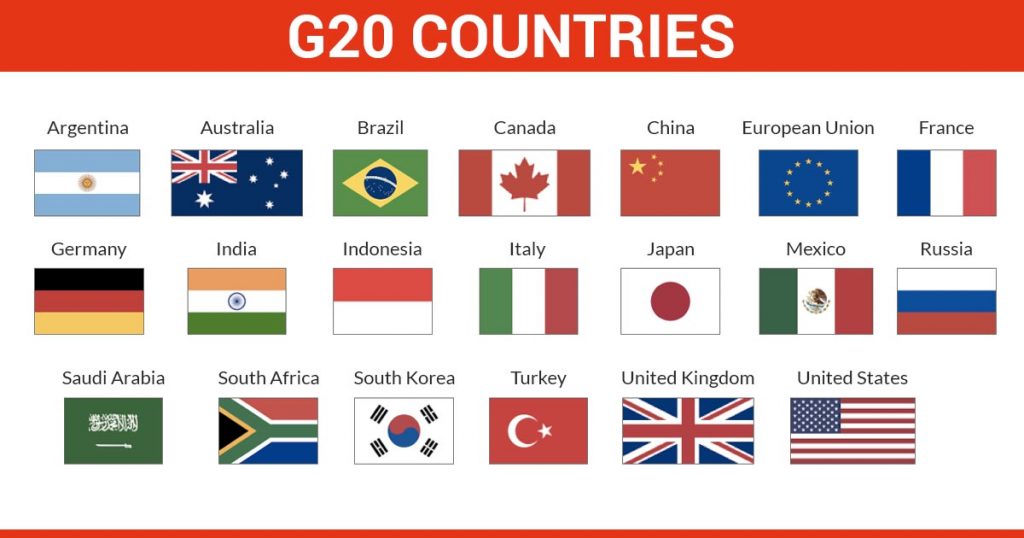
    G20

    • Formed in 1999, the G20 is an international forum of the governments and central bank governors from 20 major economies.
    • Collectively, the G20 economies account for around 85 percent of the Gross World Product (GWP), 80 percent of world trade.
    • To tackle the problems or the address issues that plague the world, the heads of governments of the G20 nations periodically participate in summits.
    • In addition to it, the group also hosts separate meetings of the finance ministers and foreign ministers.
    • The G20 has no permanent staff of its own and its chairmanship rotates annually between nations divided into regional groupings. 

    Aims and objectives

    • The Group was formed with the aim of studying, reviewing, and promoting high-level discussion of policy issues pertaining to the promotion of international financial stability.
    • The forum aims to pre-empt the balance of payments problems and turmoil on financial markets by improved coordination of monetary, fiscal, and financial policies.
    • It seeks to address issues that go beyond the responsibilities of any one organisation.

    Member Countries

    The members of the G20 consist of 19 individual countries plus the European Union (EU).

    • The 19 member countries of the forum are Argentina, Australia, Brazil, Canada, China, France, Germany, India, Indonesia, Italy, Japan, Mexico, Russia, Saudi Arabia, South Africa, South Korea, Turkey, United Kingdom and the United States.
    • The European Union is represented by the European Commission and by the European Central Bank.

     Who are the G20 Sherpas?

    • A Sherpa is the personal representative of a head of state or government who prepares an international summit, particularly the annual G7 and G20 summits.
    • Between the summits, there are multiple Sherpa conferences where possible agreements are laid out.
    • This reduces the amount of time and resources required at the negotiations of the heads of state at the final summit.
    • The Sherpa is generally quite influential, although they do not have the authority to make a final decision about any given agreement.
    • The name is derived from the Sherpa people, a Nepalese ethnic group, who serve as guides and porters in the Himalayas, a reference to the fact that the Sherpa clears the way for a head of state at a major summit.

    G7

    • The G7 or the Group of Seven is a group of the seven most advanced economies as per the International Monetary Fund (IMF).
    • The seven countries are Canada, USA, UK, France, Germany, Japan and Italy. The EU is also represented in the G7.
    • These countries, with the seven largest IMF-described advanced economies in the world, represent 58% of the global net wealth ($317 trillion).
    • The G7 countries also represent more than 46% of the global gross domestic product (GDP) based on nominal values, and more than 32% of the global GDP based on purchasing power parity.
    • The requirements to be a member of the G7 are a high net national wealth and a high HDI (Human Development Index).


  • ‘BharatMarket’: An e-commerce platform for retail traders

    Traders’ body Confederation of All India Traders (CAIT) said that it will soon launch a national e-commerce marketplace ‘BharatMarket’ for all retail traders in collaboration with several technology partners.

    A prelims question with tricky options to throw you off track-

    The BharatMarket initiative recently seen in news is-

    A. Trade of Bharat-22 Exchange Traded Fund (ETF)

    B. Platform for farmer to sell their produce

    C. Initiative in power sector

    D. e-commerce platform

    Here you have to play safe…..

    BharatMarket

    • The marketplace will integrate the capabilities of various technology companies to provide end-to-end services in the logistics and supply chains from manufacturers to end consumers, including deliveries at home.
    • It will include nationwide participation by retailers and aims to bring 95 per cent of retail traders onboard the platform, who would exclusively run the portal.
    • It has been already started as a pilot project, initially with a limited number of essential commodities, in six cities — Prayagraj, Gorakhpur, Varanasi, Lucknow, Kanpur and Bengaluru.
    • This will be an effective way to get essential commodities to consumers during the lockdown period and within containment zones.
  • [pib] UV Blaster: A UV Disinfection Tower

    The DRDO has developed an Ultra Violet (UV) Disinfection Tower for rapid and chemical-free disinfection of high infection-prone areas.

    GYAN:

    We have a UV filter in our home based water filter.  Ever wondered, how do UV rays kill viruses/bacteria?

    UV Blaster

    • The UV blaster is a UV based area sanitizer designed and developed by Laser Science & Technology Centre (LASTEC), the Delhi based premier laboratory of DRDO.
    • It is useful for high tech surfaces like electronic equipment, computers and other gadgets in laboratories and offices that are not suitable for disinfection with chemical methods.
    • The product is also effective for areas with a large flow of people such as airports, shopping malls, metros, hotels, factories, offices, etc.

    How does it work?

    • The UV based area sanitizer may be used by remote operation through laptop/mobile phone using wifi link.
    • The equipment has six lamps each with 43 watts of UV-C power at 254 nm wavelength for 360-degree illumination.
    • For a room of about 12 x 12 feet dimension, the disinfection time is about 10 minutes and 30 minutes for 400 square feet area by positioning the equipment at different places within the room.
    • This sanitizer switches off on the accidental opening of a room or human intervention.

    Back2Basics: UV germicidal irradiation

    • UV irradiation is a disinfection method that uses short-wavelength ultraviolet rays to kill or inactivate microorganisms by destroying nucleic acids and disrupting their DNA, leaving them unable to perform vital cellular functions.
    • UVGI is used in a variety of applications, such as food, air, and water purification.
    • UVGI devices can produce strong enough UVC light in circulating air or water systems to make them inhospitable environments to microorganisms such as bacteria, viruses, moulds, and other pathogens.
    • UVGI can be coupled with a filtration system to sanitize air and water.
    • It has been used primarily in medical sanitation and sterile work facilities.
    • Increasingly, it has been employed to sterilize drinking and wastewater since the holding facilities are enclosed and can be circulated to ensure a higher exposure to the UV.