India 2016, better known as INDIA YEAR BOOK (IYB) among the IAS aspirants was released couple of weeks back. The book is considered as holy grail of UPSC preparation. Offline coaching wallahs and book publishers would give you separate notes for IYB.
Online IAS gurus turned coaching wallahs (you know who I am talking about) would post a strategy with page numbers for most important stuff and after the exam, search from IYB for questions asked in the IAS prelims and sometimes even IAS mains and would put them in Yearbook stuff questions category.
New age coaching wallahs (online test series and micro planing wallahs) would assure you that they would include questions from year book in their tests and they would make you read the IYB. Even some toppers would recommend reading IYB especially for first time aspirants (or freshers as they say).
By all accounts IYB seems like a very important book to read for IAS preparation. It’s a very fat book, some 1000+ pages. It has a great cover pic jacket. So question arises, how to read this book effectively?
Well I am not a big fan of this book. Naah, I said it very mildly, this book is pure rubbish. If you have already bought it, aaj hi raddi wale ko de do.
First let me bust the myth of a lot questions being directly asked from the book and strategy of selective reading. Click on hyperlinked texts to read analysis and questions of coaching wallahs.
Which of the above flows / flow through Arunachal Pradesh?
(a) 1 only (b) 2 and 3 only (c) 1 and 3 only (d) 1, 2 and 3
(Chapter Land the People: The Brahmaputra rises in Tibet, where it is known as Tsangpo and runs a long distance till it crosses over into India in Arunachal Pradesh under the name of Dihang. Near Passighat, the Debang and Lohit join the river Brahmaputra and the combined river runs all along the Assam in a narrow valley. It crosses into Bangladesh downstream of Dhubri. The principal tributaries of Brahmaputra in India are the Subansiri, Jia Bhareli, Dhansiri, Puthimari, Pagladiya and the Manas….)
Seriously, they want you to prepare geography from IYB. Are you kidding me?
It does not tell anything about Barak river, how would I know whether or not Barak river flows from Arunachal or not. I would need to see the map and yessss IYB does not teach you geography through maps.
It does not tell me whether or not Subansiri also flows through Arunachal.
You decide it for yourself, if that’s not fraud, what is. Would you want to prepare polity from India year book? Okay, let’s see
#2. The power of Supreme Court of India to decide disputes between the Centre and the States falls under its
advisory jurisdiction
appellate jurisdiction
original jurisdiction
writ jurisdiction
Two questions which made IYB relevant again
Saka era, 21st March
Satyamev jayate, mundak upanishad
These are given in the national symbol chapter but they come in news every year on 21st March.
Satyamev jayate? Come onnnn, everyone studies it in 5th standard and if you didn’t remember it, chances are you wouldn’t even after reading this chapter.
And national symbol chapter is also given in history book Grover and Grover, so i can say, questions directly asked from Grover, start reading Grover also for history.
Other questions as you can all see are all far fetched hyperboles!
Let’s come to their selective reading strategy. I read what they recommended. For instance in energy chapter, IAS Score recommended reading e wastes, renewable energy etc. I did and result was waste of 20 previous minutes of my life.
A few facts
India 2016 is updated only till November 2015, in most cases till June 2015. IAS Mains will be in Dec 2016, won’t be of any use
There are only facts no analysis making it a very boring read (second to none)!
Presentation is worse than the worst presented book you would have read. Someone ask them to at least put 10 images in a 1000 page book. In geography, they don’t even present maps. The font size is going to make you want to go for prescription glasses!
Every economic, commercial and agricultural data is infinite times better presented in economic survey.
Then what explains the popularity and seemingly unwavering faith in the so called India year book?
India year book was meant for the time when IAS paper was more static in nature and Internet was not available (80s, 90s even early noughties). It provided every scheme even if incomplete, non analytical and only factual information in one place.
Internet 1st entered into India on 15th August 1995 and became ubiquitous if I can say so during last decade, more precisely in 2010s only.
IAS aspirants are budding bureaucrats. They are status quoists and risk averse (even though this exam itself is the biggest gamble). So for instance, when everyone had left Orkut and migrated to Facebook and other social platforms, they continued on Orkut. During its final days, Orkut was sustained by IAS aspirants community alone. You don’t believe me? check out with the ForumIAS admins!
On top of that fraud payed by coaching wallahs and online gurus help perpetuate the myth that is INDIA YEAR BOOK
Now there are 4 options available with you
Read the book from cover to cover or as coaching wallah and online gurus suggest, 1st reading only to highlight important stuff and then in 2nd reading highlighted stuff as well as notes making and 3rd reading, only reading notes. May god be with you!
Buy any substandard summary of book from the market. Well, it will save time compared to option one but you would still get nothing out of that
Read chapter 2 national symbols, chapter 4 agriculture , global and regional security scenario from chapter 9, defence and last chapter diary of national events. Read chapter 28, welfare if you do not have any idea about schemes for weaker sections
Not reading the book at all and using that time to read good books, newspapers, magazines. Very decent approach.
You can make out my order of recommendations.
What you should do instead
Read policy and updates from analytical websites. For policy updates follow PRS Legislative research. This is the best resource you can find out there!
You can go back in time and read their monthly policy reviews. It’s available from March 2014, I suppose.
We asked students to fill up the google form and tell us about their struggles. Some really good stories will be put in here so that they help in comforting every other reader (that they all sail in same boat).
———
Confession #1
An upsc aspirant is the most soft target as far as civil services exam is concerned. There will be hundreds of people giving you advice on what to do in life and keep a check on your upsc results and give suggestion when you fail in it. A person who had never even filled the form will tell you how hard this exam is. I know one thing it doesn’t matter how you performed in your college exams ,we all know how u can get marks in those exam. But upsc is altogether a very different thing. I remember telling people how a person named Rukmani Riar AIR 2 in 2012 CSE was just on the line , she scored 199 in preliminary and that year cut off was 198 and then went on to become the second topper and also Ira Singhal AIR 1 in 2014 exam for that matter. Upsc is a mix of both luck and hard work. I believe that luck has a peculiar habit of helping those who doesn’t depend on it. You just need to keep walking. Whenever i feel its getting tough i just remember the lines from Robert Frosts well known piece “woods are lovely dark and deep but I have promises to keep A miles to go before i sleep”
Inflation or price rise has been a major concern of policymakers for a long long time. Common man also lists price rise among his top most concerns. Responsibility of controlling price rise lies with government and RBI. But to control something, we need data which tells us direction in which we are moving.
In India, that data or measure of inflation is Wholesale Price Index (WPI) and Consumer Price Index (CPI). But of late both these data sets are moving in opposite direction.
Then are the prices rising or falling? What explains the difference b/w these two indicators? Which one should be used for taking important policy decisions which affect the whole economy? And finally why is inflation such a bad thing and if it were such a bad thing, surely deflation should be great. who wouldn’t like cheap goods! But why is then Japan struggling with precisely such a thing and Eurozone doing its utmost to avoid deflation?
Let’s understand inflation
Inflation is a sustained increase in the general price level of goods and services in an economy over a period of time.
Note here the term general price level i.e. increase in price of only 1 or 2 commodities is not inflation but increase in prices of a basket of goods and services.
Let’s understand this with a one commodity economy first-
Suppose in India only apples are consumed and they cost 100 rs a kg in 2010
Year
Commodity
Price
Quantity (Kg)
Bill
Inflation
2010
Apple
100
1
100
No data
2011
Apple
110
1
110
110-100/100
2012
Apple
130
1
130
130-110/110
But suppose both apples are oranges are consumed in India and prices of oranges actually fell from 100 to 95 and then 90.
Inflation in oranges 95-100/100 would be -5%
so general inflation would be 10% + (-5%) = 5% right? If you think so, CSAT mein kamjor lagte ho. Consider this
Year
Commodity
Price
Quantity (kg)
Bill
Inflation
2010
1. Apple
2. Orange
100
100
1
2
100*1 + 100*2 = 300
No data
2011
1. Apple
2. Oranges
110
95
1
2
100*1 + 95*2= 300
300-300/300 =
Here, we introduce the concept of weights. When calculating general inflation, we need to assign weights to different goods and services in the proportion they are consumed and then we take weighted average to compute general inflation.
The year whose consumption level is included in creation of basket of goods and services is called base year, in this case 2010. Base Year has to be frequently revised as consumption basket keeps on changing. For instance, pizza would not have been in the consumption basket about a decade back.
Base Effect
Scenario one,
Year
Commodity
Price
inflation
2010
Apple
100
No data
2011
Apple
150
50%
2012
Apple
140
140-150/150= negative inflation
in 2012 there is negative inflation while w.r.t to 2010, prices have risen significantly.
Scenario two
Year
Commodity
Price
inflation
2010
Apple
100
No data
2011
Apple
120
20%
2012
Apple
140
140-120/120= 17%
In this scenario also prices in 2010 and 2012 are same but due to excessive inflation in 2011 in earlier case, 2012 appeared to be deflationary. This anomalous situation is being created due to base effect.
What we were calculating till now was price rise in items average citizen consume. Because we are talking about consumers this is called Consumer Price Index (CPI) inflation.
Let’s know more about CPI inflation in India
Base year- 2012
Calculated by – Central Statistical Organization (CSO) in Ministry of Statistics and Programme Implementation (MoSPI) using Laspeyres formula (basically our weighted average formula)
Source- firstpost
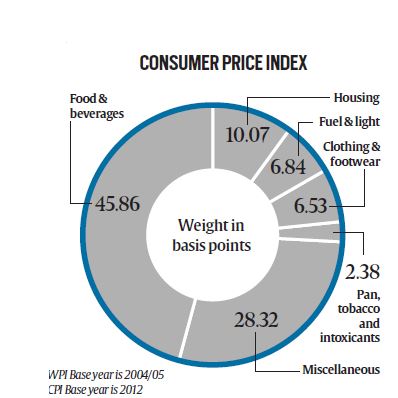
Basket:
These broad categories are further divided into subcategories but that’s not important. What is important is that about 46% weight is given to food items and any increase in food prices will lead to increase in CPI inflation.
Other point to note is that health, education etc services are also there in CPI basket. we shall later see services are not in WPI basket and thus CPI gauges services inflation as well.
But food prices are highly volatile as food products can’t be stored for long and prices depend on agriculture output. Also food is an essential good and people will buy food no matter what the food prices are, food inflation is not much affected by central bank policies. It’s a supply side issue.
Similar is the case with fuel prices which are highly volatile.
When we remove these components from overall inflation, we get core inflation
Core CPI =Headline CPI MINUS (food and fuel components.)
Why is overall inflation called Headline Inflation?
That is what newspaper headlines report
Because consumption basket of rural and urban areas are different, CPI inflation is calculated separately for rural and urban areas.
CPI (rural) and CPI (urban) both have same 2012 base with slightly different weightage. For instance Rural CPI doesn’t consider Housing inflation. Weightage of food items is about higher in rural areas. Weighted average of CPI(R) and CPI(U) gives overall CPI inflation.
Earlier we used to calculate 4 different categories of CPI inflation
Agricultural Labourer (AL)
Rural Labourer (RL)
Industrial Workers (IW)
Urban Non-Manual Employees (UNME)
First 3 computed by Labour bureau, as you can guess and the last one by CSO. We continue to compute these indices but focus now is on CPI (rural), CPI (Urban) and overall CPI
Why is CPI important-
It directly affects what consumers pay to buy a select basket of goods and services. It is thus better indicator of the cost of living and, hence, reflecting the welfare objective of monetary policy.
Let’s now take a look at Wholesale Price Index (WPI) inflation.
As the name suggests it computes price rise at the level of goods and services sold at wholesale level
Base Year : 2004
Calculated by Economic Adviser in the commerce ministry using same Laspeyres formula
Source- firstpost
Basket
Primary Articles include food, non food and minerals
Weightage of food items in WPI is weightage of primary food articles (cereal, pulses etc) + weightage of manufactured food items (ice cream, ghee, butter etc)
14% + 10% = 24%
Core WPI ignore Food and Fuel (volatile components)
Core WPI is WPI of Non-food manufacturing industries
Note here that WPI does not take into account inflation in services sector such as education, health etc. while 65% of our GDP comes from services sector i.e. it does not give complete picture of price rise in the economy.
In spite of that, RBI used to focus on WPI earlier as CPI basket and base year was not frequently revised and data set was not robust but after the signing of monetary policy framework RBI has decided to focus on CPI as it directly affects consumers and thus better indicator for policy formulation.
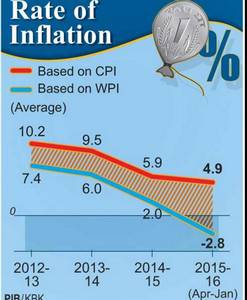
But if RBI is to focus on CPI only, what’s the importance of WPI and why so much divergence with WPI in negative and CPI 5% in positive.
WPICPI divergence Source-economic survey
Statistical difference –
inclusion of services in CPI
Different weightage to different items with food occupying highest weightage in CPI and food inflation being higher
While reduced crude prices leading to negative WPI
2. Transaction costs – Middlemen might have increased their profit margin
3. Taxes – Indirect taxes
If same item has higher inflation in CPI than WPI, possible reason could be higher margins and govt can target that area to bring down inflation.
Other measure of inflation is GDP deflator which we understood in this article
What is Produce Price Index (PPI)
PPI is inflation at producer level without any tax component
Advantage of PPI over WPI
Majority of the OECD countries measure inflation based on PPI (International Best Practice)
WPI includes taxes while PPI tracks inflation minus tax component
PPI will track average change over time in selling prices received by domestic producers for their output for both goods and services while WPI tracks transaction only at the wholesale level for goods.
Govt set up a committee headed by Professor BN Goldar to devise PPI.
Earlier two separate groups headed by Abhijit Sen and Saumitra Chaudhuri underscored the importance of PPI but felt that more work and data was needed to fully construct PPI.
Let’s understand some other terms associated with inflation
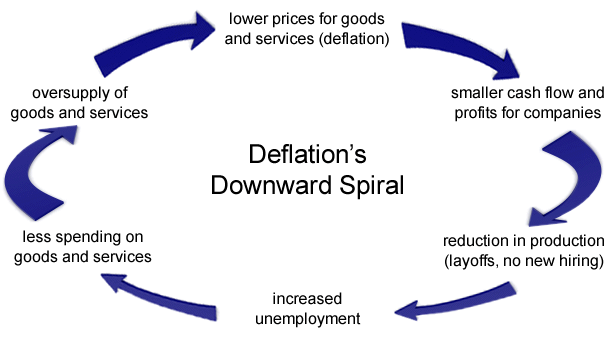
Deflation- Opposite of inflation i.e. general decline in prices. it is generally associated with contracting economy i.e. recession and is much more dangerous than inflation.
Disinflation-Slow down in the rate of inflation i.e. prices are still rising but as the lower pace. Eg. If inflation rate was 10%, 2 years back, 8% last year and, 6% this year, economy is said to be in disinflation.
Hyperinflation– Very high and accelerating inflation which cause people to severely curtail their use of the currency as currency simply becomes worthless. For instance in Germany after 1st world war or in Zimbabwe a few years back. Prices rise 10% or more month on month.
stagnation plus inflation i.e. inflation in a stagnating economy. Generally inflation is associated with a booming, high growth economy but when economy is contracting, growth rates are coming down, unemployment is rising and there is high inflation , it is called stagflation.
What are the causes of inflation?
Essentially there is more amount of money to buy limited amount of goods and services leading to rise in prices (demand supply mismatch). It could be due to following reasons-
Demand pull inflation – increases in aggregate demand due to increased private and government spending. Thus high fiscal deficits, high subsidies lead to demand pull inflation.
Cost push inflation– also called “supply shock inflation,” is caused by a drop in aggregate supply. This may be due to natural disasters, or increased prices of inputs. For example, a sudden decrease in the supply of oil, leading to increased oil prices, can cause cost-push inflation. Producers for whom oil is a part of their costs could then pass this on to consumers in the form of increased prices. Another example could be inflation due to high administered prices due to high MSP.
Monetary policy can mainly control demand pull inflation by raising interest rates, tightening liquidity thus reducing amount of money available. Supply side inflation is difficult to control by monetary authorities and in case of India main cause of inflation is high food prices which is a supply side issue due to rigidities in agriculture markets. Then why does RBI raise interest rate when inflation is due to supply side issues such as high food prices?
Here comes the role of 3rd factor-
3. Built in inflation is induced by adaptive expectations, and is often linked to the price-wage spiral. Essentially workers try to keep their wages up with prices (above the rate of inflation), and firms pass these higher labor costs on to their customers as higher prices, leading to a ‘vicious circle’.
Wage-Price Spiral Source – abahe.co.uk
RBI raises rates to break this vicious circle.
For this very reason, RBI conducts survey of inflationary expectations and latest surveys suggest in spite of inflation being down to 5%, expectations are of double digit inflation due to very high inflation for a prolonged period.
Let’s now understand effects of inflation
General Effects –
As same amount of money buys less goods, purchasing power of currency comes down, currency depreciates in international exchange rate market. How? Learn here
It benefit borrowers or debtors as in real terms they have to repay less amount in real terms while it hurts creditors or savers.
Year
Borrowed/ lent
Inflation
Apple price
Real amount Borrowed/ returned
2010
1000
No data
100
10 kg
2011
1000
10%
110
9 .1 kg
You can clearly see, borrower/ debtor has to return less in real term, thus advantage debtor/and disadvantage creditor / bond holder.
Negative effect-
Uncertainty about future rate of inflation makes it difficult to conclude business deals, affects investment.
Savers tend to park their money in fixed assets, financial savings fall. One of the reason for gold rush in India was high inflation.
Hurts poor the most as they are not able to bargain for higher wages to keep up with the rising prices
Hoarding– to take advantage of higher prices in future, this furthers inflation and vicious cycle starts. Recall the case of pulse hoarders when pulse prices were shooting up.
Finally there is always that risk of inflation going out of control resulting in hyperinflationary situation which can cripple the whole economy
Positives
1.Most important positive is that it avoids deflationary tendencies which is the worst
Effects of deflation
As we saw above, it harms borrowers resulting in inability to repay loans. Companies and banks collapse
While in inflation people start hoarding, here people postpone their purchases in the expectation of future fall in prices. If nobody buys, demand goes down and economy goes under recession resulting in job losses and high unemployment
Source-investinganswers
Labour-market adjustments- Nominal wages are slow to adjust downwards. Since inflation allows real wages to fall even if nominal wages are kept constant, moderate inflation enables labor markets to reach equilibrium faster.
Consider this, real salary has decreased but person would feel he had been awarded 8% pay hike.
Year
Nominal salary
Inflation
Apple price
Real salary in apples
2010
1000
No data
100
10 kg
2011
1080
20%
120
9 kg
But if there were no inflation, he would have resisted wage decline, though it would have been same, worth 9 kg apples.
Year
Nominal salary
Inflation
Apple price
Real salary in apples
2010
1000
No data
100
10 kg
2011
900
0
100
9 kg
In emerging economies such as India, structure of economy changes rapidly and thus more frequent churning and adjustment in labour market is required. It is for this reason that inflation level of 4-6% is considered healthy in emerging economies while most advanced economies don’t like inflation beyond 2%.
Inflation especially demand pull inflation is associated with high growth and low unemployment. As demand rises, industries increase their production leading to higher growth and employment. This holds true only for short term.
A few more terms before we wind up our discussion –
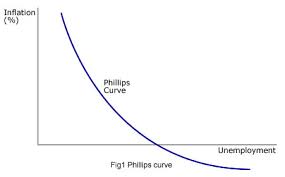
Phillips curve is a historical inverse relationship between rates of unemployment and corresponding rates of inflation.
Misery index – the sum of the inflation and unemployment rates
Modified misery index – sum of the interest, inflation, and unemployment rates, minus the year-over-year percent change in per-capita GDP growth
In the next article we shall discuss tools available with government and RBI to control inflation and why monetary policy transmission is very poor in India.
Now it’s time to solve a few questions asked in previous years IAS prelims-
#1. Which of the following brings out the ‘Consumer Price Index Number for Industrial Workers? (IAS pre 2015)
(a) The Reserve Bank of India
(b) The Department of Economic Affairs
(c) The Labour Bureau
(d) The Department of Personnel and Training
#2. A rise in general level of prices may be caused by
an increase in the money supply
a decrease in the aggregate level of output
an increase in the effective demand
Select the correct answer using the codes given below.
1 only
1 and 2 only
2 and 3 only
1, 2 and 3
#3. Consider the following statements: (IAS Pre 2014)
Inflation benefits the debtors.
Inflation benefits the bond-holders.
Which of the statements given above is/are correct?
1 only
2 only
Both 1 and 2
Neither 1 nor 2
#4. India has experienced persistent and high food inflation in the recent past. What could be the reasons?(2011)
Due to a gradual switchover to the cultivation of commercial crops, the area under the cultivation of food grains has steadily decreased in the last five years by about 30%.
As a consequence of increasing incomes, the consumption patterns of the% people have undergone a significant change.
The food supply chain has structural constraints.
Which of the statements given above are correct?
(a.) 1 and 2 only
(b.) 2 and 3 only
(c.) 1 and 3 only
(d.) 1, 2 and 3
#5. A rapid increase in the rate of inflation is sometimes attributed to the “base effect”. What is “base effect”?(2011)
(a.) It is the impact of drastic deficiency in supply due to failure of crops
(b.) It is the impact of the surge in demand due to rapid economic growth
(c.) It is the impact of the price levels of previous year on the calculation of inflation rate
(d.)None of the statements (a), (b) and (c) ‘given above is correct in this context
#6. Economic growth is usually coupled with (2011)
In this section, we will deal with the sector which is very important for a country like India, where more than two-third of the population resides in villages – Rural Sector.
Take a look at basic statistics, which will give you a larger picture about govt.’s approach towards rural sector, where emphasis is on rural employment and infrastructure:
Total allocation for rural sector is 87,700 cr
Rs. 2.87 lakh cr grant-in-aid to Gram Panchayats and Municipalities
Rs. 38,500 crore has been allocated for MGNREGS in 2016-17
Digital Literacy mission to cover additonal 6 cr households
Focus Areas
#1. Decentralization
As per 14th Finance Commission recommendations, the budget has allocated a sum of Rs. 2.87 lakh cr grant-in-aid to Gram Panchayats and Municipalities, which is higher by 228% as compared to the previous 5-year period.
Each Gram Panchayat will receive an average assistance of Rs 80 lakh, where as each Urban Local Body will get Rs. 21 cr.
#2. Mitigating Rural Distress
Every block in the distress areas will be set up as an intensive Block under the Deen Dayal Antyodaya Mission
Formation of Self Help Groups will be speeded up to promote multiple livelihoods
Cluster Facilitation Teams will be set up under MGNREGS to ensure water conservation and natural resource management
These Clusters will incubate growth centres in rural areas by providing infrastructure amenities and market access for the farmers. They will also expand employment opportunities for the youth.
#4. Electrification
Govt is targeting to achieve 100% village electrification by 1st May, 2018. The budget has allocated Rs. 8,500 crore for Deendayal Upadhayaya Gram Jyoti Yojna and Integrated Power Development Schemes.
#5. Modernization of Land Records
Govt. has revamped National Land Record Modernisation Programme, to build an integrated land information management system, which is critical for dispute free titles.
#6. Sanitation
Govt. will reward villages that have become free from open defecation, under Swachh Bharat Mission
New Initiatives
Promotion to Digital Literacy
About 12 crore households out of the total 16.8 crore rural households, do not have computers and are unlikely to have digitally literate persons. In this regard, there are already 2 schemes, which are approved to promote digital literacy:
National Digital Literacy Mission
Digital Saksharta Abhiyan
Govt. will launch a new Digital Literacy Mission Scheme for rural India to cover around 6 crore additional households within the next 3 years. This will help India to derive greater benefit from our demographic advantage.
Improving Governance of PRI’s
Govt. will make efforts to develop governance capabilities of Panchayat Raj Institutions so that they can deliver on the Sustainable Development Goals. In this regard, govt. has proposed to launch a new restructured scheme, called Rashtriya Gram Swaraj Abhiyan.
PS: Please click on the green hyperlinked text to read more about the concepts. Revise and revise & feel free to ask pertinent questions.
Brazil, Russia, India, China and South Africa (BRICS) are leading emerging economies and political powers at the regional and international level.
When? 2008. They had their first official meeting in 2009
Origin:
The acronym, BRIC, was coined by Jim O’Neill of Goldman Sachs way back in 2001
He predicted that by year 2050, Brazil, Russia, India and China would become bigger than the 6 most industrialized nations in dollar terms and would completely change the power dynamics of the last 300 years
It was pointed out that high growth rates, economic potential and demographic development were going to put BRICS further in a lead position
Why is BRICS suddenly so important?
The idea of development bank (NDB) and Contingency Reserve Arrangement (CRA) has strengthen BRICS as a grouping
Both of these concepts were formalised over in 2015 (@BRICS summit at Fortaleza and Brasilia) and this was seen as a strong signal to the challenge of western dominated discourses in some forums (IMF, WB)
We will get to these details in a short while but since these developments happened in 2015, the IAS aspirants from 2016 onwards are required to sweat blood in order to be on top of this theme (kidding!)
What prompted the need for emergence of BRICS?
Most multilateral institutions were designed in the era when the West dominated the world. The US and Europe are over-represented in the IMF and the World Bank. Together with Japan, they control most regional development banks as well! That’s a big bad bully in making, right?
The main reason for co-operation to start among the BRICs nation was the financial crises of 2008
The crises raised scepticism on the dollar dominated monetary system and the need for participation by non-G7 countries became evident. If you don’t know about G7, click this wiki page to know the countries involved
What reform did BRICS want out of the multilateral institutions?
Since their inception in 1944, the Bretton Woods institutions (IMF and World Bank) had not reformed their governance structure, to give more voting and voice to emerging economies. Both dominated by USA and developed countries. Both were out of sync with the new dynamics of world economy
The BRICs called for the “the reform of multilateral institutions in order that they reflect the structural changes in the world economy and the increasingly central role that emerging markets now play
BRICS managed to push for institutional reform which led to International Monetary Fund (IMF) quota reform in 2010 (although, it met with limited success as United States Congress did not ratify)!
Three new terms? Bretton Woods, Quota reforms, 2008 financial crisis. We will get to them later.
So, essentially, BRICS opened up a possibility for countries of the global South to challenge the global North. When the quota reforms were quashed in 2010, BRICS moved towards enlarging their spheres of cooperation. We will talk about the BRICS bank at a later stage.
Advantage India?
Now that NAM (Non-alignment) is almost defunct and very little wealth is left in the Commonwealth, BRICS provide a great alternate for India to build its global profile.
But don’t we have a G 20 group to further India’s interest in the global arena?Yes, that’s another big one (besides UN).
G 20 is a bloc of developing nations established on 20 August 2003. The G-20 accounts for – 60% of the world’s population, 70% of its farmers and 26% of world’s agricultural exports.
India has tried to use BRICS as a forum to engage China as the latter has become the largest market for the fast-industrializing countries of East Asia. India wants to resolve the age-old mis trust and complicated relationship between the two countries since the 1962 war between them.
What are the factors that will bolster co-operation among BRICS members?
Firstly, the common need among developing countries to construct economic order that reflects current situation will drive the BRICS’ efforts. In this matter, the idea of NDB and CRA are defining and will have a huge geo-economic and geopolitical impact
Secondly, the BRICS alternative idea in the landscape of global governance will attract support from other countries. There have been suggestions by political analysts that BRICS may expand its member quota
Thirdly, the expansion of BRICS interaction to other sector will make it more strong partnership
Lastly, Chinese support to BRICS will make sure that group remains a force to reckon with in the future
Chinese support – interesting point. Some would say that a lot depends on how China carries its might behind BRICS for the time to come.
Some concerns regarding the future of BRICS
Competition within themselves – The BRICS countries aspire to be regional powers and hence at some point will compete with each other
Different forms of governance – They have different political systems with Brazil, India and South Africa being democracies while Russia and China having authoritarian characteristics. It would be interesting to see how policy consensus is brought about!
Trade conflicts, maybe? Brazil and Russia are commodity exporting countries and thus benefit from high commodity prices while India and China are commodity importers that benefit from low commodity prices
Territorial Issues – China and India have outstanding territorial issues to resolve and India looks askance to any institution that has Chinese domination. Russia looks suspiciously at China’s interest in its sparsely populated far eastern of Siberia
The big daddy China – China spearheads three other major initiatives in this region – One Belt One Road (OBOR), Asian Infrastructure Investment Bank (AIIB) and SCO. You should know that the 7th BRICS summit was held as a joint summit with SCO. BRICS has to find a reckoning space among them to keep china’s interests alive!
Parting words on BRICS (more mirch masala)
All that UPSC want from an IAS aspirant is: Analysis, analysis, analysis. These are some of the fodder points that you can use in any answer involving BRICS and world arena.
Engaging China has been one of the important components of India’s foreign policy in recent years, considering that co-operation and negotiations with China is imperative to clearing the mistrust between the two countries.
Geostrategically, BRICS are now represented on all continents of the global south. In bilateral and regional agreements, the BRICS emphasize south-south solidarity and horizontal cooperation in contrast to western dominance.
Yet, in global fora such as G20, UN Security Council or World Climate Conferences, BRICS claim to speak on behalf of the developing world (whether they actually do represent these countries is disputable) and gradually challenge western supremacy in international politics.
Phew. This was a long one! Did we cover everything? Nope. We will cover later
Latest BRICS summit
All about the BRICS Bank (NDB) & Contingency Reserve Arrangement (CRA)
Comparison of BRICS Bank with AIIB (another master stroke by China)
#1. With reference to a grouping of countries known as BRICS, consider the following statements: (IAS Prelims 2014)
1. The First Summit of BRICS was held in Rio de Janeiro in 2009.
2. South Africa was the last to join the BRICS grouping.
Which of the statements given above is / are correct?
(a) 1 only
(b) 2 only
(c) Both 1 and 2
(d) Neither 1 nor 2 #2. The ‘Fortaleza Declaration’, recently in the news, is related to the affairs of ((IAS Prelims 2015)
(a) ASEAN
(b) BRICS
(c) OECD
(d) WTO
#3. With reference to BRIC countries, consider the following statements (IAS Prelims 2010)
1. At present, China’s GDP is more than the combined GDP of all the three other countries.
2. China’s population is more than the combined population of any two other countries.
Which of the statements given above is/are correct?
A. 1 only
B. 2 only
C. Both 1 and 2
D. Neither 1 nor 2
There are so many wisecracks about budgets. World over, budgets have managed to create madness, hysteria, protests, and satire. It is basic to the human mind that no other mind is possibly capable of carefully handling and allocating that joyous commodity, money. Add this sense of insecurity to the Orwellian point of view that all politicians are equal (in their incapability) but some politicians are more equal than the others, and you quintessentially have, what our Parliamentarians fondly call ‘The Budget Session’.
Budgets are largely an exercise in philosophy; you deliver the numbers only to realise that they are never deliverable and never have been, to begin with. “Deficits satyam, Budget mithya” could well be the Indian take on the issue. Americans, those descendants of immigrants and revolutionaries, have scant regard for things as deep as the Shankara philosophy. Their philosophy about budgets goes about as deep as, errr, a bean bag. It was the inimitable Will Rogers, who in his loud style commented, “The budget is a mythical bean bag. Congress votes mythical beans into it, and then tries to reach in and pull real beans out.”
American budgets have inspired perhaps the biggest quips and laughs. George W Bush, never quite revered across the globe for his intelligence, much to the delight of his critics, is believed to have said, “Of course it’s a budget. It’s got a lot of numbers in it.” Can’t get more dubiously Dubya than that, eh?
Greeks, the other race that pride themselves on their philosophical underpinnings, have a different way of looking at budgets and debt burdens. When in trouble, they have a strange Greek way of using wonderful quotes by their forefathers in a most inappropriate fashion. “Speaking the truth and repaying your debts is not a correct definition of justice,” once said Plato. And now says Tsipras, to the great horror of Merkel and Co. It was humour in its blackest form that the Greeks recently passed an ‘austerity’ budget.
Even the late Sophocles, that great master of tragedy who is believed to create despair even in Heaven, started laughing uncontrollably when he heard about that one. Merkel showed her technical German wit when she primly commented, “Austerity makes it sound evil. I prefer to call it balancing the budget.” Even the British raised their eyebrows in appreciation.
Because, perhaps the greatest kind of budget humour can only come from the stiff upper lip of Europe, Great Britain. Unwittingly and unknowingly, George Osborne, the finance minister of UK, created complete confusion in Britain when he dared to claim last year in the British parliament, “This will be a budget for working people.” The Brits paused for a minute over their seventy-third cup of tea to exclaim, “I say, what does he mean, working people? We thought they were called Germans!”
Back home at North Block, the entire team is getting serious about how to get funny. The FM has been braving suggestions on taglines that could scroll on the bottom of the TV screen whilst he would read the budget provisos. Senior advisors have suggested sher-o-shayari, but Ghalib makes you feel depressed, and Iqbal, Congressed. The younger interns are all for filmi taglines.
Imagine, the FM would declare the fiscal deficit target for FY17 to be 4.2 per cent, markets would tank, only to be assured by the tagline scroll, “Bade bade deshon mein aisi choti choti baatein hoti rehti hain.” Or whilst talking of subsidies, “Hum AAP ke hain kaun.” The FM is hoping for an ‘Airlift’
Amidst global and domestic headwinds, Finance Minister presented a growth and development-oriented Budget that seeks to transform india for the benefit of farmers and the vulnerable. We will take a look at the budget in terms of various sectors.
In this section, we will deal with the sector which received a lot of attention in this budget – Agriculture and Farmer’s Welfare
Take a look at basic statistics, which will not be useful for memorizing, but certainly will help you in analyzing the shifting focus of govt. towards agriculture.
Total allocation for Agriculture and Farmers’ welfare is 35,984 crore
28.5 lakh heactares of land will be brought under irrigation
5 lakh acres to be brought under organic farming over a 3-year period
Rs 6,000 crore for recharging of ground water recharging
Dedicated irrigation fund in NABARD of Rs.20.000 crore
Focus Areas
#1. Food Security to Income Security
Govt. is targeting to double the farmers’ income in 5 years. Govt. will re-orient its efforts both in farm and non-farm sectors. The access to markets becomes critical in this respect, so govt. will implement a Unified Agriculture Marketing Scheme which envisages a common e-market platform that will be deployed in selected 585 regulated wholesale markets.
#2. Irrigation
Irrigation is a critical input for increasing agriculture production and productivity. Out of 141 million hectares of net cultivated area in the country, only 46% is covered with irrigation. A dedicated Long Term Irrigation Fund will be created in NABARD with an initial corpus of about `20,000 crore.
The ‘Pradhan Mantri Krishi Sinchai Yojana‘ has been strengthened and will be implemented in mission mode. 28.5 lakh hectares will be brought under irrigation under this scheme. Govt. is taking efforts to fast track 89 irrigation projects languishing under AIBP, which will help to irrigate 80.6 lakh hectares.
Under the sustainable management of ground water resources, at least 5 lakh farm ponds and dug wells in rain fed areas will be created and 10 lakh compost pits for production of organic manure will be taken up by making productive use of the allocations under MGNREGA.
#3. Conserve Soil Health and Fertility
There is a National Project on Soil Health and Fertility and govt. is implementing Soil Health Card Scheme. It enables farmers to get information about nutrient level of the soil and can make judicious use of fertilizers. The target is to cover all 14 crore farm holdings by March 2017.
#4. Credit Availability
Govt. is making special efforts to ensure adequate and timely flow of credit to farm sector. The target for agricultural credit in 2016-17 will be at an all-time high of Rs. 9 lakh crore, as against the target of Rs. 8.5 lakh crore in 2015-16.
Govt. has made the provision of Rs. 15,000 crore towards interest subvention, in order to reduce the burden of loan repayment on farmers
#5. Food Processing Industry
100% FDI will be allowed through FIPB route in marketing of food products produced and manufactured in India. It will benefit farmers as fruits and vegetables will fetch right prices and also reduce their wastage. It will also give impetus to food processing industry and create vast employment opportunities.
New Initiatives
Finances
A Krishi Kalyan Cess will be imposed at 0.5% on all taxable services, proceeds of which would be exclusively used for financing initiatives relating to improvement of agriculture and welfare of farmers. To know more about basics of cess – Read more.
Broadening MSP
Govt. will make efforts to ensure that the benefit of MSP reaches farmers in all parts of the country. Govt. will encourage remaining states to take up decentralized procurement. An online procurement system will be undertaken through the Food Corporation of India. Govt has also made effective arrangements for pulses procurement.
Dairy Development
Govt. will bring four new projects to make dairying more remunerative to the farmers:
Pashudhan Sanjivani – An animal wellness programme and provision of Animal Health Cards (‘Nakul Swasthya Patra’)
An advanced breeding technology
Creation of ‘E-Pashudhan Haat’ – An e-market portal for connecting breeders and farmers
A National Genomic Centre for indigenous breeds
Agriculture Insurance
In order to protect the farmer from the adverse consequences of nature, govt. has recently announced PM Fasal Bima Yojna, which will have nominal premium and highest ever compensation in case of crop loss.
PS: Please click on the green hyperlinked text to read more about the concepts. Revise and revise & feel free to ask pertinent questions.
Having discussed how to read Economic Survey earlier, we now start our series on economic survey chapter by chapter. We shall follow a standard pattern across all chapters. We shall begin by highlighting ‘quotable quotes’ or observations which might not otherwise come for discussion but nevertheless very important for general understanding, general studies papers and essay. We shall then present some very basic statistics from the chapter and move to discuss broad themes of the chapter. In the end, important reading from the chapter shall be recommended.
I have hyperlinked text with articles previously covered. So go back in time and read the articles if any doubt. Take this opportunity to revise the economy section of syllabus.
So let’s get started
It’s futile to expect “Big Bang” reforms because of two reasons
dispersed nature of power in India, too many veto centers
the absence of that impelling driver—crisis
Note that reform of 1991 was in response to major crisis, SEBI was given statutory backing in response to major scam in stock market and recent merger of Forward Market Commission (FMC) with SEBI was also a response to major scam.
Therefore, “persistent, creative and encompassing incrementalism” will be the key.
2. Being pro industry and pro market or pro competition is not one and the same
India has moved away from being reflexively anti-markets and uncritically pro-state to being pro-entrepreneurship and skeptical about the state
But being pro industry must evolve into being genuinely pro competition, and the legacy of the pervasive exemptions Raj and corporate subsidies highlights why favoring business (and not markets) can actually impede competition
Similarly, skepticism about the state must translate into making it leaner, without delegitimizing its essential roles and indeed by strengthening it in important areas
3. Amid the world economy which is full of turbulence and volatility, India is a refuge of stability and an outpost of opportunity
Fastest Growing Economy
Survey projects GDP growth of 7-7.75% for the financial year (FY) 17
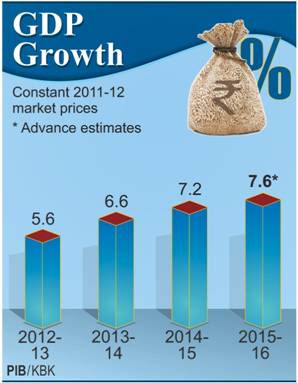
For FY16, GDP growth is estimated to be 7.6%
Forex reseves have risen to >350b$
Let’s now discuss some broad issues
India becoming more and more intertwined with global growth
the correlation between India’s growth rate and that of the world has risen sharply to .42 from .2 for the period 1991- 2002 i.e. 1 % decrease in the world growth rate # 0.42 % decrease in Indian growth rates
India’s exports of manufactured goods and services now constitute about 18 percent of GDP, up from about 11 percent a decade ago
Realizing long term potential growth of 8-10% requires a push on at least three fronts-
major investments in people— health and education- to exploit India’s demographic dividend.
Don’t neglect agriculture as 42% of Indian households derive the bulk of their income from farming. Smaller farmers and landless laborers especially are highly vulnerable to productivity, weather, and market shocks changes that affect their incomes. Govt response –PM Fasal Bima Yojana
Evolution of relative role of centre and states in the delivery of services-
With increased devolution of resources (courtesy 14th Finance commission), states need to expand their capacity and improve the efficiency of service delivery.
shift the focus from outlays to outcomes, and to learn by monitoring, innovating, and even erring.
the Centre should focus on improving policies, strengthening regulatory institutions, and facilitating cooperative and competitive federalism
while the states mobilize around implementing programs and schemes to ensure better service delivery
How does competitive federalism help?
Ease of Doing Business in States
States that perform well are increasingly becoming “models and magnets.”
Successful experiments in one state are models for others states to emulate by showing what can be done and stripping away excuses for inaction and under-performance.
They are also magnets because they attract resources, talent and technology away from the lagging states, forcing change via channel of exit.
Twin Balance Sheet Challenge
What are twin balance sheets – Bank balance sheet and corporate balance sheet
Basically both are interlinked, as asset on bank balance sheet is liability on corporate balance sheet and if corporate does not repay debt, asset turns bad (Non Performing Asset or NPA) and both balance sheets get stretched. It results in banks not lending and corporate not investing resulting in vicious circle.
Solution-
What has been done so far– Indradhanush scheme, Strategic Debt Restructuring (SDR) scheme, 5:25 scheme
What needs to be done– 4Rs
Recognition- Banks must value their assets as far as possible close to true value i.e. recognize NPAs as NPAs
Recapitalization– capital position must be safeguarded via infusions of equity
Resolution– the underlying stressed assets in the corporate sector must be sold or rehabilitated
Reform– future incentives for the private sector and corporates must be set right to avoid a repetition of the problem
But where would resources for recapitalization would come from given that government is committed to the path of fiscal consolidation?
Divest govt. equities in non financial companies and invest in PSBs
Dilute RBI’s capital to capitalize banks
govt can dilute its equity in banks to raise resources from the market
What should be the stance of fiscal consolidation?
Govt announced revised FRBM timeline last year with fiscal deficit target of 3.9% for FY16 and 3.5% for FY17. In this context question arises whether or not we remain committed to the same path of fiscal consolidation.
Arguments for accelerated fiscal consolidation –
debt ratio of the consolidated government (Centre plus states), 67 per cent of GDP is high compared to some countries in Emerging Asia
would reinforce govt’s credibility
also why such a commitment should be abandoned when the economy is growing at more than 7 per cent
Higher deficits may increase short term interest rates and thus hurt corporate investment and increase govt spending on interest
Arguments against-
7th Pay commission award will increase expenditure by about .5% of GDP, to maintain same fiscal deficit, govt might need to slash capital expenditure
Public investment may need to be increased further to address a pressing backlog of infrastructure needs
current global environment is fraught with risks and India should not take chances against growth
In this context it is important that government utilizes resources available to it to increase capital expenditure in roads, railways, ports etc which increases overall productivity and competitiveness of economy.
Update- Government chose prudence and stuck to fiscal deficit target of 3.5% of GDP in the budget announced today.
India and WTO
Two issues in agriculture-
Special safeguard mechanism (SSM) which came for discussion in Nairobi ministerial meeting . The question which arises is whether India even needs such protection
We are already allowed tariff from 40 per cent to 100 per cent (India’s modal rate in agriculture) to 150 per cent.
In a preponderance of tariff lines, there is a considerable gap between applied tariffs and the level of tariff binding
India’s only real need for SSM arises in relation to a small fraction of its tariff lines—some milk and dairy products, some fruits, and raw hides—where its tariff bindings are in the range of about 10-40 percent, uncomfortably close to India’s current tariffs, limiting India’s options in the event of import surges
India should call for a discussion of SSMs not as a generic issue of principle but as a pragmatic negotiating objective covering a small part of agricultural tariffs.
2. Food security/ stockholding issue
The particular policies (MSP) which are being defended are those that India intends to move out of in any case because of their well-documented impacts:
decline in water tables, over-use of electricity and fertilizers (causing health harm), and rising environmental pollution, owing to post-harvest burning of husks
the government is steadfastly committed to providing direct income support to farmers and crop insurance which will not be restricted by WTO rules
The way forward in WTO on agriculture
India should consider offering reduction in its very high tariff bindings and instead seek more freedom to provide higher levels of domestic support: this would be especially true for pulses going forward where higher minimum support prices may be necessary to incentivize pulses production
India’s “big-but-poor” dilemma
India’s self-perception as a poor country translates into a reluctance to recognize and practice reciprocity (give-and-take) in trade negotiations
India’s policies have a significant impact on global markets and it has become a large economy in which partner countries have a legitimate stake in seeking market access
Net effect- India is unable to play reciprocal game in trade negotiations and WTO is fast becoming irrelevant (not good for India)
Cost of reluctant engagement-
India is excluded from Trans Pacific Partnership (TPP) and it is shaped in a way that do not take into account India’s important interests (the rules on intellectual property)
If and when India joins, it will be not on India’s terms but on terms already cast in stone, terms that India could not influence because of being perceived as not engaged fully
What should be India’s response-
We should use our growing markets as leverage to attain our own market interests abroad, including the mobility of labor and engage in reciprocal game to strengthen WTO.
How should trade policy deal with ongoing stress?
Chinese dumping, weak global environment, protectionist measures abroad, beggar thy neighbor policies etc .
Broad principle- resist calls to seek recourse in protectionist measures, especially in relation to items that could undermine the competitiveness of downstream firms and industries. For instance– imposing higher duty on imported steel hurts domestic manufacturers such as cycle manufacturers and lead to inverted duty structure.
Three sets of responses-
Exchange rate. Keep rupee’s value fair, avoid strengthening using some combination of monetary relaxation, allow gradual declines in the rupee if capital flows are weak, intervention in foreign exchange markets if inflows are robust.
India should strengthen procedures that allow WTO-consistent and hence legitimate actions against dumping (anti-dumping), subsidization (countervailing duties), and surges in imports (safeguard measures) to be taken expeditiously and effectively.
India should eliminate all the policies that currently provide negative protection for Indian manufacturing and favor foreign manufacturing. Implement GST asap.
What you have to read for yourself-
All the boxes- read especially Box 1.5: El Niño, La Niña and Forecast for FY 2017 Agriculture
Open all the hyperlinks. Learn, understand and revise.
Ask all your doubts in the comment section below or in doubts clearing forum . all your suggestions, criticism and feedback is most welcome.
1) 60 per cent of provident fund withdrawals will be taxed from April 1, 2016, according to Budget 2016. Currently, withdrawals from Employee Provident Fund are completely exempt from income tax. (Negative for middle class)
2) Total allocation for agriculture sector has been hiked to Rs. 35,984 crore. (Positive for agrarian sector)
3) Thumbs up for MGNERGA: Government will spend a record Rs. 38,500 crore on rural jobs programme (MGNREGA). Rural road development schemes will get Rs. 19,000 crore, while another Rs. 20,000 crore will be used to fund irrigation schemes. (Positive to address rural stress as well as to create purchasing power in rural economy)
4) The finance minister allocated Rs. 2.21 lakh crore for building road and rail infrastructure. (Positive for everyone)
5) A new amnesty scheme for those holding unaccounted money and assets has been announced. Those declaring undisclosed income under this scheme will have to pay 45 per cent tax. (Negative for honest taxpayers. Also non-starter as nobody is going to pay 45% tax on black money)
6) some good changes in dispute redressal mechanism in income tax. (positive for taxpayers but negative for CA/Lawyer)
This budget is good combination of NDA and UPA policies. NDA has adopted AADHAR and MGNREGA with full covictions in this budgets. Trust this will give pro people (marginal population) direction to policies of the government.