The European Parliament and European Union (EU) Member States announced that they had reached a political agreement on the Digital Services Act (DSA).
What is DSA?
DSA is a landmark legislation to force big Internet companies to act against disinformation and illegal and harmful content, and to “provide better protection for Internet users and their fundamental rights”.
The Act, which is yet to become law, was proposed by the EU Commission (anti-trust) in December 2020.
As defined by the EU Commission, the DSA is “a set of common rules on intermediaries’ obligations and accountability across the single market”.
It seeks to ensure higher protection to all EU users, irrespective of their country.
The proposed Act will work in conjunction with the EU’s Digital Markets Act (DMA), which was approved last month.
Whom will the DSA apply?
Intermediaries: The DSA will tightly regulate the way intermediaries, especially large platforms such as Google, Facebook, and YouTube, function when it comes to moderating user content.
Abusive or illegal content: Instead of letting platforms decide how to deal with abusive or illegal content, the DSA will lay down specific rules and obligations for these companies to follow.
Ambit platforms: The legislation brings in its ambit platforms that provide Internet access, domain name registrars, hosting services such as cloud computing and web-hosting services.
Very large platforms: But more importantly, very large online platforms (VLOPs) and very large online search engines (VLOSEs) will face “more stringent requirements.”
45 million monthly users-base: Any service with more than 45 million monthly active users in the EU will fall into this category. Those with under 45 million monthly active users in the EU will be exempt from certain new obligations.
Key features
A wide range of proposals seeks to ensure that the negative social impact arising from many of the practices followed by the Internet giants is minimised or removed:
Faster removal of illicit content: Online platforms and intermediaries such as Facebook, Google, YouTube, etc will have to add “new procedures for faster removal” of content deemed illegal or harmful. This can vary according to the laws of each EU Member State.
Introduction of Trusted Flaggers: Users will be able to challenge these takedowns as well. Platforms will need to have a clear mechanism to help users flag content that is illegal. Platforms will have to cooperate with “trusted flaggers”.
Imposition of duty of care: Marketplaces such as Amazon will have to “impose a duty of care” on sellers who are using their platform to sell products online. They will have to “collect and display information on the products and services sold in order to ensure that consumers are properly informed.”
Annual audit of big platforms: The DSA adds an obligation for very large digital platforms and services to analyse systemic risks they create and to carry out risk reduction analysis. This audit for platforms like Google and Facebook will need to take place every year.
Promoting independent research: The Act proposes to allow independent vetted researchers to have access to public data from these platforms to carry out studies to understand these risks better.
Ban ‘Dark Patterns’ or “misleading interfaces: The DSA proposes to ban ‘Dark Patterns’ or “misleading interfaces” that are designed to trick users into doing something that they would not agree to otherwise.
Transparency of Algorithms: It also proposes “transparency measures for online platforms on a variety of issues, including on the algorithms used for recommending content or products to users”.
Easy cancellation of subscription: Finally, it says that cancelling a subscription should be as easy as subscribing.
Protection of minors: The law proposes stronger protection for minors, and aims to ban targeted advertising for them based on their personal data.
Crisis mechanism clause: This clause will make it “possible to analyse the impact of the activities of these platforms” on the crisis, and the Commission will decide the appropriate steps to be taken to ensure the fundamental rights of users are not violated.
Others: Companies will have to look at the risk of “dissemination of illegal content”, “adverse effects on fundamental rights”, “manipulation of services having an impact on democratic processes and public security”, “adverse effects on gender-based violence, and on minors and serious consequences for the physical or mental health of users.”
Bar over Social Media
It has been clarified that the platforms and other intermediaries will not be liable for the unlawful behaviour of users.
So, they still have ‘safe harbour’ in some sense.
However, if the platforms are “aware of illegal acts and fail to remove them, they will be liable for this user behaviour.
Small platforms, which remove any illegal content they detect, will not be liable.
Are there any such rules in India?
India last year brought the Information Technology (Intermediary Guidelines and Digital Media Ethics Code) Rules, 2021.
These rules make the social media intermediary and its executives liable if the company fails to carry out due diligence.
Rule 4 (a) states that significant social media intermediaries — such as Facebook or Google — must appoint a chief compliance officer (CCO), who could be booked if a tweet or post that violates local laws is not removed within the stipulated period.
India’s Rules also introduce the need to publish a monthly compliance report.
They include a clause on the need to trace the originator of a message — this provision has been challenged by WhatsApp in the Delhi High Court.
The abrupt ban on palm oil exports by Indonesia, its biggest exporter, is expected to rock household economics globally.
Indonesia curbs palm oil export
Indonesia has clamped down on exports starting 28 April primarily because of soaring inflation in the country.
This is not the first time the South East Asian country decided to arrest local prices by banning exports—it had announced limited curbs in January too.
However, brokerages suggest that the ban will probably be a temporary measure of two to three weeks, as Indonesia cannot afford to lose out on exports for long.
Indonesia’s president Joko Widodo has stated that he would ensure that the availability of cooking oil in the domestic market becomes “abundant and affordable”.
How will this ban affect India?
Palm oil is among the world’s most-used cooking oils, and India’s dependence on Indonesia is expected to deal a supply-side shock.
The export ban could send food inflation soaring as India is the largest importer of palm oil from Indonesia.
It imports about 8 million tonnes of palm oil annually; the commodity accounts for nearly 40% share of India’s overall edible oil consumption basket.
Edible oil prices could surge as much as 100-200% in India if the government fails to find a new source of palm oil.
Cooking oil prices are already at record levels as the Ukraine war disrupted shipments of sunflower oil.
Prior to the war, the Black Sea region made up over 75% of global sunflower oil exports.
How could it impact packaged goods firms?
Since palm oil and its derivatives are used in the production of several household goods, the impact of the ban could eat into the margins of Indian packaged consumer goods players.
Analysts said listed firms such as Hindustan Unilever Ltd, Godrej Consumer Products Ltd, Britannia Industries Ltd, and Nestle SA could feel the impact of the ban in the near term.
What are India’s import options?
India is most likely to turn to Malaysia, the second-biggest palm oil exporter, to plug the gap.
But Malaysia is also facing a labour shortage owing to the pandemic which has resulted in a production shortfall.
Hence Malaysia is unlikely to be able to plug the gap.
Also the bilateral ties have soured since few years due to unwarranted comments by its former PM Mahathir Mohammed on Kashmir.
India could also explore importing from Thailand and Africa—they produce three million tonnes each.
How can India mitigate the impact of the ban?
Palm oil prices rose by nearly 5% over the weekend after the announcement of the export ban. Finding an immediate solution is going to be a challenge.
Even if India manages to find an alternative source, prices will be high as a major exporter is now out of the calculation.
The industry expects India to engage with Indonesia on an urgent basis, before the ban comes into effect on 28 April.
Besides, the Centre is likely to negotiate with other oil-supplying nations in Latin America and Canada.
Less than a month after the Union government gave the seal of approval to an agreement to partially resolve the disputed sectors on the Assam-Meghalaya border, Arunachal Pradesh CM and his Assam counterpart decided to form district-level committees for settling their inter-state boundary disputes.
Arunachal-Assam Boundary Dispute
Assam has had boundary disputes with all the north-eastern states that were carved out of it.
While Nagaland became a State in 1963, Meghalaya first became an Autonomous State in 1970 and a full-fledged State in 1972.
Arunachal Pradesh and Mizoram were separated from Assam as Union Territories in 1972 and as States in 1987.
None of the new States accepted the “constitutional boundary” that they said was dictated by the partisan administration of undivided Assam without consulting the tribal stakeholders.
They also claimed that the disputed areas were traditionally under the control of tribal chieftains before Assam, post-India’s independence, inherited the “imaginary boundaries” drawn during British rule.
The issue with Arunachal Pradesh has more to do with a 1951 report prepared by a sub-committee headed by Assam’s first Chief Minister, Gopinath Bordoloi.
Genesis of the dispute
Arunachal Pradesh and Assam have disputes at about 1,200 points along their 804 km boundary.
The disputes cropped up in the 1970s and intensified in the 1990s with frequent flare-ups along the border.
However, the issue dates back to 1873 when the British government introduced the inner-line permit vaguely separating the plains from the frontier hills.
This area became the North-East Frontier Agency (NEFA) in 1954, three years after a notification based on the 1951 report saw 3,648 sq. km of the “plain” area of Balipara and Sadiya foothills being transferred to the Darrang and Lakhimpur districts of Assam.
Arunachal has been celebrating its statehood with an eye on China since 1987, but what has been causing resentment is the inability of the people living in the transferred patches.
Leaders in Arunachal Pradesh claim the transfer was done arbitrarily without consulting its tribes who had customary rights over these lands.
Their counterparts in Assam say the 1951 demarcation is constitutional and legal.
Earlier attempts for resolving dispute
There were several efforts to demarcate the boundary between Assam and NEFA/Arunachal Pradesh between 1971 and 1974.
To end the stalemate, a high-powered tripartite committee involving the Centre and the two States was formed in April 1979 to delineate the boundary based on Survey of India maps.
About 489 km of the inter-state boundary north of the Brahmaputra River was demarcated by 1984, but Arunachal did not accept the recommendations and staked claim to much of the areas transferred in 1951.
Assam objected and approached the Supreme Court in 1989, accusing Arunachal Pradesh of “encroachment”.
The apex court-appointed a local boundary commission in 2006 headed by one of its retired judges.
In its September 2014 report, this commission recommended that Arunachal Pradesh should get back some of the areas transferred in 1951. However, this did not work out.
Way forward
Following the model adopted in the exercise to resolve the dispute with Meghalaya, Assam and Arunachal Pradesh have agreed to form district-level committees.
They will be tasked with undertaking joint surveys in the disputed sectors to find tangible solutions to the long-pending issue based on historical perspective, ethnicity, contiguity, people’s will and administrative convenience.
The two States have decided to form 12 such committees involving the districts sharing the boundary. Assam has eight districts touching the boundary with Arunachal Pradesh, which has 12 such districts.
This is especially in light of egging the north-eastern States to end their territorial issues once and for all by August 15, 2022, when the country celebrates 75 years of independence.
Moreover, there is a general belief that the region’s sister-States are in a better position to fast-track the resolution since they are ruled by the present regime with the same dispensation at the Centre.
The Tamil Nadu Assembly has adopted two Bills that seek to empower the government to appoint Vice-Chancellors (VCs) to 13 State universities under the aegis of the Higher Education Department by amending the respective Acts.
Role of Governors in State Universities
In most cases, the Governor of the state is the ex-officio chancellor of the universities in that state.
Its powers and functions as the Chancellor are laid out in the statutes that govern the universities under a particular state government.
Their role in appointing the Vice-Chancellors has often triggered disputes with the political executive.
Who is a Chancellor of a University?
In India, almost all universities have a chancellor as their titular head whose function is largely ceremonial.
The governor of the state, appointed as the union’s representative of state by the president, is the honorary chancellor of all State owned universities.
The de facto head of any government university is the vice-chancellor.
In private non-profit universities, normally the head of the foundation who has established the university is the chancellor of the university and is the head of the university.
What about Central Universities?
Under the Central Universities Act, 2009, and other statutes, the President of India shall be the Visitor of a central university.
With their role limited to presiding over convocations, Chancellors in central universities are titular heads, who are appointed by the President in his capacity as Visitor.
The VCs too are appointed by the Visitor from panels of names picked by search and selection committees formed by the Union government.
The Act adds that the President, as Visitor, shall have the right to authorize inspections of academic and non-academic aspects of the universities and also to institute inquiries.
What are the highlights of the TN Bills?
The Bills passed in Tamil Nadu stress that “every appointment of the Vice-Chancellor shall be made by the Government from out of a panel of three names” recommended by a search-cum-selection committee.
Currently, the Governor, in his capacity as the Chancellor of state universities, has the power to pick a VC from the shortlisted names.
The Bills also seek to empower the state government to have the final word on the removal of VCs, if needed.
Removal will be carried out based on inquiries by a retired High Court judge or a bureaucrat who has served at least as a Chief Secretary, according to one of the Bills.
Are other states trying to curtail the Governor’s role in appointing VCs?
In December, the Maharashtra Assembly passed a Bill amending the Maharashtra Public Universities Act, 2016.
Under the original Act, the Maharashtra government had no say in the appointment of VCs.
If the changes take effect, the Governor will be given two names to choose from by the state government.
In 2019, the West Bengal government took away the Governor’s authority in appointing VCs to state universities.
It has also hinted at removing the Governor as the Chancellor of the universities.
But all such motives have been challenged by the University Grants Commission (UGC).
What is at the root of the differences?
In West Bengal, Maharashtra and Tamil Nadu, the elected governments have repeatedly accused the Governors of acting at the behest of the Centre on various subjects, including education.
The regulations, which differ from state to state, are often open to interpretation and disputes are routine.
In fact, the TN Bills make a case for giving the state government the upper hand in the VC appointment process by citing the examples of Gujarat and Telangana.
In Karnataka, Jharkhand and Rajasthan, state laws underline the need for concurrence between the state and the Governor.
The terms “concurrence” or “consultation” are absent from state legislation in most cases.
What is the UGC’s role in this?
Education comes under the Concurrent List.
But entry 66 of the Union List states — “coordination and determination of standards in institutions for higher education or research and scientific and technical institutions”.
This gives the Centre substantial authority over higher education.
The UGC plays that standard-setting role, even in the case of appointments in universities and colleges.
According to the UGC Regulations, 2018, the “Visitor/Chancellor” — mostly the Governor in states — shall appoint the VC out of the panel of names recommended by search-cum-selection committees.
Higher educational institutions, particularly those that get UGC funds, are mandated to follow its regulations.
These are usually followed without friction in the case of central universities, but are sometimes resisted by the states in the case of state universities.
Judicial observations in this regard
A Bench of Justices M R Shah and B V Nagarathna said “any appointment as a VC contrary to the provisions of the UGC Regulations can be said to be in violation of the statutory provisions, warranting a writ of quo warranto”.
It said every subordinate legislation of the UGC, in this case the one on minimum standards on appointments, flows from the parent UGC Act, 1956.
Therefore, being a subordinate legislation, UGC Regulations become part of the Act.
In case of any conflict between state legislation and central legislation, central legislation shall prevail by applying the rule/principle of repugnancy as enunciated in Article 254 of the Constitution.
It reiterated that the subject ‘education’ is in the Concurrent List of the Seventh Schedule of the Constitution.
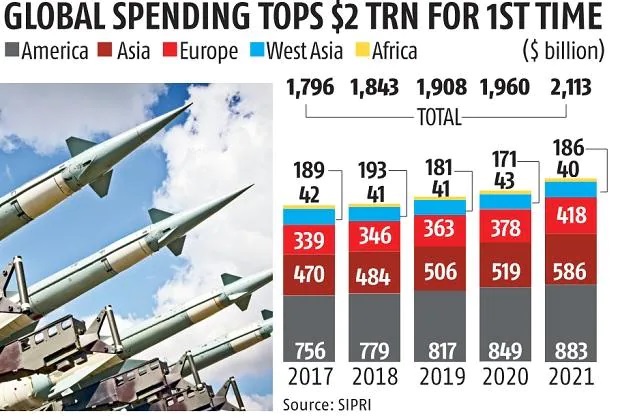
World military spending continued to grow in 2021, reaching a record $2.1 trillion despite the economic fallout of the pandemic, according to new data on global military spending published by the Stockholm International Peace Research Institute (SIPRI).
Top defence spenders in 2021
The five largest spenders in 2021 were the U.S., China, India, the U.K. and Russia, together accounting for 62% of expenditure.
The U.S. and China alone accounted for 52%.
India’s defence expenditure
India’s military spending of $76.6 billion ranked third highest in the world.
This was up by 0.9% from 2020 and by 33% from 2012.
Amid ongoing tensions and border disputes with China and Pakistan that occasionally spill over into armed clashes, India has prioritised the modernisation of its armed forces and self-reliance in arms production, the report said.
What about Russia and Ukraine?
Russia increased its military expenditure by 2.9% in 2021, to $65.9 billion, at a time when it was building up its forces along the Ukrainian border.
On Ukraine, the report remarked that as it had strengthened its defences against Russia, its military spending “has risen by 72% since the annexation of Crimea in 2014”.
Spending fell in 2021, to $5.9 billion, but still accounted for 3.2% of the country’s GDP.
Japan has recently described the Kuril Islands (which Japan calls the Northern Territories and Russia as the South Kurils) as being under Russia’s “illegal occupation”.
Note the Islands of Japan in North to South Direction: Hokkaido, Honshu , Shikoku, and Kyushu
What are the Kuril Islands/ Northern Territories?
These are a set of four islands situated between the Sea of Okhotsk and the Pacific Ocean near the north of Japan’s northernmost prefecture, Hokkaido.
Both Moscow and Tokyo claim sovereignty over them though the islands have been under Russian control since the end of World War II.
The Soviet Union had seized the islands at the end of World War II and by 1949 had expelled its Japanese residents.
Tokyo claims that the disputed islands have been part of Japan since the early 19th century.
Why in news?
This is the first time in about two decades that Japan has used this phrase to describe the dispute over the Kuril Islands.
Japan had been using softer language since 2003, saying that the dispute over the islands was the greatest concern in Russia-Japan bilateral ties.
What lies behind the dispute?
Japan’s sovereignty over the islands is confirmed by several treaties since 1855.
Russia, on the other hand, claims the Yalta Agreement (1945) and the Potsdam Declaration (1945) as proof of its sovereignty.
It argues that the San Francisco Treaty of 1951 is legal evidence that Japan had acknowledged Russian sovereignty over the islands.
Under Article 2 of the treaty, Japan had “renounced all right, title and claim to the Kuril Islands.”
However, Japan argues that the San Francisco Treaty cannot be used here as the Soviet Union never signed the peace treaty.
Continuing the WW2
In fact, Japan and Russia are technically still at war because they have not signed a peace treaty after World War II.
In 1956, during Japanese PM Ichiro Hatoyama’s visit to the Soviet Union, it was suggested that two of the four islands would be returned to Japan once a peace treaty was signed.
However, persisting differences prevented the signing of a peace treaty though the two countries signed the Japan-Soviet Joint Declaration, which restored diplomatic relations between the two nations.
The Soviet Union later hardened its position, even refusing to recognise that a territorial dispute existed with Japan.
It was only in 1991 during Mikhail Gorbachev’s visit to Japan that the USSR recognised that the islands were the subject of a territorial dispute.
Have there been attempts at resolution?
Since 1991, there have been many attempts to resolve the dispute and sign a peace treaty.
The most recent attempt was under PM Shinzo Abe when joint economic development of the disputed islands was explored.
In fact, both countries had agreed to have bilateral negotiations based on the 1956 Japan-Soviet Joint Declaration.
Russia was even willing to give back two islands, the Shikotan Island and the Habomai islets, to Japan after the conclusion of a peace treaty as per the 1956 declaration.
Japan’s attempt to improve ties with Russia was driven by its need to diversify energy sources and Russia by its need to diversify its basket of buyers and bring in foreign investments.
But nationalist sentiments on both sides prevented resolution of the dispute.
Implications for Japan
Soon after the Russian invasion of Ukraine, Japan made its unhappiness with Russia clear.
Japan has been among the most steadfast of Western allies in denouncing Russian aggression and punishing it with sanctions.
Japan has probably been spurred by its fears of a Russia-China alliance as Japan itself has territorial disputes and an uneasy history with China.
Secondly, Japan might have felt that this is a good opportunity to further isolate Russia and paint it as a “habitual offender” of international law.
Finally, Tokyo might have been prompted to take this position as it feels that the invasion of Ukraine proves that getting back the Kuril Islands is a lost cause.
Download Habitat app from the Playstore Join our Official Civilsdaily Space for GS and CSATHere
26th Apr 2022
Indian Festivals
Kumbha Mela
Held at all 4 places every 3 years by rotation (Allahabad, Haridwar, Nashik, Ujjain)
Associated rivers : Ganga at Haridwar, the Sangam of the Ganga, Yamuna and the mythical Saraswati at Allahabad, Godawari at Nashik, and Shipra at Ujjain
Ardha Kumbh Mela : Haridwar and Prayag every 6 years
Purna Kumbh Mela : Prayag every 12 years
Maha Kumbh Mela : Prayag every 144 years
Holi
last full moon day of Phalguna
Maha Shivaratri
13th night in Krishna Paksha of Phalguna
Navaratri
9 forms of Shakti are worshipped on 9 nights
Vinayaga Chaturthi
On occasion of birth of Ganesha
Vasant Panchami
Worshiping Saraswati – the goddess of knowledge, music and art
Children are taught to write their first words; Brahmins are fed ; ancestral worship is performed; the god of love- Kamadeva is worshipped
People usually wear yellow garments
Ramzan
Muslims refrain from eating, drinking and sexual relations from dawn until sunset
Intended to teach Muslims about patience, humility & spirituality
Guru Purnima
Buddhists in the honour of Lord Buddha who gave his first sermon on this day at Sarnath
Hindus on this day offer Puja or pay respect to their Guru
Buddha Poornima
Birth anniversary of Lord Buddha
Christmas
Commemorate the birth of Jesus
Easter
Oldest and holiest Christian festival – the day when Jesus Christ was crucified
On this day Jesus Christ rose from the dead and ascended into heaven
Thai Pongal
Harvest festival celebrated in Tamil Nadu, Puducherry and Sri Lanka
To thank the Sun God and farmstead livestock
Boiling of milk in clay pot symbolize material abundance for household
Muharram
Celebrated on the 1st month of the Islamic calendar
unlawful to fight during this month
Dree Festival
an agricultural rite, which is observed by Apatanis in Arunachal Pradesh
involves a sacrifice of fowls, eggs and animals to the sun & moon god to appease these Gods to avoid feminine
Indian Dances
Indian Folk Music
Baul : It is a type of Bengali music and a religious sect. The lyrics carry influence from Bhakti movement as well as Sufi movement.
Wanawan : Folk music from Kashmir which is sung during wedding ceremonies.
Padwani : This music is based on Mahabharata and uses both singing and playing instruments.
Alha : Song is from Madhya Pradesh and is a heroic ballad song.
Paani hari : Song is from the state of Rajasthan and is thematically related to water. Songs are generally about women fetching water from nearby well.
Ovi : Maharashtra and Goan women sing such songs during leisure time.
Pai song : Songs are mostly from Madhya Pradesh sung during festivals.
Lavani : Popular folk song from Maharashtra. Music has a powerful rhythm and beats and is suitable for dancing.
Maand : Developed in the royal circles
Dandiya raas : Performed in Gujarat and is associated with Holi and Lila of Krishna and Radha at Vrindavan
Powada : Folk type emerging from Maharashtra
Khongjom Parva : Important folk music from the state of Manipur.
Bhagwati : Popular amongst masses of Karnataka and Maharashtra. Musically they are close to ghazals and are sung on a slower pitch.
Classical Dances
The classical dance forms recognised by the Sangeet Natak Akademi and the Ministry of Culture are
Bharatanatyam, from Tamil Nadu
Kathak, from Uttar Pradesh and western India
Kathakali, from Kerala
Kuchipudi, from Andhra Pradesh
Odissi, from Odisha
Sattriya, from Assam
Manipuri, from Manipur
Mohiniyattam, from Kerala
Indian Music
MUSIC OF INDIA
The two main traditions of classical music in India are Carnatic music and Hindustani Music. Carnatic Music is found predominantly in the peninsular regions and Hindustani music are found in the northern and central regions.
Hindustani Music
Hindustani music was not only influenced by ancient Hindu musical traditions but also enriched by the Persian performance practices of the Mughals.
Dhrupad is an old style of Hindustani singing, traditionally performed by male singers. The great Indian musician Tansen sang in the Dhrupad style. Dhrupad was the main form of northern Indian classical music but has now given way to Khyal.
Khyal is a form of vocal music in Hindustani music. It was adopted from medieval Persian music It is special as it is based on improvising and expressing emotion.
Another vocal form Tarana are medium to fast-paced songs that are usually performed towards the end of the concert. They consist of a few lines of poetry with rhythmic syllables.
Tappa is a form of Indian semi-classical vocal music. It originated from the folk songs of the camel riders of Punjab and was developed as a form of classical music by Mian Ghulam Nabi Shori.
Thumri is a semi-classical vocal form said to have begun in Uttar Pradesh. The lyrics are typically in Brij Bhasha and are usually romantic.
Ghazal is an originally Persian form of Poetry. In India, Ghazal became the most common form of poetry in the Urdu language.
Although Hindustani music clearly is focused on vocal performance, recently instrumental Hindustani music is very popular than vocal music especially outside South Asia.
Carnatic Music
Carnatic music is a system of music commonly associated with the southern part of India especially. Andhra Pradesh, Karnataka, Kerala and Tamil Nadu. Carnatic music is completely melodic with improvised variations. Purandara Dasa is credited with having founded today’s Carnatic music. He is credited with having elevated Carnatic music from religious and devotional music into the realm of performing art. Carnatic music is usually performed by a small ensemble of musicians consist ing of a principal performer (vocalist ) a violin, mridanga ,and a tamburu. Today Carnatic music is presented by musicians in concerts or recordings either vocally or through instruments.
Important Indian Crafts
ZARI
Zari is an even thread traditionally made offine gold or silver used in traditional Indian, Pakistani and Persian garments and curtains, etc. Four types of zari are produced in India, namely, real zari, semi real zari, imitation zari and plastic zari.
Real zari is made of silver and electroplated with gold, whereas semi real zari has a composition of copper coated with silver and gold electroplating. Surat is the home of zari industry in India. Other clusters producing zari are Bareilly, Varanasi, Agra, Hyderabad, Lucknow, Vadodara, Lathur, Jaipur, Barmer, etc.
Coir Twisting
Coir is a natural, eco-friendly, waterproof and exceptionally tensile fibre extracted from the nuts of coconut palms.
It is found in abundance and is used for manufacturing a wide range of eco-friendly toys, mats, brushes, mattresses, wall hangings, key rings, pen stands and other home decoratives.
This craft is primarily produced in Odisha (Sakhigopal, Puri, Pipli, Bhubaneswar, Batamangala and Kendrapara). It is also produced in Kerala (Ernakulam).
Folk Painting
Indian folk paintings are pictorial expressions of village painters which are marked by the subjects chosen from epics like Ramayana and Mahabharata, Indian Puranas as well as daily events. There are several vibrant folk painting types in India in different stages.
The Gond tribe of Madhya Pradesh is engaged in floor and wall painting. Warli is a vivid expression of daily and social events of Warli tribe in Maharashtra. Rajasthan is famous for Phad painting done on cloth.
Other types of paintings arc Pilhora painting in Gujarat and Madhya Pradesh, Madhubani painting of Bihar, Chitrakar painting of West Bengal, Patachitras in Odisha, and Kalamkar Srikalahasti, Andhra Pradesh.
Metal Ware
The metal crafts of India display intricate craftsmanship and fine art in shaping gold, silver, brass, copper into exquisitely designed images, idols, jewellery, and utility items. Different categories of handicrafts that come under metal ware are brass metalware of Moradabad, metal bidri work and bell metal in Madhya Pradesh, Odisha, and so on.
India is the largest brassware producer in the world. Major clusters of brassware are Moradabad, Murshidabad, Madurai, Salem, Cuttack and Haryana.
Bidriware is a metal handicraft that originated in Bidar, Karnataka. The term ‘Bidriware’ originates from the township of Bidar, which is still the main centre of the unique metalware. It is a form of encrusted metalware, where one metal is inlaid on to another.
Bidri products include a diverse range of objects including hukka bases, bowls, boxes, candle stands, trays, jewellery and buttons. It travelled from Iran to Ajmer in Rajasthan in the 13th century AD, and from there to Bijapur and flourished during the reign of the Deccan Sultanate.Itis also practised in Aurangabad district in the state of Maharashtra and Hyderabad in Andhra Pradesh. The basic metal used for Bidri is the alloy of zinc and copper.
Filigree and Silverware
Filigree is an extremely ancient technique dating back to 4000 years ago. Filigree work is performed on silver and involves significant precision and technicality. Two major clusters of silver filigree in India are Karimnagar in Andhra Pradesh and Cuttack in Odisha.
The practice in Karimnagar is about two centuries old. However, it is also practised in Warangal in Andhra Pradesh. Key raw materials used are silver wire, tracing sheet, copper, charcoal, dilute sulphuric acid.
Textile Hand Embroidery
In textile hand embroidery, embellishment is made on fabric with threads and sometimes with other materials.
There are many popular embroidery clusters such as chikankari and zardozi of Lucknow, katha of Bengal pulkari of Punjab. kutchi embroidery of Gujarat and kashidakari of Kashmir. Zardozi has been traditionally prevalent in Lucknow and the six surrounding districts ofBarabanki, Unnao, Sitapur, Rae Bareli, Hardoi and Amethi.
Textile Hand Printing
Hand-printed textiles is a craft in which cloth is dyed with hand or printed using shapes. Various types of hand printing practiced in India are block printing, batik, kalamkari (hand printing by pen) and bandhani (tie and die).
Some of the important centres of this craft are in Hyderabad, Machalipattnam, Varanasi, Farrukabad, Bagh, Behrongarh, Indore, Mandsar, Burhanpur, Ahmedabad, Rajkot, Kutch, Bagru, Chittroli, Sanganer, Jaipur and Jodhpur.
Preparing for 2023 and not able to plan your preparation? No worries, Talk to our senior mentors directly.
Fill up this form to schedule a free on-call discussion with senior mentor from Civilsdaily. Once submitted we will call you within 24 hours. Click Here
The recent anti-encroachment drive in northwest Delhi’s violence-hit Jahangirpuri has become the latest flashpoint between political parties in the national capital.
The matter also reached the Supreme Court, which ordered a stay on the drive.
However, dissidents has now put questions over the legality of actions by municipal authorities and the manner in which certain structures were razed to the ground using bulldozers.
A close look at the pertinent legal provisions and constitutional principles involved in issues related to coercive processes against unauthorised constructions and encroachments may help putting the entire controversy in the right perspective:
What is Encroachment?
Encroachment is a real estate situation where a property owner violates contractual property rights by unlawfully entering, building, or extending structures onto Public Land without permission.
Structural encroachment occurs when a property owner unlawfully builds or extends structures on the Public Land.
Examples of Encroachment:
Unlawfully entering, trespassing, or walking through a property
Building a fence that goes past own property line
Extending structures or buildings onto the public domain (e.g., roads and sidewalks)
Non-government construction that overlaps govt property lines
Why encroachment is a problem?
Land is already a scarce commodity: Illicit occupation of public land puts stress on the already declining land resource availability.
Encroachment results in constriction of the public spaces: Road is narrowed down since it is occupied by structures supporting the livelihoods of the poor.
Public has the right of way: Pedestrians would suffer as people would have fewer spaces to walk. Encroachment on public roads increases the road traffic.
Maintenance of civic amenities becomes difficult: Severs, nullahs are chocked up due to encroachment. This creates sanitation and health crisis especially during monsoons.
Genesis of anti-encroachment drives in India
Anti-CAA protests: In 2019, after protests against the Citizenship Amendment Act (CAA) turned violent in Uttar Pradesh.
Compensation of public property damage: The CM ordered that compensation from property damage will be extracted from those who participated in the riots, to the tune of Rs 50 lakh.
Seizure of properties: He also announced that properties will be seized if people default on these payments.
How is Encroachment Demolition related to Rioting?
Prevention of Damage to Public Property Act, 1984: This is what governs actions taken against people convicted of rioting. However, this act levies a jail term and a fine on the offenders.
Assessment of damages caused: In 2009, the Supreme Court had said that respective high courts can appoint benches to adjudicate on damages during protests and riots.
Civil liability against damaging: In 2018, the Supreme Court had said that individuals will invite civil and criminal liability if found guilty of damaging public property.
What is the communal angle of recent demolition drive?
Ans. State-directed demolition of homes of the alleged rioters
The demolition drive was initiated by North Delhi Municipal Corporation (NDMC) to demolish the “illegal constructions” of the rioters in Jahangirpuri.
Communal violence had broken out in the area when a religious procession, which did not have police permission, clashed with minority community as it went alongside the place of worship.
This put a repulsive on other incidents, in Khargone in MP and Khambhat in Gujarat, where communal flare-ups were followed by the state-directed demolition of homes of the alleged rioters.
How did this intimidate minority groups?
Anti-encroachment drives in India are not new. What is new is that the current drives are outside the pale of the law.
Actions without notice: Irrespective of the legal status of the settlement, no public authority can demolish buildings without giving the affected parties a chance to be heard.
Bulldozing of petty areas: The bulldozer has now become a symbol of brute state power and a revolting mascot to intimidate minority groups in the country.
Collective punishment is state tyranny: It conveys the cynical use of brute state power for collective punishment undermining the basic tenets of criminal law.
Flawed binary of legality over illegality: The binary of slums settlements has very little meaning in Delhi, and much of urban India, since a majority of the residents appears to be of minority community.
Revengeful majoritarian justice: The demolition of homes and shops of alleged culprits of portrays the establishment as a bulldozer state that dispenses revengeful justice.
Public endorsement from the far-rights: Worryingly, the new rule of the bulldozer state seems to have some level of public endorsement.
Why impulsive encroachment demolition is a bad idea?
Issue of fair trial: From the legal perspective, the concept of a fair trial comes under question, since the government issued those notices before the people accused of participating in the riots were tried by any court.
Ambiguity of Public Property Act, 1984: Senior advocates thus said that such a decision is unconstitutional and has no backing from the law.
Curbing dissent: They also claimed seizure of property was being used as a means to curb peaceful dissent staged by certain communities.
Disregard for the due process of law: Such actions show a blatant disregard for the due process of law and established judicial precedents regarding evictions.
Arbitrary actions: Even before any charges are framed, the executive rather than the judiciary arbitrarily imposes a form of collective punishment upon a whole neighbourhood.
Creation of communal disharmony: Petitioners in the case claimed that the demolition drives were communal in nature since they were aimed at the localities of minority communities.
Larger impact: Rise of minority assertion
Marginalization and alienation: Minority community in India feels to be increasingly marginalized ever since the reigning in of the right-winged government. They have faced a spike in attacks, hate speech and harassment.
Demonizing the entire community: The modus operandi looks similar these days, i.e. to create an event of communal tension and clashes, declare names of rioters in a one-sided way, hence demonizing the community.
Rise in collective insecurity: Arbitrarily punitive demolition of this kind using a bulldozer as an extrajudicial threat or extrajudicial punishment is adding fuel to this temptation of insecurity.
Communal disharmony: Arbitrary state actions tends to divide people on religious lines– in most cases the minority and to win power on the basis of a religious identity.
Threats of radicalization: The poor and marginalized community is often vulnerable to the brisk of radicalization. There is a possibility of its inevitability.
Supreme Court rulings on removal of unauthorised constructions and encroachments
There has been a long line of cases underlining the significance of due process and adherence to the principle of natural justice where people are deprived of their rights to shelter or to earn a livelihood:
(1) Ahmedabad Municipal Corporation Vs Nawabkhan Gulabkhan and others (1977)
The top court held that while a notice may not be required in cases of encroachment of recent origin, if a municipal body allows settlement of encroachers for a long time, it must give a notice of reasonable time to such settlers.
If the encroachment is not removed within the specified time, it added, the competent authority would be at liberty to have it removed.
That would meet the fairness of procedure and principle of giving opportunity to remove the encroachment voluntarily by the encroachers.
The landmark verdict acknowledged the right to shelter and the right to earn livelihood as forming part of right to life under Article 21 of the Constitution.
The apex court rejected the plea of BMC that no notice need be given to slum dwellers since slums were sheer encroachments on public lands.
Removal of encroachmentswithout prior notice was arbitrary; the court held that such powers are designed to operate as an “exception” and not the “general rule.”
(3) MC Mehta Case (2006)
The Supreme Court was dealing with sealing of properties in Delhi on account of unauthorised use of properties (residential properties being used for commercial purposes).
It directed that the MCD would firstissue public notices in leading newspapers, asking violators to stop misuse of properties within the period of 30 days.
Official justification of the recent demolition drive
Anti-encroachment drives were long due: Officials claimed in court, that the demolitions were a part of anti-encroachment drives that had been planned in advance and were not specifically targeting the alleged rioters.
Discouraging the ever-increasing Slumization: The non-enforcement of strict regulations against encourages the public for encroachment hence the move was carried out.
No communal intent: The demolition drive in New Delhi has bulldozed all illicit constructions irrespective of the encroachers identity since the areas are inhabited by all communities.
Way Forward
Prevention of further encroachments: The local authorities and the state governments must become proactive in the prevention of encroachment of public lands.
Law abiding citizens: The citizens should abide by the rules and regulations and if they violate the rule of law, the violators should be penalized.
Due process of law must be held prime: Respecting the law of the land should be the norm and if there are any deviations the illegal structures should be bulldozed only after following due process of law.
Considering involuntary and forceful encroachments: The Supreme Court’s guidelines in the Olga Tellis judgment needs to be imbibed in true spirit.
Rehabilitation of slum-dwellers: and not the destruction of slums is the only way forward.
Conclusion
Slums and ‘unauthorised’ colonies like Jahangirpuri form the underbelly of India’s capital.
The city derives its energy from the thousands of informal workers living in these colonies.
It is high time the State recognizes their value and rights.
Over the last year, the World Health Organization (WHO) has been busy, in an unprecedented effort, to calculate the global death toll from COVID-19.
Revision of Covid-19 death toll by WHO
Globally from an estimated six million reported deaths, WHO now estimates these deaths to be closer to almost triple the number.
The new estimates also take into account formerly uncounted deaths, but also deaths resulting from the impact of COVID-19.
For example, millions who could not access care, i.e., diagnosis or treatment due to COVID-19 restrictions or from COVID-19 cases overwhelming health services.
India’s stand: India is in serious disagreement with the WHO-prepared COVID-19 mortality estimates.
The argument being made by India’s health establishment through a public clarification is that this is an overestimation, and the methodology employed is incorrect.
India’s Covid response
India’s COVID-19 response has been replete with delays and denials.
For instance, for the longest time that India’s COVID-19 number rose, the health establishment continued to insist that community transmission was not under way.
It took months and several lakh cases before they agreed that COVID-19 was finally in community transmission.
The devastation of the second wave showed how unprepared we were to combat the deadly Delta variant.
By the time the wave subsided, India’s population was devastated, and helpless, seeing dignity neither in disease nor in death.
Conclusion
The figures ratchet up not only issues of administrative but also moral accountability for governments that they have been previously side stepped.
As the Prelims is getting closer, many tasks line up like static revisions, attempting mocks and wrapping up your current affairs. Quick revisions can help you remember the factual information on the final day.
To take care of your quick revision plan, Civilsdaily is introducing Prelims Mahasangram 2022.
The program will focus on targeted coverage of syllabus; Daily Discussion with Q&A; TIKDAM Lectures, weekly zoom calls.
Program Starts on Monday 18th April, 2022.
Your War Commanders are Core mentors from Civilsdaily. They mentored around 50 Aspirants in 2021 and more than 22 Aspirants cleared prelims following their Strategy.
Now that the battleground is ready, Are you ready for the Mahasangram?
Complete the most important books like Laxmikant, Spectrum, NCERTs etc with Prelims Battle: Gamified.
Understand the Magic of Elimination through Lectures.
Win daily, weekly and eventually final War with your favourite War Commanders.
Be the top on the weekly Leaderboard and arrange a strategy session on Google Meet with your War Commanders.
Major Components of The Program
Detailed Plan: You War commanders will provide you with a broader, Weekly and daily plan. They will also set Daily Accountability to ensure Consistency. Every morning you will be given a target to complete, which will be eventually taken up for discussion in the evening.
A Roadmap to secure 105 marks in Prelims 2022: You are not supposed to score 200 but just 100+ to secure a seat for mains 2022. Reading Everything in detail right now will create confusion and panic. Your War Lords will give you their smart strategy which helped their older spartans to clear prelims with flying colors. They will tell you the perfect plan to reach this milestone.
Daily Sessions: Evaluation is necessary after you complete your targets. Your War commanders will conduct daily sessions and ensure you do not miss any relevant topic. These session will be based on Q&A method on our Official Civilsdaily Space, Habitat.
Strategy: Strategy will definitely help you to plan your study for the next 45 days in a more efficient manner.You War commanders will provide you subject wise strategy specifically for prelims.
Daily and Weekly Leaderboard: Follow the daily schedule and earn reward points.
Weekly Rewards: Those who get the top 5 spots on the weekly leaderboard will get a personal session with the mentors over google meet.
TIKDAM Lectures: Learn the Art of Elimination and Be the warrior who will win the war. Ravi Sir is one of the pioneers of Tikdam and he will help you in developing logics. These logics will definitely help you clear the exam.There will be 10 Tikdam sessions.
You can get the joining and payment details for the program on the link given below:
See How Tikdam Works even with the toughest questions:
Q. Consider the following statements:
1. 21st February is declared to be the International Mother Language Day by UNICEF.
2. The demand that Bangla has to be one of the national languages was raised in the Constituent Assembly of Pakistan.
Which of the above statements is/are correct?
(a) 1 only
(b) 2 only
(c) Both 1 and 2
(d) Neither 1 nor 2
Statement-1: It is a part of culture therefore it should be UNESCO not UNICEF. Also by TIKDAM Rule-1, Above statement should be incorrect.
Statement 2: Present Bangladesh was a part of the then Pakistan. The statement does not say for the first time or only in the Assembly but a general statement that the demand was raised which sounds logical because East Bengal was a part of it as well. Therefore this statement should be correct.
Q Consider the following statements:
1. Moringa (drumstick tree) is a leguminous evergreen tree.
2. The Tamarind tree is endemic to South Asia.
3. In India, most of the tamarind is collected as minor forest produce.
4. India exports tamarind and seeds of moringa.
5. Seeds of moringa and tamarind can be used in the production of biofuels.
Which of the statements given above are correct?
(a) 1, 2, 4 and 5
(b) 3, 4 and 5
(c) 1, 3 and 4
(d) 1, 2, 3 and 5
Almost every Indian has seen the Moringa Trees(Mungna, Saijan in hindi). They drop their leaves as we have seen. This means they are not evergreen. By eliminating we can get B as an answer.
Q What is blue carbon?
(a) Carbon captured by oceans and coastal ecosystems
(b) Carbon sequestered in forest biomass and agricultural soils
(c) Carbon contained in petroleum and natural gas
(d) Carbon present in atmosphere
We all know blue is used for Water/Oceans. Now option A has Ocean.
Q. With reference to the book “Desher Kather” written by Sakharam Ganesh Deuskar during the freedom struggle, consider the following statements :
1. It warned against the Colonial States hypnotic conquest of the mind.
2. It inspired the performance of swadeshi street plays and folk songs.
3. The use of desh‘ by Deuskar was in the specific context of the region of Bengal.
Which of the statements given above are curt?
(a) 1 and 2 only
(b) 2 and 3 only
(c) 1 and 3 only
(d) 1, 2 and 3
Anything in the context of Bengal used to start as ‘Bang.’ For example Bang Bhasha Prakashak Sabha, Bang Bhang, Bangladesh etc. Therefore Desh should not be in the context of Bengal. Now by simply eliminating S3 we can get the answer.
After a gap of 15 months, the India-Sri Lanka Joint Working Group (JWG) on fisheries held its much-awaited deliberations (in virtual format) on March 25.
Background of the issue
As sections of fishermen from the Palk Bay bordering districts of Tamil Nadu continue to transgress the International Maritime Boundary Line (IMBL), cases of many of them getting arrested and their boats being impounded by the Sri Lankan authorities continue.
Apart from poaching in the territorial waters of Sri Lanka, the use of mechanised bottom trawlers is another issue that has become a bone of contention between the fishermen of the two countries; the dispute is not just between the two states.
Use of mechanised bottom trawlers: This method of fishing, which was once promoted by the authorities in India, is now seen as being extremely adverse to the marine ecology, and has been acknowledged so by India.
The actions of the Tamil Nadu fishermen adversely affect their counterparts in the Northern Province.
Reason for transgression: The fishermen of Tamil Nadu experience a genuine problem — the lack of fishing areas consequent to the demarcation of the IMBL in June 1974.
If they confine themselves to Indian waters, they find the area available for fishing full of rocks and coral reefs besides being shallow.
Under the Tamil Nadu Marine Fishing Regulation Act 1983, mechanised fishing boats can fish only beyond 3 NM from the coast.
This explains the trend of the fishermen having to cross the IMBL frequently.
Way forward
Transition to deep-sea fishing: While Indian fishermen can present a road map for their transition to deep sea fishing or alternative methods of fishing, the Sri Lankan side has to take a pragmatic view that the transition cannot happen abruptly.
In the meantime, India will have to modify its scheme on deep-sea fishing to accommodate the concerns of its fishermen, especially those from Ramanathapuram district, so that they take to deep-sea fishing without any reservation.
Alternative livelihood measures: There is a compelling need for the Central and State governments to implement in Tamil Nadu the Pradhan Mantri Matsya Sampada Yojana in a proactive manner.
The scheme, which was flagged off two years ago, covers alternative livelihood measures too including seaweed cultivation, open sea cage cultivation, and sea/ocean ranching.
During Mr. Jaishankar’s visit, India had signed a memorandum of understanding with Sri Lanka for the development of fisheries harbours.
This can be modified to include a scheme for deep-sea fishing to the fishermen of the North.
Joint research on fisheries: . It is a welcome development that the JWG has agreed to have joint research on fisheries, which should be commissioned at the earliest.
Institutional mechanism: Simultaneously, the two countries should explore the possibility of establishing a permanent multi-stakeholder institutional mechanism to regulate fishing activity in the region.
Using common thread of culture, language and religion: The people of the two countries in general and fisherfolk in particular have common threads of language, culture and religion, all of which can be used purposefully to resolve any dispute.
Conclusion
What everyone needs to remember is that the fisheries dispute is not an insurmountable problem. A number of options are available to make the Palk Bay not only free of troubles but also a model for collaborative endeavours in fishing.
The release of two new working papers, one from the World Bank and the other from the IMF, has led to a renewed debate on poverty in India.
A substantial decline in extreme poverty in India
Both papers claim that extreme poverty in the country, based on the international definition of $1.90 per capita per day (in purchasing power parity (PPP), has declined substantially.
The World Bank paper uses the Consumer Pyramid Household Surveys (CPHS) data to conclude that 10.2 per cent of the country’s population was at extreme poverty levels in 2019.
The IMF paper calculates poverty by using the NSO Consumer Expenditure Survey as the base and adjusts it for the direct effect of the massive food grain subsidy given under the National Food Security Act (NFSA, 2013) and PM Garib Kalyan Anna Yojana (PMGKAY) during the pandemic period.
It claims that extreme poverty has almost vanished – it was 0.77 per cent in 2019 and 0.86 per cent in 2020.
Another estimate of poverty by the NITI Aayog, the multi-dimensional poverty index (MPI), has put Indian poverty at 25 per cent in 2015 based on NFHS data.
How MPI is calculated?: This MPI is calculated using twelve key components from areas such as health and nutrition, education and standard of living.
How much should be the coverage under NFSA, 2013?
The offtake of grains under NFSA in FY20 was 56.1 million metric tonnes (MMT).
Following the outbreak of Covid-19, the government launched the Pradhan Mantri Garib Kalyan Anna Yojana (PMGKAY) in April 2020 to distribute 25 kg cereals per family per month in addition to food transfers under the NFSA.
That catapulted the offtake to 87.5 MMT (under PMGKAY and NFSA) in FY21.
The scheme continued in FY22, and the grain offtake touched 93.2 MMT.
Issues with the wide coverage
A further extension of free food on top of the NFSA allocations was uncalled for.
This will strain the fisc, reduce public investments and hamper potential job creation.
A look at the size of food freebies will help understand the gravity of this problem.
As of April 1, the Food Corporation of India’s wheat and rice stocks stood at 74 MMT against a buffer stock norm of 21 MMT – there is, therefore, an “excess stock” of 53 MMT.
The cost of excess stock: The economic cost of rice, as given by FCI, is Rs 3,7267.6/tonne and that of wheat is Rs 2,6838.4/tonne (2020/21).
The value of “excess stocks”, beyond the buffer norm, is, therefore, Rs 1.85 lakh crore — this, despite a total of 72.2 MMT grains distributed for free under the PMGKAY in FY21 and FY22.
Ballooning food subsidy: All this results in a ballooning food subsidy for FY 23, it is provisioned at Rs 2.06 lakh crore, for FY 23, it is provisioned at Rs 2.06 lakh crore.
But this amount is likely to go beyond Rs 2.8 lakh crore with the continuing distribution of free food under the PMGKAY.
This would amount to more than 10 per cent of the Centre’s net tax revenue (after deducting the states’ share).
Way forward
It is all the more important to change the current policy of free food given the massive leakages in the PDS.
As per the High-Level Committee on restructuring FCI, leakages were more than 40 per cent based on the NSSO data of 2011.
Ground reports suggest that these leakages hover around 30 per cent or so today.
Make PDS more targeted: In reforming this system of free food, wisdom lies in going back to the Antyodaya Anna Yojana (AAY).
Under AAy, the “antyodaya” households (the most poor category) get more rations (35 kg per household) at a higher subsidy (rice, for instance, at Rs 3/kg and wheat at Rs2/kg).
For the remaining below poverty line (BPL) families, the price charged was 50 per cent of the procurement price and for above poverty line families (APL), it was 90 per cent of the procurement price.
This will make PDS more targeted and lead to cost savings.
Use of technology: There could be some problems in identifying the poor. However, technology can help overcome this difficulty.
Option of cash transfer: This measure should be combined with giving people the option of receiving cash instead of providing grains to targeted beneficiaries.
The savings so generated from this reform can be ploughed back as investments in agri-R&D, rural infrastructure (irrigation, roads, markets) and innovations that will help create more jobs and reduce poverty on a sustainable basis.
Conclusion
The government needs to bite the bullet and emulate the Vajpayee government (which had introduced AAY) in using scarce resources more wisely.
Since its inception, UPSC-CSE has had toppers from various academic and socio-economic backgrounds who have cracked the exam with flying colours. It’s clear that one doesn’t have to go to Delhi or a coaching centre to crack UPSC-CSE.
If education, geographical and economic background doesn’t matter, then what does? Attitude, or precisely consistency. If you are persistent and adamant to clear UPSC- CSE and have given more than two attempts till now, then you must replace that with consistency. Because, being persistent might lead you to the door, but it’s consistency that unlocks it.
In last month’s Samanvaya 1-on-1 counselling sessions, our expert Civilsdaily mentors reached out to aspirants to address their concerns regarding UPSC-CSE preparation. These are the responses they often heard from them —
How do I start preparing after a gap of 3-4 months?
It’s easy for me to maintain consistency in GS Preparation but not Revision
I study daily, but can only remain focused for 2-3 hours. How do I improve?
My long working hours don’t allow me to study daily.
Why am I losing interest in completing a subject? It’ s easier to read a new subject everyday.
This week, we have decided to answer all these questions and take additional questions in our personalised & motivational counselling session.
Key-Takeaways from This Week’s Samanvaya, Free 1-on-1 Counselling Session?
If you want to experience the same mentorship as Rishab Sharma, then here’s the good news – your first UPSC mentorship is on us and is absolutely free! All you have to do is confirm your slot now.
This prompted us to reach out to one of our students who is currently an IPS officer, Rishabh Sharma. He cleared the exam in 2020 with AIR 454. After his first attempt, Rishabh had enrolled in Smash Mains program underSajal sir and also attended our free interview program. Cracking the mighty UPSC-CSE the second time, Rishabh explains what consistency means to him —
UPSC doesn’t just test your intellect. It tests your patience, mental strength, your emotions, the very character of yours . As far as the journey of CSE is concerned you might know when to start, but you never know when the journey will come to an end. So be consistent and enjoy the journey.
Every topper follows a plan, a method or strategy that makes it easier for them to study on a daily basis and complete the traget modules of the day. In this free live counselling session, we will explain the many ways you can do to avoid faltering on your preparation.
1. The difference between a consistent study pattern v/s an inconsistent one. How UPSC-CSE becomes easier over time with consistency?
2. Social media distraction. How to avoid spending long hours on social media?
3. Number of ideal breaks everyday. Why is it necessary to reward yourself with a short break from time to time?
4. Best way to plan your timetable in advance? Why daily timetable should not be rigid but yearly timetable should be well defined?
5. How to remain consistent when you are not opting for coaching?
6. What are the practical methods to maintain regularity in studies. Tips to sustain the fire and passion for studies.
7. Why using Public Libraries is a way to remain consistent in UPSC-CSE preparation?
8. What are the 4 factors that determine if you can remain consistent for a year? If not, then why should you work on them first before starting UPSC-CSE preparation?
Get Motivated to Maintain Overall Consistency for UPSC
It’s understandable we are humans and not programmable robots who can maintain the same level of interest everyday. However, maintaining an overall consistency throughout our preparation is neccessary to clear this competitive and vast exam.
Our philosophy behind MENTORSHIP is to get you out of this Snooze cycle. This ensures that you are the BEST VERSION of yourself in this journey. If you are under the impression that mentorship is weekly calls you attend, then you are mistaken, my friend. Trust us, your mentor will be your ‘FRIEND, PHILOSOPHER AND GUIDE’.
TO EACH THEIR OWN – Every aspirant is different. Their strengths and weaknesses are different. Their time availability is also different. Identifying this is important so you don’t end up making unrealistic targets and lose momentum. Your mentor will make sure you start slow but remain consistent to build your confidence. Making your schedule structured based on our experience of working with 2500+ students is our first priority.
TRACK YOUR PROGRESS – When you see yourself grow, it becomes easier to motivate yourself to push boundaries. Tracking your progress can happen in many ways like mentorship calls or chat sessions or by regular tests. The idea is to ensure that you don’t go off track in your preparation, and even if you do, we have your back.
EVOLUTION – A constant guidance is important to bring consistency to your UPSC preparation. Guidance is not about clearing your doubts or asking you to study when you don’t. It is also about the evolution of your preparation. This is where you and your mentor work as a team. A constant effort to PLAN AND BUILD UP YOUR ABILITY to learn in a faster and more efficient way.
TALK IT OUT – The biggest hurdle in achieving your highest level of consistency is the emotional part. Every now and then, you. surround yourself with negative thoughts, you feel scared and depressed. Instead of resolving these emotional issues, you avoid them as it seems like a waste of your precious time. You have to understand that ignoring emotional troubles does not solve them. What your doing is building an emotional time bomb that may burst a week before your mains or prelims! This is where your MENTOR AS A FRIEND comes in. All our mentors have been through this journey. We understand your fears and anxieties. So, TALK IT OUT.
Don’t let inconsistency keep you away from your dreams.
Fill up the SAMANVAYA form given below. Let us know your problems and we will find a solution to it, just like our students say ” TOGETHER WE CAN AND WE WILL”. BOOK YOUR SLOT FOR YOUR FREE 1-0N-1 COUNSELLING SESSION IN THE NEXT 24 HOURS
How has Civilsdaily Mentorship, helped Aspirants become Toppers?
The most difficult challenge faced by EVERY candidate is inconsistency. Be it inconsistency in studies, answer-writing practice, covering the syllabus, or revision, every candidate finds it difficult to cope with. Buthow do successful candidates manage to FIGHT Inconsistency so consistently?
In UPSC 2020, Civilsdaily helped 80+ students secure ranks in their exams. In the top 100, every 3rd ranker was a Civilsdaily student.
A very recent success story would be Vishwa Shah, student of Civilsdaily Mentor, Sukanya Ma’am. Vishwa has cleared the GPSC exam to become the Deputy Superintendent of Police in Gujarat. He has penned a thank-you note yesterday. Heartiest Congratulations to Vishwa!
One of our other Civilsdaily Student, Shubham Nagargojecleared the exams in 2020 to become an IPS Officer. Shubham was gracious enough to let us know how he felt about Civilsdaily Samanvaya Guidance under Parth sir.
To know how all of them cleared the exam with our mentorship, visit the UnherdPodcast.
Now that results are announced for UPSC 2021 Prelims, out of 15 out of 25 students of Santhosh Gupta sir have been recommended to Mains. One such student, Rahul expresses his gratitude and extends his appreciation.
Most of our Mentors like Sudhanshu sir, Sajal sir, Santhosh sir, Pravin sir, Parth Verma sir and Sukanya Ma’am were UPSC aspirants themselves and have attended UPSC Mains more than five times and UPSC Interview more than twice. Hence their mentorship is always a blend of the best test series, comprehensive notes and current affairs knowledge.
All of them dedicate their time weekly to give 1-on-1 mentorship to every student where they discuss last week’s performance and next week’s approach.
Be it Telegram, Whatsapp or Habitiat channels, they are always available and clear student’s doubts in a turnaround time of 24 Hours.
Why Civilsdaily Mentors are the GPS for Your UPSC-CSE Preparation
Remember there is always light at the end of the tunnel and if you want to get out of the tunnel you have to follow the direction of the light! Our mentors’ give you direction which is divided into daily modules. All you have to do is study and complete them on time.
As every year passes by, we don’t get confident by the previous years’ performance and become laidback. Instead, we become more hungry to convert all our students into toppers.REGISTER HERE TO SCHEDULE YOUR FIRST FREE SAMANVAYA COUNSELLING SESSION IN NEXT 24 HOURS
How are Current Civilsdaily Students Gearing up for UPSC-CSE 2022?
Initially, our Civilsdaily student Smriti wasn’t confident about Prelims when she began her preparation. Though she had joined Civilsdaily in 2020, she started studying for UPSC-CSE back in 2019. At that time, Smriti had enrolled in multiple institutes. Though, most of these institutes had promised a personal mentor, she was unable to get in touch with them on a daily basis. Also those mentors never scheduled test-series on a weekly basis. Hence, despite preparing for a year, Smriti had scored only 35 marks out of 200 in her first test series by Civilsdaily.
She then started writing 20-25 test series over the course of UAP 2021 and in her last test, her scores have drastically improved. She now scores in the range of 130-135 marks in prelims’ and 110+ in mains’ papers.
In Smriti’s own words she describes her Samanvaya Mentorship Experience to be —
“Our parents provide us financial and emotional support, friends provide us moral support and the right mentor gives you logistic and logical support for UPSC. There are days when I felt I won’t be able to compete against lakhs of aspirants. That’s when my mentor, Ravi sir reminded me of my improvement and encouraged me that I can crack it with the same consistency. We need someone, who tells us we are performing well especially when we cannot see that ourselves. The mentorship at Civilsdaily helped me become mentally stronger as a person. In other institutes, mentors are allotted only for doubt resolution. But at Civilsdaily, I am getting end-to-end mentorship via value added notes, classes, test series and detailed evaluation.”
Similarly our another Civilsdaily student, Ashishsums up his Samanvaya experience with Civilsdaily mentor,Pravin Sir, “Because of Pravin sir’s support, I am able to understand a topic in lesser time.”
This is how Pravin sir evaluates Ashish’s Mains Test Series every week. After every test series evaluation, Pravin sir schedules a 1 hour call to discuss how Ashish can improve his marks and the sources he can refer for key topics.
It’s Your Turn Get the Free 40 Min Counselling Session By a CD Mentor
Civilsdaily mentors are so dedicated, consistent and focused for your UPSC goal, that you will eventually become focused into turning your dreams to reality.
At the core of Civilsdaily UPSC mentorship, lies the fact that each one of you will have a unique journey while preparing for the exam. Some will get through on the first attempt without much effort while others will take both more time and more effort.
We want to understand you better to help you optimize your journey so you can focus on the right things and not waste time on the wrong ones. We are asking you to tap into the valuable experiences of mentors who underwent the same grind and realize the pitfalls and understand the shortcuts to make it.
In the first counselling session, we will understand your weaknesses. We then help you to stick to one plan or strategy throughout your preparation. We will then follow up with you on a daily basis to check if you are right on track. TALK TO OUR MENTORS & CLARIFY YOUR DOUBTS NOW
As Mahatma Gandhi’s nation, India must be a committed and relentless apostle of peace and non-violence, both at home and in the world.
How the Russia-Ukraine conflict is reshaping the world order
Ever since the fall of the Berlin Wall in 1989, a paradigm of free societies, frictionless borders and open economies evolved to be the governing order in many nations.
This catalysed freer movement of people, goods, services and capital across the world.
India too has benefited enormously from being an active participant in this interconnected world, with a tripling of trade (as share of GDP) in the last three decades and providing vast numbers of jobs.
Such tight inter-dependence among nations will lead to fewer conflicts and promote peace, was the established wisdom.
The Russia-Ukraine conflict has dismantled this wisdom.
Mutually beneficial to mutually harmful: If inter-connectedness and trade among nations were mutually beneficial, then it follows that its disruption and blockade will be mutually harmful.
Global Village was built on the foundation of advanced transportation networks, cemented with the U.S. dollar as the reserve currency and fenced by integrated payment systems.
Any disruption to this delicate balance runs the risk of plunging the ‘Global Village’ into disequilibrium and derailing the lives of all.
Trade opportunity for India
Trade with other nations should and will always be an integral cornerstone of India’s economic future.
A reversal towards isolationism and protectionism will be foolhardy and calamitous for India.
As the western bloc of nations looks to reduce dependence on the Russia-China bloc of nations, it presents newer avenues for India to expand trade.
It presents a tremendous opportunity for India to become a large producing nation for the world and a global economic powerhouse.
However, to capitalise on these opportunities, India needs free access to these markets, an accepted and established global currency to trade in and seamless trade settlements.
Suggestions for India
1] Bilateral currency agreements are unsustainable
The American dollar has emerged as the global trade currency, bestowing an ‘exorbitant privilege’ on the dollar.
But a forced and hurried dismantling of this order and replacing it with rushed bilateral local currency arrangements can prove to be more detrimental for the global economy in the longer run.
We had an Indian rupee-Russian rouble agreement in the late 1970s and 1980s, when we mutually agreed on exchange rates for trading purposes.
Now, with India’s robust external sector, a flourishing trading relationship with many nations and tremendous potential to expand trade, such bilateral arrangements are unsustainable, unwieldy, and perilous.
2] Avoid discounted commodity purchases from Russia
In the long run, India stands to gain more from unfettered access to the western bloc markets for Indian exports under the established trading order than from discounted commodities purchased under new bilateral currency arrangements that seek to create a new and parallel global trade structure.
It entails a prolonged departure from the established order of dollar-based trade settlement or jeopardises established trading relationships with western bloc markets, it can have longer term implications for India’s export potential.
3] Non-disruptive geo-economic policy
India needs not just a non-aligned doctrine for the looming new world order but also a non-disruptive geo-economic policy that seeks to maintain the current global economic equilibrium.
By the dint of its sheer size and scale, India can be both a large producer and a consumer.
To best utilise this opportunity, India needs not just cordial relationships with nations on either side of the new divide but also a stable and established global economic environment.
4] Social harmony is a must
Just as it is in India’s best interests to balance the current geo-economic equilibrium, it is also imperative for India to maintain its domestic social equilibrium.
Social harmony is the edifice of economic prosperity.
Fanning mutual distrust, hate and anger among citizens, causing social disharmony is a shameful slide to perdition.
Conclusion
The reshaping and realignment of the world order will be a unique opportunity for India to reassess its foreign policy, economic policy and geo-political strategy and don the mantle of global leadership.
A 37-year-old Constitution Bench judgment of the Supreme Court which held that pavement dwellers are different from trespassers. This may become a game-changer in the Jahangirpuri case.
What is the Olga Tellis judgment?
The judgment, Olga Tellis vs. Bombay Municipal Corporation, was given in 1985 by a five-judge Bench led by then Chief Justice of India Y.V. Chandrachud (F/O Justice D.Y Chandrachud).
It is agreed that pavement dwellers do occupy public spaces in an unauthorized manner.
Key takeaways of the Judgment
Opportunity to depart: The court maintained they should be given a chance to be heard and a reasonable opportunity to depart before force is used to expel them.
No use of force: The Supreme Court reasoned that eviction using unreasonable force, without giving them a chance to explain is unconstitutional.
Right to life: Pavement dwellers, too, have a right to life and dignity. The right to life included the right to livelihood. They earn a meagre livelihood by living and working on the footpaths.
No misuse of powers of eviction: A welfare state and its authorities should not use its powers of eviction as a means to deprive pavement dwellers of their livelihood.
What led to the judgment?
Sometime in 1981, the State of Maharashtra and the Bombay Municipal Corporation decided that pavement and slum dwellers in Bombay city should be evicted and “deported to their respective places of origin or places outside the city of Bombay.”
Some demolitions were carried out before the case was brought to the Bombay High Court by pavement dwellers, residents of slums across the city, NGOs and journalists.
While they conceded that they did not have “any fundamental right to put up huts on pavements or public roads”, the case came up before the Supreme Court on larger questions of law.
What were the questions discussed before the Supreme Court?
One of the main questions was whether eviction of a pavement dweller would amount to depriving him/her of their livelihood guaranteed under Article 21 of the Constitution.
The Article mandates that “no person shall be deprived of his life or personal liberty EXCEPTaccording to procedure established by law.”
The Constitution Bench was also asked to determine if provisions in the Bombay Municipal Corporation Act, 1888, allowing the removal of encroachments without prior notice, were arbitrary and unreasonable.
The Supreme Court also decided to examine the question whether it was constitutionally impermissible to characterise pavement dwellers as trespassers.
What was the State government’s defence?
The State government and the corporation countered that pavement dwellers should be estopped (estoppel is a judicial device whereby a court may prevent or “estop” a person from making assertions.
Estoppel may prevent someone from bringing a particular claim from contending that the shacks constructed by them on the pavements cannot be demolished because of their right to livelihood.
They cannot claim any fundamental right to encroach and put up huts on pavements or public roads over which the public has a ‘right of way.’
How did the Supreme Court rule?
The Bench threw out the government’s argument of estoppel, saying “there can be no estoppel against the Constitution.”
The court held that the right to life of pavement dwellers were at stake here.
The right to livelihood was an “integral component” of the right to life. They can come to court to assert their right.
If the right to livelihood is not treated as a part of the constitutional right to live, the easiest way of depriving a person of his right to life would be to deprive him of his means of livelihood to the point of abrogation.
Any aggrieved person can challenge the deprivation as offending the right to life.
Removal of encroachments without prior notice was arbitrary; the court held that such powers are designed to operate as an “exception” and not the “general rule.”
The procedure of eviction should lean in favour of procedural safeguards which follow the natural principles of justice like giving the other side an opportunity to be heard.
Finally, the court emphatically objected to authorities treating pavement dwellers as mere trespassers.
The encroachment committed are involuntary acts in the sense that those acts are compelled by inevitable circumstances and are not guided by choice.
Way ahead
It is not a free choice to exercise as to whether to commit an encroachment and if so, where.
Trespassers should not be evicted by using force greater than what is reasonable and appropriate.
He/she should be asked and given a reasonable opportunity to depart before force is used to expel him.
Vice-President M. Venkaiah Naidu said that there was a need to amend the anti-defection legislation in the country to plug existing loopholes.
What did VP notice now?
Stating that there was no clarity in the law about the time frame for the action of the House Chairperson or Speaker in anti-defection cases.
Some cases are taking six months and some even three years.
There are cases that are disposed of after the term is over.
What is Anti-defection Law?
The Anti-Defection Law under the Tenth Schedule of the Constitution punishes MPs/ MLAs for defecting from their party by taking away their membership of the legislature.
It gives the Speaker of the legislature the power to decide the outcome of defection proceedings.
It was added to the Constitution through the Fifty-Second (Amendment) Act, 1985 when Rajiv Gandhi was PM.
The law applies to both Parliament and state assemblies.
Cases considered under the anti-defection law
The law covers three scenarios with respect to shifting of political parties by an MP or an MLA.
(1) Voluntary give-up
The first is when a member elected on the ticket of a political party “voluntarily gives up” membership of such a party or votes in the House against the wishes of the party.
Such persons lose his seat.
(2) Independent members
When a legislator who has won his or her seat as an independent candidate joins a political party after the election.
In both these instances, the legislator loses the seat in the legislature on changing (or joining) a party.
(3) Nominated MPs
In their case, the law gives them six months to join a political party, after being nominated.
If they join a party after such time, they stand to lose their seat in the House.
Powers to disqualification
Under the anti-defection law, the power to decide the disqualification of an MP or MLA rests with the presiding officer of the legislature.
The law does not specify a time frame in which such a decision has to be made.
As a result, Speakers of legislatures have sometimes acted very quickly or have delayed the decision for years — and have been accused of political bias in both situations.
Significant role of the Speaker/Presiding Officer
Pandit Nehru had referred to the Speaker as “the symbol of the nation’s freedom and liberty” and emphasized that Speakers should be men of “outstanding ability and impartiality”.
Several judgments on the anti-defection law have been rendered by the Supreme Court.
A common factor that shows up in these rulings is the blatant, partisan conduct of speakers in state assemblies.
Reasons for Speakers’ ambiguous action
The Speaker continues to belong to a particular political party.
The electoral system and conventions in India have ‘not been developed to ensure protection to the office, there are cogent reasons for Speakers to retain party membership.
It would be unrealistic to expect a speaker to completely abjure all party considerations while functioning.
There are structural issues regarding the manner of appointment of the Speaker and her tenure in office.
Way forward
Parliament may seriously consider a Constitutional amendment to bring in a permanent Tribunal for dealing with defection cases.
It is suggested that a scheme should be brought wherein Speakers should renounce all political affiliations, membership, and activity once they have been elected.
We can learn from the UK model. In practice, once elected, the Speaker gives up all-partisan affiliation, as in other Parliaments of British tradition.
He/she remains in office until retirement, even though the majority may change and does not express any political views during debates.
Conclusion
Impartiality, fairness, and autonomy in decision-making are the hallmarks of a robust institution.
It is the freedom from interference and pressures which provide the necessary atmosphere where one can work with an absolute commitment to the cause of neutrality as a constitutional value.
Communal violence, a complex phenomenon, has been over-simplified to suit a convenient political narrative.
India’s syncretic traditions and impact of invasions
For aeons, India has had syncretic traditions inspired by the Vedic aphorism, “Ekam sad vipra bahudha vadanti” (there is only one truth and learned persons call it by many names).
Because of this underpinning, Indian society has never insisted on uniformity in any facet of life.
This equanimity of Indian society was, however, disrupted by invading creeds.
The first such incursion came in 712, when Muhammad bin Qasim vanquished Sindh, and as Chach Nama, a contemporary Arab chronicle states, introduced the practice of treating local Hindus as zimmis, forcing them to pay jizya (a poll tax), as a penalty to live by their beliefs.
In the 11th century, Mahmud of Ghazni, while receiving the caliphate honours on his accession to the throne, took a vow to wage jihad every year against Indian idolaters.
The fact is, ties between the two communities were seldom cordial.
There were intermittent skirmishes, wars and occasional short-lived opportunistic alliances.
When Pakistan declared itself an Islamic Republic in 1947, it would have been natural for India to identify itself as a Hindu state.
It didn’t, and couldn’t have — because of its Hindu ethos of pluralism.
India, is, and will always be, catholic, plural, myriad and a vibrant democracy.
Conclusion
It’s relevant to recall what Lester Pearson (14th PM of Canada) said: “Misunderstanding arising from ignorance breeds fear, and fear remains the greatest enemy of peace.”
Retired Supreme Court judge Justice BN Srikrishna has said that there is a blatant misuse of rape laws in the country.
What did Justice BN Srikrishna say?
Lesser convictions: Statistics show that even after the amendment of rape laws, there have been less number of convictions.
Need for objective analysis: It is time that rape cases be looked at in a very objective manner.
Authencity of women’s claims needs to be checked: We need to question — is the woman really subjected to cruelty and atrocities? Otherwise, in the general course of things, the accused is presumed to be innocent unless proven guilty should apply.
Tilt of such laws is always against the men: However, in rape cases, whatever the woman says is treated as the gospel truth. But that is not the intention of the law. It is not the way to empower women.
Various laws for the protection of women
Various special laws relating to women include:
Protection of Women from Domestic Violence Act, 2005
Dowry Prohibition Act, 1961
Indecent Representation of Women (Prohibition) Act, 1986
Sexual Harassment of Women at Workplace (Prevention, Prohibition and Redressal) Act, 2013
Prohibition of Child Marriage Act, 2006
Alleged rape cases these days
False accusations: Justice BN Srikrishna said that, sometimes some innocent men are being falsely accused of rape and later getting acquitted.
Consensual sex is later cried as rape: There are many cases either in a consensual relationship or in co-habitation for a long time, there is a disagreement and the woman cries rape.
Tool to preserve honour: There are instances where a secret affair is going on, people get to know of it and in order to come out of the ignominy of it, she cries rape, Justice Srikrishna said.
Issues with such alleged rape cases
Whenever the man is accused of rape, he gets arrested, newspapers carry it on the front page.
But when there is an acquittal, it is not carried in the same way. This is terrible.
The balance is always tilted in favour of women in such cases.
Various sexual crimes in India
Sexual Abuse/ Molestation/ Rape: Rape is one of the most common crimes in India. According to the National Crime Records Bureau, one woman is raped every 20 minutes in India.
Marital Crimes: In India, marital rape is not a criminal offense. India is one of fifty countries that have not yet outlawed marital rape.
Forced Marriage: Girls are vulnerable to being forced into marriage at young ages, suffering from a double vulnerability: both for being a child and for being female.
Trafficking and forced prostitution: Human trafficking, especially of girls and women, often leads to forced prostitution and sexual slavery.
Online abuse: Women are regularly subject to online rape threats, online harassment, cyber-stalking, blackmail, trolling, slut-shaming and more.
Harassment at the workplace: Sexual harassment at workplace, mostly comprising of indecent remarks, unwanted touches, demands for sex, and the dissemination of pornography.
Various initiative to protect women
The Government has taken a number of initiatives for the safety of women and girls, which are given below:
Nirbhaya Fund for projects for the safety and security of women
One-Stop Centre Scheme to provide integrated support and assistance to women affected by violence, both in private and public spaces under one roof
Online analytic tool for police called “Investigation Tracking System for Sexual Offences” to monitor and track time-bound investigation in sexual assault cases in accordance with Criminal Law (Amendment) Act 2018.
National Database on Sexual Offenders (NDSO) to facilitate investigation and tracking of sexual offenders across the country by law enforcement agencies.
Way ahead
Breaking the cycle of abuse will require concerted collaboration and action between governmental and non-governmental actors including educators, health-care authorities, legislators, the judiciary and the mass media.
Gender-based violence, an especially violent crime like rape, is a multifaceted problem.
Although the incorporation of stringent laws and stricter punishments are important to deter people from committing such crimes, the solution to this is much more than just promulgation.
Education of both men and women will lead to change in attitudes and perceptions.
It is a mammoth task. We are just doing bits and pieces. A way ahead is obscure but in our sphere with concrete and pronounced steps.
The annual Raisina Dialogue in Delhi held this year by National Security Adviser Ajit Doval will host intelligence agency chiefs of several countries.
What is the conference about?
The conference is modelled on the lines of the annual Munich Security Conference and Singapore’s Shangri-La dialogue.
It is expected to bring together heads and deputy heads of the top intelligence and security organisations from more than 20 — mostly Western countries and their allies.
Intelligence chiefs and deputies from Australia, Germany, Israel, Singapore, Japan and New Zealand are among those expected to attend the conference.
The meet is held on the sidelines of the “Five eyes alliance” of the U.S., U.K., Canada, New Zealand and Australia, who coordinate on terrorism and security issues.
What is the Five Eyes Alliance?
The Five Eyes (FVEY) is an intelligence alliance comprising Australia, Canada, New Zealand, the United Kingdom, and the United States.
These countries are parties to the multilateral UKUSA Agreement, a treaty for joint cooperation in signals intelligence.
The origins of the FVEY can be traced to informal secret meetings during World War II between British and American code-breakers.
It was started before the US formally entered the war, followed by the Allies’ 1941 Atlantic Charter that established their vision of the post-war world.
Back2Basics: Munich Security Conference
The Munich Security Conference is an annual conference on international security policy that has been held in Munich, Bavaria, Germany since 1963.
It brings together heads of state, diplomats and business leaders from the world’s leading democracies for three days of meetings and presentations.
It is the world’s largest gathering of its kind.
Over the past four decades the MSC has become the most important independent forum for the exchange of views by international security policy decision-makers.
The All-India Household Consumer Expenditure Survey, usually conducted by the National Statistical Office (NSO) every five years, is set to resume this year after a prolonged break.
What is the Consumer Expenditure Survey (CES)?
The CES is traditionally a quinquennial (recurring every five years) survey conducted by the government’s National Sample Survey Office (NSSO).
It is designed to collect information on the consumer spending patterns of households across the country, both urban and rural.
Typically, the Survey is conducted between July and June and this year’s exercise is expected to be completed by June 2023.
Utility of the survey
The data gathered in this exercise reveals the average expenditure on goods (food and non-food) and services.
It helps generate estimates of household Monthly Per Capita Consumer Expenditure (MPCE) as well as the distribution of households and persons over the MPCE classes.
It is used to arrive at estimates of poverty levels in different parts of the country and to review economic indicators such as the GDP, since 2011-12.
Why need this survey?
India has not had any official estimates on per capita household spending.
It provides separate data sets for rural and urban parts, and also splice spending patterns for each State and Union Territory, as well as different socio-economic groups.
What about the previous survey?
The survey was last held in 2017-2018.
The government announced that it had data quality issues.