P Srija, AIR 20, UPSC 2020, in conversation with Birendra sir shared her mindset and thought process that helped her crack IAS exam. Srija also gave valuable advice to aspirants for prelims as well as mains.
Srija, is an MBBS graduate and secured rank 20 in her first attempt in UPSC 2020 examination. In this series, she has talked about how a hardwork and a true mentor can change the journey of the aspirants.
After got to know from Anudeep Durishetty Rank 1 in 2017, it is clearly mentioned that she started preparing current affairs from Samachar Manthan where there is a discussion and written test every week on the various important issues. Not only the test series but also Sukanya Mam who is among the core mentor in Civilsdaily has helped her to evolve with the art of answer writing and motivated her at every stage of the preperation.
In Civilsdaily, we have a team of such dedicated mentors helping aspirants at every stage of the preparation to understand their weaknesses and approach to overcome them.
In February, Facebook stated that its revenue in 2022 is anticipated to reduce by $10 billion due to steps undertaken by Apple to enhance user privacy on its mobile operating system.
Move towards more privacy-preserving options
Apple introduced AppTrackingTransparency feature that requires apps to request permission from users before tracking them across other apps and websites or sharing their information with and from third parties.
Through this change, Apple effectively shut the door on “permissionless” internet tracking and has given consumers more control over how their data is used.
Privacy experts have welcomed this move because it is predicted to enhance awareness and nudge other actors to move towards more privacy-preserving options, leading to a market for “Privacy Enhancing Technologies”.
Google’s Privacy Sandbox project is a case in point, though it remains to be seen whether it will be truly privacy-preserving.
Big Tech dominance and issues related to it
Privacy and acquisitions: One standout feature of the Big Tech dominance has been the non-price factors such as quality of service (QoS) in general and privacy and acquisitions in particular.
Acquisitions to kill competition: Acquisitions by Big Tech are regular and eat up big bucks, not always to promote efficiency but to eliminate potential competition, described evocatively as “kill zone” by specialists.
According to a report released by the Federal Trade Commission, between 2010 and 2019, Big Tech made 616 acquisitions.
In the absence of a modern framework, competition law continues to rely on Bork’s theory of consumer welfare which postulated that the sole normative objective of antitrust should be to maximise consumer welfare, best pursued through promoting economic efficiency.
Market structure thus became irrelevant and conduct became the sole criterion for judgement.
Conduct now predominantly revolves around QoS which, like much else surrounding digital platforms, is pushing competition authorities to fortify their existing regulatory toolkits.
Privacy as a metric of quality
Companies such as Apple and DuckDuckGo (with its slogan “the search engine that doesn’t track you”) are employing enhanced user privacy as a competitive metric.
It has been shown that “websites which do not face strong competition are significantly more likely to ask for more personal information than other services provided for free”.
In 2018, OECD accepted that privacy is a relevant dimension of quality despite the low quality that may be prevalent due to lack of market development.
Regulators across the globe are recognising privacy as a serious metric of quality.
For instance, the Competition Commission of India (CCI) in 2021 took suo moto cognisance of changes to WhatsApp’s “take-it” or “leave-it” privacy policy that made it mandatory for every user to share data with Facebook.
In its prima facie order, the CCI inter alia observed that this amounts to degradation of privacy and therefore quality.
Way forward
Privacy and competition have overlapping boundaries.
If privacy becomes a competitive constraint, then companies will have the incentive to create privacy-preserving and enhancing technologies.
Barriers for new entrants: On the other hand, care must be taken so that Big Tech, aka the gatekeepers in the EU’s Digital Markets Act, do not misuse privacy to create barriers for newer entrants.
Restricting third-party tracking is not novel and other browsers such as Mozilla Firefox and Microsoft’s Edge have already done so.
But Google, which owns 65 per cent of the global browser market, is different.
By disabling third parties from tracking but continuing to use that data in its own ad tech stack, Google harms competition.
The use of privacy as a tool for market development, therefore, has to tread this tightrope between enabling and stifling competition.
Conclusion
An approach that balances user autonomy, consumer protection, innovation, and market competition in digital markets is a real win-win and worth investing in.
Book your slot for UPSC Mock interviews (paneled by ex UPSC members) and get a dedicated mentor, on-call DAF analysis, DAF-based personalized questionnaire, and Situational questionnaire (FREE)
You are bound to get such bouncers of questions from UPSC panelists in the interview. Tackling them is both a matter of skill and practice. Should you attempt to answer such questions or respectfully accept your ignorance? Discuss 1-1 with our CD panelists and mentors.
Moreover, we will prepare a personalized DAF-based questionnaire to keep you prepared for such questions.
As a part of Transcend Interview Guidance Program for UPSC 2021 we’ve also prepared and compiled a high-quality comprehensive questionnaire.
A recent Gazette notification regarding the creation of the Indian Railway Management Service (IRMS) marks a paradigm shift in the management of one of the world’s largest rail networks.
About the merger and IRMS
A nearly 8,000 strong cadre of the erstwhile eight services is now merged into one.
Eight out of 10 Group-A Indian Railway services have been merged to create the IRMS.
The merged services are: Indian Railway Traffic Service (IRTS), Indian Railway Personnel Service (IRPS), Indian Railway Accounts Service (IRAS), Indian Railway Service of Electrical Engineers (IRSEE), Indian Railway Service of Signal Engineers (IRSS), Indian Railway Service of Mechanical Engineers (IRSME), Indian Railway Service of Civil Engineers (IRSE) and Indian Railway Stores Service (IRSS).
Aims of the restructuring: Besides removing silos, this restructuring also aims at rationalising the top-heavy bureaucracy of the Indian Railways.
Way forward: Training
Training the future leaders of India’s public transporter in the rapidly evolving logistics sector of the country is the most important task ahead.
The UPSC will recruit a few hundred IRMS officers each year from now, they will remain much less in number when compared to already serving officers for a long time to come.
Training of the existing cadre of officers: The fact remains that even after the creation of the IRMS, the 8,000 strong (already serving) officers of the Indian Railways will need to work in coordination and not in silos, as they will be serving in the organisation for decades to come.
This highlights the importance of training of the existing cadre of officers as they will have to deliver on the ambitious Gati-Shakti projects.
The task of training such a dynamic talent pool assumes importance in view of India’s aspirations of becoming a $5 trillion economy.
All this will require a massive revamp of the capacity building ecosystem of the Indian Railways.
Redesign the training: The merger of services provides an opportunity to redesign the training for newly recruited IRMS officers to make them future-ready. Initial training along with mid-career training programmes may be reoriented.
The IRMS training needs to be designed based on the competencies required for different leadership roles.
Mission Karmayogi of the Government of India provides for competencies based postings of officers.
The Integrated Government Online Training (iGOT) programme of the Government of India will be instrumental in shaping the career progression of IRMS officers.
Conclusion
Future IRMS officers should be ready to face the challenges of working in an organisation that is involved in round the clock and round the year operations, has substantial social obligations to meet and, at the same time, which must earn for itself.
The fourth ‘2+2’ dialogue between India and the United States is underway in Washington DC.
2+2 talks between India and allies
The 2+2 dialogue is a format of meeting of the foreign and defence ministers of India and its allies on strategic and security issues.
A 2+2 ministerial dialogue enables the partners to better understand and appreciate each other’s strategic concerns and sensitivities taking into account political factors on both sides.
This helps to build a stronger, more integrated strategic relationship in a rapidly changing global environment.
India has 2+2 dialogues with four key strategic partners: US, Australia, Japan, and RUSSIA.
Inception of the idea
The inaugural 2+2 dialogue with Australia was held in September 2021 when Jaishankar and Singh met with their counterparts Marise Payne and Peter Dutton in New Delhi.
India held its first 2+2 dialogue with Russia in December last year, when Russian Foreign Minister Sergey Lavrov and Defence Minister Sergei Shoigu visited India.
The first India-Japan talks in the 2+2 format were held on November 30, 2019 in New Delhi.
Dialogue with the US
The US is India’s oldest and most important 2+2 talks partner.
The first 2+2 dialogue between the two countries was held during the Trump Administration.
It hosted then-Secretary of State Michael Pompeo and then-Secretary of Defence James Mattis and the late Sushma Swaraj and then Defence Minister Nirmala Sitharaman in New Delhi in September 2018.
The second and third editions of the 2+2 dialogues were held in Washington DC and New Delhi in 2019 and 2020 respectively.
Defence and strategic agreements
Over the years, the strategic bilateral relationship with its partners, including the dialogues held in the 2+2 format, have produced tangible and far-reaching results for India.
Logistics Exchange Memorandum of Agreement (LEMOA) in 2016
Communications Compatibility and Security Agreement (COMCASA) after the first 2+2 dialogue in 2018, and
Basic Exchange and Cooperation Agreement (BECA) in 2020
Deterrents in ties ahead of the meet
There is little doubt as to how beneficial this mechanism has been.
On one side, the ‘two plus dialogue’ is expected to abate, if not resolve, highly problematic issues such as Chinese aggression.
Even though there is a tonne of expectations from this mutual dialogue between the two countries, the dialogue is also the source of some worry.
This time, the US is sceptical of India’s mammoth oil import from Russia.
Another problematic pointer is India’s voluminous weaponry sanctions from Russia.
Why a 2+2 with Russia?
Russia is one of those countries with which a 2+2 format talk “fits perfectly” in India’s foreign policy.
India and Russia have shared a strategic relationship since October 2000, which later got upgraded to ‘Special and Privileged Strategic Partnership’ in December 2010.
To be sure, the India-Russia 2+2 does have a particularly strong signalling component when seen against the backdrop of the S400 controversy.
Holding the 2+2 talks with Russia is much needed. This gives out a strong message to the world that India sees everyone to be on the same level.
This is visible messaging that India cannot be compelled to choose partners. India pursues an independent foreign policy serving its national and non-allied interests.
Having a 2+2 with Russia also means that India is “not in anyone’s camp” and that bilateral ties between Moscow and New Delhi are “traditional and comprehensive”.
Way forward
India and the US don’t set ‘red lines’ and are pushing for “an honest dialogue”, the ongoing 2+2 dialogue is an opportunity for both India and the US.
The US also understands that India is one of the few countries that could leverage its relationship with Russia to bring the two warring parties to the negotiating table through a ceasefire and diplomatic resolution.
For Delhi, it is a season for careful and adroit diplomacy.
Book your slot for UPSC Mock interviews (paneled by ex UPSC members) and get a dedicated mentor, on-call DAF analysis, DAF-based personalized questionnaire, and Situational questionnaire (FREE)
To give you a real feel of the panel that you will be facing in your real UPSC interview 2021, CD has brought together a mix of the most experienced and valued panelists for your mock interview.
Panelists for Mock Interviews:
Shri Shankar Aggarwal, IAS (retd.), former Secretary
Dr. Noor Mohammad, IAS (retd.), former EC
Dr. P.K. Agrawal, IAS (Retd.), former Ch. Secy
Shri T. N. Thakur, IAAS (retd.), former Dy CAG
Shri V. P. Singh, IRPS
Mrs.Aditi Gupta, Corporate Leadership Specialist
Prof. U.M. Amin, Jamia Milia University
Mr. S. D. Singh, IFoS (Retd.)
Mr. Kunal Aggarwal, IRS
Mr. Debraj Das, IPS
Tentative: Shri S. Y. Quraishi (former CEC), Shri Harsh V. Pant (Observer Research Foundation), Shri SN Tripathi, IAS (Director IIPA), Shri Yogesh Narain (Retd. Defence Secretary), Shri Dipankar Gupta (Indian Sociologist), and others.
Upcoming Mock interview and session
This week’s mock interview dates have been fixed.
Mock interview this week 14th April onwards – (Book your slot)
Time: 10 a.m. – 7 p.m.
Mode:Online/Offline
Do You Know That Civilsdaily Has a 75% Success Rate In UPSC Interview?
India has long suffered the anomaly of imported raw material being taxed more than the finished product. Economists call it the inverted duty structure. A spate of free trade agreements (FTAs) in the past have not helped. Are the new ones any better?
What is the inverted duty structure?
An inverted duty structure comes up in a situation where import duties on input goods are higher than on finished goods.
In other words, the GST rate paid on purchases is more than the GST rate payable on sales.
Why is it a problem?
When manufacturers cannot set off the taxes paid on raw materials against the tax on the final product, the excess tax paid on inputs gets built into the price of the product.
This makes an Indian-made product more expensive than the imported finished product, affecting the competitiveness of Indian makers.
The issue is acute in sectors like textiles and apparels.
Correcting duty anomalies is key to attracting investments in manufacturing.
Will new FTAs worsen the problem?
Looks unlikely. The FTAs under negotiations are structurally very different from those signed a decade ago.
The FTAs signed in the early 2000s were with manufacturing hubs like the 10-nation ASEAN which includes the Philippines, Vietnam, South Korea, and Japan.
Most of these countries directly compete with India in a host of manufacturing sectors including apparel, electronics, and engineering goods.
They largely produced the same goods as India.
By contrast, the new FTAs being signed by India are with countries like the United Arab Emirates (UAE) that share complementarities with India with respect to trade interests.
How is India addressing duty anomalies?
India has been increasing import duties since 2014-15 to correct the inverted duty structure for non-FTA countries and the average tariff rose from 13.5% in 2014 to 15% in 2020.
In fact, the last two budgets sought to correct it by removing duty exemptions and lowering the duty on raw materials.
How did the earlier FTAs impact India?
In old FTAs, India agreed to lower or eliminate duties on finished goods. But import duty on raw materials remained high.
That made it cheaper to import the final product than make them in India, hurting domestic manufacturers.
This can be seen from the fact that the share of ASEAN in India’s total imports has grown from 8.2% in FY11 to 12% in FY21, while exports have stagnated at 10%.
The share of South Korea rose from 2.83% in FY11 to 3.23% in FY21, while exports are up marginally from 1.5% to 1.6% during the same period.
And how are the new FTAs different?
The UAE, for example, is a services, oil, and gold-led economy rather than a manufacturer. India benefits from duty-free access for mobile phones, which the UAE does not make.
Australia, which signed a pact with India last week is again not a major manufacturing economy, but a services one with key interests in wines and minerals, pears, oranges, etc.
Besides, this time around, the government is holding consultations with the industry during the FTA talks, doing a SWOT analysis to ensure FTAs benefit India’s exports.
This newscard is an excerpt from the original article published in The Hindu.
Does software have copyright? Even more specifically, is the Internet free inspite of software copyright? Are software programming languages free of cost? How does copyright apply to software?
Software licensing
A copyright gives a creator the legal right to own, distribute and profit from his or her creative work.
There are different kinds of software licences that allow free use of software:
(1) Proprietary License
There is proprietary software which is to be purchased as a one-time transaction or as yearly licences.
A popular example is Microsoft Windows which is purchased along with the computer or Microsoft Office which typically has a yearly licence that has to be renewed upon payment.
(2) Creative Commons licence (CC)
There is the Creative Commons licence (CC) which is public domain: any software or work that is in CC can be used and distributed free of cost.
For example, Wikipedia is under CC and hence its contents can be used freely with the condition that attribution is made to Wikipedia (this is called ‘Creative Commons – Attribution-ShareAlike).
(3) Permissive Software licence
Another form of free software licence is Permissive Software licence which is popular in the software developer community and in the commercial world.
This licence allows free use and modification of software. There are further specific licences under this category, like the Apache licence and MIT licence.
(4) Apache licence
The Apache licence is maintained by the Apache Software Foundation which is a non-profit entity.
Many popular and powerful softwares like Spark (used in Big Data) have been developed under Apache licence.
MIT licence is maintained by the Massachusetts Institute of Technology and it covers hundreds of software packages including GitLab and Dot NET.
What are Open Software?
All free and permissive software licences are similar to Free and Open Source Software (FOSS).
This is a set of rules and free software brought under one umbrella in the 1980s by Richard Stallman, a famous computer scientist and activist.
FOSS maintains its own licence, called GNU GPL (Gnu’s Not Unix General Public Licence) to govern and distribute free software but it comes with restrictions that its adoption and modification be for free use.
In the software community, ‘open source’ means any of the above non-proprietary licences.
Who maintains open source softwares?
Open source software packages are developed and maintained by programmers from around the world.
Until the mid-1990s, the idea of the general public collaborating to create software for free seemed to be unrealistic and confined to small, elite communities.
However, with the success of a free operating system like Linux (which is under GNU GPL licence), many were convinced that open source could create sophisticated solutions because of access to top programmers around the world.
Is the Internet free?
To access and to create content on the internet, there are costs involved such as infrastructure costs like network cost and the cost to host and maintain the content.
However, the core of the internet itself is free: it is free to use ideas like linking contents on the internet, transferring them with a network software protocol and adopting the associated standards like maintaining the website address (Uniform Resource Locator-URL).
Are programming languages free of cost?
Until the 1980s, popular programming languages had a price but with the advent of Java in the 1990s and thanks to the initiatives of Richard Stallman and his Free Software Foundation in the 1980s, many languages, especially modern ones like Go or popular ones like Python are free.
Java is somewhere in the middle where there are free implementations of the language that most software developers use but there are also paid implementations provided by Oracle.
In general, the realisation in the software community is that a free language has widespread adoption and leads to the availability of an expert pool of programmers.
The last two decades have seen a proliferation of open source software and the future is even more exciting.
The southwest monsoon is likely to be “normal” in 2022, though rainfall in August, the second rainiest month, will likely be subdued, according to the private weather company Skymet.
El Nino and La Nina
While El Niño (Spanish for ‘little boy’), the more common expression, is the abnormal surface warming observed along the eastern and central regions of the Pacific Ocean (the region between Peru and Papua New Guinea).
The La Niña (Spanish for ‘little girl’) is an abnormal cooling of these surface waters.
Together, the El Niño (Warm Phase) and La Niña (Cool Phase) phenomena are termed as El Niño Southern Oscillation (ENSO).
These are large-scale ocean phenomena which influence the global weather — winds, temperature and rainfall. They have the ability to trigger extreme weather events like droughts, floods, hot and cold conditions, globally.
Each cycle can last anywhere between 9 to 12 months, at times extendable to 18 months — and re-occur after every three to five years.
Meteorologists record the sea surface temperatures for four different regions, known as Niño regions, along this equatorial belt.
Depending on the temperatures, they forecast either as an El Niño, an ENSO neutral phase, or a La Niña.
Impact on India
El Nino during winter causes warm conditions over the Indian subcontinent and during summer, it leads to dry conditions and deficient monsoon.
Whereas La Nina results in better than normal monsoon in India.
It has been established that Indian summer monsoon is a fully coupled land-atmosphere-ocean system and that it is linked to ocean temperature variability.
In an agricultural country like India, the extreme departure from normal seasonal rainfall seriously affects the agricultural output and thus the economy of the country.
Try this PYQ:
Q. La Nina is suspected to have caused recent floods in Australia. How is La Nina different from El Nino?
La Nina is characterized by unusually cold ocean temperature in equatorial Indian Ocean whereas El Nino is characterized by unusually warm ocean temperature in the equatorial Pacific Ocean.
El Nino has an adverse effect on south-west monsoon of India, but La Nina has no effect on monsoon climate.
Which of the statements given above is/are correct?
(a) Only 1
(b) Only 2
(c) Both 1 and 2
(d) Neither 1 nor 2
Post your answers here.
UPSC 2022 countdown has begun! Get your personal guidance plan now! (Click here)
As part of the Seema Darshan project, Union Home Minister inaugurated an Indo-Pakistan border viewing point in Nadabet in Gujarat, around 188 km from Ahmedabad.
Where is Nadabet?
Located in the Rann of Kutch region, Nadabet is also known as the ‘Wagah of Gujarat’.
It is connected by a narrow bitumen road cutting across mudflats that get inundated during high-tide.
The biggest attraction of the Seema Darshan Project is the access provided to civilians to view the fenced international border with Pakistan at ‘Zero Point’.
This is guarded round the clock by the Border Security Force (BSF) in Banaskantha district of Gujarat.
Pakistan is around 150 metres from the border pillar 960 at Nadabet.
Though the BSF conducts a parade similar to the one held at Attari-Wagah border in Punjab every evening during sunset, there won’t be anyone present across the border on the Pakistani side.
What is the Seema Darshan Project?
The Seema Darshan project is a joint initiative of the tourism department of the Gujarat state government and the BSF Gujarat Frontier.
The focus is to develop border-tourism in the region which has a sparse population and even sparser vegetation.
The project aims to boost tourism as well as restrict migration from the villages across the border to the Indian side.
Role of Nadabet in 1971 Indo-Pak War
Nadabet played a key role in the 1971 Indo-Pakistan War.
It was in this region that the BSF not only stalled the enemy trying to invade from the west, but also captured 15 enemy posts.
During the war, the BSF had captured 1,038 square km of Pakistan territory in Nagarparkar and Diplo areas.
The area was returned to Pakistan after the Shimla Agreement was signed.
Since its inception, UPSC-CSE has had toppers from various academic and socio-economic backgrounds who have cracked the exam with flying colours. It’s clear that one doesn’t have to go to Delhi or a coaching centre to crack UPSC-CSE.
If education, geographical and economic background doesn’t matter, then what does? Attitude, or precisely consistency. If you are persistent and adamant to clear UPSC- CSE and have given more than two attempts till now, then you must replace that with consistency. Because, being persistent might lead you to the door, but it’s consistency that unlocks it.
In last month’s Samanvaya 1-on-1 counselling sessions, our expert Civilsdaily mentors reached out to aspirants to address their concerns regarding UPSC-CSE preparation. These are the responses they often heard from them —
How do I start preparing after a gap of 3-4 months?
It’s easy for me to maintain consistency in GS Preparation but not Revision
I study daily, but can only remain focused for 2-3 hours. How do I improve?
My long working hours don’t allow me to study daily.
Why am I losing interest in completing a subject? It’ s easier to read a new subject everyday.
This week, we have decided to answer all these questions and take additional questions in our personalised & motivational counselling session.
Key-Takeaways from This Week’s Samanvaya, Free 1-on-1 Counselling Session?
If you want to experience the same mentorship as Rishab Sharma, then here’s the good news – your first UPSC mentorship is on us and is absolutely free! All you have to do is confirm your slot now.
This prompted us to reach out to one of our students who is currently an IPS officer, Rishabh Sharma. He cleared the exam in 2020 with AIR 454. After his first attempt, Rishabh had enrolled in Smash Mains program underSajal sir and also attended our free interview program. Cracking the mighty UPSC-CSE the second time, Rishabh explains what consistency means to him —
UPSC doesn’t just test your intellect. It tests your patience, mental strength, your emotions, the very character of yours . As far as the journey of CSE is concerned you might know when to start, but you never know when the journey will come to an end. So be consistent and enjoy the journey.
Every topper follows a plan, a method or strategy that makes it easier for them to study on a daily basis and complete the traget modules of the day. In this free live counselling session, we will explain the many ways you can do to avoid faltering on your preparation.
1. The difference between a consistent study pattern v/s an inconsistent one. How UPSC-CSE becomes easier over time with consistency?
2. Social media distraction. How to avoid spending long hours on social media?
3. Number of ideal breaks everyday. Why is it necessary to reward yourself with a short break from time to time?
4. Best way to plan your timetable in advance? Why daily timetable should not be rigid but yearly timetable should be well defined?
5. How to remain consistent when you are not opting for coaching?
6. What are the practical methods to maintain regularity in studies. Tips to sustain the fire and passion for studies.
7. Why using Public Libraries is a way to remain consistent in UPSC-CSE preparation?
8. What are the 4 factors that determine if you can remain consistent for a year? If not, then why should you work on them first before starting UPSC-CSE preparation?
Get Motivated to Maintain Overall Consistency for UPSC
It’s understandable we are humans and not programmable robots who can maintain the same level of interest everyday. However, maintaining an overall consistency throughout our preparation is neccessary to clear this competitive and vast exam.
Our philosophy behind MENTORSHIP is to get you out of this Snooze cycle. This ensures that you are the BEST VERSION of yourself in this journey. If you are under the impression that mentorship is weekly calls you attend, then you are mistaken, my friend. Trust us, your mentor will be your ‘FRIEND, PHILOSOPHER AND GUIDE’.
TO EACH THEIR OWN – Every aspirant is different. Their strengths and weaknesses are different. Their time availability is also different. Identifying this is important so you don’t end up making unrealistic targets and lose momentum. Your mentor will make sure you start slow but remain consistent to build your confidence. Making your schedule structured based on our experience of working with 2500+ students is our first priority.
TRACK YOUR PROGRESS – When you see yourself grow, it becomes easier to motivate yourself to push boundaries. Tracking your progress can happen in many ways like mentorship calls or chat sessions or by regular tests. The idea is to ensure that you don’t go off track in your preparation, and even if you do, we have your back.
EVOLUTION – A constant guidance is important to bring consistency to your UPSC preparation. Guidance is not about clearing your doubts or asking you to study when you don’t. It is also about the evolution of your preparation. This is where you and your mentor work as a team. A constant effort to PLAN AND BUILD UP YOUR ABILITY to learn in a faster and more efficient way.
TALK IT OUT – The biggest hurdle in achieving your highest level of consistency is the emotional part. Every now and then, you. surround yourself with negative thoughts, you feel scared and depressed. Instead of resolving these emotional issues, you avoid them as it seems like a waste of your precious time. You have to understand that ignoring emotional troubles does not solve them. What your doing is building an emotional time bomb that may burst a week before your mains or prelims! This is where your MENTOR AS A FRIEND comes in. All our mentors have been through this journey. We understand your fears and anxieties. So, TALK IT OUT.
Don’t let inconsistency keep you away from your dreams.
Fill up the SAMANVAYA form given below. Let us know your problems and we will find a solution to it, just like our students say ” TOGETHER WE CAN AND WE WILL”. BOOK YOUR SLOT FOR YOUR FREE 1-0N-1 COUNSELLING SESSION IN THE NEXT 24 HOURS
How has Civilsdaily Mentorship, helped Aspirants become Toppers?
The most difficult challenge faced by EVERY candidate is inconsistency. Be it inconsistency in studies, answer-writing practice, covering the syllabus, or revision, every candidate finds it difficult to cope with. Buthow do successful candidates manage to FIGHT Inconsistency so consistently?
In UPSC 2020, Civilsdaily helped 80+ students secure ranks in their exams. In the top 100, every 3rd ranker was a Civilsdaily student.
A very recent success story would be Vishwa Shah, student of Civilsdaily Mentor, Sukanya Ma’am. Vishwa has cleared the GPSC exam to become the Deputy Superintendent of Police in Gujarat. He has penned a thank-you note yesterday. Heartiest Congratulations to Vishwa!
One of our other Civilsdaily Student, Shubham Nagargojecleared the exams in 2020 to become an IPS Officer. Shubham was gracious enough to let us know how he felt about Civilsdaily Samanvaya Guidance under Parth sir.
To know how all of them cleared the exam with our mentorship, visit the UnherdPodcast.
Now that results are announced for UPSC 2021 Prelims, out of 15 out of 25 students of Santhosh Gupta sir have been recommended to Mains. One such student, Rahul expresses his gratitude and extends his appreciation.
Most of our Mentors like Sudhanshu sir, Sajal sir, Santhosh sir, Pravin sir, Parth Verma sir and Sukanya Ma’am were UPSC aspirants themselves and have attended UPSC Mains more than five times and UPSC Interview more than twice. Hence their mentorship is always a blend of the best test series, comprehensive notes and current affairs knowledge.
All of them dedicate their time weekly to give 1-on-1 mentorship to every student where they discuss last week’s performance and next week’s approach.
Be it Telegram, Whatsapp or Habitiat channels, they are always available and clear student’s doubts in a turnaround time of 24 Hours.
Why Civilsdaily Mentors are the GPS for Your UPSC-CSE Preparation
Remember there is always light at the end of the tunnel and if you want to get out of the tunnel you have to follow the direction of the light! Our mentors’ give you direction which is divided into daily modules. All you have to do is study and complete them on time.
As every year passes by, we don’t get confident by the previous years’ performance and become laidback. Instead, we become more hungry to convert all our students into toppers.REGISTER HERE TO SCHEDULE YOUR FIRST FREE SAMANVAYA COUNSELLING SESSION IN NEXT 24 HOURS
How are Current Civilsdaily Students Gearing up for UPSC-CSE 2022?
Initially, our Civilsdaily student Smriti wasn’t confident about Prelims when she began her preparation. Though she had joined Civilsdaily in 2020, she started studying for UPSC-CSE back in 2019. At that time, Smriti had enrolled in multiple institutes. Though, most of these institutes had promised a personal mentor, she was unable to get in touch with them on a daily basis. Also those mentors never scheduled test-series on a weekly basis. Hence, despite preparing for a year, Smriti had scored only 35 marks out of 200 in her first test series by Civilsdaily.
She then started writing 20-25 test series over the course of UAP 2021 and in her last test, her scores have drastically improved. She now scores in the range of 130-135 marks in prelims’ and 110+ in mains’ papers.
In Smriti’s own words she describes her Samanvaya Mentorship Experience to be —
“Our parents provide us financial and emotional support, friends provide us moral support and the right mentor gives you logistic and logical support for UPSC. There are days when I felt I won’t be able to compete against lakhs of aspirants. That’s when my mentor, Ravi sir reminded me of my improvement and encouraged me that I can crack it with the same consistency. We need someone, who tells us we are performing well especially when we cannot see that ourselves. The mentorship at Civilsdaily helped me become mentally stronger as a person. In other institutes, mentors are allotted only for doubt resolution. But at Civilsdaily, I am getting end-to-end mentorship via value added notes, classes, test series and detailed evaluation.”
Similarly our another Civilsdaily student, Ashishsums up his Samanvaya experience with Civilsdaily mentor,Pravin Sir, “Because of Pravin sir’s support, I am able to understand a topic in lesser time.”
This is how Pravin sir evaluates Ashish’s Mains Test Series every week. After every test series evaluation, Pravin sir schedules a 1 hour call to discuss how Ashish can improve his marks and the sources he can refer for key topics.
It’s Your Turn Get the Free 40 Min Counselling Session By a CD Mentor
Civilsdaily mentors are so dedicated, consistent and focused for your UPSC goal, that you will eventually become focused into turning your dreams to reality.
At the core of Civilsdaily UPSC mentorship, lies the fact that each one of you will have a unique journey while preparing for the exam. Some will get through on the first attempt without much effort while others will take both more time and more effort.
We want to understand you better to help you optimize your journey so you can focus on the right things and not waste time on the wrong ones. We are asking you to tap into the valuable experiences of mentors who underwent the same grind and realize the pitfalls and understand the shortcuts to make it.
In the first counselling session, we will understand your weaknesses. We then help you to stick to one plan or strategy throughout your preparation. We will then follow up with you on a daily basis to check if you are right on track. TALK TO OUR MENTORS & CLARIFY YOUR DOUBTS NOW
With Less than 60 days remaining for UPSC 2022 Prelims, your preparation must revolve around revision and attempting tests. At this stage, aspirants become more stressed and anxious than when they first started their preparation. Having a foolproof strategy for the last few days can work wonders — especially for those falling on the borderline, scoring between 80-90 marks in the mock test series. Now is the time to focus on improving your performance and boosting your scores.
While many of you, would have felt easier following a timetable for an entire year, you might not be sure how to revise every topic in the syllabus along with test series and current affairs of 1.5 years in last few days.
Open to all, Free Live Webinar by IPoS Officer Vikas Palwe (CSE 2020)
Vikas Palwe has a special command over UPSC Prelims. In all his 5 attempts, He scored 120+ marks consistently. Now, with prelims coming up in few days, he would be happy to share his mantras and techniques to scoring high in prelims with future aspirants.
If you are attempting this year’s prelims then do not miss this opportunity. Attend the webinar to gain topper’s insights on prelims and clear your personal queries with him.
Webinar Details
This Ask me Anything session is free for all aspirants to attend but is perfect for anyone looking for a refreshing break from their grueling studies. Only limited slots are available, so register ASAP.
Evening 09:00 PM – TIKDAM: Art of Elimination Session.
Download Habitat app from the Playstore Join our Official Civilsdaily Space for GS and CSATHere
13th Apr 2022
The monsoonal rainfall in India is concentrated only in four months and more than 50% of the net sown area is rainfed only. Irrigation is thus essential to overcome spatial and temporal variation of rainfall.
Archaeological and historical records show that from ancient times we have been constructing sophisticated hydraulic structures like dams built of stone rubble, reservoirs or lakes, embankments and canals for irrigation. Not surprisingly, we have continued this tradition in modern India by building dams in most of our river basins. Before we look at these methods of irrigation in detail, let’s have a look at some of the hydraulic structures used in ancient India!
Some Hydraulic Structures used in Ancient India:
In the first century BC, Sringaverapura near Allahabad had sophisticated water harvesting system channelling the flood water of the river Ganga.
During the time of Chandragupta Maurya, dams, lakes and irrigation systems were extensively built.
Evidences of sophisticated irrigation works have also been found in Kalinga (Orissa), Nagarjunakonda (Andhra Pradesh), Bennur (Karnataka), Kolhapur (Maharashtra), etc.
In the eleventh century, Bhopal Lake, one of the largest artificial lakes of its time was built.
In the 14th century, the tank in Hauz Khas, Delhi was constructed by Iltutmish for supplying water to the Siri Fort Area.
Coming back to irrigation in the present day India, let’s look at some important facts and figures before we move forward:
Some important facts and figures:
The net irrigated area = 66.1 million hectares.
Total/Gross Irrigated Area = 92.6 million hectares.
Irrigation Intensity in India = (Gross Irrigated Area ÷Gross Sown Area) * 100
= (92.6 ÷ 194.4) *100
= 47.6%
More than 50% of the country’s cropped area depends exclusively on rainfall, most of which is concentrated in a few months of the year. Even where the annual overall precipitation is high, the available moisture is not adequate to support multiple cropping.
Ultimate Irrigation Potential:
As seen in the above figures, only about 66mha i.e. 47.6% of the net sown area is estimated to be irrigated. There is a need to bring more cropped area under assured irrigation so as to increase agricultural productivity and production.
The total ultimate irrigation potential of the country has been estimated as 140mha, with about 76 mha from surface water sources and about 64mha from groundwater sources.
Irrigation – Sources and Methods
The main sources of irrigation in India are:
Canals
Wells (and tubewells)
Tanks
The relative importance of these has been changing from time to time. Let’s look at these in detail:
1. Canal Irrigation:
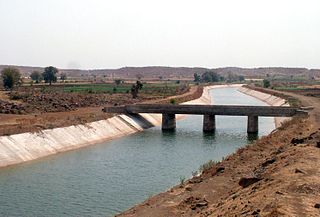
A canal is an artificial watercourse constructed for water supply and irrigation.
Inundation Canals – These are taken out from the rivers without any regulating system like weirs etc at their head. Such canals are useful only during the rainy season
Perennial Canals – These are those which are taken off from perennial rivers by constructing a barrage across the river. Most of the canals at present in India are perennial.
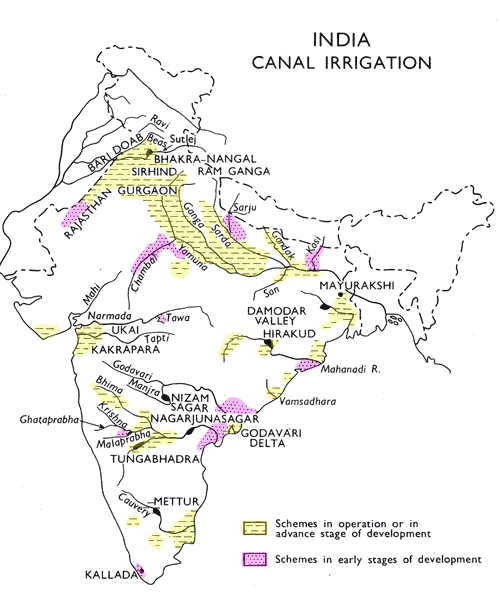
Canals can be an effective source of irrigation in areas of low relief, deep fertile soils, perennial source of water and an extensive command area. Therefore the main concentration of canal irrigation is in the northern plains.
The canals are practically absent from the peninsular plateau region because of rocky terrain. However, the coastal and the delta regions in South India have some canals for irrigation.
The percentage of canal irrigation area to total irrigated area in the country has fallen from about 40% in 1950-51 to less than 25% at present.
The states UP, Punjab, Haryana, Rajasthan and Bihar account for about 60% of the canal irrigated area in the country.
Merits of canal irrigation:
Perennial Source
Provides safety from droughts
Brings fertile sediments to the fields
Economical to serve a large area
Demerits:
Canal water soaks into the ground and leads to water logging, increases salinization, and leads to marshy conditions leading to malaria and flooding
Wastage of water.
2. Wells (and Tube Wells)
A well is a hole dug in the ground to obtain the subsoil water. An ordinary well is about 3-5 metres deep but deeper wells up to 15 metres are also dug.
This method of irrigation has been used in India from time immemorial. Various methods are used to lift the ground water from the well. Some of the widely used methods are the persian wheel, reht, charas or mot, and dhinghly (lever) etc.
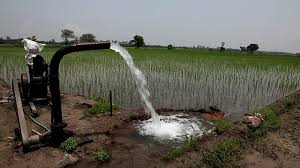
A tube well is a deeper well (generally over 15 metres deep) from which water is lifted with the help of a pumping set operated by an electric motor or a diesel engine.
Well irrigation is gradually giving way to energized tube wells. But there are many wells still in use where electricity is not available or the farmers are too poor t0 afford diesel oil.
This method of irrigation is popular in those areas where sufficient sweet ground water is available.
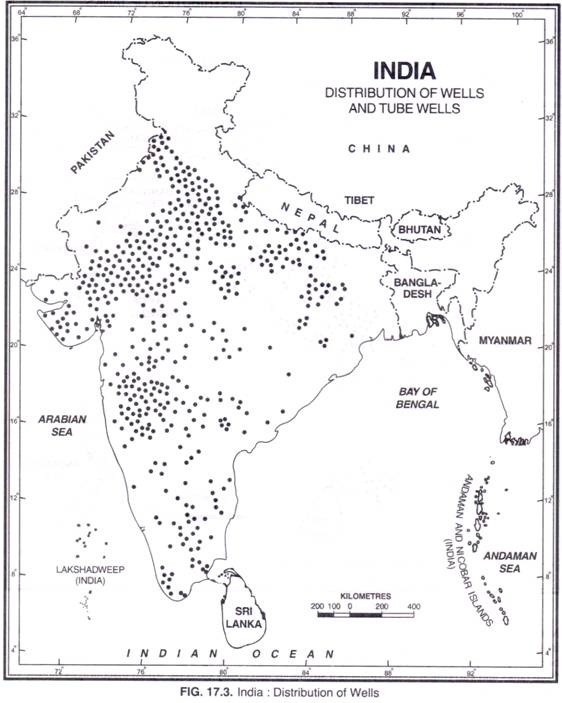
It is particularly suitable in areas with permeable rock structure which allows accumulation of ground water through percolation. Therefore wells are seen more in areas with alluvial soil, regur soil, etc. and less seen in rocky terrain or mountainous regions.
These areas include a large part of the great northern plains, the deltaic regions of the Mahanadi, the Godavari, the Krishna and the Cauvery, parts of the Narmada and the Tapi valleys and the weathered layers of the Deccan trap and crystalline rocks and the sedimentary zones of the peninsula
However, the greater part of peninsular India is not suitable for well irrigation due to rocky structure, uneven surface and lack of underground water.
Large dry tracts of Rajasthan, the adjoining parts of Punjab, Haryana and Gujarat and some parts of Up have brackish ground water which is not fit for irrigation and human consumption and hence unsuitable for well irrigation
At present irrigation from wells and tubewells accounts for more than 60% of the net irrigated area in the country.
UP has the largest area under well irrigation which accounts for 28% of the well irrigated area of the country. U.P., Rajasthan, Punjab, Madhya Pradesh, Gujarat, Bihar and Andhra Pradesh account for about three-fourths of the total well-irrigated area
Well is an independent source of irrigation and can be used as and when the necessity arises. Canal irrigation, on the other hand, is controlled by other agencies and cannot be used at will.
Some ground water salts are useful for crops
Does not lead to salinization and flooding problems
There is a limit to the extent of canal irrigation beyond the tail end of the canal while a well can be dug at any convenient place.
Demerits
Only limited area can be irrigated. Normally, a well can irrigate 1 to 8 hectares of land.
Not suitable for dry regions
Overuse may lead to lowering of water table
3. Tank irrigation
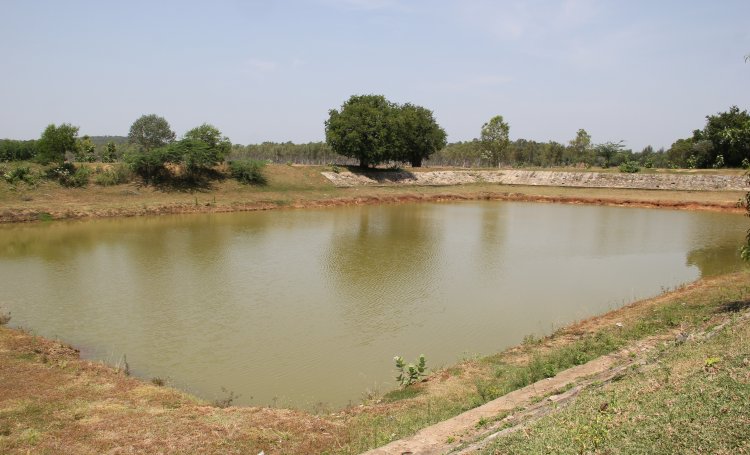
A tank is a reservoir for irrigation, a small lake or pool made by damming the valley of a stream to retain the monsoon rain for later use.
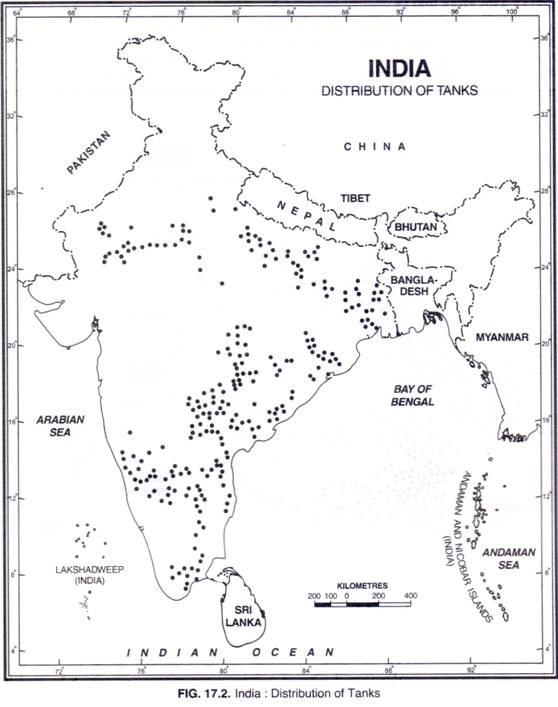
It is practised mainly in the peninsular region due to the following reasons:
The undulating relief and hard rocks make it difficult to dig canals and wells
There is little percolation of water due to hard rock structure and ground water is not available in large quantities.
Most of the rivers are seasonal; there are many streams which become torrential during the rainy season – so the only way to use this water is to impound it by constructing bunds and building tanks. Also, it is easy to collect rainwater in natural or artificial pits because of impermeable rocks.
Scattered nature of agricultural fields
Merits
Most of the tanks are natural and do not involve cost for their construction
Independent source for an individual farmer or a small group of farmers
longer life span
can be used for fishing also
Demerits
Depends on rain and these tanks may dry up during the dry season
Silting of their beds
Require large areas
Evaporation losses
Sometimes there might be a need to lift the water to take it to the field
Irrigation water is generally applied to crops by:
Flooding on the field surface
Applying beneath the soil surface
Spraying under pressure
Applying in drops in the crop root zone
The application method must ensure a uniform distribution of water along the cropped field as well as in the root zone of the crop with high application efficiency. The ratio of water stored in the root zone to that delivered to the field should be maximum. There should be minimum or no wastage of water either through surface run-off or deep percolation below the root zone of a crop.
Several water application methods are practised to suit different soil types, water supply and its quantity, the topography of the land, crops to be irrigated and costs.
Surface Application Methods:
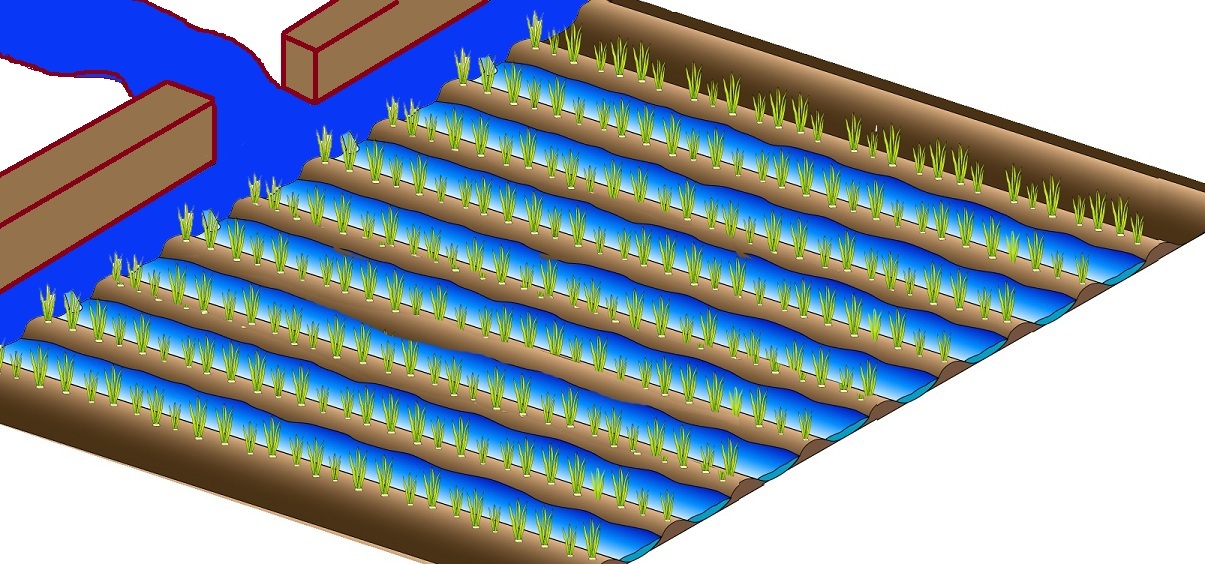
In this method, water is applied to the crop by flooding it on the soil surface.
This method requires proper land grading for the flow of water over the land surface.
More than 95% of the irrigated area in India is under surface irrigation.
Merits:
It is simple in layout and operation.
The amount of manual labour required is minimum.
It does not obstruct the use of machinery for land preparation, cultivation, harvesting, etc.
Demerits:
The overall irrigation efficiency is low. The worldwide average irrigation in canal command areas shows an overall efficiency of as low as 28%.
It may result in water=logging and soil salinization besides the huge amount of water losses.
Surface Irrigation methods may be broadly classified as:
Border Method:
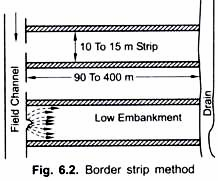
Borders are formed by dividing the field into a number of strips which are separated by ridges.
The strips are generally levelled along the width but may or may not have slope along the length.
An irrigation channel runs along the upper end of the borders.
The water is diverted from the channel into the strips. The water flows slowly towards the lower end, wetting the soil as it advances. Extra water is generally removed from the strip by means of a collecting drain. It is provided at the other end.
This method is suitable in the fields where the soil is sufficiently capable of absorbing the water.
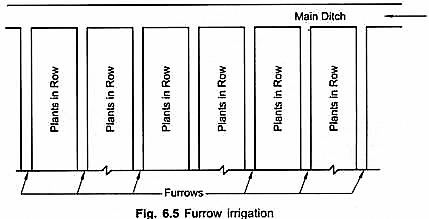
Furrow irrigation is adaptable to a great variation in slope, crops and topography.
When the crops are grown and planted in rows this method is the best suited. In this method, unlike flooding, only a part of the field is wetted. The area wetted varies from 1/2 to 1/5 of total area over which crops are grown.
Close growing crops, on slopes and soils that develop crust after being wet, may be irrigated with small furrows which are called corrugations or rills.
Furrow spacing should be such that the lateral water movement of the moisture wets the ridges by the time irrigation is complete. The lateral movement from the furrows depends on the soil type.
Furrow spacing is determined by agronomic requirements of row-to-row spacing and machinery to be used for planting and cultivation.
Furrow length: Longer furrows = more percolation and less run-off
Benefits of this method:
In this method plants in their early tender age are not damaged by the flow of water.
The land between the rows of plants is utilised to construct furrows, therefore useful irrigable land is not wasted.
As the area wetted is just 1/2 to 1/5 of the cropped area of the field, puddling and crusting of the soil is minimum.
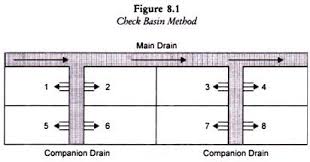
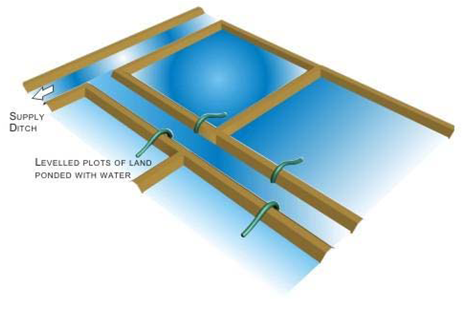
Check basin:
It consists of running water into relatively level plots surrounded by small ridges.
The length of the plot is generally less than 3 times the width.
The main and lateral channels irrigate The main channel is aligned along the upper end of the field and checks are made on the either side of the lateral channels.
The check basins are especially suitable for heavy soils with low infiltration rate or highly permeable sandy soils.
The key to attaining high irrigation efficiency in the design of the check basin is to spread water over the entire basin as rapidly as possible.
Therefore, the use of large inflow stream reduces water spread time over the basin.
Sprinkler and Micro-Sprinkler Application:
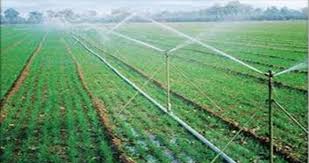
Sprinklers:
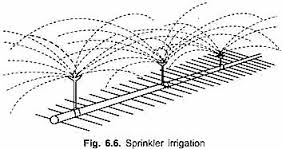
This system sprinkles water in a manner similar to rainfall so that run-off and deep percolation losses are avoided and the uniformity of application is quite high.
The system consists of sprinkler heads or nozzles, which are mounted on risers in lateral lines taken from the main line, which is further connected to a pumping unit.
The soil is too porous for good distribution by surface irrigation.
The fields have an uneven surface.
The soil is easily erodable.
The water supply is just sufficient for crop growth.
Merits:
Sprinklers can be used on all soil types of any topography.
It entails increased irrigation frequency which has a positive effect on crop yield.
In this method, a water saving of 30% to 50% is reported in comparison to the surface method of irrigation
Thus by introducing sprinklers, an additional area ~ up to 50% can be brought under irrigation besides increased crop yields
The overall efficiency of the system is above 80% and no land is wasted on making bunds and channels, and about 40-50% of saving in labour as compared to surface irrigation.
Only 2 to 5% water is lost through evaporation.
Demerits:
Expensive
Requires continuous maintenance and skill for installation and operation
The high energy requirement for operation as sprinklers operate at water pressure ranging from 1 to 10 kg/sq cm.
Wind interferes with the distribution pattern. It reduces the spreading rate and in turn the efficiency. Under high temperatures and strong winds heavy evaporation loss takes place thereby offsetting the saving in water.
Micro-sprinklers:
It sprinkles around the root zone with small sprinklers that work under low pressure.
In this method, water is applied only to the root zone area unlike to the entire field as in the case of sprinkler irrigation method.
This method is highly suitable for orchard crops and vegetable crops.
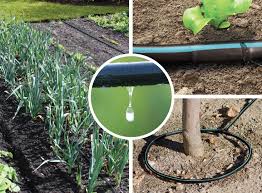
Drip Application
In this method, the application of water is precise but slow as discrete drops, continuous drops, tiny streams or miniature sprays through mechanical devices, called emitters or applicators located at selected points along water delivery lines.
This is useful in areas with water scarcity and salt problems.
Drip irrigation system consists of main pipe, sub-mains, lateral valves, drippers or emitters, a riser valve, vacuum breakers, pressure gauges, water metres, filters, fertiliser tanks etc.
These are designed to supply water at desired rates (1 to 10 litres/hour) directly to the soil.
Low pressures ranging from 0.35 to kg/sq cm are sufficient for drip system
Book your slot for UPSC Mock interviews (paneled by ex UPSC members) and get a dedicated mentor, on-call DAF analysis, DAF-based personalized questionnaire, and Situational questionnaire (FREE)
We, at Civilsdaily, dedicate our work to our students, and we work hard every day to make sure our students get the best guidance and study material possible. Our efforts feel magical when our students succeed and share their views. Jagrati Awasthi, AIR 2, had an interview with a television channel about her success. And in that interview, she recommended Civilsdaily for preparation. She said that the content on Civilsdaily is rich and high quality. It helped her prepare better for Mains and succeed!