Introduction: describe the office of the Speaker of Lok Sabha in short.
Issue: Recently, the Speaker’s role has become a reason for conflict between the opposition and ruling parties for alleged partisanship.
Role of the Speaker: Explain how Speaker plays a crucial role in issues such as money bill, maintaining the decorum in assembly, passing of critical motions like censure motion and no-confidence motion etc
Problems with the current system: Explain how the current system of appointing the Speaker from the ruling party without any procedure is hampering its role and leads to the subjective interpretation of issues rather than objectivity needed in a parliamentary democracy.
In conclusion, suggestions should be made, about how this post can be made more impartial along-with the benefits of doing so.
All Mains Recommended Aspirants, here is the good news! Civilsdaily is providing a free compilation of the topic-wise data and statistics that will help you write better answers for Mains 2022 examination. If you have difficulty remembering facts, you can use this handbook as a revision material.
We all know how an aspirant can create a good impression and get the extra 2-4 marks in their papers when they write an introduction and conclusion with solid data. The statistics, reports & indices complied by Civilsdaily is based on the past 1-2 year survey and committee reports.
The topics range from Education, Employment, Labour & MSME’s , Infrastructure, Population and Security.
Are you finding Current Affairs for UPSC-CSE to be a time-consuming affair? Do you either spend the entire day reading only current affairs or skip reading it for many days? Is there a lack of clarity while answering current affairs questions? Do you want to know the right approach to prepare for UPSC-CSE Current affairs without wasting time on trial and error? Then it’s time you filled the Samanvaya form for free 1-on-1 counselling session with an experienced faculty from Civilsdaily!
Current Affairs for UPSC-CSE doesn’t only test an aspirant’s basic understanding, but their ability to critically analyze and remember certain very important details. It requires you to do match the following — you need to match the topic in your UPSC syllabus with the current affairs as you read. For example, India has placed an anti-dumping duty recently on China to protect it’s local manufacturers from cheap imports. This news is related to GS 3 Economics and comes under Foreign Trade topic.
But that’s not all. Current Affairs is the key component that you cannot do without in all the 3 stages of your UPSC-CSE preparation — Prelims, Mains and Interview. And the way you are supposed to prepare for current affairs under each stage varies. You have to remember facts for Prelims, understand the background, challenges and the solutions of current events for Mains and for Interview you should be able to drive meaningful discussions with your current affairs knowledge. Hence, simply reading a newspaper cannot help you ace current affairs for UPSC-CSE.
Unlike popular notion, importance of current affairs isn’t decreasing in UPSC-CSE papers. Rather, it’s become a part and parcel of every topic in the Core Subjects like Economy, Polity, Science and Environment. Let’s understand this with a question asked in UPSC-CSE Mains 2020 —
Which steps are required for constitutionalization of a commission? Do you think imparting constitutionality to the National Commission for Women would ensure greater gender justice and empowerment in India? Give reasons.
This question needs you to have current knowledge on government policies/interventions, constitutional and non-constitutional bodies, constitutional provisions and issues related to developmental and management of social sectors. That’s totally 4 topics for one answer!
Remembering current affairs indices for Prelims MCQs & using them to substantiate answers in Mains is crucial to get marks above cut-off.
Why Samanvaya for UPSC-CSE Current Affairs Preparation?
In UPSC 2020, Civilsdaily helped 80+ students secure ranks in their exams. In the top 100, every 3rd ranker was a Civilsdaily student.
A very recent success story would be Vishwa Shah, student of Civilsdaily Mentor, Sukanya Ma’am. Vishwa has cleared the GPSC exam to become the Deputy Superintendent of Police in Gujarat. He has penned a thank-you note yesterday. Heartiest Congratulations to Vishwa!
One of our other Civilsdaily Student, Shubham Nagargojecleared the exams in 2020 to become an IPS Officer. Shubham was gracious enough to let us know how he felt about Civilsdaily Samanvaya Guidance under Parth sir.
To know how all of them cleared the exam with our mentorship, visit the UnherdPodcast.
Now that results are announced for UPSC 2021 Prelims, out of 15 out of 25 students of Santhosh Gupta sir have been recommended to Mains. One such student, Rahul expresses his gratitude and extends his appreciation.
Most of our Mentors like Sudhanshu sir, Sajal sir, Santhosh sir, Pravin sir, Parth Verma sir and Sukanya Ma’am were UPSC aspirants themselves and have attended UPSC Mains more than five times and UPSC Interview more than twice. Hence their mentorship is always a blend of the best test series, comprehensive notes and current affairs knowledge.
All of them dedicate their time weekly to give 1-on-1 mentorship to every student where they discuss last week’s performance and next week’s approach.
Be it Telegram, Whatsapp or Habitiat channels, they are always available and clear student’s doubts in a turnaround time of 24 Hours.
Why Civilsdaily Mentors are the GPS for Your UPSC-CSE Preparation
Remember there is always light at the end of the tunnel and if you want to get out of the tunnel you have to follow the direction of the light! Our mentors’ give you direction which is divided into daily modules. All you have to do is study and complete them on time.
As every year passes by, we don’t get confident by the previous years’ performance and become laidback. Instead, we become more hungry to convert all our students into toppers.
How are Current Civilsdaily Students Gearing up for UPSC-CSE 2022?
Initially, our Civilsdaily student Smriti wasn’t confident about Prelims when she began her preparation. Though she had joined Civilsdaily in 2020, she started studying for UPSC-CSE back in 2019. At that time, Smriti had enrolled in multiple institutes. Though, most of these institutes had promised a personal mentor, she was unable to get in touch with them on a daily basis. Also those mentors never scheduled test-series on a weekly basis. Hence, despite preparing for a year, Smriti had scored only 35 marks out of 200 in her first test series by Civilsdaily.
She then started writing 20-25 test series over the course of UAP 2021 and in her last test, her scores have drastically improved. She now scores in the range of 130-135 marks in prelims’ and 110+ in mains’ papers.
In Smriti’s own words she describes her Samanvaya Mentorship Experience to be —
“Our parents provide us financial and emotional support, friends provide us moral support and the right mentor gives you logistic and logical support for UPSC. There are days when I felt I won’t be able to compete against lakhs of aspirants. That’s when my mentor, Ravi sir reminded me of my improvement and encouraged me that I can crack it with the same consistency. We need someone, who tells us we are performing well especially when we cannot see that ourselves. The mentorship at Civilsdaily helped me become mentally stronger as a person. In other institutes, mentors are allotted only for doubt resolution. But at Civilsdaily, I am getting end-to-end mentorship via value added notes, classes, test series and detailed evaluation.”
Similarly our another Civilsdaily student, Ashishsums up his Samanvaya experience with Civilsdaily mentor,Pravin Sir, “Because of Pravin sir’s support, I am able to understand a topic in lesser time.”
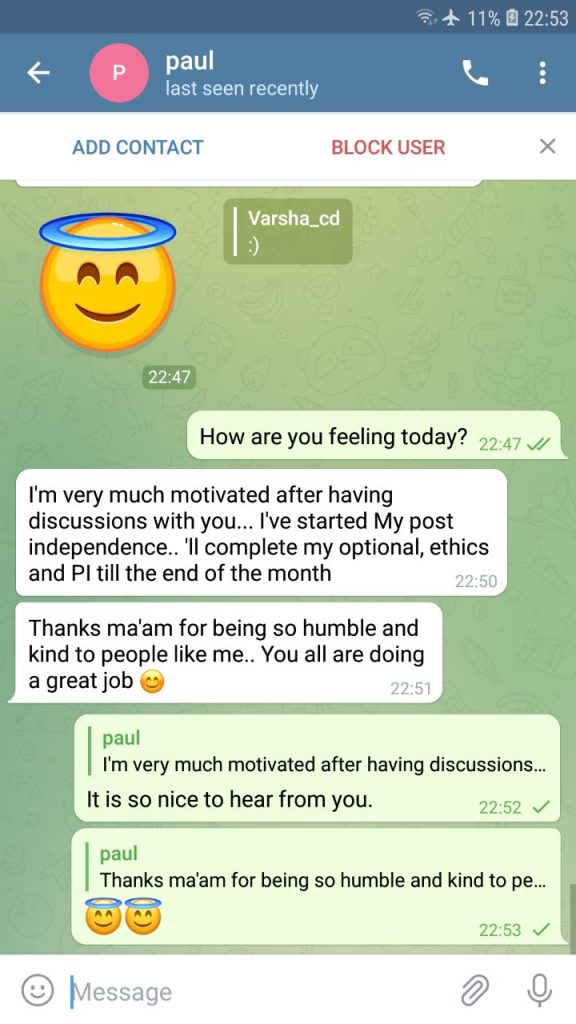
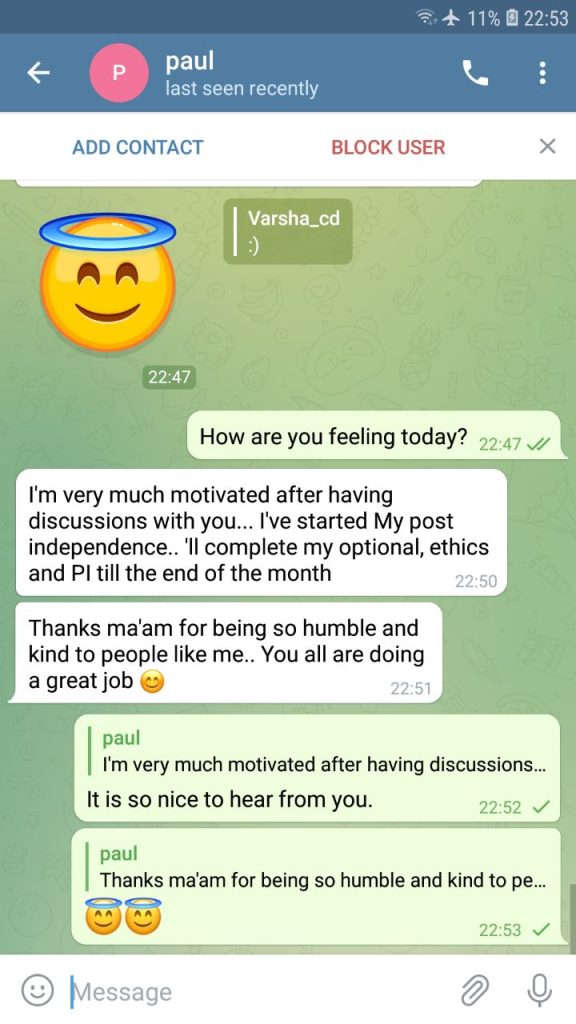
This is how Pravin sir evaluates Ashish’s Mains Test Series every week. After every test series evaluation, Pravin sir schedules a 1 hour call to discuss how Ashish can improve his marks and the sources he can refer for key topics.
It’s Your Turn Get the Free 40 Min Counselling Session By a CD Mentor
At the core of Samanvaya lies the fact that each one of you will have a unique journey while preparing for the exam. Some will get through on the first attempt without much effort while others will take both more time and more effort.
We want to understand you better to help you optimize your journey so you can focus on the right things and not waste time on the wrong ones. We are asking you to tap into the valuable experiences of mentors who underwent the same grind and realize the pitfalls and understand the shortcuts to make it.
In the first counselling session, we will understand your weaknesses. Over 80% of students who claimed to have revised NCERTs twice were unable to answer basic questions. Many were not comfortable with at least 1 GS subject and Optional. Many struggled with ‘What went wrong’ after 2-3 years of hard work. Our mentors will provide free preliminary assignments so that we can assess your preparedness and suggest accurate strategies. We then help you to stick to one plan or strategy throughout your preparation.
The Election Laws (Amendment) Bill, 2021 which facilitates amendment to the Representation of People’s Act, is a step toward implementing online-based remote e-voting for which the use of Aadhaar will be the primary identity.
Objectives of linking
The linking of Aadhaar with one’s voter ID was primarily to build a biometric dependent voting system from the very beginning.
The change could help fight fraud and duplicates in the electoral rolls.
About the pilot programmes on linking the voter id
In 2014, the Election Commission of India (ECI) conducted two pilot programmes on linking the voter id with Aadhaar in the districts of Nizamabad and Hyderabad.
Based on the effectiveness, the ECI called for a National Consultation on Aadhaar and voter id linking.
The ECI launched the National Electoral Roll Purification and Authentication Programme (NERPAP) on April 1, 2015, which had to be completed by August 31, 2015.
After a Supreme Court of India order on August 11, 2015, it was announced that this NERPAP would be shut down.
But as Telangana and Andhra Pradesh were early adopters of this programme since 2014, both States have nearly completed linking Aadhaar and voter id for all residents.
Methodology is unknown: The methodology followed by the ECI to find duplicate voters using Aadhaar is unknown to the general public.
SRDH data used: In a letter from the CEO Andhra Pradesh (then for Telangana and Andhra Pradesh) to the ECI, it is clear that the State Resident Data Hub (SRDH) application of the Government of Telangana and Andhra Pradesh was used to curate electoral rolls.
The SRDH has data on residents of the State which is supplied by the Unique Identification Authority of India (UIDAI) or collected further by the State governments.
While the UIDAI was constrained not to collect data on caste, religion and other sensitive information data for Aadhaar, it recommended to the States to collect this information, if required, as part of Aadhaar data collection; it termed the process as Know Your Resident (KYR) and Know Your Resident Plus (KYR+).
It is these SRDH applications that the ECI used to curate electoral rolls which resulted in the deletion of a sizeable number of voters from the list in Telangana in 2018.
Concerns
Disenfranchisement: The role of the ECI to verify voters using door-to-door verification (in 2015) has been subsumed; a software algorithm commissioned by the Government for purposes unknown to the public and maintained by a private IT company is in control now.
Subjecting key electoral rolls to surveillance software damages the concept of universal adult suffrage.
What the experience in Telangana and Andhra Pradesh highlights is voter suppression and disenfranchisement.
Issue of ensuring electoral integrity: In a situation where the role of money makes a mockery of the democratic process, linking Aadhaar will be futile.
Electronic Voting Machines (EVMs), if foolproof, put an end to the days of booth capturing prevalent in the days of paper ballots.
E-voting can also be gamed using malware to change the outcome of an election.
While the Bill does not look into large-scale e-voting, there is an issue of ensuring electoral integrity.
Voter profiling: An Aadhaar-voter ID linkage will also help political parties create voter profiles and influence the voting process.
Online trends on the day of voting and micro-targeting voters using their data will make it easier for political parties in power to use data for elections.
Consider the question “What are the objectives of Aadhar-Voter Id linking? What are the concerns associated with such linking?”
Conclusion
The linking of Aadhaar with voter ID will create complexities in the voter databases that will be hard to fix. This process will introduce errors in electoral rolls and vastly impact India’s electoral democracy.
Group Studies for UPSC-CSE has it’s pros and cons. At it’s best, you are exposed to highly competitive and helpful aspirants who will share their knowledge and resources with you. You also get to discuss and debate on important current affairs issues with like-minded peers. When everyone transparently shares their marks, you get motivated to perform better. You will also understand easy ways to complete your preparation from another person.
But, many a times this ideal is not achieved and group studies initiatives fail. This is because there is no one to lead the group and provide a structured agenda for everyone to follow. Every aspirant is busy, wrapped up in their own schedule that they don’t meet up often.
At Civilsdaily, we are bridging this gap and turning the ideal to reality. Our mentors lead the telegram channels and give a direction for all aspirants to contribute. Doubts are resolved, notes are shared, timetable is laid out for everyone to complete.
Are you finding Current Affairs for UPSC-CSE to be a time-consuming affair? Do you either spend the entire day reading only current affairs or skip reading it for many days? Is there a lack of clarity while answering current affairs questions? Do you want to know the right approach to prepare for UPSC-CSE Current affairs without wasting time on trial and error? Then it’s time you filled the Samanvaya form for free 1-on-1 counselling session with an experienced faculty from Civilsdaily!
Current Affairs for UPSC-CSE doesn’t only test an aspirant’s basic understanding, but their ability to critically analyze and remember certain very important details. It requires you to do match the following — you need to match the topic in your UPSC syllabus with the current affairs as you read. For example, India has placed an anti-dumping duty recently on China to protect it’s local manufacturers from cheap imports. This news is related to GS 3 Economics and comes under Foreign Trade topic.
But that’s not all. Current Affairs is the key component that you cannot do without in all the 3 stages of your UPSC-CSE preparation — Prelims, Mains and Interview. And the way you are supposed to prepare for current affairs under each stage varies. You have to remember facts for Prelims, understand the background, challenges and the solutions of current events for Mains and for Interview you should be able to drive meaningful discussions with your current affairs knowledge. Hence, simply reading a newspaper cannot help you ace current affairs for UPSC-CSE.
Unlike popular notion, importance of current affairs isn’t decreasing in UPSC-CSE papers. Rather, it’s become a part and parcel of every topic in the Core Subjects like Economy, Polity, Science and Environment. Let’s understand this with a question asked in UPSC-CSE Mains 2020 —
Which steps are required for constitutionalization of a commission? Do you think imparting constitutionality to the National Commission for Women would ensure greater gender justice and empowerment in India? Give reasons.
This question needs you to have current knowledge on government policies/interventions, constitutional and non-constitutional bodies, constitutional provisions and issues related to developmental and management of social sectors. That’s totally 4 topics for one answer!
Remembering current affairs indices for Prelims MCQs & using them to substantiate answers in Mains is crucial to get marks above cut-off.
Why Samanvaya for UPSC-CSE Current Affairs Preparation?
In UPSC 2020, Civilsdaily helped 80+ students secure ranks in their exams. In the top 100, every 3rd ranker was a Civilsdaily student.
A very recent success story would be Vishwa Shah, student of Civilsdaily Mentor, Sukanya Ma’am. Vishwa has cleared the GPSC exam to become the Deputy Superintendent of Police in Gujarat. He has penned a thank-you note yesterday. Heartiest Congratulations to Vishwa!
One of our other Civilsdaily Student, Shubham Nagargojecleared the exams in 2020 to become an IPS Officer. Shubham was gracious enough to let us know how he felt about Civilsdaily Samanvaya Guidance under Parth sir.
To know how all of them cleared the exam with our mentorship, visit the UnherdPodcast.
Now that results are announced for UPSC 2021 Prelims, out of 15 out of 25 students of Santhosh Gupta sir have been recommended to Mains. One such student, Rahul expresses his gratitude and extends his appreciation.
Most of our Mentors like Sudhanshu sir, Sajal sir, Santhosh sir, Pravin sir, Parth Verma sir and Sukanya Ma’am were UPSC aspirants themselves and have attended UPSC Mains more than five times and UPSC Interview more than twice. Hence their mentorship is always a blend of the best test series, comprehensive notes and current affairs knowledge.
All of them dedicate their time weekly to give 1-on-1 mentorship to every student where they discuss last week’s performance and next week’s approach.
Be it Telegram, Whatsapp or Habitiat channels, they are always available and clear student’s doubts in a turnaround time of 24 Hours.
Why Civilsdaily Mentors are the GPS for Your UPSC-CSE Preparation
Remember there is always light at the end of the tunnel and if you want to get out of the tunnel you have to follow the direction of the light! Our mentors’ give you direction which is divided into daily modules. All you have to do is study and complete them on time.
As every year passes by, we don’t get confident by the previous years’ performance and become laidback. Instead, we become more hungry to convert all our students into toppers.
How are Current Civilsdaily Students Gearing up for UPSC-CSE 2022?
Initially, our Civilsdaily student Smriti wasn’t confident about Prelims when she began her preparation. Though she had joined Civilsdaily in 2020, she started studying for UPSC-CSE back in 2019. At that time, Smriti had enrolled in multiple institutes. Though, most of these institutes had promised a personal mentor, she was unable to get in touch with them on a daily basis. Also those mentors never scheduled test-series on a weekly basis. Hence, despite preparing for a year, Smriti had scored only 35 marks out of 200 in her first test series by Civilsdaily.
She then started writing 20-25 test series over the course of UAP 2021 and in her last test, her scores have drastically improved. She now scores in the range of 130-135 marks in prelims’ and 110+ in mains’ papers.
In Smriti’s own words she describes her Samanvaya Mentorship Experience to be —
“Our parents provide us financial and emotional support, friends provide us moral support and the right mentor gives you logistic and logical support for UPSC. There are days when I felt I won’t be able to compete against lakhs of aspirants. That’s when my mentor, Ravi sir reminded me of my improvement and encouraged me that I can crack it with the same consistency. We need someone, who tells us we are performing well especially when we cannot see that ourselves. The mentorship at Civilsdaily helped me become mentally stronger as a person. In other institutes, mentors are allotted only for doubt resolution. But at Civilsdaily, I am getting end-to-end mentorship via value added notes, classes, test series and detailed evaluation.”
Similarly our another Civilsdaily student, Ashishsums up his Samanvaya experience with Civilsdaily mentor,Pravin Sir, “Because of Pravin sir’s support, I am able to understand a topic in lesser time.”
This is how Pravin sir evaluates Ashish’s Mains Test Series every week. After every test series evaluation, Pravin sir schedules a 1 hour call to discuss how Ashish can improve his marks and the sources he can refer for key topics.
It’s Your Turn Get the Free 40 Min Counselling Session By a CD Mentor
At the core of Samanvaya lies the fact that each one of you will have a unique journey while preparing for the exam. Some will get through on the first attempt without much effort while others will take both more time and more effort.
We want to understand you better to help you optimize your journey so you can focus on the right things and not waste time on the wrong ones. We are asking you to tap into the valuable experiences of mentors who underwent the same grind and realize the pitfalls and understand the shortcuts to make it.
In the first counselling session, we will understand your weaknesses. Over 80% of students who claimed to have revised NCERTs twice were unable to answer basic questions. Many were not comfortable with at least 1 GS subject and Optional. Many struggled with ‘What went wrong’ after 2-3 years of hard work. Our mentors will provide free preliminary assignments so that we can assess your preparedness and suggest accurate strategies. We then help you to stick to one plan or strategy throughout your preparation.
Do you know that toppers use certain techniques of answer-writing to score higher marks? Are you aware of the PESTLE approach or the 7-5-3 technique of answer writing? If not, then this video by Sajal Sir will be helpful
https://youtu.be/b_KUYPgrHJI
Sajal sir in the past 7 years has mentored over 400 students who went onto become UPSC toppers. Apart from this, his course SMASH Mains 2020 had a turnover of 80% interview recommended candidates.
This is how the UPSC Toppers scored in test series before Sajal sir’s intervention —
They had tried everything but were not able to score high in the exams. From their approach to answering to the body of answers, they faced problems. They faced problems with things like putting proper headings, how to frame dimensions, introductions, conclusions, etc. They never even got the right feedback which could have helped them!
And this is how they improved after learning the best answer writing practices from him —
In October, the Environment Ministry published draft regulations on Extended Producer Responsibility (EPR), set to come into effect by the end of this year. These regulations denote a backslide, particularly with respect to integration of the informal sector.
What is EPR?
Extended Producer Responsibility (EPR) requires the manufacturer of a product, or the party that introduces the product into the community, to take responsibility for its life cycle.
An FMCG company should not only account for the costs of making, packing and distributing a packet of chips, but also for the collection and recycling/reuse of the packet.
Shortcomings in the guidelines
The guidelines fall short in three areas: people, plastics and processing.
[1] Integration of informal sector is lacking
By failing to mention waste pickers or outlining mechanisms for their incorporation under EPR, the guidelines are retrogressive.
For decades, waste pickers, working in dangerous and unsanitary conditions, have picked up what we throw away.
Besides, by diverting waste towards recycling and reuse, waste pickers also subsidise local governments responsible for solid waste management.
Further, they reduce the amount of waste accumulating in cities, water bodies and dumpsites and increase recycling and reuse, creating environmental and public health benefits.
Between 1.5 and 4 million waste pickers in India work without social security, health insurance, minimum wages or basic protective gear.
Suggestions: An effective EPR framework should address the issue of plastics and plastic waste management in tandem with the existing machinery, minimise duplication and lead to a positive environmental impact, with monitoring mechanisms including penalties for non-compliance.
EPR funds could be deployed for mapping and registration of the informal sector actors, building their capacity, upgrading infrastructure, promoting technology transfer, and creating closed loop feedback and monitoring mechanisms.
[2] The scope of plastic covered need to be altered
The EPR guidelines are limited to plastic packaging.
There are other multi-material plastic items like sanitary pads, chappals, and polyester that pose a huge waste management challenge today, but have been left out of the scope of EPR.
Three categories of plastic packaging: Plastic packaging can be roughly grouped into three categories: recyclable and effectively handled by the informal sector, technologically recyclable but not economically viable to recycle, technologically challenging to recycle (or non-recyclable).
[1] Rigid plastics like PET and HDPE are effectively recycled.
Suggestion: The government could support and strengthen the informal recycling chain by bridging gaps in adequate physical spaces, infrastructure, etc.
[2] Typically flexible plastics like LDPE and PP bags are recyclable, but due to their contamination with organic waste, lightweight, and high volume, the costs of recycling are prohibitively expensive relative to the market value of the output.
Suggestion: Market value for these plastics can be increased by increasing the demand for and use of recycled plastics in packaging, thus creating the value to accommodate the current costs of recycling.
[3] Multi-layered and multi-material plastics are low weight and voluminous, making them expensive to handle and transport.
Since they are primarily used in food packaging, they often attract rodents, making storage problematic.
Even if this plastic is picked, recycling is technologically challenging as it is heterogeneous material.
The Plastic Waste Management Rules mandated the phase-out of these plastics.
However, in 2018, this mandate was reversed.
[3] Processing technologies need to be closely evaluated
Not all processing is recycling.
Processes like waste-to-energy, co-processing and incineration have been proven to release carbon dioxide, particulate matter, harmful dioxins and furans which have negative climate and health impacts.
While the environmental impact and desirability of these processes continues to be debated, the draft regulations legitimise them to justify the continued production of multi-layered plastics.
Technologies like chemical recycling and pyrolysis are capital-intensive, yielding low returns and running into frequent breakdowns and technological problems.
They also release carbon dioxide and other pollutants.
These end-of-life processes are economically, environmentally and operationally unsustainable.
A number of gasification, pyrolysis and other chemical recycling projects have figured in accidents such as fires, explosions and financial losses.
Way forward
Address issues of the informal sector: The consultation process should involve informal workers.
Alter the scope of plastics covered: The scope of plastics covered by the guidelines could be altered to exclude those plastics which are already efficiently recycled and to include other plastic and multi-material items.
Processing technologies should be closely evaluated: And end-of-life processing technologies should be closely evaluated, based not only on their health and environmental impacts, but also on the implications for continued production of low-quality and multi-layered plastics.
Consider the question ” The Environment Ministry published draft regulations on Extended Producer Responsibility (EPR). Examine the issues with the regulations and suggest the way forward”
Conclusion
In conclusion, the government should redo the consultation process for the draft guidelines.
GS-1 Salient features of world’s physical geography
GS-2 Bilateral, regional and global groupings and agreements involving India and/or affecting India’s interests.
GS-3 Conservation, environmental pollution and degradation, environmental impact assessment.
GS-4 Probity in Governance: Information sharing and_ transparency in government, Right to Information, Codes of Ethics, Codes of Conduct, Citizen’s Charters, Work culture, Quality of service delivery, Utilization of public funds, challenges of corruption
HOW TO ATTEMPT ANSWERS IN DAILY ANSWER WRITING ENHANCEMENT(AWE)?
Daily 4 questions from General studies 1, 2, 3, and 4 will be provided to you.
A Mentor’s Comment will be available for all answers. This can be used as a guidance tool but we encourage you to write original answers.
You can write your answer on an A4 sheet and scan/click pictures of the same.
Upload the scanned answer in the comment section of the same question.
Along with the scanned answer, please share your Razor payment ID, so that paid members are given priority.
If you upload the answer on the same day like the answer of 11th October is uploaded on 11th October then your answer will be checked within 72 hours. Also, reviews will be in the order of submission- First come first serve basis
If you are writing answers late, for example, 11th October is uploaded on 13th October, then these answers will be evaluated as per the mentor’s schedule.
We encourage you to write answers on the same day. However, if you are uploading an answer late then tag the mentor like @Staff so that the mentor is notified about your answer.
*In case your answer is not reviewed, reply to your answer saying *NOT CHECKED*.
In the body, mention the issues such as not addressing the concerns of waste pickers, in the suggestions mention using EPR funds for mapping and registration of the informal sector actors, building their capacity, upgrading infrastructure, promoting technology transfer, and creating closed-loop feedback and monitoring mechanisms.
Next mention that guidelines are limited to plastic packaging only while a large part of plastics produced are single-use or throwaway plastic packaging, there are other multi-material plastic items. Also mention the debatable desirability and environmental impact of processing technologies while draft regulations legitimise them to justify the continued production of multi-layered plastics.
Conclude by mentioning the need for reconsideration of guidelines on three aspects addressing informal workers’ concerns, increasing the scope of plastic covered and evaluation of end-of-life processing technologies.
In the intro, mention in brief the military coup and political situation in Myanmar.
In the body, mention India’s calibrated middle path position in contrast with the West’s reflexive policy of condemnation, threats and sanctions and opportunistic policies of Russia and China. India’s position is similar to and supportive of ASEAN i.e.release of political prisoners, resolution of issues through dialogues, cessation of all violence etc.
In the bilateral issues mention border security and refugee issue. Next, mention that India economic cooperation.
Conclude by mentioning the need for India to leverage the current political realities.
Dowry death can be presumed if the wife was harassed, mentally and physically close before her death in the marital home, the Supreme Court has held.
Section 304B, IPC
A Bench led by Chief Justice of India N.V. Ramana was interpreting Section 304B of the Indian Penal Code (dowry death).
The provision mandates that the death of a married woman could be linked to the crime if she had been harassed for dowry “soon before her death”.
What is the recent judgment?
Ans.Bridges the gap between extreme Harassment and Death
The cruelty has to be proved during the close proximity of time of death. It should be continuous.
Such continuous harassment, physical or mental, by the accused should make life of the deceased miserable which may force her to commit suicide, ruled Justice Hima Kohli.
The court said the expression “soon before her death” would normally imply that the interval should not be much between the cruelty or harassment concerned and the death in question.
In other words, there exists a proximate and live link between the effect of cruelty based on dowry demand and the death concerned.
Other takeaways
Frequent incidents of cruelty disturb the mental equilibrium of the women concerned, ruled the court.
However, the presumption of dowry death was also rebuttable, observed the court.
Dowry System : A Backgrounder
The dowry system in India incorporates payments in the form of capital, durable goods, real estate among others, made to the bridegroom from the family of the bride as a condition for marriage.
The abuse for the demand for dowry can be in the form of verbal and the most serious can take the shape of death of the victim or dowry death.
Dowry Deaths in India
Dowry deaths are deaths of married women who are murdered or driven to suicide by continuous harassment and torture by their husbands and in-laws.
This is mainly over the demand of dowry, making the women’s homes the most dangerous place for them to be.
What numbers reveal?
In 2020, reported dowry death cases in India amounted to nearly seven thousand.
This was a gradual decrease from the 2014, in which this number was approximately 8.5 thousand.
Why is dowry so much prevalent?
Bride pricing: There exists a system of “bride price”, whereby the family of the groom had to give some gifts to the family of the women before marriage.
Property inheritance: Until its amendment in 2005, the Hindu Succession Act of 1956 was biased towards the male next of kin when it came to property inheritance. The amendment stated that women had the right to their parents’ property irrespective of being married.
Financial dependency: In practice, the inheritance of the woman is socially imparted to her as dowry in marriage leading to financial dependence on the husband or the in-laws.
Factors contributing to its continuance
Traditions and historicity: It has been a preconceived notion of the people that the dowry system has been existing since centuries back and it is quintessential to be followed by the two families.
Social status associated with Dowry: It is a belief among people that dowry giving or receiving gives a lot of merit in reputation and honor within the society.
Illiteracy: Although dowry is something that is even practiced by the literates of our society, it becomes a lot difficult to make them understand the laws.
Bridegroom coercion: The demand for the well-earned bridegroom in prestigious workplaces often encourages brides families to pay hefty dowries leading to the continuance of such evil customs.
Legal measures against dowry
Code of Criminal Procedure, 1973: Dowry death is a non-bailable offence and the person cannot be acquitted without court’s order.
Dowry Prohibition Act of 1961: It was passed by the government which prohibits the giving or taking of dowry in India.
Dysfunctions created by the Dowry system
Defamation: There have been many instances where these laws have been used to defame or slander one’s name.
Fights for property inheritance: This go ugly when the girl involves into interfaith marriage. This often leads to honor killing.
Way forward
The dignity, modesty and safety of women must be prioritized by all. Abusing them just for dowry or any other financial favour is a shameful act in itself.
To prevent such heinous crimes stringent provisions and measures need to be undertaken by the government.
Six Maoists including four women cadres were killed morning in an “exchange of fire” with a joint team of Telangana and Chhattisgarh police in Sukma district of Chhattisgarh.
What is Naxalism?
The term ‘Naxal’ derives its name from the village Naxalbari of district Darjeeling in West Bengal, where the movement originated in 1967 under the leadership of Charu Majumdar and Kanu Sanyal.
It refers to the use of violence to destabilize the state through various communist guerrilla groups.
Naxalites are far-left radical communists who derive their political ideology from the teachings of Mao Zedong.
History and evolution
Russian Revolution: Naxalism in India, like any other leftist movement around the globe draws its ideological basis from the Russian revolution.
Overthrowing Tsarist Regime: Lenin successfully fought against the Czarist Rule through a combination of peasant movement and an armed struggle.
Marxian ideology of class struggle: The prime intent was to bestow power in the hands of the exploited and marginalized and enforce societal control over governance and nation building.
Neo-Marxism: After the success of the Lenin-led revolution in Russia, the intellectual class in many countries got inspired. Prominent amongst them were Fidel Castro and Mao Zedong.
Root cause of origin in India
Corporate exploitation: Since Eastern India is rich in natural resources including forests, minerals and mines, tribal face exploitation and harassment from government and corporate bodies targeting to extract those resources.
Tribal alienation: Tribal communities have been systematically alienated from their traditional rights over natural resources after independence.
Livelihood losses: Tribal livelihood is at stake due to depletion of natural resource base.
Forceful displacement: Forceful displacement from their homeland destroys their traditional governance system.
Absence of governance: In such exploited areas, the absence of governance becomes a self-fulfilling prophecy since the delivery systems are extinguished through killings and intimidation.
Foreign provocations: Many of LWE outfits are supported by external forces inimical to India and the Maoists consider such alliances as strategic assets.
Other factors:
Oppression and HR violations by Security Forces e.g. AFSPA
Violation of Constitutional Protections under PESA and FRA
Prevalence of Acute Poverty
Impact of LWE
Romanticism without a cause: Some sections of the society, especially the younger generation, have romantic illusions about the Maoists, arising out of an incomplete understanding of their ideology of Class –Struggle.
Extreme violence: Their doctrine glorifies violence as the primary means to overwhelm the existing socio-economic and political structures.
Destruction of governance mechanism: LWEs aims at creating a vacuum at the grassroots level of the existing governance structures by killing lower-level government officials, police personnel of the local police stations and the people’s representatives of the PRIs.
Radicalization of youths: After creating a political and governance vacuum, they coerce the local population to join the movement.
Urban-Maoism: Many extremists have facilitated mass-mobilization in semi-urban and urban areas through ostensibly democratic means often led by well-educated intellectuals.
Outcomes of perpetrating LWE
The Leftist organizations skilfully use state structures and legal processes to further the Maoist agenda and weaken the enforcement regime through:
Recruitment of ‘professional revolutionaries’
Raising funds for the insurgency
Creating urban shelters for underground cadres
Providing legal assistance to arrested cadres and
Mass- mobilization by agitating over issues of relevance/ convenience
Govt initiatives for LWE affected areas
Aspirational Districts: The MHA has been tasked with the monitoring of the Aspirational districts programme in 35 LWE affected districts.
HRD measures: Building of schools under the Eklavya model.
Road Connectivity Project for LWE affected areas (RRP-II): This aims for improving road connectivity in LWE affected States. Under this, 9279 km of roads and 392 bridges are sanctioned.
Naxal Surrender Policy: It aims to wean away misguided youth and hardcore naxalites who have strayed into the fold of the naxal movement and cannot find a way back.
SAMADHAN doctrine: It encompasses the entire strategy of government from short-term policy to long-term policy formulated at different levels. SAMADHAN stands for-
S- Smart Leadership
A- Aggressive Strategy
M- Motivation and Training
A- Actionable Intelligence
D- Dashboard Based KPIs (Key Performance Indicators) and KRAs (Key Result Areas)
H- Harnessing Technology
A- Action plan for each Theatre
N- No access to Financing
Way forward
Indian counterinsurgency has to work with a dual objective of defeating the insurgents militarily and fully quell the insurgent impulses. This will need institutional overhauls.
States must do more to synergize their efforts by launching coordinated operations, thereby denying Maoists any space for maneuverability.
On parallel grounds, it is also important to segregate the population from the insurgents both operationally and ideologically.
The conflict over the distribution of resources can be mended with economic development.
Delhi, Gurgaon, Mumbai, Bengaluru, Kolkata, Ahmedabad, Hyderabad, and Pune will be the first places to get 5G services next year in 2022, informed the Department of Telecommunications (DoT).
5G or fifth generation is the latest upgrade in the long-term evolution (LTE) mobile broadband networks.
It’s a unified platform which is much more capable than previous mobile services with more capacity, lower latency, faster data delivery rate and better utilisation of spectrum.
5G spectrum
5G mainly works in 3 bands, namely low, mid and high-frequency spectrum — all of which have their own uses as well as limitations.
(1) Low band spectrum
It has a great promise in terms of coverage and speed of internet and data exchange but the maximum speed is limited to 100 Mbps (Megabits per second).
So Telcos can use and install it for commercial cell phone users who may not have specific demands for very high speed internet, the low band spectrum may not be optimal for specialized needs of the industry.
(2) Mid-band spectrum
It offers higher speeds compared to the low band, but has limitations in terms of coverage area and penetration of signals.
This band may be used by industries and specialized factory units for building captive networks that can be moulded into the needs of that particular industry.
(3) High-band spectrum
It offers the highest speed of all the three bands, but has extremely limited coverage and signal penetration strength.
Internet speeds in the high-band spectrum of 5G has been tested to be as high as 20 Gbps (giga bits per second), while, in most cases, the maximum internet data speed in 4G has been recorded at 1 Gbps.
Stipulated bands for roll-out
While the low band spectrum has shown great promise in terms of coverage and speed of Internet and data exchange, the maximum speed is limited to 100 Mbps (Megabits per second).
This means that while telecoms can use and install it for commercial cellphone users who may not have specific demands for very high speed Internet.
However the low band spectrum may not be optimal for specialised needs of the industry.
The mid-band spectrum, on the other hand, offers higher speeds compared to the low band, but has limitations in terms of coverage area and penetration of signals.
Where does India stand in the 5G technology race?
Like other global players, India had, in 2018, planned to start 5G services as soon as possible, with an aim to capitalise on the better network speeds and strength that the technology promised.
India’s private telecom players have been urging the DoT to lay out a clear road map of spectrum allocation and 5G frequency bands.
Issues in roll-out
Monopoly: One big hurdle, however, is the lack of flow of cash and adequate capital with some players due to an existing monopoly.
AGR dues: There is an ongoing dispute between the telecoms and the government mainly over the definition of Adjusted Gross Revenue.
Device upgrade: As far as commercial smartphones are concerned, some newer devices in the market claim to be 5G-ready but are much costlier.
Why is there early roll-out in big cities?
Services penetration: One of the reasons why the bigger cities were chosen for these trials is their telecom services penetration, making it easier to convince more people to upgrade from 4G.
Cost management: Since the costs for 5G services are initially going to be on the higher side, it would be wise to test the service in areas where more consumers would find them affordable.
Testing ground: A third reason is that cities provide all kinds of locations, such as walled complexes and open spaces, that are suitable for testing of various 5G bands.
What is the global progress on 5G?
More than governments, global telecom companies have started building 5G networks and rolling it out to their customers on a trial basis.
South Korea: Samsung, which had started researching on 5G technology way back in 2011, has taken the lead when it comes to building the hardware for 5G networks for several companies.
USA: In countries like the US, companies such as AT&T, T-mobile, and Verizon have taken the lead when it comes to rolling out commercial 5G for their users.
China: In other countries such as China, some of the telecoms such as China Unicom had started 5G trials as early as 2018, and have since rolled out the commercial services for users.
What changes for consumers with 5G?
One of the major changes will be in terms of rich experiences on their phones and other connected devices.
For instance, users will be able to stream videos with multiple camera angles during sports matches or even play immersive video games using VR headsets or other accessories.
This next-generation telecom network will also enable a mesh of connected Internet of Things (IoT)-enabled devices and services with zero-fail rate, as in the case of connected cars.
5G could also draw high-speed mobile broadband connectivity to replace existing broadband services, especially in locations where these services are constrained, provided there isn’t a huge price differential.
Try this question from CSP 2019:
With reference to communication technologies, what is/are the difference/differences between LTE (Long-Term Evolution) and VoLTE (Voice over Long-Term Evolution)?
LTE ‘is commonly marketed as 3G and VoLTE is commonly marketed as advanced 3G.
LTE is data-only technology and VoLTE is voice-only technology.
Select the correct answer using the code given below.
The Union Home Ministry has refused to renew the Foreign Contribution Regulation Act (FCRA) registration of Missionaries of Charity (MoC) set up by Nobel laureate Mother Teresa.
About Foreign Contribution Regulation Act (FCRA)
The FCRA regulates foreign donations and ensures that such contributions do not adversely affect internal security.
First enacted in 1976, it was amended in 2010 when a slew of new measures was adopted to regulate foreign donations.
The FCRA is applicable to all associations, groups and NGOs which intend to receive foreign donations.
It is mandatory for all such NGOs to register themselves under the FCRA.
The registration is initially valid for five years and it can be renewed subsequently if they comply with all norms.
Why was FCRA enacted?
The FCRA sought to consolidate the acceptance and utilisation of foreign contribution or foreign hospitality by individuals, associations or companies.
It sought to prohibit such contributions from being used for activities detrimental to national interest.
What was the recent Amendment?
The FCRA was amended in September 2020 to introduce some new restrictions.
The Government says it did so because it found that many recipients were wanting in compliance with provisions relating to filing of annual returns and maintenance of accounts.
Many did not utilise the funds received for the intended objectives.
It claimed that the annual inflow as foreign contributions almost doubled between 2010 and 2019.
The FCRA registration of 19,000 organisations was cancelled and, in some cases, prosecution was also initiated.
How has the law changed?
There are at least three major changes that NGOs find too restrictive.
Prohibition of fund transfer: An amendment to Section 7 of the Act completely prohibits the transfer of foreign funds received by an organisation to any other individual or association.
Directed and single bank account: Another amendment mandates that every person (or association) granted a certificate or prior permission to receive overseas funds must open an FCRA bank account in a designated branch of the SBI in New Delhi.
Utilization of funds: Fund All foreign funds should be received only in this account and none other. However, the recipients are allowed to open another FCRA bank account in any scheduled bank for utilisation.
Shared information: The designated bank will inform authorities about any foreign remittance with details about its source and the manner in which it was received.
Aadhaar mandate: In addition, the Government is also authorised to take the Aadhaar numbers of all the key functionaries of any organisation that applies for FCRA registration or for prior approval for receiving foreign funds.
Cap on administrative expenditure: Another change is that the portion of the receipts allowed as administrative expenditure has been reduced from 50% to 20%.
What is the criticism against these changes?
Arbitrary restrictions: NGOs questioning the law consider the prohibition on transfer arbitrary and too heavy a restriction.
Non-sharing of funds: One of its consequences is that recipients cannot fund other organisations. When foreign help is received as material, it becomes impossible to share the aid.
Irrationality of designated bank accounts: There is no rational link between designating a particular branch of a bank with the objective of preserving national interest.
Un-ease of operation: Due to Delhi based bank account, it is also inconvenient as the NGOS might be operating elsewhere.
Illogical narrative: ‘National security’ cannot be cited as a reason without adequate justification as observed by the Supreme Court in Pegasus Case.
What does the Government say?
Zero tolerance against intervention: The amendments were necessary to prevent foreign state and non-state actors from interfering with the country’s polity and internal matters.
Diversion of foreign funds: The changes are also needed to prevent malpractices by NGOs and diversion of foreign funds.
Fund flow monitoring: The provision of having one designated bank for receiving foreign funds is aimed at making it easier to monitor the flow of funds.
Ease of operation: The Government clarified that there was no need for anyone to come to Delhi to open the account as it can be done remotely.
NITI Aayog has released the fourth edition of the State Health Index for 2019–20.
State Health Index
The State Health Index is an annual tool to assess the performance of states and UTs. It is being compiled and published since 2017.
The index is part of a report commissioned by the NITI Aayog, the World Bank, and the Union Health and Family Welfare Ministry.
The reports aim to nudge states/UTs towards building robust health systems and improving service delivery.
Components of the index
It is a weighted composite index based on 24 indicators grouped under the domains of ‘Health Outcomes’, ‘Governance and Information’, and ‘Key Inputs/Processes’.
Health outcomes: It includes parameters such as neonatal mortality rate, under-5 mortality rate, and sex ratio at birth.
Governance: This includes institutional deliveries, average occupancy of senior officers in key posts earmarked for health.
Key inputs: It consists of the proportion of shortfall in healthcare providers to what is recommended, functional medical facilities, birth, and death registration, and tuberculosis treatment success rate.
Performance of the states
For the fourth year in a row, Kerala has topped a ranking of States on health indicators. Uttar Pradesh has come in at the bottom.
Kerala is followed by Tamil Nadu and Telangana, which improved its ranking.