💥Mains Ready By December. Smash Mains & Smash PYQ Admissions Open

Subject: Basic Sciences

  • What is Computer Tomography?

    The first computed tomography image – a CT scan – of the human brain was made 50 years ago, on Oct. 1, 1971.

    A few months back, almost all of us have heard about the High-resolution computed tomography (HRCT) scan being conducted on our relatives for diagnosing the damage of lungs caused due to the Wuhan Virus.

    About Computer Tomography (CT)

    • A CT scan is a medical imaging technique used in radiology to get detailed images of the body noninvasively for diagnostic purposes.
    • The multiple X-ray measurements taken from different angles are then processed on a computer using reconstruction algorithms to produce tomographic (cross-sectional) images (virtual “slices”) of a body.

    How does it work?

    • They use a narrow X-ray beam that circles around one part of your body. This provides a series of images from many different angles.
    • A computer uses this information to create a cross-sectional picture. Like one piece in a loaf of bread, this two-dimensional (2D) scan shows a “slice” of the inside of your body.
    • This process is repeated to produce a number of slices.
    • The computer stacks these scans one on top of the other to create a detailed image of your organs, bones, or blood vessels.
    • For example, a surgeon may use this type of scan to look at all sides of a tumor to prepare for an operation.

    Its development

    • Since its development in the 1970s, CT has proven to be a versatile imaging technique.
    • While CT is most prominently used in diagnostic medicine, it also may be used to form images of non-living objects.
    • The 1979 Nobel Prize in Physiology or Medicine was awarded jointly to South African-American physicist Allan M. Cormack and British electrical engineer Godfrey N. Hounsfield “for the development of computer-assisted tomography”.

    Threats

    • CT scans use X-rays, which produce ionizing radiation.
    • Such radiation may damage your DNA and lead to cancer.
    • The risk increases with every CT scan we get.
    • Ionizing radiation may be more harmful in children.


    UPSC 2022 countdown has begun! Get your personal guidance plan now! (Click here)

  • IIT-B develops One-time Programmable Memory

    IIT Bombay researchers have developed a “memory technology” that can, in principle, revolutionise Indian industry and the many applications that need semiconductor chips, such as in the defence sector, automobiles and future aspirations in cell phone manufacturing.

    One-time Programmable Memory

    • Hard disks, flash memory, etc, are examples of memory technology.
    • There is also another form of memory called the one-time programmable memory (OTP) where the memory is written once, stored for a lifetime, and retrieved and used many times.
    • This finds varied uses, one of which is in correcting faulty chips that have been mass produced for specific applications.

    Its utility

    • For instance, think of a chip that helps read off the temperature.
    • Due to a manufacturing defect, the chip may read 100 degree Celsius as 101 degree Celsius.
    • This “offset” of 1 degree may be corrected by storing the error correction parameter in the OTP memory.
    • This is done uniquely for each chip and once stored, the memory corrects the chip’s output for its lifetime.
    • OTP memories are also used for other purposes, mainly three: chip identity, secure information storage and chip calibration for error correction.

    How does it work?

    • To store the correction value, the researchers used eight memory cells, each of which would store one “bit” (that is a value of zero or one).
    • Each of the memory cells consist of an ultrathin silicon dioxide layer which is 10-15 atomic layers thick.
    • This is deposited uniformly over a dinner plate–sized eight-inch silicon wafer to form millions of nanoscale capacitors.
    • The pristine silicon dioxide layer is insulating, passing a very low current [which in digital electronics is read as a “0”].
    • A nanoscale lightning is generated of 3.3 volts to blow the capacitor, leading to a short circuit that produced high current [this is a “1”].
    • Thus, the OTP memory remembers either the “0” state or “1” state through its lifetime.

    Benefits offered

    • The group has successfully demonstrated CMOS 180-nanometre–based, production-ready, eight-bit memory technology.
    • These include successful operation between minus 40 degrees C to 125 degrees C and reliability to ensure excess of 95% yield on eight-bit memories.

    Significance

    • A large fraction of manufactured chips may need to be discarded for faults that can be corrected using this technology.
    • This technology is the first indigenous semiconductor memory technology adoption to manufacturing at 180-nanometre node.
    • Thus, this is a major national milestone for semiconductor innovation.


    UPSC 2022 countdown has begun! Get your personal guidance plan now! (Click here)

  • IISc finds alternative for single-use plastics

    Researchers from the Department of Material Engineering, Indian Institute of Science, Bengaluru (IISc) have found a way to make a substitute for single-use plastic that can, in principle help mitigate the problem of accumulating plastic waste in the environment.

    What is the new material?

    • IISc has developed polymers using non-edible oil and cellulose extracted from agricultural stubble.
    • These polymers can be moulded into sheets having properties suitable for making bags, cutlery or containers.
    • The material so made is bio-degradable, leak-proof and non-toxic.

    Key features

    • In order to obtain sheets with properties like flexibility suitable for making different articles, the researchers played with the proportions of cellulose to non-edible oil.
    • The more cellulose they added, and less non-edible oil, the stiffer was the material, so that it was more suitable to making tumblers and cutlery.
    • The greater the proportion of oil, the more flexible was the material and it could be moulded into sheets for making bags.

    Why needed?

    Ans. Plastic waste menace in India

    • According to a report by Central Pollution Control Board of India, for the year 2018-2019, 3.3 million metric tonnes of plastic waste are generated by Indians.
    • The bad news is that this may well be an under-estimation of the problem.
    • Another alarming statistic is that of all the plastic waste produced in the world, 79% enters the environment.
    • Only 9% of all plastic waste is recycled.
    • Accumulation of plastic waste is detrimental to the environment and when this waste finds its way into the sea, there can be major harm to aquatic ecosystems, too.

    Agricultural stubble

    • While plastic waste causes one type of pollution, agricultural stubble burning is responsible for air pollution in several States.
    • In Delhi, for example, the air quality index dips to indicate “severe” or “hazardous” level of pollution every winter, and this is due in part to the burning of agricultural stubble in the surrounding regions.

    Try this PYQ from CSP 2020:

    Which of the following statements are correct regarding the general difference between plant and animal cells?

    1. Plant cells have cellulose cell walls whilst animal cells do not.
    2. Plant cells do not have plasma membranes unlike animal cells which do.
    3. Mature plant cell has one large vacuole whilst animal cell has many small vacuoles.

    Select the correct answer using the code given below:

    (a) 1 and 2 only

    (b) 2 and 3 only

    (c) 1 and 3 only

    (d) 1, 2 and 3


    [wpdiscuz-feedback id=”yl9mtpfmnq” question=”Please leave a feedback on this” opened=”1″]Post your answers here.[/wpdiscuz-feedback]

    UPSC 2022 countdown has begun! Get your personal guidance plan now! (Click here)

  • [pib] Hybodont Shark fossils found in Jaisalmer

    In a rare discovery, teeth of new species of Hybodont shark of Jurassic age have been reported for the first time from Jaisalmer by a team of officers from the Geological Survey of India (GSI).

    Hybodont Shark

    • Hybodonts, an extinct group of sharks, was a dominant group of fishes in both marine and fluvial environments during the Triassic and early Jurassic time.
    • However, hybodont sharks started to decline in marine environments from the Middle Jurassic onwards until they formed a relatively minor component of open-marine shark assemblages.
    • They finally became extinct at the end of the Cretaceous time 65 million years ago.

    Significance of the fossil

    • The newly discovered crushing teeth from Jaisalmer represents a new species named by the research team as Strophodusjaisalmerensis.
    • These sharks have been reported for the first time from the Jurassic rocks (approximately, between 160 and 168 million years old) of the Jaisalmer region of Rajasthan.
    • The genus Strophodus has been identified for the first time from the Indian subcontinent and is only the third such record from Asia, the other two being from Japan and Thailand.
    • It opens a new window for further research in the domain of vertebrate fossils.

    UPSC 2022 countdown has begun! Get your personal guidance plan now! (Click here)
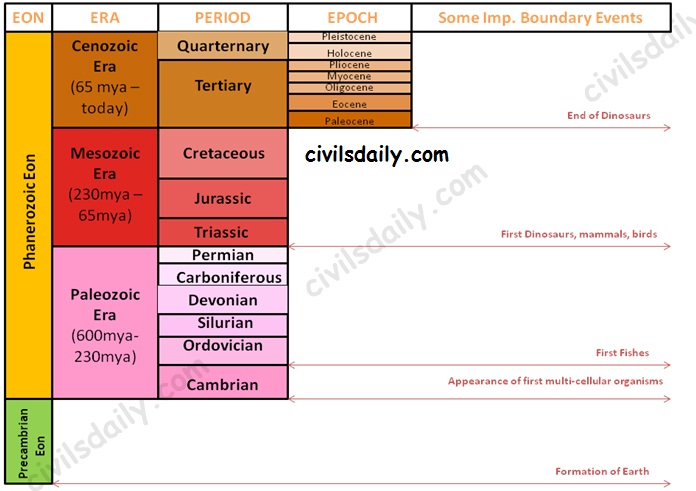

    Back2Basics: Geological time-scale

  • What is Wood Wide Web?

    Plants appear to be simple enough in their organization. Whether small shrubs or tall trees, all they seem to be made up of is leaves, flowers, fruits, stems, and roots. But simple they are not. Being rooted in one spot has required very special personality traits.

    Wood Wide Web

    • Trees in the forest share resources by using an underground network.
    • A scientist from the University of British Columbia, Dr. Suzanne Simard, revealed this network and called it the wood wide web.
    • In the wood wide web, mycorrhizal fungi colonize the plant roots, and their tiny fungal filaments, or mycelia, connect hairy root tips of different trees together.
    • Mycorrhizal fungi refer to the role they play in the plant’s root system—as symbionts.
    • These root-associated fungi are harmless to plants. Instead, they form harmonious symbiotic relationships with plants.

    An ancient association

    • The association between plants and fungi is ancient.
    • Fossils of plants from about 400 million years ago show the first evidence of roots, and these roots are fungus associations – rhizoids – suggesting that roots co-evolved with fungi.
    • One good example is species of Penicillium, the fungus from which Alexander Fleming isolated the antibiotic penicillin.
    • Fungus–root associations, called mycorrhizae, appear at first glance to be simple mutualisms that are beneficial to both.
    • The root-invading fungus gains nutrients made by the plant, and the plants get difficult-to-find minerals like phosphorus from the microbe. But the association is deeper.

    How does it work?

    • The wood wide web works by offering a win-win situation for all parties: mycorrhizal fungi and trees.
    • The fungal filaments transport nitrogen, phosphorous, water, and other hard-to-capture nutrients from the soil to the trees, in exchange for carbon-rich sugars made by the plants.
    • The fungi also help deliver substances from one tree to its neighboring trees.
    • By using the network, mature trees feed their seedlings with nutrients to boost their survival.
    • When a plant is sick or dying, it can allocate its nutrients to the other plants nearby through the wood wide web.

    Benefits offered

    • Bacteria that associate with roots are called rhizobacteria, and a very wide range of these species are plant growth promoters.
    • Like the fungi, mutualism operates in these relationships too. In exchange for sugars, these bacteria offer plants a wide range of benefits.
    • They may help plants ward off pathogens that cause diseases of the root. They may even trigger systemic resistance to a pathogen throughout the plant.

    Back2Basics: Symbiotic Relationship

    Parasitism

    • It is a type of interaction between two species that results in damage and harm to one member and benefit to another member.
    • Ex. As in the case of the tick-host relationship, the tick gains benefit by sucking blood while the host is harmed as it loses blood.

    Commensalism

    • In this type of relationship one species benefits without affecting the other.
    • Barnacles growing on the back of the whale, orchids growing as an epiphyte on some mango branch, cattle egret and grazing cattle in close association, Sea anemone, and the Clown Fish are some of the classic examples of Commensalism.

    Amensalism

    • In this relationship, one species is harmed while the other is neither harmed nor benefitted and remains unaffected.
    • When an organism excretes the chemicals as a part of the normal metabolism of its own, but which may severely impact other nearby species, this kind of relationship is seen.

    Mutualism

    • In this type of relationship both the partners benefit from one another. When similar interaction occurs within a species, it is known as cooperation.
    • Lichens a mutual relationship between algae and fungus. In this mutual cooperation, fungus gives protection and raw material for the preparation of the food while Green Algae synthesizes the food for both.

    Saprophytism

    • In this kind of biotic interaction, certain organisms live on dead and decaying organic matter.
    • Dung Beetles, Vultures, Fungi, Bacteria, Protozoa are the example of Saprophytism.

    Predation

    • In this type of biological interaction, a predator feeds upon its prey and in this type of relationship, one species is benefitted while the other is harmed.

    Competition

    • In this type of interaction both the species compete with each other for the resources like food, shelter, mating, and both the species get harmed out of the process of competition.
  • What is Milky Sea Phenomenon?

    Some researchers would use satellites to study the elusive milky sea phenomenon.

    What is the Milky Sea?

    • Milky seas, also called mareel, is a luminous phenomenon in the ocean in which large areas of seawater appear to glow translucently (in varying shades of blue).
    • Such occurrences glow brightly enough at night to be visible from satellites orbiting Earth.
    • They are a rare nocturnal phenomenon in which the ocean’s surface emits a steady bright glow.

    Why do they glow?

    • Luminous bacteria cause the particles they colonize to glow.
    • The purpose of this glow could be to attract fish that eat them.
    • These bacteria thrive in the guts of fishes, so when their populations get too big for their main food supply, a fish’s stomach makes a great second option.

    How do they occur?

    • It is typically caused by Noctiluca scintillans (popularly known as “sea sparkle”), a dinoflagellate that glows when disturbed and is found in oceans throughout much of the world.
    • Once their population gets large enough – about 100 million individual cells per millilitre of water – a sort of internal biological switch is flipped and they all start glowing steadily.

    UPSC 2022 countdown has begun! Get your personal guidance plan now! (Click here)

  • Colourful molecules of turmeric

    Researchers have come forward with some interesting findings on Turmeric.

    Turmeric

    • Turmeric has about 3% of the active component molecule called curcumin, a polyphenol diketone (and not a steroid).
    • Researchers point out that there is another molecule in turmeric called piperine, which is an alkaloid, responsible for the pungency of pepper that we use every day in our cooking, along with turmeric.
    • Piperine enhances curcumin absorption in the body. It gives turmeric its multivariate healing and protective power.

    Benefits of turmeric consumption

    • Turmeric has been known for over 4,000 years in the Indian subcontinent, West Asia, Burma, Indonesia and China, and is used as an essential part of our daily food – what the colonials called curry powder.
    • It has also been known as a medicine for ages, and to have anti-bacterial, anti-oxidant and anti-inflammatory properties.
    • Herbal medicine experts have used turmeric to treat painful symptoms of arthritis, joint stiffness, and joint pain.
    • They have also claimed that turmeric helps cure acute kidney injuries. Some of these claims need to be checked using controlled trials.

    Against COVID-19

    • Most recently, an exciting study has recently been published by a group in Mumbai which shows that turmeric aids in the treatment of COVID-19 patients.
    • The researchers did a trial of about 40 COVID-19 patients and found that turmeric could substantially reduce morbidity and mortality.

    UPSC 2022 countdown has begun! Get your personal guidance plan now! (Click here)

  • Nuclear Fusion and the recent breakthrough

    California based researchers have announced that their experiment has made a breakthrough in nuclear fusion research.

    What exactly is Nuclear Fusion?

    • Nuclear fusion is defined as the combining of several small nuclei into one large nucleus with the subsequent release of huge amounts of energy.
    • The difference in mass between the reactants and products is manifested as either the release or the absorption of energy.
    • Nuclear fusion powers our sun and harnessing this fusion energy could provide an unlimited amount of renewable energy.
    • An example of nuclear fusion is the process of four hydrogens coming together to form helium.

    What was the experiment?

    • In the experiment, lasers were used to heat a small target or fuel pellets.
    • These pellets containing deuterium and tritium fused and produced more energy.
    • The team noted that they were able to achieve a yield of more than 1.3 megajoules of heat energy.
    • This megajoule of energy released in the experiment is indeed impressive in fusion terms.

    How was the new breakthrough achieved?

    • The team used new diagnostics, improved laser precision, and even made changes to the design.
    • They applied laser energy on fuel pellets to heat and pressurize them at conditions similar to that at the center of our Sun. This triggered the fusion reactions.
    • These reactions released positively charged particles called alpha particles, which in turn heated the surrounding plasma.
    • At high temperatures, electrons are ripped from an atom’s nuclei and become a plasma or an ionized state of matter. Plasma is also known as the fourth state of matter.
    • The heated plasma also released alpha particles and a self-sustaining reaction called ignition took place.

    Future prospects: Benefits

    • It is expected that fusion could meet humanity’s energy needs for millions of years.
    • Fusion fuel is plentiful and easily accessible: deuterium can be extracted inexpensively from seawater, and tritium can be produced from naturally abundant lithium.
    • Future fusion reactors will not produce high activity, long-lived nuclear waste, and a meltdown at a fusion reactor is practically impossible.
    • Importantly, nuclear fusion does not emit carbon dioxide or other greenhouse gases into the atmosphere, and so along with nuclear fission could play a future climate change mitigating role as a low carbon energy source.
  • Celebrating Einstein’s century

    Context

    In 1921, the Nobel Prize Committee concluded that Einstein would have to wait and the Committee decided not to award the Prize to anyone in 1921. Opinions changed in a year and when Einstein did receive the 1921 Prize in 1922.

    Background

    • Noble Prize was not awarded for his theories of relativity but for “his services to Theoretical Physics, and especially for his discovery of the law of the photoelectric effect”.
    • The citation harked back to the revolutionary theories that Einstein had established in 1905. ‘Annus Mirabilis’, or the Year of Miracles, is how 1905 is remembered by physicists because Einstein, only 26 then, published four remarkable papers that year.
    • One of them explained that light was made of photons and when the light shone on metal, each photon’s energy correlated to the electron’s speed on the metal’s surface.
    • This theory redefined the composition of light and Einstein himself dubbed it revolutionary.
    • It was for this that he received the Nobel Prize.

    Special theory of relativity

    • The special theory of relativity was published in 1905.
    • James Maxwell had established that light was an electromagnetic wave and the value of its speed was calculated. Building on this,
    • Speed of light remains constant for all observers: Einstein understood that while moving from one frame of reference to another, which is moving at a different speed, the speed of light remains a constant.
    • He gave a physical interpretation to the equations governing the transformation from one frame to another based on this fact.
    • Time slows down when measured from the rest: Einstein’s theory establishes that time moves slower within a moving body when measured from a point at rest (but moves normally within the moving body itself).
    • Length reduces: The length of the moving body contracts when measured from an outside point at rest.
    • When a moving body emits light, the length contraction and time slowdown of the moving body are just exactly what are needed to restore the speed of light to its constant value.
    • Einstein’s insight was that there was no absolute time because time was measured by the simultaneity of two events and this simultaneity would be observed differently.
    • As lagniappe to the scientific community, Einstein published his famous mass-energy equivalence E=mc2 in late 1905.
    • A mundane example of the application of the special theory of relativity is the use of GPS on our phones.

    General theory of relativity

    • The theory is general enough to apply to all forms of motion, including those where gravity does not appear.
    • Einstein worked out equations using tensors, the mathematical implement to describe the transformation of different dimensions.
    • In November 1915, Einstein completed the general theory of relativity.
    • As per this theory, space and time form a continuum, like a fabric, and every object in the universe distorts this fabric, much like how dropping a large ball distorts a taut trampoline sheet.
    • This distortion is gravity. It produces two effects.
    • One, the fabric causes any other object in the vicinity to move towards the heavier object and this is why gravity causes an object to pull things towards it.
    • Two, it bends light in the process of attracting it.

    Conclusion

    In just two decades, Einstein led physics out of its traditional moorings, laid the entablature of modern physics on Newtonian and Maxwellian pillars of classical physics and opened it up to newer questions.

    UPSC 2022 countdown has begun! Get your personal guidance plan now! (Click here)

  • [pib] Revamped National Gene Bank

    The Union Agriculture Minister has inaugurated the world’s second-largest refurbished gene bank at the National Bureau of Plant Genetic Resources.

    National Gene Bank

    • The National Gene Bank was established in the year 1996 to preserve the seeds of Plant Genetic Resources (PGR) for future generations.
    • It has the capacity to preserve about one million germplasm in the form of seeds.
    • Presently it is protecting 4.52 lakh accessions, of which 2.7 lakh are Indian germplasm and the rest have been imported from other countries.
    • National Bureau of Plant Genetic Resources is meeting the need of in-situ and ex-situ germplasm conservation through Delhi Headquarters and 10 regional stations in the country.

    Key facilities provided

    • The NGB has four kinds of facilities to cater to long-term as well as medium-term conservation namely:
    1. Seed Gene bank (- 18°C),
    2. Cryo gene bank (-170°C to -196°C),
    3. In-vitro Gene bank (25°C), and
    4. Field Gene bank
    • It stores different crop groups such as cereals, millets, medicinal and aromatic plants, and narcotics, etc.

    What is the latest update?

    • This is the world’s second-largest gene bank located in the national capital.
    • It has the capacity to preserve about one million germplasm in the form of seeds.
    • Presently, it is protecting 4.52 lakh accessions, of which 2.7 lakh are Indian germplasm and the rest have been imported from other countries.

    UPSC 2022 countdown has begun! Get your personal guidance plan now! (Click here)


    Also read:

    Svalbard Global Seed Vault