💥Mains Ready By December. Smash Mains & Smash PYQ Admissions Open

Subject: BilateralXNeighbourhood

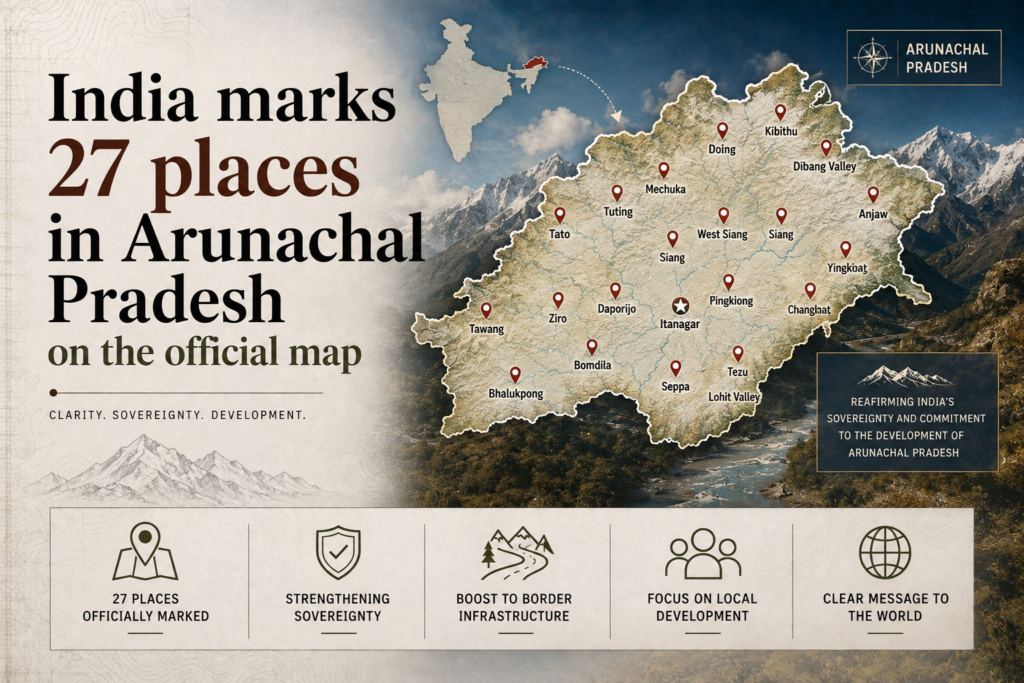
  • India marks 27 places in Arunachal Pradesh on the official map

    Why in the News

    India officially marked 27 places in Arunachal Pradesh with standard names on Survey of India maps, responding to China’s attempts to rename locations in the State.

    What is the Cartographic Dispute?

    • China: Calls Arunachal Pradesh Zangnan and periodically assigns Chinese names to locations.
    • India: Rejects China’s claims and maintains that Arunachal Pradesh is an integral part of India.

    Strategic Locations

    • Long Ju: Site of a 1959 India China boundary confrontation.
    • Thag La: Strategic ridge associated with the 1962 India China War.

    Why Does Naming Matter?

    • LAC: Reinforces India’s position along the disputed Line of Actual Control.
    • Sovereign record: Official mapping creates a formal cartographic record of India’s territorial claims.
    • Information warfare: Place naming is also a tool of strategic signalling and narrative competition.

    What Remains Unresolved?

    • The India China boundary dispute remains unsettled despite diplomatic and military negotiations.
    • Cartographic measures do not by themselves alter the ground position or resolve the boundary.

    Back2Basics: Survey of India

    • Status: India’s national mapping agency and one of the oldest scientific departments of the Government of India.
    • Ministry: Department of Science and Technology.
    • Role: Prepares official topographic and boundary maps.
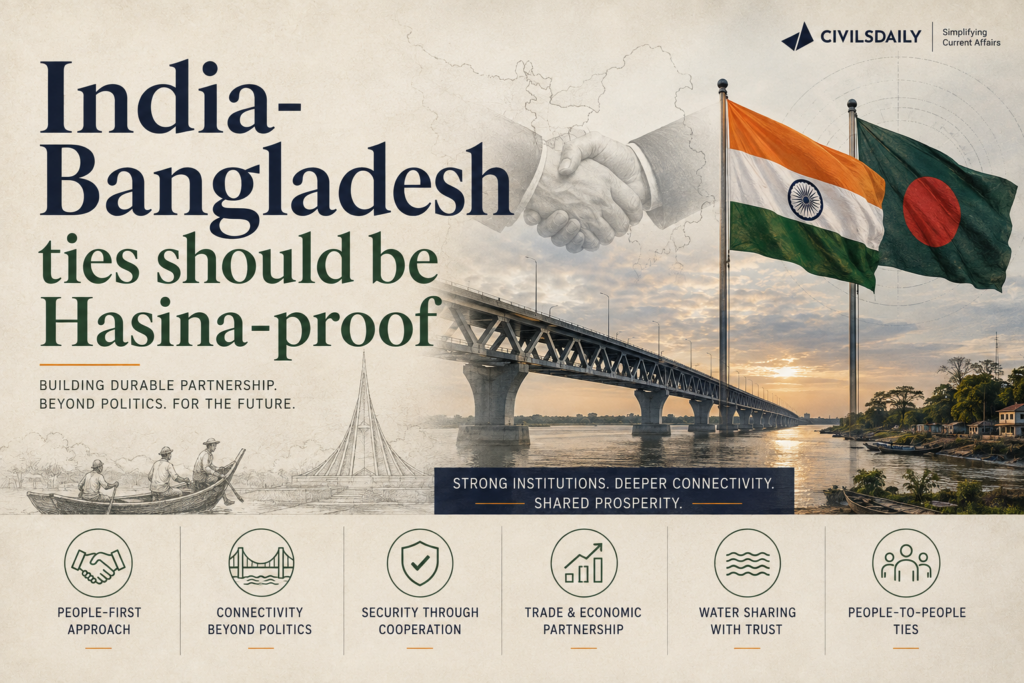
  • India-Bangladesh ties should be Hasina-proof

    Why in the News

    The former Bangladesh Prime Minister held her first question taking media interaction from exile in India. She announced a political comeback and said she would return in December. The event risks turning India’s grant of refuge into a diplomatic irritant with Dhaka’s elected government.

    What is the diplomatic dilemma India faces?

    1. Refuge granted: India gave the former Prime Minister refuge after she fled Bangladesh on 5 August 2024 amid protests.
    2. Legitimacy concern: the grant was defended given the unfairness of the legal proceedings against her, including a death sentence by the International Crimes Tribunal.
    3. Platform risk: using the refuge as a political platform complicates ties with the elected government.
    4. Elected counterpart: the Bangladesh Nationalist Party (BNP) led administration under the new Prime Minister took office about six months earlier.

    Why is the timing fraught?

    1. Reset underway: New Delhi is rebuilding ties after strained relations with the earlier Muhammad Yunus led interim government.
    2. Domestic backlash: a mob hurled petrol bombs at a party member’s residence after he joined the exiled leader online.
    3. Media bar: the statements were barred from broadcast in Bangladesh under laws the former government itself once used.
    4. Awami League banned: the leader’s party is barred from contesting, so the comeback call targets the incumbent government.

    What unresolved issues shadow the relationship?

    1. Ganga treaty: the 1996 Ganga Water Treaty is due for renewal this year.
    2. Teesta treaty: the Teesta water sharing treaty is still to be signed.
    3. Migration: New Delhi views illegal immigration from Bangladesh as a major irritant.
    4. Trade curbs: some trade restrictions remain even after Bangladesh removed visa curbs.
    5. China factor: India is wary of Dhaka drifting into China’s orbit, and the new Prime Minister has visited China but not India.

    Why must ties be insulated from any single individual?

    1. Shared border: a 4,000 kilometre border makes cooperation indispensable against trafficking and cross border extremism.
    2. Economic stakes: Indian investment and infrastructure financing support Bangladesh’s growth, with stakes in power and connectivity.
    3. Strategic caution: both governments need to insulate bilateral ties from short term compulsions.

    Conclusion

    India was right to shelter the former Prime Minister, but her political aspirations cannot bruise ties with the elected government. The bilateral relationship, anchored in geography and security, is too important to be held hostage by one individual. New Delhi’s task is to keep the reset with Dhaka insulated from her comeback bid.

    Back2Basics

    The 1996 Ganga Water Treaty is a 30-year bilateral agreement between India and Bangladesh signed on December 12, 1996. It governs the sharing of dry-season (January 1 to May 31) water flows from the Ganges River at the Farakka Barrage.

    Key Provisions and Formula

    1. Lean Season Focus: Applies specifically to lean-season flows from January 1 through May 31.
    2. 50:50 Sharing Rule: If the water flow at Farakka is 70,000 cusecs or less, India and Bangladesh each receive 50% of the water.
    3. Fixed Allocation Windows:
      • Flows of 70,000-75,000 cusecs: Bangladesh receives a fixed 35,000 cusecs, and India receives the rest.
      • Flows above 75,000 cusecs: India receives 75,000 cusecs, and Bangladesh receives the balance.
    4. Emergency Clause: If water flow drops below 50,000 cusecs in any 10-day period, both nations must hold immediate consultations for emergency adjustments.

    Administration and Oversight

    1. Joint Committee: An equal-representation monitoring committee measures daily flows at the Farakka feeder canal and Bangladesh’s Hardinge Bridge.
    2. Review Schedule: Subject to five-year reviews or earlier adjustments if requested.

    PYQ Relevance

    [UPSC 2013] Critically examine the compulsions which prompted India to play a decisive role in the emergence of Bangladesh.

    Linkage: It examines the strategic and political foundations of India–Bangladesh relations. The article highlights how India must balance humanitarian refuge with long-term bilateral and strategic interests.

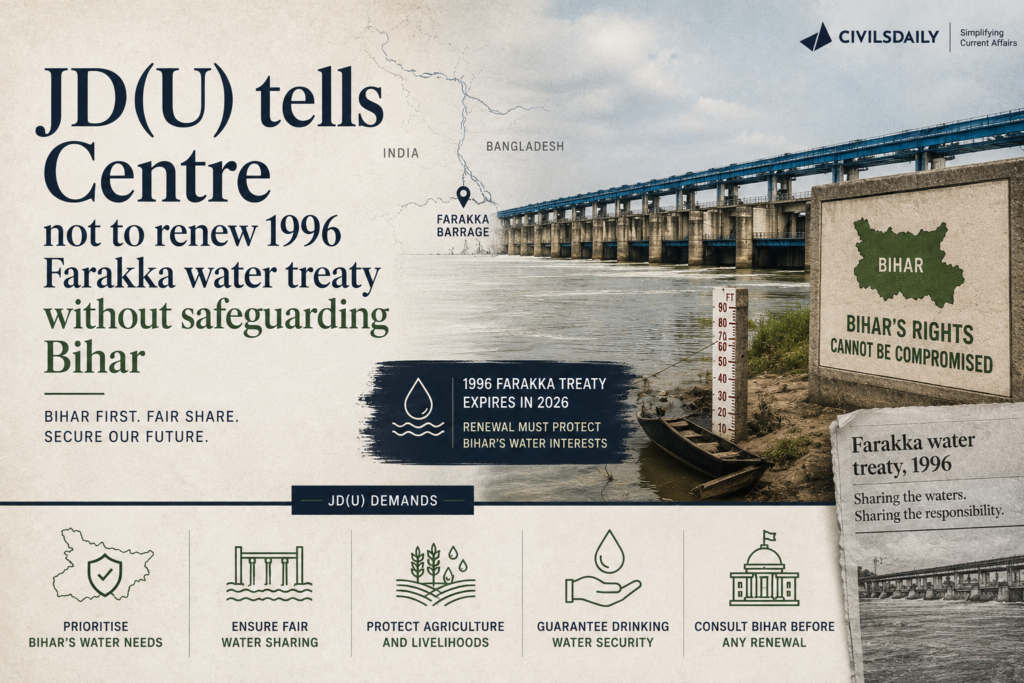
  • JD(U) tells Centre not to renew 1996 Farakka water treaty without safeguarding Bihar

    Why in the News

    The 1996 Farakka Water Treaty between India and Bangladesh is set to expire on 12 December 2026. The JD(U) has urged the Centre not to renew the treaty unless Bihar’s long term water security and developmental needs are adequately addressed.

    What is the 1996 Farakka Water Treaty?

    • Definition: A bilateral agreement between India and Bangladesh for sharing the Ganga’s dry season flow at the Farakka Barrage.
    • Objective: To allocate Ganga waters during the lean season between the two countries.
    • Duration: Signed in 1996 for 30 years, expiring on 12 December 2026.

    What is the Farakka Barrage?

    • Location: Built across the Ganga River in West Bengal.
    • Purpose: Diverts water into the Hooghly River.
    • Objective: Flushes silt to maintain the navigability of Kolkata Port.

    Why has Bihar opposed the treaty’s renewal?

    • Reduced Water Availability: Bihar argues that diversion at Farakka reduces lean season water availability within the state.
    • Development Concerns: Seeks greater consideration of Bihar’s long term irrigation, drinking water and development needs.
    • Demand for Renegotiation: JD(U) has called for safeguards before any extension of the treaty.
    • Federal Dimension: Highlights the need to balance state interests with India’s international water sharing commitments.

    Why is the treaty sensitive for India and Bangladesh?

    • Shared Rivers: India and Bangladesh share numerous transboundary rivers, making water sharing politically significant.
    • Dry Season Scarcity: Limited lean season flows often lead to competing demands.
    • Related Issue: The Farakka dispute exists alongside the unresolved Teesta Water Sharing Agreement, another key bilateral concern.

    [2013, GS2, 10 marks] The protests in Shahbag Square in Dhaka in Bangladesh reveal a fundamental split in society between the nationalists and Islamic forces. What is its significance for India?

    [2017] With reference to river Teesta, consider the following statements:
    1. The source of river Teesta is the same as that of Brahmaputra but it flows through Sikkim.
    2. River Rangeet originates in Sikkim and it is a tributary of river Teesta.
    3. River Teesta flows into Bay of Bengal on the border of India and Bangladesh.
    Which of the statements given above is/are correct?

    [A] 1 and 3 only

    [B] 2 only

    [C] 2 and 3 only

    [D] 1, 2 and 3

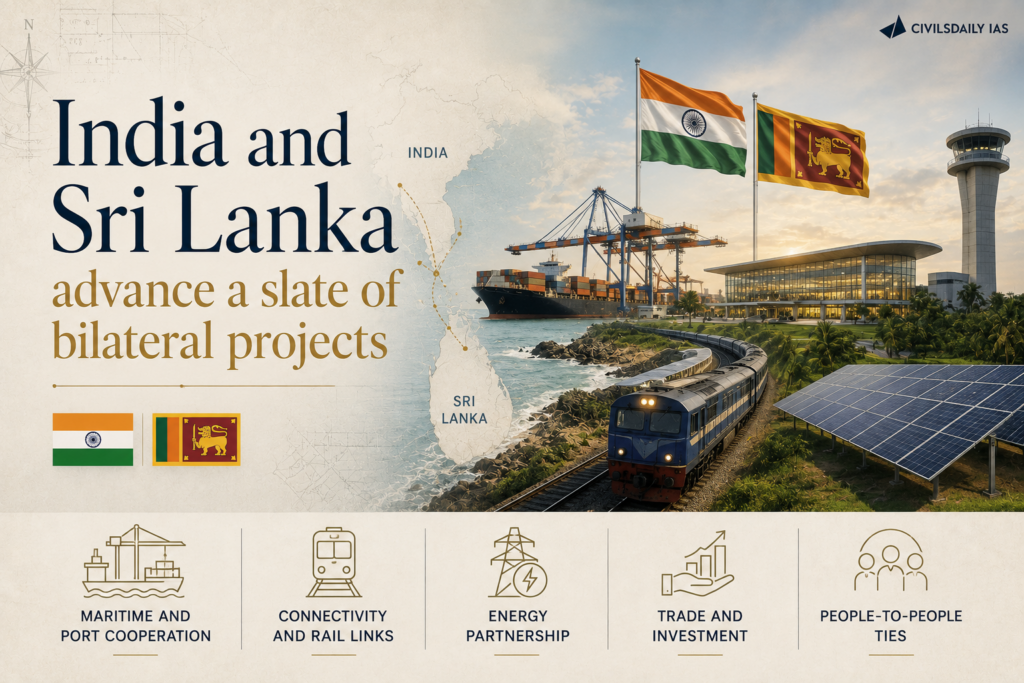
  • India and Sri Lanka advance a slate of bilateral projects

    Why in the News

    A high level visit produced concrete movement across trade, finance, energy, and connectivity between India and Sri Lanka. The development adds to the standing bilateral dossier rather than resolving a single dispute.

    What is the 13th Amendment context?

    1. Devolution law: The 13th Amendment to Sri Lanka’s Constitution created Provincial Councils to devolve power, including to Tamil majority areas.
    2. India’s interest: India has consistently pressed for its full implementation and Provincial Council elections.
    3. Pending status: Implementation has remained incomplete for decades.

    What was agreed on this visit?

    1. Trade and social security: Both sides agreed to advance the free trade agreement update and a social security pact.
    2. Rupee credit: Agreements were exchanged on Indian Rupee denominated Lines of Credit worth $350 million within a $450 million Cyclone Ditwah reconstruction package.
    3. Energy and connectivity: Talks covered grid interconnection, the Sampur solar project, the Trincomalee energy hub, and Kankesanthurai harbour.
    4. Digital identity: A Unique Digital Identity project modelled on India’s system was discussed.

    Why does the relationship matter for India?

    1. Neighbourhood first: Sri Lanka is central to India’s regional policy.
    2. Strategic location: Its position astride Indian Ocean sea lanes shapes maritime security.
    3. China factor: Deeper Indian engagement counters competing external influence.

    Conclusion

    The visit deepens a multi sector partnership without a single headline pact. The next milestone is the finalisation of the free trade agreement update and the social security pact.

    [2022, GS2, 10 marks] India is an age-old friend of Sri Lanka.’ Discuss India’s role in the recent crisis in Sri Lanka the light of the preceding statement.”

  • Why has Pakistan-occupied Kashmir erupted in protests?

    Why in the News?

    Simmering discontent over inflation and opaque governance in Pakistan-occupied Kashmir (PoK) has escalated into a violent security crackdown. The Jammu Kashmir Joint Awami Action Committee (JKJAAC) is leading opposition to a three-phase election and to 12 seats reserved for refugees in the 53-seat legislature. The unrest exposes the gap between an establishment-backed electoral process and a local demand for genuine political representation.

    Who are the Jammu Kashmir Joint Awami Action Committee (JKJAAC)?

    1. The JKJAAC is an alliance of civil society groups leading the protest movement in PoK. It has been protesting in Rawalakot, Muzaffarabad, and other locations.
    2. Demand: It seeks a more representative political system and removal of the reserved seats. It alleges the current election process is rigged.

    What is Pakistan-occupied Kashmir (PoK)?

    1. Definition: PoK is the part of the former princely State of Jammu and Kashmir under Pakistan’s control since 1947. India regards it as territory under illegal occupation.
    2. Two Regions: Pakistan administers the area as Azad Jammu and Kashmir (AJK) and Gilgit-Baltistan.
    3. India’s position: The Ministry of External Affairs maintains that the Union Territories of Jammu and Kashmir and Ladakh are integral and inalienable parts of India. It asserts Pakistan is in illegal and forcible occupation and considers local laws or elections void.

    How did a price protest become a movement for representation?

    1. Origins: The movement emerged after the COVID-19 pandemic to curb the prices of essential items. It evolved over the years into a protest against the lack of local political representation.
    2. Legislature structure: The PoK legislature has 53 seats, of which 45 are elected and 8 are nominated. Of the 45 elected seats, 12 are reserved for refugees of Indian Jammu and Kashmir who migrated after 1947.
    3. Grievance over reserved seats: Voters for these 12 seats cast ballots from outside PoK. Locals claim the reserved seats reduce regional representation and let Islamabad override local concerns.
    4. Escalation: The JKJAAC called a “long march” after authorities proceeded with the election without addressing the demand. The protest gained momentum after a PhD scholar was reportedly killed in police firing in Rawalakot.

    Why is Islamabad’s relationship with PoK strained?

    1. Developmental neglect: Mainstream parties have not met the region’s developmental aspirations. Locals allege long-standing neglect by Islamabad.
    2. Inflammatory rhetoric: The Pakistan Defence Minister called the protesters “enemies just like Indians”. The remark inflamed public sentiment.
    3. Parallel with other regions: The complaints echo those long voiced in Khyber Pakhtunkhwa and Balochistan. Both regions have seen protests and insurgencies for decades.
    4. Rigging allegations: The second phase of polling drew allegations of irregularities. The Pakistan Muslim League-Nawaz swept the phase, enabling it to form the regional government.

    How have India and international actors responded?

    1. India’s condemnation: The Ministry of External Affairs blamed the Pakistani establishment for the deaths of over 40 civilians. It called the ongoing polls a cosmetic exercise to camouflage illegal occupation.
    2. JKJAAC’s distancing: The committee rejected any Indian attempt to appropriate the movement. It stated the civil rights movement is neither a proxy nor an extension of interstate rivalries.
    3. Amnesty International: Amnesty urged Pakistan to restore communications access and allow media and independent observers. It responded to a communication blackout in PoK.
    4. United Kingdom diaspora: Non-resident Mirpuri Kashmiris with a strong presence in the UK began an online campaign. It urges restraint on Pakistan’s security establishment.

    Conclusion

    The unrest reflects a contest between an establishment-managed election and a local movement rejecting its political basis. The current status is a continuing three-phase poll amid a deadly crackdown and a communication blackout. Whether the protests subside depends on whether Islamabad addresses the demand over reserved seats, which it has so far refused.

    Back2Basics

    1. PoK: Pakistan-occupied Kashmir, part of the former princely State of Jammu and Kashmir under Pakistan’s control since 1947; India treats it as illegally occupied territory.
    2. Legislature: The PoK assembly has 53 seats, 45 elected and 8 nominated, with 12 elected seats reserved for post-1947 refugees.
    3. Line of Control: The military control line dividing Indian and Pakistani-administered Kashmir, formalised after the Shimla Agreement of 1972.
    4. India’s stance: The Union Territories of Jammu and Kashmir and Ladakh are integral parts of India, with Pakistan in illegal and forcible occupation of parts of them.

  • The Case for Updating the Indus Waters Treaty

    Why in the News?

    India has continued to hold on to the Indus Waters Treaty (IWT) in abeyance, following the terrorist strikes in Pahalgam. This has drawn war threats from Pakistan and revived attention to India’s separate, pending request to renegotiate the 65-year-old treaty. Pakistan has publicly treated the abeyance and the renegotiation notices as a single hostile act. This is despite  India’s actual 2023 and 2024 notices for treaty revision unanswered.

    Why is India’s push to renegotiate the IWT not an unusual or hostile move?

    1. Global norm of treaty revision: At least 250 separate transboundary river-water treaties exist worldwide, covering 113 river systems, as per a 2013 study. Supplementary protocols, amendments and data-sharing arrangements had already taken the total number of agreements to 688 by then.
    2. Continuing growth in revisions: The International Freshwater Treaties database (Oregon State University) now records over 800 such agreements, showing that transboundary treaties are routinely reviewed and updated.
    3. India’s own precedent: India’s 1996 Ganga water-sharing treaty with Bangladesh carries a 30-year validity and is due for renewal this year, showing India itself treats such treaties as time-bound instruments needing renewal.
    4. IWT already permits revision: Article VII allows the Permanent Indus Commissions of both countries to agree on new drainage or engineering works, though this has never been invoked. Article XII allows treaty modification “from time to time” through a fresh government-level treaty: the provision India invoked to serve its 2023 and 2024 notices.
    5. Not a new demand: Pakistani experts and scholars themselves called for review of the IWT well before the present standoff. India’s notices are the first official move by either side, not the first such call.

    What modern water-management elements does the IWT’s design fail to address?

    1. No groundwater provision: The treaty does not mention groundwater resources at all, despite groundwater being connected across borders in the same way as surface water.
    2. No water-quality standards: The treaty sets no requirements for water quality in the shared rivers.
    3. No environmental-flow provision: There is no mechanism to maintain minimum ecological flows in the rivers.
    4. Pakistan’s own grievance illustrates the gap: Pakistan has repeatedly complained that India releases municipal and sewage waste into the eastern rivers, over which India has full control under the treaty, affecting Pakistan’s soil and water health, a complaint the treaty’s silence on water quality leaves unresolved.
    5. Climate change was structurally excluded: No treaty negotiated before the 1990s could have factored in climate change; the IWT (1960) is no exception.
    6. Partition rather than sharing: Most water-sharing treaties guarantee a fixed volume or percentage of flow to each party. The IWT instead allocates entire rivers to one party or the other, making it more a partition agreement than a sharing arrangement, a design that has reduced incentive for joint river-basin management.

    How does the Mekong River Commission show the institutional flexibility the IWT’s commission lacks?

    1. Mekong River Commission (Southeast Asia, established 1995): Functions as a joint river water-management system, not merely a treaty-implementation body.
    2. Power to revise strategies: While it cannot alter the original treaty’s provisions, it is empowered to develop and revise joint basin-management strategies, data-sharing protocols, and water-quality rules.
    3. Contrast with the Permanent Indus Commission (PIC): The PIC, set up under the IWT, functions merely as the treaty’s implementing agency and has so far focused largely on ensuring the treaty’s existing provisions are not violated. It has no comparable mandate to revise or adapt joint management practices.

    Is India’s renegotiation push a technical necessity or an extension of the security standoff?

    1. Pakistan’s conflation: Pakistan organised an “international” conference on the treaty, with ministers and leaders threatening war over any disruption to the Indus basin’s rivers. They treat the abeyance and the renegotiation request as one hostile package.
    2. Selective response: Despite this rhetoric, Pakistan has still not responded to India’s actual 2023 and 2024 notices seeking treaty modification.
    3. Independent climate evidence: A study by researchers Vimal Mishra and Urmin Vegad of IIT Gandhinagar found climate change is affecting the two basins differently.
    4. Divergent basin trends: The eastern river basins have seen a 20% decline in annual rainfall over the last 70 years, while precipitation in the western river basins has remained largely unchanged.
    5. The delinking argument: India’s request to renegotiate the treaty must be seen as separate from its decision to hold it in abeyance. Agreeing to renegotiate, rather than continued brinkmanship, is presented as Pakistan’s most reliable route to ending the abeyance.

    Conclusion

    The Indus Waters Treaty was designed for a 1960 hydrological and political reality. It partitions entire rivers rather than sharing flows, omits groundwater, water-quality and environmental-flow provisions, and gives its joint commission no mandate to revise the treaty. These are the gaps that comparable transboundary arrangements, including the Mekong River Commission, address through built-in review mechanisms. This creates an independent, technical case for updating the IWT. India’s renegotiation request must be evaluated on this basis, delinked from its abeyance decision; Pakistan’s willingness to renegotiate, not further confrontation, is what would end the abeyance.

    PYQ Relevance

    [UPSC 2026] Present an account of the Indus Water Treaty and examine its ecological, economic and bilateral relation.

    Linkage: The PYQ directly asks for an account of the IWT and its bilateral implications. This article supplies the treaty’s institutional design flaws and the current bilateral context directly answering such a question today.