đŸ’„Join UPSC 2027,2028 Mentorship (July Batch) + XFactor Notes & Microthemes PDF

Subject: Conservation & Mitigation

1. Conservation Progs.
2. Worldwide initiatives
3. Mitigation Strategies
4. Conventions and Protocols

  • Species in news: Jungle Fowl

    A recent study by scientists has revealed new details about the earliest domestication of chicken from the Jungle Fowl.

    Try this question from CSP 2012:

    Q.What is the difference between the antelopes’ Oryx and Chiru?

    (a) Oryx is adapted to live in hot and arid areas like Africa and Arabia whereas Chiru is adapted to live in steppes and semi-desert areas of cold high mountains of Tibetan Plateau.

    (b) Oryx is poached for its antlers whereas Chiru is poached for its musk

    (c) Oryx exists in western India only whereas Chiru exists in northeast India only.

    (d) None of the statements (a), (b) and (c) given above is correct.

    Jungle Fowl

    • The DNA sequencing of 863 genomes has shown the first domestication of chicken occurred in southwestern China, northern Thailand and Myanmar.
    • The study involved sequencing of genomes from all four species of the genus Gallus, five subspecies of Red Jungle Fowl and various domestic chicken breeds collected worldwide.
    • It revealed single domestication from Red Jungle Fowl sub-species Gallus spadiceous.
    • The study also demonstrated that all five Red Jungle Fowl sub-species were genetically differentiated from each other approximately 50,000 years ago much earlier than domestication.
    • The results contradicted the earlier claim that chickens were domesticated in northern China and the Indus Valley.

    Domestication of Chicken

    • The question of domestication of chickens has intrigued scientists for centuries and has been the subject of debate.
    • Charles Darwin postulated that chickens were domesticated around 4,000 B.C. from a single ancestor, Red Jungle Fowl in the Indus Valley.
    • An important study published earlier from Uppsala University claimed the Grey Jungle Fowl had contributed to chicken domestication.
    • With this, a couple of studies from India, China and other South-Asian countries have argued the monophyletic origin of chicken.
  • Issues with draft EIA Notification 2020

    The changes made in the recent notification gives rise to several issues. These changes and issues that could arise are discussed in this article.

    • Environmental Impact Assessment (EIA) is a process of evaluating the likely environmental impacts of a proposed project or development, taking into account inter-related socio-economic, cultural and human-health impacts, both beneficial and adverse.
    • UNEP defines Environmental Impact Assessment (EIA) as a tool used to identify the environmental, social and economic impacts of a project prior to decision-making.
    • It aims to predict environmental impacts at an early stage in project planning and design, find ways and means to reduce adverse impacts, shape projects to suit the local environment and present the predictions and options to decision-makers.
    • Environment Impact Assessment in India is statutorily backed by the Environment Protection Act, 1986 which contains various provisions on EIA methodology and process.

    History of EIA in India

    • The Indian experience with Environmental Impact Assessment began over 20 years back. It started in 1976-77 when the Planning Commission asked the Department of Science and Technology to examine the river-valley projects from an environmental angle.
    • Till 1994, environmental clearance from the Central Government was an administrative decision and lacked legislative support.
    • On 27 January 1994, the then Union Ministry of Environment and Forests, under the Environmental (Protection) Act 1986, promulgated an EIA notification making Environmental Clearance (EC) mandatory for expansion or modernisation of any activity or for setting up new projects listed in Schedule 1 of the notification.
    • The Ministry of Environment, Forests and Climate Change (MoEFCC) notified new EIA legislation in September 2006.
      • The notification makes it mandatory for various projects such as mining, thermal power plants, river valley, infrastructure (road, highway, ports, harbours and airports) and industries including very small electroplating or foundry units to get environment clearance.
      • However, unlike the EIA Notification of 1994, the new legislation has put the onus of clearing projects on the state government depending on the size/capacity of the project.

    The EIA Process

    EIA involves the steps mentioned below. However, the EIA process is cyclical with interaction between the various steps.

    • Screening: The project plan is screened for scale of investment, location and type of development and if the project needs statutory clearance.
    • Scoping: The project’s potential impacts, zone of impacts, mitigation possibilities and need for monitoring.
    • Collection of baseline data: Baseline data is the environmental status of study area.
    • Impact prediction: Positive and negative, reversible and irreversible and temporary and permanent impacts need to be predicted which presupposes a good understanding of the project by the assessment agency.
    • Mitigation measures and EIA report: The EIA report should include the actions and steps for preventing, minimizing or by passing the impacts or else the level of compensation for probable environmental damage or loss.
    • Public hearing: On completion of the EIA report, public and environmental groups living close to project site may be informed and consulted.
    • Decision making: Impact Assessment Authority along with the experts consult the project-in-charge along with consultant to take the final decision, keeping in mind EIA and EMP (Environment Management Plan).
    • Monitoring and implementation of environmental management plan: The various phases of implementation of the project are monitored.
    • Assessment of Alternatives, Delineation of Mitigation Measures and Environmental Impact Assessment Report: For every project, possible alternatives should be identified, and environmental attributes compared. Alternatives should cover both project location and process technologies.
      • Once alternatives have been reviewed, a mitigation plan should be drawn up for the selected option and is supplemented with an Environmental Management Plan (EMP) to guide the proponent towards environmental improvements.
    • Risk assessment: Inventory analysis and hazard probability and index also form part of EIA procedures.

    Importance of Precautionary Principle

    • The basis in global environmental law for the EIA is the “precautionary principle”.
    • Environmental harm is often irreparable and it is cheaper to avoid damage to the environment than to remedy it.
    • We are legally bound to the precautionary principle under international treaties and obligations, as well as by Supreme Court judgments.

    What is the issue?

    • Streamlining the EIA process and bringing it in line with recent judgments are the reasons given by the government for latest notification.
    • The Draft EIA Notification disables it, shrinks its scope and removes what teeth it did have.
    • The most devastating blow to the EIA regime is the creation of an ex-post-facto clearance route. 

    1.What is ex-post-facto clearance route?

    • It applies to ongoing or completed project for which an EIA clearance was never sought or granted, and the construction of the project took place regardless.[violating the norms]
    • The project now can be slapped with minor fines for the violations and get cleared.
    • Where such ex-post-facto clearances were being granted previously, the courts cracked down on them as illegal.
    • Therefore, what could not be ratified will now find itself notified.
    • The legality of sidestepping the courts is questionable and will have to be tested.

    How it will affect?

    •  It will become a business decision as to whether the
    • There is an argument that this route will be an “exception”.
    • But it is difficult to believe in India. Our law has a long history of expanding the exception into the rule.

    Time to furnish response shortened

    • The draft notification also shortens the time for the public to furnish responses on the project.
    • For project-affected people, who are frequently forest dwellers or otherwise do not have access to information and technology.
    • This will make it harder to put forth representations.

    2.Monitoring requirements reduced

    • Monitoring requirements have been slackened.
    • The draft EIA notification halves the frequency of reporting requirements from every six months to once a year.
    • It also extends the validity period for approvals in critical sectors such as mining.

    3.Scope of EIA reduced

    • Industries that previously required a full assessment have been downgraded.
    • The construction industry will be one such beneficiary, where only the largest projects will be scrutinised fully.
    • While defence and national security installations were always understandably exempt, a vague new category of projects “involving other strategic considerations” will also now be free from public consultation requirements.

    4.Recent industrial mishaps

    • Oil India Limited’s oil wells in the Tinsukia district, Assam went up in flames this month.
    • It is situated only a few kilometres away from protected forest.
    • Recent processes for expansion and modification apparently took place without fresh environmental clearance.
    • There was a deadly gas leak at LG Polymers’ Visakhapatnam plant in May.
    • The plant had been operating without a valid environmental clearance for decades.

    Consider the question “Examine the changes made in the draft EIA Notification and what are the issues with it? “

    Way Forward

    On a positive note, the 2020 draft notification has a clause dedicated to definitions to several terms related to EIA. It may be beneficial in the sense that it consolidates the EIA rules and has the potential of alleviating some ambiguity in the present law.

    • The ministry, instead of reducing the time for public consultation, should focus on ensuring access to information as well as awareness about the public hearing and its impact upon the whole EIA process.
    • In order to improve ease of doing business, the government should bring down the average delay of 238 days in granting environmental clearance, that emanates from bureaucratic delays and complex laws.
    • Grow now, sustain later should not be the policy, as the notion is dangerously tilted against the concept of sustainable development.

    Conclusion

    Environmental regulation must balance damage to the environment with sustainable development and possible benefits but the new notification lays more emphasis on the benefits and so must be reconsidered.

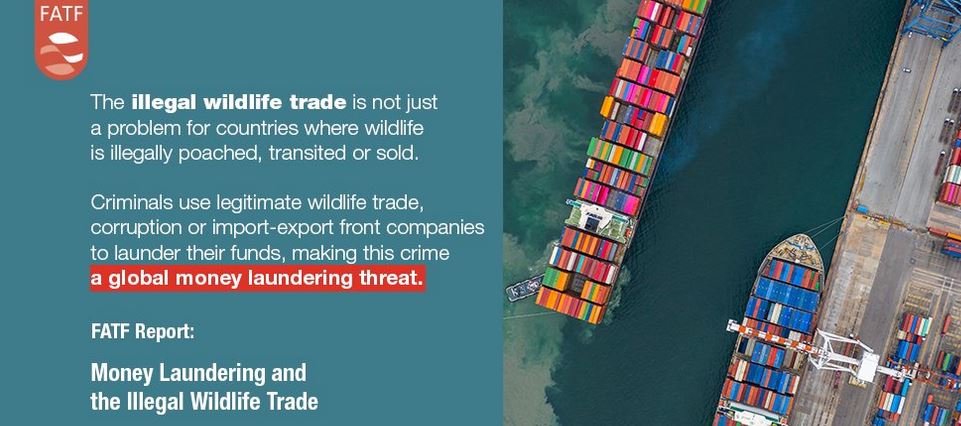
  • “Money Laundering and the Illegal Wildlife Trade” Report

    A first global report on the illegal wildlife trade has been recently published by the Financial Action Task Force (FATF).

    Try this MCQ:

    Q.The report “Money Laundering and the Illegal Wildlife Trade”  recently seen in news is released by:

    A. TRAFFIC/ B. CITES/ C. IUCN/ D. FATF

    Highlights of the Report

    • FATF has described illegal wildlife trade as a “global threat”, which also has links with other organised crimes like modern slavery, drug trafficking and arms trade.
    • The illegal trade is estimated to generate revenues of up to $23 billion a year.
    • The report flagged a lack of focus on the financial aspects of wildlife crime.

    (1)Economy of illicit wildlife trade

    • It said that criminals are frequently misusing the legitimate wildlife trade, as well as other import-export type businesses.
    • The FATF found that jurisdictions often did not have the required knowledge, legislative basis and resources to assess and combat the threat posed by the funds generated through the illegal trade.
    • The study has highlighted the growing role of online marketplaces and mobile and social media-based payments to facilitate the movement of proceeds warranting a coordinated response from government bodies, the private sector and the civil society.

    (2)Money laundering is prominent

    • According to the report, criminal syndicates are misusing the formal financial sector to launder the proceeds.
    • Funds are laundered through cash deposits, under the guise of loans or payments, e-banking platforms, licensed money value transfer systems, and third-party wire transfers via banks.
    • Accounts of innocent victims are also used and high-value payments avoided evading detection.

    (3)Misuse of front companies

    • Another common trend is the misuse of front companies with links to the legal wildlife trade, said the report.
    • Front companies, often linked to import-export industries, and shell firms are used for the movement of goods and trans-border money transfers.

    Recommendations of the report

    • The report says the financial probe is the key to dismantling the syndicates involved, which can in turn significantly impact the associated criminal activities.
    • It recommended that jurisdictions should consider implementing good practices, as observed during the study.
    • They include providing all relevant agencies with the necessary mandate and tools; and cooperating with other jurisdictions, international bodies and the private sector.
    • The FATF said that legislative changes were necessary to increase the applicability of anti-money laundering laws to the illegal wildlife trade-linked offences.

    Back2Basics

    https://www.civilsdaily.com/news/financial-action-task-force-fatf-2/

  • In news: Athirappally Waterfalls

    The Kerala government recently gave the go-ahead for the proposed 163-megawatt (MW) Athirappally Hydroelectric Project.

    Information about some of India’s tallest waterfalls is provided in the B2b section. Kindly pen them down along with their respective states. They can be asked in the match the pair type question.

    Athirappally Waterfalls

    • The famous Athirappally Waterfalls is located on the Chalakudy River in Thrissur district of Kerala.
    • It originates from the upper reaches of the Western Ghats at the entrance to the Sholayar ranges.
    • It is the largest waterfall in Kerala, which stands tall at 80 feet and is nicknamed “The Niagara of India”.
    • Controversy about a state-proposed hydroelectric dam on the Chalakudy River above the waterfalls began in the 1990s and continued through 2021.

    Issues with the Hydel project

    • A number of families belonging to the Kadar tribal group are facing displacement here.
    • The dam will also affect irrigation and tourism possibilities in the downstream parts of the Chalakudy River.
    • The falls and its surroundings are part of a crucial biodiversity-rich region coming under the Ecologically Sensitive Zone 1 of the Western Ghats.
    • The Ghats themselves are a UNESCO World Heritage Site and are one of the eight “hottest hot-spots” of biological diversity in the world.

    Back2Basics: Waterfalls in India

    • Vajrai Falls (560m): Satara, Maharashtra
    • Kunchikal Falls (455m): Shimoga, Karnataka
    • Barehipani Falls (390m): Odisha
    • Nohkalikai Falls (340m): East Khasi, Meghalaya
    • Dudhsagar Falls (310m): Karnataka, Goa
  • ‘Decarbonizing Transport in India (DTI)’ Project

    http://www.newsonair.com/writereaddata/News_Pictures/NAT/2020/Jun/NPIC-2020622172010.jpg

    NITI Aayog in collaboration with International Transport Forum (ITF) is set to launch the “Decarbonising Transport in India” project with the intention to develop a pathway towards a low-carbon transport system for India.

    Note the following things about ‘Decarbonising Transport in India (DTI)’ Project:

    1. Associated international institution

    2. Whether the institution is a UN body or not

    3. If India is a member of that body

    The DTI Project

    • The India project is carried out in the wider context of the International Transport Forum’s “Decarbonising Transport” initiative.
    • It is part of the “Decarbonising Transport in Emerging Economies” (DTEE) family of projects, which supports transport decarbonisation across different world regions.
    • India, Argentina, Azerbaijan, and Morocco are current participants.
    • The DTEE is a collaboration between the ITF and the Wuppertal Institute, supported by the International Climate Initiative (IKI) of the German Federal Ministry for the Environment.

    Objectives of the project

    • The project will design a tailor-made transport emissions assessment framework for India.
    • It will provide the government with a detailed understanding of current and future transport activity and the related CO2 emissions as a basis for their decision-making.

    About International Transport Forum (ITF)

    • The ITF is an inter-governmental organisation within the OECD (Organisation for Economic Co-operation and Development) system.
    • It is the only global body with a mandate for all modes of transport.
    • It acts as a think tank for transport policy issues and organises the annual global summit of transport ministers.
    • The ITF’s motto is “Global dialogue for better transport”.
    • India has been a member of ITF since 2008.

    Back2Basics: OCED

    • The OECD is an international, intergovernmental economic organization of 36 countries.
    • OECD was founded in the year 1961 to stimulate world trade and economic progress.
    • OECD originated in 1948, as the Organisation for European Economic Co-operation (OEEC).
    • The Organisation for European Economic Co-operation (OEEC) was founded to govern the predominantly US-funded Marshall Plan for post-war reconstruction on the continent.
    • The OEEC was instrumental in helping the European Economic Community (EEC). The EEC has evolved into the European Union (EU) to establish a European Free Trade Area.
    • India is NOT a member of OECD.
  • Species in news: Horseshoe Crab

    Horseshoe crabs face an uncertain future in Odisha, their largest habitat in India, even as the world gets ready to celebrate the first-ever ‘International Horseshoe Crab Day’ on June 20, 2020.

    Try this question from CSP 2012:

    Q. Which one of the following groups of animals belongs to the category of endangered species?

    (a) Great Indian Bustard, Musk Deer, Red Panda and Asiatic Wild Ass

    (b) Kashmir Stag, Cheetal, Blue Bull and Great Indian Bustard

    (c) Snow Leopard, Swamp Deer, Rhesus Monkey and Saras (Crane)

    (d) Lion-tailed Macaque, Blue Bull, Hanuman Langur and Cheetal

    Horseshoe Crabs

    IUCN status: (Data insufficient for the Indian variant)

    • Horseshoe crabs are marine and brackish water arthropods. They are not true crabs, which are crustaceans.
    • The crabs are represented by four extant species in the world. Out of the four, two species are distributed along the northeast coast of India.
    • Only T gigas species of the horseshoe crab is found along Balasore coast of Odisha.
    • The crab was included on September 9, 2009, in the Schedule IV of the Wild (Life) Protection Act, 1972, under which, the catching and killing of a horseshoe crab is an offence.

    Their significance

    • The horseshoe crab is one of the oldest marine living fossils whose origin date back to 445 million years before the dinosaurs existed.
    • One of their ecological functions is to lay millions of eggs on beaches to feed shorebirds, fish and other wildlife.

    Threats

    • Poachers kill them for their meat that is popularly believed to have aphrodisiac qualities.
    • The blood of horseshoe crabs, which is blue in colour, is used for detection of bacterial endotoxins in medical applications.
  • Species in news: Pangolin

    China accorded the pangolin the highest level of protection and removed the scales of the endangered mammal from its list of approved traditional medicines amid links between wild meat and the transmission of the SARS-CoV-2 virus.

    Practice question for mains:

    Q. What are Zoonotic Diseases? Discuss the hazards of importing zoonotic diseases through wildlife trade.

    About Pangolin

    IUCN status: Endangered

    • India is home to two species of pangolin.
    • While the Chinese Pangolin (Manis pentadactyla) is found in northeastern India, the Indian Pangolin is distributed in other parts of the country as well as Sri Lanka, Bangladesh and Pakistan.
    • Both these species are protected and are listed under the Schedule I Part I of the Wild Life (Protection) Act, 1972 and under Appendix I of the Convention on International Trade in Endangered Species (CITES).
    • Commonly known as ‘scaly anteaters’, the toothless animals are unique, a result of millions of years of evolution.
    • Pangolins evolved scales as a means of protection. When threatened by big carnivores like lions or tigers they usually curl into a ball.
    • The scales defend them against dental attacks from the predators.

    Pangolin in China

    • Pangolin meat is considered a delicacy in China and Vietnam.
    • Their scales which are made of keratin, the same protein present in human nails — are believed to improve lactation, promote blood circulation, and remove blood stasis.
    • These so-called health benefits are so far unproven.

    What makes pangolins the most trafficked animals in the world?

    • Their alleged health benefits in traditional Chinese medicines prompted a booming illicit export of scales from Africa over the past decade.
    • Officials quote trafficking price of Pangolin and its scale anywhere between Rs 30,000 and Rs 1 crore for a single animal.
    • Conservation of pangolins received its first shot in the arm when the 2017 Convention on International Trade in Endangered Species (CITES) enforced an international trade ban.

    How will China’s decision impact pangolin trafficking?

    • The immediate impact would be pangolin scales losing their legitimacy in traditional Chinese medicines. However, the history of the ban on wildlife trade in China is not encouraging.
    • The continued availability of tiger bone wine — believed to cure a host of conditions ranging from dysentery to rheumatism — despite its ban on tiger products in 1993. The price of elephant ivory plummeted by two-thirds after China banned it.
    • India, where the trade largely remains local, has been registering a decline from before China’s ban.
    • The trade-in pangolin scales are already showing a decreasing trend in India and the only trade is the trade-in live animals by unorganised traders, who ask for a few crores for each live animal.
  • Guidelines for Import of Exotic Species

    The Ministry of Environment Forest and Climate Change (MOEFCC) has issued an advisory saying people importing “exotic live species” will have to make a voluntary disclosure.

    Practice questions for mains:

    Q. What are Zoonotic Diseases? Discuss how the illicit trade in wildlife has resulted in the spread of zoonotic diseases of the scale of the ongoing COVID-19?

    What is the new Advisory?

    • According to the advisory, the phrase “exotic live species” includes “animals named under the Appendices I, II and III of the Convention of International Trade in Endangered Species of Wild Fauna and Flora”.
    • It does not include species from the Schedules of the Wildlife (Protection) Act 1972.
    • This will create a process where all imports will be screened.
    • As of now, the imports are being made through the Director-General of Foreign Trade and State Forest departments are not kept in the loop.
    • For new “exotic live species”, the importer should obtain a no-objection certificate from the Chief Wildlife Warden (CWLW) of the State.
    • For existing species, stocks shall be declared by the owner/ holder (stock, as on 1 January 2020) to the Chief Wildlife Warden (CWLW) of the concerned State or UT.

    Why need such advisory?

    • Many exotic species of birds, reptiles and amphibians are imported into India for commercial purposes.
    • Some of the most sought after exotic species in India are Ball python, Scarlet Macaw, sea turtles, sugar glider (Petaurus breviceps), marmoset and grey African parrots.
    • These imports were happening through the Director-General of Foreign Trade (DGFT), but they were beyond the purview of the forest departments and the chief wildlife wardens weren’t aware of them.
    • Wildlife experts have long been asking for stringent laws and guidelines to document and regulate numbers of exotic species being kept as pets by individuals and breeders in India.

    Significance

    • The move comes as the outbreak of coronavirus (COVID-19) has raised global concern about illegal wildlife trade and zoonotic diseases.
    • Often these species are illegally trafficked into the country to avoid lengthy documentation and scrutiny.

    Issues with guidelines

    • Matters such as the spread of invasive species as well as zoonotic diseases had not been taken care of in the advisory.
    • There is a growing domestic trade in exotic species of wildlife that is unfortunately not listed under the various appendices of CITES (such as sugar gliders, corn snakes).
    • Hence limiting the scope of the latest advisory to only those species covered under CITES drastically limits the scope of the advisory itself.
    • It does not have the force of law and could potentially incentivize illegal trade by offering a long amnesty period.

    Back2Basics: CITES

    • CITES stands for the Convention on International Trade in Endangered Species of Wild Fauna and Flora.
    • It is as an international agreement aimed at ensuring “that international trade in specimens of wild animals and plants does not threaten their survival”.
    • It was drafted after a resolution was adopted at a meeting of the members of the International Union for Conservation of Nature (IUCN) in 1963.
    • It entered into force on July 1, 1975, and now has 183 parties.
    • The Convention is legally binding on the Parties in the sense that they are committed to implementing it; however, it does not take the place of national laws.
    • India is a signatory to and has also ratified CITES convention in 1976.

    CITES Appendices

    • CITES works by subjecting international trade in specimens of selected species to certain controls.
    • All import, export, re-exports and introduction from the sea of species covered by the convention has to be authorized through a licensing system.

    It has three appendices:

    • Appendix I includes species threatened with extinction. Trade-in specimens of these species are permitted only in exceptional circumstances.
    • Appendix II provides a lower level of protection.
    • Appendix III contains species that are protected in at least one country, which has asked other CITES Parties for assistance in controlling trade.
  • Species in news: Indian Gaur

    The first population estimation exercise of the Indian gaur carried out in the Nilgiris Forest Division has revealed that more than an estimated 2,000 Indian gaurs inhabit the entire division.

    Try this question from CSP 2012:

    Q. Which one of the following groups of animals belongs to the category of endangered species?(2012)

    (a) Great Indian Bustard, Musk Deer, Red Panda and Asiatic Wild Ass

    (b) Kashmir Stag, Cheetal, Blue Bull and Great Indian Bustard

    (c) Snow Leopard, Swamp Deer, Rhesus Monkey and Saras (Crane)

    (d) Lion-tailed Macaque, Blue Bull, Hanuman Langur and Cheetal

    Indian Gaur

    • The Indian Gaur also called the Indian bison is one of the largest extant bovines found in India.
    • It is native to South and Southeast Asia and has been listed as Vulnerable on the IUCN Red List since 1986.
    • The global population has been estimated at maximum 21,000 mature individuals by 2016.
    • It declined by more than 70% during the last three generations, and is extinct in Sri Lanka and probably also in Bangladesh.
    • In Malaysia, it is called Seladang and Pyaung in Myanmar. The domesticated form of the gaur is called Gayal (Bos frontalis) or Mithun.
    • They are highly threatened by poaching for trade to supply international markets, but also by opportunistic hunting, and specific hunting for home consumption.
  • Species in news: Asiatic Lion

    Asiatic lions have now significantly risen in number at an estimated population of 674 in the Gir forest region of Gujarat. Unlike in previous years, this count was estimated not from a Census, but from a population “observation” exercise called Poonam Avlokan.

    Try this question from CSP 2017:

    Q. The term ‘M-STrIPES’ is sometimes seen in the news in the context of

    (a) Captive breeding of Wild Fauna

    (b) Maintenance of Tiger Reserves

    (c) Indigenous Satellite Navigation System

    (d) Security of National Highways

    Asiatic Lion

    • Indian Lion (Panthera Leo Persica) is listed as Endangered and exists as a single population in Gujarat.
    • It is one of five big cat species found in India and Gir National Park and Wildlife Sanctuary is the only habitat for Asiatic lions.
    • Historically, it inhabited much of Western Asia and the Middle East up to northern India.
    • On the IUCN Red List, it is listed under its former scientific name Panthera leo persica as Endangered because of its small population size and area of occupancy.
    • More than two dozen lions died last year in an outbreak of canine distemper virus (CDV) and Babesiosis.

    What is Poonam Avlokan?

    It includes two methods:

    • Block counting method — in which census enumerators remain stationed at water points in a given block and estimate abundance of lions in that block, based on the direct sighting of lions who need to drink water at least once in 24 hours during the summer.
    • Other teams keep moving in their respective territories and make their estimates based on inputs provided by lion trackers and on chance sightings.

    Back2Basics: Lion Census in India

    • The first Lion Census was conducted by the Nawab of Junagadh in 1936; since 1965, the Forest Department has been regularly conducting the Lion Census every five years.
    • The 6th, 8th and 11th Censuses were each delayed by a year, for various reasons.
    • This year it was postponed after the lockdown was announced.