đŸ’„Join UPSC 2027,2028 Mentorship (July Batch) + XFactor Notes & Microthemes PDF

Subject: Conservation & Mitigation

1. Conservation Progs.
2. Worldwide initiatives
3. Mitigation Strategies
4. Conventions and Protocols

  • Forest Conservation Rules infringe upon Land Rights of Tribals: NCST

    The National Commission for Scheduled Tribes (NCST) has asked the Centre to put the new Forest Conservation Rules, 2022, on hold.

    What are the Forest Conservation Rules?

    • The Forest Conservation Rules deal with the implementation of the Forest Conservation Act (FCA), 1980.
    • They prescribe the procedure to be followed for forest land to be diverted for non-forestry uses such as road construction, highway development, railway lines, and mining.
    • The broad aims of the FCA are:
    1. To protect forest and wildlife
    2. Put brakes on State governments’ attempts to hive off forest land for commercial projects and
    3. Striving to increase the area under forests

    How does it work?

    • For forest land beyond five hectares, approval for diverting land must be given by the Central government.
    • This is via a specially constituted committee, called the Forest Advisory Committee (FAC).
    • The FAC approval also means that the future users of the land must provide compensatory land for afforestation as well as pay the net present value (ranging between â‚č10-15 lakh per hectare.)

    What do the updated rules say?

    • The new rules aims to streamline the process of approvals.
    • The rules make a provision for private parties to cultivate plantations and sell them as land to companies who need to meet compensatory forestation targets.
    • This aims to help increase forest cover as well as solve the problems of the States of not finding land within their jurisdiction for compensatory purposes.

    Why in news now?

    • The point of contention flagged by NCST is- the new rules has no word for what happens to tribals and forest-dwelling communities whose land would be hived off for developmental work.
    • Prior to the updated rules, state bodies would forward documents to the FAC that would also include information on the status of whether the forest rights of locals in the area were settled.

    Back2Basics: National Commission for Scheduled Tribes (NCST)

    • National Commission for Scheduled Tribes (NCST) is an Indian constitutional body that was established through Constitution (89th Amendment) Act, 2003.
    • It functions under the jurisdiction of Ministry of Social Justice and Empowerment.
    • The original constitution provided for the appointment of a Special Officer under Article 338.
    • The special officer was designated as the Commissioner for Scheduled Castes and Scheduled Tribes.
    • The 65th Constitutional Amendment Act 1990, amended Article 338 of the Constitution to introduce a joint NC for SCs and STs.
    • Later by 89th Amendment, NC for Scheduled Castes (NCSC) and NC for Scheduled Tribes (NCST) were separated by creating a new Article 338-A.


    UPSC 2023 countdown has begun! Get your personal guidance plan now! (Click here)

  • PM launches Mission LiFE

    World

    Context

    • Our world today is in turmoil, facing multiple, mutually reinforcing crises. for the first time since it began over 30 years ago, the United Nations Development Programme’s Human Development Report has warned that global human development measures have declined across most countries in the past two years.

    Background

    • Ever increasing Existential threat: The greatest existential threat of all, the triple planetary crisis of climate change, pollution and biodiversity loss.
    • Climate change and extreme forms of weather events associated with it: Nine of the warmest years on record have come in the past decade alone. This year’s record-breaking heat waves, floods, droughts, and other extreme forms of weather have forced us to face these increasingly devastating impacts.
    • Window for action is closing fast: Climate change is a disruption multiplier in a disrupted world, rolling back progress across the global Sustainable Development Goals. Commitments we have now will not keep warming below the 1.5°C target that gives us the best chance of averting catastrophe.
    • LIFE, a fresh perspective: LIFE, or Lifestyle for Environment, announced by Prime Minister Narendra Modi at COP26 in November 2021, brings a fresh and much-needed perspective.

    World

    What is “LIFE” called by PM Narendra Modi?

    • LIFE: “LIFE – Lifestyle for the Environment”, PM Modi had proposed the one-word mass movement “LIFE” at the 26th session of the Conference of the Parties to the UN Framework Convention on Climate Change at Glasgow last November.
    • A theme for COP27: “LIFE”, a global initiative launched by Prime Minister Narendra Modi, will be the theme of the India pavilion at the upcoming COP27 at Sharm-El-Sheikh in Egypt.
    • LIFE Movement: Subsequently, PM Modi launched ‘Lifestyle for the Environment – LIFE Movement’ on 5 June on the occasion of world environment day.
    • What is the vision of LIFE: The vision of ‘LIFE’ is to live a lifestyle that is in tune with our planet and does not harm it The people who live such a lifestyle can be called “Pro-Planet people.”

    What is LiFE-Movement?

    • Objective of LiFE: The idea promotes an environmentally conscious lifestyle that focuses on ‘mindful and deliberate utilisation’ instead of ‘mindless and wasteful consumption’.
    • Aim of LiFE: The LiFE Movement aims to utilise the power of collective action and nudge individuals across the world to undertake simple climate-friendly actions in their daily lives. The LiFE movement, additionally, also seeks to leverage the strength of social networks to influence social norms surrounding climate.
    • Creating Pro-planet people: The Mission plans to create and nurture a global network of individuals, namely ‘Pro-Planet People’ (P3), who will have a shared commitment to adopt and promote environmentally friendly lifestyles.
    • Seeks to behavioural change and individual actions: Through the P3 community, the Mission seeks to create an ecosystem that will reinforce and enable environmentally friendly behaviours to be self-sustainable. LIFE recognizes that small individual actions can tip the balance in the planet’s favour.
    • Mission liFE for India: Mission LiFE borrows from the past, operates in the present and focuses on the future. Reduce, Reuse and Recycle are the concepts woven into our life. The Circular Economy has been an integral part of our culture and lifestyle.

    World

    What can be done to fulfil the vision of LiFE?

    • Cultivating the attitude of individual responsibility starting from the home: Mindful choices cultivated by LIFE animate this spirit actions such as saving energy at home; cycling and using public transport instead of driving; eating more plant-based foods and wasting less; and leveraging our position as customers and employees to demand climate-friendly choices.
    • Applying the nudging techniques to encourage positive behaviour: Many of the goals of LIFE can be achieved by deploying ‘nudges’, gentle persuasion techniques to encourage positive behaviour. The UN Environment Programme (UNEP) employs proven nudging techniques such as discouraging food waste by offering smaller plates in cafeterias; encouraging recycling by making bin lids eye-catching; and encouraging cycling by creating cycle paths.
    • Adopting greener consumption habits: According to the UNEP, more than two-thirds of greenhouse gas emissions can be attributed to household consumption and lifestyles the urgent cuts to global emissions we need can only be achieved through widespread adoption of greener consumption habits.

    World

    How India could be the torch bearer?

    • Historical wisdom: “Vasudhaiv kutumbakam” which means the world is one family, India insists on this philosophy. In the words of Mahatma Gandhi, “the world has enough for everyone’s need, but not enough for everyone’s greed.” Even The Prime Minister recalled that Mahatma Gandhi talked about a zero-carbon lifestyle.
    • India’s proven track record of mass movements: India has a proven track record translating the aspirations of national missions into whole-of-society efforts. The success of the Swachh Bharat Mission, which mobilised individuals and communities across socio-economic strata to become drivers of collective good health and sanitation is an example.
    • India is strong to uphold Climate Justice: LIFE resonates with the global climate justice India has rightfully called for highlighting enhanced obligations those in developed countries bear, to support climate adaptation and mitigation for those most affected, yet least responsible. The average carbon footprint of a person in high income country is more than 80 times higher than that of a person in a least developed country. It is common sense and only fair to call on the developed world to shoulder a proportionate share of this transition.
    • Indi’s leadership on climate action at the international stage: From the Panchamrit targets announced by Mr. Modi at COP26, to support for the International Solar Alliance, the Coalition for Disaster Resilient Infrastructure and South-South cooperation platforms, from the world’s fifth largest economy with vibrant businesses making enormous investments in renewables and electric mobility, to a world class public digital tech stack, India brings scale, expertise and legitimacy; a well-positioned founding UN Member State bridging the G20 and G77.
    • India’s COP pavilions setting up an example: India has been setting up its pavilions at COPs since 2015 to showcase its achievements in climate actions. Several think tanks, civil society organizations, industry bodies and private sector organise side events at the India pavilion.

    Conclusion

    • While governments and industry carry the lion’s share of responsibility for responding to the crisis of climate change, we as consumers play a large role in driving unsustainable production methods. With COP27 next month, we should commit to be an active partner of a global network of ‘Pro-Planet People’ (P3), to adopt and promote environmentally friendly lifestyles.

    Mains Question

    Q. In the time of the triple planetary crisis of climate change, pollution and biodiversity loss, India shows a path for mitigating the climate crisis through LiFE movement. Discuss.

    UPSC 2023 countdown has begun! Get your personal guidance plan now! (Click here)

  • GRAP Stage II kicks in as Delhi’s air quality may turn ‘very poor’

    The Commission for Air Quality Management directed New Delhi authorities to enforce stage II of the Graded Response Action Plan (GRAP) with immediate effect.

    Graded Response Action Plan (GRAP)

    • In 2014, when a study by the WHO found that Delhi was the most polluted city in the world, panic spread in the Centre and the state government.
    • Approved by the Supreme Court in 2016, the plan was formulated after several meetings that the Environment Pollution (Prevention and Control) Authority (EPCA) held with state government and experts.
    • The result was a plan that institutionalized measures to be taken when air quality deteriorates.
    • GRAP also works as an emergency measure.
    • It includes strict measures such as a ban on the entry of heavy vehicles, the odd-even road rationing restrictions, and a halt of construction work – each of which is likely to be impractical at a time when the pandemic has exacted heavy economic costs and public transport has been seen as an infection risk.

    How does it work?

    • As such, the plan does not include action by various state governments to be taken throughout the year to tackle industrial, vehicular and combustion emissions.
    • When the air quality shifts from poor to very poor, the measures listed under both sections have to be followed since the plan is incremental in nature.
    • If air quality reaches the severe+ stage, GRAP talks about shutting down schools and implementing the odd-even road-space rationing scheme.

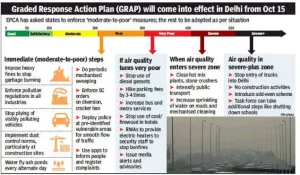
    Measures taken under GRAP

    1) Severe+ or Emergency

    (PM 2.5 over 300 ”g/cubic metre or PM10 over 500 ”g/cu. m. for 48+ hours)

    • Stop entry of trucks into Delhi (except essential commodities)
    • Stop construction work
    • Introduce odd/even scheme for private vehicles and minimise exemptions
    • Task Force to decide any additional steps including shutting of schools

    2) Severe

    (PM 2.5 over 250 ”g/cu. m. or PM10 over 430 ”g/cu. m.)

    • Close brick kilns, hot mix plants, stone crushers
    • Maximise power generation from natural gas to reduce generation from coal
    • Encourage public transport, with differential rates
    • More frequent mechanized cleaning of road and sprinkling of water

    3) Very Poor

    (PM2.5 over 121-250 ”g/cu. m. or PM10 over 351-430 ”g/cu. m.)

    • Stop use of diesel generator sets
    • Enhance parking fee by 3-4 times
    • Increase bus and Metro services
    • Apartment owners to discourage burning fires in winter by providing electric heaters during winter
    • Advisories to people with respiratory and cardiac conditions to restrict outdoor movement

    4) Moderate to poor

    (PM2.5 over 61-120 ”g/cu. m. or PM10 over 101-350 ”g/cu. m.)

    • Heavy fines for garbage burning
    • Close/enforce pollution control regulations in brick kilns and industries
    • Mechanized sweeping on roads with heavy traffic and water sprinkling
    • Strictly enforce a ban on firecrackers


    UPSC 2023 countdown has begun! Get your personal guidance plan now! (Click here)

  • What are Green Crackers?

    cracker

    Many states have outlawed firecrackers and mandated the production, sale, and usage of only green firecrackers in light of Diwali’s impending arrival and the air pollution crisis.

    What are green crackers?

    • Green Crackers are fireworks that are healthy to the environment and can lessen the air pollution that conventional firecrackers produce.
    • The Council for Scientific and Industrial Research (CSIR) created these.
    • These green crackers, designed by the National Environmental and Engineering Research Institute (NEERI), a CSIR lab, contain flower pots, pencils, fireworks, maroons, bombs, and chakkar.

    How are they made?

    • Green crackers, also known as eco-friendly crackers, are made from alternative raw materials to have a smaller negative impact on the environment and to pose fewer health hazards.
    • It has been stated that green crackers are environmentally friendly because they don’t contain aluminum, barium, potassium nitrate, or carbon.

    Are they totally pollution free?

    • Green crackers are 30% less polluting than regular ones.
    • Green crackers have less or no barium, and that the chemical barium nitrate is what causes the smoke and emissions.
    • In addition to lowering air pollution, green crackers are said to have a lower sound level than the ordinary crackers—between 110 and 125 decibels as opposed to roughly 160 decibels for conventional crackers.
    • Despite all of their benefits, these environmentally friendly firecrackers are more expensive than standard ones.

    Types of green crackers

    (1) SWAS – Safe Water Releaser

    • They will discharge water vapour into the atmosphere, which will dampen the discharged dust.
    • It won’t contain sulphur or potassium nitrate.
    • There will be a release of a diluent for gaseous emissions.
    • There will be a 30% reduction in the amount of particle dust emitted.

    (2) STAR – Safe Thermite Cracker

    • Does not contain sulphur and potassium nitrate
    • Discharge of less particulate matter
    • Lowered noise level

    (3) SAFAL – Safe Minimal Aluminum

    • Does not contain sulphur and potassium nitrate
    • Discharge of less particulate matter
    • Lowered noise level as compared to traditional ones

    Judicial observation over fire-crackers

    • It is made clear that there is no total ban on the use of firecrackers.
    • Only those firecrackers are banned (joined, chemical) which are found to be injurious to health and affect the health of the citizens particularly the senior citizens and the children.

    What are the traders’ concerns?

    • Traders have expressed concerns about the crackers’ shelf life due to the new green cracker composition.
    • Manufacturers also need to overcome the rigorous certification process run by the Petroleum and Explosives Safety Organisation (PESO).


    UPSC 2023 countdown has begun! Get your personal guidance plan now! (Click here)

  • Public dashboard to track remediation of legacy Landfills

    landfill

    The remediation of all legacy landfills in India are in full swing and a public dashboard on the progress at 2,200 such sites is in the offing.

    What are Landfills?

    • A landfill site, also known as a tip, dump, rubbish dump, garbage dump, or dumping ground, is a site for the disposal of waste materials.
    • Some landfill sites are also used for waste management purposes, such as temporary storage, consolidation and transfer, or for various stages of processing waste material, such as sorting, treatment, or recycling.

    Threats posed by landfills

    Landfills have the potential to cause a number of issues. Infrastructure disruption, such as damage to access roads by heavy vehicles, may occur amongst others.

    1) Leachate

    • When precipitation falls on open landfills, water percolates through the garbage and becomes contaminated with suspended and dissolved material, forming leachate.
    • If this is not contained it can contaminate groundwater.

    2) Decomposition gases

    • Rotting food and other decaying organic waste create decomposition gases, especially CO2 and CH4 from aerobic and anaerobic decomposition, respectively.
    • Both processes occur simultaneously in different parts of a landfill.

    3) Other threats

    • Poorly run landfills may become nuisances because of vectors such as rats and flies which can spread infectious diseases.
    • The occurrence of such vectors can be mitigated through the use of daily cover.
    • Other potential issues include wildlife disruption due to occupation of habitat and animal health disruption caused by consuming waste from landfills, dust, odour, noise pollution, and reduced local property values.

    Why clear landfills?

    • Once removed, the sites would free up 15,000 acres of land.
    • For instance, the largest such landfill, in Mumbai, is spread over 300 acres and contains 2.60 crore tonnes of waste.
    • Delhi’s three landfills — Ghazipur, Bhalswa and Okhla — contain around 2.8 crore tonnes of waste.

    What is landfill remediation?

    The most common methods for the remediation of landfills include:

    • Excavation to recover recyclable materials
    • Capping to reduce leachate generation
    • Air sparging and soil vapor extraction to capture and remediate gases and
    • Pump-and-treat of the leachate-contaminated plume

    Significance of the portal

    • Through the portal, citizens would be able to track the progress of their cities’ action plans for remediation of legacy landfills.
    • The plans cover everything from remediation to the eventual reuse of the land.


    UPSC 2023 countdown has begun! Get your personal guidance plan now! (Click here)

  • Living Planet Report 2022: Wildlife populations decline by 69% in 50 years

    There has been a 69 per cent decline in the wildlife populations of mammals, birds, amphibians, reptiles and fish, across the globe in the last 50 years, according to the latest Living Planet Report by World Wide Fund for Nature (WWF).

    What is Living Planet Report?

    • The Living Planet Report is published every 2 years by the World Wide Fund for Nature since 1998.
    • It is based on the Living Planet Index and ecological footprint calculations.
    • The report is the world’s leading, science-based analysis, on the health of our planet and the impact of human activity.

    Issues raised by various versions of the report

    • The 2018 report found a “decline of 60% in population sizes” of vertebrate species overall from 1970 to 2014.
    • The tropics of South and Central America had an 89% loss compared to 1970.
    • The 2018 report calls for new goals post-2020 alongside those of the Convention on Biological Diversity, the Paris Climate Agreement and the Sustainable Development Goals.
    • The 2020 report says systemic changes are necessary to stop the destruction of global wildlife populations, including a complete overhaul of food production and consumption industries.
    • The 2022 report found that vertebrate wildlife populations have declined by an average of almost 70% since 1970, and attributes the loss primarily to agriculture and fishing.

    What is the Living Planet Index (LPI)?

    • The Living Planet Index (LPI) is a measure of the state of the world’s biological diversity based on population trends of vertebrate species from terrestrial, freshwater and marine habitats.
    • The LPI was adopted by the Convention of Biological Diversity (CBD) as an indicator of progress towards its 2011-2020 targets.
    • It can play an important role in monitoring progress towards the post-2020 goals and targets negotiated at COP15 this December.
    Features of the LPI Common misconceptions
    The LPI is shows the average rate of change in animal population sizes The LPI doesn’t show numbers of species lost or extinctions, although some populations do decline to local extinction
    Species and populations in the LPI show increasing, declining and stable trends Not all species and populations in the LPI are in decline
    About half of the species we have in the LPI show an average decline in population trend The LPI statistic does not mean that 69 per cent of species or populations are declining
    The average change in population size in the LPI is a decline of 69 per cent The LPI statistic does not mean that 69% populations or individual animals have been lost
    The LPI represents the monitored populations included in the index The LPI doesn’t necessarily represent trends in other populations, species or biodiversity as a whole
    The LPI includes data for threatened and non-threatened species – if it’s monitored consistently over time, it goes in! The species in the LPI are not selected based on whether they are under threat, but as to whether there is robust population trend data available


    UPSC 2023 countdown has begun! Get your personal guidance plan now! (Click here)

  • Eco-Sensitive Zones: SC may take up Kerala’s review

    The Supreme Court has indicated that it may consider taking up Kerala’s review of the Supreme Court’s judgment to have a 1km eco-sensitive zone ringing protected forests, national parks and wildlife sanctuaries across the country.

    What are the Eco-sensitive Zones (ESZs)?

    • Eco-Sensitive Zones (ESZs) or Ecologically Fragile Areas (EFAs) are areas notified by the MoEFCC around Protected Areas, National Parks and Wildlife Sanctuaries.
    • The purpose of declaring ESZs is to create some kind of “shock absorbers” to the protected areas by regulating and managing the activities around such areas.
    • They also act as a transition zone from areas of high protection to areas involving lesser protection.

    How are they demarcated?

    • The Environment (Protection) Act, 1986 does NOT mention the word “Eco-Sensitive Zones”.
    • However, Section 3(2)(v) of the Act, says that Central Government can restrict areas in which any industries, operations or processes or class of industries, operations or processes shall be carried out or shall not, subject to certain safeguards.
    • Besides Rule 5(1) of the Environment (Protection) Rules, 1986 states that central government can prohibit or restrict the location of industries and carrying on certain operations or processes on the basis of certain considerations.
    • The same criteria have been used by the government to declare No Development Zones (NDZs).

    Defining its boundaries

    • An ESZ could go up to 10 kilometres around a protected area as provided in the Wildlife Conservation Strategy, 2002.
    • Moreover, in the case where sensitive corridors, connectivity and ecologically important patches, crucial for landscape linkage, are beyond 10 km width, these should be included in the ESZs.
    • Further, even in the context of a particular Protected Area, the distribution of an area of ESZ and the extent of regulation may not be uniform all around and it could be of variable width and extent.

    Activities Permitted and Prohibited

    • Permitted: Ongoing agricultural or horticultural practices, rainwater harvesting, organic farming, use of renewable energy sources, and adoption of green technology for all activities.
    • Prohibited: Commercial mining, saw mills, industries causing pollution (air, water, soil, noise etc), the establishment of major hydroelectric projects (HEP), commercial use of wood, Tourism activities like hot-air balloons over the National Park, discharge of effluents or any solid waste or production of hazardous substances.
    • Under regulation: Felling of trees, the establishment of hotels and resorts, commercial use of natural water, erection of electrical cables, drastic change of agriculture system, e.g. adoption of heavy technology, pesticides etc, widening of roads.

    What is the recent SC judgment that has caused an uproar in Kerala?

    • On June 3, a three-judge bench of the Supreme Court heard a PIL that sought to protect forest lands in the Nilgiris in Tamil Nadu, but was later expanded to cover the entire country.
    • In its judgment, the court while referring to the 2011 guidelines as “reasonable”, directed all states to have a mandatory 1-km ESZ from the demarcated boundaries of every protected area.
    • It also stated that no new permanent structure or mining will be permitted within the ESZ.
    • If the existing ESZ goes beyond 1-km buffer zone or if any statutory instrument prescribes a higher limit, then such extended boundary shall prevail, the court, as per the Live Law report, said.

    Why are people protesting against it?

    • There is a high density of human population near the notified protected areas.
    • Farmer’s groups and political parties have been demanding that all human settlements be exempt from the ESZ ruling.
    • The total extent of the wildlife sanctuaries in Kerala is eight lakh acres.
    • If one-km of ESZ is demarcated from their boundaries, around 4 lakh acres of human settlements, including farmlands, would come within that purview.


    UPSC 2023 countdown has begun! Get your personal guidance plan now! (Click here)

  • Centre to set up Paddy Straw Pellet Units to arrest Stubble Burning

    stubble

    To prevent stubble burning, the Union Environment Ministry announced a â‚č50 crore scheme on to incentivise industrialists and entrepreneurs to set up paddy straw pelletization and torrefaction plants.

    What is Stubble Burning?

    • Stubble (parali) burning is a method of removing paddy crop residues from the field to sow wheat from the last week of September to November.
    • It is usually required in areas that use the combined harvesting method which leaves crop residue behind.
    • This practice mostly carried out in Punjab, Haryana and UP contributes solely to the grave winter pollution in the national capital.

    Emissions from stubble burning

    • The process of burning farm residue is one of the major causes of air pollution in parts of north India, deteriorating the air quality.
    • Stubble burning is a significant source of carbon dioxide (CO2), volatile organic compounds (VOCs), nitrogen oxides (NOx) and hydrocarbons (HC).

    Despite emissions, why do farmers burn stubble?

    • Crop residue burning is practised by the farmers to prepare the land for the next cultivation.
    • The major reason behind the stubble burning is the short time available between rice harvesting and sowing of wheat as delay in sowing wheat affects the wheat crop.
    • Between the harvesting of the paddy crop and the sowing of the next crop, there is only a two to three weeks’ time window is left.
    • Even though farmers are aware that the burning of straw is harmful to health, they do not have alternatives for utilizing them effectively.
    • The farmers are ill-equipped to deal with waste because they cannot afford the new technology that is available to handle the waste material.
    • Therefore, stubble burning is considered one of the cheapest methods to clean the field after the harvesting season.

    Impact of stubble burning

    • Air Pollution: Stubble burning emits toxic pollutants in the atmosphere containing harmful gases like Carbon Monoxide (CO), methane (CH4), carcinogenic polycyclic aromatic hydrocarbons, volatile organic compounds (VOC). These pollutants disperse in the surroundings and eventually affect air quality and people’s health by forming a thick blanket of smog. Along with vehicular emissions, it affects the Air Quality Index (AQI) in the national capital and NCR.
    • Soil degradation: Soil becomes less fertile and its nutrients are destroyed when the husk is burned on the ground. Organic content of soil is completely destroyed. Stubble burning generates heat that penetrates into the soil, causing an increase in erosion, loss of useful microbes and moisture.

    Alternative solutions

    • Power generation: The available paddy straw can be effectively used for power generation, which will go a long way towards overcoming the problem of disposal of crop residues and power deficit in the region.
    • In-situ decomposition: Suitable machinery for collection, chopping and in situ incorporation of straw is required. We can use Pusa Biodecomposer, Biomethanation etc.
    • Organic manuring: Convert the removed residues into enriched organic manure through composting.

    Conclusion

    • Unless financial assistance is to be provided by the Centre for boosting farm mechanization, it is difficult to completely stop stubble burning.
    • States need to make alternative arrangements for the consumption of paddy straw into the soil as per the directions of the NGT.


    UPSC 2023 countdown has begun! Get your personal guidance plan now! (Click here)
  • Species in news: Sloth Bear

    sloth bear

    The first World Sloth Bear Day was observed yesterday to generate awareness and strengthen conservation efforts around the unique bear species endemic to the Indian subcontinent.

    Sloth Bear

    • The sloth bear (Melursus ursinus) is an important species and endemic to the Indian subcontinent with small populations in Nepal and Sri Lanka.
    • Classified as “vulnerable” on the IUCN Red List, sloth bears are endemic to the Indian sub-continent and 90% of the species population is found in India.
    • Listed under Schedule I of the (Wildlife Protection) Act of India, 1972, the species has the same level of protection as tigers, rhinos and elephants.
    • Commercial international trade of the sloth bear (including parts and derivatives) is prohibited as it is listed in Appendix I of the Convention on International Trade in Endangered Species (CITES).
    • The sloth bears are omnivorous and survived on termites, ants and fruits.

    Why protect sloth bears?

    • For a long time, sloth bears were exploited as dancing bears. Though the practice has been banned there are still a few cases of rescue.
    • Sloth bears are one of the most aggressive extant due to large human populations often closely surrounding reserves that hold bears.
    • Aggressive encounters and attacks are relatively frequent, though in some places, attacks appear to be a reaction to encountering people accidentally.


    UPSC 2023 countdown has begun! Get your personal guidance plan now! (Click here)

  • Stubble burning in Punjab at 3-year low

    stubble

    Though early days, the number of crop fires reported out of Punjab are at a three-year low, suggest data from the Indian Agricultural Research Institute (IARI) that tracks such fires via satellite.

    What is Stubble Burning?

    • Stubble (parali) burning is a method of removing paddy crop residues from the field to sow wheat from the last week of September to November.
    • It is usually required in areas that use the combined harvesting method which leaves crop residue behind.
    • This practice mostly carried out in Punjab, Haryana and UP contributes solely to the grave winter pollution in the national capital.

    Emissions from stubble burning

    • The process of burning farm residue is one of the major causes of air pollution in parts of north India, deteriorating the air quality.
    • Stubble burning is a significant source of carbon dioxide (CO2), volatile organic compounds (VOCs), nitrogen oxides (NOx) and hydrocarbons (HC).

    Despite emissions, why do farmers burn stubble?

    • Crop residue burning is practised by the farmers to prepare the land for the next cultivation.
    • The major reason behind the stubble burning is the short time available between rice harvesting and sowing of wheat as delay in sowing wheat affects the wheat crop.
    • Between the harvesting of the paddy crop and the sowing of the next crop, there is only a two to three weeks’ time window is left.
    • Even though farmers are aware that the burning of straw is harmful to health, they do not have alternatives for utilizing them effectively.
    • The farmers are ill-equipped to deal with waste because they cannot afford the new technology that is available to handle the waste material.
    • Therefore, stubble burning is considered one of the cheapest methods to clean the field after the harvesting season.

    Impact of stubble burning

    • Air Pollution: Stubble burning emits toxic pollutants in the atmosphere containing harmful gases like Carbon Monoxide (CO), methane (CH4), carcinogenic polycyclic aromatic hydrocarbons, volatile organic compounds (VOC). These pollutants disperse in the surroundings and eventually affect air quality and people’s health by forming a thick blanket of smog. Along with vehicular emissions, it affects the Air Quality Index (AQI) in the national capital and NCR.
    • Soil degradation: Soil becomes less fertile and its nutrients are destroyed when the husk is burned on the ground. Organic content of soil is completely destroyed. Stubble burning generates heat that penetrates into the soil, causing an increase in erosion, loss of useful microbes and moisture.

    Alternative solutions

    • Power generation: The available paddy straw can be effectively used for power generation, which will go a long way towards overcoming the problem of disposal of crop residues and power deficit in the region.
    • In-situ decomposition: Suitable machinery for collection, chopping and in situ incorporation of straw is required. We can use Pusa Biodecomposer, Biomethanation etc.
    • Organic manuring: Convert the removed residues into enriched organic manure through composting.

    Conclusion

    • Unless financial assistance is to be provided by the Centre for boosting farm mechanization, it is difficult to completely stop stubble burning.
    • States need to make alternative arrangements for the consumption of paddy straw into the soil as per the directions of the NGT.


    UPSC 2023 countdown has begun! Get your personal guidance plan now! (Click here)