💥Mains Ready By December. Smash Mains & Smash PYQ Admissions Open

Subject: Economics

  • Coastal Zones Management and Regulations

    Shailesh Nayak Committee has recently relaxed norms under coastal regulation zones. It has proposed for allowing housing infrastructure and slum redevelopment activities, tourism, ports and harbor and fisheries-related activities in coastal regulation zone.

    source

    CRZs have been in news at times. Objections have been raised various times to broad the scope of activities that are permitted at these places.

    India has a long coastal line which makes these areas important for the country. Let’s understand this thing in a better way:

    • What are CRZs?
    • Classification of CRZ in India
    • What are the activities permitted and prohibited in these areas?
    • Why are CRZs important for India?
    • Objectives of the Coastal Regulation Zone Notification, 2011
    • Achievements of CRZ rules, 2011
    • Drawbacks of CRZ rules, 2011
    • Shailesh Nayak committee on review of coastal regulation zone notification
    • Analysis of new recommendations

    What are CRZs?

    • Coastal Regulation Zones (CRZ) are classified as the region between the outer limits of territorial waters (12 nautical miles) and a specified inward distance (inland) from the high tide line along coasts.
    • These zones are recognised as fragile ecosystems and as such are accorded protection against unregulated human activities such as construction, sand mining etc.
    • As per the notification, the coastal land up to 500m from the High Tide Line (HTL) and a stage of 100m along banks of creeks, estuaries, backwater and rivers subject to tidal fluctuations, is called the Coastal Regulation Zone(CRZ).

    Classification of CRZ in India

    For regulation of developmental activities, the coastal stretches within 500m of HTL on the landward side are classified into four categories, viz.

    • Category I (CRZ-I)
    • Category II (CRZ – II)
    • Category III (CRZ-III)
    • Category IV (CRZ-IV)

    Category I (CRZ -I):

    a) Areas that are ecologically sensitive and important, such as national parks/marine parks, sanctuaries, reserve forests, wild habitats, mangroves, corals/coral reefs, areas likely to be inundated due to rise in sea level consequent upon global warming and such areas as may be declared by the authorities.

    b) Areas between the Low Tide Line and High Tide Line

    Category II (CRZ -II):

    The area that have already been developed up to or the shoreline.

    Category III (CRZ -III):

    Areas that are relatively undisturbed and those which do not belong to either Category I or II. These include coastal zone in the areas (developed and undeveloped) and also areas within Municipal limits or in other legally designated urban areas which are not substantially built up.

    Category IV (CRZ-IV):

    Coastal stretches in the Andaman and Nicobar Islands, Lakshadweep and small islands, except those designated as CRZ I, CRZ II and CRZ III.

    What are the activities permitted and prohibited in these areas?

    CRZ I: Regulations

    No new constructions shall be permitted within 500m of the HTL.
    CRZ II: Regulations

    • Buildings shall be permitted neither on the seaward side of the existing road or on the seaward side of the existing and proposed road
    • Reconstruction of the authorized building to be permitted subject to the existing FSI/FAR norms and without change in the existing use
    • The design and construction of buildings shall be consistent with the surrounding landscape and architectural style 

    CRZ III: Regulations

    • The area up to 200m from the HTL is be earmarked as ‘No Development Zone’.
    • No construction shall be permitted in this zone except for repairs of existing authorized structures not exceeding existing FSI, existing plinth area and existing density.
    • However, the following uses may be permissible in this zone-agriculture, horticulture, gardens, pastures, parks, play fields, forestry and salt manufacture from sea water.

    Why are CRZs important for India?

    • India has a long coastline of 7516 km, ranging from Gujarat to West Bengal, and two island archipelagos (Andaman Island and Lakshadweep).
    • Our coastal ecosystems provide protection from natural disasters such as floods and tsunamis.
    • Coastal waters provide a source of primary livelihood to 7 million households.
    • Our marine ecosystems are a treasure trove of biodiversity, which we are only beginning to discover and catalogue.
    • Thus, our coastline is both a precious natural resource and an important economic asset, and we need a robust progressive framework to regulate our coast.

    Objectives of the Coastal Regulation Zone Notification, 2011

    The main objectives of the Coastal Regulation Zone Notification, 2011 were:

    • To ensure livelihood security to the fishing communities and other local communities living in the coastal areas;
    • To conserve and protect coastal stretches and;
    • To promote development in a sustainable manner based on scientific principles, taking into account the dangers of natural hazards in the coastal areas and sea level rise due to global warming.

    Achievements of CRZ rules, 2011

    • It widens the definition of CRZ to include the land area from HTL to 500 m on the landward side, as well as the land area between HTL to 100 m or width of the creek, whichever is less, on the landward side along tidal influenced water bodies connected to the sea.
    • The concept of a ‘hazard line’ has been introduced.
    • Clearances for obtaining CRZ approval have been made time-bound. Further, for the first time, post-clearance monitoring of projects has been introduced
    • Introduction of the Coastal Zone Management Plans, which will regulate coastal development activity and which are to be formulated by the State Governments or the administration of Union Territories.
    • The 2011 Notification also lists out certain measures that have to be taken to prevent pollution in the coastal areas/coastal waters.

    Drawbacks of CRZ rules, 2011

    • Although the no-development zone of 200 metres from the HTL is reduced to 100 metres, the pro­vision has been made applicable to “traditional coastal communities, including fisher-folk”, thereby giving the chance for increased construction on the coast and higher pressure on coastal resources
    • Disallowing Special Economic Zone(“SEZ”) projects in the CRZ
    • There are no restrictions for expansion of housing for rural communities in CRZ III

    Shailesh Nayak committee on review of coastal regulation zone notification

    The main recommendations of this new committee are:

    • Need to demarcate precisely: There exists ambiguities in key baseline data, including the demarcation of high and low tide lines and the coastal zone boundary, which has affected the preparation of Coastal Zone Management Plans.
    • Shift in Governance: Transferring control of development in the CRZ-II zone, the existing built-up area close to the shoreline, from the Environment Department to State Town Planning authorities, as proposed, would mark a radical shift in governance.
    • Construction Activities: Proposed lightly regulated tourism in “no development zones”. Construction and other activities could be taken up in CRZ-III zones just 50 m from the high tide line in densely populated rural areas under State norms (with the responsibility to rescue and rehabilitate during natural calamities left to local authorities) could be based on an over-estimation of the capacity in such bodies.
    • Pollution Control: The plan should be to identify specific areas for such activity, assess its environmental impact, demarcate the area under the State’s management plans, and fix responsibility for enforcement, particularly for pollution control.
    • Make it participatory: Involving the local communities in the betterment of these areas has yet not been achieved and incorporating a community-based approach should be made a priority.

    Analysis of new recommendations

    The recommendation by committee has tried to establish a balance between development and coastal conservation. However there are certain areas of concern-

    • The demarcation of high tide and low tide lines and coastal zone boundary affected the coastal zone management plans which are crucial for CRZ.
    • The transfer of developmental control of CRZ 2 from environmental department to town planning committee encourages local participation but it may disturb the whole system of governance.
    • Construction and other activities in CRZ 3 which is in the densely populated zone will hazards human settlement.
    • The proposed lightly tourism activity in the “No development zone” would suffocate further biodiversity conservation.

    Way ahead

    The new recommendations have tried to address issues such as time-bound clearances, enforcement measures, special provisions for specific coastal stretches etc. There is a significant change in the new notification but there is always need for further improvement.

  • Port Infrastructure and Shipping Industry – Sagarmala Project, SDC, CEZ, etc.

    India has a coastline spanning 7516.6 kilometers, forming one of the biggest peninsulas in the world.


    According to the Ministry of Shipping, around 95 per cent of India’s trading by volume and 70 per cent by value is done through maritime transport. It is serviced by 13 major ports, 200 notified minor and intermediate ports. The total 200 non-major ports are in the following States:-

    Maharashtra (48); Gujarat (42); Tamil Nadu (15); Karnataka (10); Kerala (17); Andhra Pradesh (12); Odisha (13); Goa (5); West Bengal (1); Daman and Diu (2); Lakshadweep (10); Pondicherry (2); and Andaman & Nicobar (23).


    source

    Present situation of Indian Ports

    • The development of port infrastructure in India is not on par with other ports across the world. China’s 10th largest port is 50% bigger than India’s largest, all of India’s 12 ports that are officially classified as “major” carry less traffic between them than the single port-city of Singapore.
    • Colombo can handle more container traffic than all of India’s ports put together — With something like three-quarters of that being transshipment of containers from India, because India’s ports are too shallow to accommodate big container vessels. For a country with a long maritime tradition, this is a pathetic state of affairs.
    • Indian ships account for a tiny part of the country’s trade: About 15%, compared to the international norm of 40%. It has no civilian shipyards to compare with the world’s best. The two or three private ones that look to build commercial vessels are deep in debt and short of orders; most Indian ship-owners prefer to look to foreign yards, because of better quality and assurance on delivery schedules. In short, India’s maritime business needs a booster shot.

    What’s the reason for such situation?

    • The cost-inefficiency and non-competitiveness of the cargo has resulted in higher through-port and transport costs.
    • Shipping lines avoid touching ports in India because of the long waiting time. The capacity of various ports including Mumbai has already been exhausted and now capacities of other ports like JNPT are on the verge of exhaustion.
    • The turnaround time at ports in India is one of the biggest handicaps logistics service providers have to deal with. The major reason for the poor turnaround time at Indian ports is that they are not comparable to global standards.
    • There are 12 types of different taxes that Ships have to pay at our Ports
    • Three-quarters of Traffic Which Colombo port handles consists of transshipment of containers from India, because India’s ports are too shallow to accommodate big container vessels. This is the reason why Colombo Port handles more ships than all of India’s ports put together.
    • Governance issues: Major ports managed by Central govt. while minor ports by state govt. So skewed distribution of traffic, , lack of coordination in port traffic management and non-uniform tariff,resulting in suboptimal utilization of port infra.
    • Political pressure, lack of autonomy, absence of incentives, excessive bureaucracy, and hierarchical rigidities are contributors to the current state of the Indian ports
    • Inadequate dredging and container handling facilities
    • Many major ports are affected by silting and require frequent dredging
    • Except for Bombay and Madras, other ports do not have the facility of night navigation and pilots. This hampers working round the clock

    Steps taken by Government to improve the situation

    • The government has launched Sagarmala and its prime objective is to “promote port-led direct and indirect development and to provide infrastructure to transport goods to and from ports quickly, efficiently and cost-effectively.”
    • Under this plan, a comprehensive and integrated planning for Sagarmala for the entire coastline shall be prepared within six months which will identify potential geographical regions to be called Coastal Economic Zones (CEZs).
    • Government has proposed Central Ports Act 2016 to replace major port trusts act 1963 to give more power and autonomy to the major sea ports. Under the proposed act the Major ports will be able to lease land for port-related use for up to 40 years, and for non-port related activities up to 20 years
    • Government has given SEZ status to JNPT port
    • Passing of National Water ways Act 2015 and Coastal shipping agreement with Bangladesh which will give boost to coastal and inland waterways.
    • Port led industrialization and modernization of adjacent situated areas has been envisaged as mechanism for enhancing indigenous manufacturing potential and creating employment opportunities
    • Government has allowed 100% FDI for port development projects
    • 100% income tax exemption from income tax is extended to companies investing in port infrastructure. Further, a 10-year tax holiday has been given to enterprises engaged in the business of developing, maintaining and operating ports, inland waterways and inland ports.
    • Government has proposed to work towards converting 12 public port trusts in India into corporations under the Companies Act to bring greater efficiencies in operations, raise funds for growth and compete better with their private sector counterparts.
    • The Centre recently gave its ‘in-principle’ approval to set up the country’s13th major port at Enayam in Tamil Nadu

    What more should be done?

    As India eyes resurgence in port-led activities in the country the above mentioned problems faced by Indian ports, indicate the need for the Central government to undertake measures to facilitate trade through Indian ports, either in terms of building and maintaining infrastructure for handling desired capacities or undertaking relevant policy and regulatory reforms. These Reforms should include

    • In terms of infrastructure, it is important to maintain draft to serve bigger vessels, ensure mechanisation of ports through introduction of new equipment and procedures, build new facilities, upgrade existing facilities and automate systems/procedures.
    • In terms of policy and regulatory reforms, it is important to streamline tariff determination by TAMP along with a provision for periodic revisions, ensure transparent and effective contractual arrangements in PPPs, implement strengthened communication platforms for seamless information flow among stakeholders, strengthen system integration, ensure paperless clearance of procedures and transactions, develop user information portals
    • We also need corporatization of our major ports.
    • More major Sea ports should be built

    There is also need to improve the road connectivity between the ports and Hinterland.

  • Intellectual Property Rights in India

    What are IPRs?

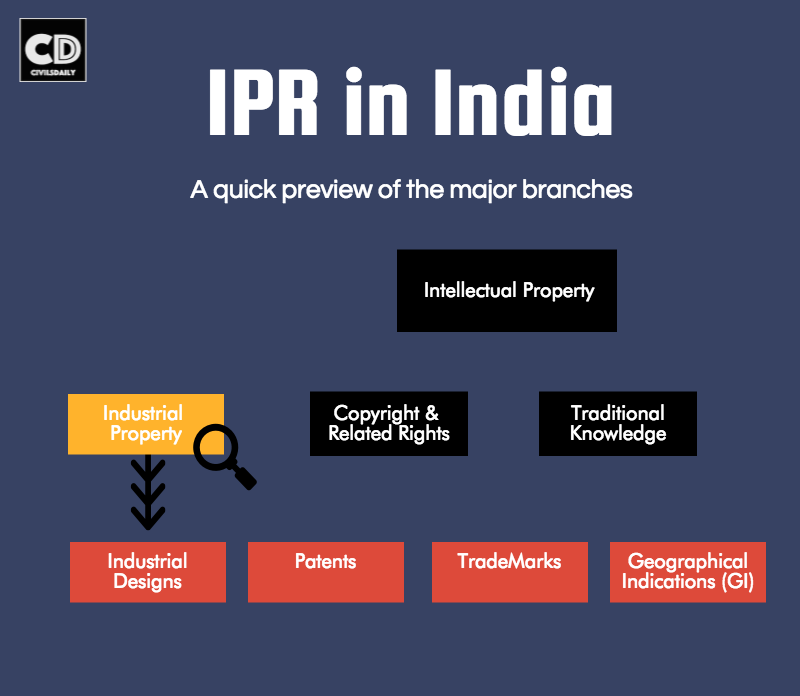
    Intellectual Property Rights (IPRs) are legal rights, which result from intellectual invention, innovation and discovery in the industrial, scientific, literary and artistic fields. These rights entitle an individual or group to the moral and economic rights of creators in their creation.


    Types:

    Patent- It is a set of exclusive rights granted by a sovereign state to an inventor for a limited period of time in exchange for detailed public disclosure of an invention.

    Copyright- It is a legal right created by the law of a country that grants the creator of an original work exclusive rights for its use and distribution. It includes literary & artistic works such as novels, poems, plays, films, musical works, drawing, painting, photography, sculpture, architectural designs

    Trademark- It is a recognizable sign, design, or expression which identifies products or services of a particular source from those of others. Trademarks used to identify services are usually called service marks.

    Industrial design right- It is an intellectual property right that protects the visual design of objects that are not purely utilitarian. An industrial design consists of the creation of a shape, configuration or composition of pattern or color, or combination of pattern and color in three-dimensional form containing aesthetic value. An industrial design can be a two- or three-dimensional pattern used to produce a product, industrial commodity or handicraft.

    Trade secret- It is a formula, practice, process, design, instrument, pattern, commercial method, or compilation of information which is not generally known or reasonably ascertainable by others, and by which a business can obtain an economic advantage over competitors or customers

    Geographical Indication (GI)- It is a name or sign used on certain products which corresponds to a specific geographical location or origin (e.g. a town, region, or country). The use of a geographical indication may act as a certification that the product possesses certain qualities, is made according to traditional methods, or enjoys a certain reputation, due to its geographical origin. A recent example is of Indian variety of Basmati rice getting GI tag.

    From above points, it is clear that IPR is a very sensitive issue in terms of businesses different kinds and international relations as well.

    IPRs in pharmaceutical sector:

    Some sectors are very sensitive in terms of IPRs like pharmaceuticals. Let’s explore briefly into IPR issues in pharmaceutical sector.

    We hear of two kinds of drugs- generic and brand name drugs:

    Generic drugs are those whose patent has expired or does not exist and which can be produced by any registered manufacturer without need of taking permission from any authority and also without any payment of royalty.

    Brand name drugs are those which are patented and cannot be produced without the consent of the patent holder. A royalty is to be paid for production of these drugs.

    But what happens if a company holds patent of an essential drug and there is an emergency in which the drug needs to be provided at low cost for vast populace? In this case, Compulsory Licensing comes to the rescue.

    What is Compulsory Licensing?

    • A compulsory license provides that the owner of a patent or copyright licenses the use of their rights against a payment. This payment is either set by law or determined through some form of arbitration
    • In essence, under a compulsory license, an individual or company seeking to use another’s intellectual property can do so without seeking the rights holder’s consent, and pays the rights holder a set fee for the license
    • This is an exception to the general rule under intellectual property laws that the intellectual property owner enjoys exclusive rights that it may license – or decline to license – to others

    Does there have to be an emergency?

    Not necessarily. This is a common misunderstanding. The TRIPS Agreement does not specifically list the reasons that might be used to justify compulsory licensing. However, the Doha Declaration on TRIPS and Public Health confirms that countries are free to determine the grounds for granting compulsory licences.

    In March 2012, India granted its first compulsory license ever. The license was granted to Indian generic drug manufacturer Natco Pharma Ltd for Sorafenib tosylate, a cancer drug patented by Bayer.

    Here, first thing first, What is TRIPS?

    • TRIPS is an international agreement administered by the World Trade Organization (WTO), which sets down minimum standards for many forms of intellectual property (IP) regulations as applied to the nationals of other WTO Members
    • It was negotiated at the end of the Uruguay Round of the General Agreement on Tariffs and Trade (GATT) in 1994
    • TRIPS requires WTO members to provide copyright rights, covering content producers including performers, producers of sound recordings and broadcasting organizations, geographical indications, including appellations of origin, industrial designs, integrated circuit layout-designs, patents, new plant varieties, trademarks, trade dress, and undisclosed or confidential information
    • The agreement also specifies enforcement procedures, remedies, and dispute resolution procedures

    Now, back to the topic…

    India is a huge market for generic drugs and hence it is very obvious that there must emerge issues out of patents for pharmaceuticals.

    One such case came up in 1998- Novartis v. Union of India & Others

    It was a landmark decision by a two-judge bench of the Supreme Court, on the issue of whether Novartis could patent Glivec in India. It was the culmination of a seven-year-long litigation fought by Novartis. The Supreme Court upheld the Indian patent office’s rejection of the patent application.

    Ground of rejection?

    Novartis claimed patent for he changed form of Glivec on the basis of the increased bio-availability in the body of the patient by making changes in chemical composition of its original anti-cancer drug Imatinib Mesylate. This changed form of the drug could not withstand the ‘enhanced therapeutic efficacy’ test enshrined under Section 3(d) of Indian Patents Act and therefore it was rejected.

    Recently, Gilead got patent for its Hepatitis C drug Solvadi. An application for the same patent was first rejected in January 2015 as lacking inventiveness and novelty. The decision, however, is seen as a major blow to the access to drug movement

    Now let’s turn towards the latest developments in the IPRs in India.

    New IPR Policy

    Govt of India recently released a new National Intellectual Property Rights (IPR) Policy which is in compliance with WTO’s agreement on TRIPS

    Why a new policy?

    • Global drug brands led by US companies have been pushing for changes to India’s intellectual property rules for quite some time now. They have often complained about India’s price controls and marketing restrictions
    • Also, an IPR policy is important for the government to formulate incentives in the form of tax concessions to encourage research and development (R&D)
    • It is also critical to strengthen the Make In India, Startup and Digital India schemes
    • The IPR policy comes at a time when India and other emerging countries faces fresh challenges from the developed world and mega regional trade agreements such as the Trans-Pacific Partnership (TPP)

    Seven objectives:

    1. IPR Awareness: To create public awareness about the economic, social and cultural benefits of IPRs among all sections of society
    2. Generation of IPRs: To stimulate the generation of IPRs
    3. Legal and Legislative Framework: To have strong and effective IPR laws, which balance the interests of rights owners with larger public interest
    4. Administration and Management: To modernize and strengthen service-oriented IPR administration
    5. Commercialization of IPRs: Get value for IPRs through commercialization
    6. Enforcement and Adjudication: To strengthen the enforcement and adjudicatory mechanisms for combating IPR infringements
    7. Human Capital Development: To strengthen and expand human resources, institutions and capacities for teaching, training, research and skill building in IPRs

    Highlights:

    • The new policy calls for providing financial support to the less empowered groups of IP owners or creators such as farmers, weavers and artisans through financial institutions like rural banks or co-operative banks offering IP-friendly loans
    • The work done by various ministries and departments will be monitored by the Department of Industrial Policy & Promotion (DIPP), which will be the nodal department to coordinate, guide and oversee implementation and future development of IPRs in India
    • The policy, with a tagline of Creative India: Innovative India, also calls for updating various intellectual property laws, including the Indian Cinematography Act, to remove anomalies and inconsistencies in consultation with stakeholders
    • For supporting financial aspects of IPR commercialisation, it asks for financial support to develop IP assets through links with financial institutions, including banks, VC funds, angel funds and crowd-funding mechanisms
    • To achieve the objective of strengthening enforcement and adjudicatory mechanisms to combat IPR infringements, it called for taking actions against attempts to treat generic drugs as spurious or counterfeit and undertake stringent measures to curb manufacture and sale of misbranded, adulterated and spurious drugs
    • The policy will be reviewed after every five years to keep pace with further developments in the sector

    International angle:

    Last month, the US Trade Representative kept India, China and Russia on its “Priority Watch List” for inadequate improvement in IPR protection. However, brushing aside concerns of the US on India’s IPR regime, the government said its intellectual property rights laws are legal-equitable and WTO-compliant. Thus, the government has not yielded to pressure from the United States to amend India’s patent laws.

    Benefits:

    • The new policy will try to safeguard the interests of rights owners with the wider public interest, while combating infringements of intellectual property rights
    • By 2017, the window for trademark registration will be brought down to one month. This will help in clearing over 237,000 pending applications in India’s four patent offices
    • It also seeks to promote R&D through tax benefits available under various laws and simplification of procedures for availing of direct and indirect tax benefits
    • Unlike earlier where copyright was accorded to only books and publications, the recast regime will cover films, music and industrial drawings
    • A host of laws will also be streamlined — on semi-conductors, designs, geographical indications, trademarks and patents
    • The policy also puts a premium on enhancing access to healthcare, food security and environmental protection
    • Policy will provide both domestic and foreign investors a stable IPR framework in the country
    • This will promote a holistic and conducive ecosystem to catalyse the full potential of intellectual property for India’s growth and socio-cultural development while protecting public interest
    • It is expected to lay the future roadmap for intellectual property in India, besides putting in place an institutional mechanism for implementation, monitoring and review
    • The idea is to incorporate global best practices in the Indian context and adapt to the same

    Challenges:

    • According to the policy, India will retain the right to issue so-called compulsory licenses to its drug firms, under “emergency” conditions
    • Also, the government has indicated that there is no urgent need to change patent laws that are already fully World Trade Organization-compliant. So India has resisted pressure from the US and other Western countries to amend its patent laws
    • The policy also specifically does not open up Section 3(d) of the Patents Act, which sets the standard for what is considered an invention in India, for reinterpretation


    Published with inputs from Swapnil


  • NPA Crisis

    • What is NPA?
    • Impact of NPA on economy
    • Reasons for the rise in NPA in recent years
    • Why most NPA in Public sector?
    • Steps taken by RBI and Government in last few years to curb NPA
    • How to curb the menace of NPA

    source

    According to RBI’s recent data, the gross non-performing assets (NPAs) of public sector banks are just under Rs 4 lakh crore, and they collectively account for 90 percent of such rotten apples in the country’s banking portfolio.

    In terms of net NPAs, their share is even higher – at 92 percent of the total bad loans reported so far in the banking system. The total NPAs of Indian banks, as a percentage of the total loans, has grown from 2.11 per cent(2008) to 5.08 percent(2016).

    In this article we will explain what is NPA, The reason why NPA increased in India and steps taken by Government in recent years to curb the menace of NPA and what else needs to be done.

    What is NPA?

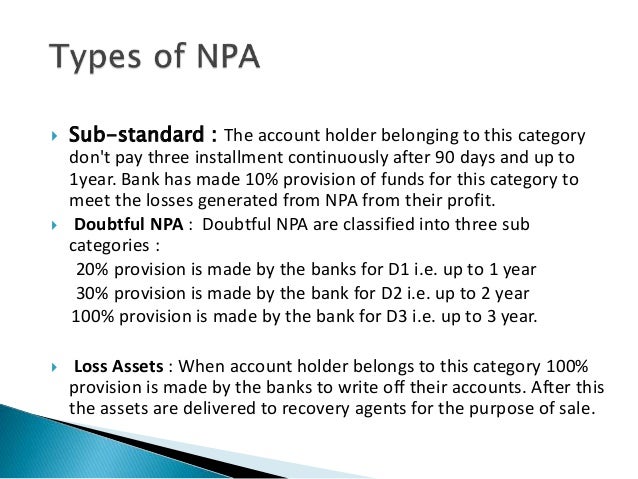
    • The assets of the banks which don’t perform (that is – don’t bring any return) are called Non Performing Assets (NPA) or bad loans. Bank’s assets are the loans and advances given to customers. If customers don’t pay either interest or part of principal or both, the loan turns into bad loan.
    • According to RBI, terms loans on which interest or instalment of principal remain overdue for a period of more than 90 days from the end of a particular quarter is called a Non-performing Asset.
    • However, in terms of Agriculture / Farm Loans; the NPA is defined as under: For short duration crop agriculture loans such as paddy, Jowar, Bajra etc. if the loan (installment / interest) is not paid for 2 crop seasons, it would be termed as a NPA. For Long Duration Crops, the above would be 1 Crop season from the due date.
    source

    Impact of NPA on Economy

    The problem of NPAs in the Indian banking system is one of the foremost and the most formidable problems that had impact the entire banking system. Higher NPA leads to following adverse impact on Economy:

    1. Depositors do not get rightful returns and many times may lose uninsured deposits. Banks may begin charging higher interest rates on some products to compensate Non-performing loan losses
    2. Bank shareholders are adversely affected
    3. Bad loans imply redirecting of funds from good projects to bad ones. Hence, the economy suffers due to loss of good projects and failure of bad investments
    4. When bank do not get loan repayment or interest payments, liquidity problems may ensue.

    Reasons for the rise in NPA in recent years

    • GDP slowdown: Between early 2000’s and 2008 Indian economy were in the boom phase. During this period Banks especially Public sector banks lent extensively to corporates. However, the profits of most of the corporate dwindled due to slowdown in the global and domestic economy, bans in mining projects, delays in environmental related permits ,Land acquisition hurdles and volatility in prices of raw material. This has adversely affected their ability to pay back loans and is the most important reason behind increase in NPA of public sector banks.
    • Relaxed lending Norms: One of the main reasons of rising NPA was the relaxed lending norms especially for corporate honchos when their financial status and credit rating was not analyzed properly. Also, to face competition banks were hugely selling unsecured loans .
    • Priority Sector Lending: There is a myth that main reason for rise in NPA in Public sector banks was Priority sector lending as according to the findings of Standing Committee on Finance , NPAs in the corporate sector are far higher than those in the priority or agriculture sector. However, even if PSL is not the main cause but it is still a cause for rising NPA which can be seen from the fact that As per the latest estimates by the SBI, education loans constitute 20% of its NPAs.
    • The Lack of Bankruptcy code in India and sluggish legal system makes it difficult for banks to recover these loans from both corporate and noncorporate.

    Other factors

    • Banks did not conducted adequate contingency planning, especially for mitigating project risk. They did not factor eventualities like failure of gas projects to ensure supply of gas or failure of land acquisition process for highways.
    • Restructuring of loan facility was extended to companies that were facing larger problems of over-leverage & inadequate profitability. This problem was more in the Public sector banks.
    • Companies with dwindling debt repayment capacity were raising more & more debt from the system.

    Why most NPA in Public sector?

    • Five sectors Textile, aviation, mining, Infrastructure contributes to most of the NPA, since most of the loan given in these sector are by PSB, they account for most of the NPA.
    • Public Sector banks provide around 80% of the credit to industries and it is this part of the credit distribution that forms a great chunk of NPA. Last year, when kingfisher was marred in financial crisis, SBI provided it huge amount of loan which it is not able to recover from it.
    • Less Professional management
    • Political Pressure and interference forces PSB to lend to not so commercially sounds project.

    Steps taken by RBI and Government in last few years to curb NPA

    • Government has launched Mission Indradhanush to make the working of public sector bank more transparent and professional in order to curb the menace of NPA in future.
    • Government has also proposed to introduce Bankruptcy code which will make it easier for banks to Recover the loans from the debtors.
    • RBI introduced number of measures in last few years which include:
      • Tightening the Corporate Debt Restructuring (CDR) mechanism,
      • Setting up a Joint Lenders’ Forum, prodding banks to disclose the real picture of bad loans, asking them to increase provisioning for stressed assets,
      • Introducing a 5:25 scheme where loans are to be amortized over 25 years with refinancing option after every five years, and
      • Empowering them to take majority control in defaulting companies under the Strategic Debt Restructuring (SDR) scheme.

    How to curb the menace of NPA?

    #1. Short Term measures

    • Review of NPA’S/Restructured advances- We need to assess the viability case by case. Viable accounts need to be given more finance for turnaround and unviable accounts should either be given to Asset Reconstruction Company or Management/ownership restructuring or permitting banks to take over the units.
    • Bankruptcy code should be passed as soon as possible. Bankruptcy code will make it easier for banks to recover loans from unviable enterprises.
    • Government should establish ARC with equity contribution from the government and the Reserve Bank of India (RBI). The established ARC should take the tumor (of non-performing assets or NPAs) out” of the banking system. An ARC acquires bad loans from banks and financial institutions, usually at a discount, and works to recover them through a variety of measures, including sale of assets or a turnaround steered by professional management. Relieved of their NPA burden, the banks can focus on their core activity of lending.

    #2. Long term Measures

    • Improving credit risk management– This includes credit appraisal, credit monitoring, and efficient system of fixing accountability and analyzing trends in group leverage to which the borrowing firm belongs to
    • Sources/structure of equity capital– Banks need to see that promoter’s contribution is funded through equity and not debt.
    • Banks should conduct necessary sensitivity analysis and contingency planning while appraising the projects and it should built adequate safeguards against such external factors.
    • Strengthen credit monitoring– Develop an early warning mechanism and comprehensive MIS(Management information system) can play an important role in it.MIS must enable timely detection of problem accounts, flag early signs of delinquencies and facilitate timely information to management on these aspects.
    • Enforce accountability- Till now lower ring officials considered accountable even though loaning decisions are taken at higher level. Thus sanction official should also share the burden of responsibility.
    • Restructured accounts should treated as non performing and technical write offs where Banks remove NPA’S from their balance sheets Permanently should be dispensed with.
    • Address corporate governance issues in PSB- This includes explicit fit and proper criteria for appointment of top executives and instituting system of an open market wide search for Chairman.

    References: