💥Mains Ready By December. Smash Mains & Smash PYQ Admissions Open

Subject: Economics

  • NCRB Report on Farmers Suicide

    In 2017, 10,655 people involved in agriculture committed suicide in India, according to data released January 2, 2020 by the National Crime Record Bureau (NCRB).

    NCRB had released the 2017 crime data last October 2019, but held back information on suicides.

    Highlights of the report

    • NCRB highlighted that the toll was the lowest since 2013.
    • Among those who took their lives, 5,955 were farmers / cultivators and 4,700 agricultural labourers — both lower than in 2016.
    • They comprised 8.2 per cent of all suicide cases in the country in 2017.
    • In 2016, 6270 farmers killed themselves, down from 8,007 in 2015, while 5,109 farm hands committed suicide, up from 4,595.
    • The number of women farmers committing suicide, however, jumped to 480 in 2017 from 275 in ’16.

    Farm suicides over half a decade

    Years No. of farm sector suicides No. of farmers
    2017 10,655 5,955
    2016 11,379 6270
    2015 12,602 8007
    2014 12,360 5650

    Statewise data

    • In 2017, the most number of farm suicides were reportedly in Maharashtra (34.7 per cent), followed by Karnataka (20.3 per cent), Madhya Pradesh (9 per cent), Telangana (8 per cent) and Andhra Pradesh (7.7 per cent).
    • The trend was quite similar to previous year: In 2016, Maharashtra accounted for 32.2 per cent, Karnataka 18.3 per cent, MP 11.6 per cent, Andhra 7.1 per cent and Chhattisgarh 6 per cent.
    • In 2015 too Maharashtra tops in farmers suicides followed by Karnataka, Madhya Pradesh in 2016.
    • West Bengal, Odisha, Nagaland, Manipur, Mizoram, Uttarakhand, Chandigarh, Dadra and Nagar Haveli, Daman and Diu, Delhi, Lakshadweep and Puducherry reported zero suicides by farmers or agricultural labourers.

    Causes of Farmers Suicide

    • Major causes of farm suicides were reportedly bankruptcy / indebtedness, problems in the families, crop failure, illness and alcohol / substance abuse.

    Assist this newscard with:

    [Burning Issue] Annual Crime in India Report-2017

  • Arabica Coffee

    India’s Arabica production has hit an all-time low this coffee-picking season.

    Coffee Production in India

    • Coffee is grown in three regions of India with Karnataka, Kerala and Tamil Nadu forming the traditional coffee growing region.
    • It is followed by the new areas developed in the non-traditional areas of Andhra Pradesh and Orissa in the eastern coast of the country and with a third region comprising the NE states.
    • Indian coffee, grown mostly in southern states under monsoon rainfall conditions, is also termed as “Indian monsooned coffee”.
    • The two well known species of coffee grown are the Arabica and Robusta.

    History of Coffee in India

    • In the Indian context, coffee growing started with a saint, Baba Budan who, while returning from a pilgrimage to Mecca, smuggled seven coffee beans from Yemen to Mysore in India.
    • He planted them on the Chandragiri Hills now named after the saint as Baba Budan Giri in Chikkamagaluru district of Karnataka.
  • National Infrastructure Pipeline (NIP)

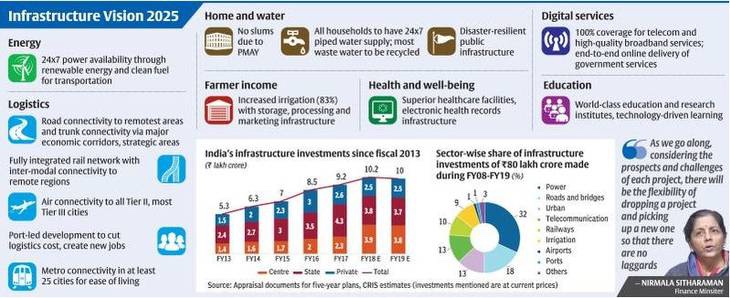
    Union Finance Minister has unveiled Rs 102 lakh crore of infrastructure projects, under National Infrastructure Pipeline. It will be implemented in the next five years as part of the government’s spending push in the infrastructure sector.

    What is the National Infrastructure Pipeline (NIP)?

    • NIP includes economic and social infrastructure projects.
    • During the fiscals 2020 to 2025, sectors such as Energy (24%), Roads (19%), Urban (16%), and Railways (13%) amount to around 70% of the projected capital expenditure in infrastructure in India.
    • It has outlined plans to invest more than ₹102 lakh crore on infrastructure projects by 2024-25, with the Centre, States and the private sector to share the capital expenditure in a 39:39:22 formula.

    Key benefits of NIP

    • Economic: Well-planned NIP will enable more infra projects, grow businesses, create jobs, improve ease of living, and provide equitable access to infrastructure for all, making growth more inclusive.
    • Government: Well-developed infrastructure enhances the level of economic activity, creates additional fiscal space by improving the revenue base of the government, and ensures the quality of expenditure focused in productive areas.
    • Developers: Provides a better view of project supply, provides time to be better prepared for project bidding, reduces aggressive bids/ failure in project delivery, ensures enhanced access to sources of finance as a result of increased investor confidence.
    • Banks/financial institutions (F1s)/investors: Builds investor confidence as identified projects are likely to be better prepared, exposures less likely to suffer stress given active project monitoring, thereby less likelihood of NPAs.

    Is NIP a road to $5 trillion economy?

    • Finance minister said that the Rs 102 lakh crore National Infrastructure Projects will help make India a $5 trillion economy by 2025.
    • These projects are on top of Rs 51 lakh crore spent by the Centre and the states during the last six years.
    • The new pipeline consists of 39 per cent projects each by the Centre and states and the balance by 22 per cent by private sector.