💥Join UPSC 2027,2028 Mentorship (July Batch) + XFactor Notes & Microthemes PDF

Subject: Fundamental Rights,DPSP

1. History + Evolution
2. Features
3. Amendments
4. Basic Structure

  • Domicile-based job quota in MP

    The Madhya Pradesh government’s recent decision to reserve all government jobs for “children of the state” raises constitutional questions relating to the fundamental right to equality.

    Try this PYQ:

    One of the implications of equality in society is the absence of- (CSP 2018)

    (a) Privileges

    (b) Restraints

    (c) Competition

    (d) Ideology

    Constitutional provision for Equal Treatment

    • Article 16 of the Constitution guarantees equal treatment under the law in matters of public employment. It prohibits the state from discriminating on grounds of place of birth or residence.
    • Article 16(2) states that “no citizen shall, on grounds only of religion, race, caste, sex, descent, place of birth, residence or any of them, be ineligible for, or discriminated against in respect of, any employment or office under the State”.
    • The provision is supplemented by the other clauses in the Constitution that guarantee equality.
    • However, Article 16(3) of the Constitution provides an exception by saying that Parliament may make a law “prescribing” a requirement of residence for jobs in a particular state.
    • This power vests solely in the Parliament, not state legislatures.

    Why does the Constitution prohibit reservation based on domicile?

    • When the Constitution came into force, India turned itself into one nation from a geographical unit of individual principalities and the idea of the universality of Indian citizenship took root.
    • India has single citizenship, and it gives citizens the liberty to move around freely in any part of the country.
    • Hence the requirement of a place of birth or residence cannot be qualifications for granting public employment in any state.

    But are reservations not granted on other grounds such as caste?

    • Equality enshrined in the Constitution is not mathematical equality and does not mean all citizens will be treated alike without any distinction.
    • To this effect, the Constitution underlines two distinct aspects which together form the essence of equality law:
    1. Non-discrimination among equals, and
    2. Affirmative action to equalize the unequal

    Supreme Court rulings on quota for locals

    • The Supreme Court has ruled against reservation based on place of birth or residence.
    • In 1984, ruling in Dr Pradeep Jain v Union of India, the issue of legislation for “sons of the soil” was discussed.
    • The court expressed an opinion that such policies would be unconstitutional but did not expressly rule on it as the case was on different aspects of the right to equality.
    • In a subsequent ruling in Sunanda Reddy v State of Andhra Pradesh (1995), the Supreme Court affirmed the observation in 1984 ruling to strike down a state government policy that gave 5% extra weightage to candidates.
    • In 2002, the Supreme Court invalidated appointment of government teachers in Rajasthan in which the state selection board gave preference to “applicants belonging to the district or the rural areas of the district concerned”.
    • In 2019, the Allahabad HC struck down a recruitment notification by the UP PSC which prescribed preference for women who are “original residents” of the UP alone.

    What about securing jobs for locals in the private sector?

    • Such a law will be difficult to implement even if allowed.
    • Private employers do not go on an annual recruitment drive to fill vacancies identified in advance but hire as and when required.
    • The state can recommend a preference to locals but ensuring that it is followed would be difficult.
    • In 2017, Karnataka mulled similar legislation but it was dropped after the state’s Advocate General raised questions on its legality.
    • In 2019, the state government once again issued a notification asking private employers to “prefer” Kannadigas for blue-collar jobs.

    How do some states then have laws that reserve jobs for locals?

    • Exercising the powers it has under Article 16(3), Parliament enacted the Public Employment (Requirement as to Residence) Act.
    • The act aimed at abolishing all existing residence requirements in the states and enacting exceptions only in the case of the special instances of Andhra Pradesh, Manipur, Tripura and Himachal Pradesh.
    • Constitutionally, some states also have special protections under Article 371. AP under Section 371(d) has powers to have “direct recruitment of local cadre” in specified areas.
    • Some states have gone around the mandate of Article 16(2) by using language. States that conduct official business in their regional languages prescribe knowledge of the language as a criterion.
    • This ensures that local citizens are preferred for jobs. For example, states including Maharashtra, West Bengal and Tamil Nadu require a language test.
  • Jurisdictional conflict in the running of Delhi Government

    The article analyses the tussle between the Delhi Government and the Lt. Governor.

    What the 2018 SC judgement was about

    • The Supreme Court in Government of NCT of Delhi vs. Union of India (2018) decided on the conflicts between the government of NCT and the Union Government and its representative, the Lieutenant Governor.
    • It reminds the Lt. Governor what his real functions are.
    •  It tells the State government that it should remember that Delhi is a special category Union Territory.
    • It lays down the parameters to enabling the harmonious functioning of the government and the Lt. Governor.
    • It did not very clearly delineate the issues in respect of which the Lt. Governor can refer a decision taken by the Council of Ministers to the President in the event of a difference of opinion between the Lt. Governor and the State government.

    Settled issues and clarifications

    • The Supreme Court affirming that the Lt. Governor is bound to act on the aid and advice of council of ministers except in respect of ‘Land’, ‘Public Order’ and the ‘Police’.
    • The Court has also made it clear that there is no requirement of the concurrence of the Lt. Governor and that he has no power to overrule the decisions of the State government.
    • However, Article 239AA (4) (proviso) which says that in the case of a difference of opinion between the Lt. Governor and his Ministers on any matter, the Lt. Governor shall refer it to the President for decision and act according to that decision.
    • If the Lt. Governor thinks that the matter is urgent he can take immediate action on his own.

    How Article 239 AA(4) matters

    •  Lt. Governor can frustrate the efforts of the government, by declaring that there is a difference of opinion on any issue and refer it to the President.
    • Refering matter to the President in reality means the Union Home Ministry.
    • The Lt. Governor being its representative, it is easier for him to secure a decision in his favour.
    • The State government will be totally helpless in such a situation.
    • The recent appointment of prosecutors for conducting the Delhi riot cases in the High Court is a case in point.
    •  When the government decided to appoint them, the Lt. Governor referred it under proviso to Article 239AA (4) to the President stating that there is a difference of opinion.
    • This episode clearly points to the fault lines which still exist in the power equations in the capital’s administrative structure.

    But, can Lt. Governor refer routine administrative matter to the President?

    • A close reading of the Supreme Court judgment in the NCT Delhi case (supra) would reveal that he cannot.
    • The Supreme Court says “The words ‘any matter’ employed in the proviso to Article 239AA (4) cannot be inferred to mean ‘every matter’.
    • Court also says that “The power of the Lieutenant Governor under the said proviso represents the exception and not the general rule”.
    • The President is the highest Constitutional authority and his decision should be sought only on constitutionally important issues.

    Executive powers and legislative powers

    • Parliament can legislate for Delhi on any matter in the State List and the Concurrent List.
    • But the executive power in relation to Delhi except the ‘Police’, ‘Land’ and ‘Public Orders’ vests only in the State government headed by the Chief Minister.
    • The executive power of the Union does not extend to any of the matters which come within the jurisdiction of the Delhi Assembly.
    • The only occasion when the Union Government can overrule the decision of the State government is when the Lt. Governor refers a matter to the President under the proviso to clause (4).

    Consider the question “What are the parameters laid down by the Supreme Court in the Government of NCT of Delhi vs. Union of India (2018) to avoid the conflict between Lt. Governor and the Delhi Government? Also examine the scope of referring any matter to the consideration of the President by the Lt. Governor.”

    Conclusion

    In the Constitutional scheme adopted for the NCT of Delhi Lt. Governor should not emerge as an adversary having a hostile attitude towards the Council of Ministers of Delhi; rather, he should act as a facilitator.

  • The future of Indian secularism

    Secularism in India faces multiple challenges. This article analyses challenge the Indian secularims faces from the party-political secularims.

    Features of constitutional secularism in India

    • Constitutional secularism is marked by at least two features.
    • First, critical respect for all religions.
    • Unlike some secularisms, ours is not blindly anti-religious but respects religion.
    • It respects not one but all religions.
    • Every aspect of religious doctrine or practice cannot be respected but respect for religion must be accompanied by critique.
    • Second, intervene whenever religious groups promote communal disharmony.
    • Thus, it has to constantly decide when to engage or disengage, help or hinder religion depending entirely on which of these enhances our constitutional commitment to freedom, equality and fraternity.

    How populism is harming secularism

    • Secularism has paid a heavy price in our country for being at the centre of public and political discourse.
    • Populism based politics is indifferent to freedom and equality-based religious reform, it has removed critical from the term ‘critical respect’.
    • It has even been complicit in igniting communal violence.
    • This party-political ‘secular’ state, cozying up alternately to the fanatical fringe of the minority and the majority, was readymade for takeover by a majoritarian party.
    • This takeover was accomplished by removing the word ‘all’ and replacing it by ‘majority’.
    • Today, Indian constitutional secularism is swallowed up by this party-political secularism, with not a little help from the Opposition, media and judiciary.

    Way forward

    • 1) There is a need for a shift of focus from a politically-led project to a socially-driven movement for justice.
    • 2) Also, a shift of emphasis from inter-religious to intra-religious issues.
    • Such focus on intra-relisious issues may allow deeper introspection within, multiple dissenting voices to resurface, create conditions to root out intra-religious injustices, and make its members free and equal.
    • 3) Europe’s secularism provided a principle to fight intra-religious oppressions. 
    • In India, secularism was not only a project of civic friendship among religious communities but also of opposition to religion-based caste and gender oppressions.
    • A collective push from young men and women  may help strengthen the social struggle of emancipation from intra-religious injustices.
    • 4) Inter-religious issues also should not be ignored.
    • Distance, freedom from mutual obsession, give communities breathing space.
    • Each can now explore resources within to construct new ways of living together.

    Consider the question “How populism in the politics thretens the idea of secularim in India? Suggest the ways to deal with it.”

    Conclusion

    Needed today are new forms of socio-religious reciprocity, crucial for the business of everyday life and novel ways of reducing the political alienation of citizens, a democratic deficit whose ramifications go beyond the ambit of secularism.

  • [pib] Appointment of the UPSC Chairman

    The President of India has appointed Pradeep Kumar Joshi as Chairman of Union Public Service Commission (UPSC).

    Try this PYQ:

    Q.Consider the following statements:

    1. The Executive Power of the Union of India is vested in the Prime Minister.
    2. The Prime Minister is the ex-officio Chairman of the Civil Services Board.

    Which of the statements given above is/are correct? (CSP 2015)

    (a) 1 only

    (b) 2 only

    (c) Both 1 and 2

    (d) Neither 1 nor 2

    Backgrounder: UPSC

    • Established on 1 October 1926 as Public Service Commission, it was later reconstituted as Federal Public Service Commission by the GoI Act 1935; only to be renamed as today’s UPSC after the independence.
    • The UPSC is India’s premier central recruiting agency responsible for appointments to and examinations for All India services and group A & group B of Central services.
    • The Department of Personnel and Training is the central personnel agency in India.
    • It is also required to be consulted by the Government in matters relating to the appointment, transfer, promotion and disciplinary matters.

    Appointments to the UPSC

    • As per Article 316 of the constitution, the Chairman and other members of UPSC shall be appointed by the President.
    • In case the office of the Chairman becomes vacant his duties shall be performed by one of the other members of the Commission as the President may appoint for the purpose.
    • Under Art. 318, the President is empowered to determine the number of members of the Commission and their conditions of service.
    • As per Art 319, a person who holds office as Chairman shall, on the expiration of his term of office, be ineligible for re-appointment to that office.
    • But, a member other than the Chairman shall be eligible for appointment as the Chairman of the UPSC.
    • Also, the Chairman of a State PSC shall be eligible for appointment as the Chairman or any other member of the UPSC.

    Removal of members/chairman

    • As per Art. 317, the Chairman or any other member of a UPSC shall only be removed from their office by order of the President on the ground of “misbehaviour” after the Supreme Court inquiry report.
    • The President may suspend the Chairman or other member of the Commission until a report of the Supreme Court is received.

    Distinguishing features

    • The commission reports directly to the President and can advise the Government through him.
    • Although, such advice is not binding on the Government.
    • Being a constitutional authority, UPSC is amongst the few institutions which function with both autonomy and freedom, along with the country’s higher judiciary and lately the Election Commission.
  • Back in news: EWS quota law

    The Supreme Court has referred to a five-judge Constitution Bench a batch of petitions challenging the 103rd Constitution Amendment of 2019 that provides 10% reservation for Economically Backward Section (EWS).

    Try this question for mains:

    Q.What are the various constitutional challenges posed by the 103rd Constitutional Amendment Act?

    What does the reference mean?

    • A reference to a larger Bench means that the legal challenge is an important one.
    • As per Article 145(3) of the Constitution, “the minimum number of Judges who are to sit for the purpose of deciding any case involving a substantial question of law as to the interpretation of this Constitution” shall be five.
    • The Supreme Court rules of 2013 also say that writ petitions that allege a violation of fundamental rights will generally be heard by a bench of two judges unless it raises substantial questions of law.
    • In that case, a five-judge bench would hear the case.
    • Laws made by Parliament are presumed to be constitutional until proven otherwise in court.
    • The SC had refused to stay the 103rd Amendment. A reference will make no difference to the operation of the EWS quota.

    What is the 103rd amendment about?

    • It provides for 10% reservation in government jobs and educational institutions for EWS, by amending Articles 15 and 16 that deal with the fundamental right to equality.
    • While Article 15 prohibits discrimination on grounds of religion, race, caste, sex or place of birth, Article 16 guarantees equal opportunity in matters of public employment.
    • An additional clause was added to both provisions, giving Parliament the power to make special laws for EWS as it does for SCs, STs and OBCs.
    • The states are to notify who constitute EWS to be eligible for reservation.

    Issues with the law

    The SC agreed that the case involved at least three substantial questions of law, whether:

    • First, it violates the Basic Structure of the Constitution. This argument stems from the view that the special protections guaranteed to socially disadvantaged groups is part of the Basic Structure and that the 103rd Amendment departs from this by promising special protections on the sole basis of economic status.
    • Second, it violates the SC’s 1992 ruling in Indra Sawhney Case, which upheld the Mandal Report and capped reservations at 50%. In the ruling, the court held that economic backwardness cannot be the sole criterion for identifying backward class.
    • The third challenge has been of private, unaided educational institutions. They have argued that their fundamental right to practise a trade/profession is violated when the state compels them to implement its reservation policy and admit students on any criteria other than merit.

    What are the government’s arguments?

    • The Ministry of Social Justice and Empowerment filed counter-affidavits to defend the amendment.
    • When a law is challenged, the burden of proving it unconstitutional lies on the petitioners.
    • The government argued that under Article 46 of the Constitution, part of DPSP, it has a duty to protect the interests of economically weaker sections.

    1) The very identity of the Constitution has not been altered.

    2) Countering the claims about Indra Sawhney principle, the government relied on a 2008 ruling— Ashok Kumar Thakur v Union of India, in which the SC upheld the 27% quota for OBCs. Here, the court accepted that the definition of OBCs was not made on the sole criterion of caste but a mix of caste and economic factors, to prove that there need not a sole criterion for according reservation.

    3) For the unaided institutions, the government argued that the Constitution allows the Parliament to place “reasonable restrictions” on the right to carry on trade.

    B2BASICS

    What are the significances of the EWS quota?

    • Address economic inequality: Currently, the economically weaker sections of citizens have remained excluded from attending higher educational institutions and public employment due to their financial incapacity. Therefore, the 10% quota is progressive and could address the issues of educational and income inequality in India.
    • Constitutional recognition:The proposed reservation through a constitutional amendment would give constitutional recognition to the poor from the upper castes.
    • Remove stigma associated with Reservation: It will gradually remove the stigma associated with reservation because reservation has historically been related with caste and most often the upper caste look down upon those who come through the reservation.

    What are the challenges before the EWS quota?

    1.Eligibility criteria:

    • Critics claim that the 8 lakh income threshold is very high and will practically cover nearly all population not already covered by reservations.
    • Notably, NSSO and IT department data shows that at least 95% of Indian families will fall within this limit.
    • Other eligibility criteria have also claimed to be flawed.

    2.Sole economic criteria:

    • The Supreme Court in Indra Sawhney judgement has maintained that a backward class cannot be determined mainly with respect to the economic criterion.
    • Hence introducing reservation based on economic criteria would invite judicial scrutiny.

    3.50 percent limit:

    The SC has put a cap for reservations at 50% – the current proposal will exceed the limit and hence could be legally challenged.

    4.Determining economic backwardness:

    This is a  major challenge as there are concerns regarding the inclusion and exclusion of persons under the criteria.

    5.Enforcement:

    The implementation of the legislation would also be a great challenge since the states do not have the finances to enforce even the present and constitutionally mandated reservations.

    Shrinking jobs:

    When the government is trying to restrict its public services through the advancement of technology in the government system, providing quota in jobs will be a useless move.

    6.Encouraging reservations: 

    The intent of constitutional makers as originally manifested via Article 15 and 16 was to be reviewed after 10 years. However, instead of restricting the policy of positive discrimination, the government is pushing it in some or other forms.

    7.Populist initiative:

    When elections are near, many populists’ measures are put forward by political parties such as loan waiver, reservations, etc. Considering the low levels of political literacy and awareness among masses, political parties take leverage of the same thus impacting the socio-economic and political structure at large.

    8.Lack of proofs to back the outcomes:

    Even after years of reservation policy, there are no considerable pieces of evidence to support the achievements of the original intent of affirmative action. For instance, only about 4 percent each of rural Scheduled Tribe and Scheduled Caste households have a member in a government job.

    9.Lack of Level Playing Field:

    It has to be noted that the Upper ladder in the reserved category are mainly benefitted from the policy whereas the benefits do not reach the marginalized. It may also happen with respect to reservation based on economic criteria as well.

    What is the way forward?

    • One-time usage: Make sure that beneficiaries use their reserved category status only once in their lifetime. For example, a person shall not be allowed to use the reservation for jobs if he/she has already used it for college admissions. Aadhaar can be utilized for this purpose in order to prohibit the second usage.
    • Quality of education: The government should focus on quality in addition to access. For instance, it is no use to give reservation to the poor people in college admission if the quality of the education is low = they get no job. Hence, the quality of education should be given due attention from the primary school stage itself.
    • Vocational education: should be promoted with the necessary skills and knowledge to make them industry ready.
    • Entrepreneurship: Create a spirit of entrepreneurship and make them job giver instead of a job seeker.
    • Social upliftment measures: Alternative as well as effective social upliftment measures should be adopted instead of just focussing on reservation aspect.


  • Protesting is a fundamental right: UN

    As authorities worldwide grapple with demonstrations over issues like political rights and racial justice, a UN committee has reaffirmed that protesting peacefully, online or in person, is a fundamental human right.

    Practice question for mains:

    Q.There is an urgent need for reforming the criminal justice system in India in light of rising cases of custodial torture and killings. Comment.

    What is the news?

    • The independent experts on the Human Rights Committee published a fresh interpretation of the right of peaceful assembly.
    • It offered comprehensive legal guidance about where and how it applies and also outlining governments’ obligations.
    • The committee is tasked with monitoring how countries implement the International Covenant on Civil and Political Rights (ICCPR), which under Article 21 guarantees the right to peaceful assembly.

    About ICCPR

    • The ICCPR is a multilateral treaty adopted by UN General Assembly Resolution on 16 December 1966, and in force from 23 March 1976.
    • The covenant commits its parties to respect the civil and political rights of individuals, including the right to life, freedom of religion, freedom of speech, freedom of assembly, electoral rights and rights to due process and a fair trial.
    • As of September 2019, the Covenant has 173 parties and six more signatories without ratification.
    • It is part of the International Bill of Human Rights, along with the International Covenant on Economic, Social and Cultural Rights (ICESCR) and the Universal Declaration of Human Rights (UDHR).
    • It is monitored by the UN Human Rights Committee (a separate body to the UN Human Rights Council).

    Back2Basics: Article 21

    • Article 21 is the protection of life and personal liberty No person shall be deprived of his life or personal liberty except according to the procedure established by law.
    • The Article prohibits the deprivation of the above rights except according to a procedure established by law.
    • Article 21 applies to natural persons. The right is available to every person, citizen or alien. Thus, even a foreigner can claim this right.
    • It, however, does not entitle a foreigner the right to reside and settle in India, as mentioned in Article 19 (1) (e).
  • Case for presidential system

    The article brings out the flaws in the parliamentary system of government in India and makes the case for the parliamentary system.

    Problems with our parliamentary system

    • Our parliamentary system has created a unique breed of legislator, largely unqualified to legislate.
    • Those legislators has sought election only in order to wield executive power.
    • It has produced governments dependent on a fickle legislative majority.
    • Fickle majority leads the government to focus more on politics than on policy or performance.
    • Current system has distorted the voting preferences of an electorate that knows which individuals it wants to vote for but not necessarily which parties.
    • It has given rise to parties that are shifting alliances of selfish individual interests, not vehicles of coherent sets of ideas.
    • It has forced governments to concentrate less on governing than on staying in office, and obliged them to cater to the lowest common denominator of their coalitions.

    Problems with party system in India

    •  Parliamentary system, devised in Britain — is based on traditions which simply do not exist in India.
    • The parties in England are clearly defined, each with a coherent set of policies and preferences that distinguish it from the next.
    • In India, a party is all-too-often a label of convenience which a politician adopts and discards frequently.
    • So, a politician changing a party is not treated as an unusual event in India.
    • In the absence of a real party system, the voter chooses not between parties but between individuals.
    • The candidates are usually chosen on the basis of their caste, their public image or other personal qualities.
    • So, voters vote for a legislature not to legislate but in order to form the executive.

    4 Problems with choosing executive from Parliament

    • 1) It limits executive posts to those who are electable rather than to those who are able.
    • Though he can bring some members in through the Rajya Sabha, but it too has been largely the preserve of full-time politicians, so the talent pool has not been significantly widened.
    • 2) It puts a premium on defections and horse-trading. The anti-defection Act of 1985 has failed to cure the problem.
    • 3) Legislation suffers. Most laws are drafted by the executive — in practice by the bureaucracy.
    • The ruling party inevitably issues a whip to its members in order to ensure unimpeded passage of a bill.
    • The parliamentary system does not permit the existence of a legislature distinct from the executive.
    • Accountability of the government to the people, through their elected representatives, is weakened.
    • 4) For those parties who do not get into government Parliament or Assembly serves as a theatre for the demonstration of their power to disrupt.

    Case for presidential system

    • A directly elected chief executive at Centre and State would be free from vulnerabilities of coalition support politics, would have the stability of tenure free from a legislative whim.
    • He/she will be able to appoint a cabinet of talents, be able to devote his or her energies to governance, and not just to government.
    • The Indian voter will be able to vote directly for the individual he or she wants to be ruled by.
    • The president will truly be able to claim to speak for a majority of Indians rather than a majority of MPs.

    The risk of dictatorship

    • The only serious objection to the presidential system is that it carries with it the risk of dictatorship.
    • The fear is of an imperious president, immune to parliamentary defeat and impervious to public opinion, ruling the country by fiat.
    • But under the current parliamentary system, a leader with absolute majority and subservient legislature could act in the same manner.

    Consider the question “Examine the differences between the presidential system and the parliamentary system of government. Do you think that the parliamentary system has served well in the Indian context?”

    Conclusion

    With the needs and challenges of one-sixth of humanity before our leaders, we must have a democracy that delivers progress to our people.

  • Time to revisit the practice of floor test

    The growing trend of the toppling of the government by luring the MLAs of ruling party. The SC needs to reconsider the floor test usually ordered in such cases. The article analyses this issue here.

    Reading Article 191(2) and 10th Schedule

    • Article 191(2) declares that a person shall be disqualified from being a member of the legislative assembly or legislative council of a state if he is so disqualified under the Tenth Schedule.
    • The Tenth Schedule to the Constitution contains “provisions as to disqualification on ground of defection”.
    • Tenth Schedule also fixes the relationship between a member and a political party which selected him as a candidate.
    • It also provides one of the grounds for disqualification: “If he voluntarily gives up his membership of such political party”.
    • The decision as to disqualification is left to the absolute discretion of the Speaker.

    Constitutional morality and 10th Schedule

    • Tenth Schedule brings to the fore the need to emphasise “constitutional morality”.
    • Constitutional morality means “strict adherence to the core principles of constitutional democracy”.
    • So, Constitutional transgressions by MLAs coming through a “party platform” to serve the people for five years (Article 172), cannot be accepted.
    • In so doing, these MLAs forget the oath, taken under Article 188 of the Constitution to bear true faith and allegiance to the Constitution of India as established by law.
    • Legislators do not have absolute freedom to behave in any way they like.

    Issues with the floor test

    • When ruling party MLAs are lured with rewards, political or otherwise, then the “floor test” becomes constitutionally immoral and unjust.
    • This will amount to circumventing the Tenth Schedule through engineered defections through the judicial process.
    • It is high time the judiciary revisited the use of a “floor test” to prove a majority in a legislature.

    Consider the question “Examine the ways in which a member of the house is deemed to have given up his membership under the 10th Schedule as interpreted in the various judgements. Also, analyse the implications of conducting a floor test in a situation when members of the ruling party are lured with rewards.”

    Conclusion

    Judiciary must take note of the toppling of the majority government through luring of the MLAs and subsequent floor test by the courts. The floor test in such a situation needs reconsideration.

  • Judicial intervention in Anti-defection Proceedings

    A Supreme Court Bench is scheduled to hear an appeal filed by the Rajasthan Assembly Speaker’s office challenging the State High Court order to defer anti-defection proceedings against former Deputy CM.

    Try these questions:

    Q. “The anti-defection law works best as an insurance against violation of the people’s mandate for a party, but it cannot be made a tool to stifle all dissent.” Discuss.

    —–

    Q.Which one of the following Schedules of the Constitution of India contains provisions regarding anti-defection? (CSP 2014)

    (a) Second Schedule

    (b) Fifth Schedule

    (c) Eighth Schedule

    (d) Tenth Schedule

    What is the issue?

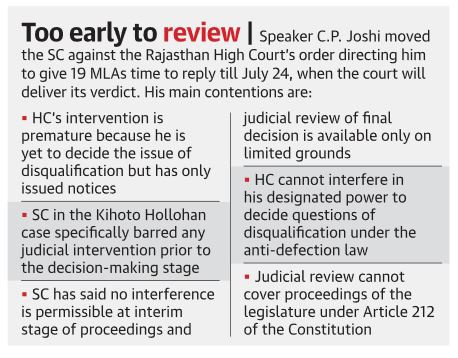
    • The petition said the HC has crossed its jurisdiction by asking the Speaker to put off his decision on the disqualification notices issued to dissident MLAs.
    • The HC order was an affront to the powers of the Speaker.
    • The High Court’s interim order granting extended time to rebel MLAs to file their replies to anti-defection notices amounted to a violation of Article 212 (courts not to inquire into the proceedings of the legislature).

    Backed by Tenth Schedule

    • The petition said that judicial review of ongoing anti-defection proceedings was limited.
    • Notice is much prior to any final determination or decision on disqualification.
    • The proceedings, including the notice, are in the realm of the legislative proceedings under Paragraph 6(2) of the Tenth Schedule, the Speaker’s office argued.

    Citing the Kihoto Hollohan case

    • The petition referred to the Constitution Bench judgment of the top court in the Kihoto Hollohan case in 1992 in this context.
    • Judicial review cannot be available at a stage prior to the making of a decision by the Speaker/Chairman and a prior action would not be permissible.
    • Nor would interference be permissible at an interlocutory stage of the proceedings, the verdict says.

    Must read:

    https://www.civilsdaily.com/news/kihoto-hollohan-order-1992/

    What does the dissident MLAs have to say?

    • The dissident MLAs had challenged the constitutionality of Paragraph 2(1)(a) of the Tenth Schedule which makes “voluntarily giving up membership of a political party” liable for disqualification.
    • The MLAs had argued that the provision infringed their right to dissent.
    • But the Speaker’s office countered that Paragraph 2 (1)(a) of the Tenth Schedule was the law of the land.
    • A mere challenge to its constitutionality cannot efface it from the statute book.


    Back2Basics

    https://www.civilsdaily.com/news/explained-anti-defection-law-and-its-evolution/

  • The Kihoto Hollohan Judgment and its Significance

    The 28 YO Kihoto Hollohan judgment has found its relevance in the case of ousted Rajasthan Dy. CM and some MLAs who were issued a notice under the anti-defection law.

    Try this question from CSP 2019:

    Q.The Ninth Schedule was introduced in the Constitution of India during the prime-ministership of:

    (a) Jawaharlal Nehru

    (b) Lal Bahadur Shastri

    (c) Indira Gandhi

    (d) Morarji Desai

    Under debate: Speaker’s power

    • The power for this disqualification is vested in the Speaker, who is usually a nominee of the ruling party.
    • Since no action was taken by the Speaker on the disqualification petitions, a writ petition was filed before the High Court of Manipur in Imphal seeking directions to decide on the petition.
    • However, the court did not pass an order.
    • It said that the larger issue of whether a High Court can direct a Speaker to decide a disqualification petition within a certain timeframe is pending before a Constitution Bench of the Supreme Court.
    • The parties are left with the option to move the apex court or wait for the outcome of the cases pending before it.

    The Kihoto Hollohan Judgment

    • The 1992 judgment of the Supreme Court in the Kihoto Hollohan versus Zachillu and Others has said that “judicial review cannot be available at a stage prior to the making of a decision by the Speaker/Chairman.
    • Nor would interference be permissible at an interlocutory stage of the proceedings said the Supreme Court.
    • The only exception for any interlocutory interference can be cases of interlocutory disqualifications or suspensions which may have grave, immediate and irreversible repercussions and consequence.

    Free speech

    • The ruling party in Rajasthan has challenged the constitutionality of Paragraph 2(1)(a) of the Tenth Schedule which makes “voluntarily giving up membership of a political party” liable for disqualification.
    • The MLAs have said the provision infringes into their right to express dissent and is a violation of their fundamental right to free speech as a legislator.
    • The Rajasthan HC Bench explained that the reason for limiting the role of courts in ongoing defection proceedings is that the “office of the Speaker is held in the highest respect and esteem in parliamentary traditions.

    Exceptions to the Kihoto Judgment

    • The judgment had said that even the scope of judicial review against an order of a Speaker or Chairman in anti-defection proceedings would be confined to jurisdictional errors.
    • That is if its infirmities are based on a violation of constitutional mandate, mala fides, non-compliance with rules of natural justice and perversity.

    Back2Basics

    https://www.civilsdaily.com/news/explained-anti-defection-law-and-its-evolution/