💥Join UPSC 2027,2028 Mentorship (July Batch) + XFactor Notes & Microthemes PDF

Subject: Geographical Features

  • Annular Solar Eclipse

    Why in the News?

    An annular solar eclipse will be visible in parts of South America on October 2, 2023.  It, however, will not be visible from India.

    What is a Solar Eclipse?

    • A solar eclipse occurs when the Moon moves between the Earth and the Sun, blocking the Sun’s light either fully or partially, casting a shadow on certain parts of the Earth.
    • There are four types of solar eclipses:
      1. Total Solar Eclipse: When the Moon completely blocks the Sun, turning the sky dark. People in the path of a total solar eclipse can witness the Sun’s corona (its outer atmosphere), which is normally hidden by the bright sunlight.
      2. Annular Solar Eclipse: Occurs when the Moon is at or near its farthest point from Earth. The Moon does not fully cover the Sun, leaving a visible ring of fire around the Moon. This is what people in parts of South America will witness on October 2, 2023.
      3. Partial Solar Eclipse: Happens when the Moon blocks only a part of the Sun, giving it a crescent shape. During both partial and annular eclipses, areas outside the Moon’s umbra (the darkest part of its shadow) experience a partial eclipse. It is the most common type of solar eclipse.
      4. Hybrid Solar Eclipse: The rarest type, where the eclipse shifts between total and annular as the Moon’s shadow moves across the Earth. Some places see a total solar eclipse, while others see an annular one.

    Frequency of Solar Eclipses

    • A solar eclipse can only occur during the new moon, when the Moon and Sun are aligned on the same side of the Earth.
    • A new moon happens approximately every 29.5 days because that is the time it takes for the Moon to orbit the Earth.
    • However, solar eclipses don’t happen every month. They occur two to five times annually, but not every new moon results in an eclipse.
    • Why don’t they occur every month:
      • The Moon’s orbit around the Earth is tilted by about 5 degrees compared to the Earth’s orbit around the Sun.
      • This means the Moon’s shadow usually misses the Earth.
      • A solar eclipse only occur when the Moon crosses specific points in its orbit, called nodes, where the Moon’s orbit intersects the plane of Earth’s orbit around the Sun.
      • When a new moon occurs at one of these nodes, a solar eclipse is possible.

    PYQ:

    [2019] On 21st June, the Sun

    (a) does not set below the horizon at the Arctic Circle

    (b) does not set below the horizon at Antarctic Circle

    (c) shines vertically overhead at noon on the Equator

    (d) shines vertically overhead at the Tropic of Capricorn

  • Why Earth will temporarily get a ‘Mini-Moon’ in September?

    Why in the News?

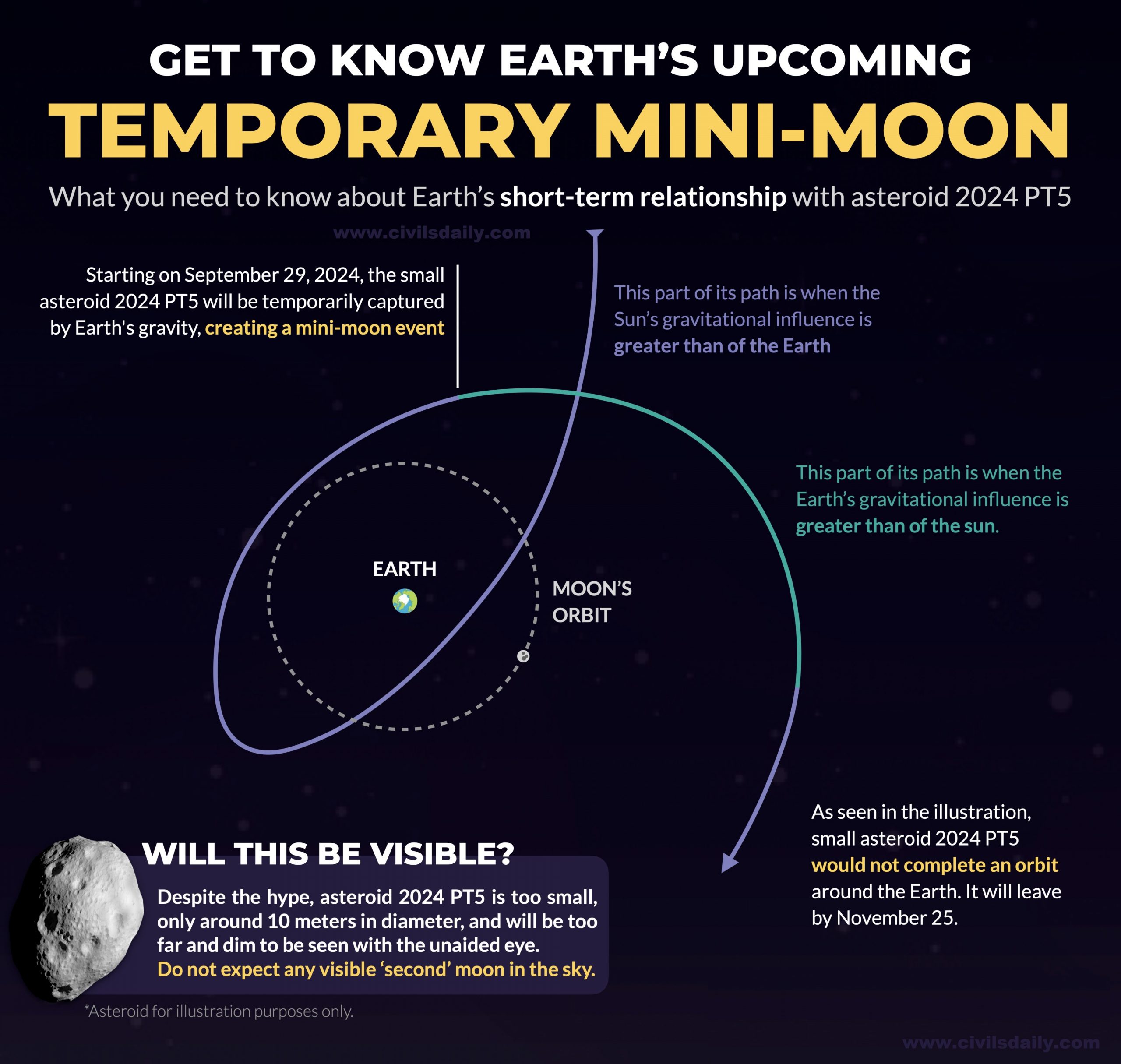
    In a rare celestial event, Earth’s gravitational field will witness a small asteroid, 2024 PT5, creating a “mini-moon” for two months.

    What is Mini-Moon?

    • A mini-moon is a small asteroid temporarily captured by Earth’s gravitational field, orbiting the planet for a short period before escaping back into space.
    • Unlike Earth’s permanent moon, mini-moons only stay for a few months to a few years before being ejected from orbit.
    • Mini-moons are a rare occurrence because most asteroids either pass by Earth or burn up in the atmosphere rather than being captured by Earth’s gravity.
    • Mini-moons are usually small, often just a few meters in diameter.
      • For example, 2024 PT5 is only about 33 feet (10 meters) in length.
    • They are hard to detect and are usually discovered using advanced telescopic surveys like NASA’s Asteroid Terrestrial-impact Last Alert System (ATLAS).

    Significance of Mini-Moons

    • Mini-moons offer scientists a unique opportunity to study near-Earth objects, enhancing our understanding of asteroids’ behavior and composition.
    • Mini-moons could contain valuable minerals or water, making them potential targets for future space missions to extract resources.
    • Studying mini-moons helps scientists learn more about Earth’s gravitational influence and how it interacts with space objects.

    PYQ:

    [2011] What is the difference between asteroids and comets?

    1. Asteroids are small rocky planetoids, while comets are formed of frozen gases held together by rocky and metallic material.
    2. Asteroids are found mostly between the orbits of Jupiter and Mars, while comets are found mostly between Venus and Mercury.
    3. Comets show a perceptible glowing tail, while asteroids do not.

    Which of the statements given above is/are correct?

    (a) 1 and 2 only
    (b) 1 and 3 only
    (c) 3 only
    (d) 1, 2 and 3

  • The Volcanic Island of Rapa Nui

    Rapa Nui

    Why in the News?

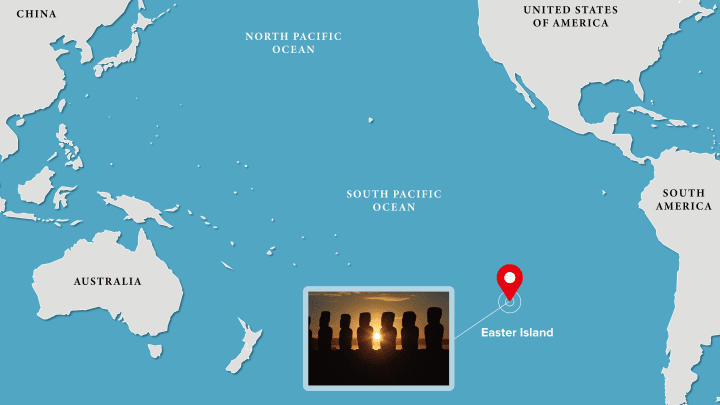
    The Volcanic Island of Rapa Nui (also known as Easter Island) has always been mysterious due to its harsh geography and iconic Moai statues.

    About Rapa Nui Island

    Details
    Location • Situated in the southeastern Pacific Ocean, Rapa Nui is part of Polynesia and a territory of Chile.
    • One of the most remote islands, about 3,500 km from Chile.
    Size • Covers an area of 160 sq. km.
    Geographical details • The island has a volcanic origin, featuring lava-covered terrain and rocky soil.

    • Notable volcanoes include Terevaka, Poike, and Rano Kau.

    Tropical climate with average temperatures ranging between 18°C and 28°C.

    Rainfall occurs mostly in the winter months.

    Moai Statues • Famous for over 900 moai statues, some as tall as 40 ft and weighing 75 tonnes.
    • These statues were built between the 13th and 16th centuries to honor revered ancestors.
    • Carved from volcanic rock and transported across great distances.
    Discovery • Discovered by European sailors on Easter Sunday, 1722, which gave it the name Easter Island.
    • The island had been settled centuries earlier by Polynesian explorers who navigated thousands of kilometers of ocean.
    Significance of New Findings • Recent studies, including the use of AI analysis of satellite images, have debunked earlier theories of ecological collapse.
    • Genetic studies show Native American ancestry before European contact, indicating earlier interactions with South America.


    PYQ:

    [2018] Consider the following statements:

    1. The Barren Island volcano is an active volcano located in the Indian territory.

    2. Barren Island lies about 140 km east of Great Nicobar.

    3. The last time the Barren Island volcano erupted was in 1991 and it has remained inactive since then.

    Which of the statements given above is/are correct?

    (a) 1 only

    (b) 2 and 3

    (c) 3 only

    (d) 1 and 3

  • Why gold nuggets are found in quartz veins?

    Why in the News?

    Researchers have been curious about why the majority of gold nuggets discovered throughout history have been found in orogenic quartz veins.

    Location and distribution of Gold:

    • Orogenic gold systems are commonly found in mountainous regions where large-scale geological processes, such as the collision of tectonic plates, have occurred.
    • For example, the Himalayas, the Canadian Shield, and the Western Australian goldfields.
    • Large gold nuggets are often found in orogenic quartz veins formed during the tectonic processes that create mountains.
    • These nuggets form because, during earthquakes, the stress on quartz crystals causes a reaction that deposits gold on their surfaces. This process happens repeatedly, leading to the accumulation of gold nuggets.

    Note: 

    • Gold nuggets are naturally occurring pieces of gold that have formed into lumps or chunks. They are typically found in riverbeds, streams, or within rock formations, often in quartz veins.
    • Orogenic quartz veins are quartz veins that form in mountainous regions.

    Findings by Researchers:

      • Piezocatalytic Effect and Gold Accumulation: Researchers discovered that the piezocatalytic effect of quartz under seismic stress causes the accumulation of gold in quartz veins.
        • The piezoelectric quartz crystal generates an electric field when subjected to stress. 
        • This field can drive electrochemical reactions at the interface between the quartz and a surrounding aqueous solution containing dissolved gold. These reactions cause gold to be deposited on the quartz surface. 
      • Seismic Activity and Localized Gold Deposits: The study suggests that gold nuggets in orogenic systems are formed through repeated piezocatalytic reactions over time, driven by natural seismic activity. This process explains the highly localized and interconnected nature of gold deposits within quartz veins.
      Conclusion: Researchers have found that gold nuggets in orogenic quartz veins form through piezocatalytic reactions caused by seismic stress on quartz. This process drives gold deposition on quartz surfaces, explaining the concentration and localization of gold in mountainous regions.

    Mains PYQ:

    Q Craze for gold in Indian has led to surge in import of gold in recent years and put pressure on balance of payments and external value of rupee. In view of this, examine the merits of Gold Monetization scheme. (UPSC IAS/2015)

  • Frequent mass wasting in Tibet a cause for worry in India 

    Why in the News?

    A recent study on frequent mass wasting in Sedongpu Gully and rapid warming raises concerns for India’s Northeast region.

    About Sedongpu Gully:

    • The Sedongpu gully (29°47′7.20′′N, 94°55′24′′E) is in the large bend region of the Yarlung Tsangpo River, located in the southeastern Tibetan Plateau.
    • Debris flows have occurred in two adjacent gullies, namely Sedongpu Gully (SDP) and Zelongnong Gully (ZLN), since the 1950s.

    Mass Wasting in the Gully: Stats and Reasons

    • Since 2017, over 700 million cubic meters of debris have been mobilized in the Sedongpu Gully catchment, with more than 68% of the total 19 identified mass-wasting events occurring in this period.
      • The events include ice-rock avalanches (IRAs), ice-moraine avalanches (IMAs), and glacier debris flows (GDFs).
    • Causes: The increased frequency of mass wasting is attributed to a combination of long-term warming and seismic activity.
      • The area rarely experienced temperatures above 0º C before 2012, but climate change has led to significant warming, destabilizing permafrost and increasing landslide activity.
      • The 6.4-magnitude Nyingchi earthquake in November 2017 also contributed to the destabilization of slopes.

    Implications of sedimentation from mass wasting events:

    • River Choking and Flash Floods: The study warns that the increased sedimentation from mass wasting events could choke river channels, particularly affecting the Brahmaputra River system. 
    • Hydropower Projects: China is planning to construct a massive 60-gigawatt hydropower project on the Tsangpo River, which could exacerbate sedimentation issues downstream.
      • This project is expected to have three times the capacity of the Three Gorges Dam, raising concerns about river management and flood risks in India and Bangladesh.
    • Historical Flood Events: Past incidents, like the 2000 floods in Arunachal Pradesh caused by landslides blocking the Tsangpo River, show how dangerous landslides can be for areas downstream.
      • The chance of similar disasters is higher now because of the ongoing geological instability in the Sedongpu Gully.

    Way forward: 

    • Bilateral and Multilateral Dialogues: India should intensify diplomatic efforts with China, advocating for shared water management strategies and transparency in hydropower projects on the Tsangpo River.
    • Real-Time Monitoring: Establish advanced real-time monitoring systems for the Brahmaputra River and its tributaries, using satellite imagery, remote sensing, and ground-based observations to track landslides, sedimentation, and water flow.

    Mains question for practice:

    Q Discuss the potential risks posed by the increasing frequency of mass wasting events in the Sedongpu Gully and the implications for India’s Northeast region. (150 words) 10M

  • In news: Gumti River

    Why in the News?

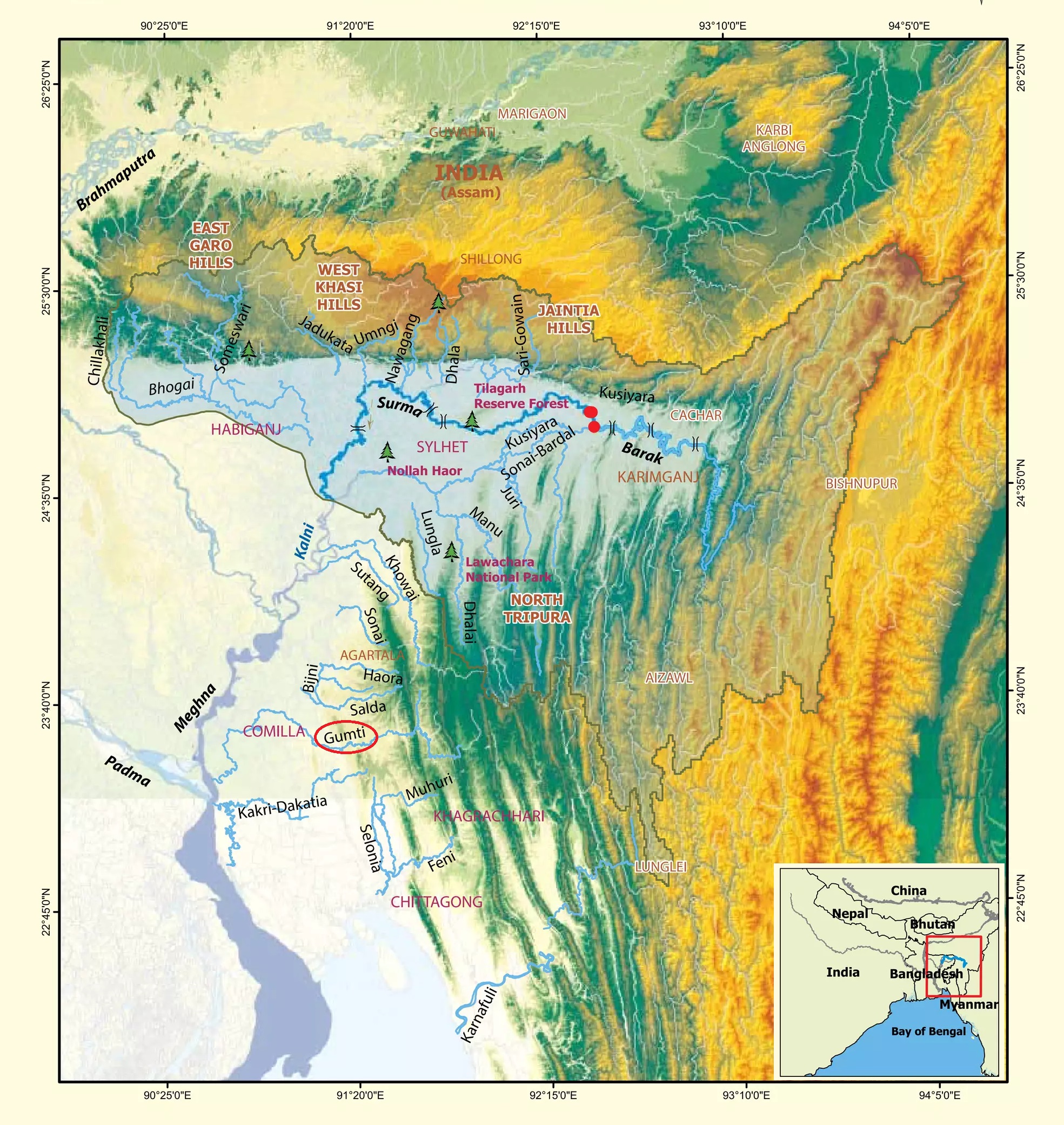
    India has refuted allegations that the recent floods in eastern Bangladesh were caused by the opening of the Dumbur dam over Gumti River in Tripura.

    About Gumti River

    Details
    Origin Dumboor Lake, Tripura, India
    Length Approximately 150 kilometers
    Course
    • Flows southward through Tripura, India, and then into Bangladesh;
    • Joins the Meghna River.
    Tributaries
    • Left: Raima, Manu
    • Right: Deo, Khowai
    Terrain Hilly terrain in upper course, fertile plains in lower course
    Biodiversity Supports diverse flora and fauna
    Projects Installed
    • Gumti Hydroelectric Project: Located near Dumbur; Generates hydroelectric power in Tripura; Bangladesh also receives 40 MW.
    • Gumti Irrigation Project: Supports irrigation for agriculture in Tripura, India


    PYQ:

    [2014] Consider the following rivers:

    1. Barak
    2. Lohit
    3. Subansiri

    Which of the above flows / flow through Arunachal Pradesh?

    (a) 1 only

    (b) 2 and 3 only

    (c) 1 and 3 only

    (d) 1, 2 and 3

  • Shiveluch Volcano

    Why in the News?

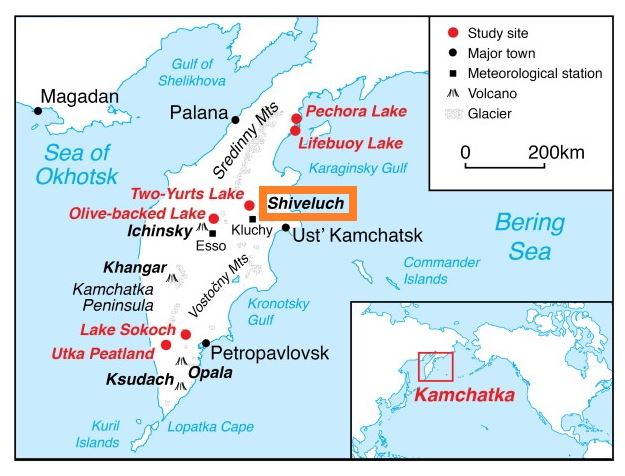
    The Shiveluch Volcano in Russia erupted following a 7.0 magnitude earthquake off the country’s eastern coast.

    About Shiveluch Volcano

    Details
    Location
    • Kamchatka Peninsula, Russia
    • Approximately 56°39′N 161°21′E
    • Stratovolcano (Composite Volcano)
    • Approximately 3,283 meters (10,771 feet)
    Geological Features Large actively growing lava dome, andesitic to dacitic lava
    Eruption History Frequent eruptions; significant activity in 2005, 2010, and ongoing in 2023-2024
    Hazards Ash plumes, pyroclastic flows, lahars
    Kamchatka Peninsula
    • Lies in far eastern Russia, between the Sea of Okhotsk on the west and the Pacific Ocean and Bering Sea on the east.
    • One of the world’s most concentrated areas of geothermal activity, with about 30 active volcanoes.
    • Approximately 1,200 km long and 480 km across at its widest.
    • Climate: Severe, with prolonged, cold, and snowy winters and wet, cool summers.
    • Regional Capital: Petropavlovsk-Kamchatsky.
    • Kuril Island chain runs from the southern tip of the peninsula to near Japan’s northern Hokkaido Island.
  • What is a Waterspout?

    Why in the News?

    A yacht sank off the coast of Sicily, Italy after being hit by a Waterspout.

    What are Waterspouts?

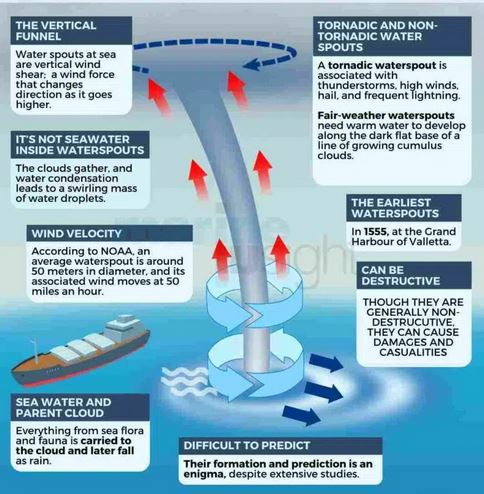
    • A waterspout is a rotating column of air and mist over a water body.
    • It is a weaker relative of tornadoes and typically lasts for about five minutes, although it can occasionally last up to 10 minutes.
    • Size and Strength:
      • Average diameter: Around 165 feet.
      • Wind speeds: Can reach up to 100 km/hr.
    • Waterspouts are more common in tropical waters but can form anywhere with high humidity and relatively warm water temperatures compared to the overlying air.

    Types of Waterspouts:

    • Tornadic Waterspouts
        • These are actual tornadoes that either form over water or move from land to water.
    • They are associated with severe thunderstorms and can be accompanied by high winds, large hail, and dangerous lightning.
    • Fair-Weather Waterspouts:
      • These are more common and form only over water during fair weather.
      • They are generally smaller and less dangerous than tornadic waterspouts.

    PYQ:

    [2020] Consider the following statements:

    1. Jet streams occur in the Northern Hemisphere only.

    2. Only some cyclones develop an eye.

    3. The temperature inside the eye of a cyclone is nearly 10ºC lesser than that of the surroundings.

    Which of the statements given above is/are correct?

    (a) 1 only

    (b) 2 and 3 only

    (c) 2 only

    (d) 1 and 3 only

  • What is the Perseid Meteor Shower?

    Why in the News?

    The Perseid meteor shower, which began in July, is currently at its peak activity from August 11 to 13, 2024.

    About Perseid Meteor Shower

    Details
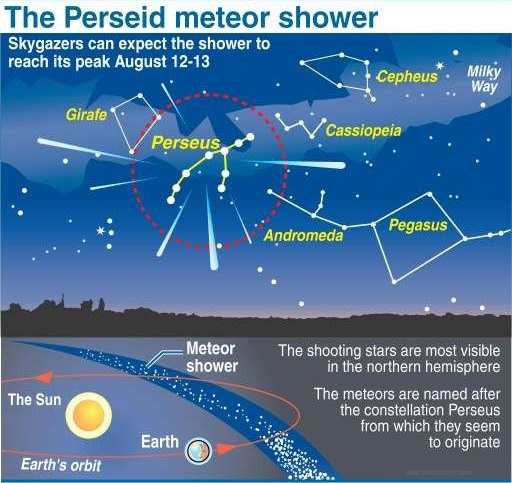
    Origin Named after the constellation Perseus, from which the meteors appear to originate.
    Cause Caused by debris left behind by Comet Swift-Tuttle as it orbits the Sun.
    How It Occurs
    • Consists of ice, rock, and dust particles shed by Comet Swift-Tuttle.
    • Earth passes through this debris field annually between mid-July and late August.
    • Particles enter Earth’s atmosphere at around 214,000 km/h, causing them to heat up and create bright streaks of light.
    Discovery The connection between the Perseid meteor shower and Comet Swift-Tuttle was established in 1862 by Lewis Swift and Horace Tuttle.
    Historical Observations Observed for centuries, with records dating back to ancient Chinese, Japanese, and European civilizations.
    Impact of Earth’s Gravity
    • Earth’s gravity pulls particles from the debris field, causing them to enter the atmosphere.
    • Larger particles can create fireballs—bright meteors that are more intense and last longer.

    Note: In the 1990s, scientists feared comet Swift-Tuttle might hit Earth or the Moon in 2126, but later calculations confirmed safety for two millennia.

    PYQ:

    [2011] What is the difference between asteroids and comets?

    1. Asteroids are small rocky planetoids, while comets are formed of frozen gases held together by rocky and metallic material.
    2. Asteroids are found mostly between the orbits of Jupiter and Mars, while comets are found mostly between Venus and Mercury.
    3. Comets show a perceptible glowing tail, while asteroids do not.

    Which of the statements given above is/are correct?

    (a) 1 and 2 only
    (b) 1 and 3 only
    (c) 3 only
    (d) 1, 2 and 3

  • Mapping: River Seine

    Why in the News?

    The swimming events in the ongoing Paris Olympics were postponed due to concerns about the water quality of the River Seine.

    Issues with River Seine’s Water Quality:

    • Old Sewage System: Paris’ aged sewage system combines rainwater and wastewater in the same pipes, leading to overflow during heavy rains.
    • Untreated Sewage Discharge: Overflowing pipes cause untreated sewage to be discharged directly into the Seine instead of being treated.
    • Wildlife Contamination: Heavy rains wash wildlife, such as rodents, into the river, adding to the contamination.
    • E. coli Threat: The River often has high levels of E. coli bacteria, which can cause severe gastrointestinal and urinary tract infections.
    • Exceeding Safe Levels: Following heavy rains, E. coli levels in the Seine frequently exceed the safe threshold of 900 colony-forming units (cfu) per 100 ml of water.
    • Long-term Pollution: The Seine has been historically polluted, with a swimming ban in place since 1923 due to health risks.
    • Health Risks: High contamination levels pose significant health risks to swimmers, including infections and illnesses.

    About River Seine

    Details
    Country France
    Length 777 km
    Major Cities Along Course Paris, Troyes, Melun, Rouen, Le Havre
    Major Tributaries Aube, Marne, Yonne, Oise, Eure
    Population in Basin About 17 million people, including the Paris metropolitan area
    Navigability Navigable for about 560 kilometers from the estuary to Burgundy
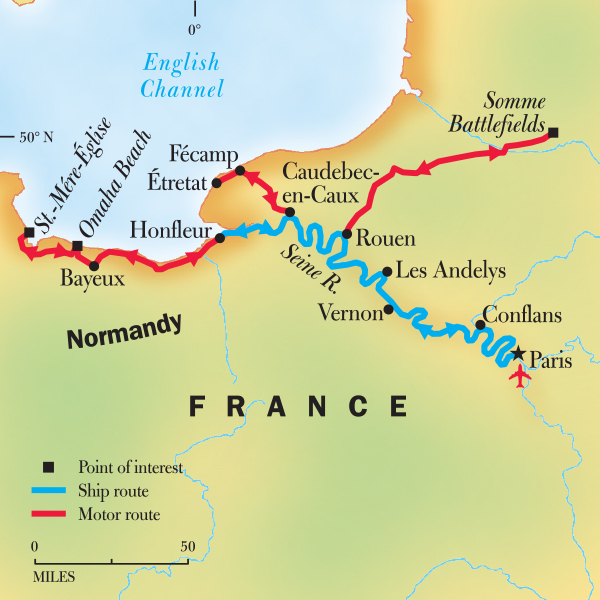
    Estuary Location Empties into the English Channel at Le Havre and Honfleur
    Estuary Type Tidal estuary with significant tidal influence up to Rouen
    Historical Significance Central to Paris, with landmarks like Notre-Dame Cathedral, Eiffel Tower, and the Louvre along its banks
    UNESCO Status Banks of the Seine in Paris are listed as a UNESCO World Heritage Site
    Economic Importance Major waterway for commercial shipping and tourism; key ports include Paris, Rouen, and Le Havre
    Recreational Activities Popular for river cruises, boating, fishing, and walking along its banks


    PYQ:

    [2020] Consider the following pairs?

    River: Flows into

    1. Mekong:  Andaman sea
    2. Thames: Irish Sea
    3. Volga: Caspian Sea
    4. Zambezi: Indian Ocean

    Which of the pairs above is/are correctly matched?

    (a) Only 1

    (b) Only 2

    (c) 3 Only

    (d) None of the above/More than one of the above.


    https://indianexpress.com/article/explained/explained-sports/paris-olympics-triathlon-event-river-seines-water-quality-sewage-system-water-treatment-plants-9485616/