💥Join UPSC 2027,2028 Mentorship (July Batch) + XFactor Notes & Microthemes PDF

Subject: History

  • Who was Tilka Manjhi?

    The Nation is remembering revolutionary freedom fighter and tribal leader Tilka Manjhi on his 272nd birth anniversary.

    Tilka Manjhi (1750-1785)

    • He organized Adivasis into an army and led the famous Santhal Hool in 1784 against the exploitative British.
    • In 1770, there was a severe famine in the Santhal region and people were dying of hunger.
    • Tilka Manjhi looted the treasury of the East India Company and distributed it among the poor and needy.
    • Inspired by this noble act of Tilka, many other tribals also joined the rebellion.
    • With this began his Santhal Hool, the revolt of the Santhals.
    • He continued to attack the British and their sycophantic allies.
    • From 1771 to 1784, Tilka Manjhi never surrendered.

    Offensive with the colonists

    • Tilka Majhi attacked Augustus Cleveland, an East India Company administrator and fatally wounded him.
    • The British surrounded the Tilapore forest from which he operated but he and his men held them at bay for several weeks.
    • When he was finally caught in 1784, he was tied to the tail of a horse and dragged all the way to the Collector’s residence at Bhagalpur, Bihar, India.
    • There, his deeply wounded body was hung from a Banyan tree.

    Try this question from CSP 2018:

    Q.After the Santhal uprising subsided, what was/ were the measure/measures taken by the colonial government?

    1. The territories called ‘Santhal Paraganas’ were created.
    2. It became illegal for a Santhal to transfer land to a non Santhal.

    Select the correct answer using the code given below:

    (a) 1 only

    (b) 2 only

    (c) Both 1 and 2

    (d) Neither 1 nor 2


    [wpdiscuz-feedback id=”21kicbmy07″ question=”Please leave a feedback on this” opened=”1″]Post your answers here.[/wpdiscuz-feedback]


    UPSC 2022 countdown has begun! Get your personal guidance plan now! (Click here)

  • Places in news: Chandernagore

    The Registry Building, a two-storey structure at Chandernagore built in 1875 and a symbol of French settlement of the colonial town, has been awaiting restoration for a long time.

    French in India

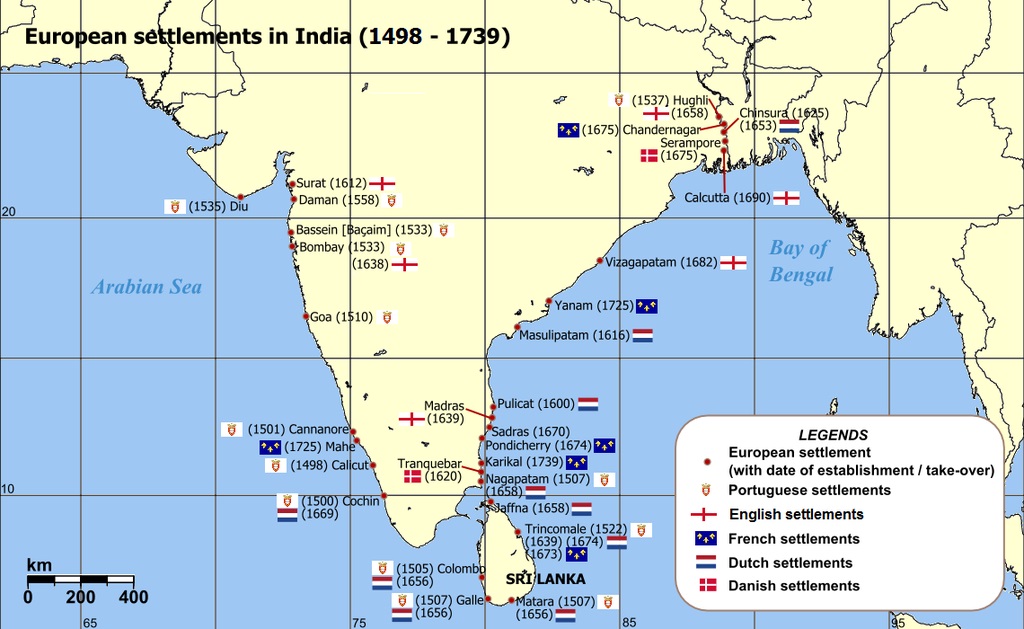
    • France was the last of the major European maritime powers of the 17th century to enter the East India trade.
    • The French settlement in India began in 1673 with the purchase of land at Chandernagore from the Mughal Governor of Bengal.
    • The next year they acquired Pondicherry from the Sultan of Bijapur. Both became the centers of maritime commercial activities of the French in India.
    • Joseph Francois Dupleix who was initially appointed as Intendent of Chandernagore in 1731, sowed the seeds of colonization.
    • The village, which hitherto was engaged in maritime commerce along with Pondicherry, got fortified by him.

    Significance of Chandernagore

    • Chandernagore, though a part of French colonies in India, was unique in many ways.
    • It was very active in spearheading the freedom movement against the British. Due to its close proximity to Calcutta, it became a safe haven for freedom fighters of all hues.
    • Even Aurobindo Ghosh who was one of the accused in the Alipore Bomb case of 1909, was acquitted unconditionally and after a short stay at Chandernagore moved to Pondicherry.
    • Since the partition of Bengal in 1905, Chandernagore was in the thick of activities of freedom fighters against the British and produced several martyrs including Kanailal Dutt.

    Merger into India

    • As the British decided to hand over powers to the people of India by August 15, 1947, the people living under French rule in Pondicherry, Chandernagore, Karaikal, Mahe and Yanam were eager to join their homeland.
    • But the French were yet to learn their lessons. They tried all the tricks in the book to avert this.
    • Facing the onslaught from the people under their rule and the British and Indian rulers, the French declared Chandernagore as free city in 1947.
    • In June 1948, they conducted a referendum in which an overwhelming majority of 97 per cent people opted for a merger with India.
    • After so many legal hurdles, it became a part of India on October 2, 1955.

    Back2Basics: European Colonies in India


    UPSC 2022 countdown has begun! Get your personal guidance plan now! (Click here)

  • Kodiyal Theru Festival

    The annual Kodiyal Theru car (chariot) festival has begun in Mangalore, Karnataka.

    Kodiyal Theru

    • It falls in late January or early February in the Hindu month of Magha.
    • It begins on Tritiya or the third day of the bright moon and ends on the seventh to be followed by Holi (Okuli) after the festival.
    • For these six days, the Car Festival rules in the Car Street in front of the Venkatramana Temple in Mangalore.
    • The Festival begins with the Dwajarohana or hoisting of the ‘flag’ – actually a framed picture of Garuda.
    • This is done ceremoniously on the first day of the festival amidst the clanging of bells and the reverberation of drumbeats.
    • The Garuda stays aloft for the rest of the festival until he is again lowered in an equally ceremonial manner on the day of the Holi and this is the concluding event of the festival.


    UPSC 2022 countdown has begun! Get your personal guidance plan now! (Click here)

  • President quotes Thirukkural while addressing Parliament

    President Ram Nath Kovind quoted a couplet from Thirukkural while addressing the joint Houses of Parliament for Budget Session.

    What did the President quote?

    • ‘Karka Kasadara Karpavai Kattrapin Nirka Atharku Thaka’ was the couplet chosen by him to reiterate the importance of the New Education Policy.
    • The couplet insists on thorough and flawless learning and adhering to what one has learnt.

    What is Thirukkural?

    • The Tirukkuṟaḷ (meaning ‘sacred verses’), or shortly the Kural, is a classic Tamil language text consisting of 1,330 short couplets, or kurals, of seven words each.
    • The text is divided into three books with aphoristic teachings on virtue (aram), wealth (porul) and love (inbam), respectively.
    • Considered one of the greatest works ever written on ethics and morality, it is known for its universality and secular nature.

    Three major parts of the book

    1. Aram : Book of Virtue (Dharma), dealing with moral values of an individual and essentials of yoga philosophy
    2. Porul : Book of Polity (Artha), dealing with socio-economic values, polity, society and administration
    3. Inbam: Book of Love (Kama), dealing with psychological values and love

    Who authored it and when?

    • Its authorship is traditionally attributed to Valluvar, also known in full as Thiruvalluvar.
    • The text has been dated variously from 300 BCE to 5th century CE.
    • The traditional accounts describe it as the last work of the third Sangam, but linguistic analysis suggests a later date of 450 to 500 CE and that it was composed after the Sangam period.

    Cultural significance of Thirukkural

    • The Kural is traditionally praised with epithets and alternative titles, including “the Tamil Veda” and “the Divine Book.”
    • Written on the foundations of ahimsa, it emphasizes non-violence and moral vegetarianism as virtues for an individual.
    • In addition, it highlights truthfulness, self-restraint, gratitude, hospitality, kindness, goodness, duty, giving, and so forth.
    • It covers a wide range of social and political topics such as king, ministers, taxes, justice, forts, war, greatness of army and soldier’s honor.
    • It emphasizes death sentence for the wicked, agriculture, education, abstinence from alcohol and intoxicants.
    • It also includes chapters on friendship, love, sexual unions, and domestic life.

    Read these quotes and bookmark them. They can be used in essays:

    1. Nothing is impossible for those who act after wise counsel and careful thought.
    2. Real kindness seeks no return.
    3. The only gift is giving to the poor; All else is exchange.
    4. Friendship with the wise gets better with time, as a good book gets better with age.
    5. Worthless are those who injure others vengefully, while those who stoically endure are like stored gold.
    6. Among a man’s many good possessions, A good command of speech has no equal. Prosperity and ruin issue from the power of the tongue. Therefore, guard yourself against thoughtless speech.
    7. A fortress is of no use to cowards.
    8. Even the ignorant may appear very worthy, If they keep silent before the learned.


    UPSC 2022 countdown has begun! Get your personal guidance plan now! (Click here)

  • [pib] Sacred Ensembles of the Hoysalas

    The Hoysala Temples of Belur, Halebid and Somnathapura in Karnataka have been finalized as India’s nomination for consideration as World Heritage for the year 2022-2023.

    Sacred Ensembles of the Hoysalas

    • The sacred ensembles of the Hoysalas are extraordinary expressions of spiritual purpose and vehicles of spiritual practice and attainment.
    • The sacred ensembles of the Hoysalas at Belur and Halebid are the finest, most exquisite, and most representative examples of the artistic genius and cultural accomplishments of the Hoysalas remaining today.

     [I] Belur: Chennakeshava Temple Complex

    • The Chennakeshava temple complex was at the center of the old walled town located on the banks of the Yagachi River.
    • The complex itself was walled in a rectangular campus with four rectilinear streets around it for ritual circumambulation of the deity.
    • Construction of the temple commenced in 1117 AD and took a 103 years to complete.
    • The temple was devoted to Vishnu.
    • The richly sculptured exterior of the temple narrate scenes from the life of Vishnu and his reincarnations and the epics, Ramayana, and Mahabharata.
    • However, some of the representations of Shiva are also included.
    • Consecrated on a sacred site, the temple has remained continuously worshipped since its establishment and remains until today as a site of pilgrimage for Vaishnavites.

    [II] Halebid: Hoysaleshwara Temple

    • At the zenith of the Hoysala empire, the capital was shifted from Belur to Halebid that was then known as Dorasamudhra.
    • The Hoysaleshwara temple at Halebidu is the most exemplary architectural ensemble of the Hoysalas extant today.
    • Built in 1121CE during the reign of the Hoysala King, Vishnuvardhana Hoysaleshwara.
    • The temple, dedicated to Shiva, was sponsored and built by wealthy citizens and merchants of Dorasamudra.
    • The temple is most well-known for the more than 240 wall sculptures that run all along the outer wall.
    • Halebid has a walled complex containing of three Jaina basadi (temples) of the Hoysala period as well as a stepped well.

    [III] Somnathpur: Kesava Temple

    • The Keshava temple at Somanathapura is another magnificent Hoysala monument, perhaps the last.
    • This is a breathtakingly beautiful Trikuta Temple dedicated to Lord Krishna in three forms – Janardhana, Keshava and Venugopala.
    • Unfortunately, the main Keshava idol is missing, and the Janardhana and Venugopala idols are damaged.
    • Still this temple is worth a visit just to soak in the artistry and sheer talent of the sculptors who created this magnificent monument to the Divine.


    UPSC 2022 countdown has begun! Get your personal guidance plan now! (Click here)

  • What is Beating Retreat Ceremony?

    There are 26 tunes that will be played at Beating Retreat this year on January 29 skipping the “Abide with Me” tune.

    What is the Beating Retreat function?

    • ‘Beating Retreat’ marks a centuries old military tradition, when the troops ceased fighting, sheathed their arms and withdrew from the battlefield and returned to the camps at sunset at the sounding of the Retreat.
    • The military tradition began in 17th century England, when King James II ordered his troops to beat drums, lower flags and organise a parade to announce the end of a day of combat.
    • The ceremony was then called ‘watch setting’ and took place at sunset after firing a single round from the evening gun.
    • The ceremony is currently held by Armed Forces in the UK, US, Canada, New Zealand, Australia, and India, among others.

    How did it begin in India?

    • Beating the Retreat’ has emerged as an event of national pride when the Colours and Standards are paraded.
    • The ceremony traces its origins to the early 1950s when Major Roberts of the Indian Army indigenously developed the unique ceremony of display by the massed bands.
    • Section D (Ceremonials) at the Ministry of Defence conducts the event.
    • The ceremony consists of musical performances by the bands, who each year play Indian and western tunes.


    UPSC 2022 countdown has begun! Get your personal guidance plan now! (Click here)

  • Netaji’s relationship with Nehru, Gandhi and the Congress

    In public discourse, the popular imagination of Netaji Subhash Chandra Bose is increasing all across the length and breadth of our country these days.

    Back in 2016, when there was ruckus over de-classification of some files associated with Netaji, a question too appeared in UPSC CSE Mains:


    Q. Highlight the differences in the approach of Subhash Chandra Bose and Mahatma Gandhi in the struggle for freedom.


    We can expect a repetition again considering the scale of ongoing debate around Netaji and the vitality of his INA leading to immediate withdrawal of British rulers from India.

    Also read:

    Celebration of Parakram Diwas

    Context

    The Bose-Gandhi rivalry is frequently understood as the biggest dichotomy of the Indian nationalist movement.

    Bose: A complex character of freedom movement

    • Bose was a complex character. His complexity comes alive when one realizes his disagreement with the Congress leadership, when Bose took over the Indian National Army (INA).
    • He constituted four regiments, three of which were named after Gandhi, Nehru and Maulana Azad.
    • He had profound respect for his colleagues.
    • In 1943, while Gandhi was in jail, Bose on the former’s birthday gave a moving address over the Azad Hind Radio where he referred to Gandhi as ‘father of the nation’.
    • This was probably the first time this epithet was used for Gandhi, and soon it became ubiquitous.

    Bose and his association with INC

    • Bose was a key member and a frontline leader of the Indian National Congress.
    • He plunged into the anti-colonial movement under Gandhi’s leadership in 1921 and rose to be the president of the Congress in 1938 and 39.
    • There were certain differences of opinion with the Gandhian high command in 1939, but he remained true to the Congress ideal of freedom.

    Joining the Indian National Congress

    • On July 16, 1921, Bose had returned to Bombay from London where he had gone on his father’s insistence to prepare for the Indian Civil Services examination.
    • Despite qualifying for the services he had refused to take up the opportunity.
    • Such was Bose’s zeal to join the freedom struggle that on the very afternoon he arrived in India he went to meet Gandhi at Mani Bhawan.

    Relations with the mainstream leaders

    (A) Bose vs. Gandhi

    • Bose wanted to know how the different aspects of the movement were going to culminate in the non-payment of taxes, the last stage of the campaign.
    • Secondly, he wanted to know how the non-payment of taxes would eventually force the British to leave and thirdly how Gandhi could promise Swaraj in one year.
    • On Gandhi’s advice Bose moved to Calcutta, where he worked closely with the lawyer and Congress leader C R Das.
    • As president of the Congress, his first disagreement with Gandhi happened in December 1938 when Bose was eager to form a coalition government in Bengal along with the Krishak Praja Party.
    • The following year, Bose was hopeful for re-election as Congress president. A second term was very rare and Gandhi was pretty much against the idea of re-electing Bose.
    • Bose found support from the younger and left leaning members of the Congress and also from the literary giant Rabindranath Tagore.
    • Tagore had personally written to Gandhi requesting a second term for Bose. However, Bose was aggrieved to know that Gandhi saw this as a ‘personal defeat’.

    (B) Bose vs. Nehru

    • Both leaders were of same age, similar political leanings and often finding themselves frustrated by Gandhi’s commitment to non-violence.
    • However, while Nehru was starry-eyed in his reverence for Gandhi, Bose though immensely respectful of Gandhi, found his political strategies to be ambiguous.
    • Bose and Nehru had been in prison at that time and both expressed disappointment and anger over unilateral withdrawal of non-cooperation movement over Chauri Chaura incident.
    • Both were left-leaning radical men, unswerving in their commitment to ‘purna swaraj’ and to the forming of a socialist state in independent India.
    • When Bose sought the support of the Nazi government in Germany, he found himself ideologically at the farthest end to Nehru’s views.

    (C) Bose vs. Patel

    • In response to Bose’s re-election, several members of the Congress Working Committee resigned including Vallabhbhai Patel and Rajendra Prasad.
    • Patel had an old rivalry with Bose, which was both personal and political.
    • Their relationship had deteriorated rapidly with the death of Patel’s elder brother Vithalbhai in 1933.
    • Bose had been very close to Vithalbhai and had nursed him during his last days.
    • In his will, Vithalbhai had left a substantial portion of his property to Bose.
    • Vallabhbhai had cast aspersions on the authenticity of the will and a long legal battle had followed culminating in the victory of Patel.

    As Congress president

    • In February 1938 Bose had taken over as president of the Congress and the next two years would be defining in creating his political profile as a Congressman and in drawing the rift with Gandhi and Nehru.
    • At the Haripura session of the Congress, Bose made his presidential address, which is known to be the lengthiest and most important speech he ever made to the party.
    • He made it clear that he stood for unqualified Swaraj.
    • However, it needs to be noted that nowhere in the speech did Bose suggest any criticism or deviation from Gandhi’s methods.

    Resignation from INC

    • On April 29, 1939 Bose resigned from his post as president of the Congress Party.
    • In a statement to the press, he mentioned the efforts he had made to find a common ground with Gandhi.
    • These having failed, he felt his presidency may be a sort of obstacle or handicap in the path of the Congress as it sought to reconcile its two wings.

    Life after leaving Congress

    (A) World War II

    • In September 1939 German tanks invaded Poland, marking the beginning of the Second World War.
    • The war was to have a most significant impact in the history of modern India.
    • Bose was a special invitee in the three-day meeting of the Congress Working Committee from September 9 to decide India’s position on the war.
    • For Bose, the war served as a golden opportunity for India to launch a civil disobedience movement in order to win independence.
    • For Bose the stance taken by the resolution to support British was completely unacceptable.
    • Nehru had nothing but hatred towards Fascism and Nazism and sought for some concessions from the British government to fight Mussolini and Hitler.

    (B) Escape to Germany

    • Bose organized mass protests in Calcutta for the removal of the Holwell monument that stood in Dalhousie Square as a memorial to those who died in the Black Hole of Calcutta.
    • He was arrested by the British government for the protests, but was released soon after he went into a seven-day hunger strike.
    • Bose’s arrest and the subsequent release set the scene for him to escape to Germany via Afghanistan and the Soviet Union.

    After Netaji’s demise ( rather disappearance)

    • It is also worth noting that at the end of the Second World War, Nehru put on his barrister’s gown and joined the defense team for the INA prisoners at the time of the Red Fort trials.
    • In the several speeches of Nehru after Bose’s death, the former referred to Netaji in the most affectionate way.
    • In August 1947, in his first speech from the ramparts of the Red Fort, Nehru mentioned only two people by name and were Gandhi and Bose. It was quite a warm reference.


    UPSC 2022 countdown has begun! Get your personal guidance plan now! (Click here)

  • UNESCO tag sought for Living Root Bridges of Meghalaya

    The Zoological Survey of India (ZSI) has underlined some green rules for the living root bridges of Meghalaya to get the UNESCO World Heritage Site tag.

    Living Root Bridges

    • A living root bridge is a type of simple suspension bridge formed of living plant roots by tree shaping.
    • They are common in the southern part of the Northeast Indian state of Meghalaya. Such a bridge is locally called jingkieng jri.
    • They are handmade from the aerial roots of rubber fig trees (Ficus elastic) by the Khasi and Jaintia peoples of the mountainous terrain along the southern part of the Shillong Plateau.
    • Most of the bridges grow on steep slopes of subtropical moist broadleaf forest between 50m and 1150m above sea level.

    Why is it so unique?

    • As long as the tree from which it is formed remains healthy, the roots in the bridge can naturally grow thick and strengthen.
    • New roots can grow throughout the tree’s life and must be pruned or manipulated to strengthen the bridge.
    • Once mature some bridges can have as many as 50 or more people crossing, and have a lifespan of up to 150 years.


    UPSC 2022 countdown has begun! Get your personal guidance plan now! (Click here)
  • Who was Sri Ramanuja?

    Work is going apace on the 216-ft tall ‘Statue of Equality’ of the 11th century reformer and Vaishnavite saint, Sri Ramanuja, to be unveiled by PM Modi next month in Hyderabad.

    Statue of Equality

    • The ‘Statue of Equality’, as it is called, is being installed to mark the 1,000th birth anniversary of Sri Ramanuja.
    • It was built of panchaloha, a combination of gold, silver, copper, brass and zinc, by the Aerospun Corporation in China and shipped to India.
    • It is the second largest in the world in sitting position of the saint.
    • The monument will be surrounded by 108 “Divya Desams” of Sri Vaishnavite tradition (model temples) like Tirumala, Srirangam, Kanchi, Ahobhilam, Badrinath, Muktinath, Ayodhya, Brindavan, Kumbakonam and others.
    • The idols of deities and structures were constructed in the shape at the existing temples.

    Who was Sri Ramanuja?

    Ramanuja or Ramanujacharya (1017–1137 CE) was a philosopher, Hindu theologian, social reformer, and one of the most important exponents of Sri Vaishnavism tradition within Hinduism.

    • His philosophical foundations for devotionalism were influential to the Bhakti movement.

    His works

    • Ramanuja’s philosophical foundation was qualified monism and is called Vishishtadvaita in the Hindu tradition.
    • His ideas are one of three subschools in Vedanta, the other two are known as Adi Shankara’s Advaita (absolute monism) and Madhvacharya’s Dvaita (dualism)
    • Important writings include:
    1. Vedarthasangraha (literally, “Summary of the Vedas meaning”),
    2. Sri Bhashya (a review and commentary on the Brahma Sutras),
    3. Bhagavad Gita Bhashya (a review and commentary on the Bhagavad Gita), and
    • The minor works titled Vedantapida, Vedantasara, Gadya Trayam (which is a compilation of three texts called the Saranagati Gadyam, Sriranga Gadyam and the Srivaikunta Gadyam), and Nitya Grantham.


    UPSC 2022 countdown has begun! Get your personal guidance plan now! (Click here)

  • Amar Jawan Jyoti and its Relocation

    The iconic Amar Jawan Jyoti (AJJ) at India Gate was extinguished as a part of its merger with the flame at the National War Memorial (NWM). This has sparked a political controversy.

    What is the Amar Jawan Jyoti?

    • The eternal flame at the AJJ underneath India Gate in central Delhi was an iconic symbol of the nation’s tributes to the soldiers who have died for the country in various wars and conflicts since Independence.
    • Established in 1972, it was to mark India’s victory over Pakistan in the 1971 War, which resulted in the creation of Bangladesh.
    • The then PM Indira Gandhi had inaugurated it on Republic Day 1972, after India defeated Pakistan in December 1971.

    Description of the bust

    • The key elements of the Amar Jawan Jyoti included a black marble plinth, a cenotaph, which acted as a tomb of the Unknown Soldier.
    • The plinth had an inverted L1A1 self-loading rifle with a bayonet, on top of which was a soldier’s war helmet.

    How the eternal flame was kept burning?

    • For 50 years the eternal flame had been burning underneath India Gate, without being extinguished.
    • But on Friday, the flame was finally put off, as it was merged with another eternal flame at the National War Memorial.
    • Since 1972, when it was inaugurated, it used to be kept alive with the help of cylinders of liquefied petroleum gas, or LPG.
    • One cylinder could keep one burner alive for a day and a half.
    • In 2006 that was changed. Though a project that cost around Rs 6 lakh the fuel for the flames was changed from LPG to piped natural gas, or PNG.
    • It is through this piped gas that the flame marking the tribute to Indian soldiers had been kept alive eternally.

    Why was it placed at India Gate?

    • The India Gate, All India War Memorial, as it was known earlier, was built by the British in 1931.
    • It was erected as a memorial to around 90,000 Indian soldiers of the British Indian Army, who had died in several wars and campaigns till then.
    • Names of more than 13,000 dead soldiers are mentioned on the memorial commemorating them.
    • As it was a memorial for the Indian soldiers killed in wars, the Amar Jawan Jyoti was established underneath it by the government in 1972.

    Reasons for its relocation

    • The correct perspective is that the flame will not be extinguished, but just moved to be merged with the one at the National War Memorial.
    • The flame which paid homage to the soldiers killed in the 1971 War, does not even mention their name, and the India Gate is a “symbol of our colonial past”.
    • The names of all Indian martyrs from all the wars, including 1971 and wars before and after it are housed at the National War Memorial.
    • Hence it is a true tribute to have the flame paying tribute to martyrs there.
    • Further, it can also be seen as part of the government’s redevelopment of the entire Central Vista, of which India Gate, the AJJ and the National War Memorial are parts of.

    What else is planned with the extinguish?

    • The canopy next to the India Gate will get a statue of the Netaji Subhash Chandra Bose.
    • The new statue will be 28 feet high.
    • Till the statue is completed, a hologram statue of Bose will be placed under the canopy, which he will unveil on January 23.
    • The canopy used to have a statue of Kind George V, which was removed in 1968.

    Why Netaji?

    • January 23 this year marks his 125th birth anniversary.
    • From this year onwards, Republic Day celebrations will start on January 23, as opposed to the usual practice of starting it on January 24, to mark the birth anniversary of Bose.
    • It will end on January 30, the day Mahatma Gandhi was assassinated.
    • The government had earlier announced that Bose’s birth anniversary would be celebrated as Parakram Divas.

    What is the National War Memorial and when was it made?

    • The National War Memorial, which is around 400 meters from India Gate was inaugurated in February 2019, in an area of around 40 acres.
    • It was built to commemorate all the soldiers who have laid down their lives in the various battles, wars, operations and conflicts of Independent India.
    • There are many independent memorials for such soldiers, but no memorial existed commemorating them all at the national level.
    • Discussions to build such a memorial had been ongoing since 1961, but it did not come up.

    Its architecture

    • The architecture of the memorial is based on four concentric circles.
    • Largest is the Raksha Chakra or the Circle of Protection which is marked by a row of trees, each of which represent soldiers, who protect the country.
    • The Tyag Chakra, the Circle of Sacrifice, has circular concentric walls of honour based on the Chakravyuh.
    • The walls have independent granite tablets for each of the soldiers who have died for the country since Independence.
    • As of today, there are 26,466 names of such soldiers on these granite tablets etched in golden letters.
    • A tablet is added every time a soldier is killed in the line of duty.
    • The final is the Amar Chakra, the Circle of Immortality, which has an obelisk, and the Eternal Flame.
    • Busts of the 21 soldiers who have been conferred with the highest gallantry award of the country, Param Vir Chakra, are also installed at the memorial.


    UPSC 2022 countdown has begun! Get your personal guidance plan now! (Click here)