💥Join UPSC 2027,2028 Mentorship (July Batch) + XFactor Notes & Microthemes PDF

Subject: History

  • Telangana’s Tribal Fair: Sammakka-Sarakka Jatara

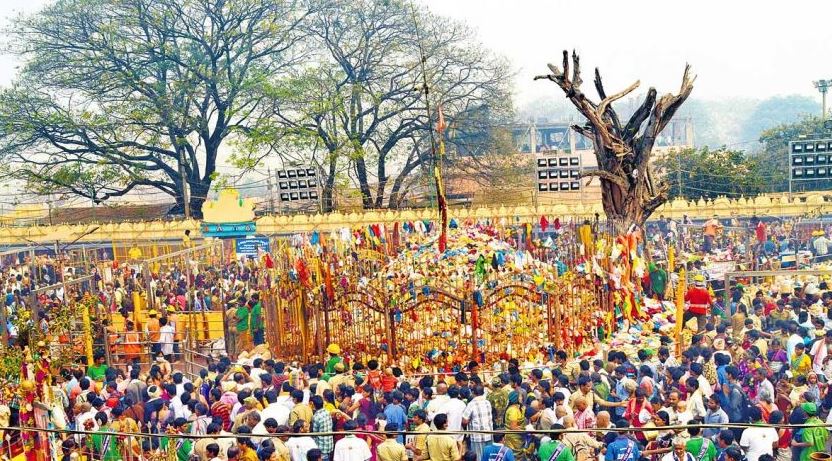
    Medaram, a tiny village in Telangana’s tribal heartland of Mulugu district, is getting ready to host the Sammakka-Sarakka jatara, billed as the country’s biggest tribal fair.

    Sammakka-Sarakka Jatara

    • The mega four-day jatara, scheduled to begin on February 16 in Medaram. It takes place once in two years.
    • It is perhaps the only tribal fair devoted to pay tribute to tribal warriors who made supreme sacrifices defending the rights of aboriginal tribal people.
    • It symbolises the traditions and heritage of the Koya tribal people.
    • The sacred site in Medaram and its surrounding Jampanna vagu, named after tribal martyr Jampanna, son of Sammakka, comes alive with lakhs of devotees during the four-day jatara.

    Why do tribals come to Medaram?

    • This festival commemorates a tribal revolt led by Sammakka and Saralamma, a mother-daughter duo, against levy of taxes on tribal people during drought conditions by the then Kakatiya rulers in the 12th century.
    • Tribals (and others) flock to Medaram during the jatara not just from Telangana and Andhra Pradesh but also from as far as Madhya Pradesh, Jharkhand, Chhattisgarh and Maharashtra.
    • Sammakka and Saralamma are revered by devotees as tribal goddesses, and devotees make offerings to propitiate them to bestow health and wealth.
    • All the rituals at the jatara site are held in tune with tribal traditions under the aegis of tribal priests.

    Features of the celebrations

    • One of the striking features of the tribal fair is the offering of jaggery to the tribal goddess at the altars (bamboo poles).
    • It encompasses common features of tribal fairs – die-hard devotees going into a trance, the sacrifice of fowls and goats, besides pulsating traditional drum beats accompanying folk songs.


    UPSC 2022 countdown has begun! Get your personal guidance plan now! (Click here)

  • In news: Ancient Tamil Civilization

    A reconnaissance survey in the sea off the coast of Korkai in Thoothukudi district where Tamiraparani River joins the sea, which finds mention in Sangam literature, will be undertaken by the Tamil Nadu Archaeology Department.

    About Tamiraparani River

    • The Thamirabarani or Tamraparni or Porunai is a perennial river that originates from the Agastyarkoodam peak of the Pothigai hills of the Western Ghats.
    • It flows through the Tirunelveli and Thoothukudi districts of the Tamil Nadu state of southern India into the Gulf of Mannar.
    • It was called the Tamraparni River in the pre-classical period, a name it lent to the island of Sri Lanka.
    • The old Tamil name of the river is Porunai.

    Its history

    • Its many name derivations of Tan Porunai include Tampraparani, Tamirabarni, Tamiravaruni.
    • Tan Porunai nathi finds mention by classical Tamil poets in ancient Sangam Tamil literature Purananuru.
    • Recognised as a holy river in Sanskrit literature Puranas, Mahabharata and Ramayana, the river was famed in the Early Pandyan Kingdom for its pearl and conch fisheries and trade.
    • The movement of people, including the faithful, trade merchants and toddy tapers from Tamraparni river to northwestern Sri Lanka led to the shared appellation of the name for the closely connected region.
    • One important historical document on the river is the treatise Tamraparni Mahatmyam.
    • It has many ancient temples along its banks. A hamlet known as Appankoil is located on the northern side of the river.

    Back2Basics: Keeladi Civilization

    • The Keeladi tale began to unravel in March 2015 when first round of excavation was undertaken by the Archaeological Survey of India (ASI).
    • It unearthed antiquities providing crucial evidence to understanding the missing links of the Iron Age [12th century BCE to 6th century BCE] to the Early Historic Period [6th century BCE to 4th century BCE].
    • Further excavations threw up strong clues about the existence of a Tamil Civilization that had trade links with other regions in the country and abroad.
    • This civilization has been described by Tamil poets belonging to the Sangam period.
    • Results of carbon dating of a few artifacts traced their existence to 2nd century BCE (the Sangam period).

    Key findings in excavations

    • These included brick structures, terracotta ring wells, fallen roofing with tiles, golden ornaments, broken parts of copper objects, iron implements, terracotta chess pieces, ear ornaments, spindle whorls, figurines.
    • It also had black and redware, rouletted ware and a few pieces of Arretine ware, besides beads made of glass, terracotta and semi-precious stones.


    UPSC 2022 countdown has begun! Get your personal guidance plan now! (Click here)

  • AP govt bans Chintamani Padya Natakam: A noted Telugu folk play

    The Andhra Pradesh government has brought the curtains down on the popular Telugu play ‘Chintamani Padya Natakam’, which has enthralled people for almost 100 years.

    Chintamani Padya Natakam

    • It is a stage play penned by social reformer, writer and poet Kallakuri Narayana Rao about 100 years ago.
    • In the play, the writer explains how people neglect their families by falling prey to certain social evils.
    • It was aimed to create awareness on the Devadasi system and how the flesh trade was ruining many families at that particular period.
    • Subbisetty, Chintamani, Bilvamangaludu, Bhavani Shankaram, and Srihari are some of the characters in the play.

    Its performance

    • The play is named after the main character, Chintamani, a woman born into a family involved in the flesh trade.
    • The play focuses on how she attained salvation after repentance.
    • Subbi Shetty, a character in the play, loses his wealth to Chintamani and his character is utilised in a way that engages the audience.
    • Chintamani play is popular across the state. It has been performed at thousands of places.
    • The play continues to engage the audience even today and has become a must stage play in villages during Dasara celebrations.

    Why it got banned?

    • Began as a social sermon, this play has been increasingly going vulgar.
    • Subbi Shetty, who resembles a person of a transgender community, is used to portray the social group in a bad way.
    • Obscene dialogues are added to the play in the name of creativity.


    UPSC 2022 countdown has begun! Get your personal guidance plan now! (Click here)
  • Art-form in news: Kathak

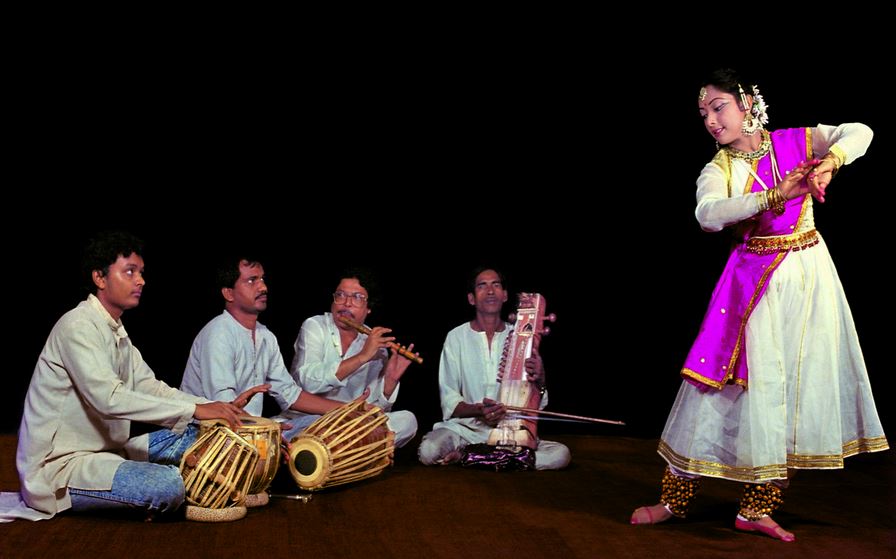
    Kathak legend Pandit Birju Maharaj has recently passed away.

    About Kathak

    • Kathak is one of the eight major forms of Indian classical dance.
    • The origin of Kathak is traditionally attributed to the traveling bards in of ancient northern India known as Kathakars or storytellers.
    • The term Kathak is derived from the Vedic Sanskrit word Katha which means “story”, and Kathakar which means “the one who tells a story”, or “to do with stories”.
    • Wandering Kathakars communicated stories from the great epics and ancient mythology through dance, songs and music.

    Its origin

    • Kathak dancers tell various stories through their hand movements and extensive footwork, their body movements and flexibility but most importantly through their facial expressions.
    • It evolved during the Bhakti movement, particularly by incorporating the childhood and stories of the Hindu god Krishna, as well as independently in the courts of north Indian kingdoms.
    • Kathak is unique in having both Hindu and Muslim gharanas and cultural elements of these gharanas.
    • Kathak performances include Urdu Ghazals and commonly used instruments brought during the Mughal period.

    Major gharanas

    • Kathak is found in three distinct forms, called “gharanas”, named after the cities where the Kathak dance tradition evolved – Jaipur, Banaras and Lucknow.
    • While the Jaipur gharana focuses more on the foot movements, the Banaras and Lucknow gharanas focus more on facial expressions and graceful hand movements.

    Performance details

    • It involves both Nritta (pure dance) and Nritya (expressive dance).
    • Stylistically, the Kathak dance form emphasizes rhythmic foot movements, adorned with small bells (Ghungroo) and the movement harmonized to the music.
    • The legs and torso are generally straight, and the story is told through a developed vocabulary based on the gestures of arms and upper body movement, facial expressions, neck movements, eyes and eyebrow movement, stage movements, bends and turns.
    • The main focus of the dance becomes the eyes and the foot movements.
    • The eyes work as a medium of communication of the story the dancer is trying to communicate. With the eyebrows the dancer gives various facial expressions.
    • A Kathak performance can be solo, duo or team. In a technical performance, the speed and energy the dancers exchange with the audience increases in multiples, that is the tempo doubles or quadruples.


    UPSC 2022 countdown has begun! Get your personal guidance plan now! (Click here)

  • [pib] Harvest Festivals in India

    The President has greeted the people of India on the occasion of Makar Sankranti and Pongal festivals.

    Makar Sankranti

    • Makar Sankranti or Uttarayan or Maghi or simply Sankranti is considered as the transition day of Sun into the Capricorn.
    • Now the sun moves northwards in the Hindu calendar.
    • Dedicated to the deity Surya, many native festivals are organized all over India.
    • It mostly falls at the end of Kharif harvests.

    Statewise festivals celebration

    • Pongal: In South India and particularly in Tamil Nadu, it’s the festival of Pongal which is being celebrated over 4 days at harvest time.
    • Lohri: It is celebrated in North India particularly in Punjab as a traditional winter folk festival or as a popular harvest festival of farmers.
    • Bhogi: In Andhra Pradesh, it is celebrated as a four day festival with a bonfire with logs of wood, other solid-fuels, and wooden furniture at home that are no longer useful.
    • Magha Bihu: In Assam and many parts of the North East, the festival of Magha Bihu is celebrated. It sees the first harvest of the season being offered to the gods along with prayers for peace and prosperity.
    • Uttarayan: Gujarat celebrates it in the form of the convivial kite festival of Uttarayan.
    • Saaji: In Shimla District of Himachal Pradesh, Makara Sankranti is known as Magha Saaji. Saaji is the Pahari word for Sankranti, start of the new month. Hence this day marks the start of the month of Magha.

    Try this question from our AWE initiative:

    Do we have cultural pockets of small India all over the nation? Elaborate with examples. (15 Marks)


    UPSC 2022 countdown has begun! Get your personal guidance plan now! (Click here)

  • Veer Baal Diwas to be observed on December 26

    Prime Minister has declared that December 26 shall henceforth be marked as Veer Baal Diwas to pay homage to the courage of the Sahibzades, four sons of Guru Gobind Singh, the last Sikh guru.

    What is the legend of Sahibzades?

    • The word “Sahibzada” means “son” in Punjabi and is a term commonly used to refer to the 4 sons of Guru Gobind Singh, the tenth Sikh Guru.
    • The week of 21 to 27 December is celebrated as the Sacrificial Week in memory of the four Sahibzadas who made sacrifices for the protection of Sikhism and Hinduism.
    • Sahibzada Ajit Singh, Jujhar Singh, Zorawar Singh and Fateh Singh got martyrdom while saving their religious faiths against forceful conversion.

    Their martyrdom: A backgrounder story

    • After the establishment of the Khalsa Panth, Guru Gobind Singh left the fort of Sri Anandpur Sahib with his family on 20-21 December 1704 to fight the invasion by Aurgangzeb.
    • The elder sahibzade Ajit Singh, Jujhar Singh stayed with Guru ji, while the younger sons Zorawar Singh and Fateh Singh were with Mata Gujri ji.
    • Subedar Wazir Khan of Sirhind arrested the two Sahibzades subsequently and lured them for religious conversion.
    • In the end, it was announced to get them elected in the living walls.
    • The rest two sahibzades got assassinated in the battle of Chamkaur (1705).

    Implications of their martyrdom

    • When the news of this reached Guruji, he wrote a zafarnama (letter of victory) to Aurangzeb, in which he warned Aurangzeb that the Khalsa Panth was ready to destroy your empire.
    • Baba Banda Singh Bahadur took revenge for the martyrdom of Guruji’s Sahibzadas.
    • He punished Wazir Khan for his deeds in Sirhind and established Sikh hegemony over the entire area.
    • The result of this sacrifice was that later a large Sikh empire emerged under the leadership of Maharaja Ranjit Singh.

    A historic event in Indian History

    • This event is an important part of Indian history and the occasion of their martyrdom is remembered and commemorated both with great vigor and sorrow.
    • The names of Sahibzades are reverently preserved and are recalled every time Ardas (prayer) of supplication is recited at a congregation or privately by an individual.


    UPSC 2022 countdown has begun! Get your personal guidance plan now! (Click here)

  • Significance of Delhi government’s recognition to fifth Sikh Takht

    The Delhi Assembly has passed an amendment Bill to the Delhi Sikh Gurdwara Act, 1971, recognizing Takht Damdama Sahib as the fifth Takht of Sikhs.

    What is a Sikh Takht?

    • A Takht, which means a throne, is a seat of temporal authority for Sikhs.
    • There are five Sikh Takhts, three in Punjab and one each in Maharashtra and Bihar.

    (1) Akal Takht

    • Located in Amritsar, it is the oldest of the Takhts, and considered supreme among the five.
    • It was set up in 1606 by Guru Hargobind, whose succession as the sixth Guru after the execution of his father, Guru Arjan Dev, is considered a turning point in Sikh history.
    • The Akal Takht, a raised platform that he built in front of the causeway leading to the sanctum sanctorum of the Harmandir Sahib (Golden Temple).
    • It symbolised the coming together of the temporal authority and the political sovereignty of the Sikh community (miri) with the spiritual authority (piri).
    • It is seen as the first marker of Sikh nationalism.

    The other four Takhts are linked to Guru Gobind Singh, the tenth Sikh Guru.

    (2) Takht Keshgarh Sahib

    • Located in Anandpur Sahib in Punjab. It was here that Guru Gobind Singh raised Khalsa, the initiated Sikh warriors, in 1699.

    (3) Takht Patna Sahib

    • Guru Gobind Singh was born here in 1666.

    (4) Takht Hazur Sahib

    • In Nanded, where Guru Gobin Singh spent time and where he was cremated in 1708.

    (5) Takht Damdama Sahib

    • In Talwandi Sabo of Bathinda. Guru Gobind Singh spent several months here.

    What does the amendment to the Delhi Sikh Gurdwara Act mean?

    • Simply put, it adds one more ex officio member in the Delhi Sikh Gurdwara Managament Committee (DSGMC) house.
    • Earlier, there were four ex officio members in the house — the chiefs (jathedars) of the other four Sikh Takhts.

    Is it the first time it has been recognised as the fifth Takht?

    • It was back in 1999 that Takht Damdama Sahib was recognised as the fifth Sikh Takht by the Union Home Ministry.
    • It included it as such in the Sikh Gurdwaras Act, 1925 (Punjab Act VIII of 1925) with a notification dated April 23, 1999.
    • Before that, an SGPC sub-committee had declared it the fifth Takht of Sikhs back in November 1966 after Punjab was carved out as a separate state through the Punjab Reorganisation Act, 1966.

    How politically significant is the move?

    • It comes ahead of the Punjab Assembly elections, where the, Delhi’s ruling party, has high stakes.

    What is the role of the Sikh Takhts?

    • The Takhts are known to issue hukumnamas (morality orders) from time to time on issues that concern the Sikh community.
    • Akal Takht is supreme among them because it is the oldest and was created by a Sikh Guru himself, say Sikh scholars.
    • Any edict or order concerning the entire community is issued only from Akal Takht.
    • It is from Akal Takht that Sikhs found to be violating the Sikh doctrine and code of conduct are awarded religious punishment (declared tankhaiya).

    Who appoints the jathedars of the Takhts?

    • The three Takhts in Punjab are directly controlled by the SGPC, which appoints the jathedars.
    • The SGPC is dominated by SAD members.
    • It is widely understood that SAD puts the final seal on the appointment of these three jathedars.
    • The two Takhts outside Punjab have their own trusts and boards.


    UPSC 2022 countdown has begun! Get your personal guidance plan now! (Click here)

  • Who was Rani Velu Nachiyar?

    The Prime Minister has paid tributes to Rani Velu Nachiyar on her birth anniversary.

    Velu Nachiyar (1730-1796)

    • Rani Velu Nachiyar was a queen of Sivaganga estate from c. 1780–1790.
    • She was the first Indian queen to wage war with the East India Company in India.
    • She is widely known as Veeramangai (“brave woman”).

    Her legend

    [A] Early life

    • Velu Nachiyar was the princess of Ramanathapuram and the only child of King Chellamuthu Vijayaragunatha Sethupathy and Queen Sakandhimuthathal of the Ramnad kingdom.
    • Nachiyar was trained in many methods of combat, including war match weapons usage, martial arts like Valari, Silambam, horse riding, and archery.
    • She was a scholar in many languages and was proficient in languages like French, English and Urdu.

    [B] Battles fought

    • During this period, she formed an army and sought an alliance with Hyder Ali with the aim of launching a campaign against the East India Company in 1780.
    • When her husband, Muthu Vaduganatha Periyavudaya Thevar was killed in a battle with EIC soldiers, she was drawn into the conflict.
    • When Velu Nachiyar found the place where the EIC stored some of their ammunition, she arranged a suicide attack on the location, blowing it up.


    UPSC 2022 countdown has begun! Get your personal guidance plan now! (Click here)

  • George Wittet, who left beautiful fingerprints across Mumbai

    The restored and refurbished Chhatrapati Shivaji Maharaj Vastu Sangrahalaya (CSMVS) (erstwhile Prince of Wales Museum) will open this month as the building enters its centenary year.

    Who was George Wittet?

    • George Wittet was born in Blair Atholl, Scotland. He studied architecture in Perth, Scotland, and worked in Edinburgh and York before arriving in India in 1904.
    • In India, he became assistant to John Begg, consulting architect to the Government of Bombay.
    • Together, they pioneered the Indo-Saracenic style, using it in many government and public buildings across Bombay.
    • About a decade later, Wittet rose to be consulting architect himself and was also elected as the first president of The Indian Institute of Architects.
    • Besides the Prince of Wales Museum, Wittet also designed the Gateway of India, a fine example of Indo-Saracenic architecture and among the most identifiable landmarks of Mumbai.

    What is Indo-Saracenic style?

    • The Indo-Saracenic style was promoted by British architects starting from the late 19th century.
    • It is exemplified by the use of elements seen in architecture across India, from Mughal structures to Hindu temples.
    • The style was dominated by Indo-Islamic elements, but sometimes combined with Gothic and neo-classical elements popular in Britain at that time.
    • Major features of the style include domes and domelets, chhattris, minarets, and open pavilions.
    • Indo-Saracenic was seen as Raj’s efforts to promote “Indian” culture, so that their colonial subjects would view them more favorably, especially after the Revolt of 1857.

    Notable monuments

    Examples from other parts of India include the magnificent:

    • Victoria Memorial in Kolkata
    • Amba Vilas Palace (Mysore Palace) in Mysuru
    • Senate House (on the Madras University campus) in Chennai
    • Secretariat Building (Central Secretariat) in New Delhi

    Mumbai’s notable architecture: CSMVS

    • The dome of the CSMVS is based on the Gol Gumbaz, the mausoleum of king Mohammed Adil Shah of Bijapur.
    • Wittet had toured the historic buildings of Bijapur, which was key to his Indo-Saracenic designs.
    • CSMVS’s finial is based on that of the Taj Mahal.
    • However, even though he won the competition for the museum’s design, it wasn’t his design that was executed finally.


    UPSC 2022 countdown has begun! Get your personal guidance plan now! (Click here)

  • Back in news: Aryan Invasion Theory

    The 2022 calendar of the IIT, Kharagpur on the theme of “evidence” for “rebutting the Aryan invasion myth” has caused controversy.

    What is the Aryan Invasion Theory?

    • It has always been understood that the Aryans migration from the Steppe happened after 2000 BCE.
    • In 1953 Mortimer Wheeler proposed that the invasion of an Indo-European tribe from Central Asia, the “Aryans”, caused the decline of the Indus Civilization.
    • As evidence, he cited a group of 37 skeletons found in various parts of Mohenjo-daro, and passages in the Vedas referring to battles and forts.
    • However, scholars soon started to reject Wheeler’s theory, since the skeletons belonged to a period after the city’s abandonment and none were found near the citadel.

    Basis of this theory

    • This was first propounded when linguistic similarities between Sanskrit and the major European languages were discovered by European scholars during the colonial era.
    • This tool was used by the colonizers to legitimize their rule in India.
    • The theory hypothesizes that during 2000BC Aryans from Europe invaded or migrated into the Asian subcontinent.
    • It states these ‘invaders’ killed the original Dravidians and set up the Aryan race in the South-Asian subcontinent.
    • The Aryan Invasion Theory claimed that these ‘invaders’ were the root of modern Indian civilization, not the Harappan civilization.

    Its rebuttal

    • Recent studies have debunked the theory after DNA samples from 5000-year old Harappan remains were proven to be similar to modern Indians’ DNA as part of the Rakhigarhi Project.

    Who were the Harappans then?

    • The Harappans who created the agricultural revolution in northwestern India and then built the Harappan civilization were a mix of First Indians and Iranians who spoke a pre-Arya language.
    • The Arya were central Asian Steppe pastoralists who arrived in India between roughly 2000 BCE and 1500 BCE, and brought Indo-European languages to the subcontinent.
    • The new study says the Iranians arrived in India before agriculture or even herding had begun anywhere in the world.
    • In other words, these migrants were likely to have been hunter-gatherers, which means they did not bring a knowledge of agriculture.

    Try this PYQ:

    Q With reference to the difference between the culture of Rigvedic Aryans and Indus Valley people, which of the following statements correct?

    1. Rigvedic Aryans used the coat of mail and helmet in warfare whereas the people of Indus Valley Civilization did not leave any evidence of using them.
    2. Rigvedic Aryans knew gold, silver and copper whereas Indus Valley people knew only copper and iron.
    3. Rigvedic Aryans had domesticated the horse whereas there is no evidence of Indus Valley people having been aware of this animal.

    Select the correct answer using the code given below:

    (a) Only 1

    (c) 1 and 3 only

    (b) 2 and 3 only

    (d) 1, 2 and 3


    [wpdiscuz-feedback id=”piz6vf17w7″ question=”Please leave a feedback on this” opened=”1″]Post your answers here.[/wpdiscuz-feedback]


    UPSC 2022 countdown has begun! Get your personal guidance plan now! (Click here)