💥Join UPSC 2027,2028 Mentorship (July Batch) + XFactor Notes & Microthemes PDF

Subject: History

  • Rakhigarhi skeletons’ DNA samples sent for analysis

    DNA samples collected from two human skeletons unearthed at a necropolis of a Harappan-era city site in Rakhigarhi, Haryana have been sent for scientific examination.

    Why in news?

    • DNA analysis might tell about the ancestry and food habits of people who lived in the Rakhigarhi region thousands of years ago.

    About Rakhi Garhi

    • The ancient site of Rakhi-Khas and Rakhi-Shahpur are collectively known as Rakhigarhi, located on the right bank of the now dried up Palaeo-channel of Drishadvati.
    • It is located in the Ghaggar-Hakra river plain in the Hissar district of Haryana.
    • Seven mounds are located here.
    • The site has yielded various stages of Harappan culture and is by far one of the largest Harappan sites in India.
    • The site shows the sequential development of the Indus culture in the now dried up Saraswati basin.

    Major findings at Rakhi Garhi

    • Findings confirm both early and mature Harappan phases and include 4,600-year-old human skeletons, fortification and bricks.
    • Digging so far reveals a well-planned city with 1.92 m wide roads, a bit wider than in Kalibangan.
    • The pottery is similar to Kalibangan and Banawali.
    • Pits surrounded by walls have been found, which are thought to be for sacrificial or some religious ceremonies.
    • There are brick-lined drains to handle sewage from the houses.
    • Terracotta statues, weights, bronze artefacts, comb, copper fish hooks, needles and terracotta seals have also been found.
    • A bronze vessel has been found which is decorated with gold and silver.
    • A granary belonging to the mature Harappan phase has been found here.
    • Fire altars structures were revealed in Rakhigarhi.


    UPSC 2023 countdown has begun! Get your personal guidance plan now! (Click here)

  • Who was Veer Kunwar Singh (1777-1858)?

    Political factions in Bihar has planned to organise the birth anniversary of the 1857 uprising hero Veer Kunwar Singh on April 23 at Jagdishpur in Bhojpur.

    Veer Kunwar Singh

    • Kunwar Singh also known as Babu Kunwar Singh was a leader during the uprising of 1857.
    • He belonged to a family of the Ujjainiya clan of the Parmar Rajputs of Jagdispur, currently a part of Bhojpur district, Bihar.
    • At the age of 80, he led a selected band of armed soldiers against the troops under the command of the British East India Company.
    • He was the chief organiser of the fight against the British in Bihar.
    • He is popularly known as Veer Kunwar Singh or Veer Babu Kunwar Singh.

    Role in 1857 Uprising

    • Singh led the Indian Rebellion of 1857 in Bihar. He was nearly eighty and in failing health when he was called upon to take up arms.
    • He was assisted by both his brother, Babu Amar Singh and his commander-in-chief, Hare Krishna Singh.
    • He gave a good fight and harried British forces for nearly a year and remained invincible until the end.
    • He was an expert in the art of guerrilla warfare.

    In popular culture

    • To honour his contribution to India’s freedom movement, the Centre issued a commemorative stamp on 23 April 1966.
    • The Government of Bihar established the Veer Kunwar Singh University, Arrah, in 1992.


    UPSC 2022 countdown has begun! Get your personal guidance plan now! (Click here)

  • Festivals in news: Karaga Festival

    The centuries-old Karaga (temple fair) festival was recently held at the Dharmaraya Swamy Temple in Bengaluru.

    Karaga Festival

    • It is celebrated annually in the Chaitra month (March/April) according to the Hindu calendar.
    • The festival has found its roots in the epic Mahabharata.
    • It honours Draupadi as the ideal woman and Goddess Shakti.
    • The word ‘Karaga’ translates to an earthen pot, supporting a floral pyramid and an idol of Goddess.
    • The Karaga is carried on the head of the bearer without touching it.
    • The carrier wears a woman’s attire with bangles, mangal-sutra, and vermillion on his forehead.

    Cultural significance of Karaga

    • The Karaga procession makes a customary halt at Astana e-Hazrath Tawakkal Mastan Shah Saharwardi Dargah to pay obeisance to Tawakkal Mastan.
    • The Dargah, a symbol of syncretic Sufism, has been taken care by the Muzavvar family for several generations.
    • According to them, the history of the Dargah goes back to at least 300 years when Tawakkal Mastan, who came to Bengaluru with his horses looking for business opportunities, was adored as a saint.
    • Hyder Ali, who was the ruler then, was a patron of Mastak for his good deeds.


    UPSC 2022 countdown has begun! Get your personal guidance plan now! (Click here)

  • Solving India’s idol theft problem

    Context

    Building an inventory of antiquities should be the first step in dealing with the problem.

    Measures taken by the worldwide organisations

    • CAG in its 2013 Report stated that “131 antiquities were stolen from monuments/sites and 37 antiquities from Site Museums from 1981 to 2012″
    • It added that in similar situations, worldwide, organisations took many more effective steps:
    • 1] Checking of catalogues of international auction house(s),
    • 2] Posting news of such theft on websites.
    • 3] Posting information about theft in the International Art Loss Registry.
    • 4] Sending photographs of stolen objects electronically to dealers and auction houses and intimate scholars in the field.
    • Lack of legal provisions: The report also stated that the ASI had never participated or collected information on Indian antiquities put on sale at well-known international auction houses viz. Sotheby’s, Christie’s, etc. as there was no explicit provision in the AAT (Antiquities and Art Treasures) Act, 1972 for doing so.

    International conventions and treaties

    • India is a signatory to the 1970 UNESCO Convention on the Means of Prohibiting and Preventing the Illicit Import, Export and Transfer of Ownership of Cultural Property. (We ratified it in 1977).
    • Perhaps we should also sign the 1995 UNIDROIT (International Institute for the Unification of Private Law) Convention on Stolen or Illegally Exported Cultural Objects.

    Lessons from Italy

    • Italy also suffers and several stolen antiquities have been returned by the US to Italy.
    • That being the case, it shouldn’t be surprising that many best practices originate in Italy.
    • The following list is illustrative.
    • (1) A specific law on protecting cultural heritage, with enhanced penalties;
    • (2) Centralised management before granting authorisation for archaeological research;
    • (3) Specialisation in cultural heritage for public prosecutors;
    • (4) An inter-ministerial committee for recovery and return of cultural objects;
    • (5) MOUs and bilateral agreements with other countries and international organisations to prevent illegal trafficking;
    • (6) Involvement of private organisations and individuals in protection;
    • (7) A complete inventory of moveable and immoveable cultural heritage, with detailed catalogues;
    • (8) Monitoring and inspection of cultural sites; and
    • (9) Centralised granting of export requests.

    Way forward

    • One could say the 2013 CAG Report did a bit of (8), but that was a one-off and isn’t a permanent solution.
    • This isn’t a binary, nor is it possible to accomplish everything overnight. However, incrementally, one can move towards (1), (3), (4), (5), (6), (8) and, especially, (7).
    • We should start with that inventory.

    Conclusion

    While fingers can rightly be pointed at Western museums and auction-houses (this isn’t only about the colonial era), there is internal connivance.

    UPSC 2022 countdown has begun! Get your personal guidance plan now! (Click here)

  • Festivals in news: Madhavpur Mela

    The Madhavpur Mela was recently inaugurated by the President of India.

    In the entire country, there is no other fair which the President and host of Union Ministers and Chief Ministers of a number of states visit.

    What is the Madhavpur Mela?

    • The Mela is a religio-cultural fair taking place every year in Madhavpur, a village on the Porbandar coast, also known as Madhavpur Ghed.
    • The village has temples of Madhavraiji, or Lord Krishna, and his consort Rukmini, believed to have been built in the 15th century.
    • It is also known for its sandy sea beach, the turquoise waters of the Arabian Sea, a sea turtle hatchery and the Osho Ashram
    • The fair begins on Ram Navami, Lord Rama’s birth anniversary falling on the ninth day of the month of Chaitra in the Hindu calendar, and culminates on Tryodashi, the 13th day of the month.

    Mythology behind the fair

    • The fair celebrates the marriage of Lord Krishna with Rukmini around 4,000 years ago, as per Hindu mythology.
    • The fair begins on Ram Navami, Lord Rama’s birth anniversary falling on the ninth day of the month of Chaitra in the Hindu calendar, and culminates on Tryodashi, the 13th day of the month.
    • According to mythology, Lord Krishna had established his kingdom in Dwarka near Porbandar.
    • Rukmini, daughter of King Bhimak of the present-day Arunachal Pradesh, wanted to marry Krishna, while her brother wanted to marry her off to Shishupal, Krishna’s cousin.
    • Therefore, Krishna abducted Rukmini, brought her to Gujarat and tied the knot with her at Madhavpur village.
    • Today, to mark the wedding, marriage rituals go on for five days.
    • They culminate with the idols of Lord Krishna and Rukmini being taken out in a procession through Madhavpur for ‘samaiya’, a ritual to welcome the bridegroom back home with his bride.

    Significance of the fair

    • The President observed that fairs and festivals have bonded the people of India for ages and that Madhavpur Mela also integrates Gujarat to the Northeast of India.
    • This fair reflects that, despite our languages, dialects and lifestyles being different, Indians, since time immemorial, have been one culturally.

    Do you know?

    There is one such festival called ‘Pushkaram’ which is celebrated by the people of Tamil Nadu. Devotees from Tamil Nadu perform rituals at the banks of Brahmaputra River.

    UPSC 2022 countdown has begun! Get your personal guidance plan now! (Click here)

  • How ancient megalithic jars connect Assam with Laos and Indonesia

    The discovery of a number of megalithic stone jars in Assam’s Dima Hasao district has brought to focus possible links between India’s Northeast and Southeast Asia, dating back to the second millennium BC.

    What is the news?

    • According to a study in Asian Archaeology, the jars are a “unique archaeological phenomenon”.
    • It calls for more research to understand the “likely cultural relationship” between Assam and Laos and Indonesia, the only two other sites where similar jars have been found.

    About the Megalithic Jars

    • The jars of Assam were first sighted in 1929 by British civil servants James Philip Mills and John Henry Hutton.
    • They recorded their presence in six sites in Dima Hasao: Derebore (now Hojai Dobongling), Kobak, Kartong, Molongpa (now Melangpeuram), Ndunglo and Bolasan (now Nuchubunglo).
    • More such sites were later discovered in 2016 and 2020.
    • Researchers documented three distinct jar shapes (bulbous top with conical end; biconcial; cylindrical) on spurs, hill slopes and ridge lines.

    Their significance

    • While the jars are yet to be scientifically dated, the researchers said links could be drawn with the stone jars found in Laos and Indonesia.
    • There are typological and morphological similarities between the jars found at all three sites.
    • Dating done at the Laos site suggests that jars were positioned at the sites as early as the late second millennium BC.
    • The other takeaway is the link to mortuary practices with human skeletal remains found inside and buried around the jars.
    • In Indonesia, the function of the jars remains unconfirmed, although some scholars suggest a similar mortuary role.

    Back2Basics: Megalithic Burials in India

    • Megaliths were constructed either as burial sites or commemorative (non-sepulchral) memorials.
    • The former are sites with actual burial remains, such as dolmenoid cists (box-shaped stone burial chambers), cairn circles (stone circles with defined peripheries) and capstones (distinctive mushroom-shaped burial chambers found mainly in Kerala).
    • The urn or the sarcophagus containing the mortal remains was usually made of terracotta.
    • Non-sepulchral megaliths include memorial sites such as menhirs. (The line separating the two is a bit blurry, since remains have been discovered underneath otherwise non-sepulchral sites, and vice versa.)
    • Taken together, these monuments lend these disparate peoples the common traits of what we know as megalithic culture, one which lasted from the Neolithic Stone Age to the early Historical Period (2500 BC to AD 200) across the world.
    • In India, archaeologists trace the majority of the megaliths to the Iron Age (1500 BC to 500 BC), though some sites precede the Iron Age, extending up to 2000 BC.


    UPSC 2022 countdown has begun! Get your personal guidance plan now! (Click here)


  • Artform in news: Yakshagana

    Many students from Madhya Pradesh, Uttar Pradesh, West Bengal, Gujarat, and Rajasthan are enrolling for training of Yakshagana theatre.

    What is Yakshagana?

    • Yakshagana is a traditional theater, developed in Dakshina Kannada, Udupi, Uttara Kannada, Shimoga and western parts of Chikmagalur districts, in the state of Karnataka and in Kasaragod district in Kerala.
    • It emerged in the Vijayanagara Empire and was performed by Jakkula Varu.
    • It combines dance, music, dialogue, costume, make-up, and stage techniques with a unique style and form.
    • Towards the south from Dakshina Kannada to Kasaragod of Tulu Nadu region, the form of Yakshagana is called as ‘Thenku thittu’ and towards north from Udupi up to Uttara Kannada it’s called as ‘Badaga Thittu‘.
    • It is sometimes simply called “Aata” or āṭa (meaning “the play”). Yakshagana is traditionally presented from dusk to dawn.
    • Its stories are drawn from Ramayana, Mahabharata, Bhagavata and other epics from both Hindu and Jain and other ancient Indic traditions.


    Try this question from CSP 2017:

    Q.With reference to Manipuri Sankirtana, consider the following statements:

    1. It is a song and dance performance.
    2. Cymbals are the only musical instruments used in the performance.
    3. It is performed to narrate the life and deeds of Lord Krishna.

    Which of the statements given above is/are correct?

    (a) 1, 2 and 3.

    (b) 1 and 3 only

    (c) 2 and 3 only

    (d) 1 only


    [wpdiscuz-feedback id=”t4gdklzgyg” question=”Please leave a feedback on this” opened=”1″]Post your answers here.[/wpdiscuz-feedback]

  • Who was Guru Nabha Dass?

    Punjab government has announced gazetted holiday on the birth anniversary of Guru Nabha Dass, a 16th century saint, taking it out from list of restricted holidays.

    Who was Guru Nabha Dass?

    • Guru Nabha Dass was born on April 8, 1537 at village Bhadrachalam on the bank of Godavari river in Khammam district, which falls in the present day Telangana.
    • He belonged to Mahasha also known as doom or dumna community, which is one of the Schedule Caste communities.
    • Since childhood, orphaned Guru Nabha Dass, whose original name was Narayan Dass, had an inclination towards spirituality.
    • Two religious gurus — Agar Dass and Keel Dass — who were passing through his village took the orphan child to a temple at Ghalta Dham, which is now main pilgrimage of Nabhadassias, at Jaipur.
    • People from this community are also known as Nabhadassias. They are known for making baskets and grain storage containers with bamboo.

    His legacy

    • Guru Nabha Dass wrote ‘Bhagatmal’ in 1585.
    • It has the life history of around 200 saints. He died in 1643.

    What is his connection with Punjab?

    • Guru Nabha Dass used to visit village Pandori in Gurdaspur district where people of Doom community live.
    • Some gurus of the community also used to live there.

    What made government announce gazetted holiday now?

    • Political parties can’t manage to ignore the sentiments of such a large community.
    • The community had been requesting the government to declare April 8 as a gazetted holiday since long.


    UPSC 2022 countdown has begun! Get your personal guidance plan now! (Click here)
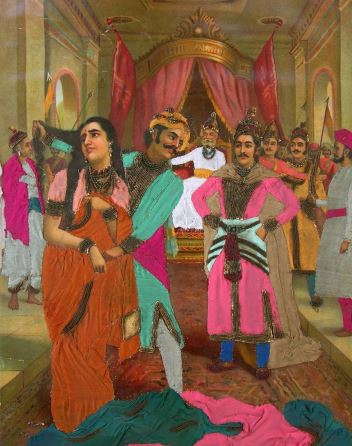
  • Raja Ravi Varma and his Arts

    Raja Rai Varma’s Draupadi Vastraharan is expected to fetch between Rs 15 and Rs 20 crore at an auction.

    Who was Raja Ravi Varma?

    • Raja Ravi Varma was born in April 1848 in Kilimanoor, Kerala, to a family which was very close to the royals of Travancore.
    • Often referred to as the father of modern Indian art, he is widely known for his realistic portrayal of Indian gods and goddesses.
    • While he majorly painted for the royalty, he is also credited for taking art to the masses with his prints and oleographs.
    • At a young age, he would draw animals and everyday scenes on the walls in indigenous colours made from natural materials such as leaves, flowers and soil.
    • His uncle, Raja Raja Varma, noticed this and encouraged his talent.
    • Patronised by Ayilyam Thirunal, the then ruler of Travancore, he learnt watercolour painting from the royal painter Ramaswamy Naidu, and later trained in oil painting from Dutch artist Theodore Jensen.

    How he became an artist of the royals?

    • Varma became a much sought-after artist for the aristocrats and was commissioned several portraits in late 19th century.
    • Arguably, at one point, he became so popular that the Kilimanoor Palace in Kerala opened a post office due to the sheer number of painting requests that would come in for him.
    • He travelled across India extensively, for work and inspiration.

    Fame as a notable painter

    • Following a portrait of Maharaja Sayajirao of Baroda, he was commissioned 14 Puranic paintings for the Durbar Hall of the new Lakshmi Vilas Palace at Baroda.
    • Depicting Indian culture, Varma borrowed from episodes of Mahabharata and Ramayana for the same.
    • He also received patronage from numerous other rulers, including the Maharaja of Mysore and Maharaja of Udaipur.
    • As his popularity soared, the artist won an award for an exhibition of his paintings at Vienna in 1873.
    • He was also awarded three gold medals at the World’s Columbian Exposition in Chicago in 1893.

    Nature of his artforms

    • Much of his celebrated art also borrows heavily from Indian mythology.
    • In fact, he is often credited with defining the images of Indian gods and goddesses through his relatable and more realistic portrayals often painted with humans as models.
    • The depictions include Lakshmi as the goddess of wealth, Saraswati as the goddess of knowledge and wisdom, and Lord Vishnu with his consorts, Maya and Lakshmi.

    How he took Indian art to the masses?

    • Raja Ravi Varma aspired to take his art to the masses and the intent led him to open a Lithographic Press in Bombay in 1894.
    • The idea, reportedly, came from Sir T Madhava Rao, former Dewan of Travancore and later Baroda, in a letter where he pointed out to Varma that since it was impossible for him to meet the large demand for his work, it would be ideal for him to send some of his select works to Europe and have them produced as oleographs.
    • Varma, instead, chose to establish a printing press of his own.
    • The first picture printed at Varma’s press was reportedly The Birth of Shakuntala, followed by numerous mythological figures and saints such as Adi Shankaracharya.

    Try this PYQ:

    Q. There are only two known examples of cave paintings of the Gupta period in ancient India. One of these is paintings of Ajanta caves. Where is the other surviving example of Gupta paintings?


    (a) Bagh caves

    (b) Ellora caves

    (c) Lomas Rishi cave

    (d) Nasik caves


    [wpdiscuz-feedback id=”x49cnsnw71″ question=”Please leave a feedback on this” opened=”1″]Post your answers here.[/wpdiscuz-feedback]


    UPSC 2022 countdown has begun! Get your personal guidance plan now! (Click here)

  • [pib] Festivals in news: Gudi Padwa

    The President of India has sent his greetings to fellow citizens on the eve of Chaitra Sukladi, Ugadi, Gudi Padwa, Cheti Chand, Navreh and Sajibu Cheiraoba.

    Gudi Padwa

    • Gudi Padwa is a spring-time festival that marks the traditional New Year for Marathi and Konkani Hindus, but is also celebrated by other Hindus as well.
    • It is celebrated in and around Maharashtra, Goa, and the union territory of Damaon on the first day of the Chaitra month, to mark the beginning of the New Year according to the luni-solar method of the Hindu calendar.
    • Padava or paadvo comes from the Sanskrit word pratipada, which is the first day of a lunar fortnight.
    • The spring festival is observed with colourful floor decorations called rangoli, a special Gudhi dvaja (flag garlanded with flowers, mango and neem leaves, topped with upturned silver or copper vessels), street processions, dancing& festive foods.

    Significance

    • Gudhi Padva signifies the arrival of spring and to the reaping of Rabi crops.
    • The festival is linked to the mythical day on which Hindu god Brahma created time and universe.
    • To some, it commemorates the coronation of Rama in Ayodhya after his victory over evil Ravana, or alternatively the start of Shalivahan calendar after he defeated the Huns invasion in the 1st century.

    State-wide celebrations

    • Bihu among the Assamese of Assam.
    • Cheti Chand among the Sindhi people
    • Navreh among the Kashmiri Pandits in Jammu and Kashmir.
    • Pahela Baishakh among the Bengalis in West Bengal and Bangladesh.
    • Puthandu among the Tamils in Tamil Nadu.
    • Samvatsar Padvo among Hindu Konkanis of Goa and Konkani diaspora in Kerala
    • Vaisakhi or Baisakhi among the Punjabis in Punjab.
    • Vishu or among the Malayalis in Kerala.
    • Ugadi among the south-Indian states of Karnataka, Andhra Pradesh and Telangana.
    • Sajibu Cheiraoba in Manipur


    UPSC 2022 countdown has begun! Get your personal guidance plan now! (Click here)