💥Join UPSC 2027,2028 Mentorship (July Batch) + XFactor Notes & Microthemes PDF

Subject: History

  • In news: Madhubani/Mithila Paintings

    An artist known as the ‘mask man’ of Bihar dispatches masks with hand-painted Madhubani motifs all over India.

    Also read:

    [Prelims Spotlight] Indian Paintings and Handicrafts

    Madhubani Paintings

    • Madhubani art (or Mithila painting) is a style of Indian painting, practised in the Mithila region of Bihar.
    • This painting is done with a variety of tools, including fingers, twigs, brushes, nib-pens, and matchsticks and using natural dyes and pigments.
    • It is characterized by its eye-catching geometrical patterns.
    • It was traditionally created by the women of various communities in the Mithila region of the Indian subcontinent.
    • This painting as a form of wall art was practised widely throughout the region; the more recent development of painting on paper and canvas mainly originated among the villages around Madhubani.
    • It is these latter developments that led to the term “Madhubani art” being used alongside “Mithila Painting.”

    Its features

    • It uses two-dimensional imagery, and the colours used are derived from plants. Ochre, Lampblack and Red are used for reddish-brown and black, respectively.
    • It mostly depicts people and their association with nature and scenes and deities from the ancient epics.
    • Natural objects like the sun, the moon, and religious plants like tulsi are also widely painted, along with scenes from the royal court and social events like weddings.
    • Generally, no space is left empty; the gaps are filled by paintings of flowers, animals, birds, and even geometric designs.
    • Madhubani art has five distinctive styles: Bharni, Kachni, Tantrik, Godna and Kohbar.
    • This painting has also received a GI (Geographical Indication) status.
  • How the US’ Trinity Test led to the dawn of the atomic age?

    On this day, exactly 75 years ago, US scientists tested ‘Gadget’— the world’s first atomic bomb — in what was dubbed as the ‘Trinity Test’.

    Practice question for mains:

    Q.What is the Manhattan Project? Describe its consequences on the post-world war scenario.

    The Trinity Test

    • The super bomb, nicknamed ‘Gadget’, was built by a team of scientists at a top-secret site in Los Alamos, New Mexico.
    • It was developed as part of the US-led Manhattan Project, which sought to build nuclear weapons to give the allied forces an edge over Germany, Japan and Italy in World War 2.
    • Very soon after the Trinity test, an identical nuclear bomb called ‘Fat Man’ was dropped on the Japanese city of Nagasaki, killing tens of thousands of people.
    • Before it detonated, the scientists had placed bets on what could happen. Some believed that the bomb would be a dud and would fail to explode.

    What was the Manhattan Project?

    • Germany initiated World War II by invading Poland.
    • A letter signed by Nobel prize-winning physicist Albert Einstein warned then-US President Franklin D Roosevelt of the potential threat posed by an atomic weapon being developed by Adolf Hitler.
    • Soon after, the US launched a secret atomic research undertaking, code-named the Manhattan Project, which sought to develop an atomic weapon to end the war.

    Execution of the project

    • The Project remained a relatively small-scale initiative for the next two years.
    • It was only after the bombing of Pearl Harbour the project was officially kicked into gear.
    • By December 1942 facilities were established in remote locations across the US, as well as in Canada.
    • However, the superbomb was finally designed and conceptualized by a team of scientists at a top-secret laboratory in Los Alamos.
    • The Los Alamos team developed two types of bombs — one was uranium-based, which was later code-named ‘the Little Boy’ before it was dropped on Hiroshima; the other had a plutonium core.

    Looping-in nuclear physicists

    • The project brought together some of the country’s leading atomic experts as well as exiled scientists and physicists from Germany and other Nazi-occupied nations.
    • The team at Los Alamos was headed by J Robert Oppenheimer, a physics professor at the University of California, Berkeley.
    • Oppenheimer later came to be known as the “father of the atomic bomb”.
    • His team included famous Danish scientist Niels Bohr and Italian scientists Enrico Fermi.

    What were the repercussions of the Trinity Test?

    • New Mexico residents were pointedly not warned before the test, to ensure that it was carried out secretly.
    • Data collected by the New Mexico health department, which showed the adverse impact of radiation caused by the detonation, was ignored for years after the test.
    • A sudden rise in infant mortality was reported in the months after the explosion. Several residents also complained that the number of cancer patients went up after the Trinity Test.
    • The dust outfall from the explosion was expected to have travelled nearly 100 miles from the test site, posing a serious threat to residents in the area.
    • Many families complained that their livestock suffered skin burns, bleeding and loss of hair.

    Impact of bombing on Japan

    • The Hiroshima and Nagasaki bombings are known to have killed well over 200,000 people — many of whom succumbed to radiation poisoning in the weeks after the blasts.
    • The uranium bomb in Hiroshima on August 6, 1945, destroyed around 70 per cent of all buildings and caused around 140,000 deaths by the end of 1945.
    • The plutonium bomb explosion over Nagasaki, which took place three days later, killed 74,000 people that year, according to International Campaign to Abolish Nuclear Weapons (ICANW) data.
    • After seeing the destruction caused to the two Japanese cities, Oppenheimer publicly admitted that he regretted building a bomb that could cause an apocalypse.

    Nuclearisation of the world thus began

    • Seventy-five years after the Trinity Test, as many as nine countries around the world are currently in possession of nuclear weapons.
    • These include the US, the UK, Russia, France, India, China, Israel, Pakistan and North Korea.
    • At least eight countries have detonated over 2,000 nuclear test explosions since 1945.
    • The most recent instance of nuclear bomb test explosions conducted by India, were the series of five explosions done as part of the Pokhran-II tests in May 1998.
    • The first test, code-named Smiling Buddha, took place in May 1974.
  • Who are the Tangams?

    Last week Arunachal CM released a book titled “Tangams: An Ethnolinguistic Study Of The Critically Endangered Group of Arunachal Pradesh”.

    Try this question from CSP 2019:

    Q.Consider the following statements about Particularly Vulnerable Tribal Groups (PVTGs) in India:

    1. PVTGs reside in 18 States and one Union Territory.
    2. A stagnant or declining population is one of the criteria for determining PVTG status.
    3. There are 95 PVTGs officially notified in the country so far.
    4. Irular and Konda Reddi tribes are included in the list of PVTGs.

    Which of the statements given above are correct?

    (a) 1, 2 and 3

    (b) 2, 3 and 4

    (c) 1, 2 and 4

    (d) 1, 3 and 4

    Who are the Tangams?

    • The Tangams is a little-known community within the larger Adi tribe of Arunachal Pradesh and resides in the hamlet of Kugging in Upper Siang district’s Paindem circle.
    • In 1975, the community’s population was pegged at 2,000 spread across 25 villages.
    • From 2016 to 2020, a team from the Centre for Endangered Languages (CFEL) of Rajiv Gandhi University (RGU), carried out extensive field research and documented the community.
    • Their survey revealed that Tangams were now concentrated in only one village (Kugging), with only 253 reported speakers.
    • As per the UNESCO World Atlas of Endangered Languages (2009), Tangam — an oral language that belongs to the Tani group, under the greater Tibeto-Burman language family — is marked ‘critically endangered’.

    Why are there only a few speakers?

    • Kugging is surrounded by a number of villages inhabited by Adi subgroups such as Shimong, Minyongs, as well as the Buddhist tribal community of Khambas, among others.
    • To communicate with their neighbours over the years, the Tangams have become multilingual, speaking not just Tangam, but other tongues such as Shimong, Khamba and Hindi.
    • They rarely speak their own language now since their population is restricted to a single village. Moreover, the Tangams are relatively unknown — even within their state.
    • The village lacks proper infrastructure in all basic sectors of education, health, drinking water facilities, road and electricity. Roads have reached Kugging only in 2018.
    • Not a single person from the community has gone to university.

    Why are the languages at risk?

    • The diversity of languages has led various communities to depend on English, Assamese and colloquial variety of Hindi called Arunachalee Hindi as the link languages.
    • Many believe this shift has led to the loss of native languages of the tribal communities.
    • Even the numerically larger tribes like Nyishi, Galo, Mishmi, Tangsa etc. whose population exceed the ten thousand mark are also not safe from endangerment, hence marked unsafe.
    • The younger generation of these tribes especially in the urban areas has mostly discarded the use of their mother tongue.
  • [pib] Mongolian Kanjur Manuscripts

    The Ministry of Culture has taken up the project of reprinting of 108 volumes of Mongolian Kanjur under the National Mission for Manuscripts (NMM).  The first sets of five volumes were presented to the President of India.

    Try this question from CSP 2011:

    Q.India maintained its early cultural contacts and trade links with Southeast Asia across the Bay of Bengal. For this preeminence of early maritime history of Bay of Bengal, which of the following could be the most convincing explanation/explanations?

    (a) As compared to other countries, India had a better ship-building technology in ancient and medieval times.

    (b) The rulers of southern India always patronized traders, Brahmin priests and Buddhist monks in this context.

    (c) Monsoon winds across the Bay of Bengal facilitated sea voyages.

    (d) Both (a) and (b) are convincing explanations in this context.

    Mongolian Kanjur

    • Mongolian Kanjur, the Buddhist canonical text in 108 volumes is considered to be the most important religious text in Mongolia.
    • In the Mongolian language ‘Kanjur’ means ‘Concise Orders’- the words of Lord Buddha in particular. It has been translated from Tibetan.
    • It is held in high esteem by the Mongolian Buddhists and they worship the Kanjur at temples and recite the lines of Kanjur in daily life as a sacred ritual.
    • The Kanjur is kept almost in every monastery in Mongolia.
    • The language of the Kanjur is Classical Mongolian and it is a source of providing a cultural identity to Mongolia.

    About National Mission for Manuscripts

    • The Mission was launched in February 2003 under the Ministry of Tourism and Culture, with the mandate of documenting, conserving and disseminating the knowledge preserved in the manuscripts.
    • One of the objectives of the mission is to publish rare and unpublished manuscripts so that the knowledge enshrined in them is spread to researchers, scholars and the general public at large.
    • Under this scheme, reprinting of 108 volumes of Mongolian Kanjur has been taken up by the Mission.
  • What is the Hagia Sophia?

    Turkey’s highest court this week convened to decide whether Istanbul’s iconic Hagia Sophia museum can be turned into a mosque.

    Try this question:

    Q. The iconic Hagia Sophia, a UNESCO World Heritage site was recently in news. It is situated in:

    a) Greece b) Turkey c) Israel d) Iran

    What is the Hagia Sophia?

    • The construction of this iconic structure in Istanbul started in 532 AD during the reign of Justinian I, the ruler of the Byzantine Empire when the city was known as Constantinople.
    • The structure was originally built to become the seat of the Patriarch of the Eastern Orthodox Church and remained so for approximately 900 years.
    • In 1453, when Constantinople fell to Sultan Mehmet II’s Ottoman forces, the Hagia Sophia was ransacked by the invading forces and turned into a mosque shortly after.
    • For a long time, the Hagia Sophia was Istanbul’s most important mosque.
    • The 1,500-year-old structure, listed as a UNESCO World Heritage site, was originally a cathedral before it was turned into a mosque.

    What is the controversy about?

    • In the 1930s, Mustafa Kemal Ataturk, the founder of the Republic of Turkey, shut down the mosque and turned it into a museum in an attempt to make the country more secular.
    • There have been calls for long from extremists groups to convert the Hagia Sophia back into a mosque.
  • Festival in news: Bahuda Yatra

    The Bahuda Yatra, the return journey of the deities to the Puri Jagannath temple after the annual Rath Yatra, was recently concluded amid permitted restrictions.

    Bahuda Yatra

    • A/c to folk stories Lord Jagannath and his siblings, Goddess Shubhadra and Lord Balabhadra, returns from their aunt’s place at Gundicha Temple to Jagannath Temple.
    • This journey is known as Bahuda Yatra.
    • Nine days after the Rath Yatra, the yatra or the return journey takes place.

    About Jagannath Rath Yatra

    • Ratha Jatra, the Festival of Chariots of Lord Jagannatha is celebrated every year at Puri, the temple town in Orissa, on the east coast of India.
    • It involves a public procession with a chariot with deities Jagannath (Vishnu avatar), BalaBhadra (his brother), Subhadra (his sister) and Sudarshana Chakra (his weapon) on a ratha, a wooden deula-shaped chariot.
    • The huge, colourfully decorated chariots, are drawn by hundreds and thousands of devotees on the bada danda, the grand avenue to the Gundicha temple, some two miles away to the North.
    • It attracts over a million Hindu pilgrims who join the procession each year.

    Back2Basics: Puri Temple Architecture

    • Jagannath Temple is a very big temple and covers an area of 37000m2. The height of the outer wall is 6.1m.
    • It is surrounded by a high fortified wall 6.1 m high is known as Meghanada Pacheri.
    • The main portion of the temple is also surrounded by a wall known as Kurma Bheda.
    • The temple is built in Rekha Deula style and has four distinct sectional structures, namely –
    1. Deula, Vimana or Garba griha (Sanctum sanctorum) where the triad deities are lodged on the ratnavedi (Throne of Pearls)
    2. Mukhashala (Frontal porch)
    3. Nata mandir/Natamandapa, which is also known as the Jagamohan (Audience Hall/Dancing Hall), and
    4. Bhoga Mandapa (Offerings Hall)

    Try this question from CSP 2019:

    Q.Building ‘Kalyaana Mandapas’ was a notable feature in the temple construction in the kingdom of-

    (a) Chalukya (b) Chandela (c) Rashtrakuta (d) Vijayanagara

  • In news: Santhal Rebellion

    Covid-19 pandemic has led to the cancellation of annual public observance of Hul in Jharkhand.

    Try this question from CSP 2018:

    Q.After the Santhal uprising subsided, what was/ were the measure/measures taken by the colonial government?

    1. The territories called ‘Santhal Paraganas’ were created.
    2. It became illegal for a Santhal to transfer land to a non Santhal.

    Select the correct answer using the code given below:

    (a) 1 only

    (b) 2 only

    (c) Both 1 and 2

    (d) Neither 1 nor 2

    Hul Divas

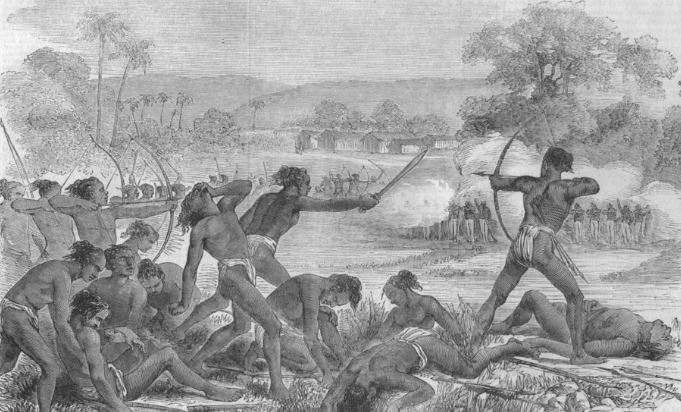
    • Hul Divas is observed annually on June 30 in memory of tribals — Sidho and Kanhu Murmu — who led the Santhal Hul (rebellion) on June 30, 1855, at Bhognadih in Sahebganj district.

    About Santhal Rebellion

    • The Santhals of Rajmahal Hills resented the oppression by revenue officials, police, money-lenders, and landlords—in general, by the “outsiders’ (whom they called diku).
    • The Santhals under Sido and Kanhu rose up against their oppressors, declared the end of the Company’s rule and asserted themselves independent in 1854.
    • It was only in 1856 after extensive military operations that the situation was brought under control. Sido died in 1855, while Kanhu was arrested in 1866.
    • A separate district of Santhal Parganas was created by the Government to pacify the Santhals.

    Must read:

    Tribal Issues | Part 2 | Pre Independence Tribal Revolts

  • The spirit of ‘Lal-Bal-Pal’ in Indian History

    To commemorate the death centenary of Tilak, a Pune based NGO is set to revive the Independence-era spirit of the ‘Lal-Bal-Pal’, named after nationalists Lala Lajpat Rai, ‘Lokmanya’ Bal Gangadhar Tilak and Bipin Chandra Pal.

    Try this PYQ from CSP 2010:

    Q. What was the immediate cause for the launch of the Swadeshi movement?

    (a) The partition of Bengal done by Lord Curzon.

    (b) A sentence of 18 months of rigorous imprisonment imposed on Lokmanya Tilak.

    (c) The arrest and deportation of Lala Lajpat Rai and Ajit Singh; and passing of the Punjab ColonizationBill.

    (d) Death sentence pronounced on the Chapekarbrothers.

    About Lal-Bal-Pal

    • Lal Bal Pal was a triumvirate of assertive nationalists in British-ruled India in the early 20th century, from 1906 to 1918.
    • They advocated the Swadeshi movement involving the boycott of all imported items and the use of Indian-made goods in 1907 during the anti-Partition agitation in Bengal which began in 1905.
    • The final years of the nineteenth century saw a radical sensibility emerge among some Indian intellectuals.
    • This position burst onto the national all-India scene in 1905 with the Swadeshi movement – the term is usually rendered as “self-reliance” or “self-sufficiency”.

    Their Legacy

    • Lal-Bal-Pal mobilized Indians across the country against the Bengal partition, and the demonstrations, strikes and boycotts of British goods that began in Bengal soon spread to other regions in a broader protest against the Raj.
    • The nationalist movement gradually faded with the arrest of its main leader Bal Gangadhar Tilak and retirement of Bipin Chandra Pal and Aurobindo Ghosh from active politics.
    • While Lala Lajpat Rai suffered from injuries, due to British police superintendent, James A. Scott, ordered the British Indian police to lathi charge and personally assaulted Rai; he died on 17 November 1928.

    Back2Basics:

    Lala Lajpat Rai

    • Born in undivided Punjab on 28 January 1865, Lala Lajpat Rai grew up in a family that allowed the freedom of faith.
    • Even before he focused his efforts towards a self-sufficient India, Rai believed in the principle.
    • In 1895, he started the Punjab National Bank—the first Indian bank to begin solely with Indian capital, and that continues to function till date.
    • Rai had travelled to America in 1907 and immediately caught up similarities between the ‘colour-caste’ practised there and the caste system prevalent in India.
    • In 1917, he even founded the Indian Home Rule League of America there.
    • His proactive, brave participation in the protest earned him the title of the Lion of Punjab or Punjab Kesari.

    Bal Gangadhar Tilak

    • Bal Gangadhar Tilak (23 July 1856 – 1 August 1920) was an Indian nationalist, teacher, and an independence activist
    • In 1884, he founded the Deccan Education Society in Pune, and under the banner, opened the New English School for primary studies and Fergusson College for higher education.
    • His involvement in the educational institutions was to emphasise on the cultural revival of young Indian minds.
    • For the British, Tilak was the “Father of the Indian Unrest.”
    • When the Indian National Congress was divided among moderates and extremes—the stand that each member took against the British government—there was no doubt which side Tilak supported.
    • Literary works: Kesari and Maratha newspapers

    Bipin Chandra Pal

    • The father of revolutionary thoughts, Bipin Chandra Pal, was born to a wealthy family in Sylhet, Bengal Presidency (now in Bangladesh).
    • Pal was a journalist by profession and often contributed to several newspapers.
    • He used his literary expertise to write against the use of British goods, advocating Indians to start using Swadeshi goods instead.
    • He was of a strong opinion that a mass reliance on Swadeshi goods would help people get rid of their poverty.
  • Why Russia celebrates WWII triumph on a different date?

    Raksha Mantri is on a three-day trip to Russia to attend the 75th Victory Day. India has sent a tri-services contingent to participate in the Victory Day Parade.

    Try these questions from CS Mains:

    Q.To what extent can Germany be held responsible for causing the two World Wars? Discuss critically. (CSM 2015)


    Q.The New Economic Policy – 1921 of Lenin had influenced the policies adopted by India soon after independence. Evaluate. (CSM 2014)

    What is Victory Day?

    • Victory Day marks the end of World War II and the victory of the Allied Forces in 1945.
    • Adolf Hitler had shot himself on April 30. On May 7, German troops surrendered, which was formally accepted the next day and came into effect on May 9.
    • In most European countries, it is celebrated on May 8 and is called the Victory in Europe Day.

    Why does Russia not celebrate Victory Day on the same date?

    • The erstwhile Soviet Union had not wanted the surrender to take place in the west and wanted that such a significant event should reflect the contribution of the Red Army and the Soviet population.
    • According to historians, Joseph Stalin, premier of the Soviet Union, wanted Germany to also sign surrender in Berlin.
    • Since crowds were already gathering in London to celebrate, Victory in Europe Day celebration in Britain would take place on 8 May, as they did in the United States.
    • This did not convince Stalin, who argued that Soviet troops were still fighting the German forces in many areas.
    • German soldiers did not surrender in East Prussia, Courland Peninsula, Czechoslovakia till later. Hence victory celebration could therefore not begin in the Soviet Union even after May 9.

    If May 9 is Victory Day, why is it being celebrated on June 24?

    • This year, the celebrations this year were pushed to June because of the Covid-19 pandemic.
    • After winning the war and having its own Victory Day on May 9, Stalin wanted to commemorate the victory with a military parade.
    • On June 22, 1945, he ordered the commemoration of the victory over Germany to hold the victory parade on June 24, 1945, in Moscow’s Red Square.
    • Hence the first Victory Day Parade took place on June 24 in Moscow. However, since then, the Parades have taken place on May 9.
  • 100 Years of Malabar Rebellion

    With the 1921 Malabar Rebellion turning 100 next year, several movies have been announced back-to-back.

    Try this question from CSP 2015:

    Q. Which amongst the following provided a common factor for tribal insurrection in India in the 19th century?

    (a.) Introduction of a new system of land revenue and taxation- of tribal products

    (b.) Influence of foreign religious missionaries in tribal areas

    (c.) Rise of a large number of money lenders, traders and revenue farmers as middlemen in tribal areas

    (d.) The complete disruption of the old agrarian order of the tribal communities

    What is the Malabar Rebellion?

    • The Malabar Rebellion in 1921 started as resistance against the British colonial rule and the feudal system in southern Malabar but ended in communal violence between Hindus and Muslims.
    • There were a series of clashes between Mappila peasantry and their landlords, supported by the British, throughout the 19th and early 20th centuries.
    • It began as a reaction against a heavy-handed crackdown on the Khilafat Movement, a campaign in defence of the Ottoman Caliphate by the British authorities in the Eranad and Valluvanad taluks of Malabar.
    • The Mappilas attacked and took control of police stations, British government offices, courts and government treasuries.

    Also in news:

    Variyankunna Kunjahammed Haji

    • He was one of the leaders of the Malabar Rebellion of 1921.
    • He raised 75000 natives, seized control of large territory from the British rule and set up a parallel government.
    • In January 1922, under the guise of a treaty, the British betrayed Haji through his close friend Unyan Musaliyar, arresting him from his hideout and producing him before a British judge.
    • He was sentenced to death along with his compatriots.