💥Join UPSC 2027,2028 Mentorship (July Batch) + XFactor Notes & Microthemes PDF

Subject: History

  • Sukapha: The founder of Ahom kingdom

    Recently, Assam CM ordered the arrest of a political commentator who had described Chaolung Sukapha as a “Chinese invader”.

    Practice question for mains:

    Q. Who are the Ahoms? Describe the role of Ahom Kingdom in cultural assimilation of modern-day Assam.

    Who was Chaolung Sukapha?

    • Sukapha was a 13th-century ruler who founded the Ahom kingdom that ruled Assam for six centuries. Contemporary scholars trace his roots to Burma.
    • He reached Brahmaputra valley in Assam from upper Burma in the 13th century with around 9,000 followers.
    • Sukapha is said to have left a place called Maulung ( in Yunnan, China ) in AD 1215 with eight nobles and 9,000 men, women and children — mostly men.
    • In 1235, Sukapha and his people settled in Charaideo in upper Assam after wandering about for years, defeating those who protested his advance and temporarily staying at different locations.
    • It was in Charaideo (in Assam) that Sukapha established his first small principality, sowing the seeds of further expansion of the Ahom kingdom.

    Who are the Ahoms today?

    • The founders of the Ahom kingdom had their own language and followed their own religion.
    • Over the centuries, the Ahoms accepted the Hindu religion and the Assamese language, scholars say.
    • The Ahoms embraced the language, religion and rituals of the communities living here — they did not impose theirs on those living here.
    • Today, the Ahom community is estimated to number between 4 million and 5 million.

    Why is Sukapha important in Assamese culture?

    • Sukapha’s significance — especially in today’s Assam — lies in his successful efforts towards the assimilation of different communities and tribes.
    • He developed very amicable relationships with the tribal communities living here — especially the Sutias, the Morans and the Kacharis.
    • Intermarriage also increased assimilation processes. He is widely referred to as the architect of “Bor Asom” or “greater Assam”.
  • Kodumanal Megalithic Burial Site

    The Kodumanal excavation in Erode Dist. of Tamil Nadu has threw light on burial rituals and the concept of afterlife in megalithic culture.

    Must read:

    Chapter 1 | Stone Age – Paleolithic, Mesolithic and Neolithic

    About these sites

    • The researchers have identified 250 cairn-circles at the village in Erode district.
    • Earlier excavations revealed that the site served as a trade-cum-industrial centre from 5th century BCE to 1st century BCE.
    • The rectangular chambered cists, each two metres long and six metres wide, are made of stone slabs, and the entire grave is surrounded by boulders that form a circle.
    • The grave could be of a village head or the head of the community as the size of two boulders, each facing east and west, are bigger than other boulders.
    • Believing that the deceased person will get a new life after death, pots and bowls filled with grains were placed outside the chambers.

    What are Megaliths?

    • Megaliths are the earliest surviving man-made monuments we know of—derived from the Latin mega (large) and lith (stone).
    • Megaliths were constructed either as burial sites or commemorative (non-sepulchral) memorials.
    • The former are sites with actual burial remains, such as dolmenoid cists (box-shaped stone burial chambers), cairn circles (stone circles with defined peripheries) and capstones (distinctive mushroom-shaped burial chambers found mainly in Kerala).
    • The urn or the sarcophagus containing the mortal remains was usually made of terracotta.
    • Non-sepulchral megaliths include memorial sites such as menhirs. (The line separating the two is a bit blurry, since remains have been discovered underneath otherwise non-sepulchral sites, and vice versa.)
    • In India, archaeologists trace the majority of the megaliths to the Iron Age (1500 BC to 500 BC), though some sites precede the Iron Age, extending up to 2000 BC.

    Megaliths in India

    • Megaliths are spread across the Indian subcontinent, though the bulk of them are found in peninsular India, concentrated in the states of Maharashtra (mainly in Vidarbha), Karnataka, Tamil Nadu, Kerala, Andhra Pradesh and Telangana.
    • According to archaeologists around 2,200 megalithic sites can be found in peninsular India itself, most of them unexcavated.
    • Even today, a living megalithic culture endures among some tribes such as the Gonds of central India and the Khasis of Meghalaya.

    Literary sources

    • Megalithic culture finds several references in ancient Tamil Sangam literature. For instance, menhirs are referred to as nadukal.
    • Ancient Sangam texts lay out, in detail, a step-by-step procedure for laying a memorial stone or nadukal in honour of a fallen hero.
    • Manimekalai (5th century AD), the famous Sangam epic, refers to the various kinds of burials namely cremation (cuṭuvōr), post excarnation burial (iṭuvōr), burying the deceased in a pit (toṭukuḻip paṭuvōr), rock chamber or cist burial (tāḻvāyiṉ aṭaippōr), urn burial encapped with lid (tāḻiyiṟ kavippōr).
    • Even in the Sangam age (when kingship and a well-ordained society had emerged) the above modes of burials survived.
  • What is Axone?

    A movie named Axone — also spelt akhuni —soya bean dish of Nagaland has been recently released.

    The traditional ‘Axone’ dish is very unique in itself. However, one must note that it does NOT carry any GI tag. Still, there is a possibility of it being asked in match the pair type questions.

    What is Axone?

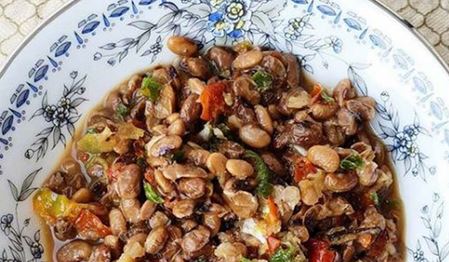
    • Axone — also spelt akhuni — is a fermented soya bean of Nagaland, known for its distinctive flavour and smell.
    • As much an ingredient as it is a condiment, Axone used to make pickles and chutneys, or curries of pork, fish, chicken, beef etc.
    • While it is called ‘axone’ in parts of Nagaland, fermented soya bean is cooked with, eaten and known by different names in different parts of Northeast India, including Meghalaya and Mizoram, Sikkim, Manipur as well in other South, Southeast and East Asian countries.
    • Axone is prepared and eaten across Nagaland but is particularly popular among the Sumi (also Sema) tribe. They use it in every meal.
  • Traditional art of Talamaddale

    The traditional art of ‘Talamaddale’, a variant of Yakshagana theatre, has gone virtual in times of COVID-19.

    Try this question from CSP 2017:

    Q.With reference to Manipuri Sankirtana, consider the following statements:

    1. It is a song and dance performance.
    2. Cymbals are the only musical instruments used in the performance.
    3. It is performed to narrate the life and deeds of Lord Krishna.

    Which of the statements given above is/are correct?

    (a) 1, 2 and 3.

    (b) 1 and 3 only

    (c) 2 and 3 only

    (d) 1 only

    Talamaddale theatre

    • Tala-Maddale is an ancient form of performance dialogue or debate performance in Southern India in the Karavali and Malnad regions of Karnataka and Kerala.
    • The plot and content of the conversation is drawn from popular mythology but the performance mainly consists of an impromptu debate between characters involving sarcasm, puns, philosophy positions and humour.
    • The main plot is sung from the same oral texts used for the Yakshgana form of dance- drama.
    • Performers claim that this was a more intellectual rendition of the dance during the monsoon season.

    How it is different from Yakshagana?

    • Unlike the Yakshagana performance, in the conventional ‘talamaddale,’ the artists sit across in a place without any costumes and engage in testing their oratory skills based on the episode chosen.
    • If music is common for both Yakshagana performance and ‘talamaddale’, the latter has only spoken word without any dance or costumes.
    • Hence it is an art form minus dance, costumes and stage conventions.
    • It has an ‘arthadhari’ who is an orator, a ‘bhagavatha’ (singer-cum-director), and a ‘maddale’ player.

    Back2Basics: Yakshagana

    • It is the oldest theatre form popular in Karnataka.
    • It emerged in the Vijayanagara Empire and was performed by Jakkula Varu
    • It is a descriptive dance drama.
    • It is presented from dusk to dawn.
    • The stories are drawn from Ramayana, Mahabharata and other epics from both Hindu and Jain tradition.
  • Discuss in detail the various policies and programmes aimed to preserve and promote languages, folk dance, Art and culture of tribals in the country. 10 marks

    Mentor’s comment-

    • In introduction we have to briefly explain why we should preserve and promote our language and culture in general.
    • The question is pretty much straight forward and in the body one must discuss the relevance of preserving and promoting the language, culture and art of the tribals. List out various schemes and policies in this direction – Guru Shishya Parampara, shilpgram, octave, National Cultural Exchange Programme (NCEP) etc.
    • We have to conclude  our answer by reasserting the significance of such schemes and policies.

    Answer-

    Introduction:
    India has traditionally been the home of different cultures and people. Unity in diversity is one of the most prominent features in the people of India. Among the diversified population a significant portion is comprised of the tribal people, the original inhabitants of the land. The tribal culture of India and their traditions and practices pervade almost all of the aspects of Indian culture and civilization.
    Body:
    To preserve & promote various forms of folk art and culture of the tribals throughout the country, the Government of India has set up seven Zonal Cultural Centres (ZCCs) with headquarters at Patiala, Nagpur, Udaipur, Prayagraj, Kolkata, Dimapur and Thanjavur. These ZCCs organize various cultural activities and programme all over the country on regular basis. These ZCCs under Ministry of Culture are also implementing a number of schemes for promoting the folk/tribal art and culture,details of which are as below
     Award to Young Talented Artists: The Scheme “Young Talented Artists” is carried out to encourage and recognize the young talents especially in the field of rare art forms. Talented youngsters of the age group of 18-30 years are selected and given a onetime cash award of Rs.10,000/-.

     Guru Shishya Parampara: This scheme envisages transmitting our valued traditions to the coming generations. Disciples are trained under veterans in art forms which are rare and vanishing. Rare and vanishing art forms of the region are identified and eminent exponents are selected to carry out the training programme in ‘Gurukula’ tradition. The monthly remuneration for Guru – Rs. 7,500/-, Accompanist – Rs. 3,750/- and Pupils – Rs. 1,500/- each for the period of six month to maximum 1 year for one scheme. The names of the Gurus are recommended by the State Cultural Affairs Departments.
     Theatre Rejuvenation: To promote theatre activities including stage shows and Production oriented workshops, etc. Honorarium Up to Rs. 30,000/- per show excluding TA & DA is paid. The groups finalized on the basis their credentials as well as the merit of project submitted by them.
     Research & Documentation: To preserve promote and propagate vanishing visual and performing art forms including folk, tribal and classical in the field of music, dance, theatre, literature, fine arts etc. in print/ audio – visual media. The art form is finalized in consultation with state Cultural Department.
     Shilpgram: To promote folk and tribal art and crafts of the zone by organizing seminar,workshops, exhibitions, craft fairs, design development and marketing support to the artisans living in the rural areas.
     Octave: To promote and propagate the rich cultural heritage of North East region comprising of eight States namely Arunachal Pradesh, Assam, Meghalaya, Mizoram, Sikkim, Nagaland, Manipur
    and Tripura to the rest of India.
     National Cultural Exchange Programme (NCEP): It can be termed as the lifeline of the Zonal Cultural Centers. Under this scheme, various festivals of performing arts, exhibitions, yatras etc are organized in member States. Artists from other zones/states are invited to participate in these programme. Participation of artists from the Zone in festivals held in other parts of the country are also facilitated. Zonal centers also participate in Major festivals happening in member States by arranging performances during these festivals where large number of audience get chance to enjoy and understand art forms of other regions. These festivals provide opportunity to taste and understand various cultures of our country.
    Conclusion:
    Tribal culture in India should be appreciated to understand the uniqueness of their culture. Warm hospitality, simple ways of living and sincere judgment of the opinions are some of the traits that mark the tribal cultures of India. Their custom depicts their belief in simplicity. Most of the tribes in India have their own gods and goddesses that reflects the dependence of Tribal people on nature. Except for the few most of the tribes in India is sociable, hospitable, and fun loving along with strong community bonds. Some of the tribes shares patriarchal cultural ties and some of the tribal societies are women oriented. They have their own festivals and celebrations. The tribal people are clinging to their identity despite of the external influences that threatened the tribal culture especially after their post-independence turbulent period.

  • In news: Raja Parba Festival

    The Prime Minister has extended his greetings to the people of Odisha for the unique Raja Parba festival.

    Match the pair based question can be asked from festivals as such with pairs of name and celebrating state. Recently, the following festivals were also in the news: Ambubachi Mela, Thrisoor Puram, Meru Jatara, Nagoba Jatara etc.

    Also, note the similarities between the Raja Parba and Ambubachi Mela …

     About Raja Parba Festival

    • Raja Parba is Odisha’s three-day unique festival celebrating the onset of monsoon and the earth’s womanhood.
    • As a mark of respect towards the earth during her menstruation days, all agricultural works, like ploughing, sowing is suspended for the three days.
    • Raja Sankranti is the first day of the Ashara month.
    • It is celebrated on the day prior to the Sankranti, (Pahili Raja), the day of Sankranti, and the day after, known as Bhu Daha or ‘Basi Raja.
    • The festival is essentially the celebration of the earth’s womanhood.
    • It is believed that during this time the Mother Earth or Bhudevi undergoes menstruation.
    • The fourth day is the day of the ‘purification bath’.
    • As it is a celebration of womanhood, a lot of the focus is on young women, who wear new clothes, apply ‘Alata’ on their feet and enjoy folk songs while swinging on decorated rope swings.


  • Tribes in news: Changpa Tribe

    The Chinese Army’s intrusion in Chumur and Demchok has left Ladakh’s nomadic herding Changpa community cut off from large parts of summer pastures.

    Pashmina shawl is a landmark product of the Kashmir Valley. But make a note here. It carries only a BIS certification and not a Geographical Indicator.

    Also try this PYQ from CSP 2014:

    Q. With reference to ‘Changpa’ community of India, consider the following statement:

    1. They live mainly in the State of Uttarakhand.
    2. They rear the Pashmina goats that yield fine wool.
    3. They are kept in the category of Scheduled Tribes.
    Which of the statements given above is/are correct?

    a) 1 only
    b) 2 and 3 only
    c) 3 only
    d) 1, 2 and 3

    Changpa Tribes

    • The Changpa of Ladakh is high altitude pastoralists, raising mainly yaks and goats.
    • Among the Ladakh Changpa, those who are still nomadic are known as Phalpa, and they take their herds from in the Hanley Valley to the village of Lato.
    • Hanley is home to six isolated settlements, where the sedentary Changpa, the Fangpa reside.
    • Despite their different lifestyles, both these groups intermarry.
    • The Changpa speak Changskhat, a dialect of Tibetan, and practice Tibetan Buddhism.

    What is the issue?

    • The Chinese Army has taken over 16 kanals (two acres) of cultivable land in Chumur and advanced around 15 km inside Demchok, taking over traditional grazing pastures and cultivable lowlands.
    • In a cascading effect, this has resulted in a sharp rise in deaths of young Pashmina goats this year in the Korzok-Chumur belt of Changthang plateau in Ladakh.
    • This incursion has destabilized the annual seasonal migration of livestocks, including yaks and Pashmina goats.

    Back2Basics: Pashmina

    • The Changthangi or Ladakh Pashmina is a breed of Cashmere goat native to the high plateau of Ladakh.
    • The much-valued wool from the Ladakh herds is essential for the prized Pashmina shawls woven in Kashmir and famous for their intricate handwork.
    • They survive on the grass in Ladakh, where temperatures plunge to as low as −20 °C.
    • These goats provide the wool for Kashmir’s famous pashmina shawls. Shawls made from Pashmina wool are considered very fine and are exported worldwide.
    • Bureau of Indian Standards (BIS) has recently published an Indian Standard for identification, marking and labelling of Pashmina products to certify its purity.
  • Festivals in news: Kheer Bhawani Mela

    In the UT of Jammu and Kashmir, the Annual Kheer Bhawani Mela in Tulmulla village of Ganderbal district has been cancelled by its religious trust.

    Match the pair based question can be asked from festivals as such. Recently, the following festivals were in the news: Ambubachi Mela, Thrisoor Puram, Meru Jatara, Nagoba Jatara etc.

    Try this:

    Q. Consider the following pairs:

    Traditions                                            Communities

    1. Chaliha Sahib Festival              —          Sindhis

    2. Nanda Raj Jaat Yatra                —          Gonds

    3. Wari-Warkari                               —          Santhals

    Which of the pairs given above is/are correctly matched ? (CSP 2017)

    (a) 1 only

    (b) 2 and 3 only

    (c) 1 and 3 only

    (d) None of the above

    Kheer Bhawani Mela

    • The festival witnesses lakhs of Hindu pilgrims from across the country largely the Kashmiri Pandit Community, who throngs the famous Ragyna Devi Temple which is popularly known as “Mata Kheer Bhawani”.
    • The festival falls on the auspicious day of “Zeshta Ashtami”.
    • The term kheer refers to rice pudding that is offered in the spring to propitiate the Goddess, which became part of the name of the temple.
    • The devotees have been asked to cooperate with the authorities and perform the worship of the Goddess at their homes only.
    • However, the holy rituals and Aarti of the Deity will be conducted as per the tradition which will be shared with the devotees via social media.

    Significance

    • Kheer Bhawani Mela is one of the biggest religious functions of Kashmiri Pandit Community.
    • It is believed and rather has been seen that the colour of the water in the spring around the Kheer Bhawani Temple changes its colour with the change in the circumstances of the Kashmir valley.
  • Purandara Dasa and his legacy

    The Department of Archaeology, Karnataka has commenced field research work regarding the birthplace of Purandara Dasa who is held as the father figure of Carnatic music.

    Recently there was a news on Lord Basaveshwara. Now comes the other popular saint.

    Vaishnavism and Shaivism are the two most profound strands of Bhakti Movement in Indian history. Enlist all the Bhakti Saints and their theistic philosophy and teachings. Try to spot the minute differences between them.

    Purandara Dasa

    • Purandara Dasa (1484 –1565) was a Haridasa, a renowned composer of Carnatic music, a great devotee of the Supreme Lord Krishna, a Vaishnava poet, a saint and a social reformer.
    • He was a disciple of the Dvaita philosopher-saint Vyasatirtha, and a contemporary of yet another Haridasa, Kanakadasa.
    • He was a composer, singer and one of the chief founding-proponents of South Indian classical music (Carnatic music).
    • In honour of his significant contributions to Carnatic music, he is widely referred to as the Pitamaha (lit. “father” or “grandfather”) of Carnatic music.
    • He is respected as an Avatara (incarnation) of the great sage Narada (a celestial being who is also a singer).

    Confusions over his birthplace

    • As ‘Purandara Vithala’ was the pen name of his compositions, it was widely believed that the mystic poet was born in Purandar (near Pune), Maharashtra.
    • However, many in Malnad claimed that he hailed from this region.
    • According to historians, Araga in Malnad was a buzzing commercial centre during the Vijayanagar rule, the period to which the poet belonged to.
    • Prior to his initiation to Haridasa tradition, Purandara Dasa was a rich merchant and was called as Srinivasa Nayaka.

    Back2Basics: Bhakti Movement

    • The Bhakti movement refers to the theistic devotional trend that emerged in medieval Hinduism.
    • It originated in eighth-century south India and spread northwards.
    • It swept over east and north India from the 15th century onwards, reaching its zenith between the 15th and 17th century CE.
    • It has traditionally been considered as an influential social reformation in Hinduism and provided an individual-focused alternative path to spirituality regardless of one’s birth or gender
    • The salvation which was previously considered attainable only by men of Brahmin, Kshatriya and Vaishya castes, became available to everyone.
  • Rail adukku pathiram Utensils of Tamil Nadu

    The rail adukku pathiram a traditional set of kitchen utensils in Tamil Nadu has become the gathered attention of all over the past few days.

    The traditional ‘rail adukku pathiram’ set of utensils are very unique in itself. However, one must note that it does NOT carry any GI tag and is completely out of use. Still, there is a possibility of it being asked in match the pair type questions asking – Q) Which among the following artefacts from Tamil Nadu carries a GI Tag?

    Rail adukku pathiram

    • The rail adukku pathiram consists of 14 vessels of different sizes, neatly placed in a compact manner inside the largest container.
    • The vessels were earlier used by families to carry groceries and cook food during train journeys.
    • These vessels were used to cook food for a mini-wedding. The interesting aspect is the compact size and easy to carry.
    • It has two vessels to cook vegetables, a sippal plate to boil rice, a frying pan, a sombu, a bronze pot to carry water and vessels of varying sizes to cook food.
    • Many in Tamil Nadu had forgotten about the existence of these multi-layered vessels until a video surfaced online recently.