💥Join UPSC 2027,2028 Mentorship (July Batch) + XFactor Notes & Microthemes PDF

Subject: History

  • Person in news: Ramkinkar Baij

    Ministry of Culture’s has organised virtual tour titled “Ramkinkar Baij | Journey through silent transformation and expressions” to commemorate his 115th Birth Anniversary.

    We can expect a description based question in prelims like-

    Q. “In 1925, he made his way to Kala Bhavana, the art school at Santiniketan and was under the guidance of Nandalal Bose. Encouraged by the liberating, intellectual environment of (Tagore’s) Santiniketan, his artistic skills and intellectual horizons blossomed, thus acquiring greater depth and complexity. One of the earliest modernists in Indian art, he assimilated the idioms of the European modern visual language and yet was rooted in his own Indian ethos.”

    Who is the imminent personality discussed?

    Who was Ramkinkar Baij?

    • Ramkinkar Baij (1906-1980), one of the most seminal artists of modern India, was an iconic sculptor, painter and graphic artist.
    • He was born in Bankura, West Bengal, into a family of little economic and social standing and grew by his sheer determination into one of the most distinguished early modernists of Indian art.
    • In 1925, he made his way to Kala Bhavana, the art school at Santiniketan and was under the guidance of Nandalal Bose.
    • Encouraged by the liberating, intellectual environment of (Tagore’s) Santiniketan, his artistic skills and intellectual horizons blossomed, thus acquiring greater depth and complexity.

    His works

    • One of the earliest modernists in Indian art, he assimilated the idioms of the European modern visual language and yet was rooted in his own Indian ethos.
    • His themes were steeped in a deep sense of humanism and an instinctive understanding of the symbiotic relationship between man and nature.
    • Both in his paintings and sculptures, he pushed the limits of experimentation and ventured into the use of new materials.
    • For instance, his use of unconventional material, for the time, such as cement concrete for his monumental public sculptures set a new precedent for art practices.
    • The use of cement, laterite and mortar to model the figures, and the use of a personal style in which modern western and Indian pre-classical sculptural values were brought together was equally radical.

    Popular recognition

    • Although his work was passed over for quite a while, gradually it began to get both national and international attention.
    • He was invited to participate in the Salon des Réalités Nouvelles in 1950 and in the Salon de Mai in 1951.
    • In the national honours began to come his way one after the other.
    • In 1970, the Government of India honoured him with the Padma Bhushan for his irrefutable contribution to Indian art.
    • In 1976 he was made a Fellow of the Lalit Kala Akademi.
    • In 1976, he was conferred the honorary Doctoral Degree of ‘Desikottama’ by Visva Bharati, and in 1979 an honorary D. Litt by Rabindra Bharati University.
  • Toda Embroidery of the Nilgiris

    Many women and indigenous Toda artisans from the Nilgiris are producing thousands of stylish, embroidered masks for local residents, police, and sanitary workers.

    Recently, the Assamese Gamosa was in new. Now the Pukhoor Embroidery has made it into the list. Keep a note of all such handicrafts. We can expect a match the pair based prelim question.

    Toda Embroidery

    • The Toda Embroidery, also locally known as “pukhoor” is an artwork among the Toda pastoral people of Nilgiris, in Tamil Nadu, made exclusively by their women.
    • The embroidery, which has a fine finish, appears like a woven cloth but is made with the use of red and black threads with a white cotton cloth background.
    • Both sides of the embroidered fabric are usable and the Toda people are proud of this heritage.
    • This handicraft product is listed as a geographically tagged product and is protected under the Geographical Indications of Goods (Registration & Protection) Act (GI Act) 1999.

    Related facts

    • The local terms used to describe the embroidery work are ‘kuty’ or ‘awtty’ meaning “stitching” and ‘kutyvoy’ meaning the embroidered piece.
    • The materials used in this work are roughly woven white cloth, woollen black and red threads with use occasionally of blue threads and manufactured needles.
    • The designs developed relate to nature and the daily cycle of life.
    • The patterns used in Toda embroidery do not cover many floral motifs but generally cover celestial bodies (like Sun and Moon), reptiles, animals, and horns of buffaloes, made in crimson and black colours.
    • Rabbit ears are a constant depiction on the boundary of the embroidered cloth. Another common design in the form of black triangles in a box design is done in honour of their first priest.
    • Women who do embroidery consider their work as a “tribute to Nature”.
    • As a traditional garment, it is worn by both men and women at all ceremonial occasions and also at funerals. Elderly people of the community wear this cloth daily.
  • Person in news: Gopal Krishna Gokhale

    The Prime Minister has paid tributes to Gopal Krishna Gokhale on his birth anniversary.

    These days, personality-based prelims questions are quite prevalent.

    Q.) He wrote biographies of Mazzini, Garibaldi, Shivaji and Shri Krishna; stayed in America for some time; and was also elected to the Central Assembly. He was – (CSP 2018)

    a) Aurobindo Ghosh

    b) Bipin Chandra Pal

    c) Lala Lajpat Rai

    d) Motilal Nehru

    Gopal Krishna Gokhale (1866-1915)

    • Gokhale was a liberal political leader and a social reformer during the Freedom Movement.
    • Gokhale was a senior leader of the Indian National Congress (INC) and the founder of the Servants of India Society.
    • Through the Society as well as the Congress and other legislative bodies he served in, Gokhale campaigned for Indian self-rule and for social reforms.

    Gokhale and INC

    • Gokhale became a member of the INC in 1889, as a protégé of social reformer MG Ranade.
    • He was the leader of the moderate faction of the Congress party that advocated reforms by working with existing government institutions.

    Quest for political reforms

    • Gokhale’s mentor, justice M.G. Ranade started the Sarvajanik Sabha Journal.
    • Gokhale’s deposition before the Welby Commission on the financial condition of India won him accolades.
    • He played a leading role in bringing about Morley-Minto Reforms (1909), the beginning of constitutional reforms in India.

    Servants of India Society

    • In 1905, when Gokhale was elected president of the INC and was at the height of his political power, he founded the Servants of India Society.
    • It aimed to specifically further one of the causes dearests to his heart: the expansion of Indian education.
    • The Society took up the cause of promoting Indian education in earnest, and among its many projects organised mobile libraries, founded schools, and provided night classes for factory workers.

    Involvement in the government

    • In 1899, Gokhale was elected to the Bombay Legislative Council.
    • He was also elected to the Imperial Council of the Governor-General of India as a non-officiating member representing Bombay Province.

    Mentor to Gandhi

    • Gokhale was famously a mentor to Mahatma Gandhi in the latter’s formative years.
    • In 1912, Gokhale visited South Africa at Gandhi’s invitation.
    • As a young barrister, Gandhi returned from his struggles and received personal guidance from Gokhale, including a knowledge and understanding of India and the issues confronting common Indians.
    • By 1931, Gandhi emerged as the leader of the Indian Independence Movement. In his autobiography, Gandhi calls Gokhale his mentor and guide.

    His literary works

    • In 1908, Gokhale founded the Ranade Institute of Economics.
    • He started the English weekly newspaper, The Hitavad (The people’s paper).
    • He also published a daily newspaper titled Jnanaprakash, which allowed him to voice his reformist views on politics and society.

    With inputs from https://en.wikipedia.org/wiki/Gopal_Krishna_Gokhale

  • Florence Nightingale and her legacy

    The 200th birth anniversary of Florence Nightingale, founder of modern nursing, falls tomorrow on May 12.

    Personality based questions sometimes find their way in the Prelims. For example:

    Q) A recent movie titled The Man Who Knew Infinity is based on the biography of – (CSP 2016)

    (a) S. Ramanujan

    (b) S. Chandrasekhar

    (c) S. N. Bose

    (d) C. V. Raman

    Who was Florence Nightingale?

    • Nightingale (1820-1910), who had considerable mathematical skills, is credited with being the first healthcare professional to use data to show that infection control improves health outcomes.
    • Through her career, she stressed a practice that is relevant as ever today — handwashing.

    Nurse and mathematician

    • Her signature effort came during the Crimean War (1854-56), when she answered a government call for nurses and took a posting in Turkey.
    • This is where she earned the name ‘Lady with the Lamp’, for walking around patients’ beds at night, holding a lamp. Here she did her pioneering work with statistics.
    • When she arrived, diseases such as cholera and typhus were rife in the hospitals.
    • Nightingale collected data, calculated the mortality rate, and showed that an improvement of sanitary methods would reduce the number of deaths.
    • The mortality rate dropped from 60% to 42.7% by February 1855, and to 2.2% by the spring.

    • She used her data to create graphics, the most famous of which is a polar area diagram (pictured) that used areas to represent variations in death rate.
    • The blue wedges from the center of the circle represent area for the deaths from Preventable or Mitigable diseases, the red wedges measured from the center is deaths from wounds, & the black wedges measured from the center is the deaths from all other causes.
    • The blue wedges, representing death by sickness, are far bigger than those representing wounds.
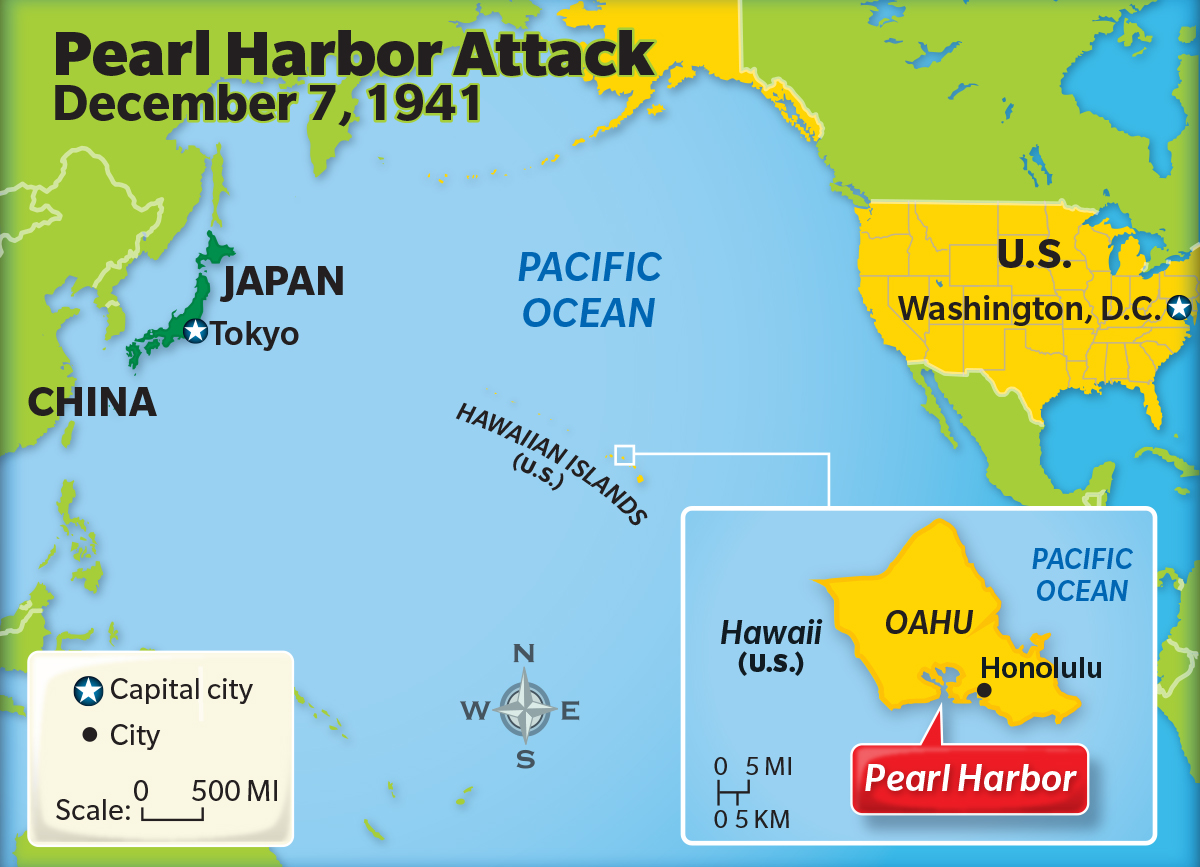
  • Attack on Pearl Harbor (1941)

    US President Mr Trump has said the COVID-19 pandemic is a worse “attack” on the U.S. than either Pearl Harbor or 9/11.

    Practice Question :

    Discuss how the world order changed post Pearl Harbour attack with context to the US hegemony in Asia-Pacific.

    Attack on Pearl Harbor

    • The December 7, 1941 attack on Pearl Harbour was among the most significant moments of the World War II.
    • It signalled the official entry of the US into the hostilities, which eventually led to the dropping of nuclear bombs on the Japanese cities of Hiroshima and Nagasaki in 1945.
    • Significantly, in December 2016, Shinzo Abe became the first sitting Japanese Prime Minister to visit Pearl Harbour.

    What led up to the attack on Pearl Harbour?

    • Before Japan attacked Pearl Harbour in 1941, relations between the US and Japan were already worsening.
    • In 1910, Japan annexed Korea and, in 1937, it invaded China, sending alarm bells ringing in the US and other Western powers about Japan’s manifest expansionist agenda.
    • Between December 1937 and January 1938, an episode which is referred to as the “Nanking Massacre” or the “Rape of Nanking”, occurred — Japanese soldiers killed and raped Chinese civilians and combatants.
    • Japanese historians estimate that anywhere between tens of thousands and 200,000 Chinese were killed.
    • The US was against Japan’s aggression in China, and imposed economic sanctions and trade embargoes after its invasion.

    Immediate causes

    • Japan was reliant on imports for oil and other natural resources — this was one of the reasons why it invaded China and later French Indo-China (present-day Vietnam, Laos and Cambodia).
    • The intention was to take control of the major Chinese ports to have access to resources such as iron, rubber, tin, and most importantly, oil.
    • In July 1941, the US ceased exporting oil to Japan.
    • Negotiations between the two countries ended with the “Hull Note”, the final proposal delivered to Japan by the US. Essentially, the US wanted Japan to withdraw from China without any conditions.
    • Ultimately, the negotiations did not lead to any concrete results, following which Japan set its task for Pearl Harbour in the last week of November 1941.
    • Japan considered the attack to be a preventive measure against the US interfering with Japan’s plans to carry out military operations in some parts of Southeast Asia.

    What happened at Pearl Harbour?

    • About 7.55 am on December 7, 1941, about 180 aircraft of the Imperial Japanese Navy attacked the US Naval base at Pearl Harbour on the island of Oahu in Hawaii.
    • The bombing killed over 2,300 Americans and destroyed the battleships USS Arizona and USS Oklahoma.
    • Roughly 160 aircraft were destroyed, and 150 were damaged.

    Impact on the US

    • In the short term, the American naval presence in the Pacific was severely weakened.
    • However, the Japanese had largely ignored the harbour’s infrastructure, and many of the damaged ships were repaired on-site and returned to duty.
    • American opinion immediately shifted to favouring war with Japan, a course that would conclude with Japan’s unconditional surrender less than four years later.
  • What is Cinco de Mayo and why is it celebrated?

    Cinco de Mayo, or fifth of May in Spanish, also called Battle of Puebla Day, is an annual celebration observed in Mexico and the US that marks the former’s military victory on its soil over French forces in 1862.

    Possible mains question:

    Q. The French colonization attempts went beyond India and had a global reach. Comment.

    French advent in Mexico

    • In the 1860s, Mexico had been severely weakened by lengthy wars over the previous two decades – the Mexican-American War (1846-48) and the internal Reform War (1858-61).
    • As a result, in 1861, the then President Benito Juárez announced a temporary moratorium of two years on repaying Mexico’s foreign debts.
    • In response, troops from Britain, Spain, and France invaded Mexico, demanding reimbursement.
    • By April 1862, Britain and Spain negotiated with Mexico and withdrew.
    • France, which at the time was led by Emperor Napoleon III, decided to establish an empire in Mexican territories with the support of the local landowning classes.
    • France also intended to curb US power in North America.

    The Battle of Puebla

    • In late 1861, a French fleet attacked the Mexican port of Veracruz on the country’s eastern coast and landed a large army that drove the Juárez government into retreat.
    • As they moved from Veracruz to capital Mexico City, the French encountered stiff resistance from Mexican forces.
    • At Puebla, over 100 km ahead of Mexico City, a poorly equipped and outnumbered Mexican force decisively defeated the advancing French troops on May 5, 1862, killing over a thousand.
    • The event marked a significant political victory of Mexican republicans and President Juárez and helped establish a sense of national unity in the country.

    Cinco de Mayo: Present-day significance

    • In Puebla, Cinco de Mayo is celebrated annually with speeches, parades, and by reenacting episodes of the 1862 battle.
    • The city today houses a museum dedicated to the battle, and the actual battlefield is maintained as a park.
    • In the US, in the mid-20th century, the celebration became a way for immigrants from Mexico to express pride in their heritage.
    • Later, Cinco de Mayo also became popular with other demographics in the country when the festivities were linked with Mexican alcoholic beverages.
    • As the celebration assumed greater importance in the country, many have criticised the negative stereotypes of Mexicans that were perpetuated as a result, as well as the promotion of excessive drinking.
  • Why May 1 is observed as Labour Day?

    Today (May 1) is May Day, also known as International Workers’ Day and as Labour Day in different parts of the world. It is an occasion that commemorates the contributions of workers and the historic labour movement.

    Personality based history question in the UPSC CSE prelims is on the way to become the new normal. Kindly note all such phenomena in the news which tend to invoke some aspects of the modern Indian history. You can find all such news here.

    The Haymarket incident

    • While observed as an ancient northern hemisphere spring festival, May 1 became associated with the labour movement in the late 19th century, after trade unions and socialist groups designated it as a day in support of workers.
    • It was decided to do so in memory of the Haymarket affair of 1886, in Chicago in the United States, in which a peaceful rally in support of workers led to a violent clash with the police, leading to the deaths of 4 civilians and 7 police officers.
    • Many of the agitationists, who were protesting workers’ rights violations, straining work hours, poor working conditions, low wages and child labour, were arrested and served terms of life imprisonment, death sentences, etc., and those who died were hailed as “Haymarket Martyrs”.
    • The incident is believed to have given the workers’ movement a great impetus.

    Linked to the Russian Revolution

    • In 1889, The Second Communist International, an organisation created by socialist and labour parties, declared that May 1 would be commemorated as International Workers’ Day from then on.
    • Finally, in 1916, the US began to recognise eight-hour work timings after years of protests and uprisings.
    • In 1904, the International Socialist Congress at Amsterdam called on to demonstrate energetically on the First of May for the legal establishment of the 8-hour day.
    • After the Russian Revolution in 1917, the celebration was embraced by the Soviet Union and the Eastern bloc nations during the Cold War– becoming a national holiday in many of them.
    • Parades were a part of the celebration– the one at Moscow’s Red Square was attended by top Communists leaders and displayed Soviet military might.

    Indian Case

    • In India, May Day was first celebrated on May 1, 1923, after the Labour Kisan Party of Hindustan initiated and Comrade Singaravelar (Singaravelu Chettiar) helmed the celebrations.
    • Chettiar was known for being one of the leaders of Self Respect Movement in the Madras Presidency and for his fight for the rights of backward classes.
    • In one of his meetings, Chettiar passed a resolution stating the government should allow everybody a national holiday on Labour Day.
  • Festival in news: Chithirai Festival

    For the first time, in place of Madurai’s Chithirai Festival, a simple celestial union is set to take place that will be streamed online.

    Match the pair based question can be asked from festivals as such. Recently, the following festivals were in the news: Ambubachi Mela, Thrisoor Puram, Meru Jatara, Nagoba Jatara etc.

    Chithirai Festival

    • Chithirai Festival or Chithirai Thiruvizha is an annual celebration celebrated in the city of Madurai during the month of April.
    • It is celebrated during the Tamil month of Chithirai.
    • It lasts for one month of which the first 15 days mark the celebrations of the coronation of Goddess Meenakshi and the Marriage of Lord Sundareswara and Goddess Meenakshi.
    • The next 15 days mark the celebrations of the Journey of Lord Alagar from Kallazhagar temple in Alagar Koyil to Madurai.

    About Meenakshi Temple

    • The ancient city of Madurai, more than 2,500 years old, was built by the Pandyan king, Kulashekarar, in the 6th century B.C.
    • But the reign of the Nayaks marks the golden period of Madurai when art, architecture and learning flourished expansively.
    • The most beautiful buildings in the city including its most famous landmark, the Meenakshi temple, were built during the Nayak rule.
    • Located in the heart of the city, the Meenakshi-Sundareshwarar temple is dedicated to goddess Meenakshi, the consort of lord Shiva.
    • The sculpted pillars are adorned with the exquisite murals that celebrate the ethereal beauty of princess Meenakshi and the scenes of her wedding with Lord Shiva.
    • The pillars depict scenes from the wedding of Meenakshi and Sundareswarar. There are 985 richly carved pillars here and each one surpasses the other in beauty.
  • Raja Ravi Varma, the painter who helped Indians bring their gods home

    April 29 is the birth anniversary of the famed Indian painter Raja Ravi Varma (1848-1906), remembered for giving Indians their western, classical representations of Hindu gods and goddesses.

    Raja Ravi Varma

    • Varma was born into aristocracy at Kilimanoor in the erstwhile Travancore state of present-day Kerala and was closely related to its royal family.
    • At the age of 14, Varma was patronised by Ayilyam Thirunal, the then ruler of Travancore, and went on to receive training in watercolours from Ramaswamy Naidu, the royal painter.
    • Later, Varma studied oil painting with the British painter Theodore Jensen.
    • Apart from Travancore, Varma also worked for other wealthy patrons such as the Gaekwad of Baroda.

    Major works

    • A prolific artist, Varma is believed to have made around 7,000 paintings before his death.
    • Varma worked on both portrait and landscape paintings and is considered among the first Indian artists to use oil paints.
    • Apart from painting Hindu mythological figures, Varma also made portraits of many Indians as well as Europeans.
    • His most famous works include Damayanti Talking to a Swan, Shakuntala Looking for Dushyanta, Nair Lady Adorning Her Hair, and Shantanu and Matsyagandha.

    His legacy

    • He continues to be regarded as the most important representative of the Europeanized school of painting in India.
    • His 1873 painting, Nair Lady Adorning Her Hair, won Varma prestigious awards including Governor’s Gold Medal when it was presented in the Madras Presidency and Certificate of Merit at an exhibition in Vienna.
    • In 1904, the British colonial government awarded Varma with the Kaiser-i-Hind Gold Medal.
    • In 2013, a crater on the planet Mercury was named in his honour.
  • Who was Lord Basaveshwara?

    Prime Minister has offered his homage to the 12th-century social reformer Basaveshwara on his birth anniversary.

    Vaishnavism and Shaivism are the two most profound strands of Bhakti Movement in Indian history. Enlist all the Bhakti Saints and their theistic philosophy and teachings. Try to spot the minute differences between them.

    Lord Basaveshwara

    • Basaveshwara or Basavanna was an Indian 12th-century statesman, philosopher, a poet and Lingayat saint in the Shiva-focussed Bhakti movement and a social reformer in Karnataka.
    • He lived during the reign of the Kalyani Chalukya/Kalachuri dynasty.
    • He was active during the rule of both dynasties but reached his peak of influence during the rule of King Bijjala II in Karnataka, India .

    Founder of Lingayat cult

    • The traditional legends and hagiographic texts state Basava to be the founder of the Lingayats.
    • However, modern scholarship relying on historical evidence such as the Kalachuri inscriptions state that Basava was the poet-philosopher who revived, refined and energized an already existing tradition.

    His Philosophy

    • Basava’s Lingayat theology was a form of qualified nondualism, wherein the individual Atman (soul) is the body of God, and that there is no difference between Shiva and Atman (self, soul).
    • Basava’s views finds places in Vedanta school, in a form closer to the 11th century Vishishtadvaita philosopher Ramanuja.

    Famous works

    • Basavanna spread social awareness through his poetry, popularly known as Vachanaas.
    • Basavanna rejected gender or social discrimination, superstitions and rituals but introduced Ishtalinga necklace, with an image of the Shiva Liṅga to every person regardless of his or her birth.
    • As the chief minister of his kingdom, he introduced new public institutions such as the Anubhava Mantapa (or, the “hall of spiritual experience”) which welcomed men and women from all socio-economic backgrounds.

    Back2Basics: Bhakti Movement

    • The Bhakti movement refers to the theistic devotional trend that emerged in medieval Hinduism.
    • It originated in eighth-century south India and spread northwards.
    • It swept over east and north India from the 15th century onwards, reaching its zenith between the 15th and 17th century CE.
    • It has traditionally been considered as an influential social reformation in Hinduism, and provided an individual-focused alternative path to spirituality regardless of one’s birth or gender
    • Salvation which was previously considered attainable only by men of Brahmin, Kshatriya and Vaishya castes, became available to everyone.