đŸ’„Join UPSC 2027,2028 Mentorship (July Batch) + XFactor Notes & Microthemes PDF

Subject: History

  • Persons in news: Sheikh Mujibur Rahman

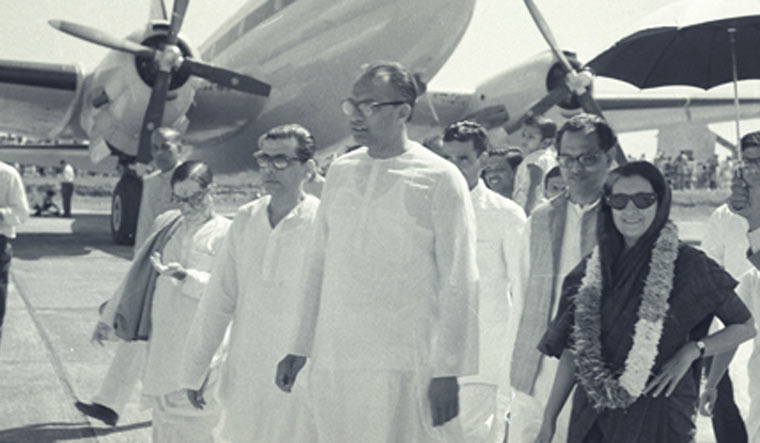
    March 17 is the birth anniversary of Bangabandhu Sheikh Mujibur Rahman (1920-1975), the founding leader of Bangladesh and the country’s first Prime Minister.

    Sheikh Mujibur Rahman

    Sheikh Mujibur Rahman in 1950.jpg

    • Before joining politics, Rahman studied law and political science in Kolkata and Dhaka and agitated for Indian independence.
    • He is referred to as Sheikh Mujib or simply Mujib, the title ‘Bangabandhu’ meaning ‘friend of Bengal’.
    • In 1949, he joined the Awami League, a political party which advocated greater autonomy for East Pakistan.
    • A popular leader in East Pakistan, Rahman played an important role in the six-point movement and the Anti-Ayub movement.

    Role in Bangladesh liberation

    • In 1970, his party secured an absolute majority in the Pakistani general elections; the country’s first, winning more seats than all parties in West Pakistan, including Zulfikar Ali Bhutto’s Pakistan People’s Party.
    • The election results were not honoured; leading to a bloody civil war, and Sheikh Mujib declared Bangladesh’s independence from Pakistan on March 26, 1971.
    • The declaration coincided with a ruthless show of strength by the Pakistani military, in which tanks rolled out on the streets of Dhaka and several students and intellectuals were killed.
    • India under then PM Indira Gandhi provided full support to Rahman and Bangladesh’s independence movement, resulting in the creation of a sovereign government at Dhaka in January 1971.

    His legacy

    • Rahman, who had been arrested and taken to West Pakistan, returned to Bangladesh after being freed in January 1972.
    • For the next three years, Rahman held the new country’s prime ministerial post, and became a celebrated icon in India as well, admired for his moving speeches and charismatic personality.
    • On 15 August 1975, Rahman was killed in a military coup along with his wife and three sons, including 10-year-old Sheikh Russel.
    • His daughters, the current Prime Minister Sheikh Hasina and her younger sister Sheikh Rehana, survived as they were abroad at the time.
  • Pyramid of Djoser


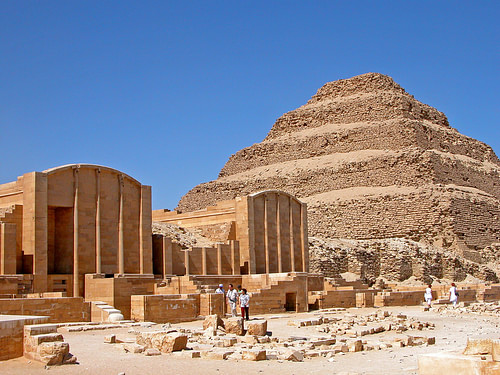
    Last week, Egypt reopened the Pyramid of Djoser, the first pyramid ever built, after a 14-year restoration. The structure is believed to be designed by Imhotep, described by some as the first architect of the world.

    The Pyramid of Djoser

    • The 4,700-year-old pyramid is 60 metres tall, and consists of six stacked steps over a burial shaft tomb 28 metres deep and seven metres wide.
    • It is located at the Saqqara archaeological site, 24 km southwest of Cairo, outside the royal capital of Memphis. A complex of halls and courts is located around the pyramid.
    • It is the world’s oldest monumental stone building.
    • Today a UNESCO world heritage site, the pyramid was constructed during the era of Pharaoh Djoser, the second king of Ancient Egypt’s Third Dynasty (2650 BC– 2575 BC).
    • The Pharaoh’s 19-year reign saw significant technical innovations in stone architecture.
    • The pyramid’s architect, Imhotep, was also a physician and astrologer, and served as Djoser’s minister.
  • Who were the Marakkars?

    The big-budget Malayalam film Marakkar: The Lion of the Arabian Sea is set to be released. It is a war film depicting the heroics of the Marakkar clan, whose leaders were naval chieftains of the Zamorin of Calicut during the 16th and 17th centuries.

    Who were the Marakkars?

    • By some accounts, they were of Arab origin and had migrated from Tunisia to Panthalayani near Koyilandy in present-day Kozhikode, and later moved to the region around present-day Kottakkal and Thikkodi near Payyoli.
    • By other accounts, the Marakkars were descendants of affluent businessman from the Cochin kingdom who migrated later to Calicut.
    • Historians say the name ‘Marakkar’ could have originated from maram or marakkalam, meaning ship, as these families lived along the coast and used ships.
    • Alternatively, it could have originated from the Arabic word markaba, meaning those who migrated via ships.
    • The Marakkars were mostly Muslims, but in some parts, they have been found to be Hindus as well.

    What was the war against the Portuguese about?

    • The Zamorin, Samoothiri in Malayalam, was the title given to rulers of the Calicut kingdom on the Malabar coast.
    • Faced with invading Portuguese ships, the Zamorin reached out to the Marakkars to defend the coast. The Marakkars fought against Portuguese invaders for nearly a century.
    • They were led in succession by four Marakkars, chief admirals who were appointed by the Zamorin with the title of Kunjali.
    • Related by bloodline, they were Kuttyali Marakkar (Kunjali Marakkar I, appointed in 1507), Kutty Pokker (Kunjali Marakkar II), Pathu Marakkar (Kunjali Marakkar III) and Muhammad Ali Marakkar (Kunjali Marakkar IV, appointed in 1595).
    • Their strategy was similar to guerrilla warfare. The Portuguese had massive ships which could not make easy manoeuvres in the sea.
    • The Marakkars used small ships which could easily surround the Portuguese ships, enabling the fighters to attack at will.

    Who is depicted the ‘Lion of the Arabian Sea’?

    • Kunjali Marakkar IV earned his reputation with his fierce onslaught on Portuguese ships, the favours he gave those who fought against the Portuguese, and his efforts to strengthen the fort at Kottakkal.
    • When he took charge in 1595, relations between the Zamorin and the Marakkars were deteriorating.
    • The Zamorin was feeling threatened by Kunjali Marakkar IV’s popularity, and by reports (said to be spread by the Portuguese) that he was planning to create a Muslim empire.
    • In 1597, the Zamorin signed a peace treaty with the Portuguese and attacked Kottakkal fort. For months, the Marakkars resisted the attack by the Zamorin’s Nair soldiers and the Portuguese fleet.
    • Eventually, as Portugal sent more forces and the Zamorin mounted his effort, Marakkar surrendered to the Zamorin on the assurance that their lives would be spared. But the Portuguese violated the terms, arrested him, took him to Goa and beheaded him.
  • Persons in news: Rajkumari Amrit Kaur


    Former PM Indira Gandhi and freedom fighter Rajkumari Amrit Kaur are mentioned in TIME magazine’s list of the 100 most powerful women who defined the last century in a new project that aims to feature those women who were “often overshadowed”.

    Who was Amrit Kaur?

    • Amrit Kaur was the first woman in independent India who joined the Cabinet as the Health Minister and remained in that position for 10 years.
    • Born into the Kapurthala royal family, she was educated in Oxford and returned to India in 1918, and began to be drawn towards the work and teachings of MK Gandhi.

    Her contributions

    • Before taking up the position of a Health Minister, Kaur was Mahatma Gandhi’s secretary.
    • During these 10 years, she founded the Indian Council for Child Welfare.
    • She also laid the foundation of the All India Institute of Medical Sciences (AIIMS) and Lady Irwin College in Delhi in the following years.
    • Apart from joining the nationalist freedom struggle, Kaur also began work on a number of other social and political issues such as the purdah system, child marriage and the Devadasi system.
    • She passed away in 1964, at the age of 75.

    Role in the freedom struggle

    • In 1936, hoping that more women would join the freedom struggle, Gandhiji invited her.
    • In the following years, as Kaur started interacting with other freedom fighters such as Gopal Krishna Gokhale and Mahatma Gandhi, she gave up her princely comforts and began to discipline herself by responding to the Gandhian call.
    • When the civil disobedience movement took off in the 1930s, Kaur dedicated her life to it.
    • Kaur was jailed after the Quit India movement and carried to the jail a spinning wheel, the Bhagwat Gita and the Bible.
    • Further, while Kaur advocated for equality, she was not in favour of reservations for women and believed that universal adult franchise would open the doors for women to enter into the legislative and administrative institutions of the country.
    • In light of this, she believed that there was no place left for reservation of seats.
  • Biju Patnaik: The flying ace who helped Indian and foreign freedom movements 


    Recently, 104th birth anniversary of former Odisha chief minister Biju Patnaik was celebrated. He was a decorated freedom fighter. PM tweeted an Intelligence Bureau document from 1945 to show how Patnaik bravely lent his flying skills to rescue freedom fighters like Ram Manohar Lohia.

    Biju Pattnaik

    • Bijayananda Patnaik (1916-1997), popularly known as Biju Patnaik, was an Indian politician, aviator and businessman. As politician, he served twice as the Chief Minister of the State of Odisha.
    • It is well known that Biju Patnaik actively helped freedom fighters in the 1940s.
    • His daring was evident as he actively joined the Quit India movement in 1942 and collaborated with the underground leaders like Jayaprakash Narayan, Aruna Asif Ali and Dr. Ram Manohar Lohia, even while in the British service.
    • Patnaik was imprisoned by the British Government for three years later.

    Role in foreign freedom struggles

    • As an officer in the Royal Indian Air Force in the early 1940s, Patnaik flew innumerable sorties to rescue British families fleeing the Japanese advance on Rangoon, the capital of Burma.
    • He also dropped arms and supplies to Chinese troops fighting the Japanese and later to the Soviet army struggling against Hitler’s onslaught near Stalingrad.
    • On the 50th anniversary of the end of the war, Patnaik was honoured by the Russians for his help,” the obit noted.
    • Interestingly, Nehru entrusted Patnaik with rescuing Indonesian resistance fighters who were fighting their Dutch colonisers.
    • Accompanied by wife Gyanwati, “the lanky pilot flew an old Dakota aircraft to Singapore en route to Jakarta where the rebels were entrenched” in 1948.
    • Dodging the Dutch guns, he entered Indonesian airspace and landed on an improvised airstrip near Jakarta.
    • Using left-over fuel from abandoned Japanese military dumps, Patnaik took off with prominent rebels, including Sultan Shariyar and Achmad Sukarno, for a secret meeting with Nehru at New Delhi.
  • The Central Sanskrit Universities Bill, 2019


    The Union Minister of HRD has introduced The Central Sanskrit Universities Bill, 2019 in Rajya Sabha.

    Central Sanskrit Universities Bill, 2019

    The Bill is intended to convert India’s three deemed-to-be Sanskrit universities — (i) Rashtriya Sanskrit Sansthan, New Delhi, (ii) Shri Lal Bahadur Shastri Rashtriya Sanskrit Vidyapeeth, New Delhi, and (iii) Rashtriya Sanskrit Vidyapeeth, Tirupati — into Central Sanskrit Universities.

    The following are the salient features of the Bill:

    What the universities will do

    The proposed central universities will:

    1. disseminate and advance knowledge for the promotion of Sanskrit,
    2. make special provisions for integrated courses in humanities, social sciences, and science, and
    3. train manpower for the overall development and preservation of Sanskrit and allied subjects.

    Powers and functions

    These include:

    1. prescribing courses of study and conducting training programmes,
    2. granting degrees, diplomas, and certificates,
    3. providing facilities through a distance education system,
    4. conferring autonomous status on a college or an institution,
    5. providing instructions for education in Sanskrit and allied subjects.

    University authorities

    Some of the authorities that the universities will have:

    • A court, which will review the policies of the university and suggest measures for its development.
    • An Executive Council, which will be the principal executive body. The 15-member council will include the Vice-Chancellor appointed by the Centre, who will be the chairperson; a joint secretary of the Ministry of HRD, and two eminent academics from the field of Sanskrit or allied subjects.
    • The council will, among other functions, create teaching and academic posts and their appointment, and manage the revenue and property of the university.
    • An Academic and Activity Council, which will supervise academic policies.
    • A Board of Studies, which will approve the subjects for research and recommend measures to improve standards of teaching.

    Visitor of the universities

    • Like at all central universities, the President of India will be the Visitor of the central Sanskrit universities.
    • He may appoint persons to review and inspect the functioning of the University.
    • The Executive Council may take action based on the findings of the inspection.
  • [pib] Various schemes implemented by Zonal Cultural Centres (ZCCs)

    The Ministry of Culture and Tourism has informed about its various schemes in the Lok Sabha.

    Zonal Cultural Centres (ZCCs)

    • To preserve & promote various forms of folk art and culture of the tribals throughout the country including West Bengal, the govt. has set up seven Zonal Cultural Centres (ZCCs).
    • These are headquartered at Patiala, Nagpur, Udaipur, Prayagraj, Kolkata, Dimapur and Thanjavur.
    • These ZCCs organize various cultural activities and programmes all over the country on regular basis.

    These ZCCs under Ministry of Culture are also implementing a number of schemes for promoting the folk/tribal art and culture, details of which are as below –

    1) Award to Young Talented Artists:

    • The Scheme “Young Talented Artists” is carried out to encourage and recognize the young talents especially in the field of rare art forms.
    • Talented youngsters of the age group of 18-30 years are selected and given a one-time  cash award of Rs. 10,000/-.

    2) Guru Shishya Parampara:

    • This scheme envisages transmitting our valued traditions to the coming generations. Disciples are trained under veterans in art forms which are rare and vanishing.
    • Rare and vanishing art forms of the region are identified and eminent exponents are selected to carry out the training programmes in ‘Gurukula’ tradition.
    • The monthly remuneration for Guru – Rs. 7,500/-, Accompanist – Rs. 3,750/- and        Pupils – Rs. 1,500/- each for the period of six month to maximum 1 year for one scheme.
    • The names of the Gurus are recommended by the State Cultural Affairs Departments.

    3) National Cultural Exchange Programme (NCEP):

    • It can be termed as the lifeline of the Zonal Cultural Centers. Under this scheme, various festivals of performing arts, exhibitions, yatras etc are organized in member States.
    • Artists from other zones/states are invited to participate in these programmes. Participation of artists from the Zone in festivals held in other parts of the country are also facilitated.
    • Zonal centres also participate in Major festivals happening in member States by arranging performances during these festivals where large number of audience get chance to enjoy and understand art forms of other regions.
    • These festivals provide opportunity to taste and understand various cultures of our country.

    4) Preservation of Languages

    • Sahitya Akademi, an autonomous organization under Ministry of Culture, encourages the preservation and promotion of languages, especially the unrecognized and tribal languages.
    • The Akademi periodically organizes language conventions throughout the country in this regard.

    5) Theatre Rejuvenation:

    • To promote theatre activities including stage shows and Production oriented workshops, etc. Honorarium Up to Rs. 30,000/- per show excluding TA & DA is paid.
    • The groups finalized on the basis their credentials as well as the merit of project submitted by them.

    6) Research & Documentation:

    • To preserve promote and propagate vanishing visual and performing art forms including folk, tribal and classical in the field of music, dance, theatre, literature, fine arts etc. in print/ audio – visual media.
    • The art form is finalized in consultation with state Cultural Department.

    7) Shilpgram:  To promote folk and tribal art and crafts of the zone by organizing seminar, workshops, exhibitions, craft fairs, design development and marketing support to the artisans living in the rural areas.

    8) Octave:  To promote and propagate the rich cultural heritage of North East region comprising of eight States namely Arunachal Pradesh, Assam, Meghalaya, Mizoram, Sikkim, Nagaland, Manipur and Tripura to the rest of India.

  • [pib] India’s nominations for 2020 World Heritage List

    Government of India has submitted two nomination dossiers namely ‘Dholavira: A Harappan City’ and ‘Monuments and Forts of Deccan Sultanate’ for inclusion in the World Heritage List for the year 2020.  Govt. of Madhya Pradesh has submitted the proposal of ‘Group of Monuments at Mandu’ in the year 2019.

    What are World Heritage Sites?

    • A World Heritage Site is a landmark or area, selected by the United Nations Educational, Scientific and Cultural Organization (UNESCO) for having cultural, historical, scientific or other forms of significance, which is legally protected by international treaties.
    • The sites are judged to be important for the collective and preservative interests of humanity.
    • To be selected, a WHS must be an already-classified landmark, unique in some respect as a geographically and historically identifiable place having special cultural or physical significance (such as an ancient ruin or historical structure, building, city, complex, desert, forest, island, lake, monument, mountain, or wilderness area).
    • It may signify a remarkable accomplishment of humanity, and serve as evidence of our intellectual history on the planet.
    • The sites are intended for practical conservation for posterity, which otherwise would be subject to risk from human or animal trespassing, unmonitored/uncontrolled/unrestricted access, or threat from local administrative negligence.
    • The list is maintained by the international World Heritage Program administered by the UNESCO World Heritage Committee, composed of 21 “states parties” that are elected by their General Assembly.

    UNESCO World Heritage Committee

    • The World Heritage Committee selects the sites to be listed as UNESCO World Heritage Sites, including the World Heritage List and the List of World Heritage in Danger.
    • It monitors the state of conservation of the World Heritage properties, defines the use of the World Heritage Fund and allocates financial assistance upon requests from States Parties.
    • It is composed of 21 states parties that are elected by the General Assembly of States Parties for a four-year term.
    • India is NOT a member of this Committee.
    • Recently, its 42nd meeting in 2018 was held in Manama Bahrain.

    Also read:

    https://www.civilsdaily.com/news/pib-india-gets-its-37th-unesco-world-heritage-site/

    https://www.civilsdaily.com/news/jaipur-gets-unesco-world-heritage-tag/

    https://www.civilsdaily.com/news/orchha-on-unesco-world-heritage-sites-tentative-list/


    Read more about the Tentative lists from India at:

    http://whc.unesco.org/en/statesparties/IN

  • Taj Mahal Complex

    The Taj Mahal complex has been spruced up for the visit of US President Donald Trump and First Lady Melania Trump.

    About Taj

    • The Taj Mahal is an ivory-white marble mausoleum on the south bank of the Yamuna river in the city of Agra.
    • It was commissioned in 1632 by Shah Jahan (reigned from 1628 to 1658) to house the tomb of his favourite wife, Mumtaz Mahal; it also houses the tomb of Shah Jahan himself.
    • The tomb is the centrepiece of a 17-hectare (42-acre) complex, which includes a mosque and a guest house, and is set in formal gardens bounded on three sides by a crenellated wall.
    • The Taj Mahal complex is believed to have been completed in its entirety in 1653 at a cost estimated at the time to be around 32 million rupees, which in 2015 would be approximately 52.8 billion rupees (U.S. $827 million).
    • The construction project employed some 20,000 artisans under the guidance of a board of architects led by the court architect to the emperor, Ustad Ahmad Lahauri.
    • The Taj Mahal was designated as a UNESCO World Heritage Site in 1983 for being “the jewel of Muslim art in India and one of the universally admired masterpieces of the world’s heritage”.

    Various threats to Taj

    • The Supreme Court had earlier expressed concern over the marble of the Taj changing colour, and asked how the white marble, which had first become yellowish, was now turning brownish and greenish.
    • Firstly, the polluting industries and the vehicular emissions in the Taj Trapezium Zone (TTZ) area are a major source of pollution.
    • The second reason is that the Yamuna River, which flows behind the Taj, has become highly polluted.
    • There is no aquatic life in it, and has caused insect and algae infestation on the Taj Mahal and other monuments situated on its banks.

    Use of mud packs

    • Increasing pollution in the air over the Gangetic Valley affecting the Taj has been a reason for concern for archaeologists and conservationists for long now.
    • Mud packs were applied on the surface of the monument first in 1994, and then again in 2001, 2008, and, most recently, beginning 2014.
    • Mud packs have been one of the ASI’s favoured ways to remove the yellow stains that have appeared over the years on the Taj Mahal’s white marble facade.
    • The clay is applied in the form of a thick paste that absorbs the grime, grease and bird droppings on the marble, before being washed off using distilled water.
    • The process is slow and tortuous, but is believed to leave the marble cleaner and shinier.
    • The intricate parts are applied with special “multani mitti’ (Fuller’s clay) treatment.
  • What did Harappan people eat?

    The National Museum in New Delhi has hosted “The Indus dining experience” a food event based on the food pattern of Indus valley civilization.

    Food of Harappans

    • Archaeological evidence from Indus Valley sites (c. 3300 BC to 1300 BC) in present-day India and Pakistan suggests that a purely vegetarian meal will not provide a complete picture of what the Harappan people ate.
    • To judge from the quantity of bones left behind, animal foods were consumed in abundance: beef, buffalo, mutton, turtles, tortoises, gharials, and river and sea fish.
    • Apart from meat, the people of the Indus Valley Civilisation grew and ate a variety of cereals and pulses.
    • There is archaeological evidence for cultivation of pea (matar), chickpea (chana), pigeon pea (tur/arhar), horse gram (chana dal) and green gram (moong).
    • Several varieties of wheat have been found at Harappan sites, as well as barley of the two-rowed and six-rowed kinds.
    • There is evidence that the Harappans cultivated Italian millet, ragi and amaranth, as well as sorghum and rice.
    • Oilseeds such as sesame, linseed, and mustard were also grown.