Extremist groups held drone strikes on Israeli territory in the Jordan Valley (which forms Jordan’s border with Israel and the West Bank).
About Jordan Valley:
Details
Geography
• Part of the Great Rift Valley, extending from the Sea of Galilee to the Dead Sea.
• Forms a natural border between Jordan, Israel, and the West Bank.
• Low-lying, with parts below sea level, especially near the Dead Sea.
Climate
• Semi-arid to arid, with hot summers and mild winters.
• Limited rainfall, necessitating irrigation for agriculture.
Significance
• An essential agricultural region, growing citrus, dates, and vegetables.
• The Jordan River is a vital water source for agriculture and drinking water.
• Ecological corridor for migratory birds.
History
• Rich in biblical and historical significance, including Jesus’ baptism in the Jordan River.
• Archaeological sites from ancient civilizations like the Canaanites and Romans.
Geopolitical Aspects
• Critical in the Israeli-Palestinian conflict, with strategic importance for security and border control.
• Vital for Palestinian economic development and a future state.
• Shared water resources create tensions between Israel, Jordan, and Syria.
Economic Activities
• Agriculture is the mainstay of the economy.
• Tourism is also significant due to religious and historical sites.
Environmental Concerns
• Water scarcity and the shrinking Dead Sea due to river diversion are major issues.
• Pollution and overuse of the Jordan River affect water quality and ecosystem health.
PYQ:
[2015] Which one of the following countries of South-West Asia does not open out to the Mediterranean Sea?
India has raised concerns over the increase in imports of silver products, platinum alloy, and dry dates from the UAE under the Free Trade Agreement (FTA).
Issues Raised by India:
The Global Trade Research Initiative (GTRI) has called for an urgent review of the India-UAE CEPA, citing concerns that the agreement allows unlimited imports of gold, silver, platinum, and diamonds with zero tariffs.
GTRI claims that many of these imports do not meet Rules of Origin requirements and thus should not qualify for concessions.
India’s gold and silver imports from the UAE increased by 210% to $10.7 billion in 2023-24.
India allows customs duty concessions of 7% on silver and 1% on 160 metric tonnes of gold under the agreement.
India also requested that the Indian Jewellery Exposition Centre in Dubai be classified as a Designated Zone to allow domestic jewellery manufacturers to benefit from concessional duties, including those not registered under UAE’s domestic regulations.
India also requested the UAE to grant recognition to the i-CAS (India Conformity Assessment Scheme) Halal scheme to simplify the certification process and boost exports of animal products.
The UAE expressed its willingness to review this request after consulting internal stakeholders, including federal tax authorities.
India-UAE Trade Relations:
Details
Volume
• The UAE is India’s 3rd largest trading partner with $83.65 billion in bilateral trade in 2023-24.
• Trade between India and UAE grew from $180 million in the 1970s to $85 billion in 2022-23.
• Signed in February 2022, making India the first country to sign such an agreement with the UAE.
• CEPA has slashed tariffs on 80% of goods and offers zero duty access to 90% of Indian exports to the UAE.
Non-Oil Trade Target
• The target of reaching $100 billion in non-oil trade by 2030 is seen as achievable given current growth trends.
Investment from UAE
• UAE’s investments in India are around $20-21 billion, with $15.5 billion as Foreign Direct Investment (FDI).
• The Abu Dhabi Investment Authority (ADIA) has invested in projects like the NIIF Master Fund and renewable energy initiatives.
India’s Exports to UAE
• UAE is India’s 2nd largest export destination after the US, with exports worth $31.61 billion in 2022-23.
• Key exports include petroleum products, gems, food items, textiles, and engineering goods.
India’s Imports from UAE
• UAE is a critical partner for India’s energy security.
• India imports petroleum, gems, minerals, and chemicals from UAE.
• UAE is India’s 4th largest crude oil supplier and 2nd largest for LNG and LPG.
PYQ:
[2022] How will I2U2 (India, Israel, UAE and USA) grouping transform India’s position in global politics?
A regional partnership of 10 countries announced that an agreement on the equitable use of Nile River water resources has come into effect, despite Egypt’s opposition.
Why discuss this?
The legal status of the “cooperative framework” was confirmed by the African Union after South Sudan joined the treaty.
The treaty is backed by the Nile Basin Initiative.
Countries Involved:
Ethiopia, Uganda, Rwanda, Burundi, and Tanzania have ratified the agreement.
Egypt and Sudan have refused to sign.
Congo abstained, while Kenya has yet to submit its ratification documents.
About Nile River:
Details
Length
Approximately 6,650 km (4,130 miles), making it the longest river in the world.
Tributaries
White Nile (originating from Lake Victoria in Uganda) and Blue Nile (originating from Lake Tana in Ethiopia).
Countries Traversed
11 countries: Uganda, Rwanda, Burundi, DR Congo, Tanzania, Kenya, Ethiopia, South Sudan, Sudan, and Egypt.
Source
White Nile from Lake Victoria,
Blue Nile from Lake Tana.
Mouth
Mediterranean Sea, forming the Nile Delta in Egypt.
Major Cities
Includes Cairo, Khartoum, and Alexandria.
Key Dams
Aswan High Dam (Egypt), controls flooding, generates hydroelectric power, and forms Lake Nasser.
Built in 1970 across the Nile in Aswan, Egypt; helps in irrigation, flood control, and hydroelectric power generation but also disrupts silt flow.
Economic Importance
Provides over 90% of water for Egypt and Sudan; vital for agriculture, fishing, industry, and energy production.
Disputes
Between Ethiopia, Egypt, and Sudan over water rights, particularly due to the Grand Ethiopian Renaissance Dam (GERD).
Historical Treaties
1929 and 1959 Nile Water Agreements allocated water mostly to Egypt and Sudan; upstream countries seek revision.
Nile Basin Initiative (NBI): Established in 1999, it is a partnership among Nile Basin countries aimed at promoting cooperation, development, and sustainable management of the Nile’s resources.
PYQ:
[2020] Consider the following pairs:
River
Flows into
1.
Mekong
Andaman Sea
2.
Thames
Irish Sea
3.
Volga
Caspian Sea
4.
Zambezi
Indian Ocean
Which of the pairs given above is/are correctly matched?
India has expressed concerns about the safety of UN peacekeepers stationed in south Lebanon, after they came under fire from Israeli forces.
Among the peacekeepers are 600 Indian soldiers, who are part of the UN peacekeeping mission and are stationed along the 120-km Blue Line on the Israel-Lebanon border.
What is UNIFIL (United Nations Interim Force in Lebanon)?
Details
Established
March 1978, following Israel’s invasion of Lebanon
UN Resolutions
Established under UNSC Resolutions 425 and 426
Primary Objectives
Confirm Israeli withdrawal from Lebanon
Restore international peace and security
Assist the Government of Lebanon in regaining control over southern Lebanon
Area of Operation
Southern Lebanon, near the border with Israel (Blue Line)
Personnel
Over 10,000 peacekeepers from 50 countries (both civilian and military personnel)
Mission
Prevent hostilities and maintain peace along the 121-km Blue Line
Ensure that no weapons or fighters are present in the region
Report violations to the UN Security Council
Rules of Engagement
Peacekeepers are armed but are only allowed to use force when their safety or civilian safety is at risk
Headquarters
Naqoura, southern Lebanon
Peacekeeper Status
Not soldiers but impartial peacekeepers, present with the consent of the host country, Lebanon
Significance of UNIFIL
Conflict Prevention: UNIFIL monitors the Blue Line and prevents escalations between Israel and Lebanon.
Civilian Protection: It safeguards civilians and supports humanitarian aid efforts in conflict zones.
Support for Lebanon: UNIFIL helps the Lebanese government extend control in the south alongside the Lebanese Armed Forces.
PYQ:
[2015] Discuss the impediments India is facing in its pursuit of a permanent seat in UN Security Council.
Q) What do you understand by ‘The String of Pearls’? How does it impact India? Briefly outline the steps taken by India to counter this. (UPSC CSE 2013) Q) Explain the formation of thousands of islands in the Indonesian and Philippines archipelagos. (UPSC CSE 2014) Q) Project ‘Mausam’ is considered a unique foreign policy initiative of the Indian government to improve relationships with its neighbors. Does the project have a strategic dimension? Discuss (UPSC CSE 2015) Q) Why is India considered as a subcontinent? Elaborate your answer. (UPSC CSE 2021)
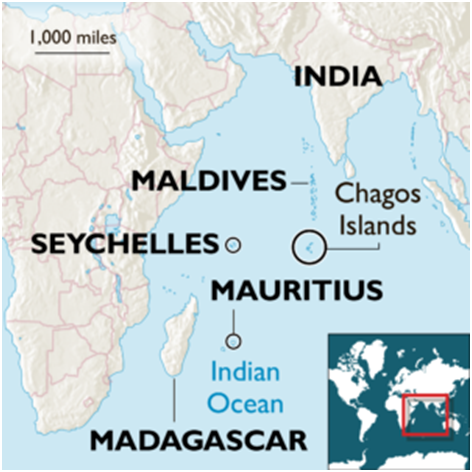
Mentor’s Comment: The Chagos Archipelago consists of 58 islands and is located approximately 500 km south of the Maldives in the Indian Ocean. The French were the first to colonize Mauritius along with the Chagos Islands in 1715. In the late 18th century, the French brought in slave labor from Africa and India to work in newly established coconut plantations. However, the UK took control of the region in 1814 after the fall of France’s Napoleon Bonaparte.
Today’s editorial by Mohamed Nasheed emphasizes the importance of the United Kingdom’s approach to its colonial legacy in the Indian Ocean, particularly concerning the Chagos Archipelago. It highlights the need for sustainable marine conservation and collaborative governance as Britain prepares to relinquish control over these islands.
_
Let’s learn!
Why in the News?
On October 9, 2024, the UK agreed to cede sovereignty of the Chagos Archipelago to Mauritius, while retaining sovereign rights over Diego Garcia for military purposes. The deal is historic as it recognizes Mauritius’s claims over the archipelago, which has been contested since the 1980s.
Historical background of Chagos Archipelago:
Historically, these islands were part of the Maldives until their detachment by the UK in 1965 to establish the British Indian Ocean Territory (BIOT).
This move was made to facilitate a military base for the United States on Diego Garcia, leading to the expulsion of the indigenous Chagossians.
The ICJ had previously ruled in 2019 that the UK’s detachment of Chagos from Mauritius was illegal and called for an end to British colonial administration in the area.
This ruling added pressure on the UK to negotiate a resolution with Mauritius
Key highlights of the agreement:
Resettlement of Chagossians: Mauritius can now resettle people on the Chagos Archipelago, except Diego Garcia, where Britain evicted 2,000 islanders for a US naval base. The deal grants Mauritius full sovereignty over the archipelago except Diego Garcia island.
Establishment of the Trust Fund: The UK has also promised to create a new trust fund for the benefit of the people of Chagos.
Other major Initiatives taken and Collaborations needed:
Sovereignty and Decolonization: The sovereignty of the Chagos Islands has been a contentious issue, with historical ties to both Mauritius and the Maldives.
The UK has agreed to transfer sovereignty of the Chagos Islands to Mauritius while securing military rights over Diego Garcia for an initial period of 99 years.
Marine Conservation Efforts: Britain’s decision to place the entire Chagos Archipelago under protected status, emphasizing its significance for marine conservation is commendable.
The Maldives employs sustainable fishing techniques that minimize bycatch, contrasting with industrial fishing practices that threaten fish stocks.
Collaborative Future: As part of the decolonization process, it is crucial for island nations in the Indian Ocean—Maldives, Mauritius, Seychelles, and Sri Lanka—to collaborate on maintaining the protected status of Chagos.
Britain needs to learn from its past mistakes in decolonization, particularly regarding India’s Partition in 1947, which had severe human costs.
How did the historical conflicts between the UK and France influence the sovereignty of the Chagos Islands?
The Chagos Islands were initially part of French colonial territory, known as Isle de France, where they established coconut plantations using enslaved African labor in the 18th century.
Following the defeat of Napoleon in 1814, the Treaty of Paris ceded Mauritius and its dependencies, including the Chagos Islands, to Britain. This marked the beginning of British administration over these territories.
In 1965, during preparations for Mauritian independence, the UK separated the Chagos Archipelago from Mauritius to create the British Indian Ocean Territory (BIOT). This move was motivated by strategic interests, particularly to establish a military base on Diego Garcia.
The UK forcibly removed the indigenous Chagossians to facilitate military operations, which has been condemned as a violation of human rights.
Despite the ICJ decision, pressure, and legal challenges, the UK maintained its claims over the islands due to their strategic military importance, particularly Diego Garcia.
Conclusion: A respectful and collaborative exit strategy is needed for the UK from its Indian Ocean territories. It advocates for joint efforts among regional nations to ensure that marine conservation is prioritized while addressing historical grievances related to colonialism.
In alignment with the theme of this year’s ASEAN Summit—“Enhancing Connectivity and Resilience”—PM Modi laid out the following ten key suggestions for strengthening cooperation.
Back2Basics: Association of Southeast Asian Nations (ASEAN)
ASEAN, founded in 1967 with the Bangkok Declaration, aims for economic growth, regional peace, and an integrated ASEAN community.
The ASEAN Charter, launched in 2008, formalized ASEAN’s legal status and sought to establish a single free-trade area.
The ASEAN Intergovernmental Commission on Human Rights (AICHR) was established in 2009, adopting the ASEAN Human Rights Declaration in 2012.
ASEAN members comprises Brunei, Cambodia, Indonesia, Laos, Malaysia, Myanmar, the Philippines, Singapore, Thailand, and Vietnam. East Timor (Timor-Leste) applied for membership in 2011 but is not yet a member.
ASEAN Plus Three (China, Japan, South Korea) aims to deepen regional integration among Southeast Asia and East Asian countries.
East Asia Summit (EAS), including ASEAN Plus Three + India, Australia, and New Zealand, enhances strategic dialogue and cooperation in the region.
Ten suggestions by PM Modi for ASEAN Connectivity and Resilience:
No.
Suggestion
Details
1
ASEAN-India Year of Tourism (2025)
Declare 2025 as ASEAN-India Year of Tourism, with India committing USD 5 million to promote tourism between India and ASEAN.
2
Celebrating a Decade of India’s Act East Policy
Organize events connecting artists, youth, entrepreneurs, and think tanks, including a Music Festival, Youth Summit, Hackathon, etc.
3
Women Scientists’ Conclave
Hold an annual Women Scientists’ Conclave under the India-ASEAN Science and Technology Fund to promote collaboration and innovation.
4
Scholarships for ASEAN Students
Double the Masters scholarships for ASEAN students at Nalanda University and launch a new scholarship program for ASEAN students in agriculture.
5
Review of ASEAN-India Trade Agreement
Complete the review of the ASEAN-India Trade in Goods Agreement by 2025 to enhance economic ties and build a secure, resilient supply chain.
6
Disaster Resilience
Allocate USD 5 million from the ASEAN-India Fund for disaster resilience, with collaboration between India’s NDMA and ASEAN’s Humanitarian Assistance Centre.
7
Health Resilience
Institutionalize the ASEAN-India Health Ministers Meeting and invite two experts from each ASEAN country to India’s National Cancer Grid Vishwam Conference.
8
Digital and Cyber Resilience
Establish a cyber-policy dialogue between India and ASEAN to strengthen digital and cyber resilience.
9
Promoting a Green Future
Organize workshops on green hydrogen involving experts from India and ASEAN to promote sustainable energy solutions.
10
Climate Resilience
Promote the “Ek Ped Maa Ke Naam” (Plant for Mother) campaign to encourage tree planting and strengthen climate resilience.
PYQ:
[2016] Evaluate the economic and strategic dimensions of India’s Look East Policy in the context of the post-Cold War international scenario.
[2015] India is a member of which among the following? (2015)
Asia-Pacific Economic Cooperation
Association of South-East Asian Nations
East Asia Summit
Select the correct answer using the code given below:
India’s participation in thesixth Quad Leaders’ Summit in Wilmington, Delaware, U.S., on September 21, 2024, has heightened expectations for strengthening security cooperation among the “four key maritime democracies in the Indo-Pacific.”
How can India navigate its relationships with major powers?
Strategic Autonomy: India maintains a policy of non-alignment, balancing relations with both the U.S. and Russia. It is careful not to be drawn into formal alliances but seeks to leverage its partnerships for national interests.
Quad vs. Russia: India’s engagement with the U.S.-led Quad strengthens its Indo-Pacific strategy, while its ties with Russia (a Quad opponent) focus on maintaining historical military and strategic benefits.
Russia-China Dynamics: As Russia moves closer to China, India seeks to rebalance, ensuring its interests are not sidelined, particularly in the context of China’s growing influence in Asia and unresolved border disputes.
U.S. Partnership: While deepening ties with the U.S., India is cautious about fully aligning with Washington’s agenda (for exports), especially regarding tensions with Russia.
What role does India play in Global Conflict Resolution?
As a Peace facilitator: India is increasingly positioning itself as a peace facilitator, evidenced by the NSA (Ajit Dowal) of India’s outreach to Russia and France regarding the Ukraine conflict and peace plan.
As a ‘Vishwa Bandhu’: India’s engagement with both Ukraine and Russia shows its willingness to serve as an interlocutor, navigating complex diplomatic terrains while pushing for dialogue in global conflicts.
India’s attempts to mediate in conflicts like Ukraine emphasize its independent foreign policy, aiming to project itself as a “Vishwa Bandhu” (friend to the world).
What implications do Domestic Issues have on India’s Foreign Policy?
Economic Dependencies: India’s reliance on Russian military equipment and discounted oil affects its stance on the Ukraine war, pushing for a more nuanced approach in balancing U.S. and Russian relations.
Border Tensions with China: Domestic security concerns, such as the standoff at the LAC, influence India’s foreign policy decisions, especially in its cautious relationship with China despite economic interdependence.
Public Opinion and Strategic Decisions: India’s foreign policy must account for domestic perceptions of global powers, balancing national security with economic growth and political stability in a complex international environment.
Way forward:
Strengthen Strategic Autonomy: India should continue balancing its relationships with major powers by deepening economic and security ties with both the U.S. and Russia, while maintaining flexibility to protect its national interests, particularly in the Indo-Pacific and vis-à-vis China.
Expand Peace Diplomacy: India can further leverage its role as a mediator in global conflicts, enhancing its international standing by promoting dialogue and peace initiatives.
External Affairs Minister S. Jaishankar highlighted that over the past 25 years, globalisation has led to job losses and dissatisfaction in many societies, as trade has become both globalised and weaponised.
How is trade being weaponised in global politics?
Trade is increasingly being used as a strategic tool by countries, intertwined with national security concerns. Nations impose tariffs, subsidies, and other economic measures as defensive actions to protect domestic industries and geopolitical interests.
Technologies and supply chains are viewed through a national security lens, leading to greater control over economic interactions.
Note:Economic and military power comes under hard power.
What implications does this weaponization of trade have for India and its foreign relations?
Rising Protectionism: India has responded to this trend by imposing over 30 anti-dumping measures against Chinese goods in 2024 alone. These defensive actions are meant to shield Indian industries from what is perceived as China’s predatory pricing strategies.
Impact on Global Supply Chains: As global supply chains become more transnational, India’s ability to secure its interests, especially in high-tech sectors, becomes crucial.
India is balancing its integration into the global economy while protecting critical sectors from foreign influence, especially from China.
Foreign Relations: India’s foreign policy is increasingly being shaped by economic security concerns.
Trade disputes, such as those with China, have prompted a re-evaluation of economic partnerships and collaboration within frameworks like the Indo-Pacific to reduce dependency on potentially adversarial nations.
What historical context informs India’s current approach to trade and international relations?
China’s Entry into WTO (2001): India, like many other countries, faced economic repercussions when Chinese goods flooded global markets after China joined the WTO. This led to job losses and industrial competition.
Globalization and Job Losses: The rapid globalization of the past 25 years has contributed to domestic job losses and dissatisfaction in various sectors in India.
Strategic Autonomy: India’s foreign relations have historically been guided by a principle of strategic autonomy.
This informs its cautious stance on fully integrating into global supply chains without safeguarding critical industries, and influences its desire to promote reforms in Multilateral Development Banks (MDBs) to suit developing nations’ needs.
Way forward:
Strengthening Domestic Industries: India should continue enhancing self-reliance through initiatives like Make in India and Atmanirbhar Bharat, focusing on boosting high-tech sectors and reducing dependency on foreign imports, especially from adversarial nations like China.
Diversifying Trade Partnerships: India must deepen economic ties with friendly nations and regional alliances such as the Indo-Pacific, while advocating for reforms in global trade systems like the WTO and MDBs to ensure fair competition and support for developing economies.
On September 26, the Sudanese Armed Forces (SAF) initiated a significant offensive against the paramilitary Rapid Support Forces (RSF) in Khartoum and Bahri. As a result, the conflict, which had been relatively calm for several months, has reignited with increased intensity.
What is the extent of the war?
Duration and Scope: The civil war has lasted for over 18 months, initially erupting from a power struggle between the two military factions—the Sudanese Armed Forces (SAF) and the Rapid Support Forces (RSF). What began in Khartoum has spread to various regions, including Omdurman, Bahri, Port Sudan, El Fasher, and areas in Darfur and Kordofan.
Casualties and Displacement: The UN reports over 20,000 fatalities since the conflict began. Additionally, the International Organization for Migration estimates 10.89 million internally displaced persons (IDPs) as of October 1.
Worsening Humanitarian Crisis: Access to aid and healthcare has become severely restricted, particularly in Darfur.
The UN has declared famine in specific camps like Zamzam, affecting nearly 500,000 IDPs. Currently, 25.6 million people—more than half of Sudan’s population—face critical food insecurity.
How have ethnic tensions and rivalries played a part in the war?
Ethnic Conflict: The war has evolved beyond a military rivalry, intensifying along ethnic lines. The RSF, composed of predominantly Arab militias, has been involved in targeting non-Arab communities, such as the Masalit, particularly in the Darfur region.
Militia Involvement: Various regional ethnic militias have taken sides in the conflict, complicating the dynamics further. The SAF has allied with the Sudanese People’s Liberation Movement, while the RSF has garnered support from Arab militias.
Historical reason: Ethnic tensions are rooted in historical grievances, exacerbating violence and leading to retaliatory attacks between communities, which have fueled the conflict.
What are the implications for the region?
Mass Displacement: Over two million refugees have fled to neighboring countries, including Chad, South Sudan, and Ethiopia. This has strained resources in host countries and raised concerns about a potential migrant crisis in Europe.
Ethnic Clashes in Neighboring Regions: The instability in Sudan has triggered ethnic violence along the borders with South Sudan and Ethiopia, particularly in contested areas like Abyei and El Fashaga.
Economic Impact: The ongoing conflict jeopardizes essential infrastructures, such as oil pipelines from South Sudan to the Red Sea, threatening regional economic stability.
Cross-Border Tensions: A lack of effective governance in Sudan has led to increased ethnic tensions and clashes in border regions, which could have wider implications for regional security and stability.
Way forward:
Facilitate Peace Talks: India can leverage its diplomatic relations with the conflicting factions (SAF and RSF) to encourage dialogue and support peace initiatives through multilateral platforms like the African Union and the UN.
Strengthen Regional Alliances: India can collaborate with neighbouring countries (Chad, South Sudan, Ethiopia) to manage the refugee crisis and promote stability through joint security initiatives.