💥Mains Ready By December. Smash Mains & Smash PYQ Admissions Open

Subject: International Stories of Key Importance

  • A global order caught up in a swirl of chaos

    Context

    Adrift at the end of the 20th century, the world of the 21st century is proving to be highly chaotic.

    Lack of strong European leadership

    • Europe has been undergoing several major changes in recent months
    • Germany, which has steered European politics for almost two wdecades under Angela Merkel, now has a Chancellor (Olaf Scholz) who has hardly any foreign policy experience.
    • Without Germany’s steadying hand, Europe would be virtually adrift in troubled waters.
    • Emmanuel Macron may have been re-elected the President of France, but his wings have been clipped with the Opposition now gaining a majority in the French National Assembly.
    •  The United Kingdom is in deep trouble, if not disarray.
    • Consequently, at a time when actual and moral issues require both deft and firm handling, Europe appears rudderless.
    • Economic impact: Compounding this situation is the negative economic impact of the war in Ukraine.
    • What is evident already is that apart from the spiralling cost of energy, food and fertilizers, quite a few countries confront the spectre of food scarcity given that Ukraine and Russia were generally viewed as the granaries of the world.
    • Apart from this, nations do face several other problems as well, including, in some cases, a foreign exchange crisis.
    • The instruments employed by the West against Russia, such as sanctions, have not had the desired impact as far as the latter is concerned.

    Growing Russia-China closeness and its implications for Indo-Pacific

    • The situation in Europe is still to be decided, but what is also becoming obvious is that outside Europe, the conflict is beginning to take on a different dimension, leading to the emergence of new patchworks of relationships.
    • China’s growing influence in the Pacific region, including in the Indo-Pacific, and further strengthened by the entente with Russia, may hardly be a by-product of the Ukraine-Russia conflict, but it has induced fresh energy into a possible conflict between two rival power blocs.
    • Asia unwilling to take sides: Understanding the changing nature of relationships in Asia, and considering that most Asian nations appear unwilling to take sides in the event of a conflict, is important.
    • No unity of purpose: Unlike the unity and the strength displayed by European nations — there is no evidence of any such unity of purpose in the event that China was to launch a conflict with Taiwan.

    Challenges for India

    • India cannot ignore the situation created by the stronger bonds between Russia and China.
    • Uncertainty about Russia: India will need to determine whether Russia can be expected to play a role as a ‘trusted friend’ of India’s.
    • Again, it would be too much to hope that in dealing with China, India can expect the same kind of support it may need from the Quad.
    • China sidelining India: China, however, seems intent on establishing its dominance and also sidelining India in Asia, which New Delhi would have discerned in the course of the virtual BRICS Summit hosted by China in June.
    • Afghanistan challenge: Apart from China, India also urgently needs to come to terms with a Taliban Afghanistan.
    • Sri Lanka Challenge: At this time, the democratic upsurge in Sri Lanka presents India with a fresh set of problems.
    • In a situation where ‘rage’ and ‘anger’ are the dominant sentiments, there is every reason for concern that even governments that have maintained a ‘hands-off’ relationship could become targets of the new forces emerging in Sri Lanka.

    Major developments in West Asia

    • The Abraham Accords in 2020, which brought about the entente between the United Arab Emirates and Israel, has been the harbinger of certain new trends in the tangled web of relationships among countries of West Asia.
    • But even as the U.S.’s relations with Arab nations in West Asia appear to weaken, Russia and China are beginning to play key roles, with Iran as the fulcrum for establishing new relationships.
    • China continues to steadily build on its connections with the region, and with Iran in particular.
    • How India is dealing with the situation: India has been making steady progress in enlarging its contacts and influence in West Asia.
    •  While the India-Israel relationship dates back to the 1990s, the India-UAE relationship has blossomed in the past couple of years.
    • India-Iran relations, however, seem to have reached a stalemate of late.
    • Issues with I2U2: India has joined a U.S.-based group, the I2U2, comprising India, Israel the UAE and the U.S.
    • Details of the new arrangements are unclear, but it is evident that the target is Iran, as China is for the Quad, injecting yet another element of uncertainty into an already troubled region.

    Implications for nuclear deterrence

    • The argument being adduced is that a wide gap exists today in regard to China and India’s nuclear deterrent capabilities, and implicitly blames India for its voluntary ban on testing and its ‘no-first-use’ doctrine from making progress in this arena.
    • What is also implied is that India could overcome the lacuna by seeking the assistance of western nations which have such capabilities and knowledge.
    • Way forward for India: It is important for India to guard against such pernicious attempts at this time to undo its carefully negotiated and structured nuclear policy and doctrine, and be inveigled into any anti-China western move on this front.

    Conclusion

    Geopolitical experts in the West confine their findings at present solely to the impact of the Russia-Ukraine conflict, believing that this alone would determine not only war and peace but also other critical aspects as well. Significant developments are also taking place in many other regions of the globe, which will have equal if not more relevance to the future of the international governance system.

    UPSC 2022 countdown has begun! Get your personal guidance plan now! (Click here)
  • With partners, India and Japan can form credible deterrence

    Context

    Last week’s report on Asian nuclear transitions by Ashley Tellis of the Carnegie Endowment for International Peace and Japan’s debate on its atomic options underline the shared security challenges for Delhi and Tokyo.

    Common nuclear challenge for India and Japan and need for rethink

    • At the root of that common nuclear challenge is the continuing growth in Chinese military power and the rapid modernisation of Beijing’s nuclear arsenal.
    • 1] Modernising and expansion by China: China is modernising and expanding its nuclear arsenal as part of the general military transformation. Some estimates say China’s arsenal could grow to 1,000 warheads by 2030 from about 350 now.
    • 2] Muscular approach of China:  Xi Jinping’s China has taken a more muscular approach to its territorial disputes, including with India and Japan.
    • 3] Reluctance of the world to confront nuclear power: The Ukraine crisis has revealed that if a nuclear weapon power invades and seizes the territory of a neighbour, the rest of the world is reluctant to directly confront the aggression for fear of an escalation to the nuclear level.
    • Russia made this amply clear with its threat to use nuclear weapons if the US and NATO decide to join the war.

    Nuclear disarmament challenge

    • Indian and Japanese capacity to deter China is eroding steadily thanks to the problems with India’s minimum deterrence posture and the US nuclear umbrella over Japan.
    • India and Japan have long presented themselves as champions of nuclear disarmament.
    • Despite its call for total nuclear disarmament, India never agreed to give up its own nuclear weapons.
    •  Japan, as the world’s victim of nuclear bombing, had even a higher moral claim than India as the champion for the global abolition of nuclear weapons.
    • But Japan’s narrative is shaded by one reality—Tokyo’s reliance on the US nuclear umbrella.
    • Today neither Delhi nor Tokyo is ready to sign the 2017 Treaty on the prohibition of nuclear weapons.
    • It is the problem presented by the expanding Chinese nuclear arsenal and its growing sophistication.
    • Locked in a confrontation with the US, China is determined to raise its nuclear profile.
    • As China closes the economic and military gap with the US, there is a darkening shadow over the credibility of the US-extended deterrence for Japan.
    • This uncertainty is transforming the Japanese security debate.
    • For India, the question is whether its nuclear restraint and policy of minimum deterrence are enough to prevent China’s bullying.

    How Japan is responding to the challenge?

    • In Japan, former prime minister Shinzo Abe had called for a fresh look at Japan’s nuclear policy.
    • He was suggesting that Tokyo must consider “nuclear weapon sharing” with the US.
    • The model is Europe, where several countries including Belgium, Italy, Germany, Italy and the Netherlands have arrangements to participate in the US nuclear weapon deployment and use.
    • This proposal was rejected by the current prime minister.
    • While rejecting nuclear solutions to the problem of deterring China, Japan’s focus has been on raising the defence expenditure, developing sophisticated conventional weapons, beefing up the alliance with the US and widening the circle of Asian as well as European military partners,

    Suggestions in the report

    • Unlike Japan, India has no constraints on its nuclear weapons programme except the ones it has imposed on itself.
    • In the wake of the nuclear tests of 1998, India quickly announced a policy of minimum deterrence and a doctrine of no-first-use of nuclear weapons.
    • The big question is whether this conservatism in India’s nuclear posture can or should be sustained in the face of China’s military modernisation, nuclear expansion and strategic assertiveness.
    • Fresh debate on nuclear policies: The Tellis report, detailed and technical, should provide a basis for a fresh Indian debate about its nuclear weapons policies.
    • Revising US attitude to India’s nuclear weapons: Tellis also calls on the US to revise its attitudes to India’s nuclear weapons programme.
    • In the past, the US insisted on constraining India’s nuclear weapon programme.
    • Today a strong Indian nuclear deterrent against China is critical for the geopolitical stability of Asia and the Indo-Pacific and in the US interest.
    • Facilitating more sophisticated nuclear warheads: Tellis suggests that the US should be prepared to facilitate India’s development of more sophisticated nuclear warheads as well as improve the survivability of the Indian deterrent against the expanding Chinese nuclear arsenal.
    • The US should midwife an agreement under which France would help India accelerate the development of an Indian underwater deterrent based on ballistic missile carrying submarines (SSBN) as well as nuclear attack submarines (SSN),

    Conclusion

    Tellis is calling both Delhi and Washington to reconsider entrenched nuclear assumptions in the two capitals. While the resistance to his ideas will be strong, Delhi and Washington will have to respond, sooner than later, to the dramatic changes in the global environment triggered by the rise and assertion of China.

    UPSC 2022 countdown has begun! Get your personal guidance plan now! (Click here)


    Back2Basics: Nuclear umbrella

    • At the dawn of the nuclear age, to encourage friendly countries to refrain from building nuclear weapons, the United States promised to protect them with U.S. nuclear weapons.
    • This arrangement came to be called the nuclear umbrella. The experts call it extended nuclear deterrence.
    • The umbrella covers the countries in the North Atlantic Treaty Organization (NATO), Japan, South Korea, and Australia.
    • It is not a binding legal arrangement included in their security treaties with the United States.
    • It is an informal assurance reinforced by dialogue and, in the case of NATO, cooperative arrangements to deliver U.S. nuclear weapons if authorized by a U.S. president.
  • Monkeypox is ‘Public Health Emergency’

    The World Health Organization’s Director-General has declared monkeypox a public health emergency of international concern (PHEIC) July 23, 2022.

    What is PHEIC?

    Definition: Under the International Health Regulations (IHR), a public health emergency is defined as “an extraordinary event which is determined, as provided in these Regulations: to constitute a public health risk to other States through the international spread of disease; and to potentially require a coordinated international response”.

    What criteria does the WHO follow to declare PHEIC?

    • PHEIC is declared in the event of some “serious public health events” that may endanger international public health.
    • The responsibility of declaring an event as an emergency lies with the Director-General of the WHO and requires the convening of a committee of members.

    Implications of a PHEIC being declared

    The PHEIC is the highest level of alert the global health body can issue.

    • There are some implications of declaring a PHEIC for the host country.
    • Only polio and SARS-CoV-2 were ongoing PHEIC prior to monkeypox.
    • Declaring a PHEIC may lead to restrictions on travel and trade.

    Back2Basics: Monkeypox

    • The monkeypox virus is an orthopoxvirus, which is a genus of viruses that also includes the variola virus, which causes smallpox, and vaccinia virus, which was used in the smallpox vaccine.
    • It causes symptoms similar to smallpox, although they are less severe.
    • While vaccination eradicated smallpox worldwide in 1980, monkeypox continues to occur in a swathe of countries in Central and West Africa, and has on occasion showed up elsewhere.
    • According to the WHO, two distinct clade are identified: the West African clade and the Congo Basin clade, also known as the Central African clade.


    UPSC 2022 countdown has begun! Get your personal guidance plan now! (Click here)

  • Russia, Ukraine seal grain exports deal

    Kyiv and Moscow penned a landmark agreement with Turkey and the UN to unblock Ukraine’s Black Sea grain exports after a Russian blockade raised fears of a global food crisis.

    What is the deal about?

    • The deal was agreed through UN and Turkish mediation.
    • It establishes safe corridors along which Ukrainian ships can come in and out of three designated Black Sea ports in and around Odessa.
    • Both sides also pledged not to attack ships on the way in or out.

    Why such move?

    • It will bring relief for developing countries on the edge of bankruptcy and the most vulnerable people on the edge of famine.
    • The five-month war has already displaced millions and left thousands dead.
    • It is being fought across one of Europe’s most fertile regions by two of the world’s biggest grain producers.
    • Up to 25 million tonnes of wheat and other grain have been blocked in Ukrainian ports by Russian warships and landmines Kyiv has laid to avert a feared amphibious assault.

    Why was the grain export deal signed?

    • Ukraine is one of the world’s largest exporters of wheat, corn and sunflower oil, but Russia’s invasion of the country and naval blockade of its ports have halted shipments.
    • Some grain is being transported through Europe by rail, road and river, but the prices of vital commodities like wheat and barley have soared during the nearly five-month war.
    • Ukrainian and Russian military delegations reached a tentative agreement last week on a UN plan that would also allow Russia to export its grain and fertilizers.
    • Ukraine is expected to export 22 million tons of grain and other agricultural products that have been stuck in Black Sea ports due to the war.

    What is the grain export deal?

    • The deal makes provisions for the safe passage of ships.
    • It foresees the establishment of a control center in Istanbul, to be staffed by UN, Turkish, Russian and Ukrainian officials, to run and coordinate the process.
    • Ships would undergo inspections to ensure they are not carrying weapons.
    • Ukraine has insisted that no Russian ship would escort vessels and that there would be no Russian representative present at Ukrainian ports.
    • Ukraine also plans an immediate military response in case of provocations.


    UPSC 2023 countdown has begun! Get your personal guidance plan now! (Click here)

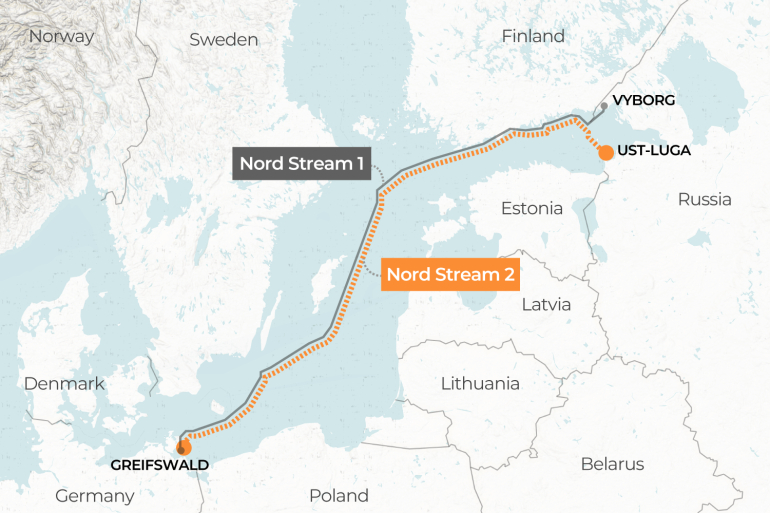
  • Russia resumes gas supplies to Europe via Nord Stream Pipeline

    Russia restored critical gas supplies to Europe through Germany via the Nord Stream pipeline after 10 days of uncertainty in guise of maintenance.

    Nord Stream Pipeline

    • It is a system of offshore natural gas pipelines running under the Baltic Sea from Russia to Germany.
    • It includes two active pipelines running from Vyborg to Lubmin near Greifswald forming the original Nord Stream, and two further pipelines under construction running from Ust-Luga to Lubmin termed Nord Stream 2.
    • In Lubmin the lines connect to the OPAL line to Olbernhau on the Czech border and to the NEL line to Rehden near Bremen.
    • The first line Nord Stream-1 was laid and inaugurated in 2011 and the second line in 2012.
    • At 1,222 km in length, Nord Stream is the longest sub-sea pipeline in the world, surpassing the Langeled pipeline.

    Why in news?

    • Germany, which is heavily dependent on Russian gas, had feared that Moscow would not reopen the pipeline after the scheduled work and accused Moscow of using energy as a “weapon”.
    • The showdown came amid the worst tensions in several years over Russia’s invasion of Ukraine.
    • Germany believes Russia is squeezing supplies in retaliation for Western sanctions over the war.

    Why is Russian gas so important?

    (1) Major chunk of energy

    • Russia supplied some 40% of Europe’s natural gas before the war.
    • That has dropped to around 15%, sending prices through the roof and straining energy-intensive industries.

    (2) Everyday use

    • Gas is used across a range of processes that most people never see – to forge steel to make cars, make glass bottles and pasteurise milk and cheese.
    • Companies warn that they often can’t switch overnight to other energy sources such as fuel oil or electricity to produce heat.

    (3) Fuel inflation

    • High energy prices are already threatening to cause a recession in Europe through record inflation, with consumers having less to spend as costs rise for food, fuel and utilities.
    • A complete cutoff could deal an even heavier blow to an already troubled economy.

    What is visible in Russia’s game plan?

    • Since the invasion, Russia’s revenue from exporting oil and gas to Europe has doubled over the average from recent years, to $95 billion.
    • So Putin has cash in hand and could calculate that painful utility bills and an energy recession could undermine public support for Ukraine in Europe and increase sentiment for a negotiated settlement in his favour.
    • It would be unwise to exclude the possibility that Russia could decide to forgo the revenue it gets from exporting gas to Europe in order to gain political leverage.

    What alternatives does Europe have?

    • The EU has turned to more-expensive liquefied natural gas, or LNG, which comes by ship from places like the US and Qatar.
    • Germany is fast-tracking construction of LNG import terminals on its North Sea coast, but that will take years.
    • But LNG alone can’t make up the gap.
    • Conservation and other energy sources are key.

    Could people freeze this winter?

    • Its unlikely homes, schools and hospitals will lose heat because governments are required to impose rationing first on businesses.
    • The German government also could allow gas suppliers to immediately pass on increases to customers.
    • The choices could include torpedoing industry and/or socking consumers with even higher bills.
    • The IEA recommends that European countries step up campaigns for people to conserve at home and plan to share gas in an emergency.


    UPSC 2023 countdown has begun! Get your personal guidance plan now! (Click here)

  • What is the Nord Stream 1 Gas Link?

    The Nord Stream 1, Germany’s main source of gas from Russia, was recently shut down for scheduled maintenance work.

    Why in news?

    • There are growing concerns in European countries that Russia would shut down its gas supplies in retaliation against the current sanctions against Moscow.

    What is Nord Stream 1?

    • It is a system of offshore natural gas pipelines running under the Baltic Sea from Russia to Germany.
    • Nord Stream 1 is a 1,224 km underwater gas pipeline that runs from Vyborg in northwest Russia to Lubmin in northeastern Germany via the Baltic Sea.
    • Two further pipelines under construction running from Ust-Luga to Lubmin termed Nord Stream 2.
    • Majority owned by the Russian energy giant Gazprom, the pipeline is the primary route through which its gas enters Germany.

    Worry for Europe

    • There have been growing concerns that there could be further restrictions to European gas supplies.
    • European countries rely on Russian energy for their cold winters.
    • But now they believe that Russia could weaponized their dependency as a response to their sanction due to the conflict in Ukraine.

    What are Europe’s alternative sources of energy?

    • As an alternative source for energy, European countries have increasingly turned towards the US, from whom they purchase liquified natural gas (LNG) that comes via ships.
    • Since ship-delivered gas ends up being far more expensive, there are also attempts to get non-Russian pipeline gas from Norway and Azerbaijan.
    • While EU countries were earlier seeking to phase out fossil fuels and emphasize renewable forms of energy, many are now returning to coal to deal with the energy crisis.


    UPSC 2023 countdown has begun! Get your personal guidance plan now! (Click here)

  • Status of China’s Belt and Road Initiative in South Asia

    China has felt a need to re-visit the various projects under the BRI in different South Asian countries.

    Why in news?

    • At the recently concluded summit of G-7 leaders in Germany, US and his allies unveiled their $600 billion plan called the Partnership for Global Infrastructure and Intelligence.
    • This is being seen as a counter to China’s Belt and Road Initiative (BRI), valued at a trillion U.S. dollars by some experts.

    What is China’s Belt and Road Initiative?

    • In 2013, Chinese President Xi Jinping, during his visits to Kazakhstan and Indonesia, expressed his vision to build a Silk Road Economic Belt and a 21st Century Maritime Silk Road.
    • He then aimed to break the “bottleneck” in Asian connectivity. This vision led to the birth of the BRI.
    • The initiative envisioned a Chinese-led investment of over $1 trillion in partner countries by 2025.
    • More than 60 countries have now joined BRI agreements with China, with infrastructure projects under the initiative being planned or under construction in Asia, Africa, Europe, and Latin America.

    How does BRI work?

    • To finance BRI projects, China offers huge loans at commercial interest rates that countries have to pay within a fixed number of years.
    • The west has accused China of debt-trapping by extending “predatory loans” that force countries to cede key assets to China.
    • However, research indicates that low and middle-income countries are often the ones to approach China after not being able to secure loans from elsewhere.
    • In recent years, the BRI seems to have experienced a slowing down as annual Chinese lending to countries slimmed from its peak of $125 billion in 2015 to around $50 to 55 billion in 2021.

    What have been the BRI’s investments in Pakistan?

    • On his 2015 visit to Pakistan, Xi unveiled the BRI’s flagship project and its biggest one in a single country — the China Pakistan Economic Corridor (CPEC).
    • The CPEC envisioned multiple projects involving energy, transport and communication systems.
    • At the centre of the CPEC was the $700 million development of the city of Gwadar into a smart port city that would become the “Singapore of Pakistan”.
    • Other major projects are the orange line metro, coal power plants to tackle energy shortages and the Main Line 1 rail project from Peshawar to Karachi.

    Pace of progress in Pakistan

    • Multiple reports have shown that shipping activities at the Gwadar Port is almost negligible so far, with only some trade to Afghanistan.
    • Gwadar residents have also protested against the large security force deployed to protect Chinese nationals involved in projects.
    • Chinese nations has also became the target of multiple deadly attacks by Baloch freedom fighters.
    • Coal plants were set up and managed by Chinese firms to improve the power situation in Pakistan.
    • Chinese power firms closing down their operations as the latter did not pay dues worth 300 billion in Pakistani rupees (approximately $1.5 billion).

    What about Sri Lanka?

    • In Sri Lanka, multiple infrastructure projects that were being financed by China came under the fold of the BRI after it was launched in 2013.
    • In 2021, Colombo ejected India and Japan out of a deal to develop the East Container Terminal at the Colombo port and got China to take up the project.
    • Some BRI projects in Sri Lanka have been described as white elephants — such as the Hambantota port.
    • The port had always been secondary to the busy Colombo port until the latter ran out of capacity.
    • Other key projects under BRI include the development of the Colombo International Container Terminal, the Central Expressway and the Hambantota International Airport among others.

    Projects in Afghanistan

    • Afghanistan has not comprehensively been brought into the BRI, despite a MoU being signed with China in 2016.
    • China had promised investments worth $100 million in Afghanistan which is small in comparison to what it shelled out in other South Asian countries.
    • The projects have not materialised so far and uncertainties have deepened after the Taliban takeover last year.

    Projects in Maldives

    • Situated in the middle of the Indian Ocean, Maldives comprises two hundred islands, and both India and China have strategic interests there.
    • One of the most prominent BRI projects undertaken in the Maldives is the two km long China-Maldives Friendship Bridge — a $200 million four lane bridge.
    • Most of China’s investment in the Maldives happened under former President Abdullah Yameen, seen as pro-China.

    Projects in Bangladesh

    • Bangladesh, which joined the BRI in 2016, has been promised the second-highest investment (about $40 billion) in South Asia after Pakistan.
    • It has been able to benefit from the BRI while maintaining diplomatic and strategic ties with both India and China.
    • It has managed to not upset India by getting India to build infrastructure projects similar to BRI in the country.
    • BRI projects include Friendship Bridges, special economic zones, the $689.35 million-Karnaphuli River tunnel project, upgradation of the Chittagong port, and a rail line between the port and China’s Yunnan province.
    • However, multiple projects have been delayed owing to the slow release of funds by China.


    UPSC 2023 countdown has begun! Get your personal guidance plan now! (Click here)

  • Russia withdraws from Snake Island

    Russian forces abandoned the strategic Black Sea outpost of Snake Island, in a major victory for Ukraine that could loosen the grip of Russia’s blockade on Ukrainian ports.

    I will give you a trick to remember countries bordering Black Sea. It is ‘GURRBUT’.

    Now please take effort to write those names of countries here.

    Snake Island

    • Zmiinyi Island, also known as Snake or Serpent Island, is a small piece of rock less than 700 metres from end to end, that has been described as being “X-shaped”.
    • It is located 35 km from the coast in the Black Sea, to the east of the mouth of the Danube and roughly southwest of the port city of Odessa.
    • The island, which has been known since ancient times and is marked on the map by the tiny village of Bile that is located on it, belongs to Ukraine.

    Why does Russia seek to control the Black Sea?

    • Domination of the Black Sea region is a geostrategic imperative for Moscow.
    • The famed water body is bound by Ukraine to the north and northwest, Russia and Georgia to the east, Turkey to the south, and Bulgaria and Romania to the west.
    • It links to the Sea of Marmara through the Bosporus and then to the Aegean through the Dardanelles.
    • It has traditionally been Russia’s warm water gateway to Europe.
    • For Russia, the Black Sea is both a stepping stone to the Mediterranean as well as a strategic buffer between NATO and itself.
    • Cutting Ukrainian access to the Black Sea will reduce it to a landlocked country and deal a crippling blow to its trade logistics.


    UPSC 2023 countdown has begun! Get your personal guidance plan now! (Click here)

  • US Supreme Court overturns Abortion Right

    In a significant curtailment of women’s rights, the US Supreme Court overturned Roe v. Wade, a 1973 landmark decision giving women in America the right to have an abortion before the foetus is viable outside the womb — before the 24-28 week mark.

    What is Roe vs. Wade Case: Upholding the Right to Abortion

    • Roe, short for Jane Roe, is the pseudonym for a Texas woman who in 1970 sought to have an abortion when she was five months pregnant.
    • Texas then had ban on abortions except to save a mother’s life. The case then went to the US Supreme Court (SCOTUS).
    • The 7-2 majority opinion of the SCOTUS written in 1973, paved the way for the recognition of abortion as a constitutional right in the US considering foetal viability.

    [Foetal viability is the point at which a foetus can survive outside the womb, at the time considered to be around 28 weeks, but today is closer to 23 or 24 weeks owing to advances in medicine and technology.]

    Right to Abortion Judgment: Key takeaways

    Based on the Roe vs Wade case, the framework of regulations that applied towards the right to abortion:

    1. Almost no limitations could be placed on that right;
    2. Only limitations to abortion rights that were aimed at protecting a woman’s health were permitted; and in the third trimester,
    3. State governments had greater leeway to limit the right to abortion except for cases in which the life and health of the mother were endangered.

    What is the debate?

    The abortion debate is the ongoing controversy surrounding the moral, legal, and religious status of induced abortion.

    The sides involved in the debate are the self-described “pro-choice” and “pro-life” movements.

    1. Pro-choice emphasizes the woman’s choice whether to terminate a pregnancy.
    2. Pro-life position stresses the humanity of both the mother and foetus, arguing that a fetus is a human person deserving of legal protection.

    Why is the judgement overturned?

    • Foetuses feel the pain: If the foetus is beyond 20 weeks of gestation, gynaecs assume that there will be pain caused to the foetus.
    • Biblical gospel: The Bible does not draw a distinction between foetuses and babies. By the time a baby is conceived, he or she is recognized by God.
    • Abortions cause psychological damage: Young adult women who undergo abortion may be at increased risk for subsequent depression.
    • Abortions reduce the number of adoptable babies: Instead of having the option to abort, women should give their unwanted babies to people who cannot conceive. Single parenthood is also gaining popularity in the US.
    • Cases of selective abortion: Such cases based on physical and genetic abnormalities (eugenic termination) is overt discrimination.
    • Abortion as a form of contraception: It is immoral to kill an unborn child for convenience. Many women are using abortion as a contraceptive method.
    • Morality put to question: If women become pregnant, they should accept the responsibility that comes with producing a child. People need to take responsibility for their actions and accept the consequences.
    • Abortion promotes throwaway culture: The legalization of abortion sends a message that human life has little value and promotes the throwaway culture.
    • Racial afflictions: Abortion disproportionately affects African American babies. In the US, black women are 3.3 times as likely as white women to have an abortion.

    Arguments in favour for Abortion Rights

    • Upholding individual conscience and decision-making:  The US Supreme Court has declared abortion to be a fundamental right guaranteed by the US Constitution.
    • Reproductive choice empowers women: The choice over when and whether to have children is central to a woman’s independence and ability to determine her future.
    • Foetal viability occurs post-birth:  Personhood begins after a foetus becomes “viable” (able to survive outside the womb) or after birth, not at conception. Abortion is the termination of a pregnancy, not a baby.
    • No proof of foetal pain: Most neuroscientists believe that the cortex is necessary for pain perception. The cortex does not become functional until at least the 26th week of a foetus’ development.
    • Preventing illegal abortions: Access to legal, professionally-performed abortions reduces maternal injury and death caused by unsafe, illegal abortions.
    • Mother’s health: Modern abortion procedures are safe and do not cause lasting health issues such as cancer and infertility.
    • Child’s health: Abortion gives pregnant women the option to choose not to bring fetuses with profound abnormalities to full term.
    • Prevents women’s exclusion: Women who are denied abortions are more likely to become unemployed, to be on public welfare, to be below the poverty line, and to become victims of domestic violence.
    • Reproductive choice protects women from financial disadvantage: Many women who choose abortion don’t have the financial resources to support a child.
    • Justified means of population control: Many defends abortion as a way to curb overpopulation. Malnutrition, starvation, poverty, lack of medical and educational services, pollution, underdevelopment, and conflict over resources are all consequences of overpopulation.

    Way forward

    • A search for the middle path perhaps the right of a woman to choose what to do with the foetus has to be balanced with the right of the foetus to survive.
    • It is only that a foetus does not have the ability to exercise an option while the person who carries it does.
    • Rather than banning abortion, lawmakers must focus on counselling, employment security, social welfare, and financial support to persuade pregnant women to give birth to their children.
    • We must achieve some degree of protection for the unborn by obtaining voluntary recognition of personal responsibility and respect for the personhood of the unborn.

    Back2Basics: Medical Termination of Pregnancy (MTP) Act

    • Abortion in India has been a legal right under various circumstances for the last 50 years with the introduction of Medical Termination of Pregnancy (MTP) Act in 1971.
    • The Act was amended in 2003 to enable women’s accessibility to safe and legal abortion services.
    • Abortion is covered 100% by the government’s public national health insurance funds, Ayushman Bharat and Employees’ State Insurance with the package rate for surgical abortion.

    The idea of terminating your pregnancy cannot originate by choice and is purely circumstantial. There are four situations under which a legal abortion is performed:

    1. If continuation of the pregnancy poses any risks to the life of the mother or mental health
    2. If the foetus has any severe abnormalities
    3. If pregnancy occurred as a result of failure of contraception (but this is only applicable to married women)
    4. If pregnancy is a result of sexual assault or rape

    These are the key changes that the Medical Termination of Pregnancy (Amendment) Act, 2021, has brought in:

    1. The gestation limit for abortions has been raised from the earlier ceiling of 20 weeks to 24 weeks, but only for special categories of pregnant women such as rape or incest survivors. But this termination would need the approval of two registered doctors.
    2. All pregnancies up to 20 weeks require one doctor’s approval. The earlier law, the MTP Act 1971, required one doctor’s approval for pregnancies upto 12 weeks and two doctors’ for pregnancies between 12 and 20 weeks.
    3. Women can now terminate unwanted pregnancies caused by contraceptive failure, regardless of their marital status. Earlier the law specified that only a “married woman and her husband” could do this.
    4. There is also no upper gestation limit for abortion in case of foetal disability if so decided by a medical board of specialist doctors, which state governments and union territories’ administrations would set up.


    UPSC 2023 countdown has begun! Get your personal guidance plan now! (Click here)

  • Pakistan’s Economic Crisis and the IMF Challenge

    Pakistan’s foreign exchange reserves have been depleting during the last one year and is heading towards a default risk as Sri Lanka did.

    Pakistani economy is said to have been crippling since the discontinuance of US ‘military’ aid which it had used

    What is the news?

    • The Pakistani rupee has been on free fall; from 150 in April 2021 to 213 against the dollar on 21 June, an all-time low.
    • This would mean high oil and electricity prices, to outrage the people who are already to the streets due to ousted PM Imran Khan.
    • The government-International Monetary Fund (IMF) talks have remained complicated.

    Options available for Pakistan

    • Pakistan is under deep Balance of Payment (BoP) crisis (as was India in 1991).
    • Pakistan has exhausted all credit options as SL did.
    • Even the China Pakistan Economic Corridor (CPEC) is at standstill.
    • Even the Saudi’s and so called ‘caliphate’ of Turkey has not come to Pakistan’s rescue.

    Only option left: IMF bail out

    • The immediate future of Pakistan’s economy would depend on IMF resuming its support.
    • Despite an intense discussion between the two, there has not been a consensus until now.

    What is IMF bail-out?

    • Bailout is a general term for extending financial support to a company or a country facing a potential bankruptcy threat.
    • When a country asks the IMF for a loan, the country is facing a major economic crisis.
    • In particular, it does not have enough foreign currency (‘dollars’) to pay for imports and the repayments on its loans. In short, the country cannot pay its international bills. So, it need a bailout.
    • The IMF will give the country an aid, which is ‘cash’ in the sense that it does not have to be spent on a particular project. This money can be used to pay its bills.
    • But, the IMF will impose certain conditions. The basic condition is to spend less – both domestically and internationally.
    • This belt-tightening is not easy – people lose jobs, prices rise, etc. And, one has to repay the loan.
    • These conditions are necessary to ensure that the money is being spent where it is supposed to.

    Pakistan and IMF: A track record

    • Pakistan’s relationship with the IMF has remained complicated. It sees conditions laid as a breach of sovereignty.
    • Though Islamabad has been negotiating with the IMF repeatedly, there has been an economic nationalism, mostly jingoistic, against approaching the IMF in recent years.
    • Imran Khan, the former PM made statements and fuelled the sentiments against the IMF.
    • After becoming the PM in 2018, he preferred approaching friendly countries (China and Saudi Arabia) and avoiding the IMF.
    • The new government is now back to the IMF; it expects the IMF to release the payments, expand the support programme, and give a longer rope to repay.

    Conditions laid out by IMF for recent bail-out

    • The IMF is willing to support Pakistan but has some conditions regarding macroeconomic reforms.
    • It wants Pakistan to be transparent about its debt situation, including what Islamabad owes to China, as a part of the CPEC.
    • Terror-financing in Pakistan is the most favored type of investment!
    • The IMF may agree to support after a few more promises by the government.
    • But the relief may be less than what Pakistan would hope for.

    A vicious cycle

    • Since its inception, Pakistan has spent more years inside an IMF programme than outside of it.
    • Every leader took the money, imposed massive hardships on the population through austerity and demand suppression and then reneges on its commitment through a patchy implementation.
    • Radical fanaticism and anti-India sentiments are successful tools of public appeasement.

    Will Pakistan pursue macroeconomic reforms?

    • In Pakistan, budgets have remained populist.
    • The economic governance declined due to corruption, lack of financial institutions’ independence, and the export decline.
    • The subsidies in the energy sector — fuel, oil and electricity — remain high to appease the public.
    • With the present coalition government facing elections, they are less likely to take any further bold decisions.

    Will “friendly countries” support Pakistan without preconditions?

    • Saudi Arabia and China have been supporting Pakistan. MBS has already pulled his hands.
    • Riyadh’s support is not unconditional.
    • It can ask Pakistan “to return the money at any time if the two countries have divergent views regarding their relationship or ties with a third country, or some other issue.”
    • China has been another significant source for Pakistan. Islamabad has been regularly seeking loans from China within and outside the CPEC projects.
    • However, since the attack on Chinese citizens by Baloch Fighters, China appears to have been disgusted with Pakistan.
    • CPEC is also at a standstill.

    FATF clearance is no panacea

    • During the latest Financial Action Task Force (FATF) meeting, there was an understanding that Pakistan has met its requirement.
    • The FATF has agreed to explore the possibilities of removing Pakistan from the grey list.
    • However, even when Pakistan was on the grey list, the IMF had been holding talks with Islamabad.
    • The big two — China and Saudi Arabia — were not constrained by Pakistan’s listing in the FATF.
    • So, the relaxation is less likely to open gates for big investments.

    Will Pakistan go the Sri Lankan way?

    • The situation was similar in Sri Lanka — the falling value of rupee, declining foreign exchange reserves, differences with the IMF, and rising fuel prices.
    • All of them led to public protests in Sri Lanka against the government.
    • The economic and energy crises in Pakistan have not snowballed into a political storm as it had happened in Sri Lanka.
    • The dope of “threats to Religion” works effectively there.

    Conclusion

    • The experiment of Pakistan (as a separate nation) has failed on various fronts.
    • To conclude, Pakistan’s economic and energy situation is serious and demands bold decisions.
    • The situation will worsen in the short term before it gets better, but this has been Pakistan’s history in the last 75 years.
    • With a relief from the IMF, after a protracted negotiation, a few band-aids, and the US intervention, Islamabad may muddle through this time as well, until the next crisis.


    UPSC 2023 countdown has begun! Get your personal guidance plan now! (Click here)