💥Mains Ready By December. Smash Mains & Smash PYQ Admissions Open

Subject: International Stories of Key Importance

  • Places in news: Snake Island

    Ukraine has said it has caused “significant losses” to the Russian military in airstrikes on Zmiinyi Island, also known as Snake Island, in the Black Sea.

    Snake Island

    • Zmiinyi Island, also known as Snake or Serpent Island, is a small piece of rock less than 700 metres from end to end, that has been described as being “X-shaped”.
    • It is located 35 km from the coast in the Black Sea, to the east of the mouth of the Danube and roughly southwest of the port city of Odessa.
    • The island, which has been known since ancient times and is marked on the map by the tiny village of Bile that is located on it, belongs to Ukraine.

    Why does Russia seek to control the Black Sea?

    • Domination of the Black Sea region is a geostrategic imperative for Moscow.
    • The famed water body is bound by Ukraine to the north and northwest, Russia and Georgia to the east, Turkey to the south, and Bulgaria and Romania to the west.
    • It links to the Sea of Marmara through the Bosporus and then to the Aegean through the Dardanelles.
    • It has traditionally been Russia’s warm water gateway to Europe.
    • For Russia, the Black Sea is both a stepping stone to the Mediterranean as well as a strategic buffer between NATO and itself.
    • Cutting Ukrainian access to the Black Sea will reduce it to a landlocked country and deal a crippling blow to its trade logistics.


    UPSC 2023 countdown has begun! Get your personal guidance plan now! (Click here)

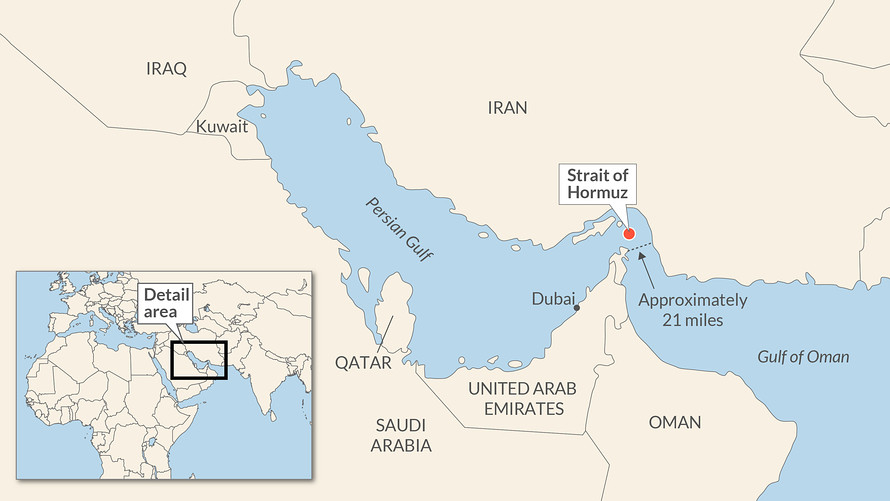
  • Places in news: Strait of Hormuz

    A US Navy warship fired a warning flare to wave off an Iranian speedboat coming straight at it during a tense encounter in the strategic Strait of Hormuz.

    Why in news?

    • The Strait of Hormuz, a narrow waterway in the Middle East marks the most sensitive transportation choke point for global oil supplies.

    Strait of Hormuz

    • The Strait of Hormuz is a narrow channel, approximately 30 miles wide at the narrowest point, between the Omani Musandam Peninsula and Iran.
    • It connects the Persian Gulf to the Gulf of Oman.
    • The Strait is deep and relatively free of maritime hazards.
    • Its depth is greatest near the Musandam Peninsula and tapers as you move north toward the Iranian shore.

    Why is it important?

    • Oil tankers carrying crude from ports on the Persian Gulf must pass through the strait.
    • Around 21 million barrels of oil a day flowed through it in 2018, equivalent to roughly a third of global seaborne oil trade and about 21% of global petroleum liquids consumption.


    UPSC 2023 countdown has begun! Get your personal guidance plan now! (Click here)

  • Outcomes of the WTO Ministerial Conference

    Recently, member countries of the World Trade Organization (WTO) wrapped up the Ministerial Conference’s twelfth outing (MC12).

    Key outcomes: “Geneva Package”

    • The conference has secured key agreements on
    1. Relaxing patent regulations to achieve global vaccine equity
    2. Ensuring food security
    3. According subsidies to the fisheries sector
    4. Continuing moratoriums relevant to e-commerce
    • Together they constitute what WTO Director-General is referred to as the “Geneva Package.”
    • India saw some successes at the MC12 with respect to the above mentioned sectors.

    What is the WTO’s Ministerial Conference?

    • The MC is at the very top of WTO’s organisational chart.
    • It meets once every two years and can take decisions on all matters under any multilateral trade agreement.
    • Unlike other organisations, such as the International Monetary Fund or World Bank, WTO does not delegate power to a board of directors or an organisational chief.
    • All decisions at the WTO are made collectively and through consensus among member countries at varied councils and committees.
    • This year’s conference took place in Geneva, Switzerland.

    Major debates at the MC12

    (1) Agriculture

    • India is a significant contributor to the World Food Programme (WFP).
    • India had earlier stated that it had never imposed export restrictions for procurement under the programme.
    • It put forth that a blanket exemption could constrain its work in ensuring food security back home.
    • In such a situation, it would have to keep its WFP commitments irrespective of its domestic needs.
    • Negotiators could not reach agreements on issues such as permissible public stockholding threshold for domestic food security, domestic support to agriculture, cotton, and market access.

    (2) Fisheries

    • India successfully managed to carve out an agreement on ELIMINATING subsidies to those engaged in illegal, unreported and unregulated fishing.
    • The only exception for continuing subsidies for overfished stock is when they are deemed essential to rebuild them to a biologically sustainable level.
    • Overfishing refers to exploiting fishes at a pace faster than they could replenish themselves — currently standing at 34% as per the UN Food and Agriculture Organization (FAO).
    • Declining fish stocks threaten to worsen poverty and endanger communities that rely on aquatic creatures for their livelihood and food security.
    • Further, the agreements hold that there would be no limitation on subsidies by developing or least-developed countries for fishing within their exclusive economic zones (EEZ).

    (3) Patent relaxations

    • Member countries agreed on authorising the use of a patent for producing COVID-19 vaccines by a member country, without the consent of the rights holder.
    • Further, it asks member countries to waive requirements, including export restrictions, set forth by WTO regulations to supply domestic markets and member countries with any number of vaccines.
    • The agreement, however, comes too little, too late for economically poorer countries.


    UPSC 2023 countdown has begun! Get your personal guidance plan now! (Click here)

  • Lessons from the Ukraine crisis price shock

    Context

    The Russia-Ukraine conflict, now more than three months old, will cause major, long-term shifts in the global energy and commodity trade.

    Factors responsible for high prices

    • Ukraine war: Western sanctions on Russia and efforts of European nations to diversify their energy supplies are already causing market distortions and high prices.
    • Crude oil prices are at their highest level since 2014; the price of LNG is at its highest ever, fertiliser and food are up and markets for several other commodities such as nickel have been disrupted.
    • Expensive commodities are already causing distress in India’s neighbourhood, for example, in Sri Lanka and Pakistan.
    • Insufficient investment: Insufficient investment in oil and gas production in preceding years resulted in high prices, and shortages were being felt.
    • A number of European investors, such as Norway’s sovereign wealth fund, announced they would no longer invest in traditional fuels — oil, gas, coal.
    • Natural gas is used as a feedstock for fertiliser.
    • An energy shock is then inevitably followed by a food price shock.

    Future trends

    1] Strained EU-Russia relations will distort prices

    • In the immediate term, the EU is trying to source its raw materials — most critically oil and natural gas, but also fertiliser, agricultural goods and metals — from non-Russian sources.
    • This will cause distortions and price spikes for those commodities in the global market, as can already be seen in the natural gas market, up 300 per cent in the last year.

    2] Sanctions are unlikely to achieve the desired political outcome

    • The US and its allies are quick to impose sanctions — and these are rarely withdrawn, if ever.
    • Iran has been under US sanctions since 1979, and the same with Venezuela for over a decade.
    • In both cases, sanctions have failed to achieve the desired political outcome.
    • As Russia is much better placed than either of those two countries to weather sanctions, the restrictions are likely to remain for a long while.

    3] Emerging world unwilling to align with West on sanctions

    • The high price of energy and the resulting inflation shows why much of the emerging world is unwilling and unable to align with the West on the current sanctions.
    • Russia is 11 per cent of the global landmass and among the world’s top five producers and exporters of oil, gas, fertiliser and other critical commodities like nickel.
    • It is too big to be replaced as a supplier.
    • In emerging economies, it can fan public anger and political unrest, as was seen in Tunisia and other Arab countries from 2010 on.

    4] Larger emerging economies will disregard sanction

    • Larger emerging economies such as China, India and Brazil will disregard sanctions on their key economic interests, particularly food, fertilisers and energy.
    • Specifically for India, its dependence on these essentials is unlikely to reduce meaningfully over the next 15-20 years.

    Way forward for India

    • Collaborate with other economies: In the immediate future, the India should collaborate with other similar economies to ensure that Russia doesn’t get locked out of global commodity markets.
    • Work on insulating the supply chains: For the long term, it must work on insulating its supply chains from global political crises.

    Conclusion

    India needs to brace for the price shock emanating from the distortion caused by the shift in the energy policies of Europe. At the same time, India needs to collaborate with other similar economies to ensure that Russia doesn’t get locked out of global commodity markets.

    UPSC 2023 countdown has begun! Get your personal guidance plan now! (Click here)

  • India is expanding its nuclear arsenal: SIPRI

    India had 160 nuclear warheads as on January 2022 and it appears to be expanding its nuclear arsenal, said the Stockholm International Peace Research Institute (SIPRI), a defense think tank.

    What is the news?

    • India’s nuclear stockpile increased from 156 in January 2021 to 160 in January 2022.

    Nukes in thy neighbour

    • Pakistan’s nuclear stockpile has remained at 165, SIPRI claimed.
    • China is in the middle of a substantial expansion of its nuclear weapon arsenal, which satellite images indicate includes the construction of over 300 new missile silos.
    • China had 350 nuclear warheads in January 2021 and 2022.

    Why do countries proliferate nuclear weapons?

    • Proliferation models centered on security concerns or dilemmas dominate nuclear literature.
    • Nuclear weapons provide an overwhelmingly destructive force that increases a state’s relative power in comparison to its neighbors.
    • It provides a powerful tool in an anarchic system where superpowers dominate other nation-states sovereignty.
    • Hence weaponizing helps establish a deterrence to prevent war.

    What is the Deterrence Theory?

    • Deterrence is widely defined as any use of threats (implicit or explicit) or limited force intended to dissuade an actor from taking an action (i.e. maintain the status quo).
    • The topic gained increased prominence as a military strategy during the Cold War with regard to the use of nuclear weapons.
    • It is related to but distinct from the concept of mutual assured destruction, which models the preventative nature of full-scale nuclear attack that would devastate both parties in a nuclear war.
    • The central problem of deterrence revolves around how to credibly threaten military action or nuclear punishment on the adversary despite its costs to the deterrer.

    Issues in Nuclear Disarmament

    • Notion of Nuclear ‘Haves’ and ‘Have-Nots’: The proponents of disarmaments are themselves nuclear armed countries thus creating a nuclear monopoly.
    • Concept of Peaceful Nuclear Explosion (PNE): conducted for non-military purposes such as mining.

    India’s commitment for de-nuclearization

    India has always batted for a universal commitment and an agreed global and non-discriminatory multilateral framework.

    • It has outlined a working paper on Nuclear Disarmament submitted to the UN General Assembly in 2006.
    • India participated in the Nuclear Security Summit process and has regularly participated in the International Conferences on Nuclear Security organised by the International Atomic Energy Agency (IAEA).
    • India is also a member of the Nuclear Security Contact Group (but has signed off the Nuclear Non-Proliferation Treaty (NPT)).
    • India has expressed its readiness to support the commencement of negotiations on a Fissile Material Cut-off Treaty (FMCT).
    • India couldn’t join the Comprehensive Nuclear-Test-Ban Treaty (CTBT) due to several concerns raised by India.
    • India has piloted an annual UNGA Resolution on “Measures to Prevent Terrorists from Acquiring Weapons of Mass Destruction” since 2002, which is adopted by consensus.

    Back2Basics: India’s Nuclear Doctrine

    • This was first articulated by Prime Minister Atal Bihari Vajpayee on May 27, 1998, days after India had undertaken a series of nuclear tests in Pokhran.
    • It outlined various principles:
    1. Building and maintaining a Credible Minimum Deterrence
    2. Posture of ‘No First Use’– nuclear weapons will only be used in retaliation against a nuclear attack on Indian Territory or on Indian forces anywhere
    3. Massive Nuclear retaliation to a first strike will be designed to inflict unacceptable damage
    4. Non-use against non-nuclear states
    5. In response to biological or chemical weapons, India will retain the option of retaliating with nuclear weapons

    UPSC 2023 countdown has begun! Get your personal guidance plan now! (Click here)

  • FATF and Pakistan’s position on its ‘Grey List’

    Pakistan which continues to face an economic crunch from the Financial Action Task Force (FATF), is hoping for some respite in the form of its removal from the FATF’s ‘grey list’.

    What is the FATF?

    • The FATF is an international watchdog for financial crimes such as money laundering and terror financing.
    • It was established at the G7 Summit of 1989 in Paris to address loopholes in the global financial system after member countries raised concerns about growing money laundering activities.
    • In the aftermath of the 9/11 terror attack on the US, FATF also added terror financing as a main focus area.
    • This was later broadened to include restricting the funding of weapons of mass destruction.
    • The FATF currently has 39 members.

    Working of FATF

    • The decision-making body of the FATF, known as its plenary, meets thrice a year.
    • Its meetings are attended by 206 countries of the global network.
    • It includes members, and observer organisations, such as the World Bank, some offices of the UN, and regional development banks.

    Functions of FATF

    • The FATF sets standards or recommendations for countries to achieve in order to plug the holes in their financial systems and make them less vulnerable to illegal financial activities.
    • It conducts regular peer-reviewed evaluations called Mutual Evaluations (ME) of countries to check their performance on standards prescribed by it.
    • The reviews are carried out by FATF and FATF-Style Regional Bodies (FSRBs), which then release Mutual Evaluation Reports (MERs).
    • For the countries that don’t perform well on certain standards, time-bound action plans are drawn up.
    • Recommendations for countries range from assessing risks of crimes to setting up legislative, investigative and judicial mechanisms to pursue cases of money laundering and terror funding.

    What are the Black List and the Grey List?

    • The words ‘grey’ and ‘black’ list do not exist in the official FATF lexicon.
    • They however designate countries that need to work on complying with FATF directives and those who are non-compliant.
    1. Black List: The blacklist, now called the “Call for action” was the common shorthand description for the FATF list of “Non-Cooperative Countries or Territories” (NCCTs).
    2. Grey List: Countries that are considered safe haven for supporting terror funding and money laundering are put in the FATF grey list. This inclusion serves as a warning to the country that it may enter the blacklist.

    Consequences of being:

    (1) In the grey list:

    • Economic sanctions from IMF, World Bank, ADB
    • Problem in getting loans from IMF, World Bank, ADB and other countries
    • Reduction in international trade
    • International boycott

    (2) In the black list:

    • High-risk jurisdictions subject to call for action
    • Countries have considerable deficiencies in their AML/CFT (anti-money laundering and counter terrorist financing) regimens
    • Enhanced due diligence
    • Members are told to apply counter-measures such as sanctions on the listed countries

    Note: Currently, North Korea and Iran are on the black list.

    Pakistan and FATF

    • Pakistan, which continues to remain on the “grey list” of FATF, had earlier been given the deadline till the June to ensure compliance with the 27-point action plan against terror funding networks.
    • It has been under the FATF’s scanner since June 2018, when it was put on the Grey List for terror financing and money laundering risks.
    • FATF and its partners such as the Asia Pacific Group (APG) are reviewing Pakistan’s processes, systems, and weaknesses on the basis of a standard matrix for anti-money laundering (AML) and combating the financing of terrorism (CFT) regime.

    Why is Pakistan on the grey list?

    • Pakistan has found itself on the grey list frequently since 2008, for weaknesses in fighting terror financing and money laundering.
    • It never addressed concerns on the front of terror financing investigations and prosecutions targeting senior leaders and commanders of UN-designated terrorist groups.
    • However, now steps had been taken in this direction such as the sentencing of terror outfit chief Hafiz Saeed, prosecution of Masood Azhar and seizure of their properties.
    • India meanwhile, a member of FATF, suspects the efficacy and permanence of Pakistani actions.

    Steps taken by Pakistan

    • Pakistan is currently banking on its potential exclusion from the grey list to help improve the status of tough negotiations with the International Monetary Fund to get bailout money.
    • Pakistan is now making a high-level political commitment to the FATF and APG to address its strategic AML/CFT deficiencies.


    UPSC 2023 countdown has begun! Get your personal guidance plan now! (Click here)

  • China’s growing footprint in the Pacific Islands

    Wang Yi, the Foreign Minister of China, is currently on an eight-day visit to ten Pacific Island Countries (PICs) after the MoU failed to gain consensus among the PICs.

    What are the PICs?

    • The Pacific Island Countries are a cluster of 14 states which are located largely in the tropical zone of the Pacific Ocean between Asia, Australia and the Americas.
    • They include Cook Islands, Fiji, Kiribati, Republic of Marshall Islands, Federated States of Micronesia (FSM), Nauru, Niue, Palau, Papua New Guinea, Samoa, Solomon Islands, Tonga, Tuvalu and Vanuatu.
    • The islands are divided on the basis of physical and human geography into three distinct parts — Micronesia, Melanesia and Polynesia.

    Geo-economics of PICs

    • The islands are very small in land area, and are spread wide across the vast equatorial swathe of the Pacific Ocean.
    • Even being the smallest and least populated states, they have some of the largest Exclusive Economic Zones (EEZs) in the world.
    • Large EEZs translate into huge economic potential due to the possibility of utilising the wealth of fisheries, energy, minerals and other marine resources present in such zones.
    • Hence, they prefer to be identified as Big Ocean States, rather than Small Island States.
    • In fact, Kiribati and FSM, both PICs, having EEZs larger than that of India.

    Strategic significance

    • PICs have played an important role in major power rivalry as springboards for power projection and laboratories for developing and demonstrating strategic capabilities.
    • The major powers of the colonial era competed with each other to gain control over these strategic territories.
    • The Pacific islands also acted as one of the major theatres of conflict during the Second World War — between imperial Japan and the US.
    • Due to the remoteness of these islands from major population centres of the world, some of the major nuclear weapon test sites of the US, UK and France were located here.
    • In addition, the 14 PICs account for as many number of votes in the United Nations, and act as a potential vote bank for major powers to mobilise international opinion.

    China’s vested interests in PIC

    • China does not have any particular historical linkages to the PICs unlike the Western powers.
    • Therefore, its interest in the PICs is of relatively recent origin, and is linked to China’s rise in the past few decades.
    • The PICs lie in the natural line of expansion of China’s maritime interest and naval power.
    • They are located beyond China’s ‘First Island Chain’, which represents the country’s first threshold of maritime expansion.
    • The PICs are located geostrategically in what is referred to by China as its ‘Far Seas’.
    • Their control will make Chinese Blue Water Navy capable, an essential prerequisite, for becoming a superpower in maritime domain.

    For the Taiwan narrative

    • China is preparing for what seems like an inevitable military invasion of Taiwan, sooner or later.
    • In this context, it becomes important to break Western domination of island chains of the Pacific.
    • This could otherwise impede reunification.
    • Wooing the PICs away from the West and Taiwan will therefore make the goal of Taiwan’s reunification easier for China.
    • Currently, only four PICs have recognised Taiwan. They are Tuvalu, Palau, Marshall Islands and Nauru.

    What are the implications of China’s latest move?

    • China has increasingly started talking about security cooperation in addition to its economic diplomacy towards the PICs.
    • In April 2022, China signed a controversial security deal with the Solomon Islands, which raised regional concerns.
    • The PICs as a collective did not agree to China’s extensive and ambitious proposals, and therefore China failed to get a consensus on the deal.

    Why did the PICs refuted China?

    • PICs perceived that they could have negative implications for the sovereignty and unity of PICs and may drag them into major power conflicts in the future.
    • Some have argued that China has acted too boldly and has therefore met with such a debacle.
    • China might have also miscalculated the regional reaction, perhaps led by a monolithic understanding of the PICs after seeing Solomon Islands’ positive response earlier this year.

    A caution for the world

    • China can always come back with improvised plan (rather bigger lollipop) which is more acceptable and use it to further pursue its final objectives incrementally.
    • Moreover, this debacle does not stop China from pursuing bilateral deals of similar nature.

    Conclusion

    • The intensification of China’s diplomacy in PICs have made the powers who have traditionally controlled the regional dynamics like the US and Australia more cautious.
    • The US has started revisiting its diplomatic priority for the region ever since the China-Solomon Islands deal.
    • The role played by the US in mobilising opposition against China’s proposed deal could not be ruled out.


    UPSC 2023 countdown has begun! Get your personal guidance plan now! (Click here)

  • Explained: European Union’s ban on Russian Oil

    As part of the sixth package of sanctions since Russia’s invasion of Ukraine, the European Union member states reached an agreement to ban 90% of Russian crude oil imports by the end of the year.

    Oil embargo on Russia

    • The proposal is to completely phase out Russian crude and refined products from EU territory.
    • It includes a complete import ban on all Russian oil, seaborne and pipeline crude and refined.
    • This however needed the agreement of all the 27 EU member states in order to be implemented.

    What was the rationale behind such a move?

    • The Russian economy is heavily dependent on energy exports, with the EU paying billions of dollars every month to Russia.
    • The EU wants to block this massive revenue inflow.
    • This is akin to Europeans bankrolling Russia’s war.

    Why such a move now?

    • The EU has been attempting, ever since the Ukraine invasion, to build consensus on ways to hurt Russia economically.
    • The most obvious route was to stop buying Russian energy, which isn’t easy given European households’ dependence on Russian oil and gas.

    What are the terms of the ‘compromise deal’ that has been agreed upon?

    • EU leaders have agreed to ban all seaborne imports of Russian crude, which account for two-thirds of EU’s oil imports from Russia.
    • Germany and Poland are pledging to phase out even their pipeline imports from Russia by the end of the year.
    • The embargo would eliminate 90% of Russian oil imports.

    Special concessions to Hungary

    • The remaining 10% that’s been allowed represents a free pass for Hungary, the Czech Republic, Slovakia, and Bulgaria to continue imports via the Druzhba pipeline, the world’s largest oil pipeline network.
    • Hungary has obtained a guarantee that it could even import seaborne Russian oil in case of a disruption to their pipeline supplies.
    • This was deemed a legitimate concession since the pipelines do pass through the war zone in Ukraine.

    Why was exemption given for pipeline imports?

    • The exemption for pipeline imports was made on the logic that landlocked countries (Hungary, Czech Republic and Slovakia).
    • They are heavily dependent on Russian pipeline oil and do not have a ready option to switch to alternative sources in the absence of ports.

    How will the sanctions affect Russia?

    • Analysts calculate that a two-thirds cut in Europe’s imports might cause Russia an annual loss in revenue of $10 billion.
    • Given Russia’s limited storage infrastructure, the cutback in demand would force Russia to find other markets.
    • Since that won’t be easy, Russia might have to cut production by 20-30%.
    • So far, Asian importers, especially India, have absorbed some of the excess inventory at discounted prices.

    Impact on the ongoing war

    • It remains unclear if the embargo would have any impact on Russian military operations in Ukraine.

    How will the sanctions affect Europe?

    • It is likely to further fuel inflation in Europe, where many countries are already facing a cost-of-living crisis.
    • European lifestyles have tended to take cheap Russian energy for granted, and if inflation peaks further, the EU runs the risk of losing public support for harsh sanctions.

    What about the import of Russian gas?

    • Compared to Russian oil, Europe’s dependence on Russian gas is much greater, and this embargo leaves the import of Russian gas — which accounts of 40% of Europe’s natural gas imports — untouched.
    • In other words, Europe will continue to pay Russia for gas imports.
    • But since crude is more expensive than natural gas, the oil ban is expected to hurt Russian revenues.

    Indian response to these developments

    • India ramped up purchases of Russian crude at discounted prices in the months following the Russian invasion, and this policy is expected to continue.
    • The announcement of the EU ban caused an immediate surge in oil prices, and as Europe seeks alternate sources – from West Asia, Africa and elsewhere — for its oil needs, prices are expected to stay high.
    • In this context, with Russia reportedly offering discounts of $30-35 per barrel, India has found it convenient to make the most of the cheap Russian crude on offer.


    UPSC 2023 countdown has begun! Get your personal guidance plan now! (Click here)

  • The return of the great power rivalries

    Context

    The post-Cold War period of peace in Europe is more an aberration than norm in the continent’s history of conflicts.

    Background of the First World War

    • The Russian power had collapsed in its far east after the war with Japan in 1904-05.
    • Faced with the erosion of Russian influence and the rise of Wilhelmine Germany, which together threatened to alter Europe’s balance of power, France and Britain, competing colonial powers, came together. 
    • France had already reached an alliance with Russia.
    • The three would later form the Triple Entente, triggering a dangerous security competition in Europe with the Triple Alliance (Germany, Austria-Hungary and Italy), which would eventually lead to the First World War in 1914.
    • What triggered the great power security competition in the run-up to the First World War was the phenomenal rise of Wilhelmine Germany as a military and industrial power and the regional hegemons’ response to it.

    Similarities with the past

    • When Otto von Bismarck became the Minister-President of Prussia in September 1862, there was no unified German state.
    •  Bismarck adopted an aggressive foreign policy, fought and won three wars — with Denmark, Austria and France — destroyed the confederation, established a stronger and larger German Reich that replaced Prussia.
    • Bismarck stayed focused on transforming Germany internally in his last two decades.
    • It was on the foundation Bismarck built that Wilhelmine Germany turned to weltpolitik in the early 20 century, seeking global domination.
    • If Bismarck inherited a weak, loosely connected group of German speaking entities in 1862, Russian President Vladimir Putin got a Russia in 2000 that was a pale shadow of what was the Soviet Union.
    • Bismarck spent his years in power expanding the borders of Germany and building a stronger state and economy.
    • The post-Cold War Russia initially stayed focused on the restoration of the state and the economy, and then sought to expand its borders and challenge the continent’s balance of power — first the Crimean annexation and now the Ukraine invasion.
    • While NATO’s expansion deepened Russia’s security concerns, driving it into aggressive moves, Russia’s aggression has strengthened NATO’s resolve to expand further into Russia’s neighbourhood.

    Offensive realism

    • Offensive realists argue that “revisionist powers” tend to use force to rewrite the balance of power if they find the circumstances are favourable, while the status quo powers, or the existing regional hegemons, would seek to thwart any new country attaining more power at their expense.
    • The result of this type of competition is permanent rivalry and conflict.
    • One major difference between the era of Wilhelmine Germany and modern Russia is that there were no well-defined international laws in the 19th and early 20th centuries.
    • The international system has evolved ever since.
    • But its basic instincts, as realists would argue, have not changed much.
    • Mr. Putin’s Russia is not the first country that violated the sovereignty of a weaker power and flouted international laws in the “rules-based” order.

    Future of Europe’s security

    • Russia apparently had two strategic objectives in Ukraine —
    • One, to expand Russian borders and create a buffer.
    • And two, to reinforce Russia’s deterrence against NATO.
    • While Russia has succeeded, though slowly, in expanding its borders by capturing almost all of Ukraine’s east, the war has backfired on its second objective.
    • Russia’s inability to clinch a quick outright victory in Ukraine and the tactical retreats it has already made have invariably dealt a blow to the perception of Russian power that existed before the war.
    • This has strengthened NATO, driving even Sweden and Finland into its arms. Besides, the economic sanctions would leave a long-term hole in Russia’s economy.
    • But a Russia that is bogged down in Ukraine and encircled by NATO need not enhance Europe’s security.
    • As Henry Kissinger said at Davos, Russia had been and would remain an important element in the European state system.

    Conclusion

    The prospects are bleak. There will not be peace in Europe unless either Russia accepts its diminished role and goes into another spell of strategic retreat or Europe and the West in general accommodate Russia’s security concerns. Both look unrealistic as of today.

    UPSC 2023 countdown has begun! Get your personal guidance plan now! (Click here)

  • A war that is shrinking India’s geopolitical options

    Context

    What was initially assumed in New Delhi to be a quick confrontation between Russia and Ukraine, the war in Europe is now raging on with no end in sight, and with its long-term implications yet unknown.

    Why Ukraine war may reduce India’s options

    • For several weeks during late March and April, it seemed as though the Ukraine war presented a number of geopolitical options for New Delhi to choose from.
    • War may limit India’s options: Instead of enhancing New Delhi’s ability to make strategic choices in its broader region, the Ukraine war may actually limit the number of options available to New Delhi for at least three reasons.
    • 1]Absence of Russia for balancing purposes: Russia as a key strategic partner is no longer available to India for balancing purposes.
    • 2] Increased Chinese influence in the region:  Russia’s sudden absence from the Asian balance of power equations has further enhanced Chinese influence in the region.
    • By the time the war ends, whatever may be the shape of the global balance of power, the regional balance of power would have irretrievably shifted in Beijing’s favour.
    • 3] Indo-Pacific region moving out of focus: Given that the United States and its western partners are more interested on the Ukraine theatre today, their focus on China is already taking a hit, if not yet on the Indo-Pacific.

    India’s dilemmas in medium to long term

    1] Managing China

    • Weakened US influence in South Asia: While the Ukraine war has strengthened and revitalised the U.S.-led military and political coalition globally, it is bound to weaken the American influence in the Southern Asian region.
    • China is the biggest beneficiary of the U.S./western retrenchment from the region which gives it a free hand in it.
    • Russia not available: For New Delhi, Moscow is no longer available for its pursuit of its regional interests, and the U.S.’s ability to produce favourable geopolitical outcomes for India in the region is shrinking as well.
    • While there is little doubt that in the longer run, a war-fatigued and weakened Russia will become a junior partner to China, India today does have an opportunity to get Moscow to nudge Beijing to stop its irredentism on the LAC.
    • If the Chinese side, taking advantage of the Ukraine distraction, heats up the LAC, India would have to turn to the West and the U.S. for support (political, diplomatic, intelligence, etc.).
    • This would invariably hurt Russian interests. 
    • Russia, it is important that two of its Asian friends — China and India — do not clash at least while the war is still on.
    • While this may be a useful way to manage the Chinese aggression on the LAC in the short term, this will depend on how China views its dynamics with Russia and that of Russia with India.
    • Herein lies the challenge for India.
    • India’s engagement with Indo-Pacific region: If China were to stabilise the LAC at the nudging of Russia, it would also expect India to go slow on the Indo-Pacific, something India can ill-afford to do.
    • Inability to exploit contradictions: While, under normal circumstances, India could have utilised the many inherent contradictions between Moscow and Beijing, the Ukraine war has suspended those contradictions.

    2] How Ukraine war affected India’s north-western continental strategy

    • India’s north-western continental strategy, in particular towards Afghanistan and Central Asia, too will get complicated due to the Ukraine war.
    • For over a year now, the Line of Control (LoC) with Pakistan is calm and the violence in Kashmir has come down.
    • More pertinently, New Delhi’s presence from Afghanistan has entirely disappeared.
    • So, it appears that the calm in Kashmir and along the LoC is a quid pro quo for the Indian withdrawal from Afghanistan.
    • If this is a bargain New Delhi accepts, it will not only mean giving up its strategic interests in Afghanistan but also reducing its engagement in the Central Asian region as well at a time China is making feverish inroads into the region, right in the backyard of the Russian sphere of influence.
    • Had Moscow not been caught in the Ukraine war, it would have fended off Beijing’s attempts to take over its backyard (in one sense, China is doing to Russia using economic means what the North Atlantic Treaty Organization has been doing to Russia using military means).
    • During the December summit, India and Russia had decided on a number of initiatives focusing on Central Asia and Afghanistan.
    • They are unlikely to be revived anytime soon, ceding further ground to China and Pakistan.

    Conclusion

    The combined geopolitical impact of the ill-timed U.S. withdrawal from Afghanistan, Russia’s Ukraine war, and the rapid expansion of Chinese influence goes to show how New Delhi’s geopolitical choices have suddenly shrunk due to the Ukraine war.

    UPSC 2023 countdown has begun! Get your personal guidance plan now! (Click here)