💥Mains Ready By December. Smash Mains & Smash PYQ Admissions Open

Subject: International Stories of Key Importance

  • Human Rights Council rejects debate on Xinjiang Abuses

    xinjiang

    The UN Human Rights Council has voted against holding a debate on alleged abuses in China’s Xinjiang region after intense lobbying by Beijing, in a major setback for Western nations.

    What is the news?

    • India and 10 other nations abstained.

    Who are the Uighurs?

    xinjiang

    • There are about 12 million Uighurs, mostly Muslim, living in north-western China in the region of Xinjiang, officially known as the Xinjiang Uyghur Autonomous Region (XUAR).
    • The Uighurs speak their own language, similar to Turkish, and see themselves as culturally and ethnically close to Central Asian nations.
    • They make up less than half of the Xinjiang population.
    • In recent decades, there’s been a mass migration of Han Chinese (China’s ethnic majority) to Xinjiang, and the Uighurs feel their culture and livelihoods are under threat.
    • In the early 20th Century, the Uighurs briefly declared independence, but the region was brought under complete control of mainland China’s new Communist government in 1949.

    Where is Xinjiang?

    • Xinjiang lies in the north-west of China and is the country’s biggest region.
    • Like Tibet, it is autonomous, meaning – in theory – it has some powers of self-governance. But in practice, both face major restrictions by the central government.
    • It is a mostly desert region, producing about a fifth of the world’s cotton.
    • It is also rich in oil and natural gas and because of its proximity to Central Asia and Europe is seen by Beijing as an important trade link.

    What was the build-up to the Uighur crackdown?

    • Anti-Han and separatist sentiment rose in Xinjiang from the 1990s, flaring into violence on occasion.
    • In 2009 some 200 people died in clashes in Xinjiang, which the Chinese blamed on Uighurs who want their own state.
    • Xinjiang is now covered by a pervasive network of surveillance, including police, checkpoints, and cameras that scan everything from number plates to individual faces.
    • According to Human Rights Watch, police are also using a mobile app to monitor peoples’ behaviour, such as how much electricity they are using and how often they use their front door.
    • Since 2017 when President Xi Jinping issued an order saying all religions in China should be Chinese in orientation, there have been further crackdowns.

    Chinese narrative

    • China says the crackdown is necessary to prevent terrorism and root out Islamist extremism and the camps are an effective tool for re-educating inmates in its fight against terrorism.
    • It insists that Uighur militants are waging a violent campaign for an independent state by plotting bombings, sabotage and civic unrest.
    • China has dismissed claims it is trying to reduce the Uighur population through mass sterilizations as “baseless”, and says allegations of forced labor are “completely fabricated”.

    Why did India abstain from voting against China?

    • India has traditionally voted against or abstained from such country-specific resolutions at the UNHRC.
    • It is understood that China’s presence within the UNHRC was a factor in the decision since any backing for the Xinjiang issue could have led to similar moves by China on other issues in India.
    • This is particularly in the context of the Kashmir issue.

    Try this PYQ:

    Q.Very recently, in which of the following countries have lakhs of people either suffered from severe famine/acute malnutrition or died due to starvation caused by war/ethnic conflicts?
    (a) Angola and Zambia
    (b) Morocco and Tunisia
    (c) Venezuela and Colombia
    (d) Yemen and South Sudan


    [wpdiscuz-feedback id=”j7gai3srqk” question=”Please leave a feedback on this” opened=”1″]Post your answers here.[/wpdiscuz-feedback]


    UPSC 2023 countdown has begun! Get your personal guidance plan now! (Click here)

  • What is OPEC+?

    Oil prices rose about 1%, as OPEC+ members agreed to its deepest cuts to output since the 2020 COVID pandemic, despite a tight market and opposition to cuts from the United States and others.

    What is OPEC+?

    • The non-OPEC countries which export crude oil along with the 14 OPECs are termed as OPEC plus countries.
    • OPEC plus countries include Azerbaijan, Bahrain, Brunei, Kazakhstan, Malaysia, Mexico, Oman, Russia, South Sudan, and Sudan.
    • Saudi and Russia, both have been at the heart of a three-year alliance of oil producers known as OPEC Plus — which now includes 11 OPEC members and 10 non-OPEC nations — that aims to shore up oil prices with production cuts.

    Why is OPEC+ slashing production?

    • Oil prices skyrocketed after Russia’s invasion of Ukraine.
    • The cut made recently is the biggest of its kind since 2020 when OPEC+ members slashed outputs by 10 million bpd during the Covid-19 pandemic.
    • The reductions would boost prices and be extremely beneficial for the Middle Eastern member states, to whom Europe has turned for oil after levelling sanctions against Russia since it invaded Ukraine.
    • OPEC+ members are concerned that a faltering global economy would reduce the demand for oil, and the cuts are seen as a way to protect profits.

    Concerns for India

    • Even after importing cheap Russian oil, India has not seen any cut in fuel prices.
    • Rising oil prices are posing fiscal challenges for India, where heavily-taxed retail fuel prices have touched record highs, threatening the demand-driven recovery.
    • India imports about 84% of its oil and relies on West Asian supplies to meet over three-fifths of its demand.
    • As one of the largest crude-consuming countries, India is concerned that such actions by producing countries have the potential to undermine consumption-led recovery.
    • This would hurt consumers, especially in our price-sensitive market.


    UPSC 2023 countdown has begun! Get your personal guidance plan now! (Click here)

  • Sports as soft power

    soft powerContext

    • Increased interest, especially by smaller nations in the world, in investing more and doing well in elite sports in international sporting events boosts a nation’s chances of attaining soft power.
    • India’s medal tally at recent International sports events demonstrate the country’s soft power on the global stage and encourage working towards the status of a great “geopolitical actor”.

    What is soft power?

    • Origin:
      • As far back as the 4th century BC, Kautilya (chankyaniti) had propounded the concept of Saam(advice or cajole),daam(pay or bribe),dand(punish),bhed(exploit secrets) which acquired western touch and can be understood by Soft power, smart power, hard power, and sharp power respectively.
      • Joseph Nye introduced the concept of “soft power” in the late 1980s. For Nye, power is the ability to influence the behavior of others to get the outcomes you want.
    • Meaning:
    • Soft power is the ability of a country to persuade others to do what it wants without force or coercion.
    • Soft power is the ability to influence the behavior of others to get the outcomes you want.

    soft powerWhy Soft power is so significant?

    Use of ‘Soft Power’ includes the number of cultural missions such as language schools, Olympic Medals and the quality of a country’s overall growth. Soft power produces following things:

    • Familiarity: If people know more about your country, culture, sports, and its talents, businesses, and resources, then soft power is enhanced.
    • Reputation: For a nation to be attractive and a role model for others, its overall reputation must be strong and positive.
    • Influence: A direct measure of the perceived presence and impact that your country has in other countries
    • Business/Innovation/Sports: The attractiveness of a country’s economic model, its digital engagement with the world, performance in sports etc.
    • Government: Showcases the ability of country’s political leadership and what it delivers to its people in different arenas.
    • Multi-Alignment: As a country rises up the ‘Soft Power’ list, more and more outside parties align themselves with the common goals of that country.

    Why the Sports being used as a tool of soft power in modern international relations?

    Sport can be used as tool of soft power both internationally and domestically.

    • International platform: Sports provide a platform for countries to showcase their culture, values and tradition.
    • Puts a Better image of a country: Sports as a tool to achieve social, political, and financial goals, and improve the image of the country.
    • International exposure: The focus on culture and peaceful values in sports make it a useful tool for countries to use soft power to achieve international goals and improve their public diplomacy.
    • Reducing differences: Sports provides a platform for trust-building; and reconciliation, integration and anti-racism.
    • Learning from China’s Case:
    • Dongfeng Liu (International Professor of Sport Management) in his survey on China’s performance in the Olympics he found that a country’s Olympic achievement has a positive effect on its national soft power.
    • As china is a communist country and reputation about human rights is not good, so China uses its superiority in elite sports to build “people-to-people” relations with other countries. For example, athletes from African countries such as Madagascar are trained in swimming, badminton, table tennis, etc. in China, which helps Beijing create a positive impact on a wider population and result in better formal relations as well.
    • There is also China’s memorandum of understanding with countries such as Kenya so that Chinese runners can train with Kenyan athletes, as they are among the best in the world when it comes to long-distance running.

    soft powerIntrospection on India’s performance at recent International Sports events

    • It is being said that the golden period of Indian sports may have begun as at the Tokyo Olympics and then the Birmingham 2022 Commonwealth Games (CWG) are examples of a good performance.
    • India’s medal tally in the Tokyo Olympics Games — seven — was its most decorated Olympic Games in Indian history.
    • At the Commonwealth games (CWG) 2022, Indian athletes won 61 medals, including 22 gold.
    • India has one of the world’s poorest population-to-medal ratios when it comes to the Olympics.
    • Ensuring competent coaches, and having adequate funding and more sports academics still remain major issues even decades later
    • India spends only three paise per day per capita on sports. In contrast China spends 1 per day per capita.

    What can be done to increase the country’s sporting performance and soft power?

    • Train Indian players overseas:
    • India should concentrate on forging MoUs with nations that excel in specific sports and train Indian players overseas.
    • For example, Australia and the United Kingdom can assist us in swimming given their standing here.
    • When it comes to running, negotiating collaborative training agreements with African countries such as Kenya would be ideal.
    • No Politics over assistance:
    • There should be no politics in seeking or even offering assistance.
    • For example China has requested Indian assistance in improving cricket development in China (Chongqing city).
    • Private Investment:
    • Private investment needs to be harnessed to develop infrastructure. The better a country performs in sporting events the greater a sports person’s interest in their sports atmosphere. This also creates a huge market for private players to invest in.
    • For example, leading corporate houses in India have already shown how their active participation and investment can improve sporting performance as a result of unique corporate sports programmes.
    • Public –private partnership at grass root :
    • The Government should also work on a public-private partnership (PPP) model to create basic sporting infrastructure.
    • As recommended by NITI Aayog, at the district level too so that talent can be captured at an early stage.

    Conclusion

    • Sports as a tool of soft power had always been a key element of leadership from the ancient times. Sports provide an international platform to develop an attitude of unity in a divided multi-polar modern world.

    Mains Question

    Q. Sports provide an international platform to develop an attitude of unity and influence others in a divided multi-polar modern world. Discuss in this context that soft power is not an end but a means to an end.


  • Geopolitics follows the geoeconomics and not vice-versa

    geoeconomicsContext

    • Over the recent years India’s manoeuvres in indo-pacific have highlighted the India’s geopolitical and ambitions. Pandemic and Chinese incursion in Ladakh forced India to move fast to achieve its geopolitical ends. However missing link in India’s endeavour is geoeconomics.

    What is mean by geopolitics and geo-economics?

    • Geopolitics: is defined as the struggle over the control of geographical entities with an international and global dimension, and the use of such geographical entities for political advantage.
    • Geo-economics: is defined as the combination of economic and geographic factors relating to international trade and a governmental policy guided by geoeconomics.
    • Geopolitics and geoeconomics are sometimes used interchangeably.

    What is the strategy to pursue geopolitical goals in indo-pacific?

    • India has managed to emerge as a major pivot of the global Indo-Pacific grand strategic imagination.
    • Avoided the temptations to militarise/securitise the Quad (Australia, Japan, India and the United States).
    • Which has ensured that the Association of Southeast Asian Nations (ASEAN) states do not feel uneasy by the ever-increasing balance of power articulations in the Indo-Pacific

    geoeconomicsWhat is the missing link in India’s geopolitical strategy?

    • The missing link in geoeconomics is India’s decision to take to the Indo-Pacific and Quad in a big way.
    • While unwilling to join two of the region’s key multilateral trading agreements goes to show that geoeconomics and geopolitics are imagined and pursued parallelly in New Delhi, not as complimenting each other.
    • The most recent example is India’s refusal to join the trade pillar of the Indo-Pacific Economic Framework (IPEF) while deciding to join the three other pillars of the IPEF supply chains, tax and anti-corruption, and clean energy.

    India also withdrew from ASEAN led RCEP.

    Is the lack of geoeconomic bad for foreign policy?

    • The absence of the world’s fifth largest economy from various regional trading platforms will invariably boost China’s geo-economic hegemony in Asia.
    • Staying out of IPEF is a bad idea is because for India, it would be hard to integrate itself into the regional and global supply chains without being a part of important regional multilateral trading agreements.
    • We have no option but to address some of the deeper challenges plaguing the investment and business environment in India.
    • If India is indeed serious about its maritime grand strategy, which cannot be solely military in nature, it needs to get the states in the region to create economic stakes in India (something China has done cleverly and consistently) and vice-versa.
    • Another impact of India’s hesitation about joining regional multilateral trading arrangements is its potential regional economic isolation. The less India engages with the region economically, and the more China does so, and given the Sino-Indian rivalry, India might risk getting economically isolated in the broader region.

    Geo-economics: is defined as the combination of economic and geographic factors relating to international trade and a governmental policy guided by geoeconomics. Geopolitics and geoeconomics are sometimes used interchangeably.What can be done?

    • New Delhi should: rethink its geoeconomic choices if it is serious about enhancing its geopolitical influence in the region. Given that India has not closed the door on the trade pillar of the IPEF, we have an opportunity to rethink our position.
    • India should: also rethink its decision not to join the RECP and seek to join the Comprehensive and Progressive Agreement for Trans-Pacific Partnership (CPTPP) from which the U.S. walked out and China is seeking to join.
    • India should: also proactively lobby to become a part of the Minerals Security Partnership, the U.S.-led 11-member grouping to secure supply chains of critical minerals.

    Conclusion

    • In the words of external affairs minister Dr. Jaishankar,” geopolitics follows the geoeconomics and not vice-versa”. Geoeconomics is inclusive of geoeconomics. India should integrate itself in multilateral trading platforms and leverage its big market to bargain the best deal for itself.

    Mains question

    Q. Indias pursuit of geopolitics is futile without inclusion of geoeconomics. Comment.

    UPSC 2023 countdown has begun! Get your personal guidance plan now! (Click here)

  • Strong nuclear diplomacy brings opportunities for India

    nuclear diplomacyContext

    • The return of nuclear weapons on the global platform. After 1998, India premised its strategy on building ‘credible minimum deterrence’. The time has come to reflect on what is ‘credible’ and redefine what ‘minimum’ might be to strengthen nuclear diplomacy.

    Definition of nuclear diplomacy

    • Nuclear diplomacy deals with prevention of nuclear war and peacetime proliferation. It also deals with the use of threat of nuclear warfare to achieve diplomatic goals.

    nuclear diplomacyTheme of article

    • India, one of the world’s nuclear weapon powers, ought to be paying a lot more attention to the international nuclear discourse that is acquiring new dimensions and taking a fresh look at its own civilian and military nuclear programmes.
    • Nuclear cooperation has brought a new dimension to India’s nuclear diplomacy in the 21st India’s status as a responsible nuclear power is predicated upon the civil relationships in the nuclear domain that it has established with major powers.

    What is credible minimum deterrence?

    • Credible minimum deterrence is the principle on which India’s nuclear diplomacy is based. It underlines no first use (NFU) with an assured second strike capability and falls under minimal deterrence, as opposed to mutually assured destruction.

    nuclear diplomacyWhy do countries proliferate nuclear weapons?

    • Proliferation models centred on security concerns or dilemmas dominate nuclear literature.
    • Nuclear weapons provide an overwhelmingly destructive force that increases a state’s relative power in comparison to its neighbours.
    • It provides a powerful tool in an anarchic system where superpowers dominate other nation-states sovereignty.
    • Hence weaponizing helps establish a deterrence to prevent war.

    Why relook is needed?

    • Possessing nuclear weapons can confer India increased leverage to conduct foreign policy in both regional and international contexts.
    • There are two ways in which the possession of nuclear weapons can affect a state’s conduct of foreign policy and diplomacy.
    • The first involves military and strategic signalling. This includes military-oriented functions of deterrence, coercion, and brinkmanship.
    • The second, deals with non-military affairs.

    Way forward

    • It should be noted that India’s quest to be a “responsible nuclear state” has given it considerable diplomatic capital in the West.
    • It would be unfortunate for India to squander such gain owing to the lack of carefully considered foreign policy that leverages its nuclear status for its national interest.

    Conclusion

    • India’s civil nuclear engagements with the global community have strengthened its position in the global civil nuclear order, there is a need for the country to push for greater engagements with more key suppliers and stakeholders to fulfill its military nuclear potential and assert its status as a responsible nuclear state.

    Mains question

    Q. India has been a nuclear weapons state for 22 years. Has this affected India’s foreign policy in a direct manner? Express your views in context of the return of nuclear weapons on the global platform.

    UPSC 2023 countdown has begun! Get your personal guidance plan now! (Click here)

  • UN accuses China of Uighur rights abuses

    The UN accused China of serious human rights violations that may amount to “crimes against humanity” in a report examining a crackdown on Uighurs and other ethnic groups.

    What is the leak about?

    • After initially denying their existence, Beijing has claimed the facilities are vocational training schools, attended voluntarily and aimed at stamping out religious extremism.
    • But the leaked documents give an insight into how leaders saw the minority population as a security threat.
    • Photos appear to show officers restraining hooded and shackled inmates with batons, while other guards wearing camouflage stand by with firearms.

    Who are the Uighurs?

    • There are about 12 million Uighurs, mostly Muslim, living in north-western China in the region of Xinjiang, officially known as the Xinjiang Uyghur Autonomous Region (XUAR).
    • The Uighurs speak their own language, similar to Turkish, and see themselves as culturally and ethnically close to Central Asian nations.
    • They make up less than half of the Xinjiang population.
    • In recent decades, there’s been a mass migration of Han Chinese (China’s ethnic majority) to Xinjiang, and the Uighurs feel their culture and livelihoods are under threat.
    • In the early 20th Century, the Uighurs briefly declared independence, but the region was brought under complete control of mainland China’s new Communist government in 1949.

    Where is Xinjiang?

    • Xinjiang lies in the north-west of China and is the country’s biggest region.
    • Like Tibet, it is autonomous, meaning – in theory – it has some powers of self-governance. But in practice, both face major restrictions by the central government.
    • It is a mostly desert region, producing about a fifth of the world’s cotton.
    • It is also rich in oil and natural gas and because of its proximity to Central Asia and Europe is seen by Beijing as an important trade link.

    Try this PYQ:


    Q.Very recently, in which of the following countries have lakhs of people either suffered from severe famine/acute malnutrition or died due to starvation caused by war/ethnic conflicts?
    (a) Angola and Zambia
    (b) Morocco and Tunisia
    (c) Venezuela and Colombia
    (d) Yemen and South Sudan


    [wpdiscuz-feedback id=”kvyzebx1ip” question=”Please leave a feedback on this” opened=”1″]Post your answers here.[/wpdiscuz-feedback]

    What was the build-up to the Uighur crackdown?

    • Anti-Han and separatist sentiment rose in Xinjiang from the 1990s, flaring into violence on occasion.
    • In 2009 some 200 people died in clashes in Xinjiang, which the Chinese blamed on Uighurs who want their own state.
    • Xinjiang is now covered by a pervasive network of surveillance, including police, checkpoints, and cameras that scan everything from number plates to individual faces.
    • According to Human Rights Watch, police are also using a mobile app to monitor peoples’ behaviour, such as how much electricity they are using and how often they use their front door.
    • Since 2017 when President Xi Jinping issued an order saying all religions in China should be Chinese in orientation, there have been further crackdowns.

    Chinese narrative

    • China says the crackdown is necessary to prevent terrorism and root out Islamist extremism and the camps are an effective tool for re-educating inmates in its fight against terrorism.
    • It insists that Uighur militants are waging a violent campaign for an independent state by plotting bombings, sabotage and civic unrest.
    • China has dismissed claims it is trying to reduce the Uighur population through mass sterilizations as “baseless”, and says allegations of forced labor are “completely fabricated”.


    UPSC 2023 countdown has begun! Get your personal guidance plan now! (Click here)

  • Why has the Solomon Islands blocked foreign navy vessels?

    After refusing access to US and UK ships to its ports earlier this month, the Solomon Islands has now temporarily halted all naval visits.
    Why in news?

    • The country’s move is a departure from the norm and is been seen as an attempt to appease China.
    • This raises concerns about China’s growing influence in the country and the region at large.

    Where is the Solomon Islands located?

    • The Solomon Islands is a sovereign country consisting of six major islands and over 900 smaller islands in Oceania, to the east of Papua New Guinea and northwest of Vanuatu.
    • Its capital, Honiara, is located on the largest island, Guadalcanal.
    • It is part of the ethnically Melanesian group of islands in the Pacific and lies between Papua New Guinea and Vanuatu.
    • The country takes its name from the Solomon Islands archipelago, which is a collection of Melanesian islands that also includes the North Solomon Islands (a part of Papua New Guinea).
    • It excludes outlying islands, such as the Santa Cruz Islands and Rennell and Bellona.

    Quick recap of its past

    • The islands, which were initially controlled by the British Empire during the colonial era, went through the hands of Germany and Japan.
    • It then went back to the UK after the Americans took over the islands from the Japanese during World War II.
    • The islands became independent in 1978 to become a constitutional monarchy under the British Crown, with a parliamentary system of government.
    • Nevertheless, its inability to manage domestic ethnic conflicts led to close security relations with Australia, which is the traditional first responder to any crisis in the South Pacific.

    How did China enter the picture?

    • Earlier this year, the Solomon Islands established a security agreement with China, saying it needed Beijing’s assistance with its domestic security situation.
    • But the announcement had rattled the west, esp. the US, Australia and others in the Indo-Pacific region.
    • The concerns were that the agreement could potentially lead to a Chinese military base on the island nation and a gain in power-projection capabilities.
    • At that time, following intense scrutiny, the Solomon Islands had denied that the agreement would allow China to establish a naval base.
    • The Island insisted that the agreement was only to assist the Solomon Islands with what he called “hard internal threats”.

    What is the Solomon Islands’ stance?

    • The government has asked all partner countries with plans to conduct naval visits or patrols to put them on hold until a revised national mechanism is in place.
    • The revised national mechanism applied to all foreign vessels seeking access to the country’s ports.
    • The nation wanted to build up its own naval capacity.
    • It has some unfortunate experiences of foreign naval vessels entering its waters without any diplomatic clearance.

    What is behind China’s growing influence in the region?

    • There is no dispute that China has been rapidly increasing its presence and influence in the region for over three decades, particularly in the South Pacific.
    • Certainly Beijing views the Pacific Island region as an important component of its Belt and Road Initiative (BRI).
    • Specifically, it sees the region as a critical air freight hub in its so-called Air Silk Road, which connects Asia with Central and South America.

    Concerns of the West

    • The United States and its regional allies, such as Australia and New Zealand, are concerned that the China-Solomon Islands security pact allows Chinese naval vessels to replenish there.
    • That could open the door to a Chinese naval base, which would significantly extend China’s military reach in the South Pacific.”
    • It is likely that this security agreement between China and the Solomon Islands has been driven by, what the CFR calls, Beijing’s “sense of vulnerability” in the region.

    What is the rationale for the Solomon Islands’ increasing proximity to China?

    • The Solomon Islands had cultivated strong ties with Taiwan, which ended with the emergence of the current government in Honiara.
    • In 2019, the regime change switched Taiwan for China.
    • This was supposedly after Beijing offered half a billion US dollars in financial aid, roughly five times what Taiwan spent on the islands in the past two decades.
    • It has been alleged by the pro-Taiwan Opposition that the incumbent government has been bribed by China.

    Why is China interested in the Solomon Islands?

    • Isolating Taiwan: The Solomon Islands was one among the six Pacific island states which had official bilateral relations with Taiwan.
    • Supporter in UN: The small Pacific island states act as potential vote banks for mobilising support for the great powers in international fora like the United Nations.
    • Larger EEZ: These states have disproportionately large maritime Exclusive Economic Zones when compared to their small sizes.
    • Natural resources: Solomon Islands, in particular, have significant reserves of timber and mineral resources, along with fisheries.
    • Countering US: But more importantly, they are strategically located for China to insert itself between America’s military bases in the Pacific islands and Australia.

    What does this mean for the established geopolitical configuration in the region?

    • Diminishing western influence: The Pacific islands, in the post-World War II scenario, were exclusively under the spheres of influence of the Western powers, in particular, the US, UK, France and Australia and New Zealand.
    • Inserting into western hegemony: All of them have territorial possessions in the region, with the three nuclear powers among them having used the region as a nuclear weapons testing ground.
    • Shifting of dependencies: The smaller island nations of the region are heavily dependent on them, especially Australia as it is a resident power.

    Damage control by West

    • Australia has reacted with boosted finances, and by extending its current security mission till 2023 when the islands will host the Pacific Games.
    • The US has responded by considering reopening its embassy in Honiara after a long 29-year gap.
    • New Zealand has shed its typical restraint about China and has criticised it for attempting to militarise the Pacific islands.


    UPSC 2023 countdown has begun! Get your personal guidance plan now! (Click here)

  • Iran drops some of its key demands for Nuclear Pact

    Iran has dropped some of its main demands on resurrecting a deal to rein in Tehran’s nuclear programme, including its insistence that international inspectors close some probes of its program, bringing the possibility of an Iran–US agreement closer.

    Which agreement is this article referring to?

    • It is an alternative name of the Joint Comprehensive Plan of Action (JCPOA).

    What demands of Iran are we talking about?

    • Iran had already largely relented on its demand that the US lift its designation of the Iran Revolutionary Guard Corps as a foreign terrorist organization (FTO) entity.
    • This designation was a more of symbolic move and insulting to Iranian authorities.
    • Iran also wanted a guarantee that the International Atomic Energy Agency (IAEA) would close investigations involving unexplained traces of uranium.
    • Iran wants guarantees that the IAEA would close all of them.

    What is JCPOA?

    • The Iran nuclear deal, formally known as the JCPOA is a landmark accord reached between Iran and several world powers, including the United States, in July 2015.
    • Under its terms, Iran agreed to dismantle much of its nuclear program and open its facilities to more extensive international inspections in exchange for billions of dollars’ worth of sanctions relief.

    Expected outcomes of the deal

    • Curb on the nuclear program: Proponents of the deal said that it would help prevent a revival of Iran’s nuclear weapons program.
    • Increasing regional engagement: It would thereby reduce the prospects for conflict between Iran and its regional rivals, including Israel and Saudi Arabia.

    Background of the JCPOA

    • Iran had previously agreed to forgo the development of nuclear weapons as a signatory to the Nuclear Non-proliferation Treaty, which has been in force since 1970.
    • However, after the overthrow of the Pahlavi dynasty in 1979, Iranian leaders secretly pursued this technology.
    • In 2007, U.S. intelligence analysts concluded that Iran halted its work on nuclear weapons in 2003 but continued to acquire nuclear technology and expertise.
    • Prior to the JCPOA, the P5+1 had been negotiating with Iran for years, offering its government various incentives to halt uranium enrichment.

    Issues with the deal

    (1) US withdrawal

    • The deal has been in jeopardy since President Donald Trump withdrew the US from it in 2018.
    • In retaliation for the US, Iran resumed some of its nuclear activities.

    (2) Iran’s insistence over sanctions removal

    • In 2021, President Joe Biden said the US will return to the deal if Iran comes back into compliance, though Iran’s leaders have insisted that Washington lift sanctions first.
    • Iran now has indicated that he will take a harder line than his predecessor in nuclear negotiations.

    Who are the participants?

    • The JCPOA, which went into effect in January 2016, imposes restrictions on Iran’s civilian nuclear enrichment program.
    • At the heart of negotiations with Iran were the five permanent members of the UN Security Council (China, France, Russia, the United Kingdom, and the United States) and Germany—collectively known as the P5+1.
    • The European Union also took part. Israel explicitly opposed the agreement, calling it too lenient.
    • Some Middle Eastern powers, such as Saudi Arabia, said they should have been consulted or included in the talks because they would be most affected by a nuclear-armed Iran.

    What did Iran agree to?

    • Nuclear restrictions: Iran agreed not to produce either the highly enriched uranium or the plutonium that could be used in a nuclear weapon.
    • Monitoring and verification:  Iran agreed to eventually implement a protocol that would allow inspectors from the International Atomic Energy Agency (IAEA), the United Nations’ nuclear watchdog.

    What did the other signatories agree to?

    • Sanctions relief: The EU, United Nations, and United States all committed to lifting their nuclear-related sanctions on Iran. However, many other U.S. sanctions on Iran, some dating back to the 1979 hostage crisis, remained in effect.
    • Weapons embargo: The parties agreed to lift an existing UN ban on Iran’s transfer of conventional weapons and ballistic missiles after five years if the IAEA certifies that Iran is only engaged in civilian nuclear activity.

    How has the deal affected Iran’s economy?

    • Prior to the JCPOA, Iran’s economy suffered years of recession, currency depreciation, and inflation, largely because of sanctions on its energy sector.
    • With the sanctions lifted, inflation slowed, exchange rates stabilized, and exports—especially of oil, agricultural goods, and luxury items­—skyrocketed as Iran regained trading partners, particularly in the EU.
    • After the JCPOA took effect, Iran began exporting more than 2.1 million barrels per day (approaching pre-2012 levels, when the oil sanctions were originally put in place).

    Try this question from CSP 2020:

    Q.In India, why are some nuclear reactors kept under “IAEA Safeguards” while others are not?

    (a) Some use Uranium and others use thorium.

    (b) Some use imported uranium and others use domestic supplies.

    (c) Some are operated by foreign enterprises and others are operated by domestic enterprises.

    (d) Some are State- owned and others are privately-owned.


    [wpdiscuz-feedback id=”lsxnmbcloo” question=”Please leave a feedback on this” opened=”1″]Post your answers here.[/wpdiscuz-feedback]


    Back2Basics: International Atomic Energy Agency (IAEA)

    • IAEA is an international organization that seeks to promote the peaceful use of nuclear energy and to inhibit its use for any military purpose, including nuclear weapons.
    • As the preeminent nuclear watchdog under the UN, the IAEA is entrusted with the task of upholding the principles of the Nuclear Non-Proliferation Treaty of 1970.
    • It was established as an autonomous organization on July 29, 1957, at the height of the Cold War between the U.S. and the Soviet Union.
    • Though established independently of the UN through its own international treaty, the agency reports to both the UN General Assembly and the UNSC.

    What are its safeguards?

    • Safeguards are activities by which the IAEA can verify that a State is living up to its international commitments not to use nuclear programs for nuclear weapons purposes.
    • Safeguards are based on assessments of the correctness and completeness of a State’s declared nuclear material and nuclear-related activities.
    • Verification measures include on-site inspections, visits, and ongoing monitoring and evaluation.

    Basically, two sets of measures are carried out in accordance with the type of safeguards agreements in force with a State.

    1. One set relates to verifying State reports of declared nuclear material and activities.
    2. Another set enables the IAEA not only to verify the non-diversion of declared nuclear material but also to provide assurances as to the absence of undeclared nuclear material and activities in a State.


    UPSC 2023 countdown has begun! Get your personal guidance plan now! (Click here)

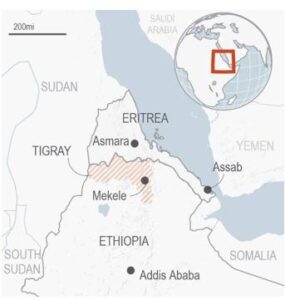
  • Tigray Crisis in Ethiopia

    The director-general of the World Health Organization (WHO), described the Tigray crisis region as the “worst humanitarian disaster on earth”.

    What is the news?

    • Ethiopia has been on the brink of a civil war.
    • On Nov 4 2020, Prime Minister Abiy Ahmed declared war on the country’s Tigray region.
    • The Tigray region is ruled by the Tigray People’s Liberation Front (TPLF).
    • The war was declared in response to the TPLF’s attack on a federal military base in Tigray.

    Tigray Crisis: A backgrounder

    • The animosity between Tigrayans and Eritrea goes back to the Ethiopian-Eritrean war that occurred between 1998 and 2000.
    • It occurred approximately two decades ago was extremely brutal and resulted in the deaths of thousands of soldiers.
    • The roots of this crisis can be traced to Ethiopia’s system of government. Since 1994, Ethiopia has had a federal system in which different ethnic groups control the affairs of 10 regions.
    • The Tigray People’s Liberation Front (TPLF) – was influential in setting up this system.
    • It was the leader of a four-party coalition that governed Ethiopia from 1991, when a military regime was ousted from power.
    • Under the coalition, Ethiopia became more prosperous and stable, but concerns were routinely raised about human rights and the level of democracy.

    How did it escalate into a crisis?

    • Eventually, discontent morphed into protest, leading to a government reshuffle that saw Mr Abiy appointed PM.
    • Abiy liberalized politics, set up a new party (the Prosperity Party), and removed key Tigrayan government leaders accused of corruption and repression.
    • Meanwhile, Abiy ended a long-standing territorial dispute with neighbouring Eritrea, earning him a Nobel Peace Prize in 2019.
    • These moves won Abiy popular acclaim, but caused unease among critics in Tigray.
    • Tigray’s leaders see Abiy’s reforms as an attempt to centralize power and destroy Ethiopia’s federal system.

    How bad is the humanitarian situation?

    • Tigray and its neighbouring regions are facing starvation.
    • There is an absence of medical facilities, no access to their own money due to shut-down banking services, ethnic and physical violence, and raids at the hands of warring forces.
    • The government declared a ceasefire on humanitarian grounds but in an effort to break the TPLF in June last year, imposed a blockade on Tigray.
    • This made it impossible to deliver humanitarian, economic, and medical assistance to Tigrayans.

    Also read:

    [Burning Issue] Ethiopian Crisis and the Geopolitics

    UPSC 2023 countdown has begun! Get your personal guidance plan now! (Click here)

  • China’s problem with top US senator visiting Taiwan

    The Speaker of the House of Representatives, Nancy Pelosi, landed in Taiwan, ignoring Chinese threats and a warning by President Xi Jinping to “not play with fire”.

    Why in news?

    • Pelosi’s visit to Taiwan is the highest-level visit by an American official to the island in a quarter century.
    • The senior US politician has been critical of China on multiple fronts over the decades.

    US defiance of One China Policy

    • The US has maintained a ‘One China’ policy since the 1970s, under which it recognises Taiwan as a part of China.
    • But it has unofficial ties with Taiwan as well — a strategy that is known as strategic or deliberate ambiguity.
    • Beijing considers Taiwan a part of China, threatens it frequently, and has not ruled out taking the island by military force at any time.

    Why does China have a problem with Pelosi visiting Taiwan?

    • For China, the presence of a senior American figure in Taiwan would indicate some kind of US support for Taiwan’s independence.
    • This move severely undermined China’s perception of sovereignty and territorial integrity.

    Brief history of China-Taiwan Tensions

    • Taiwan is an island about 160 km off the coast of southeastern China, opposite the Chinese cities of Fuzhou, Quanzhou, and Xiamen.
    • It was administered by the imperial Qing dynasty, but its control passed to the Japanese in 1895.
    • After the defeat of Japan in World War II, the island passed back into Chinese hands.
    • After the communists led by Mao Zedong won the civil war in mainland China, Chiang Kai-shek, the leader of the nationalist Kuomintang party, fled to Taiwan in 1949.
    • Chiang Kai-shek set up the government of the Republic of China on the island, and remained President until 1975.
    • Beijing has never recognised the existence of Taiwan as an independent political entity, arguing that it was always a Chinese province.

    Taiwanese stance

    • Taiwan says that the modern Chinese state was only formed after the revolution of 1911.
    • It was not a part of that state or of the People’s Republic of China that was established after the communist revolution.
    • While the political tensions have continued, China and Taiwan have had economic ties.
    • Many migrants from Taiwan work in China, and China has investments in Taiwan.
    • No doubt, cultural ties are indispensable.
    • In recent years, Taiwan’s government has said only the island’s 23 million people have the right to decide their future and that it will defend itself when attacked.
    • Since 2016, Taiwan has elected a party that leans towards independence.

    How does the world, and US, view Taiwan?

    • The UN does NOT recognise Taiwan as a separate country; in fact, only 13 countries around the world — mainly in South America, the Caribbean, Oceania, and the Vatican — do.
    • In June, President Biden said that the US would defend Taiwan if it was invaded, but it was clarified soon afterward but America does not support Taiwan’s independence.
    • While the US has no formal ties with Taipei, it remains Taiwan’s most important international backer and arms supplier.


    UPSC 2022 countdown has begun! Get your personal guidance plan now! (Click here)