💥Join UPSC 2027,2028 Mentorship (July Batch) + XFactor Notes & Microthemes PDF

Subject: Internal Security

  • Exercise Al–Mohed Al–Hindi

    The maiden bilateral naval exercise between India and Saudi Arabia named ‘AL–Mohed AL–Hindi’ has got underway.

    Must read:

    [Prelims Spotlight] Various Defence Exercises in News

    Ex Al-Mohed AI-Hindi 2021

    • This is the first edition of a bilateral naval exercise between India and Saudi Arabia.
    • It comprises several shore and sea-based drills between the two navies.
    • It reflects the growing defense ties between the two nations in the wake of the Indian Army chiefs’ first visit to the West Asian country last year.
    • INS Kochi is the Indian warship participating in the exercise.
    • The exercise is being held against the backdrop of growing tensions in the Persian Gulf following a drone attack on the tanker MV Mercer Street off Oman.

    Feeling anxious about your UPSC preparation? Don’t worry, speak with our mentors and get your problems resolved, personally! (Click here)

  • Five-point Framework for Maritime Security


    A week into India’s United Nations Security Council (UNSC) presidency, PM Modi has outlined a five-point framework for maritime security debate at UNSC.

    Maritime Security

    • Maritime security is one of the latest buzzwords of international relations.
    • Major actors in maritime policy, ocean governance and international security have in the past decade started to include maritime security in their mandate or reframed their work in such terms.
    • Core dimensions of maritime security involves the concept of blue economy, food security and the resilience of coastal populations.
    • A secure maritime environment provides the precondition for managing marine resources.

    Threats to maritime security

    Need for an agenda

    • In today’s economy, the oceans have an increased importance, allowing all countries to participate in the global marketplace.
    • More than 80 percent of the world’s trade travels by water and forges a global maritime link.
    • About half the world’s trade by value, and 90 percent of the general cargo, are transported in containers.
    • Many countries have invested significant resources in maritime infrastructure, trade, energy supply chains, cargo movements and processes.
    • China, undeniably a continental country, claims sovereignty over all of the South China Sea islands and their adjacent waters.

    5-point agenda for enhancing maritime cooperation

    [1] Removal of barriers to legitimate maritime trade:

    • Global prosperity depends on the active flow of maritime trade. Any hindrance in maritime trade can threaten the global economy, PM said.
    • Maritime trade has always been part of the civilizational ethos of India.
    • PM termed this principle as ‘SAGAR’ Security and Growth for All in the Region.

    [2] Resolution of maritime disputes peacefully in accordance with international law:

    [3] Fight threats from natural disasters, non-state actors:

    • PM said the Indian Navy has been patrolling to counter piracy in the Indian Ocean since 2008.
    • It is enhancing the common maritime domain awareness of the region through our White Shipping Information Fusion Centre.
    • India has provided support for hydrographic surveying and training of maritime security personnel to several countries.

    [4] Conservation of marine resources:

    • Our oceans directly impact our climate. Hence, it is very important that we keep our maritime environment free of pollutants like plastic waste and oil spills.
    • We also need to take joint steps against over-fishing and marine poaching, PM said.
    • He also emphasized the need for increased mutual cooperation in Ocean Science research.

    [5] Promoting responsible maritime connectivity:

    • PM said it is well understood that the creation of infrastructure is necessary to boost maritime trade.
    • He advocated for appropriate global norms and standards to ensure that such infrastructure projects are carried out as per the fiscal sustainability and absorption capacity of the host countries.
  • Advocating for sustained focus on the maritime domain

    Context

    In an innovative departure from normal practice, Prime Minister Narendra Modi will preside (in virtual mode) over the UN Security Council, on Monday (August 9) when India holds the President’s chair for one month. The subject of debate is maritime security.

    Issues with global maritime security

    • FON issue: There is  tension in the South China Sea over freedom of navigation (FON) rights in international waters and how China has laid claim to “territoriality” based on artificial structures (not natural islands).
    • This formulation has not been accepted by the US that has exercised transit rights in these waters.
    • Many ASEAN nations and Quad members such as Japan, Australia and India subscribe to the principle of FON and do not accept the Chinese interpretation of the “nine-dash-line”.
    • Traditional challenges: Piracy and non-traditional challenges at sea such as gun-running and smuggling are old chestnuts.
    • Maritime pollution: Accidents in the oceans have added to the anxiety about marine pollution and its downstream consequences for the health of the oceans.
    • Global warming: A UN report has come up with grim statistics about the impact of global warming on the chemistry of oceans.
    • This study notes that oceans have become more acidic as sea water absorbs more carbon dioxide.
    • Furthermore, the upper layers of the open ocean have lost between 0.5 per cent and 3.3 per cent of their oxygen since 1970 as temperatures have risen.

    Way forward for India at UNCS: Security and equitable growth

    • The subject to be deliberated upon by the UNSC members is “Enhancing maritime security: A case for international cooperation”.
    • This would be an extension of India’s advocacy of SAGAR (security and growth for all in the region) in relation to the Indian Ocean region (IOR).
    •  At the UNSC strategic and security issues such as the South China Sea and FON would find little consensus as China is a permanent member and would stall any meaningful debate.
    • Focus on global goods: What may find support for a useful debate at the UNSC would be those areas that could be brought under the rubric of the “global good”.
    • For instance, the welfare of seafarers who are the sinews of the global merchant marine, has received scant attention in this Covid-scarred period and the IMO (International Maritime Organisation) has been unable to effectively address such issues.
    • Correlation with globalisation: India can also advocate for sustained focus on the maritime domain and the correlation with globalisation, the blue economy, the health of the ocean and the overall impact on human security.

    Conclusion

    Security and equitable growth for all by husbanding the global ocean for future generations is a laudable goal and encouraging the UNSC to prioritise this issue is a worthy cause.

  • Places in news: Agalega Island

    Mauritius has denied a report that it has allowed India to build a military base on the remote island of Agalega.

    Agalega Island

    • Agaléga are two outer islands of Mauritius located in the Indian Ocean, about 1,000 kilometers north of Mauritius island.
    • The islands have a total area of 2,600 ha (6,400 acres).
    • There is an MoU between the governments of Mauritius and India to develop the Agaléga islands and resolve infrastructural problems faced by Agaleans.

    Why in news?

    • India asserts that these new facilities are part of its Security and Growth for All in the Region (SAGAR) policy, which aims to increase maritime cooperation between countries in the region.
    • Mauritius, for its part, has indicated that its coastguard personnel will use the new facilities.
    • But it is clear that the Indian investment of $250m in developing an airfield, port, and communications hub on this remote island is not aimed at helping Mauritius develop its capacity to police its territorial waters.

    Significance of this area

    • The Agalega area is currently a blind spot for the Indian Navy and by building a military facility in it, New Delhi hopes to expand its maritime domain awareness.
    • In times of conflict, knowing the location of enemy ships and submarines, without being detected in the process, creates a significant advantage.
    • China’s naval forays into this region are the true motivator for its expanding naval presence.
    • In peacetime, effective maritime domain awareness helps establish international partnerships with like-minded militaries and also acts as a deterrent to both state and non-state adversaries, by signaling reach.

    Conclusion

    • The Indian Ocean is now increasingly contested.
    • Whether or not China is deterred by India’s surveillance efforts, Agaléga is now a pawn in this new era of major power competition across the Indian Ocean and indeed the wider Indo-Pacific region.
  • Indigenous Aircraft Carrier 1 (INS Vikrant)

    The much-awaited sea trials of India’s maiden indigenous aircraft carrier (IAC-1), built by the public sector Cochin Shipyard Ltd (CSL) have begun.

    Indigenous Aircraft Carrier 1

    • IAC is the first aircraft carrier designed and built in India.
    • It has been designed by the Indian Navy’s Directorate of Naval Design (DND), and is being built at Cochin Shipyard Limited (CSL), a public sector shipyard under the Ministry of Shipping.
    • The IAC-1, the biggest warship made indigenously, has an overall length of 263 m and a breadth of 63 m.
    • It is capable of carrying 30 assorted aircraft including combat jets and helicopters.
    • Propelled by four gas turbines, it can attain a top speed of 30 knots (about 55 kmph).
    • The vessel will have a complement of 1,500 personnel.

    Significance of IAC 1

    • An aircraft carrier is one of the most potent marine assets for a nation, which enhances a Navy’s capability to travel far from its home shores to carry out air domination operations.
    • Many experts consider having an aircraft carrier as essential to be considered a ‘blue water’ navy — one that has the capacity to project a nation’s strength and power across the high seas.
    • An aircraft carrier generally leads as the capital ship of a carrier strike/battle group.
    • As the carrier is a valuable and sometimes vulnerable target, it is usually escorted in the group by destroyers, missile cruisers, frigates, submarines, and supply ships.

    Why does it matter that this is a Made-in-India warship?

    • Only five or six nations currently have the capability of manufacturing an aircraft carrier — India joins this elite club now.
    • According to the Navy, over 76 per cent of the material and equipment on board IAC-1 is indigenous.
    • India’s earlier aircraft carriers were either built by the British or the Russians.
    • The INS Vikramaditya, currently the Navy’s only aircraft carrier that was commissioned in 2013, started out as the Soviet-Russian Admiral Gorshkov.
    • The country’s two earlier carriers, INS Vikrant and INS Viraat, were originally the British-built HMS Hercules and HMS Hermes before being commissioned into the Navy in 1961 and 1987 respectively.

    Why will this warship be named INS Vikrant?

    • INS Vikrant, a Majestic-class 19,500-tonne warship, was the name of India’s much-loved first aircraft carrier, a source of immense national pride over several decades of service before it was decommissioned in 1997.
    • India acquired the Vikrant from the United Kingdom in 1961, and the carrier played a stellar role in the 1971 war with Pakistan that led to the birth of Bangladesh.

    Now that India has the capability, will it build more carriers?

    • Since 2015, the Navy has been seeking approval to build a third aircraft carrier for the country, which, if approved, will become India’s second Indigenous Aircraft Carrier (IAC-2).
    • This proposed carrier, to be named INS Vishal, is intended to be a giant 65,000-tonne vessel, much bigger than IAC-1 and the INS Vikramaditya.
    • The Navy has been trying to convince the government of the “operational necessity” of having a third carrier.
  • Theatre Command under Chief of Defence Staff is not a good idea

    Context

    The government is reportedly planning to re-organise the military into a theatre command under the chief of defence staff (CDS) in which the assets of the Air Force will be split into four and distributed among four operational theatres.

    Background of the creation of CDS

    • In 2012, the Naresh Chandra Committee suggested the creation of a CDS, which would take on overall functions of the chairman, chiefs of committee as well as the responsibilities pertaining to centralised planning, induction, training, intelligence and logistics. 
    • Operations, according to the committee’s suggestion, would continue to be managed by the respective chiefs of staff.
    • However, sometime in 2016-17, this idea was modified to organise the operational assets of the three services into four theatre commands, all of which are now proposed to be brought under the CDS.

    Issues with creating theatre command by dividing Air Force

    • Professional leadership is critical in support elements: The Air Chief’s professional leadership of the Air Force is crucial to orchestrate a variety of support elements like aerial tankers, AWACS (Airborne Warning And Control Systems), AEW, Heliborne support and UAVs in an “offensive operation”.
    • Lack of in-dept understanding: A land theatre command, if given power over the air elements, may not have the confidence to launch such a mission because of the lack of in-depth understanding of the organisational complexity and the risks involved.
    • Dilution of assets may harm effectiveness: Dilution of the combat assets of the Air Force, a 30-squadron force consisting of five or six types of aircraft, might severely affect mission-effectiveness.
    • Role of CDS: It is extremely doubtful if the CDS can cope with the enhanced responsibilities that include operations, albeit through the theatre commanders.
    • That would leave only training, maintenance, and support under the chiefs of staff — a gross under-utilisation of the operational leadership built over 40 years.
    • Resource limitations: Forming a separate air defence command for the air defence of the entire nation seems an impractical idea considering our resource limitations.
    • Current arrangement functioned effortlessly: The current arrangement of a decentralised air defence organisation managed by Air Force geographical commands has functioned faultlessly.
    •  Flexibility: The existing structures afford better flexibility.
    • There will be significant expenditure to construct the operational infrastructure of the theatre commands.
    • Timing: We are trying to effect changes at a time the military is deployed actively.
    • The Chinese have dug in hard, and we do not yet know their strategy.
    • To divide the Air Force into four units at this moment is inadvisable.

    Way forward

    • White paper: There is no white paper on the advantages of the theatre commands or one listing the merits of the CDS donning the mantle of the operational head of the entire military operation.
    • So, a white paper on these aspects could clear the air over the utilities of such moves.
    • Joint planning is a must, but operations are best undertaken by individual services who know what other services are doing and when.

    Conclusion

    Splitting the asset of the Air Force would result in dilution of its power and is not advisable at the current juncture.

  • Getting India’s military jointness formula right

    Context

    The Chief of Defence Staff General Bipin Rawat’s recent description of the Indian Air Force (IAF) as a supporting arm and the IAF chief Air Chief Marshal R.K.S. Bhadauria’s rebuttal highlights turbulent journey marking the reorganisation process of the armed forces.

    Issues before IAF

    • The IAF is warning against splitting it into packets.
    • Reports suggest that counting even ageing aircraft, the IAF is 25% short on fighter squadrons.
    • A pan service shortage of about 400 pilots, almost 10% of their authorised strength, further aggravates this.
    • Therefore, the IAF has a point when it warns against splitting assets, for, there may be nothing much to split.

    Way forward

    • Confidence building: A common understanding of the nuances of military airpower is the key.
    • With the experience of operating almost every kind of aircraft the IAF operates, the naval leadership understands air power.
    • This applies to the Indian Army too, in its own way.
    • Confidence needs to be developed that rightly staffed apex joint organisations can draw up professional operational plans for air power.
    • Enhancing military education: Confidence building will need some effort in the short term towards enhancing professional military education though, at the staff level.
    • Analysis before implementation: Major reorganisations must strictly follow the sequence of written concepts, their refinement through consultation, simulation or table top war gaming, field evaluation and final analysis before implementation.
    • This would help address command and control, asset adequacy, individual service roles, operational planning under new circumstances and the adequacy of joint structures.
    • Who gets to lead what also matters.
    • The Western Command between the Indian Army and the IAF, the Northern Command with the Indian Army, Maritime Command with the Indian Navy and the Air Defence Command with the IAF may be an acceptable formula.

    Why jointness?

    • With dwindling budgets, a steadily deteriorating security situation and the march of technology, the armed forces understand the need to synergise.

    Challenges

    • Challenges in co-existence: Different services do not co-exist well where they are colocated.
    • Bitter fights over land, buildings, facilities, etc. harms optimal operational synergising.
    • Allocation challenge: Then there is the issue of giving each other the best, or of wanting to be with each other.
    • Lack of operational charter: The Andaman and Nicobar Command suffered from the lack of a substantial operational charter, and the services not positioning appropriate personnel or resources there.
    • Lack of interest in joint tenure: As a joint tenure did not benefit career, no one strove for it.
    • The U.S., when faced with the same problem, made joint tenures mandatory for promotions.

    Steps to be taken

    • Security strategy: We need a comprehensive National Security Strategy to guide the services develop capacities required in their respective domains.
    • Professional education: We need to transform professional education and inter-service employment to nurture genuine respect for others.
    • Mutual resolution of difference: The armed forces must resolve their differences among themselves, as the politicians or bureaucrats cannot do it.
    • Quality staff: Good quality staff, in adequate numbers, at apex joint organisations, will help to reassure individual services and those in the field that they are in safe hands.
    • Tailored approach: There is need for the acceptance of the fact that what works for other countries need not work for us.

    Conclusion

    We may need tailor-made solutions which may need more genuine thinking. For genuine military jointness, a genuine convergence of minds is critical.

  • Challenging China

    Context

    The Chinese are about to extend their geographical advantage by building a new high-speed rail from Chengdu, running close by and parallel to the Arunachal border, up to Lhasa.

    Manpower and Defence Budget: Comparison with China

    • The Indian army, according to diverse sources, numbers between 12,50,000 and 14,00,000 officers and men.
    • Chinese PLA actually has only 9,75,000 officers and men.
    •  They have downsized their army.
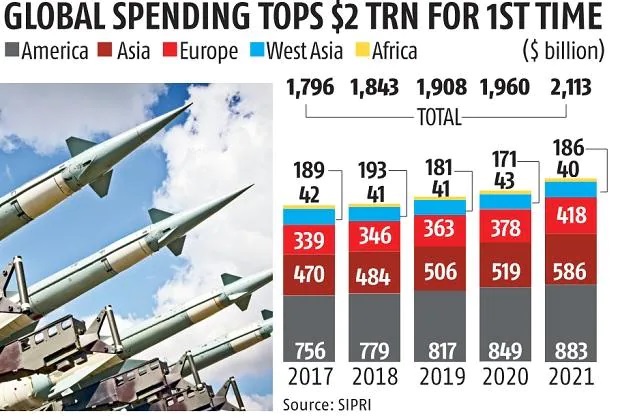
    • China is an aspiring world power that spends $252 billion on its defence budget, as compared to $72.9 billion that India spends.
    • Both countries limit their budget to around 2 per cent of their GDP, which in China’s case is five times our size.

    Why does India need to reduce manpower in defense?

    • Expensive:  A major portion of the budget is spent on manpower, 81 percent of the army budget goes into manpower and maintenance. Gradually, manpower is going to get increasingly expensive.
    • Also, our strategic options get constrained because the army gets 61 percent of the defense budget.
    • We need to downsize the army by 2,00,000 men over five years through retirement and reduced recruitment.
    • The reduction in manpower will save approximately Rs 30,000 crore, which can be equally divided between the three services.

    Way forward: Bigger role to navy and air force

    • We can achieve better conventional deterrence against China by giving bigger roles to the navy and air force.
    • The first step is to accept that we are an asymmetric power and leverage the RMA (Revolution in Military Affairs) so that numerical inferiority is of no consequence.
    • They are invulnerable on land, and their only strategic weakness is their reliance on the Indian Ocean SLOCs (sea lines of communications) for 70 percent of their imported oil.
    • The only guarantee of Chinese non-aggression and good behavior is a well-crafted threat to their oil tankers and a complete naval mastery of the escalation that is bound to follow.
    • India can also leverage the QUAD resources in various ways such as information.
    • Build up the Car Nicobar airfield into a full-fledged airbase.
    • We could negotiate with Oman for the use of the old RAF airbase at Masirah to dominate the Gulf of Hormuz and threaten the Chinese base at Djibouti.

    Conclusion

    China cannot be countered by throwing expensive manpower at the problem, but only by shifting the battlespace to advantageous geography, by a united navy and air force effort, while a technically advanced army holds the Himalayan border.

  • What is National Security Council (NSC)?

    The budgetary allocation for the National Security Council Secretariat (NSCS) increased 10 times from ₹33.17 crores in 2016-17 to ₹333.58 crores in 2017-18.

    National Security Council (NSC)

    • The NSC is an executive government agency tasked with advising the Prime Minister’s Office on matters of national security and strategic interest.
    • It was established by the former PM of India Atal Bihari Vajpayee on 19 November 1998, with Brajesh Mishra as the first National Security Advisor.
    • Prior to the formation of the NSC, these activities were overseen by the Principal Secretary to the preceding Prime Minister.

    Members

    • Besides the NSA the Deputy National Security Advisors, the Ministers of Defence, External Affairs, Home, Finance of the Government of India, and the Vice Chairman of the NITI Aayog are members of the National Security Council.
    • PM can chair the meeting of NSC (for eg – PM chaired the meeting of NSC Post Pulwama to discuss heightened tension with Pakistan).
    • Other members may be invited to attend its monthly meetings, as and when is required.

    Organizational structure

    • The NSC is the apex body of the three-tiered structure of the national security management system in India.
    • The three tiers are the Strategic Policy Group, the National Security Advisory Board, and a secretariat from the Joint Intelligence Committee.
  • Back in news: Pegasus Spyware

    Telephone numbers of some noted Indian journalists were successfully snooped upon by an unidentified agency using Pegasus software.

    Pegasus Spyware

    • All spyware do what the name suggests — they spy on people through their phones.
    • Pegasus works by sending an exploit link, and if the target user clicks on the link, the malware or the code that allows the surveillance is installed on the user’s phone.
    • A presumably newer version of the malware does not even require a target user to click a link.
    • Once Pegasus is installed, the attacker has complete access to the target user’s phone.
    • The first reports on Pegasus’s spyware operations emerged in 2016, when Ahmed Mansoor, a human rights activist in the UAE, was targeted with an SMS link on his iPhone 6.

    What is the new threat?

    • Pegasus has evolved from its earlier spear-phishing methods using text links or messages to ‘zero-click’ attacks which do not require any action from the phone’s user.
    • This had made what was without a doubt the most powerful spyware out there, more potent and almost impossible to detect or stop.

    How do zero-click attacks work?

    • A zero-click attack helps spyware like Pegasus gain control over a device without human interaction or human error.
    • Zero-click attacks are hard to detect given their nature and hence even harder to prevent.
    • Detection becomes even harder in encrypted environments where there is no visibility on the data packets being sent or received.
    • Most of these attacks exploit software that receive data even before it can determine whether what is coming in is trustworthy or not, like an email client.

    Answer this PYQ from CSP 2018:

    Q.The terms ‘WannaCry, Petya, Eternal Blue’ sometimes mentioned news recently are related to

    (a) Exoplanets

    (b) Crypto currency

    (c) Cyber attacks

    (d) Mini satellites