💥Join UPSC 2027,2028 Mentorship (July Batch) + XFactor Notes & Microthemes PDF

Year: 2016

  • Importance of Previous Years’ Prelims & Upgrading the Prelims Daily Initiative to Master Them

    Update: Download FREE Prelims Daily compilation – Click Here


    Previous year Prelims questions have no role to play in your current IAS Prelims Preparation?

    Think again.

    We tend to skip a detailed analysis of previous year’s papers thinking that UPSC is a sacrosanct institution and they are never going to repeat themselves on the Prelims or the Mains Examination. But that is not entirely true. While UPSC does continue to throw surprises at you, there is some method in madness which we should all recognise.

    There are enough instances where UPSC has repeated itself in letter and spirit and you would do well to practice previous years’ questions in the Prelims Daily initiative.

    Myth #1: Questions do not get repeated

    Look at these set questions and understand how themes and even exact questions get repeated. If you just give a good round to previous years’ questions, these would be a cakewalk

    Consider the following statements [2015]
    1. The Rajya Sabha has no power either to reject or to amend a Money Bill. 2. The Rajya Sabha cannot vote the Demands for Grants.
    3. The Rajya Sabha cannot discuss the Annual Financial Statement.
    Which of the statements given above is/are correct?
    (a) 1 only
    (b) 1 and 2 only
    (c) 2 and 3 only
    (d) 1, 2 and 3

    What is the power of Rajya Sabha regarding Money Bill ? [1979]

    (a) It can amend it
    (b) It can reject it
    (c) It can withhold the bill for 14 days to make recommendations

    (d) It has no power regarding Money Bill

    Rajya Sabha can delay the Money Bill passed by the Lok Sabha for a period not exceeding [UPSC 1980]

    (a) 9 days
    (b) 14 days
    (c) 15 days
    (d) 30 days


    The Government of India Act 1919 clearly defined [UPSC 2015] 
    (a) the separation of power between the judiciary and the legislature
    (b) the jurisdiction of the central and provincial governments
    (c) the powers of the Secretary of State for India and the Viceroy
    (d) None of the above

    Which of the following is/ are the principal feature(s) of the Government of India Act 1919? [UPSC 2012]

    1. Introduction of dyarchy in the executive government of the provinces. 2. Introduction of separate communal electorates for Muslims
    3. Devolution of legislative authority by the centre to the provinces Select the correct answer using the codes given below:

    a) 1 only
    b) 2 and 3 only
    c) 1 and 3 only
    d) 1, 2 and 3


    Myth #2: Maps are tough and impossible to do

    UPSC often repeats the same map based questions. Have a look at this set of question based on Godavari:

    Consider the following rivers : [UPSC 2015]

    1. Vamsadhara
    2. lndravati
    3. Pranahita
    4. Pennar

    Which of the above are tributaries of  Godavari?

    (a) 1, 2 and 3
    (b) 2, 3 and 4
    (c) 1, 2 and 4
    (d) 2 and 3 only

    Which one of the following statements is not true ? [UPSC 2000] 

    (a) Ghaggar’s water is utilised in the Indira Gandhi Canal
    (b) Narmada rises from Amarkantak region
    (c) Nizam Sagar is situated on the Manjra river
    (d) Penganga is a tributary of the Godavari


    Myth #3: Dynamic questions come only from this year

    Many times you would see even the themes of dynamic news getting repeated. Sometimes, even the same topics!

    H1N1 virus is sometimes mentioned in the news with reference to which one of the following diseases? [UPSC 2015]

    (a) AIDS

    (b) Bird flu

    (c) Dengue

    (d) Swine Flu

    Consider the following statements: [UPSC 2010]

    1. Every individual in the population is equally susceptible host for Swine Flu

    2. Antibiotics have no role in the primary treatment of Swine Flu

    3. To prevent the future spread of Swine Flu in the epidemic area, the swine (pigs) must all be culled.

    Which of the statement given above is/are correct?

    (a) 1 and 2 only
    (b) 2 only
    (c) 2 and 3 only

    (d) 1, 2 and 3.


    So, What changes in the Prelims Daily initiative?

    • 5 questions from previous day current affairs (with 1 explanations on Tikdams & tidbits)
    • 3 questions from previous years’ IAS Prelims papers (we will pick only relevant static questions)

    This way, we will be able to cover atleast 5 years of IAS Prelims papers by the time you appear for your IAS Prelims 2017.


    PS: We have already talked about the importance of “The Art of Tikdams” and how we at CD help you train on them at our mock test series – Download the FREE Pdf here

    PPS: Analysis done with inputs from Shashidthakur’s compilations

  • Preparing along with a 3 month old kid, Poonam Dalal nails UPSC in her fourth attempt

    source

    We all love to find excuses. Age, gender, marital status, financial background, lack of facilities, work-pressure – these are only some of the excuses one can make. But not Poonam Dalal. Her story is a story of hard work and willpower. It’s a story which can inspire not only thousands of women but also men.

    Background

    She has her ancestral roots at Chhara village in Jhajjar District, Haryana. But she was born and brought up in Delhi. Poonam started her career as a primary teacher in a government school at Delhi. Along with the job she did her graduation as an external student from Delhi University. After completing her graduation she appeared for different Bank PO Exams and SSC Graduate Level Exam and cleared all of them. She finally chose SBI PO.

    After 3 years in SBI, she joined the Income Tax Department securing a very decent rank (7) at all India level in SSC graduate level Examination 2006 which gave her the confidence of writing UPSC.

    UPSC journey

    She gave her first attempt at UPSC CSE in 2009 at the age of 28 and got Railways (RPF). She didn’t join that service and sat for CSE 2010. She again got Railways, but a different service (IRPS). Meanwhile, she had cleared Haryana PSC and joined as Dy.SP in Haryana Police in 2011.

    In 2011, she couldn’t qualify Prelims. She thought her tryst with UPSC was over due to the age-limit. Hold on! ‘Fortune favors the brave.’ In 2015, because of agitations and petitions from candidates who were affected by pattern change in 2011, the government gave an extra attempt to all those who wrote for Civil Services Exam in 2011. Thus, Poonam got an opportunity to appear again for UPSC.

    This attempt came as a great challenge as Poonam was out of touch with preparation, being working 24*7 in police force. Also she was 9 months pregnant at the time of prelims.

    She cleared UPSC prelims in flying colors by self-study. While preparing for mains she had also to take care of her son who was just 3 months old. It was never easy. But she got her best rank in her most challenging circumstances – all India rank 308!

    Optional Subject

    Sociology- because of the familiarity and interest in the subject.

    Tips for candidates

    In her final attempt she focused exclusively on self-study and online material.

    Owing to her special circumstances she could study only for 2-3 months for Prelims and she could hardly get a month before mains. Her study was concentrated on focusing on the traditional areas like Polity, History, Geography and optional Sociology. She relied on notes of certain key areas in every paper for quick reference and revision.

    This exam actually requires consistent efforts. There should be more regularity in the preparation. It is more beneficial to study for 6 hours each rather than studying one day for 18 hours and not studying another day at all. Also, study schedule should be properly planned and should be followed religiously. Prepare a monthly planner, weekly planner and daily planner based on the syllabus and time at one’s disposal. Every morning plan your day (what is your target today) and every night audit your output.

    Never let stress take over you. All of us have the same anxiety and pressure of this exam but handle this nervousness effectively otherwise it will result in more problems. Be an optimist always.

  • 10 Nov 2016 | GS4 | Mahatma Gandhi once said “If, instead of insisting on rights, everyone does his duty, there will immediately be the rule of order established among mankind”. Do you agree with this? What does mean in today’s world?

    GS4 (Ethics)

    Mahatma Gandhi once said “If, instead of insisting on rights, everyone does his duty, there will immediately be the rule of order established among mankind”. Do you agree with this? What does mean in today’s world?

  • 10 Nov 2016 | GS3 | Despite government’ s focus on the food processing industry, statistics show that many of the mega food parks announced by government have either not been opened or are on verge of shutdown. Analyse the factors for this trend and suggest what needs to be done?

    GS3 (Science and Technology)

    Despite government’ s focus on the food processing industry, statistics show that many of the mega food parks announced by government have either not been opened or are on verge of shutdown. Analyse the factors for this trend and suggest what needs to be done?

  • 10 Nov 2016 | GS2 | Indian prisons have been suffering from overcrowding of prisons, with a large number of undertrials. Discuss the causes for the same, the consequences and the measures needed to decongest the prisons in India.

    GS2 (Polity and Governance)

    Indian prisons have been suffering from overcrowding of prisons, with a large number of undertrials. Discuss the causes for the same, the consequences and the measures needed to decongest the prisons in India.

  • 10 Nov 2016 | GS1 | The collapse of Soviet Union coincided with the collapse of Communism as a concept. What factors were responsible for the collapse of communism in Soviet Union and why it still does not survive in many places in the world?

    GS1 (World History)

    The collapse of Soviet Union coincided with the collapse of Communism as a concept. What factors were responsible for the collapse of communism in Soviet Union and why it still does not survive in many places in the world?


    For a background/discussion of the topic, read this blog by K Siddhartha.

  • 10 Nov 2016 | Prelims Daily: CA Questions with Tikdams & Tidbits

    Dear students,

    When you submit your answer, if possible, give some reasoning & more info. along with the ABACAA format. Elaborate on what you know. This is going to help you retain & remember better.

    NOTE: Prelims Daily compilation for October 2016 has been released for FREE – Click2Download


    Q.1) Scientists have detected the presence of water on Psyche. Which of the following correctly describes about ‘Psyche’.

    a) Moon of the Jupiter

    b) Largest comet from the Kuiper belt

    c) Largest metallic asteroid in our solar system

    d) Smallest habitable planet from Goldilocks zone


    Q.2) Recently, First Meeting of Governing Council for Indian Council for Fertilizer and Nutrient Research (ICFNR) held. Consider following statements in this regard.

    1.ICFNR is set up under the administrative control of Department of Fertilizers (DoF), Ministry of Chemicals & Fertilizers (MoCF)

    2.ICFNR is exclusively devoted to promotion of research in Fertilizer sector.

    Which of the statements given above is/are correct?  

    a) 1 only

    b) 2 only

    c) Both 1 and 2

    d) Neither 1 nor 2


    Q.3) Consider following statements about ‘Pradhan Mantri Kaushal Vikas Yojana’.

    1.Pradhan Mantri Kaushal Vikas Yojana is the flagship scheme for skill training of youth in the country.

    2.Scheme is implemented by Ministry of Labour and Employment through the National Skill Development Corporation (NSDC).

    Which of the statements given above is/are correct?  

    a) 1 only

    b) 2 only

    c) Both 1 and 2

    d) Neither 1 nor 2


    Q.4) Recently, India has signed Memorandum of Understanding (MoU) for Marine-Earth Science and Technology with which of the following country?

    a) USA

    b) Japan

    c) China

    d) Britain


    Q.5) Which of the following states are under Armed Forces Special Powers Act (AFSPA).

    1.Tripura

    2.Assam

    3.Jammu and Kashmir

    4.Nagaland

    5.Manipur

    Select the correct answer using the codes given below.

    a) 1,2 and 4

    b) 2,3 and 5

    c) 1, 2, 3 and 5

    d) 2,3,4 and 5 only


    IMPORTANT STUFF: 

    1. These questions are mostly derived from our daily newscards. Reading daily news from Civilsdaily’s App (click here) or website + solving these questions will help you reinforce the basics.

    2. For a comprehensive preparation of IAS Prelims 2017 – consider joining one of the three Prelims Modules by CD – prelims.civilsdaily.com

    3. Solutions will be uploaded at 8 p.m. Click here for solutions.

    4. For attempting previous Prelims Daily Questions – Click here

    5. How to apply Tikdams? Read this, this and this

  • Essays from lbsnaa tests

    Write 2 essays in not more than 1200 words

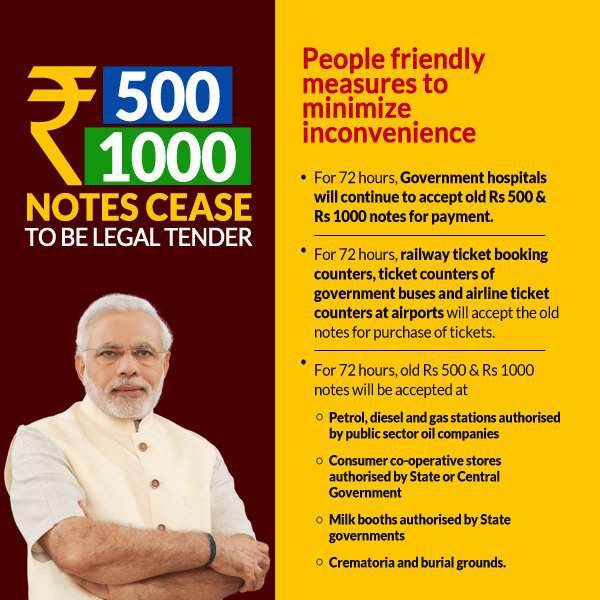
  • Rs 500-1,000 notes ban: Understand Demonetization & link JAM Trinity with this announcement on curbing Black Money

    source

    Understanding Demonetization

    Demonetization is the act of stripping a currency unit of its status as legal tender. Demonetization is necessary (this happened when Euro was introduced) whenever there is a change of national currency. The old unit of currency must be retired and replaced with a new currency unit.

    What is legal tender?

    The coins issued under the authority of Section 6 of The Coinage Act, 2011, shall be legal tender in payment or on account i.e. provided that a coin has not been defaced and has not lost weight so as to be less than such weight as may be prescribed in its case: –

    (a) coin of any denomination not lower than one rupee shall be legal tender for any sum,

    (b) half rupee coin shall be legal tender for any sum not exceeding ten rupees,

    Every banknote issued by Reserve Bank of India ( ₹ 2, ₹ 5, ₹ 10, ₹ 20, ₹ 50, ₹ 100, ₹ 500 and ₹ 1000) shall be legal tender at any place in India.

    What India witnessed on 8th november 2016 was the not the first time we plugged and play the demonetization game.

    1946: Rs1,000, Rs5,000, and Rs10,000 notes were taken out of circulation in January 1946. The Rs10,000 notes were the largest currency denomination ever printed by the Reserve Bank of India, introduced for the first time in 1938. All three notes were reintroduced in 1954

    1977: The Wanchoo committee (set up in 1970s), a direct tax inquiry committee, suggested demonetization as a measure to unearth and counter the spread of black money. However, the public nature of the recommendation sparked black money hoarders to act fast and rid themselves of high denominations before the government was able to clamp down on them!

    The High Denomination Bank Notes (Demonetisation) Act deemed the Rs 1,000, Rs 5,000 and Rs 10,000 notes illegal for the second time. At the time, then-RBI governor I.G. Patel disagreed with the measure.

    2016: Recommendations of SIT on Black Money as Contained in the Fifth SIT Report 

    Cash transactions : The SIT has felt that large amount of unaccounted wealth is stored and used in form of cash. Having considered the provisions which exist in this regard in various countries and also having considered various reports and observations of courts regarding cash transactions the SIT felt that there is a need to put an upper limit to cash transactions. Thus, the SIT has recommended that there should be a total ban on cash transactions above Rs. 3, 00,000 and an Act be framed to declare such transactions as illegal and punishable under law.

    Cash holding : The SIT has further felt that, given the fact of unaccounted wealth being held in cash which are further confirmed by huge cash recoveries in numerous enforcement actions by law enforcement agencies from time to time, the above limit of cash transaction can only succeed if there is a limitation on cash holding, as suggested in its previous reports. SIT has suggested an upper limit of Rs. 15 lakhs on cash holding. Further, stating that in case any person or industry requires holding more cash, it may obtain necessary permission from the Commissioner of Income tax of the area.

    With full backing, for the third time, India participated in the process of demonetization. RBI governor, Urjit Patel applauded Modi’s “very bold step” which addresses concerns about the “growing menace of fake Indian currency notes.”

    How big is the impact of this announcement?

    A better sense of this can be gauged from this graph below. As you can see, the monetary value of Rs500 and Rs1,000 notes in circulation far outstrips any other denomination.

    Putting it simply, at the stroke of midnight, a little over 80% of the cash in India (by value) will be worthless pieces of paper.

    With these notes now going out of circulation overnight, the government has created a solid opportunity to clean up the system. Currently India’s black money economy is about 20% of its GDP, according to estimates from Ambit Research. Apart from cash, Indians also hoard wealth worth over billions of dollars in the form of gold. To understand the issue of Black money in depth, read this blog
    What was the need for such a move?
    – The incidence of fake Indian currency notes in higher denomination has increased
    – Unaccounted money, often used in any form of corruption or illicit deals, usually takes the form of high-value notes, which in this case are the Rs 500 and Rs 1,000 bills
    – The Financial Action Task Force, a global body that looks at the criminal use of the international financial system, notes that high-value bills are used in money laundering schemes, racketeering, and drug and people trafficking
    Comparison of high value bills across the world
    – In the United States, the highest denomination bank note is $100. When it comes to the United Kingdom, the highest denomination bank note issued by the Bank of England is £50
    – As you can see, the highest denomination note is essentially 50-100 times the smallest denomination note of one dollar or one pound
    – In India, up until now the highest denomination note was Rs 1,000 and this was 1,000 times the smallest denomination note of Re 1 (Note: Re 1 notes are issued by the ministry of finance)
    When a currency has notes of higher denomination, it is easier to launder money i.e. store black money, as it takes less space and weighs less as well.
    The positives that come out of this announcement
    – Remember your economics basics? What happens when people go back and deposit their money. Deposits increase for the banks and that means eventually interest rates might come down
    – Curb on black money – corruption, terrorism etc. (as discussed above) [Backgrounder on Black money]
    – Boost to cashless economy with people adopting habits of wallets etc. [Read about Payment Banks here]
    – Boost to Jan Dhan Account’s relevance for poor people – Would be interesting to factor the surge in new account creation and activity in dormant accounts [Read more on JAM Trinity]
    – Politics and various elections are known to run on cash. Same is the case with sectors such as real estate. Expect a gradual reform in this area
    The potential negatives out of this announcement
    – Everything else being equal, withdrawal of currency in circulation, in the (very) short-run, might actually drive up interest rates
    – (Very) Short-term liquidity squeeze could be severe and hence economic activity could suffer
    – Sovereign credit rating – possibly no impact. But if there are short-term impact on economic activity which dampens government revenues and widens deficit, you can expect a short term decline in ratings
    – Cost of printing the new currency (if high) would create another political furore
    – Immediate chaos and public mayhem (which will bring out potential issues of execution)

    3 Important Steps taken before this announcement was made

    1. Jan Dhan scheme, under which 22-crore new bank accounts were opened in one-and-a-half years (May 2016), was the first truly game-changing move. Most of these accounts brought those people into the network who were outside the ambit.

    According to the Economic Survey for 2015-16 released in February this year, leakages in LPG subsidy transfers fell 24 percent and the exclusion of beneficiaries had been greatly reduced, thanks to the infrastructure created by Jan Dhan accounts, Aadhaar and mobile networks, or the JAM trinity.

    2. The next step was to bring back black money stashed away in tax havens or foreign banks abroad and here.

    3. Then came the Income Declaration Scheme. By 30 September, all illegal asset holders had the chance to declare their holdings and pay 45 % tax and a penalty in exchange for anonymity and immunity from criminal proceedings.

    The tax department has reported Rs 65,250 crore worth of black money from 64,275 declarations. This means about Rs 30,000 crore will flow into the government’s tax kitty.

    Challenges ahead

    #1. The government should come up with additional economic stimulus to offset the dampening effect:
    (a) Accelerated reduction in corporate income tax along with withdrawal of exemptions;
    (b) Ending uncertainty on GAAR and retrospective taxation or any other blockbuster measure that they might be working on, that would offset the initial adverse economic impact.
    #2. Assess Black Money better: There’s no good estimate for how much of India’s black money is in forms other than currency/physical notes such as gold, jewellery, land or any other form of wealth. Therefore, while banning Rs 500 and Rs 1,000 notes will tackle the black money that is in the form of hard cold cash, it won’t affect other forms of black money.

    #3. Prepare for the challenges of cashless economy: The UPI (unified payment interface) system is likely to be fully operationalised only by January 2017.  India was recently hit by one of its biggest financial security breaches compromising hundreds of thousands of debit cards. Read more about Cyber Security challenges from here

    Reference:

    http://thewire.in/78694/paper-money-ban-rs-500-rs-1000-notes-explained/

    http://www.firstpost.com/politics/rs-500-1000-notes-ban-jam-trinity-overseas-haul-how-pm-modi-is-winning-the-war-against-graft-3097176.html

    http://indianexpress.com/article/business/economy/ambit-capital-black-economy-shrinking-pegged-at-20-per-cent-of-gdp-2835783/


  • 9 Nov 2016 | GS4 | Trupti and Pallavi are two college-friends working in the same project in a reputed Information Technology company. Both are hardworking employees and their friendship is quite strong. One late evening, while leaving office, Pallavi saw Trupti taking printouts of the software code being developed by the team.

    GS4 (Case Study)

    Trupti and Pallavi are two college-friends working in the same project in a reputed Information Technology company. Both are hardworking employees and their friendship is quite strong. One late evening, while leaving office, Pallavi saw Trupti taking printouts of the software code being developed by the team.
    The company has strict rules regarding the use of company property and it doesn’t allow employees to take work home or to take printouts of codes. Early this year, the company had fired two employees who were found to have violated these rules.
    Pallavi knows that Trupti comes from a humble background and this job is very important for the financial security of her family.

    (a) The following are some suggested options. Please evaluate the merits and demerits of each of the options:
    1. Report to the higher management about the incident.
    2. Talk to Trupti about the issue and try to convince her to stop doing this act.
    3. Ignore the act as it does not directly concern you.

    (b) Also indicate (without necessarily restricting to the above options) what you would like to advise, giving proper reasons.


    GS4 question powered by mitrasias.com