💥Join UPSC 2027,2028 Mentorship (July Batch) + XFactor Notes & Microthemes PDF

Category: Ranker Webinars

  • Day 10| Daily Answer Wars| CD WarZone

    Topics for Today’s question:

    GS-2          Issues relating to development and management of Social Sector/Services relating to Health, Education, Human Resources.

    Question


    HOW TO ATTEMPT ANSWERS IN DAILY ANSWER WARS (DAW)?

    1. Daily 1 question either from General Studies 1, 2, 3 or 4 will be provided via live You Tube video session.
    2. You can write your answer on an A4 sheet and scan/click pictures of the same.
    3. The answer needs to be submitted by joining the telegram group given in the link below.

      https://t.me/cdwarzone

    *In case your answer is not reviewed, reply to your answer saying *NOT CHECKED*. 

    1. For the philosophy of Daily Answer Wars and payment: 
  • [Sansad TV] Perspective: Regulations for Dedicated Freight Corridor

    Context

    • With over 80% of the Dedicated Freight Corridors (DFCs) running parallel to passenger lines, a parliamentary panel has raised concerns over the lack of safety rules for the goods-only network.

    News: Leniency over regulations of DFCs

    • The Standing Committee on Transport in its report, pointed out that while rules and regulations are defined for passenger trains, no such regulation exists for the Dedicated Freight Corridors.
    • There are many instances where rules were amended by the Ministry of Railways without consulting the commission, even when provisions to such consultations exist.

    What are Dedicated Freight Corridors (DFCs)?

    • The DFC project was first proposed in April 2005 to address the needs of the rapidly developing Indian economy.
    • They were proposed to ensure a more reliable, economical, and faster transportation of goods.
    • These corridors seek to bring a paradigm shift in Railway Freight Operations in the country, thus providing relief to the heavily congested Golden Quadrilateral.

    Its conceptualization

    • The inception of DFCs can be understood clearly as one delves into Indian Railways’ freight operations scenario in the past.
    • It was majorly the Golden Quadrilateral, linking the four metropolitan cities of Delhi, Mumbai, Chennai and Howrah and its two diagonals.
    • This comprised 16% of the route, which carried over 52% of passenger traffic and 58% of freight traffic.

    Principal components: Eastern and Western DFCs

    1. Eastern DFC: It passes through Punjab, Haryana, Uttar Pradesh, Bihar, Jharkhand and West Bengal.
    2. Western DFC: From JNPT to Dadri via Vadodara-Ahmedabad- Palanpur-Phulera- Rewari, Western DFC will pass through Haryana, Rajasthan, Gujarat, Maharashtra and Uttar Pradesh.

    Need for DFCs

    • Logistics boost: To resolve the increasing need for road decongestion, accident reduction and ensuring energy security, the DFCs were launched to aid the growth of rail transportation in India.
    • Industrial competitiveness: This will also lead to the construction of industrial corridors and logistic parks along these routes, thereby making the industrial ecosystem more competitive.
    • Optimizing logistics cost: The new corridors will permit the trains to carry higher loads, in a more reliable manner, thereby reducing logistic costs.
    • Speedy movement: These lines are also being built to maximize speeds to 100 km/hour, up from the current average freight speed of 20 km/hour. This will also reduce transit time from freight source to destination.
    • Global successes: China’s new DFCs have been designed with the objective to link hinterland areas with ports, along with the aim to transfer commodities, raw materials, and other critical resources.

    Issues with Railways Freight

    • Highways are more feasible: The share of roads in freight transport is more than half in India; while in China, it is only 30%. As more highways are built rapidly, the share of roads in freight transport is increasing.
    • Costly transport: The working of Indian Railways is caught up between making it a self-sufficient organization and serving it as a transport system for the poor.  The passenger fares usually remain static for years.
    • Decline in coal freight: Decreasing dependency on coal with increasing thrust on renewable energy has crippled railway revenue from freights.
    • Lack of finances:  About 94 percent of the system’s revenues are spent on operating costs and social obligations, leaving little to modernize its infrastructure.
    • Delayed movement: Most passenger and freight lines are shared, and, when there is a delay, passenger trains are always prioritized. This makes it impossible to ensure deliveries within a set time.
    • Stuck into monopoly: The Indian railways have lacked investment. There’s been an inability to raise passenger fares because it’s a political ideology that public transport in India needs to be accessible for everyone.
    • Populist developments: Railways sometimes seem to be diverting from core issues of safety and operation and to populist needs aimed at wooing corporate travelers.
    • Regulation issue: The Commission of Railway Safety falls under the administrative control of the Ministry of Civil Aviation, and deals with matters pertaining to safety of rail travel and train operations.

    Significance of DFCs

    • Decongestion of road: Around 70% of the freight trains currently running on the Indian Railway network are slated to shift to the freight corridors, leaving the paths open for more passenger trains.  
    • Increased NTKM Capacity: NTKM stands for transportation of 1 tonne of goods over 1 km. Goods trains shall be able to run freely on DFC without any restrictions imposed by the movement of passenger trains.
    • Improvised logistics and connectivity: Tracks on DFC are designed to carry heavier loads than most of the Indian Railways. It will connect the existing ports and industrial areas for faster movement of goods.
    • Speed and Punctuality: To begin with, freight trains will run according to a timetable and as fast as express trains.  
    • Employment generation: Thousands of people will get employed in the construction of the corridor and other facilities along the corridor, including logistics parks to handle cargo and townships these corridors.

    Way forward

    • DFCs present a significant opportunity for freight logistics in India. What is important is to see how increasingly optimistic traffic projections will be realized.  
    • That depends upon the industrial and trade growth in India and the development of industrial corridors and the feeder network.
    • It would also play a lead role in transforming the railways from a loss-making operation to an efficient and profitable venture.
    • Also, it would be interesting to see the potential all these corridors hold for the regions they pass through.

    Click and get your FREE Copy of CURRENT AFFAIRS Micro Notes

    (Click) FREE 1-to-1 on-call Mentorship by IAS-IPS officers | Discuss doubts, strategy, sources, and more

  • Day 9| Daily Answer Wars| CD WarZone

    Topics for Today’s question:

    GS-3          Bilateral, regional and global groupings and agreements involving India and/or affecting  India’s interests.

    Question)


    HOW TO ATTEMPT ANSWERS IN DAILY ANSWER WARS (DAW)?

    1. Daily 1 question either from General Studies 1, 2, 3 or 4 will be provided via live You Tube video session.
    2. You can write your answer on an A4 sheet and scan/click pictures of the same.
    3. The answer needs to be submitted by joining the telegram group given in the link below.

      https://t.me/cdwarzone

    *In case your answer is not reviewed, reply to your answer saying *NOT CHECKED*. 

    1. For the philosophy of Daily Answer Wars and payment: 
  • [Sansad TV] Diplomatic Dispatch: Nepal Elections and India

    Context

    • Nepal’s next government is beginning to take shape.  The elections have provided a complex, fragmented mandate. Political stability could be elusive.
    • In this article, we will focus on the outcome of the recent Nepalese elections and their implications of newly elected govt on ties with India.

    Nepal politics and India

    • Sher Bahadur Deuba-led coalition is likely to form the next government in Nepal. This government is likely to enable smooth ties with India.
    • The Rakhi Diplomacy initiated by Deuba’s wife, was one of the landmark development for India.
    • The former prime minister KP Sharma Oli was “pro-China”.
    • Even before Oli began his first term in October 2015, India and Nepal had a bitter falling out over Nepal’s new constitution.

    India-Nepal Ties: A quick backgrounder

    • Ancient ties: The relationship between India and Nepal goes back to the times of the rule of the Sakya clan and Gautama Buddha.
    • Cultural relations: From 750 to 1750 AD period saw a shift from Buddhism to Hinduism in Nepal and witnessed widespread cultural diffusion.
    • Diplomatic ties: The India-Nepal Treaty of Peace and Friendship of 1950 forms the bedrock of the special relations that exist between India and Nepal.

    Various facets of India-Nepal ties

    (1) Cultural ties

    • While enjoying their own peculiarities, both India and Nepal share a common culture and ways of life.
    • Religion is perhaps the most important factor and plays a predominant role in shaping the cultural relations between these two countries, marked by a cross country pilgrimage on Char Dham Yatra, Pashupatinath Temple and some Buddhist sites.

     (2) Strategic ties

    • Nepal is a buffer state between India and China.
    • Several Nepali Citizens are also deployed in Indian defence forces as well. Ex. Gorkha Regiment.

    (3) Political ties

    • Constitutional turmoil is not new in Nepal. India has played a vital role in the democratic transition in Nepal against the monarch King Gyanendra.
    • Nepali Congress (NC) is one of the country’s oldest parties which supports relations with India, but the communist parties show a tilt towards China.

    (4) Economic ties

    • Nepal is an important export market for India. India is Nepal’s largest trading partner.
    • Himalayan rivers flowing through Nepal can be used for hydroelectric power projects which will benefit Border States of UP, Bihar and other adjacent areas.
    • Also, Nepal is the largest borrower of Indian Currency in South Asia. Nepal has escalating trade deficit with India.  

    (5) Connectivity

    • The 1950 Treaty of Peace and Friendship was sought by the Nepali authorities in 1949 to provide for an open border and for Nepali nationals to have the right to work in India.
    • The BBIN Motor Vehicles Agreement (MVA) in which Nepal is a partner will permit the member states to ply their vehicles in each other’s territory for the transportation of cargo and passengers.

    (6) Multilateral and Regional Fora

    • Both Nepal and India work in tandem in the United Nations, Non-aligned Movement and other international fora on most of the important international issues.
    • Both countries have been deeply engaged in the regional and sub-regional frameworks of SAARC, BIMSTEC and BBIN for enhancing cooperation for greater economic integration.

    China’s role in Nepal – A matter of concern

    • Once considered a buffer state between India and China, Nepal is now showing an inclination towards Beijing.
    • China is trying to stimulate and tempt Nepal with multiple aids, economic growth and acquisition.
    • China has overtaken India as the largest source of foreign direct investment with the annual development assistance being worth $120 million.

    Indo-Nepal Border Disputes

    India and Nepal share about an 1800 Km long border. There are 2 major border or territorial disputes:

    (1) Kalapani

    • The Kali River in the Kalapani region demarcates the border between India and Nepal.
    • The Treaty of Sugauli signed by the Kingdom of Nepal and British India (after the Anglo-Nepalese War) in 1816 located the Kali River as Nepal’s western boundary with India.
    • The discrepancy in locating the source of the Kali River led to boundary disputes between India and Nepal, with each country producing maps supporting their own claims.

    (2) Susta Region

    • It is about 140 sq. km of land in Uttar Pradesh at the Nepal border in the Terai area. India has control of the territory. Nepal claims this territory.
    • The change of course by the Gandak River is the main reason for disputes in the Susta area.

    Issue of Simultaneous floods in Bihar and Nepal

    • Some of Nepal’s biggest river systems originate in the Himalayan glaciers which then flow into India through Bihar.
    • During the monsoons, these river systems flood causing many problems for Bihar.
    • It is a necessity that there is process-driven coordination between the Centre and the Government of Bihar to handle the flooding in Nepal’s Terai and North Bihar (largely the Mithilanchal region).

    Why Nepal is Important to India?

    • Buffer to China: It acts as a strategic buffer against the aggression of China.
    • Pakistan factor: peddling of FICN, drugs and terrorism through the Indo-Nepal border. It makes the cooperation of Nepal important.
    • Common culture: There are huge Nepali communities in Darjeeling and Sikkim. Many marital relations across the border exist.
    • National Security: There is a lot of interdependence. Gurkha Regiment in Indian Army is known for its valiance.
    • Energy Security: Nepal has the potential of 80 GW of hydroelectricity. But only 600 MW potential is realized so far.

    Major irritants in bilateral ties

    • Nepali nationalism and Anti-India sentiments: Anti-India Sentiment in Nepal is largely politically motivated as it is wrongly perceived as India’s backing to Monarchy.
    • China factor: Nepal’s assent for the ‘One Belt One Region’ (OBOR) initiative of China is viewed by India with suspicion. It has been slowly fallen prey to China’s inroad debt trap policy.
    • India’s perception of Nepal: The reality is that India has ignored the changing political narrative in Nepal for far too long.
    • Open borders: The issue of open borders has also been a point of debate in Nepal in recent years- Nepalese people argue that India is benefiting more from it than Nepal.
    • Madhesis Issue: Madhesis share extensive cross-border ethnic and linguistic links with India. India upset that the final draft of the Constitution did not include the marginalization concerns of the Madhesi and the Tharu.

    Way Forward

    • Dialogues: In the best spirit of friendship, Nepal and India should restart the water dialogue and come up with policies to safeguard the interests of all those who have been affected on both sides of the border.
    • Investments: TheBilateral Investment Promotion and Protection Agreement (BIPPA) signed between India and Nepal needs more attention from Nepal’s side.
    • Sensitization: The onus is on India to rethink on a long-term basis how to recalibrate its relationship with Nepal provided Nepal should not ignore its relations with India.
    • Strengthening Economic Ties: The power trade agreement needs to be such that India can build trust in Nepal.

    Click and get your FREE Copy of CURRENT AFFAIRS Micro Notes

    (Click) FREE 1-to-1 on-call Mentorship by IAS-IPS officers | Discuss doubts, strategy, sources, and more

  • (Just launched) Smash Prelims 2023 January Edition | Target 120+ in UPSC Prelims 2023 in next 160 days | 1st Test starting from 10th January

    (Just launched) Smash Prelims 2023 January Edition | Target 120+ in UPSC Prelims 2023 in next 160 days | 1st Test starting from 10th January

    Just around 145 days are left for UPSC Prelims 2023 now.

    There is no time to read everything, no time to make lengthy notes, and to speak of facts only 1% of the aspirants will be able to clear UPSC Prelims 2023.

    But, starting today, you can guarantee a 120+ score in UPSC Prelims with Smash Prelims under Santosh sir’s guidance and mentorship. How? Continue reading.

    Enrollments are open for Smash Prelims 2023 January Edition

    Course completion (GS+Current Affairs) Lectures, Test Series, 1-to-1 Mentorship and PDF Notes

    Read about 6 pillared approach by Santosh Gupta sir below

    Table of Content:

    1. About Smash Prelims 2023- Jan batch
    2. Why Smash Prelims for UPSC Prelims 2023?
    3. Smash Prelims Test Timetable
    4. Smash Prelims Lecture Timetable
    5. Program details
    6. What do our students have to say?

    Smash Prelims 2023

    Smash Prelims January batch will be more than a crash course for UPSC Prelims 2023 that incorporates 6 pillared-approach by Santosh sir.

    The focus of this program will be on:

    1. Syllabus completion – both GS and Current affairs for 2 yrs
      • Most important and probable topics will be covered in a timely manner leaving ample time for multiple revisions.
      • Special classes on topics including Polity, History, Economics, Geography, Sessions to cover Environment innovatively, Science & Technology and more. (check timetable for lectures here)
      • To be done through LIVE lectures, Notes will be shared.
      • Comprehensive and exhaustive notes covering everything that is important.
    2. Time management and result-oriented preparation
      • Strategy and plan- both micro and macro by Santosh sir. This will ensure syllabus completion and rigorous practice through the test series.
      • Santosh sir’s personal guidance through weekly Zoom sessions
      • 1-1 mentorship calls after every test.
    3. Evidence-based questions based on the UPSC’s current trends
      • To keep your preparation relevant to UPSC 2023 pattern
      • Bringing efficiency to your preparation. Leaving out what is not important.
    4. Constant and gradual improvement through
      • One-to-one mentorship sessions with a dedicated mentor
      • Weekly Zoom sessions with Santosh sir
      • Sessions with UPSC rankers
    5. Imparting skills to attempt and solve Prelims paper
      • Targeting an accuracy rate of 90% and attempting maximum questions.
      • Logical and intelligent question-solving techniques – Tikdams.
    6. Evolving your personal approach for attempting UPSC prelims paper
      • Accuracy vs a high number of attempts. Accuracy improvement sessions.
      • Attempting from question 1 or go section-wise.

    What makes Smash Prelims the best program for UPSC Prelims 2023?

    Mentorship by Santosh sir: Highly experienced and excellent record

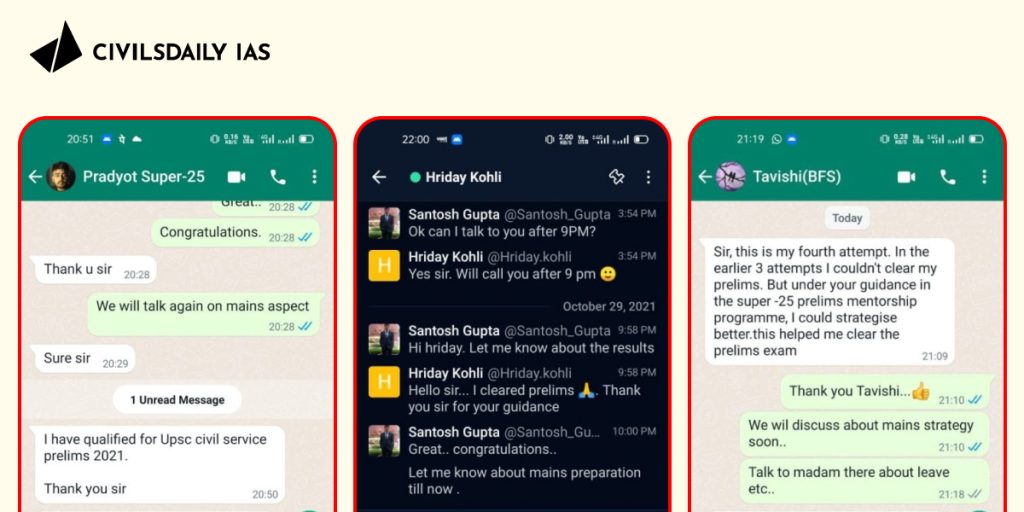
    Tavishi failed thrice in the Prelims before but after joining Santosh sir’s mentorship cleared Prelim 2022 on her 4th attempt.

    Smash Prelims 2023: Program inclusion

    1. One-to-One mentorship for UPSC Prelims 2023 by Santosh sir and the mentor team.
    2. Evidence-based and UPSC level test series: 60 Tests
      • 44 tests (14 basics + 8 Advanced + 10 FLT + 6 CSAT + 6 CA ) for back to back intensive revision
      • 16 Tests for Practice
      • Mandatory mentorship and doubt resolution call after every test
    3. Smash Value LIVE lectures: Most important and probable GS and Current Affairs topics for Prelims 2023. Lectures will be recorded and PDF notes will be shared
    4. Weekly LIVE Zoom sessions with Santosh Sir for strategy, doubt clearance, and QnA
    5. Skills to attempt and solve UPSC MCQs
      • LIVE MCQs solving (1000 questions) session
      • Intelligent Elimination techniques for a sure score of 120+ marks
    6. 1.5 yrs worth of complete current affairs topics (LIVE) covered by the core CD faculty in featured classes with a LIVE discussion + PDF notes
    7. CA magazine + budget and economic survey will be provided for free

    Smash Prelims 2023 Lecture Timetable

    Smash Prelims 2023 Test Timetable

    Other Details:

    Test start date: 10th Jan 2023

    Lecture start date: 15th December 2022

    Course fee: Rs 25,000 Rs. 20,000 + GST

    You are 8 times more likely to clear Prelims 2023 with Santosh sir’s mentorship under the Smash Prelims program


    What CivilsDaily’s Smash Prelims students have to say?

    Santosh sir’s guidance, a crucial part of the first prelims success for Rahul

    A miracle for Debarpita, Smash Prelims 2022 student

    Schedule a free mentorship call for prelims 2023 | click and fill up the form


    Other messages showering gratitude for Santosh sir and Smash Prelims team

  • Day 7| Daily Answer Wars| CD WarZone

    Topics for Today’s question:

    GS-3          Bilateral, regional and global groupings and agreements involving India and/or affecting  India’s interests.

    Question)


    HOW TO ATTEMPT ANSWERS IN DAILY ANSWER WARS (DAW)?

    1. Daily 1 question either from General Studies 1, 2, 3 or 4 will be provided via live You Tube video session.
    2. You can write your answer on an A4 sheet and scan/click pictures of the same.
    3. The answer needs to be submitted by joining the telegram group given in the link below.

      https://t.me/cdwarzone

    *In case your answer is not reviewed, reply to your answer saying *NOT CHECKED*. 

    1. For the philosophy of Daily Answer Wars and payment: 
  • (WATCH LIVE) UPSC (free) Prelims Webinar: 10 Steps Strategy to score more in less time in UPSC Prelims 2023 | Santosh sir, Asst. Commissioner, GST will share 24 week’s Micro -Macro strategy and Prelims PDF notes

    (WATCH LIVE) UPSC (free) Prelims Webinar: 10 Steps Strategy to score more in less time in UPSC Prelims 2023 | Santosh sir, Asst. Commissioner, GST will share 24 week’s Micro -Macro strategy and Prelims PDF notes

    Most important webinar by Prelims Guru, Santosh Sir | Get FREE Smash Prelims notes PDF, 24 weeks’ Micro-Macro masterplan, and MCQ tests.


    Only 24 weeks or less than 170 days are left for UPSC Prelims 2023. Starting today only those aspirants will be able to clear the Prelims who have a well-laid-out plan, the best or most relevant resources (notes, tests, etc.), guidance, and most important of all, a will to succeed.

    This is for you if:

    • You haven’t been able to clear prelims for the past 2-3 years
    • Perform well in mocks but get stuck in the 70-85 marks range in UPSC Prelims.
    • You don’t know how to approach a Prelims paper: should you go for the accuracy or maximum number of questions, should you start from questions 1 to 100, or go section-wise.
    • Don’t know the logical techniques to tackle bouncer-type completely random questions 
    • Can’t use smart and intelligent ways rather than just end up working hard without any use.

    Do you know that only 0.02% of aspirants are able to go beyond 120+ consistently? Achieving this in next 165 days will need a rock solid strategy.

    Santosh Gupta

    Let me reiterate the facts: Of all the candidates applying for IAS Prelims 2023, only 1% of them will clear Prelims 2023 it. And only a fraction of that will go beyond 120+ marks. Santosh sir, cleared all his 6 UPSC Prelims, every time scoring 120+ marks. Even his UPSC 2022 students scored 130+ without breaking a sweat.

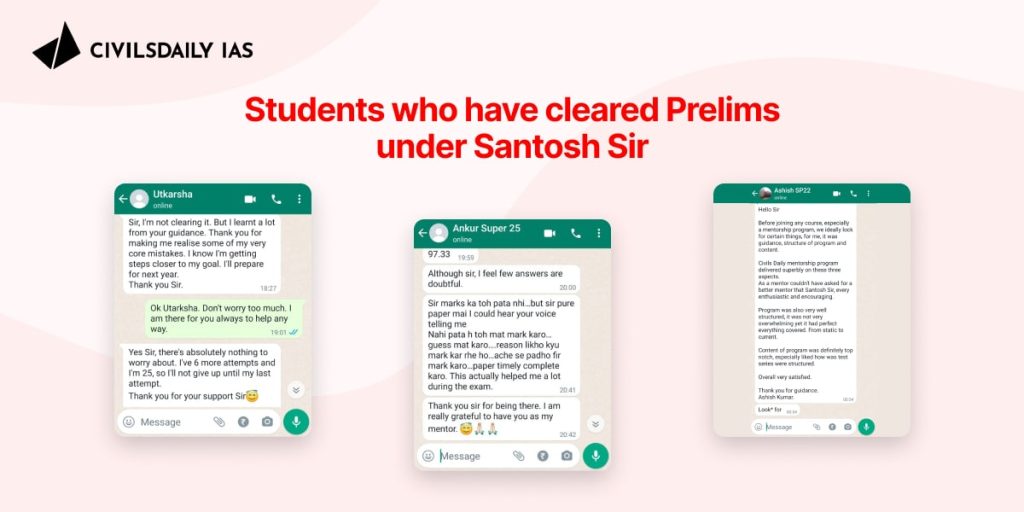
    Santosh sir has been helping aspirants clear UPSC Prelims year after year. Here is a screenshot of his students who wrote Mains 2022.

    Tavishi failed thrice in the Prelims before but after joining Santosh sir’s mentorship cleared Prelim 2022 on her 4th attempt.

    Santosh sir will be taking an important webinar for UPSC 2023 aspirants.

    Webinar Details: How to Smash Prelims 2023 in the next 165 days? Get a rock solid 24 week’s strategy and Prelims PDF notes

    Date: 12th December 2022 (Monday)

    Time: 7 pm

    We will email the invitation, Zoom link, and notes.

    What you’ll learn in the Webinar?

    1. How to prepare for UPSC Prelims 2023 successfully starting today? With less than 6 months in hand, how to go forward?
      • Santosh sir will share a workable and proven strategy for the next 165 days (around 24 weeks), including both micro and macro plans.
    2. A brief trend analysis of the past 5 yrs’ UPSC Prelims GS 1 paper. How to change your preparation methods right now?
    3. How to cover the massive UPSC prelims syllabus? both GS and Current Affairs
      • Most Probable Topics to Cover for Prelims 2023 for every GS subject.
      • How to cover Current Affairs? How many months of Current Affairs should be covered? From where?
    4. The 10 Steps of tackling Prelims 2023. How to maximize revision and minimize study materials?
    5. Learn time management –
      • Before the exam– Studying more and effectively in less time.
      • Inside the exam hall. Most of the time, twisted questions force you to take more time to answer. 
    6. How to filter out and attempt easy questions in the first round quickly and move on to the next with which moderate to difficult questions? will be discussed thoroughly. 
    7. Time-Tested Elimination Techniques. How to use these techniques in sample questions? only generalized preparation is not enough. You have to be ready for the worst. Besides usual ordinary questions, you have to solve more or less offbeat questions. Remember, Offbeat questions require an offbeat approach and it gets 120+ in prelims for you. So, how to apply ‘Intelligent guessing’‘the way of thinking, and ‘Core common sense.
    8. How to stay alert at the 5 worst mistakes areas, like unknown extremely factual questions, Random questions such as from sports in 2021, Questions from old current affairs, Ques. that are not directly from current affairs but inspired by current affairs, and Questions based on common sense such as questions in prelims-2021 
    9. How to avoid silly mistakes by using common sense to the plausibility of statements given. Usually, low-confident aspirants do not attempt these types of questions and overconfident ones make mistakes by overthinking.
    10. How to solve bouncer kind of questions? Around 5 questions in every paper have been asked by UPSC about which you have no idea and might have not even come across while preparing but they can make or break your chance.

    About Santosh Gupta Sir

    Santosh sir has scored above 140 twice in UPSC prelims and 120 plus in all 6 attempts. He has written all 6 mains and has appeared for Interviews 3 times. He has qualified for UPSC EPFO and BPSC 56-59th also. As the Prelims head at Civilsdaily, he has helped 15 out of 25 students clear the prelims examination this year.


    What The Hindu mentioned about Civilsdaily Mentorship?

  • Day 6 | Daily Answer Wars| CD WarZone

    Topics for Today’s question:

    GS-3          Issues relating to development and management of Social Sector/Services relating to Health, Education, Human Resources.

    Question)


    HOW TO ATTEMPT ANSWERS IN DAILY ANSWER WARS (DAW)?

    1. Daily 1 question either from General Studies 1, 2, 3 or 4 will be provided via live You Tube video session.
    2. Announcement video: https://www.youtube.com/watch?v=kGzTviBKVpY; Day 5 winners: Deepali, Ritu, Mohi, Pooja, Manujanshu
    3. You can write your answer on an A4 sheet and scan/click pictures of the same.
    4. The answer needs to be submitted by joining the telegram group given in the link below.

      https://t.me/cdwarzone

    *In case your answer is not reviewed, reply to your answer saying *NOT CHECKED*. 

    1. For the philosophy of Daily Answer Wars and payment: 
  • Post UPSC Mains 2022 result do one of these three things| 85% of our Mains students cleared UPSC Mains 2022 know how

    Post UPSC Mains 2022 result do one of these three things| 85% of our Mains students cleared UPSC Mains 2022 know how

    After UPSC Mains 2022 there are three things that you must do immediately. Read below.

    It has been a couple of days since UPSC Mains results were announced. We hope all the resulting euphoria or disappointment might have settled down. Now is the time to collect yourself and prepare for the next step.


    85% of CivilsDaily’s Mains students cleared UPSC Mains 2022

    CD Mentors were flooded with calls from delighted aspirants all expressing gratitude for the guidance.


    Keep reading if you have cleared the Mains 2022 stage!

    (click- What to do if you weren’t able to crack UPSC Mains 2022 even after multiple attempts- click here)

    For first category of students, congratulations on clearing the UPSC 2022 Mains exam. We salute your grit and determination. You’re one of very few amongst lakhs of candidates who wrote prelims 2022 and now reached the final stage of selection. Give yourself a pat on the back.

    However, now that time has not come yet. This time is not for self-complacent. Instead, now is the time to cross the last hurdle (UPSC Personality Test) between you and the Civil Service.

    “It is time to work harder and smarter. There is just 1 stage that can separate you from your ultimate goal.”

    It is time to start the interview preparation. DAF II has been released now and must be submitted till 14th December, but it must be filled diligently.

    Register here for a LIVE 1-1 session on DAF II filling on with a senior bureaucrat.

    For those who couldn’t find their name on the list, it is a time for introspection and reflection.

    “Failure is the opportunity to begin again more intelligently.”Henry Ford

    Even after giving your full-hearted attempt, you weren’t able to clear Mains and on the other hand, you might have encountered your friends and fellow aspirants who were able to clear it with ease.

    Certainly, there are things that must have been avoided and certain things that you must have done while preparing for UPSC Mains 2022.

    There might be issues at the fundamental level.

    Let us discuss and uncover issues that you are facing in your preparation and together we will resolve them. Fill up FREE Samanvaya mentorship form in which we will connect you to senior IAS faculty for a 1-1 detailed call.

    But we would suggest you have a detailed discussion by filling up the Samanvaya form for 1-1 session, this is FREE

    What about Smash Mains?

    This is for the third category of students. Smash Mains is a highly personalized and intensive handholding program for the crème-de-la-crème (veterans) amongst UPSC aspirants.

    This is for those aspirants who have been able to ‘almost’ clear UPSC and might have appeared for interviews in the past, but due to poor or not up-to-the-mark performance in Mains are unable to sail through.

    Click here for more details about Smash Mains program.

  • [EPW] Healthcare as a Right

    [EPW] Healthcare as a Right

    Context

    • In September this year, the Rajasthan State government introduced the Rajasthan Right to Health Bill, 2022 in the state legislative assembly.
    • As it is still being debated in the legislative assembly and has become a major part of public discourse among health care providers as well as different interest groups.
    • It becomes important to understand its legal dimensions, and more importantly, the short term and long term implications of its implementation.

    What is Right to Health?

    • The right to health is the economic, social, and cultural right to a universal minimum standard of health to which all individuals are entitled.
    • It was first articulated in the WHO Constitution (1946).
    • It states that the enjoyment of the highest attainable standard of health is one of the fundamental rights of every human being.
    • It defines health as a state of complete physical, mental and social well-being and not merely the absence of disease or infirmity.

    Features of this Right

    The 1948 Universal Declaration of Human Rights mentioned health as part of the right to an adequate standard of living (article 25). It covers-

    1. Highest attainable standard of physical and mental health
    2. Reduction of the stillbirth-rate and of infant mortality
    3. Healthy development of the child
    4. Environmental and industrial hygiene
    5. Prevention, treatment and control of epidemic, endemic, occupational and other diseases
    6. Assure to all medical service and medical attention in the event of sickness

    Locating right to health in India

    • Fundamental rights: Article 21 of the Constitution protects and upholds the right to life and liberty.  Courts have often taken a progressive stance in expanding the scope of the right to life to include the right to health.
    • Directive Principles: Articles 38, 39, 42, 43, & 47 of the DPSP put the obligation on the state in order to ensure the effective realization of the right to health.
    • Judicial observations: In State of Punjab and Ors versus Mohinder Singh Chawla (1996), the Supreme Court proclaimed the right to life includes within its fold the right to health.

    What is the Rajasthan Bill about?

    • In bringing forth the right to health bill, the Rajasthan government has acted on its constitutional mandate by providing health care services to residents of the state.
    • Falling under Item 6 of the State List in the Seventh Schedule of the Constitution, the state governments have the duty to ensure the promotion of public health and provision of medical services.

    What are the rights and duties prescribed in the Bill?

    • OOP Expenditure control: The preamble of the Bill at the outset makes the intentions of the government clear -promoting health care without causing catastrophic out-of-pocket expenditure.
    • Free checkups: The Bill provides for free and affordable health check-ups, and surgery in both private and public hospitals.
    • Special provisions for residents: It makes it a matter of right for the residents to avail free services as laid down in various insurance schemes.
    • Right to medical information: The Bill goes one step further in in tackling another thorny issue of the right to medical information in medical establishments.
    • Rights to healthcare providers: The Bill has also provided rights for health care providers such as exemption from liability in bona fide acts, a safe working environment, and access to protective gears.

    Key feature: Balancing the burden of rights

    • While the residents have enough incentives and protection to seek medical care and information about the same, health care providers would not be at a disadvantage in doing their duty.
    • If followed in other states, this balance of rights and duties can help in creating a robust health infrastructure and improving overall public health levels.

    Obligations on the state government

    With rights, come duties.  The government would be obligated to-

    1. Provide funds
    2. Set up institutions
    3. Set up grievance redressal systems
    4. Coordinate among different departments and offices for adequate and
    5. Safe drinking water and sanitation

    Issues in the realization of Right to Health

    • Poor Infrastructure:  There is a dearth of hospitals in India.
    • Fewer doctors per thousand: The WHO mandates that the doctor-to-population ratio should be 1:1,000, while India had a 1:1,404 ratio as of February 2020.
    • Lack of primary healthcare services: The existing public primary health care model is not adequate for existing healthcare burden.
    • Lack of funding: Expenditure on public health funding has been consistently low in India (approximately 1.3% of GDP).
    • Burden of NCDs: Heart ailments are rising like anything in India. It is challenging to tackle Non-communicable Diseases, which is all about prevention and early detection.

    Major policy move: Ayushman Bharat

    The Ayushman Bharat Yojana, now called the Pradhan Mantri Jan Arogya Yojana (PMJAY), aims to be one of the world’s largest health insurance schemes. It covers-

    • Healthcare cover of Rs. 5 lakh per family
    • All families listed in the SECC database to be covered
    • Priority to the girl child, women and senior citizens
    • Secondary and tertiary care
    • Cashless and paperless registration and administration
    • Private sector participation in helping to achieve public health goals

    Way forward

    • Universal health coverage: As part of the SDGs, all countries have pledged to deliver universal health coverage (UHC) by 2030.
    • Increasing healthcare professionals in numbers: India has handled the COVID-19 pandemic exceptionally well. However, considering the rise in the number of infections, India is in dire need of more medical staff and amenities.
    • More funding: Public funding on health should be increased to at least 2.5% of GDP as envisaged in the National Health Policy, 2017.
    • Revamping medical education: The government needs to rapidly build medical institutions and increase the number of doctors.
    • Enhancing pandemic preparedness: With COVID-19 we risk once again falling into the trap of a narrow vertical disease-specific approach.
    • Use of technology: There is a growing use of mobile apps, online consultations, e-pharmacies, and other tools. These are all welcome and must be leveraged.

    Conclusion

    • The Bill appears to be an ideal starting point for making the right to health a more attainable and tangible fundamental right.

    Click and get your FREE Copy of CURRENT AFFAIRS Micro Notes

    (Click) FREE 1-to-1 on-call Mentorship by IAS-IPS officers | Discuss doubts, strategy, sources, and more