💥Join UPSC 2027,2028 Mentorship (August Batch) + XFactor Notes & Microthemes PDF

Distribution: weekly

  • States can’t block elephant corridors fearing crop damage: SC

    Why in the News

    The Supreme Court has directed a fresh nationwide survey of elephant corridors, noting that several corridors remain impeded, blocked or obstructed despite existing guidelines of the Ministry of Environment, Forest and Climate Change (MoEFCC).

    The Court held that crop damage cannot justify placing obstacles in elephant movement paths, highlighting the conflict between wildlife conservation and local livelihood concerns.

    What is an Elephant Corridor?

    • Meaning: A natural or narrow land passage connecting two elephant habitats, enabling movement between them.
    • Need: Elephants move over large areas in search of food, water and mineral licks.
    • Ecological role: Corridors maintain habitat connectivity and gene flow between elephant populations.
    • Legal status: Corridors are identified through ecological and movement studies but are not automatically Protected Areas.
    • Land ownership: Many corridors pass through private, revenue, plantation or community land.
    • India: 150 elephant corridors have been identified across 15 elephant range States.

    What did the Supreme Court Direct?

    1. Fresh nationwide survey of elephant corridors.
    2. A comprehensive report on existing corridors and measures taken to prevent their obstruction.
    3. Identification of corridors that have been blocked, choked or obstructed.
    4. States cannot justify blocking elephant paths merely because of crop destruction.
    5. The Court emphasised that elephants are a wide-ranging species and require unobstructed movement.
    6. The matter will be considered again after six weeks.

    Why are Elephant Corridors Important?

    • Habitat connectivity: Prevents isolation of elephant populations.
    • Gene flow: Allows breeding between different populations.
    • Conflict reduction: Functional corridors can prevent elephants from being forced into settlements.
    • Climate resilience: Connected habitats allow species to shift their range as environmental conditions change.
    • Landscape conservation: Corridors connect forests beyond individual protected areas.

    Major Causes of Corridor Blockage

    • Resorts and other infrastructure: Restrict access to traditional movement paths.
    • Railways and highways: Increase collision and fragmentation risks.
    • Plantations and agriculture: Conversion of corridor land narrows movement routes.
    • Electric fencing: Illegal or poorly designed fencing can cause electrocution.
    • Mining and quarrying: Remove vegetation and fragment habitats.
    • Canals and irrigation structures: Create physical barriers, particularly for calves.
    • Settlements and encroachment: Increase human presence along traditional routes.

    Elephant Conservation in India

    1. The species and its status: The Asian elephant (Elephas maximus) is listed as Endangered on the IUCN Red List and is India’s National Heritage Animal, declared in 2010.
    2. India’s share of the global population: India holds the largest wild Asian elephant population, about 29,964 individuals, roughly 60 per cent of the global population as per the 2017 census.
    3. Population growth under the programme: Wild elephant numbers rose from about 25,000 in 1992 to about 30,000 in 2021 under Project Elephant.
    4. State distribution: Karnataka holds the highest population, followed by Assam and Kerala.
    5. Elephant Reserves: India has 33 elephant reserves covering about 80,777 sq km.
    6. Corridors: 150 corridors have been identified across 15 elephant range States.
    7. Regional spread of corridors: The East central region holds 52 corridors, or 35 per cent of the total, the North East 48 corridors, or 32 per cent, Southern India 32 corridors, or 21 per cent, and Northern India 18 corridors, or 12 per cent.
    8. State with the most corridors: West Bengal, with 26 corridors, about 17 per cent of the national total.
    9. Why the elephant is a keystone species: It disperses seeds over long distances and opens forest canopy and waterholes that other species depend on.

    Constitutional Framework Governing Wildlife Protection

    1. Article 48A: Directs the State to protect and improve the environment and to safeguard the forests and wildlife of the country.
    2. Article 51A(g): Places a fundamental duty on every citizen to protect and improve the natural environment including forests, lakes, rivers and wildlife, and to have compassion for living creatures.
    3. Seventh Schedule, Concurrent List Entry 17B: Places protection of wild animals and birds on the Concurrent List after the 42nd Constitutional Amendment, 1976.
    4. Seventh Schedule, Concurrent List Entry 17A: Places forests on the Concurrent List, which is why State forest departments implement central wildlife law.
    5. Article 21: Protects life and personal liberty, read to include a right to a clean and healthy environment, the basis for much environmental litigation.
    6. Article 32 and Article 142: Give the Supreme Court the power to entertain writ petitions and to pass orders necessary for complete justice, the source of continuing mandamus in wildlife matters.
    7. Article 253: Empowers Parliament to legislate to implement international conventions, the basis for wildlife law giving effect to treaty obligations.

    Laws and Rules Governing Elephants and Their Habitat

    1. Wildlife (Protection) Act, 1972: The primary law for protection of wild animals and plants and for the constitution of protected areas.
    2. Key protection: The Indian elephant is listed in Schedule I, which carries the highest degree of protection and the strictest penalties.
    3. 2022 Amendment: Rationalised the schedules, gave effect to CITES obligations in domestic law, and regulated the transfer of captive elephants for religious and other purposes.
    4. Project Elephant, 1992: A centrally sponsored scheme for protection of elephants, their habitat and corridors, and for management of human elephant conflict.
    5. Coverage: It extends to 23 States and provides the framework under which elephant reserves are declared.
    6. Forest (Conservation) Act, 1980, renamed the Van (Sanrakshan Evam Samvardhan) Adhiniyam: Requires prior central approval for diverting forest land, which governs infrastructure passing through corridors on forest land.
    7. Indian Forest Act, 1927: Provides the categories of reserved and protected forest through which many corridors run.
    8. Scheduled Tribes and Other Traditional Forest Dwellers (Recognition of Forest Rights) Act, 2006: Recognises community rights in forest areas, including in landscapes that carry elephant movement.
    9. Environment (Protection) Act, 1986: Provides for eco sensitive zone notifications and environmental clearance conditions applicable to projects near protected areas.
    10. Biological Diversity Act, 2002: Provides for conservation of biological diversity and equitable sharing of benefits, with biodiversity management committees at the local level.
    11. Convention on International Trade in Endangered Species of Wild Fauna and Flora: Lists the Asian elephant in Appendix I, barring commercial international trade in the species and its parts.
    12. Convention on the Conservation of Migratory Species of Wild Animals: Lists the Asian elephant in Appendix I, obliging range States to conserve and restore its habitats.

    Back2Basics: Asian Elephant

    1. Scientific and common name: Elephas maximus, the Asian or Asiatic elephant, of which the Indian elephant is the mainland subspecies.
    2. IUCN Red List status: Endangered.
    3. Convention on Migratory Species: Listed in Appendix I.
    4. Wildlife (Protection) Act, 1972: Listed in Schedule I, the highest protection category.
    5. Global significance: India holds the largest wild Asian elephant population in the world, about 29,964 individuals, close to 60 per cent of the global total as per the 2017 census.
    6. Range within India: Highest numbers in Karnataka, followed by Assam and Kerala, across 15 elephant range States.
    7. Habitat: Tropical moist and dry deciduous forest, grassland, scrub and adjoining agricultural landscapes, with populations in fragmented forests, tea estates and farmland.
    8. Social structure: Herds are matrilineal, led by an older female, and family units combine into clans and sub populations.
    9. Communication: Elephants use over 60 distinct calls together with gestures and physical contact, including low frequency rumbles that carry over long distances.
    10. Behavioural notes: Elephants comfort distressed companions, mourn their dead, cooperate in raising calves and adopt orphaned young, and individual animals show distinct personalities.
    11. Recorded mortuary behaviour: Research in fragmented forests, tea estates and farmland near the Gorumara Wildlife Division and Buxa Tiger Reserve in West Bengal documented herds carrying calf carcasses and burying them in a legs upright position, then avoiding paths near the burial site.
    12. Genetic structure: A recent study identified five genetically distinct populations of Asian elephants in India.
    13. Conservation framework: Project Elephant, 1992, 33 elephant reserves over about 80,777 sq km, and 150 identified corridors.
    14. Named corridors: Kaniyanpura to Moyar in Karnataka, Chilla to Motichur in Uttarakhand, Thirunelli to Kudarakote in Kerala, the Segur corridor in Tamil Nadu, Kuldiha to Hadgarh in Odisha, Edayarahalli to Doddasampige in Karnataka, and Mudahalli to Talavadi across Tamil Nadu and Karnataka.
    15. Major threats: Habitat loss and fragmentation, corridor blockage, railway collisions, electrocution, poaching for ivory, and retaliatory killing arising from crop and property damage.

    Government Initiatives

    1. Project Elephant, 1992: The umbrella centrally sponsored scheme for elephant protection, habitat and corridor management, and conflict mitigation across 23 States.
    2. Elephant Reserves: 33 reserves notified over about 80,777 sq km, providing a landscape unit for management outside the protected area system.
    3. Gaj Yatra: A national awareness campaign for securing elephant corridors, launched on World Elephant Day.
    4. Haathi Mere Saathi: A public outreach campaign of the Ministry to build tolerance and awareness in elephant range landscapes.
    5. Monitoring of Illegal Killing of Elephants: A site based monitoring programme run under the Convention on International Trade in Endangered Species, in which India participates.
    6. Surakshya portal: A national portal for real time reporting and collection of human elephant conflict data from the field.
    7. Synchronised elephant population estimation: A periodic all India estimation exercise conducted jointly by range States using common protocols.
    8. National Wildlife Action Plan 2017 to 2031: The national policy framework for wildlife conservation, including landscape level and corridor conservation.
    9. Compensatory Afforestation Fund Management and Planning Authority: Funds habitat improvement and conflict mitigation works, including barriers and water sources, in elephant landscapes.

    Key Facts about Elephants in India

    1. World Elephant Day: Observed on 12 August every year.
    2. National Heritage Animal: The Indian elephant was declared India’s National Heritage Animal in 2010.
    3. Project Elephant launch: February 1992, by the Ministry of Environment, Forest and Climate Change.
    4. Largest land mammal in Asia: The Asian elephant is the largest terrestrial mammal on the continent.
    5. Distinguishing feature: Only some male Asian elephants carry tusks, unlike the African elephant where both sexes commonly do.
    6. Gestation: About 22 months, the longest of any land mammal, which makes population recovery slow.
    7. Elephant reserves and corridors: 33 reserves and 150 identified corridors across 15 range States.
    8. Gaj Yatra launch: Launched on 12 August 2017 as a nationwide corridor awareness campaign.
    9. Global population share: India holds about 60 per cent of the world’s wild Asian elephants.

    “[2022] With reference to Indian laws about wildlife protection, consider the following statements :
    1. Wild animals are the sole property of the government.
    2. When a wild animal is declared protected, such animal is entitled for equal protection whether it is found in protected areas or outside.
    3. Apprehension of a protected wild animal becoming a danger to human life is sufficient ground for its capture or killing.
    Which of the statements given above is/are correct ?
    (a) 1 and 2
    (b) 2 only
    (c) 1 and 3
    (d) 3 only
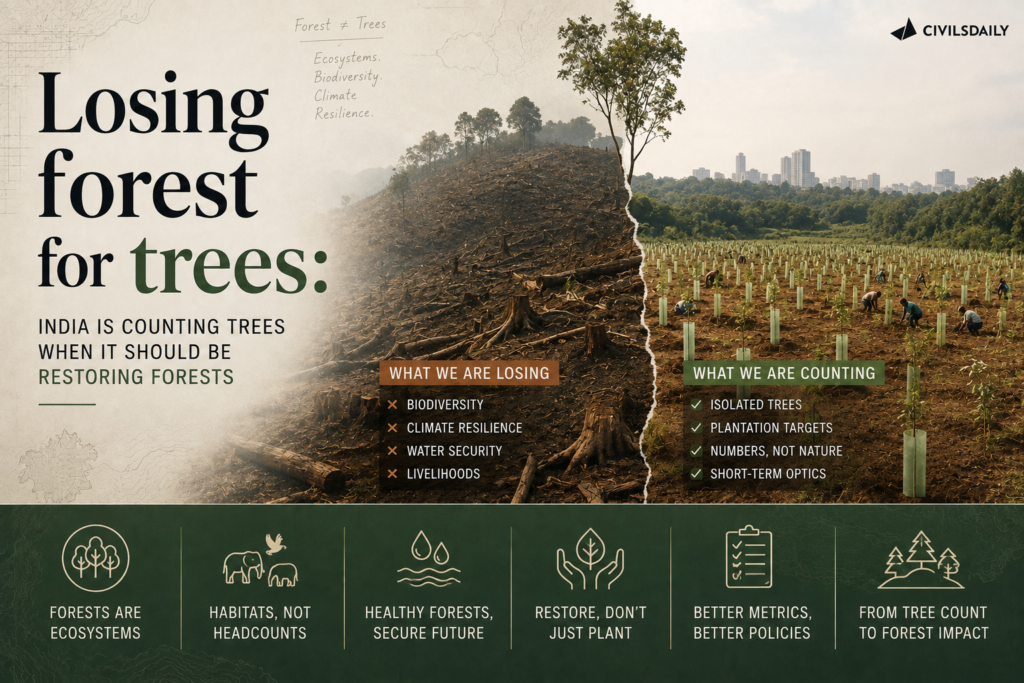
  • Losing forest for trees: India is counting trees when it should be restoring forests

    Why in the News

    A performance audit by the Comptroller and Auditor General (CAG) of the Green India Mission (GIM) has found that across a decade the Mission improved forest quality over only 0.11 million hectares against a target of 1.4 million hectares, and achieved barely 4 per cent of its forest cover expansion goal. The Mission was designed as ecological restoration, and it has been displaced in practice by a sapling planting drive whose success is measured in trees planted rather than in forest restored. The India State of Forest Report 2023 records a green cover gain of 1,445 sq km, of which only 156 sq km is true forest.

    What is the Green India Mission?

    1. What it is: A national mission of the Ministry of Environment, Forest and Climate Change aimed at protecting, restoring and enhancing India’s forest cover and at responding to climate change through adaptation and mitigation.
    2. Where it sits: It is one of the eight pillars of the National Action Plan on Climate Change, unveiled in 2008.
    3. Its climate function: It is the instrument through which India promised the Paris Agreement an additional carbon sink of 2.5 billion to 3 billion tonnes by 2030.
    4. Its animating idea: The objective is ecological, covering biodiversity, water, carbon sequestration and the revival of habitat, not the raising of tree numbers.
    5. Its twin physical targets: The Mission set out to increase forest and tree cover on one block of land and to improve the quality of existing forest cover on another.
    6. Its funding design: It was built to draw money and labour from other programmes rather than from its own budget line alone.

    What is the Compensatory Afforestation Fund Management and Planning Authority?

    1. What it is: The statutory authority, known as CAMPA, that manages funds collected from industry and other user agencies in return for the diversion of forest land to non forest use.
    2. What it funds: The money is channelled into afforestation, catchment treatment and habitat improvement, which is why the Green India Mission was designed to converge with it.

    What is tree cover outside recorded forests?

    1. What it is: Tree patches smaller than one hectare and trees standing outside the legally recorded forest area, counted separately from forest cover in the national forest assessment.
    2. Why the distinction matters: A plantation, an orchard or an avenue of trees adds to this category without adding to forest, so a rise in green cover can occur while forest itself stagnates.

    What is Ek Ped Maa Ke Naam?

    1. What it is: A tree plantation campaign launched in 2024, translated as A Tree in the Name of Mother, under which the government reports planting 140 crore saplings so far.
    2. Its effect on the Mission: For practical purposes it has replaced the Green India Mission as the visible face of India’s forest effort.

    What did the Comptroller and Auditor General audit find?

    1. Forest quality improvement: Against a target of improving forest quality over 1.4 million hectares, the Mission managed 0.11 million hectares, less than a tenth of the target.
    2. Forest cover expansion: On expanding forest cover the Mission achieved barely four per cent of its goal.
    3. Recorded shortfall on quality: The audit records a shortfall of about 91.87 per cent against the forest quality improvement target over ten years.
    4. Recorded shortfall on cover: The audit records a shortfall of about 97.57 per cent against the forest cover target over the same period.
    5. Coverage of the audit: The performance audit examined implementation across 16 States and Union Territories.
    6. Money actually received: Only about Rs 1,149.14 crore of budgetary support reached the Mission over the audited decade.
    7. Convergence not achieved: The Mission’s intended convergence with its partner schemes did not materialise.
    8. The overall verdict: A scheme conceived to heal India’s forests achieved almost nothing it set out to do across a decade.

    Why did the Mission’s convergence with other funding streams fail?

    1. The CAMPA channel: CAMPA holds money collected from industry for diverting forest land into afforestation, and that money did not flow into Mission activity as designed.
    2. The wage labour channel: The Mahatma Gandhi National Rural Employment Guarantee Scheme, rebranded VB G RAM G, funds rural wage labour that can be used for plantation and land restoration works.
    3. What convergence was meant to do: The Mission’s own budget line was small by design, so its physical targets depended on borrowing funds and labour from these two much larger streams.
    4. What happened instead: The convergence never materialised, which left the Mission with a decadal target set for one scale of resources and an actual allocation of a different scale.
    5. The consequence for accountability: A mission that does not control its own money cannot be held to its own targets, and no single agency owns the shortfall.
    6. The displacement effect: With convergence absent, the plantation drive absorbed the political attention and the reporting space that restoration was meant to occupy.

    What does the India State of Forest Report 2023 show about the quality of the gain?

    1. The headline gain: The report records a gain of 1,445 sq km in green cover.
    2. The forest share of that gain: Only 156 sq km of that gain is true forest.
    3. The remainder: The other 1,289 sq km is tree cover outside recorded forests.
    4. Inside the recorded forests: Dense canopy within recorded forest area is thinning into scrub.
    5. What the two numbers together establish: India is planting more and foresting less, so an aggregate green cover figure conceals a decline in forest quality.
    6. Why this matters for the carbon pledge: A carbon sink commitment measured in billions of tonnes rests on dense forest, not on scattered tree cover that stores far less carbon per hectare.

    Why does the Aravalli Green Wall illustrate the limits of planting?

    1. The state of the range: The Aravallis are among the country’s most degraded ranges, with hillocks quarried away over decades.
    2. The invasion: Native growth has been overrun by the invasive vilayati kikar (Prosopis juliflora), which suppresses regeneration of native species.
    3. The proposed remedy: The range is now to be rescued by a Green Wall of fresh planting.
    4. What planting cannot do, first: Fresh saplings cannot undo the damage left by years of mining and the removal of the hill itself.
    5. What planting cannot do, second: Planting does not halt encroachment on the range, which is a land use and enforcement problem.
    6. What planting cannot do, third: An ecosystem that took millennia to assemble cannot be summoned back by a plantation drive.
    7. The governing distinction: Restoration rebuilds the ecological function of a landscape, and landscaping only adds vegetation to it.

    Where does counting trees diverge from restoring forests?

    1. Two different outputs: A sapling planted is a countable annual output. A restored forest is a slow change in canopy density, species composition and soil.
    2. Two different timelines: Planting reports results within a financial year, and restoration shows results across decades, which biases the system toward planting.
    3. Two different failure modes: Plantation failure shows up as sapling mortality that is rarely audited. Restoration failure shows up in the forest report, as it has in 2023.
    4. The metric drives the money: With 140 crore saplings as the reported achievement and 0.11 million hectares as the restored area, the reporting system rewards the activity that is easiest to count.
    5. Species and structure are lost in the count: A count of trees is indifferent to whether the trees are native, whether they form a canopy, and whether they support the species the forest once held.
    6. The ecological cost of the substitution: Biodiversity, groundwater recharge and habitat revival, the Mission’s stated objectives, do not follow automatically from a higher tree count.

    What can an audit of this kind not capture?

    1. The instrument is accountancy: The audit counts hectares and rupees, and it cannot count the worth of a living forest.
    2. Ecological value is not a line item: Pollination, water regulation, soil stabilisation and habitat quality have no entry in a financial performance table.
    3. Implementation reality: The assessment cannot always capture the practical difficulties of running a mission across State forest departments with varying capacity.
    4. Time lag in forest outcomes: Restoration works undertaken late in the audit period cannot show measurable results within it.
    5. Why the verdict still stands: Even on its own limited terms, an achievement of four per cent against a cover target and a tenth of a quality target is a failure of implementation, not a measurement artefact.
    6. What the audit does establish: The mission designed to restore India’s forests was allowed to wither while the state busied itself counting trees.

    Challenges to the Green India Mission

    1. Sapling survival is not tracked: Plantation drives report numbers planted and rarely report survival after three years. e.g. successive State plantation drives reporting crore scale planting with no published third year survival audit.
    2. Monoculture and exotic species: Plantations favour fast growing and commercially useful species over native mixed forest, which limits habitat value. e.g. eucalyptus and acacia blocks raised on degraded common land in Karnataka and Gujarat.
    3. Land availability for restoration: The Mission needs degraded forest land free of competing claims, and much of it carries grazing, cultivation and settlement use. e.g. contested village common land in the Aravalli belt of Haryana and Rajasthan.
    4. Forest rights not settled first: Restoration works on land where individual and community claims under forest rights law remain undecided create conflict with forest dwellers. e.g. pending community forest resource claims across central Indian districts.
    5. Invasive species suppress regeneration: Restoration on invaded land fails unless the invasive is removed first, which is costlier than planting. e.g. Prosopis juliflora in the Aravallis and Lantana camara across central Indian forests.
    6. Weak convergence architecture: The Mission depends on funds controlled by other schemes with their own targets and reporting cycles. e.g. CAMPA balances lying unspent with State authorities while Mission works waited for money.
    7. Staffing and capacity in forest departments: Frontline forest staff vacancies limit the supervision that assisted natural regeneration requires. e.g. large vacancy levels in forest guard and forester posts reported by several State forest departments.
    8. Diversion continues alongside restoration: Forest land continues to be diverted for infrastructure while restoration targets are missed, so the net position worsens. e.g. compensatory afforestation for the Ken Betwa link inside the Panna landscape.
    9. Green cover accounting conflates categories: Counting orchards, plantations and avenue trees within green cover masks the loss of dense natural forest. e.g. the 1,289 sq km of tree cover outside recorded forests in the 2023 assessment.

    Conclusion

    India has substituted a countable output, saplings planted, for the objective it actually set itself, which is restored forest, and the audit records the cost of that substitution across a decade. The Green India Mission failed not because restoration is unachievable but because it was starved of money, denied the convergence it was designed around, and displaced by a drive that reports faster numbers. Until forest quality, canopy density and sapling survival replace planting counts as the reported metric, the Paris carbon sink commitment will rest on an inflated green cover figure. The instrument exists and the finance does not follow it.

    Forest Cover and Restoration in India

    1. What forest cover means: All land more than one hectare in area with a tree canopy density of more than 10 per cent, irrespective of ownership or legal status.
    2. The assessment: The Forest Survey of India, Dehradun, publishes the India State of Forest Report every two years using satellite data and field inventory.
    3. The national scale: Total forest and tree cover is about 8,27,357 sq km, which is about 25.17 per cent of the geographical area, per the 2023 assessment.
    4. The split: Forest cover is about 7,15,343 sq km, or 21.76 per cent, and tree cover about 1,12,014 sq km, or 3.41 per cent.
    5. The policy target: The National Forest Policy, 1988 sets a goal of 33 per cent of the geographical area under forest and tree cover.
    6. The canopy classes: Forest cover is classed as very dense forest, moderately dense forest and open forest, by canopy density bands.
    7. The international commitment: India has committed to restoring 26 million hectares of degraded land by 2030, a pledge raised from an earlier 21 million hectare commitment under the Bonn Challenge.
    8. The climate commitment: India’s nationally determined contribution promises an additional carbon sink of 2.5 billion to 3 billion tonnes of carbon dioxide equivalent through additional forest and tree cover by 2030.
    9. Why restoration differs from afforestation: Restoration rebuilds a degraded ecosystem’s native composition and function, and afforestation only establishes trees on land, often with a single species.

    Constitutional Framework Governing Forests and the Environment

    1. Article 48A: Directs the State to protect and improve the environment and to safeguard the forests and wildlife of the country.
    2. Article 51A(g): Places a fundamental duty on every citizen to protect and improve the natural environment including forests, lakes, rivers and wildlife.
    3. Article 21: Protects life and personal liberty, read by the courts to include the right to a clean and healthy environment.
    4. Seventh Schedule, Concurrent List Entry 17A: Places forests on the Concurrent List after the 42nd Constitutional Amendment, 1976.
    5. Seventh Schedule, Concurrent List Entry 17B: Places protection of wild animals and birds on the Concurrent List.
    6. Article 253: Empowers Parliament to legislate to implement international agreements, the basis for environmental laws giving effect to treaty commitments.
    7. Article 244 and the Fifth Schedule: Provide for administration of Scheduled Areas, which overlap substantially with India’s forest landscapes.
    8. Article 243ZD and Part IX: Place village level planning with Panchayats, the base for Gram Sabha consultation in forest areas.

    Laws and Rules Governing Forests and Compensatory Afforestation

    1. Indian Forest Act, 1927: Consolidates the law on forests, the transit of forest produce and the duty leviable on it, and provides for reserved, protected and village forests.
    2. Key feature: It creates the categories of legally recorded forest against which forest cover is measured.
    3. Forest (Conservation) Act, 1980: Requires prior approval of the Union government for the diversion of forest land to non forest use.
    4. 2023 amendment: Renamed the Act the Van (Sanrakshan Evam Samvardhan) Adhiniyam, 1980 and exempted specified categories of land and projects from prior approval.
    5. Compensatory Afforestation Fund Act, 2016: Establishes the National and State Compensatory Afforestation Funds and the authorities that manage them.
    6. Rules, 2018: Set out the procedure for utilisation of the accumulated fund for afforestation, catchment treatment and wildlife management.
    7. Scheduled Tribes and Other Traditional Forest Dwellers (Recognition of Forest Rights) Act, 2006: Recognises individual and community forest rights and requires Gram Sabha consent for diversion.
    8. Wildlife (Protection) Act, 1972: Governs protected areas, and restricts activities inside national parks, sanctuaries, conservation reserves and tiger reserves.
    9. Environment (Protection) Act, 1986: The umbrella law under which environmental clearance, eco sensitive zone notifications and emission standards are issued.
    10. National Green Tribunal Act, 2010: Creates a specialised tribunal for environmental disputes, including challenges to forest diversion and afforestation failures.
    11. Biological Diversity Act, 2002: Provides for conservation of biological diversity and the constitution of biodiversity management committees at the local level.

    “[2016] Which of the following best describes/ describe the aim of ‘Green India Mission’ of the Government of India?
    1. Incorporating environmental benefits and costs into the Union and State Budgets thereby implementing the ‘green accounting’
    2. Launching the second green revolution to enhance agricultural output so as to ensure food security to one and all in the future
    3. Restoring and enhancing forest cover and responding to climate change by a combination of adaptation and mitigation measures
    Select the correct answer using the code given below.
    (a) 1 only
    (b) 2 and 3 only
    (c) 3 only
    (d) 1, 2 and 3

  • Why India is finding it difficult to buy critical mineral assets abroad

    Why in the News

    A Parliamentary panel report has highlighted the limited success of Khanij Bidesh India Limited (KABIL) in acquiring critical mineral assets overseas. So far, KABIL has completed acquisitions only in Argentina, while bids in Australia and Chile have failed or lapsed.

    The issue highlights India’s challenge of securing critical minerals abroad without a sufficiently strong financial and domestic processing ecosystem.

    What is KABIL?

    • Established: 2019
    • Purpose: Acquire and develop critical mineral assets overseas.
    • PSUs involved:
      • National Aluminium Company Limited (NALCO)
      • Hindustan Copper Limited (HCL)
      • Mineral Exploration and Consultancy Limited (MECL)
    • Ministry: Ministry of Mines
    • Major success: Five lithium brine blocks in Catamarca, Argentina, acquired in January 2024.

    Key Terms

    Spodumene Concentrate

    • Concentrated hard-rock lithium ore.
    • Must be processed into lithium carbonate or lithium hydroxide for battery applications.

    Lithium Brine

    • Lithium dissolved in underground saltwater.
    • Extracted by pumping brine to the surface and concentrating it, traditionally through evaporation.

    Non-Binding Offer

    • Indicative offer that does not legally commit the bidder to complete the transaction.
    • Allows access to the seller’s data room and due diligence stage.

    Why did KABIL struggle?

    1. Limited financial capacity: KABIL cannot independently match large international bids.
    2. No domestic processing ecosystem: India lacks sufficient commercial-scale lithium conversion capacity.
    3. Price volatility: Lithium prices fluctuate sharply, making valuation difficult.
    4. Slow consortium decisions: Multiple PSUs can delay due diligence and bidding.
    5. Strong global competition: Integrated companies can pay more because they already possess refining and battery-making capacity.
    6. Exploration risk: Acquiring mineral acreage does not guarantee commercially viable reserves.

    Australia: Why India Lost the Bid

    • Indian consortium initially offered $184 million.
    • Revised offer: $233 million.
    • South Korea’s POSCO eventually offered $765 million.
    • POSCO’s integrated mining and processing ecosystem allowed it to justify a much higher valuation.
    • Core lesson: Mine ownership without processing capacity provides less strategic value.

    Chile: Why the Opportunity Lapsed

    • KABIL’s proposed Chilean lithium investment required a large financial commitment. A joint bid with other PSUs could not complete due diligence within the available timeline.
    • This exposed two weaknesses:
    • Limited capital + slow decision-making = missed strategic opportunities.

    How Other Countries Approach Critical Minerals

    • Japan: JOGMEC provides equity support and loan guarantees to Japanese companies.
    • China: Combines overseas mining acquisitions with strong domestic refining capacity.
    • South Korea: Vertically integrated companies such as POSCO connect mining with processing.
    • EU: Critical Raw Materials Act targets domestic extraction, processing and recycling.
    • USA: Minerals Security Partnership promotes joint financing of critical mineral projects.

    Why Domestic Value Chain Matters

    • India’s strategy needs to follow:
      • Overseas mine → Concentrate → Domestic refining → Battery materials → Batteries → Manufacturing
    • At present, the missing midstream processing stage reduces the economic value India can derive from an overseas mine.

    “[2025] Consider the following statements:
    I. India has joined the Minerals Security Partnership as a member.
    II. India is a resource-rich country in all the 30 critical minerals that it has identified.
    III. The Parliament in 2023 has amended the Mines and Minerals (Development and Regulation) Act, 1957 empowering the Central Government to exclusively auction mining lease and composite license for certain critical minerals.
    Which of the statements given above are correct?
    (a) I and II only
    (b) II and III only
    (c) I and III only
    (d) I, II and III

  • At Afghan embassy, Taliban diplomats mark 5th anniversary of victory day

    Why in the News

    The Afghanistan Embassy in New Delhi held a reception on 17 August 2026, marking five years of Taliban rule. Indian officials attended despite India continuing to withhold formal recognition of the Islamic Emirate of Afghanistan.

    The event highlights India’s growing working relationship with the Taliban without formal diplomatic recognition.

    What is a Chargé d’Affaires-led Mission?

    • Chargé d’Affaires: Diplomat heading a mission when no ambassador is accredited.
    • Under the Vienna Convention on Diplomatic Relations, 1961, it ranks below an ambassador.
    • An ambassador presents credentials to the Head of State, while a chargé d’affaires is accredited to the Foreign Ministry.
    • It allows diplomatic engagement without necessarily signalling formal recognition.
    • The Afghan mission in Delhi has operated under this arrangement since November 2025.

    What is the Islamic Emirate of Afghanistan?

    • Formal name used by the Taliban administration since August 2021.
    • India engages with the Taliban as a de facto authority but has not formally recognised it as Afghanistan’s government.

    How Has India-Taliban Engagement Evolved?

    • 2021: India closed its Kabul embassy and evacuated personnel.
    • 2022: India established a technical mission in Kabul.
    • 2025: Afghan Foreign Minister visited India.
    • India subsequently upgraded its Kabul mission to full embassy status.
    • November 2025: Taliban-appointed diplomats took charge of the Afghan Embassy in Delhi under a chargé d’affaires.
    • 2026: Embassy hosted its first public victory anniversary reception in Delhi.

    Why is India Engaging the Taliban?

    • Security: Maintains visibility over terrorist groups and developments affecting India.
    • Connectivity: Chabahar Port provides access to Afghanistan bypassing Pakistan.
    • Development assets: India has invested heavily in projects such as the Salma Dam, Zaranj-Delaram Highway and Afghan Parliament.
    • Regional competition: China, Russia, Iran and Central Asian countries are expanding engagement with Kabul.
    • Trade: Bilateral trade remains around $1 billion.

    “[2013, GS2, 10 marks] The proposed withdrawal of International Security Assistance Force (ISAF) from Afghanistan in 2014 is fraught with major security implications for the countries of the region. Examine in light of the fact that India is faced with a plethora of challenges and needs to safeguard its own strategic interests.”

  • ID cards issued to transgender persons remain valid: Centre

    Why in the News

    The Union government assured a three judge Bench of the Supreme Court that transgender identity cards issued before the Transgender Persons (Protection of Rights) Amendment Act, 2026 came into force continue to remain valid. The assurance was given in a challenge arguing that the amendment, in force since 30 March, dismantles the right to self identification recognised in the National Legal Services Authority v Union of India (2014) line of cases. The dispute turns on whether gender identity is declared by the person or certified by the State.

    What is the Transgender Persons (Protection of Rights) Amendment Act, 2026?

    1. About: It amends the Transgender Persons (Protection of Rights) Act, 2019, the statute that governs recognition of transgender identity and the certificate of identity issued to a transgender person.
    2. Commencement: It came into force on 30 March 2026.
    3. Core objection to it: Petitioners argue that it dismantles the right to self identification and gives the State unfettered authority to determine gender identity.
    4. Status of earlier cards: The Solicitor General assured the Court that identity cards issued before the amendment remain valid, and their validity is unaffected by the new law.
    5. Judicial position so far: The Court had already indicated in the previous hearing that the 2026 law should not operate retrospectively to invalidate cards issued under the earlier legislation.
    6. Forum: The challenge is before a three judge Bench headed by the Chief Justice of India.

    What is self identification of gender?

    1. About: Self identification is the principle that a person’s gender is determined by that person’s own declaration of identity, without any requirement of medical examination or third party certification.
    2. Legal origin in India: The Supreme Court recognised it in National Legal Services Authority v Union of India (2014), holding that the right to determine one’s gender is integral to dignity under Article 21.

    What is a transgender identity card?

    1. About: A certificate of identity issued to a transgender person that provides official recognition of the person’s self identified gender.
    2. Practical use: It is used to support changes to name and gender across official records, and the government’s transgender portal expressly enables such changes.

    What is the current status of gender identity recognition in India?

    1. Statutory basis: Recognition runs through the certificate of identity issued under the Transgender Persons (Protection of Rights) Act, 2019 and the rules made under it.
    2. Application route: An application is made to the District Magistrate, who issues a certificate of identity as a transgender person and a revised certificate after gender affirming surgery.
    3. Third gender status: Transgender persons are recognised as a third gender for the purposes of state welfare and identity documents.
    4. Prohibition of discrimination: The 2019 Act bars discrimination in education, employment, healthcare, access to public goods and the right to residence.
    5. Reservation position: No reservation in education or public employment has been extended to transgender persons as a class, despite the direction in the 2014 judgment to treat them as socially and educationally backward.
    6. Position after the amendment: The 2026 Amendment Act is in force from 30 March 2026, and its validity is under challenge before a three judge Bench.
    7. Position of existing card holders: Cards issued before the amendment continue to remain valid on the government’s own assurance to the Court.

    Constitutional Provisions Related to gender identity

    1. Article 14: Guarantees equality before the law and equal protection of the laws to every person, not only to men and women.
    2. Article 15: Prohibits discrimination on grounds of religion, race, caste, sex or place of birth, with sex read to include gender identity.
    3. Article 16: Guarantees equality of opportunity in matters of public employment and permits reservation for backward classes.
    4. Article 19(1)(a): Protects freedom of expression, which includes expression of gender identity through dress, speech and behaviour.
    5. Article 21: Guarantees life and personal liberty, read to include dignity, personal autonomy and the right to determine one’s gender.
    6. Article 15(4) and Article 16(4): Permit special provisions and reservation for socially and educationally backward classes, the route directed in the 2014 judgment.
    7. Article 32: Provides the remedy through which the present challenge to the amendment has been brought.
    8. Article 23: Prohibits trafficking and forced labour, relevant to the exploitation the community faces in the absence of livelihood options.

    What did the National Legal Services Authority judgment establish?

    1. Recognition of a third gender: The Supreme Court held in April 2014 that transgender persons must be recognised as a third gender for the purposes of law.
    2. Right to self identification: It held that the gender to which a person belongs is to be determined by that person’s own identification and not by biological or medical criteria.
    3. Constitutional grounding: It located the right in Articles 14, 15, 16, 19(1)(a) and 21, treating gender identity as an aspect of dignity and personal autonomy.
    4. Backward class direction: It directed the Centre and the States to treat transgender persons as socially and educationally backward for the purposes of reservation.
    5. Positive obligations: It directed provision of separate public toilets, medical facilities, welfare schemes and measures to address social stigma.
    6. The wider line of cases: Puttaswamy v Union of India (2017) recognised privacy and decisional autonomy, Navtej Singh Johar v Union of India (2018) decriminalised consensual same sex relations, and Arunkumar v Inspector General of Registration (2019) upheld the marriage rights of a transgender person.

    What do the petitioners argue against the 2026 amendment?

    1. Loss of self determination: The amendment allows the State unfettered authority to determine gender identity, displacing the person’s own declaration.
    2. Conflict with binding precedent: Self identification was recognised as a constitutional right in 2014, and a statute cannot narrow a right located in Article 21.
    3. Value of existing documents: The importance of transgender identity cards already issued cannot be trifled away, since name and gender across official records depend on them.
    4. Retrospective effect: Any reading that invalidates earlier cards would strip recognition already granted under a previous legislation.
    5. Who is before the Court: The petitioners include community members and activists, so the challenge is brought by the group the law regulates.

    Can the State certify gender identity without displacing the right to determine it?

    1. Two claims in tension: The State has an interest in a verifiable identity document, and the individual has a constitutional right to declare gender without external validation.
    2. Where certification becomes control: A certificate that records a declaration is administrative, and a certificate that decides the declaration is determinative of the right itself.
    3. Documentary dependence: Name and gender in every other official record follow from the certificate, so control over the certificate is control over legal personality.
    4. Precedent against statute: The right was recognised through Article 21 in 2014, and the amendment operates on the same subject through ordinary legislation.
    5. The retrospectivity carve out: Protecting existing cards resolves the immediate hardship of current holders and leaves the question of future applicants untouched.
    6. The unresolved core: The assurance settles who keeps a card already issued, not who will be entitled to one under the amended procedure.

    Major debates surrounding gender self identification

    1. Declaration against certification: Whether recognition should follow a self declaration or require screening by a district authority.
    2. Medicalisation of identity: Whether any surgical or medical requirement for a revised certificate is consistent with autonomy under Article 21.
    3. Appeal and remedy: Whether refusal of a certificate by a District Magistrate should carry a statutory appeal, which the 2019 Act was criticised for omitting.
    4. Reservation for transgender persons: Whether the 2014 direction to treat the community as socially and educationally backward requires a horizontal reservation across categories.
    5. Penalty asymmetry: Whether the lower punishment for sexual violence against transgender persons under the 2019 Act compared with the general criminal law is constitutionally sustainable.
    6. Family and residence: Whether the requirement to reside with the natal family or in a rehabilitation centre respects the autonomy of adults who leave hostile homes.
    7. Data and enumeration: Whether recognition can be operationalised at all without accurate population data, since the last enumeration of the community was in Census 2011.

    Challenges to the transgender rights framework

    1. Certification bottleneck: Recognition depends on a single district officer with no statutory appeal against refusal. e.g. applicants under the Transgender Persons (Protection of Rights) Rules, 2020 have reported long delays in issue of the certificate of identity.
    2. Absence of reservation: The 2014 direction on backward class status has not been operationalised at the national level. e.g. Karnataka became the first State to provide a one per cent reservation in public employment in 2021, and most States have not followed.
    3. Weak penalty structure: Offences against transgender persons carry lower punishment than equivalent offences in the general criminal law. e.g. the 2019 Act prescribes six months to two years for sexual abuse of a transgender person.
    4. Healthcare exclusion: Gender affirming care and mental health support are unevenly available and rarely insured. e.g. Ayushman Bharat TG Plus was created precisely because transgender persons were excluded from mainstream health coverage.
    5. Livelihood and employment: Discrimination pushes the community towards begging and sex work despite a statutory bar on discrimination. e.g. the SMILE scheme’s livelihood component was designed to move persons out of begging.
    6. Documentation mismatch: Records in education certificates, bank accounts and property documents do not update automatically after a change in gender. e.g. the government’s transgender portal exists specifically to enable name and gender changes across records.
    7. Data invisibility: Policy runs on a 2011 count with no subsequent enumeration. e.g. Census 2011 recorded 4.88 lakh transgender persons, a figure widely regarded as an undercount.

    Conclusion

    The assurance protects existing card holders and leaves the constitutional question untouched, since the dispute is about whether gender identity is declared or certified. The Transgender Persons (Protection of Rights) Amendment Act, 2026 remains in force from 30 March 2026, and its validity is pending before a three judge Bench of the Supreme Court on a challenge grounded in the 2014 line of cases. The Court has recorded that the law should not operate retrospectively and the government has accepted that position on the record. The source names no next date for the hearing, so the stage reached is the government’s undertaking and the pending challenge.

    [2024] Under which of the following Articles of the Constitution of India, has the Supreme Court of India placed the Right to Privacy?
    (a) Article 15
    (b) Article 16
    (c) Article 19
    (d) Article 21

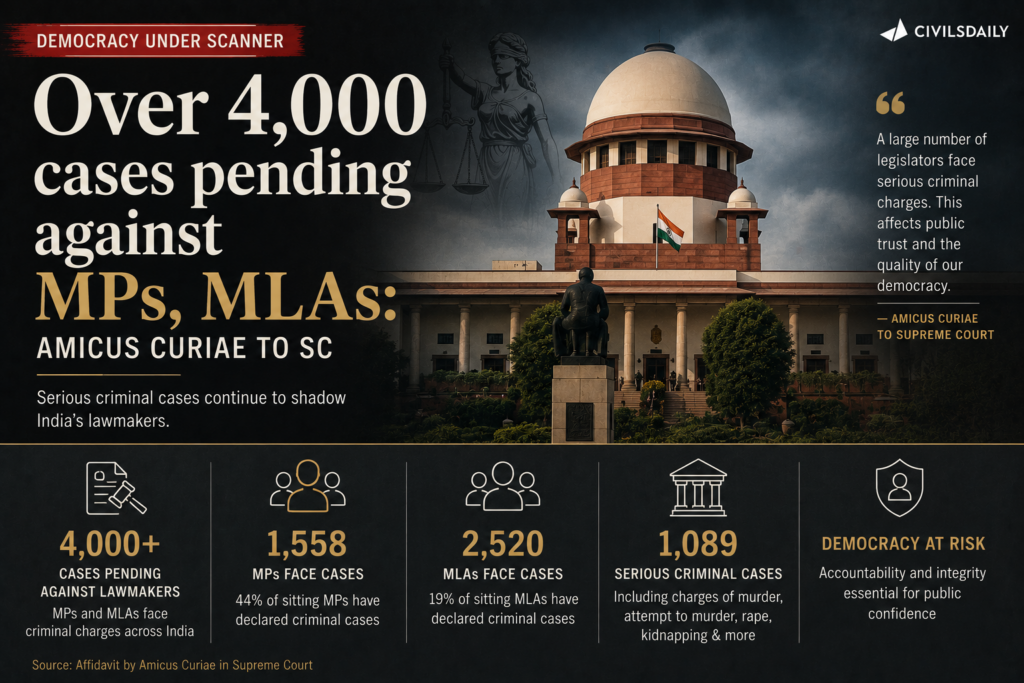
  • Over 4,000 cases pending against MPs, MLAs: Amicus curiae to SC

    Why in the News

    The 22nd report of the amicus curiae to the Supreme Court records 4,192 criminal cases pending trial against sitting and former Members of Parliament and Members of Legislative Assemblies, with 519 pending for more than a decade. The figure has stayed above 4,000 every year since 2018, through three rounds of Supreme Court directions creating special courts, designated courts and suo motu monitoring. The report therefore shifts the question from what should be ordered to why nine years of orders have not moved the number.

    Who is an amicus curiae?

    1. About: An amicus curiae is a senior lawyer appointed by a court to assist it impartially in a matter, rather than to represent any party before it.
    2. Role here: The amicus in this public interest litigation collects pendency data from every High Court, audits compliance with earlier directions and files periodic reports with recommendations.

    What is a designated court for cases against legislators?

    1. About: A designated court is an existing Sessions or Magisterial court identified in each district to hear criminal cases against sitting and former legislators on priority.
    2. Difference from a special court: A special court is constituted exclusively for such cases, while a designated court continues to carry its ordinary docket alongside them.

    What does the 22nd amicus report record?

    1. Total pendency: 4,192 cases against sitting and former MPs and MLAs are pending trial across the country.
    2. The oldest bracket: 519 cases have been pending for more than a decade.
    3. Cases still under investigation: 700 cases are pending investigation, of which 360 have stayed at that stage for more than three years without a chargesheet.
    4. Source of the data: The figure is drawn from information received from High Courts and their websites, and the High Court websites together show 4,442 pending cases.
    5. A gap in reporting: The Allahabad High Court did not submit a report, so its figure of 1,171 cases is taken from its website as of February 2024.
    6. Reach into high office: Chief Ministers of 14 of 28 States have criminal cases pending trial against them.
    7. Where the case is listed: The matter was referred to a three judge Bench in February 2025 and was listed before that Bench on 18 August.

    What is the full pendency profile in the data?

    1. Cases pending for 5 to 10 years: 754.
    2. Cases pending for 3 to 5 years: 562.
    3. Cases pending for less than 3 years: 1,095.
    4. State wise concentration: Uttar Pradesh leads with 1,171 cases, followed by Kerala at 543, Bihar at 373, Maharashtra at 364 and Odisha at 330.
    5. Chief Ministers facing cases: The Telangana Chief Minister faces the highest number at 89, followed by the West Bengal Chief Minister at 29, the Karnataka and Andhra Pradesh Chief Ministers at 19 each and the Kerala Chief Minister at 18.
    6. The trend line: Pendency rose from 4,075 in December 2018 to 5,140 in November 2022 before settling at 4,192 in July 2026, remaining above 4,000 throughout.
    7. Scale in the sitting Houses: 251 of 543 members of the Lok Sabha and 75 of 233 members of the Rajya Sabha have criminal cases against them.
    8. Data caveat: The cut off dates for the State figures vary, so the totals are indicative rather than a single day snapshot.

    What has the Supreme Court already directed since 2017?

    1. Special courts in 2017: The Court ordered the setting up of 12 special courts in 10 States and Union Territories for speedy trial of criminal cases involving legislators.
    2. Designated courts in December 2018: It directed that one designated Sessions Court and one designated Magisterial Court be identified in every district to try such cases on priority.
    3. Suo motu monitoring in November 2023: It directed the Chief Justices of all High Courts to register suo motu cases to monitor early disposal and empowered special benches to issue directions for expeditious trial.
    4. Reference in February 2025: The matter went to a three judge Bench after an earlier amicus report flagged the absence of effective monitoring by most High Courts.
    5. The outcome so far: Pendency has remained at roughly the same level across all three rounds of directions.

    Why has pendency stayed above 4,000 since 2018?

    1. Designated courts carry ordinary work: Courts identified for legislators’ cases continue to handle their regular judicial docket, so priority exists on paper only.
    2. Repeated adjournments: Hearings are deferred at the instance of parties without effective cost or consequence.
    3. Non appearance of accused persons: Accused legislators fail to appear on listed dates, and the trial cannot proceed in their absence.
    4. Delays in securing witnesses: Witnesses are not produced on the dates fixed, breaking the continuity of evidence.
    5. Inadequate High Court monitoring: Most High Courts have not run the suo motu monitoring the Court ordered in November 2023.

    What does the amicus recommend?

    1. Exclusive trials: Designated courts should conduct trials involving lawmakers exclusively until their backlog is cleared.
    2. Day to day hearing: Cases pending for more than three years should be heard on a day to day basis.
    3. Non bailable warrants: Courts should issue non bailable warrants where an accused lawmaker fails to appear on two consecutive dates.
    4. Nodal prosecution officer: A nodal prosecution officer should be appointed to secure the attendance of witnesses.
    5. Real time data upload: Case data and order sheets should be uploaded in real time on High Court websites.
    6. Trial within one year: Trials should be completed within one year of the framing of charges.
    7. Monthly monitoring: High Courts should monitor cases pending for more than three years every month.
    8. Micro monitoring: Individual delayed cases should be tracked separately rather than only in aggregate.

    Does prioritising legislators’ cases sit comfortably with equal treatment of all undertrials?

    1. Two competing claims: Legislators exercise public power and merit faster scrutiny, while ordinary undertrials suffer longer custody and have a stronger claim under Article 21.
    2. Fixed judicial capacity: Exclusive trials for legislators redirect court time within an unchanged pool of judges, so another category of case slows down.
    3. The trigger for priority: A legislator’s continuation in office turns on conviction under Section 8 of the Representation of the People Act, 1951, which no ordinary accused faces.
    4. Delay as a strategy: Prolonged trial protects the incumbent, so the beneficiary of delay is the accused who holds power.
    5. Why the equality objection is limited: The priority attaches to the office and its power over the criminal justice system, not to the person’s status as a citizen.
    6. The unresolved part: Neither the special courts of 2017 nor the designated courts of 2018 came with additional judges, so the priority was ordered without the capacity to deliver it.

    Challenges to expeditious trial of legislators

    1. No additional judicial capacity: Priority was mandated without creating new posts. e.g. the 2017 order created only 12 special courts across 10 States and Union Territories for a national caseload above 4,000.
    2. Investigation stalling before trial: A case never reaches the designated court if the chargesheet is not filed. e.g. 360 cases have stayed under investigation for more than three years without a chargesheet.
    3. Prosecutorial dependence on the executive: Public Prosecutors are appointed by State governments that the accused may lead. e.g. Chief Ministers of 14 of 28 States face pending criminal cases.
    4. Witness hostility and intimidation: Witnesses turn hostile where the accused holds local power. e.g. India still has no operational witness protection framework beyond the 2018 scheme approved in Mahender Chawla v Union of India.
    5. Withdrawal of prosecution: Section 360 of the Bharatiya Nagarik Suraksha Sanhita, 2023 permits withdrawal with the court’s consent. e.g. Uttar Pradesh moved to withdraw a large batch of political cases in 2020, prompting High Court scrutiny.
    6. Inconsistent High Court reporting: Monitoring cannot work without uniform data. e.g. the Allahabad High Court, holding the largest caseload at 1,171, did not submit a report at all.
    7. Conviction does not follow speed: Faster trials do not by themselves improve the quality of investigation. e.g. pendency fell from 5,140 in November 2022 to 4,192 in July 2026 without any recorded rise in convictions.

    Conclusion

    The report shows an institutional pattern rather than a backlog problem, since pendency has stayed above 4,000 through three separate rounds of Supreme Court directions since 2017. Priority listing without additional judges, an independent prosecution and enforceable attendance simply redistributes delay. The matter now stands listed before a three judge Bench of the Supreme Court on 18 August, where the amicus has sought exclusive trials, day to day hearing of cases older than three years and completion of trial within one year of charge framing. The number to watch after that hearing is the count of cases older than a decade, currently 519.

    “[2024, GS2, 15 marks] Explain the reasons for the growth of public interest litigation in India. As a result of it, has the Indian Supreme Court emerged as the world’s most powerful judiciary?”

  • The Centre-states tussle over the Mines and Minerals Bill

    Why in the News

    Parliament passed the Mines and Minerals (Development and Regulation) Amendment Bill, 2026 last week, barring States from imposing specified levies on mineral rights and on mineral bearing land. The bar removes the very taxing power the Supreme Court had affirmed for States on 25 July 2024. Mineral bearing States say the change strips out a revenue stream they control fully, while the Centre says uncapped State levies raise the cost of minerals for the whole economy.

    What is the Mines and Minerals (Development and Regulation) Amendment Bill, 2026?

    1. About: It amends the Mines and Minerals (Development and Regulation) Act, 1957, the parent law governing grant of mineral concessions and regulation of mines.
    2. Core bar: It restricts States from imposing specified levies on mineral rights and on mineral bearing land.
    3. Extinguishment of past dues: It wipes out unpaid or unrecovered dues arising from such levies imposed before the amendment comes into force.
    4. Scale of the dues: Estimates place outstanding dues of this kind across the mining sector at about Rs 2 lakh crore.
    5. Ceiling design: Mines Ministry officials state that about 14 levies in the mineral sector will survive, subject to a combined percentage ceiling.
    6. Stated purpose: The Centre frames the measure as fiscal certainty for mining companies over their total statutory burden.

    What is royalty on minerals?

    1. About: Royalty is the payment a lease holder makes to the State government for every unit of mineral extracted under a mining lease.
    2. Who fixes it: Rates are specified in the Schedules to the Mines and Minerals (Development and Regulation) Act, 1957 and revised by the Union government, not by the State that receives the money.

    What is the District Mineral Foundation?

    1. About: A non profit trust set up in every mining affected district, funded by a statutory contribution from lease holders, created by the 2015 amendment.
    2. Use of funds: Money is spent on people and areas affected by mining under the Pradhan Mantri Khanij Kshetra Kalyan Yojana.

    What is the National Mineral Exploration Trust?

    1. About: A trust created by the 2015 amendment and funded by a contribution equal to 2 per cent of royalty paid by lease holders.
    2. Use of funds: It finances regional and detailed mineral exploration through accredited agencies.

    What is the current status of State powers to tax mineral rights in India?

    1. Judicial position: A nine judge Constitution Bench held on 25 July 2024 that States hold legislative competence to tax mineral rights and mineral bearing land.
    2. Precedent overruled: That ruling overruled India Cement Ltd v State of Tamil Nadu (1989), which had treated royalty as a tax and placed the subject beyond State competence.
    3. Statutory position now: The 2026 amendment bars the specified levies, so a power the Court restored stands narrowed by ordinary legislation.
    4. Levies that survive: About 14 levies continue, including environmental and pollution cesses, subject to a combined ceiling still to be fixed.
    5. Centrally fixed payments: Royalty, District Mineral Foundation contributions and National Mineral Exploration Trust contributions remain set under central law.
    6. Effect on accrued claims: Levies imposed before commencement lose their recoverability, so demands already raised become unenforceable.

    Constitutional Provisions Related to taxation of mineral rights

    1. Article 246: Distributes legislative power between Parliament and State legislatures through the three lists of the Seventh Schedule.
    2. Entry 54, Union List: Regulation of mines and mineral development to the extent Parliament declares expedient in the public interest.
    3. Entry 23, State List: Regulation of mines and mineral development, expressly subject to Entry 54 of the Union List.
    4. Entry 49, State List: Taxes on lands and buildings, the entry States have relied on for a mineral bearing land cess.
    5. Entry 50, State List: Taxes on mineral rights, subject to any limitations imposed by Parliament by law relating to mineral development.
    6. Article 265: Bars the levy or collection of any tax except by authority of law.
    7. Article 300A: Bars deprivation of property save by authority of law, the provision invoked when accrued statutory dues are extinguished.
    8. Article 39(b): Directs the State to ensure that ownership and control of material resources are distributed to subserve the common good.

    Why does the 25 July 2024 ruling sit at the centre of the dispute?

    1. What was decided: The Court upheld the power of States to tax mineral rights and mineral bearing land as a distinct field from royalty.
    2. What was overruled: The 1989 India Cement position, that royalty is itself a tax, had blocked States from taxing the same subject for 35 years.
    3. What States did next: Several mineral bearing States began framing fresh cesses on mineral bearing land after the judgment.
    4. What the Centre saw: Mines Ministry officials describe the resulting levies as excessive cesses stacked on top of existing statutory payments.
    5. How Parliament responded: The amendment uses the limitation power built into Entry 50 to restrict what the Court had permitted.

    Why do mineral bearing States say the Bill damages their finances?

    1. Dependence on mining: Mining revenue accounted for about 84.9 per cent of Jharkhand’s own non tax revenue in the 2024 to 2025 financial year.
    2. Forgone cess: The Mineral Bearing Land Cess was expected to yield about Rs 11,000 crore a year for Jharkhand alone.
    3. Dues written off: Outstanding dues across the mining sector estimated at about Rs 2 lakh crore cease to be recoverable.
    4. Fiscal capacity argument: The Jharkhand Chief Minister wrote to the Prime Minister that mineral revenues are a critical component of the State’s fiscal capacity and not marginal receipts.
    5. Federal objection: The Kerala Chief Minister has raised concerns over the implications of the amendment for India’s federal structure.
    6. Political response: Jharkhand has threatened protests against the amendments.

    What is the Centre’s case for restricting State levies?

    1. Cost of key minerals: Unchecked State levies raise mineral prices and feed into inflation and infrastructure costs.
    2. Predictability for industry: A single combined ceiling gives mining companies certainty over their total fiscal burden across States.
    3. Cumulative burden: Companies already pay royalty, District Mineral Foundation and National Mineral Exploration Trust contributions and environmental and pollution cesses.
    4. The largest single addition: Industry assessment identifies the mineral bearing land tax as the biggest additional burden of the recent levies.
    5. A ceiling, not abolition: About 14 levies survive, with the combined percentage to be fixed after consulting all States.
    6. Limited realised loss: Industry view holds that most of these levies were legally contested for decades, so little was actually collected.

    Does fiscal certainty for industry justify overriding a power the Court has just affirmed?

    1. Two legitimate claims: Investment certainty in a capital heavy sector sits against the fiscal autonomy of the States that hold the minerals.
    2. A judicial gain reversed: States won the power in 2024 and lost its practical use in 2026 without any change in the constitutional text.
    3. The retrospective element: Extinguishing accrued dues removes revenue already claimed, which goes further than limiting future levies.
    4. Sequence of consultation: The ceiling is to be fixed after the bar is enacted, so States negotiate the number after losing their leverage.
    5. Who gains and who pays: The saving accrues to mining companies and mineral consuming States, the loss falls on a small group of mineral bearing States.
    6. Cost borne locally: Land loss, displacement and pollution stay with the producing State even after its claim on the rent is narrowed.

    Major debates surrounding taxation of mineral rights

    1. Royalty as tax or as consideration: India Cement treated royalty as a tax, the 2024 ruling treated it as contractual consideration, and that classification decides State competence.
    2. Reach of the Entry 50 limitation: How far Parliament may hollow out a State taxing entry through a limitation clause remains legally contested.
    3. Recovery of past dues: The 2024 ruling allowed staggered recovery of past demands, the amendment extinguishes them outright.
    4. Producer against consumer States: Mineral bearing States argue they carry the ecological and social cost while value addition and tax revenue accrue elsewhere.
    5. Cooperative against unilateral federalism: The Centre frames the change as integration of a national market, States frame it as unilateral action on their own revenue base.
    6. Deepening vertical fiscal imbalance: Non tax mineral revenue is one of the few sources States control fully, so its removal raises dependence on central transfers.

    Challenges to the Mines and Minerals Amendment Bill

    1. Litigation risk: States can challenge the bar and the extinguishment of accrued dues as a colourable exercise of legislative power. e.g. Jharkhand and Kerala both registered formal objections within days of the Bill’s passage in August 2026.
    2. Concentrated revenue shock: A small set of States carries almost the entire loss. e.g. Odisha and Jharkhand together account for the bulk of India’s iron ore and coal output.
    3. Undecided ceiling: The combined percentage is unfixed at the point of enactment, leaving States unable to plan budgets. e.g. the Mines Ministry states only that the figure will follow consultation with all States.
    4. Weak district level spending: Money already collected for mining affected areas is poorly used. e.g. audits have repeatedly flagged large unspent District Mineral Foundation balances in mining districts.
    5. Unpriced ecological damage: Removing land based levies weakens the price signal for land degradation. e.g. the Shah Commission findings preceded the suspension of iron ore mining in Goa in 2012.
    6. Certainty alone does not unlock supply: Fiscal predictability does not resolve clearance and land bottlenecks. e.g. several auctioned coal blocks remain unoperationalised for want of forest clearance.
    7. Weak consultation machinery: Resource disputes between the Union and States lack a standing forum for settlement. e.g. the Inter State Council has met only rarely since its creation in 1990.

    Conclusion

    The dispute is about who captures the rent from a fixed natural resource, not about the rate of any single cess. Parliament has passed the Mines and Minerals (Development and Regulation) Amendment Bill, 2026, and the measure now moves to Presidential assent and commencement. The next concrete step named by the Mines Ministry is fixing the combined percentage ceiling on the roughly 14 surviving levies after consulting all States. Until that ceiling is notified, mineral bearing States carry a quantified loss against an unquantified entitlement.

    “[2025, GS2, 15 marks] Examine the evolving pattern of Centre-State financial relations in the context of planned development in India. How far have the recent reforms impacted the fiscal federalism in India?”

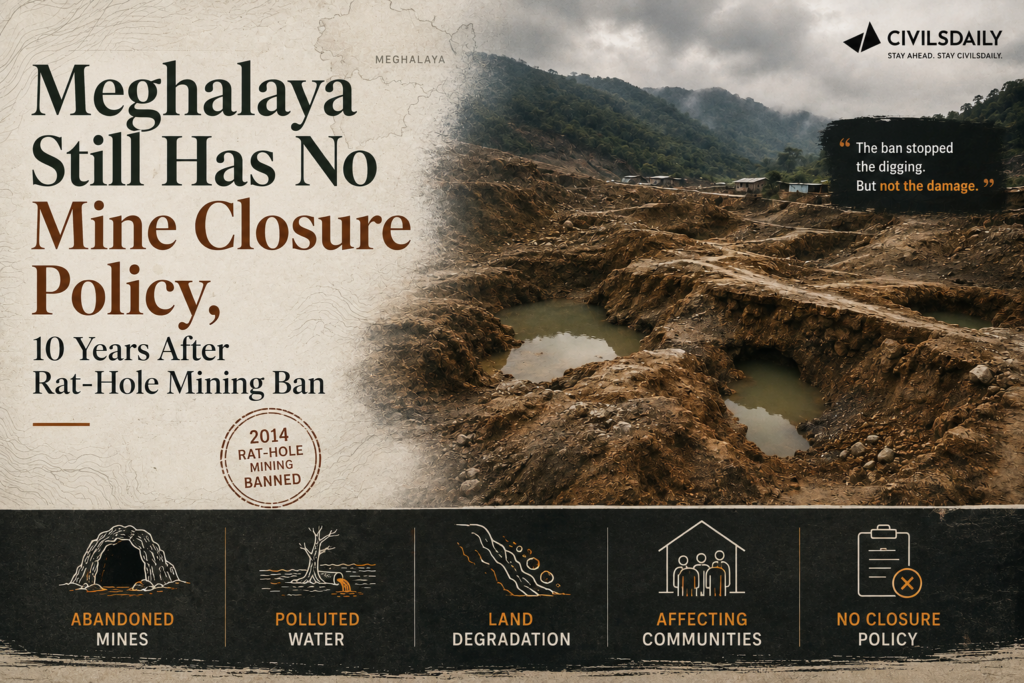
  • Meghalaya Still Has No Mine Closure Policy, 10 Years After Rat-Hole Mining Ban

    Why in the News

    The 39th interim report of the Justice B.P. Katakey Committee has flagged Meghalaya’s failure to adopt a comprehensive policy for closing and fencing abandoned rat-hole coal mines. The issue has shifted from merely stopping illegal extraction to managing the dangerous legacy of thousands of abandoned mine pits.

    What is Rat-Hole Mining?

    • A manual coal mining method involving a vertical pit and narrow horizontal tunnels.
    • Tunnels may extend 150 to 300 metres underground.
    • Side cutting: Tunnels follow exposed coal seams along hill slopes.
    • Box cutting: A vertical pit is dug first, followed by horizontal tunnels.
    • Meghalaya’s thin coal seams made this method economically attractive.

    Why is Meghalaya’s Mine Closure Issue Important?

    • The NGT banned rat-hole coal mining in April 2014.
    • The Supreme Court in 2019 upheld the prohibition and held that the MMDR Act, 1957 applies to Meghalaya.
    • Thousands of abandoned pits remain uncovered and unfenced, creating risks to people and livestock.
    • East Jaintia Hills alone is reported to have around 60,000 mines across 360 villages.
    • Sulphur-rich coal contributes to acid mine drainage, affecting rivers such as the Lukha and Myntdu.

    What is Mine Closure?

    Mine closure means planned decommissioning of a mine after extraction, including:

    • Sealing and fencing mine openings
    • Backfilling and slope stabilisation
    • Land restoration
    • Water treatment
    • Revegetation
    • Post-closure monitoring

    Indian mining regulations provide for both progressive closure during the life of a mine and final closure after mining ends. Financial assurance is maintained through an escrow mechanism for eligible mines.

    Why is Meghalaya Different?

    Meghalaya comes under the Sixth Schedule. Land and mineral resources are substantially associated with private and community ownership, creating a distinct governance framework compared with conventional state-leased mining.

    Constitutional provisions to remember

    • Article 244(2): Administration of tribal areas under the Sixth Schedule.
    • Entry 23, State List: Regulation of mines and mineral development, subject to Entry 54.
    • Entry 54, Union List: Union regulation of mines and mineral development when Parliament declares it in public interest.
    • Article 21: Right to life includes the right to a clean and healthy environment.
    • Article 48A: State duty to protect the environment.
    • Article 51A(g): Fundamental duty to protect the environment.

    Important Laws and Institutions

    • MMDR Act, 1957: Parent legislation governing mineral concessions, leases and mining regulation.
    • Mineral Conservation and Development Rules, 2017: Provide for progressive and final mine closure plans and financial assurance.
    • Mines Act, 1952: Deals with health, safety and working conditions in mines. The Directorate General of Mines Safety (DGMS) is the safety regulator.
    • National Green Tribunal Act, 2010: Created the National Green Tribunal (NGT), a specialised statutory environmental tribunal. Its 2014 order banned rat-hole mining in Meghalaya.
    • District Mineral Foundation: A non-profit trust in mining districts, funded through a levy on mining lessees, for the benefit of communities affected by mining.

    “[2025, GS3, 15 marks] Mineral resources are fundamental to the country economy and these are exploited by mining. Why is mining considered an environmental hazard? Explain the remedial measures required to reduce the environmental hazard due to mining.”

  • The 1946 Naval Mutiny That Shook British Rule in India

    Why in News

    The Royal Indian Navy (RIN) uprising began in Bombay on 18 February 1946 and spread to about 78 ships and 20 shore establishments, involving nearly 20,000 personnel. It demonstrated that British India’s armed forces could no longer be relied upon to suppress nationalist resistance.

    Causes

    • Poor food, living conditions and service grievances
    • Racial discrimination by British officers
    • Post-war demobilisation and loss of status
    • Anger over the INA trials
    • Abuse of sailors by Commander Arthur Frederick King.

    Demands

    • Action against Commander King
    • Better pay, food and service conditions
    • Withdrawal of Indian troops from Indonesia
    • Free trials for INA detainees.

    Spread & Suppression

    • Involved 78 ships + 20 shore establishments
    • Spread to Mumbai and Karachi, with civilian support
    • Strikers seized Butcher Island and removed British flags
    • Police firing in Bombay on 22 February killed at least 400 people, with estimates ranging higher.

    Significance

    • Air Force and Army units also showed mutinous conduct
    • British realised Indian forces might not obey orders to suppress Indians
    • Thus, the uprising hastened the transfer of power
    • Often described by naval historians as the “last war of independence.”

    Key Facts

    • 18-23 February 1946: Uprising
    • M.S. Khan: Naval Central Strike Committee president
    • Madan Singh: Vice-president
    • 23 February: Strikers surrendered
    • 2001: Memorial unveiled at Colaba, Mumbai
    • Butcher Island: Now Jawahar Dweep.

    “[2014, GS1, 10 marks] In what ways did the naval mutiny prove to be the last nail in the coffin of British colonial aspirations in India?”

    [2017] With reference to Indian freedom struggle, consider the following events :
    1. Mutiny in Royal Indian Navy
    2. Quit India Movement launched
    3. Second Round Table Conference

    What is the correct chronological sequence of the above events ?

    (a) 1-2-3

    (b) 2-1-3

    (c) 3-2-1

    (d) 3-1-2

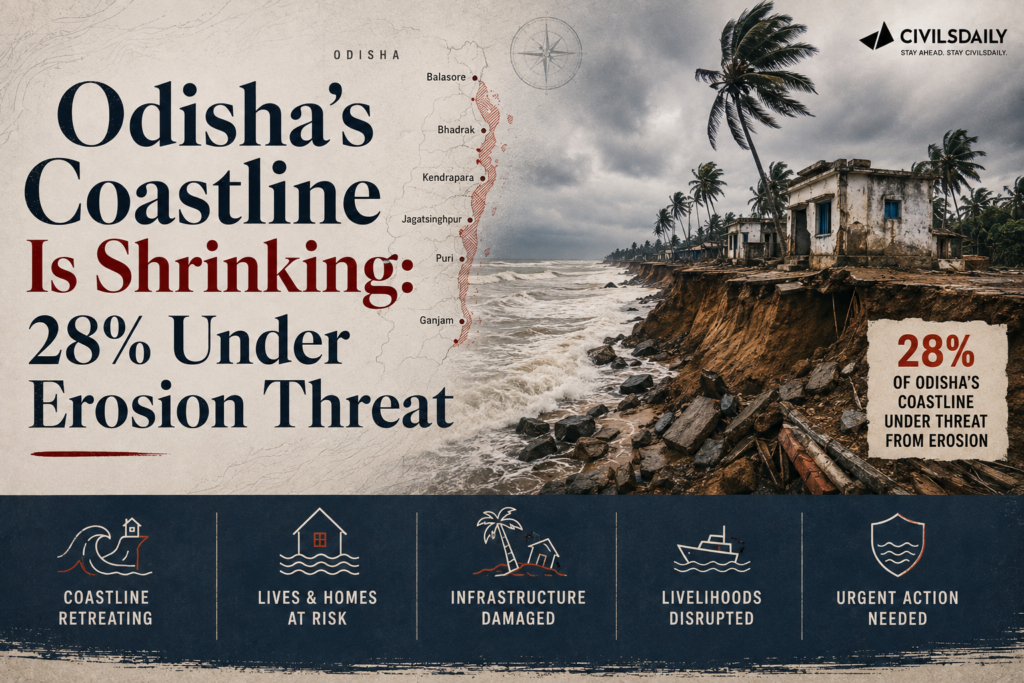
  • Odisha’s Coastline Is Shrinking: 28% Under Erosion Threat

    Why in the News

    A reply tabled in the Rajya Sabha by the Union Minister for Ports, Shipping and Waterways stated that about 28.3 percent of Odisha’s 564 km coastline is undergoing erosion. The figure sits alongside a second one that complicates it, since 54.1 percent of the same coastline is gaining land, which means the state faces not a uniformly retreating coast but a redistribution of sand that destroys some villages while building others.

    What is a geotextile tube embankment?

    1. About: A geotextile tube is a large cylindrical container fabricated from high strength, porous synthetic fabric and filled with a sand slurry to form an artificial coastal structure.
    2. Material: The fabric is a woven synthetic such as polypropylene, which retains the sand fill while allowing water to drain out through the pores.
    3. Function: Rows of such tubes are laid to form a sea wall that absorbs the impact of incoming waves at the shoreline. The energy loss at the structure reduces the scouring of the beach behind it.
    4. Deployment in Odisha: One such embankment is being developed at Pentha village in Kendrapara district, one of the worst affected stretches of the Odisha coast.
    5. Why it is preferred: The tubes are filled with locally dredged sand rather than imported rock armour, which lowers cost and allows the structure to settle with the seabed.

    What is shoreline change?

    1. About: Shoreline change is the dynamic process in which the boundary between land and water shifts over time.
    2. Drivers: The shift is produced by natural forces such as waves, tides and storms, and by human activity such as port construction and sand mining.

    What is coastal accretion?

    1. About: Accretion is the seaward growth of the shoreline when sediment carried by waves and currents is deposited faster than it is removed.
    2. Why it matters: A coastline can record accretion in aggregate while individual stretches erode, because the same longshore current that starves one beach feeds another.

    What is the National Centre for Coastal Research?

    1. About: The National Centre for Coastal Research (NCCR) is the national institution that monitors long term shoreline change across the Indian coastline.
    2. The Odisha study: It carried out a comprehensive assessment and mapping of shoreline change analysis along the Odisha coast from 1990 to 2022, and identified several stretches in the affected districts as vulnerable stretches.

    How does erosion vary across Odisha’s six coastal districts?

    1. The state level split: Of the 564 km coastline, 28.3 percent is eroding, 17.6 percent is stable with no significant shoreline change, and 54.1 percent is undergoing accretion.
    2. Jagatsinghpur: The most erosion prone district, with 47.6 percent of its 55.8 km coastline facing erosion.
    3. Ganjam: Erosion affects 45.7 percent of its 60.18 km shoreline.
    4. Kendrapara: Erosion affects 45 percent of its 149.36 km shoreline, the longest coastline among the six districts.
    5. Balasore: Erosion affects 23.8 percent of its 88 km coastline.
    6. Puri: Erosion affects 10.2 percent of its 138 km coastline.
    7. Bhadrak: Erosion affects 4.6 percent of its 72 km coastline, the lowest share among the six.

    What drives shoreline change along the Odisha coast?

    1. Natural marine forces: Waves, tides and storms continuously redistribute sediment along the coast.
    2. Coastal structures: A 2021 study on shoreline change along the Odisha coast, published in the Journal of Earth System Science, records that sea walls, breakwaters and jetties modify both the shoreline and the beach morphology.
    3. Ports and harbours: The effect is more significant where hard structures are raised for port and harbour development, which interrupts the longshore movement of sand.
    4. Extreme events: Tsunamis and cyclonic storms produce drastic shoreline changes, and Odisha is the most cyclone prone state along the Indian coast.
    5. Human extraction and construction: Sand mining and unplanned infrastructure development along the coast remove or block sediment supply.
    6. Sea level rise: Global sea level rise driven by climate change adds a permanent upward baseline to every storm surge and tidal cycle.

    What has coastal erosion already cost Odisha’s communities?

    1. Villages lost in Kendrapara: Rising sea level and coastal erosion have already submerged 16 villages in Kendrapara district, displacing several hundred people.
    2. Loss beyond land: The affected villagers lost not only their land but also their livelihoods, since fishing and cultivation both depend on proximity to the lost shoreline.
    3. Podampeta in Ganjam: A village of nearly 500 households has been deserted as the sea swept inland.
    4. Ramayapatna and other settlements: Several other coastal villages in Ganjam are witnessing the sea advance towards the landmass, rendering residents homeless.

    What measures has Odisha taken to protect its coast?

    1. Geotextile tube embankment: A geotextile tube sea wall is being developed at Pentha in Kendrapara to absorb wave impact on one of the most exposed stretches.
    2. Sea wall cum service roads: These are being developed across parts of Balasore district and at Ramayapatna beach in Ganjam.
    3. How the dual structure works: The outer tier acts as a defensive barrier against strong tidal waves and erosion. The inner tier operates as a service road for local transport and public access.
    4. Planned relocation: The state has developed a resettlement colony, described as India’s first climate resettlement colony, to accommodate people displaced by coastal erosion.
    5. Vulnerability mapping: The NCCR has identified specific vulnerable stretches within the six districts on the basis of long term shoreline analysis, which allows protection works to be prioritised.

    “[2022, GS3, 15 marks] Explain the causes and effects of coastal erosion in India. What are the available coastal management techniques for combating the hazard?”