Termed in a moment of hubris by present government as ‘“a living monument of UPA’s failures”, the government has fallen back on this Scheme in this moment of crisis. This piece is an attempt to understand the silent success of the Mahatma Gandhi National Rural Employment Guarantee Act (MGNREGA) which was allegedly dying a slow death.

Context
Due to the sudden lockdown and resultant job losses, over 1 crore people have returned to their homes, some walking hundreds of kilometres, others using all conceivable means of transport. A sizeable number may take several months to return to the cities and towns to earn a living. This extraordinary scenario of a pandemic poses a formidable challenge for the governments of the ‘home states’ to arrange suitable job opportunities for securing their livelihoods.
In this bleak scenario, MGNREGA is providing a ray of hope.
The mighty MGNREGA

- The MGNREGA stands for Mahatma Gandhi National Rural Employment Guarantee Act of 2005.
- This is labour law and social security measure that aims to guarantee the ‘Right to Work’.
- The act was first proposed in 1991 by P.V. Narasimha Rao.
The objectives of the MGNREGA are:
- To enhance the livelihood security of the rural poor by generating wage employment opportunities.
- To create a rural asset base which would enhance productive ways of employment, augment and sustain a rural household income.
Anyways, what is so Unique about it?
- MGNREGA is unique in not only ensuring at least 100 days of employment to the willing unskilled workers, but also in ensuring an enforceable commitment on the implementing machinery i.e., the State Governments, and providing a bargaining power to the labourers.
- The failure of provision for employment within 15 days of the receipt of job application from a prospective household will result in the payment of unemployment allowance to the job seekers.
- Employment is to be provided within 5 km of an applicant’s residence, and minimum wages are to be paid.
- Thus, employment under MGNREGA is a legal entitlement.
Constitutional goals of MGNREGA: The idealistic edge
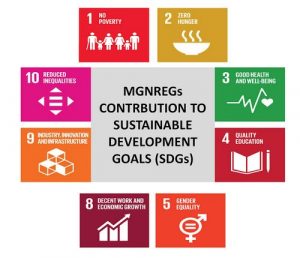
1) Implementation of DPSP
- The MGNREGA aims to follow the DPSPs enunciated in Part IV of the Constitution of India.
- The law by providing a ‘right to work’ is consistent with Article 41 that directs the State to secure to all citizens the right to work.
- The statute also seeks to protect the environment through rural works which is consistent with Article 48A that directs the State to protect the environment.
- It also follows Article 46 that requires the State to promote the interests of and work for the economic uplift of the SCs and STs and protect them from discrimination and exploitation.
- Article 40 mandates the State to organise village panchayats and endow them with such powers and authority as may be necessary to enable them to function as units of self-government.
- Conferring the primary responsibility of implementation on Gram Panchayats, the Act adheres to this constitutional principle.
2) Implementation of FRs
- In accordance with the Article 21 of the Constitution of India that guarantees the right to life with dignity to every citizen of India, this act imparts dignity to the rural people through an assurance of livelihood security.
- The FRs enshrined in Article 16 of the Constitution of India guarantees equality of opportunity in matters of public employment.
The REAL Issues crippling MGNREGA

On ground, policies and schemes do depart from their idealistic purposes. Go through these Issues to understand HOW?
1) Insufficient budgetary allocations – No Money!
- MGNREGA’s success at the ground level is subject to proper and uninterrupted fund flow to the states.
- Increase in the nominal budget but actual budget (after adjusting inflation) decreased over the years.
- Rs 61,500 crore has been allocated for the MGNREGA for the year 2020-21, down by more than 13 per cent from the total estimated expenditure for 2019-20 which was at Rs 71,001.81 crore.
2) Approved Labour Budget Constraints
- The Centre through the arbitrary “Approved Labour Budget” has reduced the number of days of work and put a cap on funds through the National Electronic Fund Management System
- According to Ne-FMS guidelines, states won’t be allowed to generate employment above the limits agreed by Approved labour Budget.
3) Not so attractive wages rate
- Currently, MGNREGA wage rates of 17 states are less than the corresponding state minimum wages.
- The ridiculously low wage rates have resulted in a lack of interest among workers in working for MGNREGA schemes, making way for contractors and middlemen to take control, locally.
4) Delay in wage (Not so attractive) payments
- Under the MGNREGA, a worker is entitled to get his or her due wages within a fortnight of completion of work, failing which the worker is entitled to the compensation.
- As of 2016-17, the total amount of wage pending is Rs. 11000 crore.
- Even the Gram Rozgar Sevak, who is the backbone of the entire scheme, who works part-time, living in the same village, does not get paid on time.
5) No-work situations are rising
- None of the states was able to provide full 100 days employment as mentioned in the scheme.
- Even though the scheme aims at providing 100 days of guaranteed employment, below 50 days of employment was actually provided an average at an all-India level in FY 18.
6) Data manipulations by authorities
- A recent study has found that data manipulation in the MGNREGA is leading to gross violations in its implementation.
- Numerous ground reports across the country suggest that because of a funds crunch, field functionaries do not even enter the work demanded by labourers in the MGNREGA database.
7) Non-purposive spending and corruptions
- Many works sanctioned under MGNREGA often seem to be non-purposive.
- Quite often, they are politically motivated hotspots to create rampant corruption by dominant sections of the local population.
- Even social audits of such projects are locally manipulated.
8) Workers penalized for administrative lapses
- The ministry withholds wage payments for workers of states that do not meet administrative requirements within the stipulated time period (for instance, submission of the previous financial year’s audited fund statements, utilization certificates, bank reconciliation certificates etc).
- There is no logical or legal explanation for this bizarre arrangement. It is beyond any logic as to why workers would be penalized for administrative lapses.
9) Genuine job cards being deleted
- Genuine job cards are being randomly deleted as there is a huge administrative pressure to meet 100 per cent DBT implementation targets in MGNREGA.
- In states like Jharkhand, there are multiple examples where the districts had later requested to resume job cards after civil society interventions into the matter.
10) Too much centralization weakening local governance
- A real-time MIS-based implementation and a centralised payment system has further left the representatives of the Panchayati Raj Institutions with literally no role in implementation.
- It has become a burden as they hardly have any power to resolve issues or make payments.
11) Local priorities being ignored
- MGNREGA could be a tool to establish decentralized governance. But, with the administration almost dictating its implementation, it is literally a burden now for the people and especially for the local elected representatives.
- The Gram Sabhas and gram panchayats’ plans are never honoured. This is a blatant violation of the Act as well.
Dark Knight Rises: MGNREGA in times of COVID

Within days, India has realized, political friend and foe alike, right-wing egotist and left-wing activist alike, that the world’s largest social welfare scheme, operationalised by UPA 1 in 2006 is a rare lifeline, almost as if designed for times of extreme adversity.
The importance of the MGNREGA scheme is now accepted by one and all. No wonder that with its hands tied due to Covid-19 crisis the state governments are struggling to ensure remunerative work in villages for the large workforce.
The central government, too, after considering all options and in order to provide job support to the large workforce which has or is reaching native villages, has acted rationally and announced another Rs 40,000 crore allocation for the MGNREGA scheme.

Highest registrations
- MGNREGA data shows that job demand this May was the highest in eight years even as all the data for May is still pouring in.
- Over 45 crore person days have been generated (2.63 crore households and 3.6 crore individuals have worked) in the 45 days of 2020-21 since works began on April 20.
- Traditionally, the months of May and June have always witnessed the highest NREGA work demand because is the lean agriculture season after Rabi harvest and before Kharif sowing.
Only viable option available
- MGNREGA appears to be the primary hope of sustaining livelihood in almost all states the during a time of massive reverse migration due to the lockdown imposed in light of COVID-19.
- MGNREGA is the only viable option at present to provide relief and work to the labourers.
Some innovation in MGNREGA that can go a long way
1) Looping in the skilled worker
- First, there is a suggestion to use it to meet the wage cost of their employment in small and medium enterprises (SMEs).
- Accordingly, skilled migrant workers may be placed in SMEs and their wages would be charged to MGNREGA.
2) Including farm related works
- In the last few years, un-remunerative prices of several crops have been the root cause of widespread agrarian distress.
- The suggestion is to allow farmers to employ MGNREGA workers in agricultural operations like land preparation, sowing, transplantation of paddy, plucking of cotton, intercultural operations and harvesting of crops etc. so as to reduce the cost of cultivation.
- The idea is to pay part of the wages of labour in agricultural operations from MGNREGA.
3) Increasing the number of Work Schemes
- Currently, there are only 2-3 work schemes (say PMAY) running per panchayat, which is leading to the crowding of workers at worksites.
- To prevent this and to ensure that all willing households are able to access employment through NREGA, the number of schemes needs to be increased, and 6-8 schemes must be introduced in each village.
4) Paying Workers Immediately
- Rural households urgently need cash-in-hand, and so the emerging demand is for immediate payment to workers. NREGA payments are frequently delayed by weeks or months.
- Given the circumstances, such delays will be entirely counterproductive.
- It is recommended that in remote areas, wage payments should be made in cash, and paid on the same day.
5) Modify Daily Workloads
- In compliance with COVID-19 guidelines, workers are wearing masks and other forms of face protection.
- NREGA works typically involve hard physical labour and workers are finding it challenging to breathe comfortably while working.
- Consequently, for as long as workers are required to wear masks, the daily volume of work assigned to them must be reduced.
6) By increasing Wages
- If NREGA wages are to effectively support rural households as they cope with this crisis, they must, at a minimum, be at par with states’ agricultural wages.
- For example, the Government of Odisha has increased the daily-wage rate for unskilled manual work under NREGA to INR 298 per day in its 20 migration-prone blocks.
7) Increase budgetary allocations
- The central government’s budgetary allocation of INR 61,500 crore to NREGA for FY 2020-21 is inadequate..
- An additional Rs 1 lakh crore needs to be allocated so that NREGA can act as a safety net and help rural households cope with the devastating impact of the lockdown.
Way Forward
- Large scale social security programmes like MGNREA are subjected to undergo several stumbling blocks in the times of ongoing pandemic.
- Government and NGOs must study the impact of MGNREGA in rural areas so as to ensure that this massive anti-poverty scheme is not getting diluted from its actual path.
- Since the adverse impact of the COVID-19 pandemic on employment is going to persist in 2020-21, government can ensure more effective implementation and strengthening of the oversight of MGNREGA through mandated social audit.
- The scheme is not only an ocean of possibilities for the jobless migrants, but it has also given the Central government a chance to get a second bite at the cherry after the devastating economic and job creation figures now officially out for FY 2019-20.
At this point in time what is needed is neither dismantling of the programme nor its slow suffocation.
Conclusion
This week the entire nation saw how teachers in Jaipur started working as MGNREGA labourers amid the pandemic. Unfortunate and not to be celebrated, it nevertheless underlines the importance of MGNREGA as a ray of hope amidst extreme darkness.
This article has attempted to convey the transformative power of MGNREGA, particularly at a time of economic stress.
To be clear, MGNREGA cannot substitute deeper and systemic efforts to generate jobs; nor can it address structural weaknesses in the economy. The need of the hour is for the Government to place MGNREGA at the heart of its strategy to tackle this economic emergency.
The Economic Survey of 2019-20 suggested that MGNREGA offers an early warning signal to detect rural distress. We can help by changing the narrative that has for too long maligned MGNREGA.
We must view MGNREGA as an opportunity and explicitly include it in a broad-based strategy to tackle the current economic crisis.
Think!
If the idea is to provide work to anybody demanding it, there should, in principle, be no restrictions on the kind of activities allowed under this scheme. If higher material component helps in building more assets with durable quality, why cannot these projects qualify under the MGNREGA? Why tie it down to particular “permitted works”? What stops MGNREGA labour from being used even to undertake railway or national highway work?
References
https://thewire.in/government/mgnrega-wage-payment-delays
https://www.theindiaforum.in/article/continuing-relevance-mgnrega
https://www.downtoearth.org.in/blog/economy/mgnrega-is-failing-10-reasons-why-62035
https://thewire.in/economy/mgnrega-rural-india-farmers
https://indianexpress.com/article/opinion/editorials/mgnrega-demand-rural-labours-migrant-workers-coronavirus-6441371/
https://www.thequint.com/news/india/how-nrega-can-help-rural-areas-in-times-of-covid-19-distress


