💥Join UPSC 2027,2028 Mentorship (July Batch) + XFactor Notes & Microthemes PDF

Distribution: yearly

  • Indian start-up joins Sodium Ion Battery Innovation

    sodium ion battery

    Central Idea

    • Coimbatore-based start-up AR4 Tech has joined hands with Singapore’s Sodion Energy to revolutionize the energy storage landscape by producing sodium-ion battery packs for both local and global markets.
    • These sodium-ion batteries will find applications in converting conventional petroleum-based vehicles, primarily two-wheelers, into electric vehicles.

    What is Sodium Ion Battery (NIB)?

    • A NIB is a type of rechargeable battery that uses sodium ions as the charge carriers to store and release electrical energy.
    • Similar in principle to lithium-ion batteries, sodium-ion batteries offer an alternative energy storage solution with potential benefits such as cost-effectiveness and abundance of sodium resources.

    Key characteristics  

    • Working Principle: Sodium-ion batteries operate on the same basic principle as lithium-ion batteries. During charging, sodium ions are moved from the positive electrode (cathode) to the negative electrode (anode), and during discharge, they move back to the cathode, generating electrical energy in the process.
    • Sodium Anode: In a sodium-ion battery, the anode typically consists of materials that can intercalate (absorb) sodium ions during charging. Graphite and other carbon-based materials are commonly used for the anode in sodium-ion batteries.
    • Cathode Materials: Various materials can be used as cathodes in sodium-ion batteries, such as transition metal oxides or polyanionic compounds. These cathode materials allow sodium ions to be stored and released, enabling the battery’s energy storage function.
    • Electrolyte: The electrolyte in a sodium-ion battery is responsible for facilitating the movement of sodium ions between the anode and cathode during charge and discharge cycles. Sodium-ion batteries typically use a solid electrolyte or a liquid electrolyte containing sodium salts.

    Advantages offered

    • Abundance of Resources: Sodium is more abundant and widely available than lithium, which can potentially make sodium-ion batteries more cost-effective.
    • Environmental Impact: They may have a lower environmental impact compared to lithium-ion batteries due to the more widespread availability of sodium resources.

    Challenges

    • Energy Density: Sodium-ion batteries generally have lower energy density compared to lithium-ion batteries, which can limit their use in applications requiring high energy storage capacity.
    • Cycle Life: Ensuring a long cycle life (the number of charge and discharge cycles a battery can go through before losing capacity) remains a challenge for sodium-ion batteries.
  • Fukushima Water Release: Facts and Controversies

    Fukushima

    Central Idea

    • Japan’s decision to release cooling water from the Fukushima nuclear power plant into the Pacific Ocean has sparked a complex debate.
    • Amidst concerns about radiation, environmental impact, and transparency, understanding the facts is vital.

    About Fukushima Disaster

    • The Fukushima disaster refers to a series of nuclear incidents that occurred at the Fukushima Daiichi Nuclear Power Plant in Okuma, Fukushima Prefecture, Japan.
    • It followed the powerful earthquake and tsunami that struck on March 11, 2011.
    • The disaster resulted in the release of radioactive materials and had significant implications for both human health and the environment.
    • It is considered one of the most severe nuclear accidents in history, alongside the Chernobyl disaster.

    Why Fukushima Water is Being Released?

    • Storage Constraints: The Fukushima facility’s storage tanks are at full capacity due to the need for constant cooling of damaged reactors since the 2011 tsunami disaster.
    • Vast Water Volume: The plant requires 170 tons of cooling water daily, with rain and groundwater further exacerbating the issue. The site holds 1,343 million cubic meters of water across 1,046 storage tanks.
    • Release Process: Filtered water undergoes a one-kilometre tunnel before entering the Pacific Ocean. This process is expected to span 30 years while the radioactive waste remains on land.

    Regulatory Approval and Skepticism

    • Regulatory Endorsement: Both Japan’s atomic agency and the International Atomic Energy Agency (IAEA) have approved the release, stating negligible radiological impact.
    • Skepticism and Concerns: Environmentalists, fishing experts, neighbouring states, and public sentiments accuse Japan of underplaying radiation levels. Concerns encompass ocean contamination, ecological harm, economic loss, and damage to reputation.

    Water Preparation and Tritium

    • Filter System: Contaminated water passes through the Advanced Liquid Processing System (ALPS), capable of filtering 62 radioactive elements but not tritium.
    • Tritium Dilution: The plant agency intends to dilute tritium concentration to 1,500 Becquerel per liter, a fraction of the safety standard, before releasing it.
    • Tritium Safety: Experts assert that tritium, a weak radioactive form of hydrogen, poses minimal risk as it emits weak beta particles, easily blocked by materials like plastic or skin.

    Pacific Ocean’s Role and Controversy

    • Dilution Principle: Experts stress that “the solution to pollution is dilution.” When water is sufficiently diluted, it becomes safe for both humans and the environment.
    • Tritium Focus and Critique: Greenpeace accuses the government and plant agency of focusing on tritium to divert attention from other radioactive elements that won’t be filtered out.
    • Alternatives and Considerations: Alternatives like additional tanks or evaporation exist. However, concerns over tank leaks and airborne radioactive releases complicate these options.

    Conclusion

    • The Fukushima water release debate presents a complex array of scientific, environmental, and geopolitical considerations.
    • Striking a balance between environmental preservation, public safety, and responsible nuclear waste management remains a challenging task.
    • As experts, activists, and governments deliberate, it’s essential to foster transparency, prioritize informed discussions, and seek solutions that minimize risks and promote global well-being.
  • India and the Northern Sea Route

    Northern Sea Route

    Central Idea

    • Murmansk, the gateway to the Arctic and the starting point of the Northern Sea Route (NSR), is witnessing a growing Indian presence in cargo traffic.

    Why discuss this?

    • India accounts for 35% of the cargo handled by the Murmansk port in the first seven months of 2023.
    • This surge in Indian engagement in the Arctic holds significant implications for India’s economic and water security.

    About Northern Sea Route

    • The Northern Sea Route (NSR) is a maritime shipping route that runs along the northern coast of Russia, connecting the Atlantic Ocean to the Pacific Ocean.
      • The North Sea lies between Great Britain, Denmark, Norway, Germany, the Netherlands, Belgium and France.
    • It traverses the Arctic Ocean and Siberian coastline, providing a shorter route between Europe and Asia compared to the traditional routes through the Suez Canal or the Panama Canal.
    • NSR stretches from the Barents Sea, near the Arctic archipelago of Novaya Zemlya, to the Bering Strait, separating Russia from Alaska

    Significance of the Arctic for India

    • Climate Impact: The Arctic’s susceptibility to climate change holds potential consequences for India, impacting economic and water security.
    • Resource Prospects: The Arctic region harbors substantial untapped hydrocarbon reserves, including oil, gas, coal, zinc, and silver, making it an enticing prospect for India’s energy needs.
    • Sustainable Approach: India’s Arctic Policy of 2022 underscores adherence to UN Sustainable Development Goals in the region’s economic development.

    India’s Arctic Journey

    • Historical Engagement: India’s connection with the Arctic dates back to the signing of the Svalbard Treaty in 1920.
    • Scientific Endeavors: India has undertaken various scientific studies and research initiatives in the Arctic, including atmospheric, marine, and glaciological studies.
    • Observations and Research: Notably, India’s research station “Himadri” in Ny-Alesund and its multi-sensor moored observatory and atmospheric laboratory demonstrate its commitment to Arctic research.

    Reviving the NSR

    • NSR Overview: The NSR is the shortest shipping route connecting Europe and Asia-Pacific countries, traversing the Arctic Ocean.
    • Distance Advantage: The NSR boasts potential distance savings of up to 50% compared to traditional routes via Suez or Panama, gaining prominence after the 2021 Suez Canal blockage.
    • Russia’s Role: Russia, equipped with a nuclear-powered icebreaker fleet, ensures safe navigation by breaking ice along the NSR.

    Drivers for India’s NSR Engagement

    • Cargo Traffic Growth: India’s involvement is fueled by the consistent rise in cargo traffic along the NSR, coupled with a 73% growth rate between 2018-2022.
    • Energy Imports: As India increasingly imports energy resources from Russia, the NSR offers a reliable and secure transportation avenue.
    • Strategic Transit: The Chennai-Vladivostok Maritime Corridor (CVMC) project aligns with India’s geographical position, enabling efficient transit routes and shorter transport times.

    Conclusion

    • India’s burgeoning involvement in the Arctic, underscored by its significant role in the Northern Sea Route’s cargo traffic, exemplifies its strategic pursuit of diversified energy resources and enhanced trade corridors.
    • As India forges partnerships with Russia and navigates the challenges of a changing Arctic landscape, it’s poised to play a pivotal role in shaping the future of Arctic trade and sustainable development.
  • BRICS inducts 6 new members to become BRICS Plus

    brics plus

    Central Idea

    • The BRICS alliance, consisting of Brazil, Russia, India, China, and South Africa, has extended invitations to six additional countries, namely Iran, the United Arab Emirates, Saudi Arabia, Argentina, Egypt, and Ethiopia.
    • This move aims to bolster the collective voice of the Global South and foster multipolarity in the international arena.

    Why discuss this?

    • As BRICS broadens its membership, it strengthens its claim to represent nearly half the world’s population and includes key oil-producing nations.
    • However, concerns also arise regarding China’s increasing influence within the alliance.

    BRICS Plus: Emerging Role

    • Heft and Influence: The inclusion of new members enhances BRICS’s position as a spokesperson for the developing world. The alliance currently represents 40% of the global population and over a quarter of the world’s GDP. With the addition of new members, it will encompass almost half the world’s population and include major oil-producing nations.
    • Global Solidarity: BRICS’s growth is driven by anti-US sentiment and a desire for multipolarity among countries in the Global South. It serves as a platform where nations can express solidarity and challenge Western-dominated narratives.

    BRICS: Evolution and Geopolitical Context

    • Emergence of BRICS: Established in 2009, BRICS initially comprised Brazil, Russia, India, and China, with South Africa joining in 2011. The alliance aimed to showcase the economic potential of these emerging markets.
    • Challenges and Opportunities: While BRICS’s economic performance has varied, geopolitical shifts like the Ukraine conflict have propelled it into a bloc with the potential to challenge Western influence and provide an alternative viewpoint.

    Dynamics of New BRICS Members

    • Unanimous Decisions: BRICS decisions require unanimous agreement from all members. While Russia and China face geopolitical challenges with the West, Brazil, South Africa, and India maintain significant partnerships with the US and Europe.
    • China’s Role: China is driving BRICS’s expansion, making membership expansion a core agenda item.
    • Inclusion of Iran: China and Russia’s influence is evident in the inclusion of Iran, highlighting their collaboration. This move brings together regional rivals Saudi Arabia and Iran within the same alliance, reflecting China’s mediation efforts.
    • Saudi Arabia’s Shift: Saudi Arabia’s inclusion marks its pursuit of a more independent foreign policy, diverging from its traditional US alliance.
    • Global Significance for Iran and Russia: For Iran and Russia, BRICS membership signifies their global partnerships and challenges to Western dominance.

    Implications for India

    • Balancing Act: India’s participation in the G7 summit and Quad summit reflects its multifaceted foreign policy approach. While engaging with Western alliances, India also places importance on its “anti-Western” stance within BRICS.
    • BRICS as a Non-Western Bloc: India views BRICS as a “non-Western” group and strives to maintain its independent voice within the alliance.
    • Concerns for India: Amid expansion, there are concerns that BRICS could tilt more toward China, potentially side-lining India’s interests.

    Conclusion

    • BRICS’s expansion signifies a step toward global multipolarity, providing a platform for diverse countries to unite against Western-centric narratives.
    • As the alliance grows, it gains greater representation and influence, strengthening the collective voice of the Global South.
    • However, with China’s increased influence, there are also legitimate concerns about the balance of power within BRICS and its impact on individual member states.
  • K Kasturirangan explains: Chandrayaan-3 and India’s Evolving Space Ambitions

    Central Idea

    • The successful Chandrayaan-3 mission not only marks a significant achievement for India’s space program but also signifies the nation’s attainment of a pivotal capability: direct physical access to another celestial body.
    • This accomplishment propels India into an elite group of spacefaring nations and affords participation in shaping future planetary exploration endeavors and resource extraction from space.

    Who is Dr. K. Kasturirangan?

    • Dr. K. Kasturirangan is a prominent Indian space scientist and engineer.
    • He led ISRO as Chairman from 1994 to 2003, overseeing achievements like PSLV launches and Chandrayaan-1.
    • Chandrayaan-1, under his leadership, discovered water molecules on the Moon.
    • He’s been active in promoting science education and enhancing research quality.
    • Dr. Kasturirangan chaired the committee behind India’s NEP 2020, focusing on holistic education.
    • His accolades include Padma Shri and Padma Bhushan awards.
    • He’s been involved in international collaborations and represented India globally.
    • Besides leadership, he’s made academic contributions in space and atmospheric sciences.
    • His influence spans various positions in scientific and academic institutions.

    India’s Integration into Planetary Exploration and Decision-Making

    • Access to Celestial Bodies: Chandrayaan-3 provides India with a tangible gateway to planetary bodies, elevating its status in space exploration.
    • Frontiers of Technology: India’s pioneering capabilities place it at the forefront of space technology, enabling participation in shaping future planetary explorations and resource extraction policies.
    • A Seat at the Table: India’s involvement in this realm positions it naturally within the club of nations that influence and formulate space-related policies, ending a history of exclusion.

    Now, India’s stature in Global Space Dynamics

    • Historical Context: India’s past exclusion from technological clubs has driven its pursuit of self-reliance and global influence, transforming from a dependent to a self-sufficient nation.
    • Space Diplomacy: Space capabilities will play a pivotal role in shaping global equations in the 21st century, and India’s active participation will bolster its international standing.
    • Equitable Contributions: Chandrayaan-3 bolsters India’s potential to play a decisive role in space-related international decision-making, strengthening its voice on equal terms.

    Chandrayaan-3’s Significance for ISRO

    • Planetary Exploration Strategy: Chandrayaan-3 showcases ISRO’s comprehensive planetary exploration capabilities, encompassing satellite deployment, lunar orbits, surface study, and landing.
    • Direct Lunar Access: The mission grants India direct physical access to the Moon, offering new avenues for lunar exploration and resource utilization.
    • Kasturirangan’s Vision: The vision of Dr. K. Kasturirangan, former ISRO chairman, harmonizes with Sarabhai’s principles, building upon a foundation of technological self-sufficiency.
    • Progressive Continuation: ISRO’s pursuits of planetary exploration and Chandrayaan missions align with the trajectory Kasturirangan initiated, enhancing the nation’s profile on the global stage.

    Completing the Transformation: From Development to Exploration

    • Sequential Alignment: ISRO’s evolution from developmental needs to commercial launches and now to scientific and planetary exploration reflects its responsiveness to India’s evolving requirements.
    • Government Support: ISRO’s consistent success has been underpinned by unwavering government backing, which has enabled the organization to expand its horizons.
    • Strategic Role: Space technology’s growing influence necessitates robust capabilities, and ISRO’s achievements foster meaningful international partnerships, enhancing India’s global prestige.

    Conclusion

    • Chandrayaan-3 is more than a singular event; it signifies India’s ascendancy as a formidable force in space exploration.
    • As the nation transitions from a developing to a developed status, its capabilities to explore, innovate, and collaborate extend far beyond Earth’s boundaries.
    • Chandrayaan-3’s impact extends beyond the Moon’s surface, fostering diplomatic connections, winning allies, and amplifying India’s influence on the global stage under the visionary guidance of Dr. K. Kasturirangan.
  • Chandrayaan-3’s Success: Future Objectives

    Chandrayaan

    Central Idea

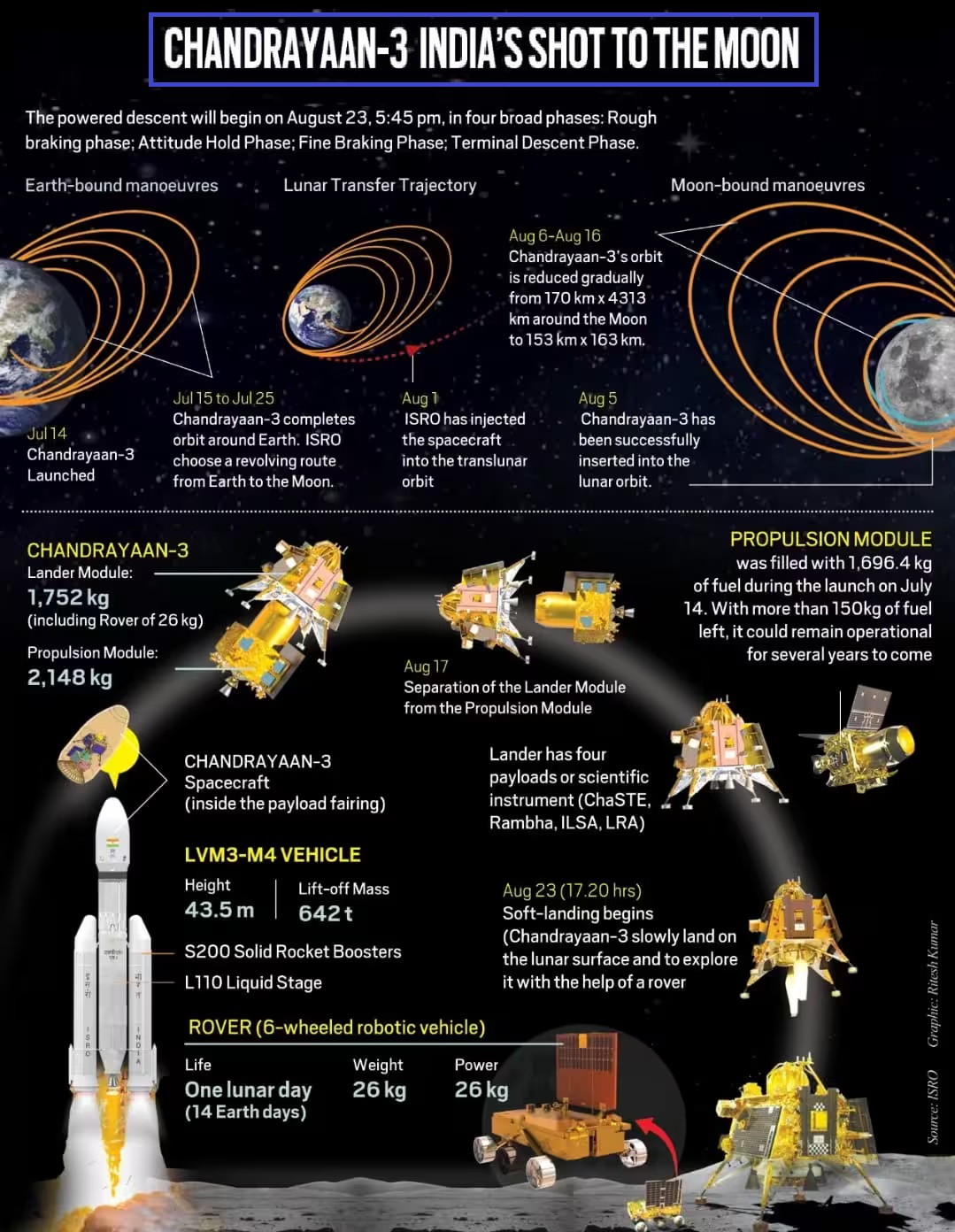
    • As Chandrayaan-3 succeeded on its lunar soft landing, its six-wheeled rover begins a journey to unravel the mysteries of the Moon.
    • With its payloads and instruments, the mission aims to build on the knowledge gained from its predecessors, investigating lunar quakes, mineral compositions, and water-ice presence.

    Chandrayaan-3 Mission: Journey post soft landing

    • Rover’s Arrival: The 26-kg rover, launched from the Chandrayaan-3 lander, is poised to cover up to 500 meters, commencing its lunar exploration.
    • Duration: The lander and rover, equipped with six payloads, are primed to collect valuable data during the single lunar day (equivalent to 14 Earth days) of operation.
    • Studying Lunar Quakes: The Chandrayaan-3 mission seeks to deepen insights into lunar quakes, expanding on the knowledge gained from its predecessors.
    • Mineral Composition: The rover’s endeavors include examining the mineral compositions of the Moon’s surface, shedding light on its geological history.
    • Electrons and Ions Study: The Radio Anatomy of Moon Bound Hypersensitive ionosphere and Atmosphere (RAMBHA) payload aims to study the behavior of electrons and ions near the lunar surface over time.
    • Thermal Properties: Chandra’s Surface Thermo physical Experiment (ChaSTE) will explore the thermal characteristics of the Moon’s Polar Regions.
    • Lunar Seismic Activity: The Instrument for Lunar Seismic Activity (ILSA) endeavors to measure lunar quakes and study the Moon’s crust and mantle composition.
    • Laser Retroreflector Array: A passive experiment by NASA, the LASER Retroreflector Array (LRA), will serve as a target for precise laser measurements in future missions.
    • Chemical Insights: The LASER Induced Breakdown Spectroscope (LIBS) aboard the rover is designed to identify the chemical and mineral composition of the lunar surface.
    • Elemental Analysis: The Alpha Particle X-ray Spectrometer (APXS) aims to analyze elements such as magnesium, aluminium, silicon, potassium, calcium, titanium, and iron in lunar soil and rocks.
    • Mineral Mapping: The CLASS X-ray Fluorescence experiment, covering nearly 95% of the lunar surface, offers detailed mineral mapping. Oxygen-rich minerals hold potential for future missions as fuel resources.

    Earlier Chandrayaan: Pioneering discoveries

    • Water Unveiled: Chandrayaan-1 played a pivotal role in uncovering the presence of water and hydroxyl molecules in the Moon’s atmosphere and surface, particularly in its southern polar regions.
    • Subsurface Water-Ice: Payloads like mini-SAR and Moon Mineralogy Mapper (M3) detected subsurface water-ice deposits within craters near the lunar South Pole.
    • Lava Tubes for Habitability: Terrain mapping on Chandrayaan-1 unveiled buried lava tubes that could provide protective habitats for humans, shielding against radiation and extreme lunar conditions.
    • Magma Ocean Hypothesis: M3 payload data suggested the possibility of a past magma ocean on the Moon, pointing to its formation and evolution.
    • Active Moon: Contrary to previous notions of lunar inactivity, Chandrayaan-1 revealed dynamic lunar processes, including volcanic activity evidenced by lava channels and vents less than 100 million years old.
    • Surface-Exosphere Interaction: Measurements indicated that the lunar surface interacts with the exosphere, evident in the emission of carbon dioxide and other gases.
    • Solar Mysteries: The Solar X-Ray Monitor on Chandrayaan-2’s orbiter observed solar microflares outside active regions, providing insights into coronal heating mysteries.

    Conclusion

    • Chandrayaan-3’s scientific journey exemplifies India’s dedication to unraveling the Moon’s mysterious nature.
    • As data pours in from its payloads and instruments, the mission builds upon its predecessors, propelling our understanding of lunar geology, composition, and mysteries.
  • Fujiwhara Effect: When cyclones dance

    fujiwhara

    Central Idea

    • In the ever-changing tapestry of Earth’s climate, the Fujiwhara effect has emerged as a captivating and consequential phenomenon.
    • With cyclones intensifying due to global warming, this intricate ‘dance’ between cyclones is garnering attention.

    Why in news?

    • Surprising Weather: Recently, a storm named Hurricane Hilary brought a tropical twist to the US west coast. It’s part of a series of odd weather happenings there.
    • Wet Weather: Earlier this year, California had an unexpected rainy season with lots of wet storms, called ‘atmospheric rivers.’
    • Fujiwhara Show: During one of these storms, something special occurred—an effect named after a scientist. Let’s dive into the details.

    Decoding the Fujiwhara Effect

    • Cyclone Waltz: Imagine two cyclones (or big storms) spinning in the same direction. When they get close, they begin a kind of dance around a common center.
    • Outcome of the Dance: Depending on the strength of the cyclones, they might merge, spin together, or one might absorb the other.
    • Super Cyclone: Rarely, if both cyclones are super strong, they can become one mega cyclone that causes big trouble.

    Historical Context and Impact

    • Origins and Discovery: The Fujiwhara effect got its name from a Japanese scientist who first talked about it in 1921. It was seen happening for real in 1964.
    • Effects Unleashed: This unusual dance can be fierce. It has caused strong winds, broken windows, and power problems in some areas.
    • Guessing Game: The Fujiwhara effect is tricky for weather experts. It’s hard to predict what will happen when two cyclones dance together.

    Climate Change Connection

    • More Frequent Moves: The Fujiwhara effect is showing up more often now. Experts believe it’s because our world is getting hotter and ocean waters are warming up.
    • Hotter Waters: Because of global warming, storms are getting stronger. For instance, in Taiwan, typhoons have become 35% stronger since 1977 due to warmer oceans.

    Implications

    • Nature’s Symphony: The Fujiwhara effect is like a nature’s concert, showing us how everything is connected in our climate.
    • Future Twist: As storms get more powerful, the Fujiwhara effect could become even more important and harder to understand.
    • Planet’s Dance: The Fujiwhara effect teaches us about our planet’s rhythm and how important it is to take care of our home.
  • Special Provisions of NE States under Article 371

    Central Idea

    • The Supreme Court recently assured that special constitutional provisions protecting the interests of northeastern states under Article 371 will remain untouched.
    • As the Constitution Bench deliberates the challenge to Article 370’s abrogation in Jammu and Kashmir, we delve into the significance of these assurances and their implications.

    What is Article 371?

    • Article 371 of the Indian Constitution grants special provisions to various states to protect their unique cultural and tribal identities.
    • These provisions are aimed at preserving local customs, social practices, and land ownership.

    Preserving Tribal Culture

    • Context: Article 371 provides special provisions for several states, particularly in the northeast, to safeguard their tribal cultures and unique identities.
    • Article 371(A) – Nagaland: Article 371(A) ensures that acts of Parliament do not apply to Nagaland concerning Nagas’ religious and social practices, customary law, civil and criminal justice based on Naga customary law, and land and resource ownership.
    • State Assembly’s Role: These provisions only apply to Nagaland after the State Assembly passes a resolution to that effect.
    • Development Impediment: Some stakeholders, like Neikiesalie Nicky Kire of the NDPP, argue that Article 371(A) hampers development by preventing the government from carrying out development activities due to landowner preferences.

    Similar Provisions in Other States

    • Article 371-G – Mizoram: Similar to Nagaland, Article 371-G provides special provisions for Mizoram to protect Mizo religious and social practices, customary law, civil and criminal justice, and land ownership.
    • Article 371B – Assam: Article 371B facilitates the creation of the sub-state ‘Meghalaya,’ aiming to provide special provisions with respect to Assam.

    State-Specific Provisions

    • Article 371C – Manipur: This article addresses special provisions for Manipur, a state that was formed in 1972.
    • Article 371F and 371H – Sikkim and Arunachal Pradesh: These articles discuss special provisions for Sikkim and Arunachal Pradesh, respectively, to address their unique needs.
    • Article 371 – Separate Development Boards: Article 371 empowers the President to establish separate development boards for specific regions within Maharashtra, Gujarat, and Andhra Pradesh, promoting balanced growth.

    Further State-Specific Provisions except NE

    • Articles 371D and 371E – Andhra Pradesh, Karnataka, Goa: These articles provide special provisions for these states to ensure their cultural and economic development.
    • Articles 371J and 371I – Karnataka and Goa: These articles grant special provisions to Karnataka and Goa, respectively, to address their specific requirements.
  • LCA Tejas successfully test-fires Astra BVR Air-to-Air Missile

    astra

    Central Idea

    • The Light Combat Aircraft (LCA) Tejas has achieved another milestone with the successful test firing of the indigenous Beyond Visual Range (BVR) air-to-air missile called Astra.

    Indigenous Marvel of Astra Missile

    • The Astra missile is an indigenous Beyond Visual Range (BVR) air-to-air missile developed by the Defence Research and Development Organisation (DRDO) of India.
    • The missile is intended for use by both the Indian Air Force (IAF) and the Indian Navy.

    Purpose and Capability

    • Astra is designed to engage and eliminate high-speed, agile aerial targets in air combat scenarios.
    • It boasts advanced air combat capabilities and can engage multiple high-performance targets simultaneously.

    Aircraft Integration

    • Astra is integrated with various aircraft platforms, including the Su-30MKI fighter jet, Mirage 2000 multi-role combat fighters, Tejas light combat aircraft (LCA), MiG-29 and MiG-21 Bison fighter jets, and the Indian Navy’s Sea Harrier jet fighter.

    Features and Specifications

    (A) Design:

    • The missile is designed for high agility, accuracy, and reliability, ensuring a high single-shot kill probability (SSKP).
    • Astra measures approximately 3.8 meters in length and has a diameter of 178mm.
    • It has a launch weight of around 160 kilograms.

    (B) Advanced Variants:

    • DRDO is working on developing an advanced variant called Astra Mk-II.
    • Astra Mk-II is expected to have an extended range of 160 kilometers.

    (C) Guidance and Warhead:

    • The missile utilizes dual-mode guidance for accurate target tracking.
    • It is equipped with a high-explosive pre-fragmented warhead for effective engagement against threats.

    (D) Propulsion and Performance:

    • The Astra missile is powered by a smokeless, single-stage, solid fuel propulsion system.
    • It is capable of achieving launch speeds ranging from Mach 0.4 to Mach 2.

    (E) Launch Range and Agility:

    • The missile’s launch range is approximately 80 kilometers.
    • It can execute maneuvers with up to 40 g turns near sea level while engaging moving targets.

    Collaborative Development

    • Astra Mk-III, a variant of the missile, is being developed in collaboration with Russia.
    • This variant employs advanced solid fuel ducted ramjet (SFDR) engine technology.

    Back2Basics: LCA Tejas

    lca

    • Origin: The LCA Tejas is an indigenous light combat aircraft developed by the Aeronautical Development Agency (ADA) in collaboration with the Hindustan Aeronautics Limited (HAL) in India.
    • Purpose: LCA Tejas is designed as a multi-role supersonic fighter aircraft for the Indian Air Force (IAF) and the Indian Navy.
    • Variants: There are two main variants of LCA Tejas:
    1. LCA Tejas Mark-I: Developed for the Indian Air Force, it is a single-seat, single-engine aircraft.
    2. LCA Tejas Mark-I Navy: Designed for the Indian Navy, it is adapted for carrier operations with features like reinforced landing gear and arrestor hook.
    • Design and Features:
    1. LCA Tejas features a delta wing design for enhanced maneuverability and stability.
    2. The aircraft incorporates advanced avionics, glass cockpit, and digital fly-by-wire controls.
    3. It is equipped with modern radar systems, electronic warfare systems, and weapons integration capabilities.
    • Powerplant: LCA Tejas is powered by a single engine, the General Electric F404-GE-IN20 turbofan engine.
    • Armament: The aircraft can carry a variety of air-to-air and air-to-ground munitions, including missiles, bombs, and rockets.
    • Performance:
    1. The aircraft has a maximum speed of around Mach 1.8 (1,390 mph or 2,240 km/h).
    2. Its operational range is approximately 500 kilometers (310 miles).
    3. LCA Tejas has a service ceiling of around 50,000 feet (15,240 meters).
    • Induction and Service:
    1. The LCA Tejas Mark-I was officially inducted into the Indian Air Force in July 2016.
    2. The aircraft has participated in various national and international airshows, showcasing its capabilities.
    • Development and Challenges:
    1. The development of LCA Tejas faced several challenges, including technical and financial issues, leading to delays.
    2. However, the successful development and induction of the aircraft marked a significant achievement for India’s aerospace industry.
  • India backs BRICS expansion: PM

    Central Idea

    • India, a key member of the BRICS group (Brazil-Russia-India-China-South Africa), has affirmed its endorsement for the bloc’s expansion based on consensus.

    BRICS Group

    Full Form Brazil, Russia, India, China, and South Africa
    Formation Originally “BRIC” in 2001, South Africa joined in 2010 to become BRICS
    Economic Significance Represents significant portion of global population, land area, and economic output
    Objectives Enhance cooperation, dialogue on political, economic, social issues
    Principles Mutual respect, equality, non-interference in internal affairs
    Summits Holds annual summits for leaders to discuss economic, trade, development issues
    Cooperation Areas Finance, trade, investment, technology, energy, agriculture, health, education
    New Development Bank (NDB) Established in 2014, finances infrastructure and sustainable projects
    Contingent Reserve Arrangement (CRA) Established in 2015, provides financial assistance during currency crises
    Political Dialogue Advocates for peace, security, stability, coordinates positions on global issues

    Embracing BRICS Expansion

    • Indian Support: PM Modi reiterated India’s full support for the expansion of BRICS membership, emphasizing the need for consensus.
    • Collaborative Approach: Modi highlighted the potential for increased collaboration between BRICS countries in fields like space, education, and technology, using India’s expertise as a basis.
    • Shared Platforms: Modi offered to share India’s technological platforms with other BRICS members, fostering a cohesive and future-ready organization.

    BRICS’ Evolution and Vision

    • BRICS Progress: Modi recalled BRICS’ journey, from being defined as “Building Responsive, Inclusive and Collective Solutions” during India’s chairmanship in 2016 to its current vision of “Breaking barriers, Revitalising economies, Inspiring innovation, Creating opportunities, and Shaping the future.”
    • Chinese Perspective: Chinese President expressed support for speedy expansion to enhance global governance’s fairness and equity. He emphasized the enthusiasm of developing nations in joining BRICS cooperation.

    Ongoing Deliberations on Expansion

    • South African Insight: South African President Cyril Ramaphosa noted that discussions on BRICS expansion are ongoing, suggesting that a clear solution will be reached collectively among BRICS leaders.
    • Indian Initiative: India’s approach to BRICS expansion was guided by the inclusion of strategic partners as new members, emphasizing consensus and unstructured discussions during leaders’ retreats.

    Ensuring Equitable Growth

    • Diverse Candidates: Approximately 20 to 30 nations expressed interest in joining BRICS, with leading candidates like Argentina, Egypt, Indonesia, Nigeria, Saudi Arabia, and the UAE. India aims to prevent a China-centric grouping.
    • Counterpoint to the West: China aims to expand BRICS as a counterpoint to Western dominance, gaining support from Russia due to diplomatic isolation linked to the Ukraine conflict.

    Enhancing BRICS Cooperation

    • Modi’s Proposals: Modi emphasized collaboration in space, technology, digital infrastructure, and education among BRICS members.
    • BRICS Space Exploration Consortium: Modi proposed creating a Brics space exploration consortium for research and weather monitoring.
    • Education and Technology: Modi cited India’s innovative solutions like Diksha and Bhashini for education and the CoWIN platform for vaccination, offering to share these platforms with BRICS partners.
    • Skill Mapping and Conservation: Modi proposed skill mapping and cooperation for the preservation of various species of big cats found in BRICS countries.
    • Support for African Union: Modi sought BRICS states’ endorsement for India’s proposal to grant the African Union full membership in the G20, reflecting shared commitment and unity within the group.

    Conclusion

    • As India reaffirms its backing for BRICS expansion, the group’s shared vision of inclusive growth and equitable global governance is reinforced.
    • PM Modi proposals highlight the potential for collaboration in diverse domains, harnessing India’s technological prowess to foster a forward-looking and cohesive BRICS organization.
    • Amid evolving global dynamics, BRICS’ united stance and collaborative efforts stand to reshape the landscape of international cooperation and equitable development.