On September 1, 1939, German troops invaded Poland, sparking World War II. Britain and France declared war on Germany two days later, on September 3.
The Sudeten crisis
Background: The Sudeten crisis emerged from Hitler’s demand that the German-majority regions of Czechoslovakia, known as Sudetenland, be ceded to Germany. These regions, with a population of over three million German-speaking people, were part of Czechoslovakia after the dissolution of the Austro-Hungarian Empire post-World War I. Hitler aimed to incorporate Sudetenland into his vision of a “Greater Germany.”
German Occupation: Following the Munich Agreement, German troops occupied Sudetenland from October 1 to October 10, 1938. This occupation was part of Hitler’s broader plan for territorial expansion.
About the Munich Agreement and changes after that
Signatories: The Munich Agreement was signed on September 29-30, 1938, by Germany, France, Italy, and Great Britain. Czechoslovakia was not a party to the agreement but was pressured into accepting it by the signing powers.
Terms: The agreement allowed Germany to annex Sudetenland in exchange for a promise of peace. Great Britain’s Prime Minister Neville Chamberlain, who supported the agreement, famously declared it as “peace with honour” after returning from Munich.
Terms and Implementation:
Plebiscite: Some regions within Sudetenland were subject to a plebiscite for determining their fate.
Military Withdrawal: The Czechoslovak government was required to withdraw its military and police forces from Sudetenland and release Sudeten German prisoners within four weeks of the agreement.
Aftermath: Despite the Munich Agreement, Hitler violated the terms within six months by invading the rest of Czechoslovakia.
The Munich Agreement, intended to appease Hitler and maintain peace, ultimately failed and was seen as a significant misjudgment of dealing with expansionist totalitarian regimes.
Conclusion: The Munich Agreement, meant to appease Hitler by ceding Sudetenland to Germany, failed disastrously. Within six months, Hitler violated the agreement by invading the rest of Czechoslovakia, highlighting the dangers of appeasing expansionist totalitarian regimes.
Mains PYQ:
Q There arose a serious challenge to the Democratic State System between the two World Wars.” Evaluate the statement. (2021)
National Sports Day is celebrated on August 29 in India to honor the memory of “Major Dhyan Chand”, widely regarded as the first superstar of Indian hockey and arguably India’s first sporting superstar.
About MajorDhyan Chand:
Details
Birth
Born on August 29, 1905, in Allahabad, India
Olympic Achievements
Led India to three Olympic gold medals in 1928 (Amsterdam), 1932 (Los Angeles), and 1936 (Berlin).
Career Goals
Scored 33 goals in 12 Olympic matches, nearly averaging a hat-trick per game.
Signature Skill
Renowned for his exceptional dribbling and ball control.
Anecdotes
Famous for his stick work so effective that his hockey stick was checked for magnets;
Declined an offer from Adolf Hitler to change nationality after the 1936 Olympics.
National Recognition
In honour of his contributions, August 29 is celebrated as National Sports Day in India.
Rajiv Gandhi Khel Ratna Award was renamed the Major Dhyan Chand Khel RatnaAward in 2021.
It is the highest sporting award given by the Ministry of Youth Affairs and Sports for the spectacular and most outstanding performance in the field of sports by a sportsperson over four years.
The award comes with a cash prize of Rs 25 lakh.
The Khel Ratna Award was instituted in 1991-1992 and the first recipient was Chess legend Viswanathan Anand.
Winners: Leander Paes, Sachin Tendulkar, Dhanraj Pillay, Pullela Gopichand, Abhinav Bindra, Anju Bobby George, Mary Kom and Rani Rampal in 2020.
Legacy
Major Dhyan Chand National Stadium in New Delhi is named after him, underscoring his impact on Indian sports infrastructure.
Q Judicial Legislation is antithetical to the doctrine of separation of powers as envisaged in the Indian Constitution. In this context justify the filing of a large number of public interest petitions praying for issuing guidelines to executive authorities. (UPSC IAS/2020) Q What are the continued challenges for Women in India against time and space? (UPSC IAS/2019) Q ‘Women’s movement in India has not addressed the issues of women of lower social strata.’ Substantiate your view.(UPSC IAS/2018) Q Is the National Commission for Women able to strategize and tackle the problems that women face at both public and private spheres? Give reasons in support of your answer. (UPSC IAS/2017)
Mentor comment: The brutal rape and murder of a woman doctor in Kolkata has reignited discussions about women’s safety in India. This incident highlights the pervasive violence women face, including sexual harassment and domestic abuse, while also emphasizing the often-overlooked psychological impacts of such violence. Despite the immediate physical consequences drawing public attention, the long-term psychological effects remain largely unaddressed and difficult to measure.
Let’s learn!
__
Why in the News?
The brutal rape and murder of a woman doctor in Kolkata has reignited discussions on the long-term psychological effects remain largely unaddressed and difficult to measure.
What are the Psychological impacts of violence on women in India? •Mental Health Disorders: Women who experience violence are at a higher risk of depression, anxiety, PTSD (post-traumatic stress disorder), and suicidal tendencies. A significant percentage of women about 12% report severe psychological distress linked to domestic violence. •Substance Abuse: Many women resort to alcohol or drugs as coping mechanisms, often accompanied by feelings of shame and low self-esteem. •Health Disorders: Victims may develop eating disorders, sleep disturbances, and psychosomatic symptoms, manifesting psychological trauma as physical ailments. •Long-term Effects: Chronic stress, loss of trust, and ongoing fear significantly impair women’s quality of life and social engagement.
An ingrained state of Alertness within women:
Women in India often live in a constant state of alertness due to inadequate societal and state protection. This heightened awareness becomes ingrained and is often perceived as normal, which results in the following aspects:
Impacts on Freedom: The need to assess threats restricts women’s freedom to explore, take risks, and enjoy simple pleasures, affecting career choices and personal relationships.
Intergenerational Effects: The burden of vigilance is passed from mothers to daughters, reinforcing the notion that women are solely responsible for their safety.
Dissonance in Living: Women face a conflict between advocating for empowerment and adapting their behaviors for safety, creating a disparity between how they live and how they wish to live.
Impact on Society
When women prioritize safety over exploration, they are denied the full spectrum of human experiences, depriving society of their potential contributions.
Due to this, the emotional strain, psychological fatigue, and loss of joy and freedom that women carry are significant and often unrecognized.
Acknowledging the burden of perpetual vigilance as a form of violence, it is essential for creating an equitable society where everyone can live, thrive, and contribute equally, free from safety concerns.
Most Disadvantaged Section: Marginalized women face intensified discrimination and greater dangers due to intersecting factors of caste, class, and religion, often lacking institutional support and navigating environments rife with exploitation and abuse, unlike their more privileged counterparts.
How can we redefine Safety to Prioritize Women’s Freedom and Empowerment?
Shift the Burden of Safety: The responsibility of a safe environment should lie with society and the state.
Invest in Gender-Sensitive Infrastructure: Developing safe and accessible public transportation systems is crucial for women’s mobility and economic empowerment. It includes well-lit streets, secure waiting areas, and the presence of female staff and security personnel.
Improve Legal Frameworks and Implementation: Laws and policies must be aligned with international standards. This requires capacity building for law enforcement, the judiciary, and service providers, as well as legal literacy programs for women.
Challenge Harmful Gender Norms: Addressing patriarchal attitudes and gender stereotypes, is crucial for creating a more equitable society. This involves engaging men and boys in gender equality initiatives, promoting positive masculinities, and challenging the normalization of violence against women.
Increase Women’s Participation in Decision-Making: Need to increase women’s representation in leadership roles in government, civil society, and community-based organizations.
Conclusion: Women should not have to choose between their safety and their freedom. State and societal measures should not restrict women’s freedom any further under the guise of ensuring safety.
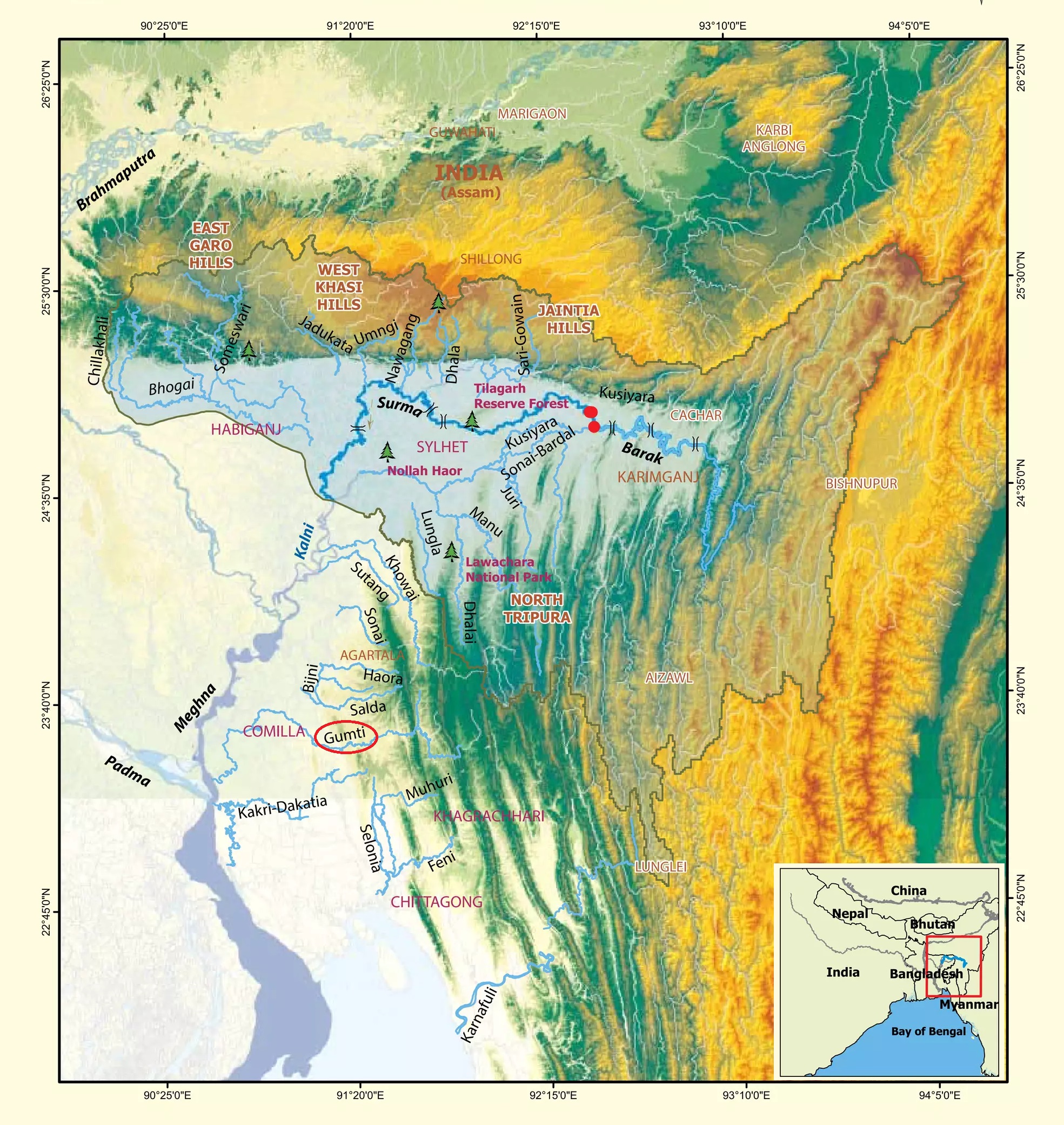
A recent study on frequent mass wasting in Sedongpu Gully and rapid warming raises concerns for India’s Northeast region.
About Sedongpu Gully:
The Sedongpu gully (29°47′7.20′′N, 94°55′24′′E) is in the large bend region of the Yarlung Tsangpo River, located in the southeastern Tibetan Plateau.
Debris flows have occurred in two adjacent gullies, namely Sedongpu Gully (SDP) and Zelongnong Gully (ZLN), since the 1950s.
Mass Wasting in the Gully: Stats and Reasons
Since 2017, over 700 million cubic meters of debris have been mobilized in the Sedongpu Gully catchment, with more than 68% of the total 19 identified mass-wasting events occurring in this period.
The events include ice-rock avalanches (IRAs), ice-moraine avalanches (IMAs), and glacier debris flows (GDFs).
Causes: The increased frequency of mass wasting is attributed to a combination of long-term warming and seismic activity.
The area rarely experienced temperatures above 0º C before 2012, but climate change has led to significant warming, destabilizing permafrost and increasing landslide activity.
The 6.4-magnitude Nyingchi earthquake in November 2017 also contributed to the destabilization of slopes.
Implications of sedimentation from mass wasting events:
River Choking and Flash Floods: The study warns that the increased sedimentation from mass wasting events could choke river channels, particularly affecting the Brahmaputra River system.
Hydropower Projects: China is planning to construct a massive 60-gigawatt hydropower project on the Tsangpo River, which could exacerbate sedimentation issues downstream.
This project is expected to have three times the capacity of the Three Gorges Dam, raising concerns about river management and flood risks in India and Bangladesh.
Historical Flood Events: Past incidents, like the 2000 floods in Arunachal Pradesh caused by landslides blocking the Tsangpo River, show how dangerous landslides can be for areas downstream.
The chance of similar disasters is higher now because of the ongoing geological instability in the Sedongpu Gully.
Way forward:
Bilateral and Multilateral Dialogues: India should intensify diplomatic efforts with China, advocating for shared water management strategies and transparency in hydropower projects on the Tsangpo River.
Real-Time Monitoring: Establish advanced real-time monitoring systems for the Brahmaputra River and its tributaries, using satellite imagery, remote sensing, and ground-based observations to track landslides, sedimentation, and water flow.
Mains question for practice:
Q Discuss the potential risks posed by the increasing frequency of mass wasting events in the Sedongpu Gully and the implications for India’s Northeast region. (150 words) 10M
Pali, Persian, Prakrit, and Farsi (Persian) as per the National Education Policy-2020.
Criteria for Classical Language Status
– High Antiquity: Recorded history of 1500-2000 years.
– Valuable Heritage: Possesses ancient literature and texts.
– Originality: Unique literary tradition, not borrowed from other languages.
– Distinctness: Language and literature distinct from modern forms.
Promotion of Classical Languages
– International Awards: Two major awards for scholars in classical Indian languages.
– Centre of Excellence: For studies in classical languages.
– Professional Chairs: UGC requested to create chairs in Central Universities.
The Eighth Schedule
Lists 22 official languages, governed by Articles 344(1) and 351 of the Constitution. Includes Assamese, Bengali, Bodo, Dogri, Gujarati, Hindi, Kannada, Kashmiri, Konkani, Maithili, Malayalam, Manipuri, Marathi, Nepali, Odia, Punjabi, Sanskrit, Santali, Sindhi, Tamil, Telugu, and Urdu.
PYQ Relevance: Q Judicial Legislation is antithetical to the doctrine of separation of powers as envisaged in the Indian Constitution. In this context justify the filing of a large number of public interest petitions praying for issuing guidelines to executive authorities. (UPSC IAS/2020) Q What are the continued challenges for Women in India against time and space? (UPSC IAS/2019) Q An apparel manufacturing company having a large number of women employees was losing sales due to various factors. The company hired a reputed marketing executive, who increased the volume of sales within a short span of time. However, some unconfirmed reports came up regarding his indulgence in sexual harassment at the work place. After sometime, a woman employee lodged a formal complaint to the management against the marketing executive about sexually harassing her. Faced with the company’s indifference in not taking cognizance of her grievance, she lodged an FIR with the Police. Realizing the sensitivity and gravity of the situation, the company called the women employee to negotiate. In that she was offered a hefty sum of money to withdraw the complaint and the FIR and also give in writing that the marketing executive is not involved in this case. Identify the ethical issues involved in this case: what options are available to the women employee? (UPSC IAS/2019)
Mentor comment: India faces significant challenges regarding sexual harassment and violence against women, deeply rooted in societal norms and systemic issues. Despite legislative measures like the Sexual Harassment of Women at Workplace (Prevention, Prohibition and Redressal) Act of 2013, the prevalence of sexual violence remains alarmingly high. Justice K. Hema Committee report, released by the Kerala government on August 19, 2024, highlights severe issues of sexual exploitation and gender discrimination faced by women in the Malayalam film industry. Initially submitted in 2019, the report reveals a culture of harassment, including the “casting couch” phenomenon, where women are pressured to exchange sexual favors for roles. It also addresses inadequate facilities and the absence of basic rights for women in the industry.
Let’s learn!
__
Why in the news?
The Justice K. Hema Committee report has sparked significant public debate and led to calls for reforms, including the establishment of an Internal Complaints Committee to address issues of sexual exploitation and gender discrimination faced by women effectively.
What does the Report say on Culture of Assault?
On Sexual Assault and Consent: Instances of sexual assault are not isolated events but are rooted in societal practices that undermine women’s autonomy and consent.
The National Crime Records Bureau reported 31,516 cases of rape in India in 2022, indicating a significant prevalence of sexual violence against women.
The Justice Hema Committee report emphasizes that rape is a manifestation of a culture that views women as objects rather than individuals with rights.
On Workplace Harassment: The Vishaka guidelines established in 1997 aimed to protect women from workplace harassment, leading to the Sexual Harassment of Women at Workplace Act, 2013, which mandates the formation of Internal Complaints Committees (ICC).
The report argues that ICCs are inadequate for the film industry due to potential biases and influence from abusers, advocating for an independent government forum to address these issues.
Lack of registration of crimes vs. Question on the Principle of Survivor Anonymity:
Nipun Saxena vs Union Of India (2018): The SC explained the importance of penalization of the disclosure of the name and the identity of the survivors of sexual offenses as mandated in Section 228A of the IPC, which is now reiterated in Sect 72 and 73of the BNS.
The provision’s objective is to protect survivors from hostile discrimination and future harassment.
Puttaswamy Judgement (2017): The Right to Privacy is integral to the Right to Life under Article 21 of the Constitution. Further, our criminal justice system initiates prosecution against the accused on behalf of the victim but it becomes quite difficult to prove a crime without the victim’s cooperation.
Right to Livelihood: Survivors fear potential retaliation from the abuser and the rest of society, in terms of refusal to give them work, and being branded as ‘problem-makers’.
CASE STUDY – #MeToo Movement:The accusations against Harvey Weinstein in 2017 sparked the global #MeToo movement, highlighting issues of sexual harassment and assault in various industries.
Need for Structural Reforms:
Acknowledgment of Challenges: The report aims to empower Indian women by raising awareness about workplace discrimination.
The findings in the Hema Committee report should lead to significant structural reforms in the Malayalam film industry, with government leadership being crucial.
Comprehensive Solutions Required: Issues such as inadequate sanitation and workplace bias must be thoroughly studied and addressed to improve conditions for women.
The report emphasizes the unique difficulties faced by women in lower-tier roles in the film industry, beyond just lead actresses.
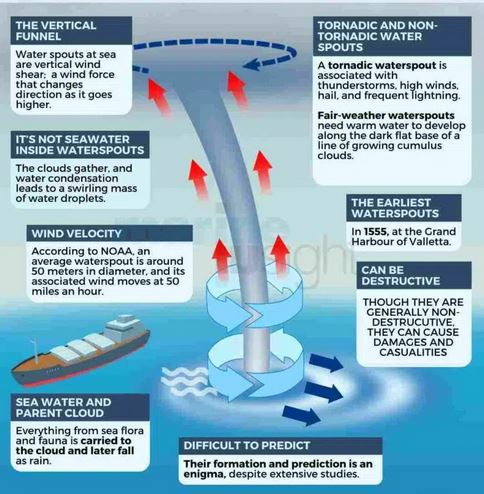
A yacht sank off the coast of Sicily, Italy after being hit by a Waterspout.
What are Waterspouts?
A waterspout is a rotating column of air and mist over a water body.
It is a weaker relative of tornadoes and typically lasts for about five minutes, although it can occasionally last up to 10 minutes.
Size and Strength:
Average diameter: Around 165 feet.
Wind speeds: Can reach up to 100 km/hr.
Waterspouts are more common in tropical waters but can form anywhere with high humidity and relatively warm water temperatures compared to the overlying air.
Types of Waterspouts:
Tornadic Waterspouts
These are actual tornadoes that either form over water or move from land to water.
They are associated with severe thunderstorms and can be accompanied by high winds, large hail, and dangerous lightning.
Fair-Weather Waterspouts:
These are more common and form only over water during fair weather.
They are generally smaller and less dangerous than tornadic waterspouts.
PYQ:
[2020] Consider the following statements:
1. Jet streams occur in the Northern Hemisphere only.
2. Only some cyclones develop an eye.
3. The temperature inside the eye of a cyclone is nearly 10ºC lesser than that of the surroundings.
Which of the statements given above is/are correct?
![[27th August 2024] The Hindu Op-ed: The heavy shackles of fear and vigilance](https://www.civilsdaily.com/wp-content/uploads/2024/08/27-Aug-1568x882.jpg)
![[26th August 2024] The Hindu Op-ed: Reality of reel life, exploitation as a structural problem](https://www.civilsdaily.com/wp-content/uploads/2024/08/26-Aug-1568x882.jpg)