💥Join UPSC 2027,2028 Mentorship (July Batch) + XFactor Notes & Microthemes PDF

GS Paper: GS2

  • India–Egypt Defence Cooperation  

     Why in the News?

    • India and Egypt held the 11th Joint Defence Committee (JDC) meeting in Cairo (April 2026)
    • Aim: Strengthen bilateral defence ties

    Key Highlights

    1. Defence Cooperation Plan (2026–27)

    • Expansion of:
      • Military engagements
      • Joint training exercises
      • Defence exchanges
    • Increased frequency of:
      • Bilateral military exercises

    2. Maritime Security Cooperation

    • Focus on: Indian Ocean security and Freedom of navigation
    • Role of: Information Fusion Centre – Indian Ocean Region
    • First: Navy-to-Navy staff talks held

    3. Defence Industry Collaboration

    • Emphasis on: Co-development and Co-production
    • India’s defence sector:
      • Production > $20 billion
      • Exports ~ $4 billion

    4. Air Force Cooperation

    • Interaction with: Egyptian Air Force leadership
    • Aim: Strengthen air defence ties

    5. Institutional Mechanism

    • Joint Defence Committee:
      • Regular dialogue platform
    • Based on:
      • 2022 MoU on defence cooperation
      • 2023 Strategic Partnership

    Strategic Importance

    • Egypt’s Geostrategic Position Controls: Suez Canal
    • Key link between: Europe, Asia, Africa
    • Ensures: Safe sea lanes and Trade security
    • Promotes:
      • Indigenous defence exports
      • Strategic partnerships
    • Cooperation supports: Stability in West Asia and Africa
    [2024] Consider the following statements: 
    Statement-I Sumed pipeline is a strategic route for Persian Gulf oil and Natural gas shipments to Europe. 
    Statement-II: Sumed pipeline connects the Red Sea with the Mediterranean Sea. 
    Which one of the following is correct in respect of the above statements? 
    [A] Both Statement-I and Statement-II are correct and Statement-II explains Statement-I
    [B] Both Statement-I and Statement-II are correct, but Statement-II does not explain Statement-I
    [C] Statement-I is correct, but Statement-II is incorrect
    [D] Statement-I is incorrect, but Statement-II is correct
  • Delimitation: At heart of row, value of a vote, fiscal imbalance

    Why in the News?

    India is approaching the first delimitation exercise after 2026, ending a freeze in place since the 1970s, making it a politically explosive issue. The debate has intensified because projections show northern states gaining up to +42 seats while southern states lose a similar number, raising fears of vote inequality and regional political imbalance. The core concern is that population-based representation may penalize states that successfully controlled population growth, fundamentally challenging the constitutional principle of “one person, one vote, one value.”

    What is delimitation?

    1. Delimitation is the process of updating Lok Sabha and state assembly constituencies and reallocating seat numbers based on population shifts to ensure fair representation, often termed “one vote one value”. 
    2. The Delimitation Commission is a powerful statutory body whose decisions are final and cannot be challenged in court. 84th Amendment Act, 2001 froze seat allocations based on the 1971 census until 2026 to promote family planning
    3. Article 82 of the Constitution mandates this exercise, with the next one due after the first census following 2026.

    Why was delimitation frozen and what was its rationale?

    Delimitation was frozen to prevent penalizing states that successfully implemented family planning, ensuring they did not lose political representation compared to faster-growing states. The 42nd Amendment (1976) locked seat allocations based on the 1971 Census until 2001, later extended by the 84th Amendment (2002) until 2026 to ensure political and administrative stability.

    1. Population Control Incentive: Ensured that states implementing family planning were not penalized; example: southern states reduced fertility significantly.
    2. 1976 Constitutional Amendment: Fixed seat allocation based on the 1971 Census for 25 years.
      1. Passed during the Emergency, the 42nd Amendment halted the reapportionment of seats to keep the political landscape stable and focus on population management policies rather than immediate, unequal representation changes.
    3. Extension till 2026: Freeze extended to avoid penalizing demographic transitions.
    4. Administrative Stability: Frequent restructuring of constituencies every ten years was seen as disruptive, and freezing the numbers brought continuity to the parliamentary and assembly structures.

    What are the projected changes in seat distribution post-2026?

    1. Northern Gains: Uttar Pradesh (+12), Bihar (+10), Rajasthan (+7) due to higher population growth.
    2. Southern Losses: Tamil Nadu (-10), Kerala (-7), Andhra Pradesh (-5).
    3. Total Shift: Approximately +42 seats to high-growth states; -42 to low-growth states.
    4. Representation Imbalance: Bihar MP represents ~3.1 million vs Kerala MP ~1.75 million.

    How does delimitation affect the principle of ‘one person, one vote’?

    1. Unequal Vote Value (Larger vs. Smaller Constituencies) Larger constituencies dilute voter influence in populous states.
      1. The Issue: When constituencies are not redrawn frequently, population shifts (e.g., migration to cities) mean that some constituencies become far more populous than others. A voter in a densely populated constituency has less “vote weight” than one in a thinly populated area.
      2. Urbanization Penalty: Rapidly growing urban areas (e.g., Pune, Surat) often become underrepresented because their expansion outpaces the creation of new seats, causing urban disenfranchisement. 
    2. Constitutional Concern: Violates principle of equal representation.
      1. The Constraint: The Indian Constitution mandates that the ratio of population to seats should be similar across all states, as far as practicable (Articles 81 & 170).
      2. The Problem: A pure population-based delimitation risks abandoning the federal principle of equitable state representation. If seats are redistributed purely by population, states that controlled their population (e.g., Southern states) would lose influence, while those with higher growth gain seats, leading to a “tyranny of numbers“.
      3. Silent Gerrymandering“: Critics argue that changing the total seat share of states (rather than just drawing internal boundaries) acts as a form of “silent gerrymandering” that favors the ruling party’s strongholds rather than just reflecting demographic changes
    3. Malapportionment: Disparity in Seat Share: Disparity between population share and seat share.
      1. Passive Malapportionment: When delimitation is frozen or delayed (as it was in India from 1976 to 2008), malapportionment increases. This means seat shares no longer match population shares.
      2. Federal Imbalance: A purely population-based exercise can lead to high-population states gaining a disproportionate share of total seats. This reduces the federal voice of smaller or more developed states in the Lok Sabha.
    4. Democratic Distortion: Vote weight differs significantly across regions.
      1. Diminished Representation: When delimitation is not done, an increasing population is represented by a single representative, making the MP less accessible and effective. (e.g., average population per MP rose from 7.32 lakh in 1951 to over 27 lakh by 2024).
      2. Communal and Political Manipulation: Delimitation can be used for political gain, where boundaries are deliberately redrawn to isolate or concentrate opposition votes, distorting the democratic outcome.

    Why is fiscal federalism central to the debate?

    Fiscal federalism is central to the Indian delimitation debate because the reallocation of Parliamentary seats based on current population data will directly alter the political power required to control the national purse strings, causing a perceived “double penalty” on wealthier southern states.

    1. Revenue Contribution Gap: Wealthier Southern States: Wealthier southern states generate more taxes.
      1. Economic Engines: States like Tamil Nadu, Kerala, Karnataka, Andhra Pradesh, and Telangana have significantly lower fertility rates and higher per capita incomes. They contribute a substantial share (approximately 35% of national GDP with only 18% of the population) to the national tax pool.
      2. The Fear: These states fear that their economic productivity will be undermined if they lose their voice in Parliament, reducing their ability to protect their tax revenues from being heavily diverted to other regions. 
    2. Redistribution Mechanism: Demographic Disadvantage: Central transfers based on population disadvantage these states.
      1. Finance Commission Formula: The Finance Commission (FC) transfers tax revenues to states based on a formula that weighs population (need) and income distance (relative poverty).
      2. The Disadvantage: If delimitation results in higher population weights in Parliament, the “need-based” redistribution formula will likely heavily favour high-population northern states, reducing the share of southern states.
      3. Cess and Surcharge: States already complain that the Centre uses non-sharable cesses and surcharges to hold more funds. A new, northern-dominated Parliament might increase this centralization, reducing the share of taxes for the South. 
    3. Double Penalty (Seats and Funds): Lose both financial share and political power.
      1. Loss of Financial Share: A reduced number of MPs in the Lok Sabha means less bargaining power in the GST Council and Finance Commission negotiations.
      2. The Penalty: The southern states fear they will lose both political representation (power to influence laws) and economic share (funds), creating a “second-class citizenship” scenario. 
    4. Horizontal Imbalance: Poorer States Gain Power and Funds: Poorer states gain both seats and fiscal transfers.
      1. Transfer Shift: The core of fiscal federalism is that wealthier states subsidize poorer ones. Delimitation accelerates this by shifting both seat share (political power) and financial allocation (fiscal transfer) towards states that failed to implement effective family planning, thereby reversing the incentives of “good governance”.

    What are the structural causes behind regional disparities?

    1. Uneven Economic Growth: Rich states grow faster than poorer states.
    2. Fertility Divergence: Lower fertility in developed states leads to slower population growth.
    3. Human Capital Differences: Education and health outcomes vary significantly.
    4. Policy Success Paradox: Successful states face reduced representation.

    What are the political and governance implications?

    1. Shift in Power Centre: Greater influence of northern states in Parliament.
    2. Policy Priorities Shift: National policies may reflect interests of high-population states.
    3. Federal Tensions: Increased friction between Union and southern states.
    4. Coalition Politics Impact: Changes electoral arithmetic and alliances.

    What reforms are being suggested?

    1. Revisiting Fiscal Federalism: Align financial transfers with efficiency and contribution.
    2. Weighted Representation Models: Balance population with development indicators.
    3. Rajya Sabha Strengthening: Ensure states retain influence irrespective of population.
    4. Constitutional Reforms: Reinterpret equality beyond strict population basis.

    Conclusion

    Delimitation after 2026 presents a constitutional dilemma between democratic equality and federal fairness. A purely population-based approach risks rewarding demographic expansion while penalizing governance success. Reforming fiscal and political frameworks is essential to maintain balanced federalism and democratic legitimacy.

    PYQ Relevance

    [UPSC 2024] What changes has the Union Government recently introduced in the domain of Centre-State relations? Suggest measures to be adopted to build trust between Centre and States and strengthen federalism.

    Linkage: The PYQ is directly linked to delimitation debate impacting federal balance and political representation of states. It tests understanding of cooperative federalism, fiscal federalism, and regional equity concerns emerging from population-based seat redistribution.

  • Ghose Commission & Telangana HC Verdict  

    Why in the News? 

    • The Telangana High Court ruled that the Ghose Commission report on the Kaleshwaram project will be “inoperative”, and no action can be taken against former CM K. Chandrashekar Rao and others.

    Background

    • The Telangana government constituted a Commission of Inquiry in 2024:
      • Headed by Justice P. C. Ghose
    • Purpose: Probe alleged irregularities in: Kaleshwaram Lift Irrigation Scheme

    About Kaleshwaram Project (KLIS)

    • One of the largest lift irrigation projects in India
    • Built on: Godavari River
    • Key barrages:
      • Medigadda
      • Annaram
      • Sundilla
    [2022] Consider the following pairs:
    Reservoirs: States 
    1. Ghataprabha: Telangana 
    2. Ghandhi Sagar: Madhya Pradesh 
    3. Indira Sagar: Andhra Pradesh 
    4. Maithon: Chhattisgarh 
    How many pairs given above ate not correctly matched? 
    [A] Only one pair [B] Only two pair [C] Only three pair [D] All four pair
  • Tuti Island in Sudan 

    Why in the News?

    • Tuti Island has drawn attention as residents return after a prolonged siege during the Sudan conflict 2023.

    Location & Geography

    • Located in Khartoum
    • Lies at the confluence of:
      • White Nile (from Uganda region)
      • Blue Nile (from Ethiopia)
    • Forms the River Nile, flowing north to Egypt

    Key Features

    • Crescent-shaped river island
    • Historically: Agricultural hub supplying fresh produce to Khartoum
    • Old settlement: Mosque dating back to 1480

    Sudan Conflict Context

    • War between: Sudanese Army and Rapid Support Forces

    Timeline

    • Conflict began: April 2023
    • Tuti Island siege: June 2023 to March 2025
    [2024] Consider the following pairs: Country: Reason for being in the news 
    1. Argentina: Worst economic crisis 
    2. Sudan       : War between the country’s regular army and paramilitary forces 
    3. Turkey       : Rescinded its membership of NATO 
    How many of the pairs given above are correctly matched? 
    [A] Only one pair [B] Only two pairs [C] All three pairs [D] None of the pairs
  • E-Visa Expansion at Seaports 

    Why in the News?

    • The Ministry of Home Affairs has added 14 seaports as Immigration Check Posts (ICPs) for entry of foreign nationals holding e-visas.

    Key Developments

    Newly Added Seaports (14)

    • Gujarat (7): Alang, Bedi Bandar, Bhavnagar, Porbandar, Hazira, Pipavav, Mandvi
    • Tamil Nadu (3): Cuddalore, Nagapattinam, Thoothukudi
    • Andhra Pradesh (2): Kakinada, Krishnapatnam
    • Odisha (2): Paradip, Dhamra

    Immigration Check Posts (ICPs)

    • Total ICPs in India: 114 (air, sea, land, rail, river routes)
    • ICPs at seaports: 37

    E-Visa Entry Points

    • Entry allowed through: 32 airports and 33 seaports

    About E-Visa

    • Features
      • Available to citizens of: 207 countries
      • Not available for: China, Pakistan, Yemen, Iran
    • Categories
      • Tourist, Business, Medical & Medical Attendant, Student, Family, Transit, Miscellaneous, and Production/Investment
    • Validity
      • Ranges from: 1 month to 5 years

    Difference Between E Visa and Visa on Arrival

    • E-Visas require an online application and approval before travel, while VoA is obtained upon reaching the destination. 
    • E-visas (like those from India Visa Online) offer more certainty and faster processing, whereas a VoA involves higher risks of delays and potential denial at the border.

    Related Development (India-China)

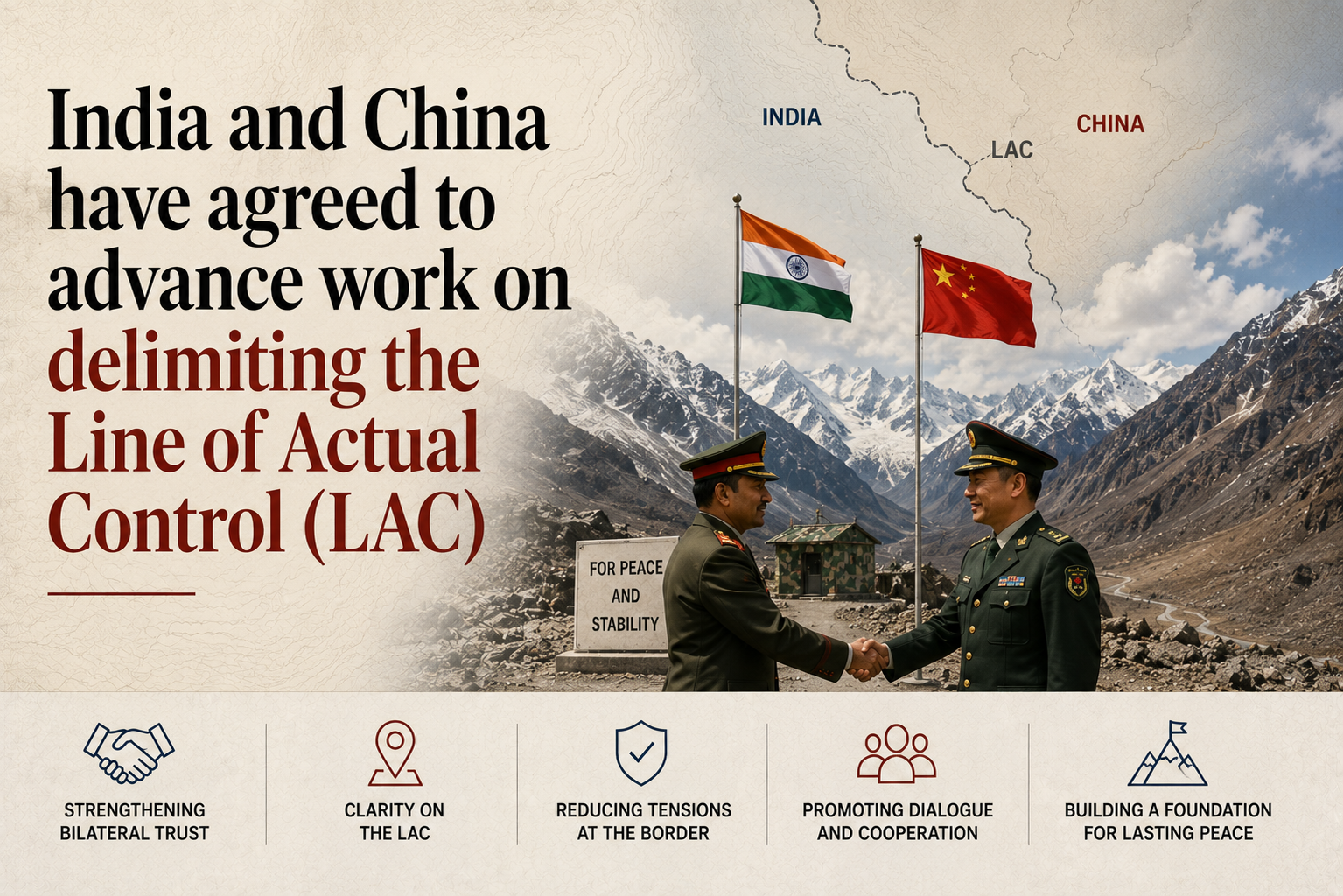
    • Tourist visas for Chinese nationals resumed after 5 years
    • Relaxations:
      • Buddhist pilgrims
      • Families of diplomats
    • Direct flights (Delhi–Beijing) resumed
    [2023] Consider the following pairs : Port—–Well known as 
    1.Kamarajar Port—-First major port in India registered as a company 
    2.Mundra Port—–Largest privately owned port in India 
    3.Visakhapatnam—-Largest container port in India 
    How many of the above pairs are correctly matched?
    [A] Only one pair [B] Only two pairs [C] All three pairs [D] None of the pairs
  • [22nd April 2026] The Hindu OpED: Lunar governance should be multilateral

    PYQ Relevance[UPSC 2019] What is India’s plan to have its own space station and how will it benefit our space programme?Linkage: The PYQ tests understanding of space governance, future space economy, and strategic autonomy, which directly connects to debates on lunar resource exploitation. It links to global commons vs national interests, as lunar governance (Artemis Accords vs multilateralism) will shape future space missions and infrastructure like space stations.

    Mentor’s Comment

    The debate on lunar governance has intensified due to the rapid operationalisation of the U.S.-led Artemis programme and associated Artemis Accords, which for the first time enable private extraction and ownership of lunar resources. This marks a sharp departure from earlier norms under the Outer Space Treaty (1967) that treated outer space as the “province of all humankind.” The issue gains urgency as scarce lunar resources, especially water ice at the south pole, are becoming strategically valuable for future missions.

    How does current geopolitical conduct undermine credibility in space governance?

    1. Selective adherence to law: Demonstrates inconsistency in upholding international norms; e.g., continued military actions despite scrutiny by the International Court of Justice (ICJ).
    2. Institutional bypassing: Weakens dispute resolution mechanisms; e.g., blockage of appointments to the WTO Appellate Body since 2019.
    3. Due process concerns: Highlights erosion of legal safeguards; e.g., deportation policies criticised by the U.S. Supreme Court.
    4. Humanitarian violations: Undermines moral authority; e.g., findings by International Commission of Jurists and Red Cross on violations in conflict zones.

    What are the legal implications of the Artemis Accords on lunar resources?

    The Artemis Accords, launched in 2020 and signed by over 60 nations as of April 2026, represent a significant evolution in international space law regarding lunar resources. They establish a principled framework aimed at operationalizing the 1967 Outer Space Treaty (OST) for commercial lunar exploration, primarily focusing on the extraction and utilization of resources. 

    1. Resource ownership rights: Enables private possession and sale of extracted resources; backed by U.S. domestic law (2015).
      1. Commercial Extraction: The Accords explicitly affirm that the extraction and utilization of space resources, such as water ice or regolith, does not inherently constitute “national appropriation” under Article II of the OST.
      2. Legal Standing: This allows signatories to authorize their private sector to possess, use, and sell extracted lunar resources, bridging the gap between scientific exploration and commercial mining.
      3. Backed by U.S. Law: This stance aligns with the U.S. Commercial Space Launch Competitiveness Act of 2015, which already granted American citizens rights to own, transport, and sell space resources.
    2. Norm-setting mechanism: Establishes bilateral agreements outside UN framework; risks fragmentation of global norms.
      1. Soft Law Approach: The Accords are non-legally binding political commitments (“soft law”) but function as mandatory requirements for participation in NASA’s Artemis program.
      2. Counter to 1979 Moon Agreement: The Accords ignore the 1979 Moon Agreement’s requirement for an international regime to govern resource exploitation, opting instead for a “first-come, first-served” approach to mining.
    3. Interpretation bias: Expands meaning of “use” under Outer Space Treaty to include commercial extraction.
      1. Redefining “Use”: The Accords interpret the OST’s allowance of the “use” of space to include commercial extraction of resources, whereas historically, this was seen as limited to scientific or operational utilization.
    4. Legal precedent: Creates de facto customary norms without universal consent.
      1. Subsequent Practice: The U.S. and its partners seek to establish “subsequent practice” under the Vienna Convention on the Law of Treaties, which could elevate these principles into customary international law through repeated actions.

    Do “safety zones” risk creating exclusionary regimes on the Moon?

    Yes, safety zones on the Moon pose a significant risk of creating exclusionary regimes. While designed to prevent harmful interference, safety zones can function as a de facto means of controlling, accessing, and exploiting high-value lunar areas (such as resource-rich polar craters) without requiring formal territorial claims. 

    1. Safety zones provision: Prevents harmful interference around operational sites.
    2. De facto territoriality: Enables early movers to control high-value regions without formal sovereignty claims.
      1. Operational Control: These zones enable actors to restrict access, creating a, de facto sovereignty by controlling entry to scientific and economic sites.
      2. Legal Ambiguity: The “due regard” principle of the OST is used to justify these zones. But the lack of a standardized size or definition allows actors to create, large exclusion zones that inhibit the free movement of others. 
    3. Resource concentration: Targets scarce locations like lunar south pole water ice.
      1. High-Value Sites: The most strategic locations, water-rich peaks of light and deep, icy craters, are limited. A safety zone around one of these sites can essentially monopolize that resource.
    4. Inequitable access: Limits entry of latecomers, especially developing countries.
      1. Rise of Contested Territory: As nations plan permanent bases, the competition for these, “safe” zones could turn them into, contested, contentious territory, rather than areas for scientific collaboration. 

    Why is multilateral governance necessary for lunar resources?

    1. Global commons principle: Treats Moon as shared heritage of humanity.
    2. Equitable distribution: Ensures fair access to resources across nations.
    3. Conflict prevention: Reduces risk of geopolitical rivalry in space.
    4. Institutional legitimacy: Strengthens UN-based frameworks like Committee on Peaceful Uses of Outer Space (COPUOS).

    What role can the Moon Agreement (1979) play in future governance?

    The Moon Agreement (1979), formally the Agreement Governing the Activities of States on the Moon and Other Celestial Bodies, provides a, yet largely underutilized, legal framework for the future of space governance, particularly regarding natural resource exploitation and environmental protection. Although limited by low ratification from major space-faring nations, its principles remain relevant in shaping debates on equitable space use. 

    1. International regime framework: The Agreement mandates the establishment of an international regime to govern the exploitation of lunar resources “as such exploitation is about to become feasible”.
      1. This provides a mechanism for establishing rules before a free-for-all scenario occurs, ensuring orderly and safe development.
    2. Collective benefit principle: Ensures benefits are shared globally.
      1. The Agreement designates the Moon and its resources as the “common heritage of mankind” (Article 11). This shifts the focus from competitive exploitation to an equitable sharing of benefits derived from resources, with special consideration for developing nations.
    3. Regulatory gap filling: It fills crucial gaps in the 1967 Outer Space Treaty (OST) regarding the exploitation of celestial resources.
      1. While the OST prohibits national appropriation, it is ambiguous regarding resource extraction. The Moon Agreement clarifies this by establishing a framework for resource management.
    4. Adoption challenge: Limited ratification reduces enforceability.
      1. The main challenge is its poor adoption, with only 17 or 18 states (as of 2023-2024) party to it, and none being major spacefaring powers (USA, Russia, China).
      2. The rise of non-binding “soft law,” such as the U.S.-led Artemis Accords, demonstrates a shift away from the binding multilateralism of the Moon Agreement towards commercial-friendly frameworks.

    Is the emerging space order shifting towards unilateralism?

    1. Power asymmetry: Dominance of technologically advanced nations.
      1. Intensifying Rivalry: The space domain is becoming a primary theater for U.S.-China strategic competition, with Russia also looking to develop asymmetric counterspace capabilities.
      2. Sovereign Constellations: China is expanding its state-directed industrial model through sovereign constellations like GuoWang and Qianfan, aiming to challenge U.S. dominance.
    2. Private sector involvement: Expands corporate influence in governance.
      1. Dominance of Commercial Players: Commercial entities, particularly SpaceX, dominate the launch cadence, commercial, and constellation deployment markets, creating a “monopoly” that pushes other nations to seek sovereign alternatives.
      2. In-Space Operations: The role of private companies is growing, with initiatives like India’s IN-SPACe enabling private sector participation in satellite launches and data analytics. 
    3. Bilateral agreements trend: Sidelines multilateral negotiations.
      1. Minilateralism/Bilateralism: Due to UN gridlock, countries are shifting to agile, “small table” negotiations and minilateral groupings like the QUAD to achieve faster, more flexible results.
    4. Strategic Competition: U.S.-China Rivalry in Space 
      1. Weaponized Interdependence: Space is viewed as an “operational battlespace” where critical commercial infrastructure can be used as a bargaining tool.
      2. Nationalization of Space Policy: Nations are increasingly integrating their space programs with national security interests, moving from exploration to defensive-offensive capabilities.
      3. Sovereign Launch Focus: U.S. allies (e.g., Australia, Canada, Spain, Germany) are aggressively funding domestic rocket startups to avoid dependency on American commercial providers, signaling a rise in sovereign-centric space policies.

    Conclusion

    Unilateral frameworks risk transforming lunar governance into a power-driven regime. A treaty-based multilateral approach remains essential to ensure equity, sustainability, and legitimacy in managing extraterrestrial resources.

  • Government to tighten AI labelling rules for social media over ‘unsatisfactory compliance’

    Why in the News?

    The government’s decision to tighten AI labelling rules marks a clear step-up in digital regulation, triggered by poor compliance from platforms like YouTube, Instagram, and X. Earlier, platforms only needed to show “prominent” labels, but now they must display continuous and clearly visible labels throughout the content, making the rules much stricter. This change is important because cases of harmful AI content, such as deepfake images of women created by X’s Grok, have exposed serious gaps in regulation, raising concerns about privacy, dignity, and large-scale misinformation.

    What are the AI Content labelling rules for social media?

    1. The Government of India has notified the Information Technology (Intermediary Guidelines and Digital Media Ethics Code) Amendment Rules, 2026 (effective February 20, 2026), making AI content labelling mandatory on social media platforms. These rules are designed to curb the spread of deepfakes, misinformation, and non-consensual sexual content (CSAM).
    2. AI content labelling on social media is the mandatory or voluntary tagging of images, videos, and audio created or altered by artificial intelligence (AI) to distinguish them from human-made content. 
    3. It aims to increase transparency, reduce misinformation (deepfakes), and comply with regulations by using visible labels (e.g., “AI-generated”) or hidden metadata.

    Key Features of the Amended IT Rules (2026):

    1. Mandatory Labelling: Social media platforms must prominently label “synthetically generated” or AI-generated images and videos that appear realistic.
    2. User Declaration: Platforms with over five million users must obtain a user declaration for AI-generated content and conduct technical verification before publishing.
    3. Excluded Content: Routine smartphone photo editing, filters, and film special effects are exempt from mandatory labelling.
    4. Permanent Metadata: Platforms must try to embed permanent metadata or watermarks to trace the origin of AI content.
    5. Takedown Timelines:
      1. 2 hours: Non-consensual deepfakes and intimate imagery must be removed within 2 hours of a complaint.
      2. 3 hours: Other illegal content must be removed within 3 hours of a court/government order.
    6. Loss of Safe Harbour: Non-compliance with these rules can result in the loss of safe harbour protection under Section 79 of the IT Act, making platforms liable for the content.

    Key Proposed AI Labeling Amendments (April 2026) and how do the proposed amendments strengthen accountability of intermediaries?

    1. Continuous On-Screen Labels: The new proposal mandates that AI labels remain continuously and clearly visible throughout the entire duration of the video or audio content, rather than just in the beginning or occasionally.
    2. Expansion of Scope: The labeling requirement applies to “synthetically generated information” (SGI), which includes text, audio, images, and videos created or altered via AI to appear authentic.
    3. Platform Accountability: Social media intermediaries must ensure these labels are present. Failure to comply could lead to a loss of “safe harbour” protection, meaning platforms could be held liable for user-generated content.
    4. User Responsibilities: Users are required to declare if content is AI-generated upon uploading, which platforms must then verify using “reasonable and proportionate technical measures“.
    5. Stricter Takedown Timelines: The proposal includes a heavily reduced takedown timeline, requiring platforms to remove illegal, non-consensual deepfakes within 2 to 3 hours of a lawful order.
    6. Feedback Deadline Extended: The deadline for public feedback on these proposed changes has been extended to May 7, 2026. 

    These moves, which follow initial rules announced in February 2026, are designed to combat the rising misuse of deepfakes and misinformation, ensuring that AI-generated material is easily distinguishable from real content

    What regulatory gap prompted stricter AI labelling norms?

    The primary regulatory gap that prompted stricter AI labelling norms was the transition from a standard of “prominent visibility” to a mandate for “continuous and clearly visible display” throughout the entire duration of the content. 

    1. Unsatisfactory compliance: Social media platforms failed to ensure consistent labelling despite February notification. For instance, only about 30% of AI-generated test posts were correctly flagged across major platforms.
    2. Inconsistent visibility: Labels appeared briefly or were not prominently displayed throughout content duration.
      1. Under earlier guidelines, AI labels often appeared only briefly or were placed in a way that was easily missed by users. The new 2026 amendments specifically aim to eliminate “blink-and-miss” disclaimers by requiring the label to remain on screen from start to finish.
    3. Regulatory dilution: Earlier proposal mandating labels to occupy 10% space was diluted, reducing effectiveness.
    4. Traceability Gaps: To prevent the removal of disclosures, the new norms mandate embedding permanent metadata or unique identifiers into synthetic content to ensure it remains traceable even when shared. 

    What is the significance of redefining Synthetic Generated Information (SGI)?

    Redefining Synthetically Generated Information (SGI) under India’s IT Rules 2026 is significant because it shifts from a reactive, general content moderation model to a proactive, AI-specific regulatory framework.

    1. Definition of SGI (Feb 2026 Rules): Refers to information created, modified, or generated using AI tools that can mimic real persons, events, or content.
      1. Includes deepfakes, AI-generated videos, audio, images, or text that appear real.
      2. Focuses on content that can mislead users or distort reality.
    2. Scope in February 2026 Rules:
      1. Broad coverage: Any AI-generated content that resembles real-world entities.
      2. Mandatory labelling: Required “prominent” disclosure, but no clarity on duration or format.
      3. Carve-outs included: Routine editing (filters, enhancement, dubbing) excluded as “good-faith use”.

    What changes in the Proposed New Rules?

    1. Stricter visibility requirement:
      1. Continuous and clearly visible labelling throughout the content duration.
      2. Removes ambiguity of “prominent” labels.
    2. Sharper focus on harm:
      1. Targets SGI that violates laws or leads to misrepresentation of identity/events.
      2. Expands regulatory intent from disclosure for the prevention of misuse.
    3. Platform accountability strengthened:
      1. Requires verification of user declarations about SGI.
      2. Mandates technical safeguards to detect and prevent harmful SGI.
    4. Enforcement mechanism: Platforms must take immediate action (remove, disable access, suspend accounts) upon detection.

    Why is this significant?

    1. Clear classification: Defines AI-generated content as SGI, ensuring regulatory clarity.
    2. Carve-outs provision: Excludes routine and good-faith editing (audio/video enhancement) from SGI definition.
    3. Misrepresentation control: Targets content that violates laws or misrepresents real-world events or identities.

    What risks associated with AI-generated content triggered regulatory urgency?

    1. Deepfake misuse: Grok-generated images of women in revealing clothing raised dignity and privacy concerns.
    2. Misinformation threat: AI content risks distorting facts and influencing public perception.
    3. Identity manipulation: Enables impersonation and false representation of individuals.
    4. Global backlash: Incident led to bans in some countries and forced platform-level corrective measures.

    How does the amendment impact Big Tech platforms?

    1. Enhanced compliance burden: Requires continuous monitoring and enforcement mechanisms.
    2. Liability exposure: Failure to act may attract legal consequences under IT Rules.
    3. User accountability integration: Platforms must ensure users disclose AI-generated content.
    4. Content moderation expansion: Strengthens obligations for proactive detection and removal.

    What are the implications for digital governance in India?

    1. Regulatory evolution: Moves from reactive to proactive AI governance.
    2. Platform responsibility shift: Transfers greater accountability to intermediaries.
    3. Rights protection: Strengthens safeguards for privacy, dignity, and authenticity.
    4. Policy alignment: Aligns with global concerns on AI ethics and misinformation control.

    Conclusion

    The proposed amendments signal a decisive shift towards stricter AI governance, emphasizing transparency and accountability. Effective implementation will determine whether India can balance innovation with safeguards against misinformation and digital harm.

    PYQ Relevance

    [UPSC 2024] Social media and encrypting messaging services pose a serious security challenge. What measures have been adopted at various levels to address the security implications of social media? Also suggest any other remedies to address the problem.

    Linkage: AI labelling rules and SGI regulation fall under GS-3 (Cyber Security, Emerging Technologies), focusing on risks like deepfakes, misinformation, and platform accountability. They also link to GS-2 (Governance) through regulation of intermediaries and GS-4 (Ethics) via concerns of privacy, dignity, and responsible AI use.

  • AI Labelling Rules  

    Why in the News?

    • The Ministry of Electronics and Information Technology proposed stricter AI content labelling norms due to unsatisfactory compliance by social media platforms.

    Key Change

    • Under Information Technology Rules 2021:
      • AI-generated content must have:
      • Continuous and clearly visible labels
      • Displayed for the entire duration of content

    Scope

    • Applies to platforms like: YouTube, Instagram, and X

    Key Term

    • Synthetically Generated Information (SGI):
      • Includes AI-generated audio, video, images
      • Excludes routine editing and quality enhancement

    Platform Obligations

    • Ensure proper labelling
    • Require user disclosure of AI content
    • Remove unlawful content
    • Use safeguards to prevent misuse

    Significance

    • Enhances transparency
    • Reduces misinformation and deepfakes
    • Strengthens digital platform accountability
    [2025] Consider the following statements regarding Al Action Summit held in Grand Palais, Paris in February 2025: 
    I. Co-chaired with India, the event builds on the advances made at the Bletchley Park Summit held in 2023 and the Seoul Summit held in 2024. 
    II. Along with other countries, US and UK also signed the declaration on inclusive and sustainable AI. 
    Which of the statements given above is/are correct? 
    [A] I only [B] II only [C] Both I and II [D] Neither I nor II
  • India–Africa Forum Summit (IAFS) 2026 

    Why in the News?

    • India will host the Fourth India–Africa Forum Summit (IAFS) 2026 after a gap of more than a decade (last held in 2015).

    What is IAFS

    • A platform for cooperation between India and African countries
    • Brings together: India and Members of the African Union

    Timeline

    • 1st IAFS → 2008 (New Delhi)
    • 2nd IAFS → 2011 (Addis Ababa)
    • 3rd IAFS → 2015 (New Delhi)
    • 4th IAFS → 2026 (New Delhi, upcoming)May 28 to May 31, 2026, in New Delhi, India

    Key Focus Areas (2026)

    1. Development Cooperation

    • Infrastructure projects
    • Capacity building initiatives

    2. Education & Skills

    • Example: IIT Madras campus in Zanzibar

    3. Diplomatic Expansion

    • India has: Opened 16 new missions since 2018
    • Presence now in: 45 African countries

    4. Defence Cooperation

    • Training and security collaboration

    5. Trade & Investment

    • Shift from: Line of Credit (LoC) to Foreign Direct Investment (FDI)
    [2016] Consider the following statements: 
    1 The India-Africa Summit Held in 2015 
    2 was the third such Summit Was actually initiated by Jawaharlal Nehru in 1951 
    Which of the statements given above is/are correct? 
    a) 1 only b) 2 only c) Both 1 and 2 d) Neither 1 nor 2
  • Disabled-Friendly Prisons — Supreme Court Directions (2026) 

    Why in the News?

    • The Supreme Court of India directed a high-powered committee to prepare a comprehensive plan for disabled-friendly prisons across India.
    • Issue highlighted: Inhumane conditions faced by disabled prisoners

    Key Supreme Court Observations

    • Rights of disabled prisoners must be protected under:
      • Article 14 → Equality before law
      • Article 21 → Right to life and dignity
    • Incarceration should not dilute fundamental rights

    Key Directions of the Court

    1. Comprehensive Action Plan

    • Create uniform standards across India

    2. Accessibility Measures

    • Provide:
      • Assistive devices
      • Mobility aids
      • Special infrastructure

    3. Medical & Social Support

    • Ensure:
      • Specialized medical care
      • Enhanced visitation rights

    4. Procurement & Maintenance

    • Define:
      • Procurement mechanisms
      • Maintenance protocols
      • Security safeguards

    5. Monitoring

    • Committee to submit report in: 4 months
    [2023] Q. Consider the following statements: 
    Statement-1: In India, prisons are managed State Governments with their own rules and regulations for the day-to-day administration of prisons. 
    Statement-II: In India, prisons are governed by the Prisons Act, 1894 which expressly kept the subject of prisons in the control of Provincial Governments. 
    Which one of the following is correct in respect of the above statements? 
    [A] Both Statement-I and Statement-II are correct and Statement-II is the correct explanation for Statement-1 
    [B] Both Statement-1 and Statement-II are correct and Statement-II is not the correct explanation for Statement-1 
    [C] Statement-1 1s correct but Statement-11 is incorrect 
    [D] Statement-1 Is incorrect but Statement-II is correct