At the COP29 climate summit in Baku, Azerbaijan, the adoption of Article 6.4 of the Paris Agreement has paved the way for global carbon trading under UN supervision.
This new development allows UN member countries to trade carbon credits globally.
What is Article 6.4?
Article 6.4 of the Paris Agreement establishes a global carbon market to facilitate carbon credit trading between countries.
It is part of Article 6, which outlines mechanisms for international cooperation in achieving net-zero emissions.
Objective: Enable countries to offset their emissions by investing in emission reduction projects in other countries.
It establishes a global carbon market overseen by a UNFCCC SupervisoryBody.
This body would develop rules, monitors credit issuance, and ensures compliance with international standards.
It allows countries to generate and trade Emission Reduction Credits (ERCs), which represent reductions in CO₂ or equivalent greenhouse gases.
Credits are earned from approved climate projects and can be traded globally.
Through subsections like Article 6.2, countries can use ITMOs (Internationally Transferred Mitigation Outcomes) to meet their NDCs, which are tradeable units representing emissions reductions.
Significance of Article 6.4
Cost-Effective Climate Action: By enabling global carbon markets, Article 6.4 could save an estimated $250 billion annually in implementing climate plans, providing a cost-efficient path to emission reductions.
Support for NDCs: The mechanism helps countries meet their NDC targets under the Paris Agreement, allowing more flexibility and incentivizing investments in green projects worldwide.
Economic Growth and Climate Mitigation: Carbon markets foster investments in clean energy, create jobs in climate-focused sectors, and link economic growth with climate action.
Encourages Sustainable Development: Article 6.4 incentivizes sustainable projects in developing countries, promoting green technology transfer and supporting local economies.
Types of Carbon Credit Projects under Article 6.4
Emission Reduction Projects
Energy Efficiency Improvements: Reducing energy consumption (e.g., efficient lighting, better insulation).
Renewable Energy: Replacing fossil fuels with solar, wind, or hydroelectric power.
Emission Removal Projects
Reforestation and Afforestation: Increasing forest cover to absorb CO₂.
Soil Carbon Sequestration: Storing carbon in soil through agricultural practices.
Carbon Storage Projects
Geological Storage: Storing CO₂ in deep underground formations.
Biochar Production: Locking carbon in biochar, enhancing soil fertility.
Technological Carbon Capture and Storage (CCS)
Direct Air Capture: Capturing CO₂ from the air and storing it underground or using it industrially.
Ocean-Based Solutions: Enhancing ocean CO₂ absorption, such as through algae cultivation.
Issues with Article 6.4
Carbon Offsetting Criticisms: Critics argue that offsetting doesn’t reduce global emissions but shifts responsibility, allowing countries to continue emitting while claiming neutrality.
Carbon Accounting Challenges: Unreliable carbon accounting can lead to “phantom credits,” where emissions reductions are overstated or inaccurately recorded, failing to match actual reductions.
Greenwashing Risks: Some countries and companies may use carbon credits as a form of greenwashing, claiming carbon neutrality while continuing to pollute.
Equity and Climate Justice Concerns: Developing nations, which contribute less to global emissions, are the most vulnerable to climate impacts.
Potential for Reversal Risks: Projects that store carbon in natural reservoirs risk releasing it back into the atmosphere. Some standards allow projects to end monitoring if reversal risk is considered “negligible,” which remains undefined and problematic.
PYQ:
[2011] Regarding “carbon credits”, which one of the following statements is not correct?
(a) The carbon credit system was ratified in conjunction with the Kyoto Protocol.
(b) Carbon credits are awarded to countries or groups that have reduced greenhouse gases below their emission quota.
(c) The goal of the carbon credit system is to limit the increase of carbon dioxide emission.
(d) Carbon credits are traded at a price fixed from time to time by the United Nations Environment Programme.
India and the US are set to hold the firstUS-India Indian Ocean Dialogue on November 14 strengthening cooperation over the Indian Ocean Region (IOR).
About theIndian Ocean Dialogue:
The Indian Ocean Dialogue (IOD) was established during the 13th Council of Ministers’ meeting in November 2013 in Perth, Australia, and is a flagship initiative of the Indian Ocean Rim Association (IORA).
It functions as a Track 1.5 discussion, combining officials and non-officials for a more inclusive dialogue, with the latest (9th edition) held in May 2023 at Zanzibar, Tanzania.
Key areas discussed in 2024 Edition:
Strengthening Maritime Security: Enhances coordination on maritime freedom and security, crucial for trade routes and energy supply.
Economic and Environmental Cooperation: Supports trade, blue economy, and addresses climate change impacts on the region.
Significance in India-U.S. Relations
Indo-Pacific Partnership: Reinforces Quad cooperation and aligns both nations’ strategic interests.
Power Balance in the Region: Counters influence from other powers, fostering an open Indo-Pacific.
Defense and Technology Collaboration: Expands ties in emerging tech and defense, enhancing India’s security role.
Disaster Preparedness: Builds climate resilience and sustainable resource management efforts.
PYQ:
[2017] Consider the following in respect of Indian Ocean Naval Symposium (IONS):
1. Inaugural IONS was held in India in 2015 under the chairmanship of the Indian Navy.
2. IONS is a voluntary initiative that seeks to increase maritime co-operation among navies of the littoral states of the Indian Ocean Region.
Which of the statements given above is/are correct?
Savanna elephants have experienced a significant population decline of around 70% across surveyed sites, primarily due to poaching and habitat loss.
Decline in African Elephants Population
Researchers conducted a comprehensive assessment of these species using data from 475 sites in 37 countries between 1964 and 2016.
Savanna Elephants: Populations declined by about 70% on average at surveyed sites.
Forest Elephants: Populations fell by about 90% on average at surveyed sites.
The total population of African elephants decreased by 77% on average at surveyed sites.
Features of African Elephants:
African elephants are the largest land animals on Earth, known for their size, intelligence, and complex social structures.
They are divided into savanna (bush) elephants (larger, with bigger tusks and open grassland habitat) and forest elephants (smaller, with straighter tusks and dense forest habitats).
Highly intelligent, African elephants display memory, empathy, and intricate social bonds within herds.
20,000 pompano fingerlings were released into the sea off Vizhinjam as part of an artificial reef project aimed at replenishing marine fishery resources and promoting sustainable fishing.
About the Artificial Reef Project in Kerala:
Details
Location
• Covers 42 fishing villages in Thiruvananthapuram district, from Pozhiyoor to Varkala.
Aims and Objectives
• Enhance fish resources along Kerala’s coast.
• Support sustainable fishing and improve fishing community livelihoods.
• Implemented by KSCADC (Kerala State Coastal Area Development Corporation).
• Technical support from CMFRI (Central Marine Fisheries Research Institute).
Future Expansion Plans:
• Phase II: Proposed to cover 96 villages in Kollam, Alappuzha, Ernakulam, and Thrissur districts (₹29.76 crore).
• Phase III: Proposed to cover 96 villages in northern districts (₹25.82 crore).
Significance
• Boosts marine biodiversity.
• Increases fish stocks and supports breeding environments.
• Promotes sustainable fishing practices.
• Enhances livelihoods of local communities.
Q) Public health system has limitations in providing universal health coverage. Do you think that private sector can help in bridging the gap? What other viable alternatives do you suggest? (UPSC CSE 2015)
Q) The increase in life expectancy in the country has led to newer health challenges in the community. What are those challenges and what steps need to be taken to meet them? (UPSC CSE 2022)
India’s Public Health System needs to focus on preventing and controlling non-communicable diseases like hypertension, diabetes, cardiovascular diseases, stroke, and cancer. These diseases affect people of all income levels, but the poor and old aged population is the most vulnerable.
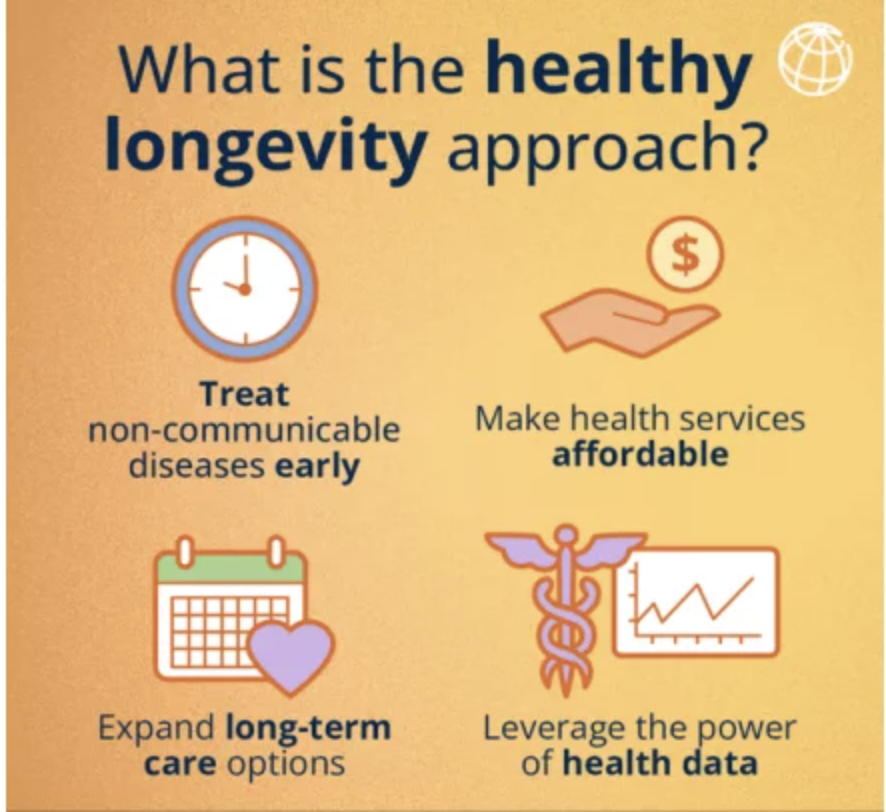
In this scenario, Health Longevity is an evidence-based approach to help countries define prioritized, costed interventions and policy changes to save and extend people’s lives. According to World Bank, investing in healthy longevity could save 150 million lives in low- and middle- income countries.
Today’s editorial emphasizes the issues related to the health sector in India especially with respect to Non-communicable diseases.
_
Let’s learn!
Why in the News?
The World Bank publishes an important and forward-thinking report on a key issue affecting people’s well-being. The report is Unlocking the Power of Healthy Longevity: Demographic Change, Non-communicable Diseases, and Human Capital, released in Washington D.C. in September 2024.
Key Findings of the Report:
● Aging and NCD Burden: Global aging is accelerating, with non-communicable diseases (NCDs) causing over 70% of deaths, especially in low- and middle-income countries. ● Potential Life Savings: Investing in healthy longevity could save 150 million lives and significantly improve productivity and economic growth by 2050. ● Life-Course Health Investments: Addressing health from maternal to elderly care, with a focus on NCD prevention, is essential for promoting healthier aging populations. ● Gender and Social Equity: Women, who often bear caregiving responsibilities and live longer with NCDs, require targeted health and social protections to ensure equity in aging.
Issues related to the Elderly Population in India:
Size of Elderly Population: India has the second-largest elderly population in the world, with approximately 140 million people aged 60 years and above.
Growth Rate: The elderly population is growing at a rate nearly three times higher than India’s overall population growth, indicating a significant demographic shift.
Aging Population Challenge: This rapidly aging population places considerable pressure on health services, social systems, and the economy.
What are the Disease Concerns in India?
Rise in Non-Communicable Diseases (NCDs): India is witnessing an increasing burden of NCDs, including heart disease, diabetes, cancer, and chronic respiratory diseases, which are now the leading causes of death.
Health Risks for the Elderly: As the elderly population grows, the prevalence of age-related diseases and NCDs is expected to surge, straining healthcare systems.
Impact on Public Health: The health challenges are compounded by the underdeveloped infrastructure for treating chronic diseases, particularly in rural areas.
Issues related to Hospital Expenses in India:
Rising Healthcare Costs: Medical expenses for elderly care, especially for chronic diseases and long-term care, are escalating. Private hospitals often charge exorbitantly, making healthcare unaffordable for many elderly individuals.
Inaccessibility of Healthcare: The elderly often face challenges in accessing healthcare facilities due to geographic and economic barriers, leading to delays in diagnosis and treatment.
Catastrophic Health Expenditure: Many elderly people, particularly in lower-income segments, face catastrophic health expenses that can push them into poverty. Even with government schemes, the out-of-pocket expenses remain high.
Steps taken by the Indian Government:
● National Programme for Health Care of the Elderly (NPHCE): This program aims to provide comprehensive healthcare services specifically tailored for older adults. ● National Social Assistance Programme (NSAP): Aimed at providing financial assistance to the elderly who are below the poverty line. ● Maintenance and Welfare of Senior Citizens Act, 2007: This act mandates maintenance and welfare provisions for senior citizens. ● Atal Vayo Abhyuday Yojana (AVYAY): A scheme focused on promoting the welfare of senior citizens through various support services. ● Elderline: A national helpline established to assist elderly individuals in accessing information and services related to their needs
Efficacy of Social Security Schemes:
Limited Coverage: India’s social security schemes, including pensions and health insurance, often do not adequately cover the elderly, especially those in lower income brackets or rural areas.
For example: Public health schemes like Ayushman Bharat aim to provide health insurance to underprivileged populations, but the coverage and access remain limited for the elderly.
Vulnerable Groups: The elderly in India, particularly those without formal employment or savings, remain highly vulnerable to financial distress from healthcare expenses and lack sufficient social security support.
Way forward:
Enhance and Expand Social Security Coverage: Strengthen existing social security schemes like Ayushman Bharat to ensure comprehensive health insurance and pension coverage for elderly populations, particularly in rural and low-income areas. This can help alleviate financial strain from healthcare costs.
Invest in Geriatric Healthcare Infrastructure: Improve healthcare facilities and services for the elderly, focusing on chronic disease management and accessible healthcare, especially in rural areas. This includes training healthcare workers in geriatric care and increasing the availability of affordable long-term care options.
On October 20, Indonesia saw a big change in leadership. Nationalist Prabowo Subianto became president.
What are the implications of Indonesia’s new leadership for India-Indonesia relations?
Increased Competition with China: Prabowo’s administration may lead to a more assertive Indonesian foreign policy that seeks to leverage its strategic position between China and India. However, the extent of this assertiveness will depend on how Indonesia navigates its growing economic reliance on China while maintaining its sovereignty.
Potential for Enhanced Cooperation: Despite the challenges posed by China’s influence, India has an opportunity to deepen its engagement with Indonesia. This could involve collaborative efforts in sectors such as defence, maritime security, and trade, particularly given Indonesia’s strategic location and resource-rich economy.
How does Indonesia’s relationship with China impact its foreign policy choices?
Strategic Balance: Prabowo’s decision to make China his first visit signals Indonesia’s pragmatic balancing between major powers. Despite concerns about China’s assertiveness in the Natuna Sea, Indonesia engages China for its economic clout and investments, especially in sectors like infrastructure and technology.
Wariness Over Chinese Influence: Indonesia’s hesitance toward China’s extensive control over economic assets provides India an opportunity to position itself as a complementary partner that respects Indonesia’s sovereignty, especially given mutual interests in upholding maritime security in the Indo-Pacific.
US-Indonesian Relations: Prabowo’s tenuous ties with the U.S. due to historical human rights allegations might encourage him to seek alternative partnerships, where India can play a constructive role in regional stability.
What opportunities exist for India to enhance its economic engagement with Indonesia?
Energy and Mineral Resources: Indonesia’s rich reserves of coal, palm oil, nickel, and tin offer significant opportunities for India to secure its mineral and energy requirements, which aligns with India’s growing manufacturing and EV industries.
Infrastructure and Maritime Cooperation: India’s existing partnerships in infrastructure, such as developing the Sabang port, can be expanded to reinforce connectivity and enhance trade routes between the Nicobar Islands and Indonesia.
Services Sector Collaboration: India’s strength in IT and financial services can support Indonesia in reducing business costs and improving economic efficiency, particularly as it seeks to modernize and diversify its economy.
Tourism and Cultural Exchange: Given Indonesia’s growing middle class and India’s appeal as a tourist destination, there is potential to expand tourism and cultural exchanges that celebrate shared heritage, including Hindu-Buddhist traditions.
Way forward:
Strengthen Strategic and Economic Partnerships: India should actively engage Indonesia in joint initiatives across defense, maritime security, and infrastructure, leveraging Indonesia’s strategic location and resources to build a resilient Indo-Pacific framework that counters China’s regional influence.
Deepen Cultural and Economic Ties: Expanding collaborations in sectors like IT, energy, and tourism, and celebrating shared heritage, will foster goodwill and position India as a trusted and complementary partner to Indonesia, reinforcing mutual growth and stability in the region.
Mains PYQ:
Q Indian Diaspora has an important role to play in South-East Asian countries’ economy and society. Appraise the role of Indian Diaspora in South- East Asia in this context. (UPSC IAS/2017)
The India-Middle East-Europe Corridor (IMEC), announced at the 2023 G20 summit, aims to cut travel time by 40% and costs by 30%, which could transform global shipping once it’s up and running.
What is IMEC (India-Middle East-Europe Corridor)?
The IMEC (India-Middle East-Europe Corridor) is a major trade route connecting India, the Middle East, and Europe to reduce transit times and transportation costs, launched in 2023 during the G20 Summit.
It aims to strengthen regional partnerships through improved infrastructure, energy grids, and digital connectivity, providing an alternative to traditional maritime routes like the Suez Canal.
What are the current challenges facing the IMEC initiative?
Geopolitical Tensions: The Israel-Palestine conflict, which escalated in October 2023, has stalled progress on the IMEC’s western segment, with Saudi Arabia and Jordan delaying collaboration due to potential geopolitical and optics issues related to their interactions with Israel.
Lack of Progress in West Asia: Due to the conflict, connectivity efforts in West Asia are moving slowly, affecting the northern part of the corridor, particularly the integration of infrastructure and trade processes with Israel and other stakeholders.
Incomplete Development of Additional Infrastructure: Beyond basic connectivity, elements such as clean energy exports, undersea fiber-optic cables, and telecommunication linkages are delayed and are expected to proceed only once stability is restored in West Asia.
Organizational and Logistical Framework: The absence of a central governing structure, like an IMEC secretariat, hinders streamlined cross-border trade processes and systematic project implementation, leading to coordination challenges among participating nations.
How IMEC Aims to Enhance Regional Cooperation and Economic Growth?
Strengthening India-UAE Economic Relations: India and the UAE are advancing bilateral trade, leveraging frameworks like the Comprehensive Economic Partnership Agreement (CEPA) and the Virtual Trade Corridor to standardize trade processes, reduce costs, and simplify logistics.
Improving Connectivity in the East: Progress on the eastern segment, particularly between India and UAE, is increasing trade and setting a foundation for cooperation through standardized trade practices and growing non-oil trade, which diversifies exports and enhances India’s regional integration.
Capacity Building: As the western segment awaits resolution of the regional conflict, eastern countries, especially India, are enhancing port infrastructure, digitalizing logistics, and developing economic zones to support connectivity and reduce trade barriers.
Potential for Economic Integration: Once operational, IMEC can link South Asia, the Middle East, and Europe, encouraging deeper economic ties, lowering costs, and creating a stable trade pathway that could foster regional development and integration.
What are the implications of IMEC for global trade dynamics?
Reduced Dependency on the Suez Canal: IMEC offers a strategic alternative to the Suez Canal, with an anticipated reduction in transit time by 40% and costs by 30%, which could significantly impact global trade routes by diversifying options and lowering shipping times and expenses.
India’s Role as a Supply Chain Alternative: By leveraging IMEC, India can enhance its position in global value chains as an alternative supply chain hub, aligning with its manufacturing ambitions and increasing export competitiveness through improved infrastructure and reduced logistics costs.
Reshaping Trade Infrastructure: The project introduces a new corridor that supports not only connectivity but also potentially includes energy infrastructure and digital linkages, providing a comprehensive trade infrastructure model that could influence future trade frameworks in the Indo-Pacific and beyond.
Attracting Participation: The IMEC secretariat, once established, could guide strategic decision-making, build empirical support for trade benefits, and encourage more countries to join the corridor, potentially expanding IMEC’s impact on international trade and cooperation in regions connected to it.
Way forward:
Strengthen Geopolitical Stability: Address regional tensions, especially in West Asia, to ensure smoother collaboration among stakeholders and accelerate the development of the western segment of the IMEC.
Develop an IMEC Secretariat: Establish a central coordinating body to streamline operations, facilitate cross-border trade, and guide infrastructure projects, ensuring systematic progress and attracting further global participation.
Mains PYQ:
Q How will I2U2 (India, Israel, UAE and USA) grouping transform India’s position in global politics? (UPSC IAS/2022)
The NISAR (NASA-ISRO Synthetic Aperture Radar) satellite is aimed at advancing our understanding of Earth’s natural processes and environmental changes.
Set to be launched into Low Earth Orbit (LEO), NISAR will act as a comprehensive Earth observation observatory.
About NISAR Satellite:
Details
Collaboration
• Joint mission between NASA (United States) and ISRO (India).
Purpose
• Designed to monitor Earth’s natural processes and environmental changes, contributing to disaster preparedness, climate research, and sustainable management.
Launch Date
• Planned for early 2025.
Launch Location
• Satish Dhawan Space Centre, Andhra Pradesh, India.
Launch Vehicle
• ISRO’s Geosynchronous Satellite Launch Vehicle Mark II (GSLV Mk II).
Orbit
• Low Earth Orbit (LEO).
Dual-Band Radar System
• L-band radar (provided by NASA): Penetrates dense vegetation and tracks ground motion.
• S-band radar (provided by ISRO): Enhances precision for surface monitoring.
Day and Night Functionality
• Operates 24/7, unaffected by weather conditions.
Large Antenna
• Diameter: 12 meters.
• Structure: 39-foot reflector made from gold-plated wire mesh to focus radar signals effectively.
Features
• Scans Earth’s entire surface every 12 days.
• Measures surface changes with accuracy down to fractions of an inch.
• Can penetrate vegetation and soil layers, providing 3D reconstructions of subsurface structures.
Areas of Study
• Ecosystems and Environmental Changes (forest biomass, deforestation, wetlands, agricultural lands, glaciers, and ice sheets).
• Natural Disasters (seismic shifts, volcanic bulging, landslides, and tsunamis).
Benefits and Applications
• Disaster Preparedness: Early warning data for natural disasters.
• Infrastructure Monitoring: Tracks structural changes in critical infrastructure.
• Environmental and Climate Research: Studies carbon storage, vegetation dynamics, and climate change impacts.
Unique Advantages
• Largest collaboration between NASA and ISRO.
• Successfully tested in thermal vacuum conditions in Bengaluru in 2023.
PYQ:
[2015] The term ‘IndARC’ sometimes seen in the news, is the name of?
(a) An indigenously developed radar system inducted into Indian Defence.
(b) India’s satellite to provide services to the countries of Indian Ocean Rim.
(c) A scientific establishment set up by India in Antarctic region.
(d) India’s underwater observatory to scientifically study the Arctic region.
The Inter-State Council has been reconstituted with Prime Minister as its chairman, all CMs and 9 Union ministers as members and 13 Union ministers as permanent invitees.
About the Inter-State Council (ISC):
Details
Formation
Established on May 28, 1990, by a presidential order following the Sarkaria Commission (1988) recommendations.
Headquartered in New Delhi.
The Council has met 12 times since its formation in 1990.
Constitutional Provisions
Not a permanent body nor a constitutional body;
Created by the President under Article 263 of the Constitution.
Powers and Functions
Investigate and discuss subjects of common interest.
Make recommendations for better coordination on subjects.
Deliberate on matters referred by the Chairman.
Composition
PM as Chairman.
Chief Ministers of all states and union territories with legislative assemblies.
Lieutenant Governors/Administrators of union territories without assemblies.
6 Union Cabinet Ministers nominated by the Prime Minister.
Governors of states under President’s rule.
Standing Committee:
Union Home Minister as Chairman.
5 Union Cabinet Ministers and 9 Chief Ministers.
PYQ:
[2013] Which of the following bodies is/are not mentioned in the Indian Constitution?
1. National Development Council
2. Planning Commission
3. Zonal Councils
Select the correct answer using the codes given below:
The study of Corpse Flower’s (Amorphophallus titanum) heat generation and odor emission has revealed how it attracts pollinators through unique adaptations for reproduction.
About theCorpse Flower (Titan Arum):
Details
Scientific Name
Amorphophallus titanum
Habitat
Rainforests of western Sumatra, Indonesia
Features
Grows up to 10-12 feet in height.
Blooms once every 5-10 years; bloom lasts 24-48 hours.
Carrion-feeding insects (flies, beetles) are attracted by smell and heat.
Strong smell of rotting flesh to attract pollinators;
Smells like cheese, garlic, decaying fish, sweaty socks, and feces