💥UPSC 2026, 2027, 2028 UAP Mentorship (March Batch) + Access XFactor Notes & Microthemes PDF

Search results for: “”

  • India stays out of ‘Trade Pillar’ of IPEF

    India stayed out of the joint declaration on the trade pillar of the US-led Indo-Pacific Economic Framework (IPEF) ministerial meet in Los Angeles, with Union Commerce Minister citing concerns over possible discrimination against developing economies.

    Why did India opt out of the trade pillar?

    • One of the reasons for staying out of the trade pillar was that the contours of the framework had not emerged yet.
    • This is particularly about the kind of commitment each country would have to make on “environment, labour, digital trade and public procurement”.
    • India’s decision also mirrors the decision to walk out after seven years of negotiations from the Regional Comprehensive Economic Partnership (RCEP).

    What is IPEF?

    • It is a US-led framework for participating countries to solidify their relationships and engage in crucial economic and trade matters that concern the region, such as building resilient supply chains battered by the pandemic.
    • It is not a free trade agreement. No market access or tariff reductions have been outlined, although experts say it can pave the way to trade deals.

    Members of IPEF

    • The member nations include Australia, Brunei, India, Indonesia, Japan, South Korea, Malaysia, New Zealand, the Philippines, Singapore, Thailand and Vietnam.
    • It includes seven out of 10 members of the Association of South East Asian Nations (ASEAN), all four Quad countries, and New Zealand.
    • Together, these countries account for 40 per cent of the global GDP.

    Four pillars of IPEF

    1. Trade that will include digital economy and emerging technology, labor commitments, the environment, trade facilitation, transparency and good regulatory practices, and corporate accountability, standards on cross-border data flow and data localisations;
    2. Supply chain resilience to develop “a first-of-its-kind supply chain agreement” that would anticipate and prevent disruptions;
    3. Clean energy and decarbonization that will include agreements on “high-ambition commitments” such as renewable energy targets, carbon removal purchasing commitments, energy efficiency standards, and new measures to combat methane emissions; and
    4. Tax and anti-corruption, with commitments to enact and enforce “effective tax, anti-money laundering, anti-bribery schemes in line with [American] values”.

    How do members participate?  

    • Countries are free to join (or not join) initiatives under any of the stipulated pillars but are expected to adhere to all commitments once they enrol.
    • Negotiations are meant to determine and list the provisions under each pillar and open the floor for countries to choose their ‘commitments’.
    • The framework would be open to other countries willing to join in the future provided they are willing to adhere to the stipulated goals and other necessary obligations.

    Reasons for the creation of IPEF

    • US regaining lost credibility: IPEF is also seen as a means by which the US is trying to regain credibility in the region after Trump pulled out of the Trans Pacific Partnership TPP).
    • Rising Chinese influence: Since then, there has been concern over the absence of a credible US economic and trade strategy to counter China’s economic influence in the region.
    • Competing RCEP: It is also in the 14-member Regional Comprehensive Economic Partnership, of which the US is not a member (India withdrew from RCEP).
    • “Pivot to Asia” strategy: US has intensified its engagement with the wider Asia-Pacific region to advance its economic and geopolitical interests.

    India’s perception of IPEF

    • PM Modi described the grouping as born from a collective desire to make the Indo-Pacific region an engine of global economic growth.
    • India has called for common and creative solutions to tackle economic challenges in the Indo-Pacific region.

    What does it have to do with China?  

    • The US strategists believe the US lacks an economic and trade strategy to counter China’s increasing economic influence in the region since 2017.
    • US companies are looking to move away from manufacturing in China.
    • IPEF would therefore offer an advantage to participating countries, allowing them to bring those businesses into their territory.
    • However, it officially excluded Taiwan despite its willingness and economic merit to join.
    • This exhibits Washington’s geopolitical caution.

    Reactions from the opponents

    • Chinese Foreign Minister Wang Yi criticized the initiative as an attempt to further economic decoupling from China.
    • He argued that the initiative, and the US Indo-Pacific strategy as a whole, created divisions and incited confrontation. It is destined to be ultimately be a failure.
    • Taiwan was excluded in order to appease key “fence-sitter” countries such as Indonesia whose governments feared angering China.

    Issues with IPEF framework

    • IPEF would neither constitute a ‘free trade agreement,’ nor a forum to discuss tariff reductions or increasing market access.
    • Unlike a traditional trade agreement, the US administration will not need congressional approval to act under the IPEF. Hence its legal status is questionable.
    • This also raises doubts among potential participants about their reluctance to offer significant concessions under the agreement.
    • The volatility of US domestic politics has raised concerns about IPEF’s durability.
    • Unlike traditional FTAs, the IPEF does not subscribe to the single undertaking principle, where all items on the agenda are negotiated simultaneously.

    Given the divisive nature of American politics, it is unclear whether the IPEF will survive past the Biden administration.

    Way forward

    • The IPEF’s launch in Tokyo was symbolic in nature; bringing the IPEF to fruition will involve significant domestic and international challenges.
    • Without ratification by Congress, the IPEF’s fortunes will remain in limbo.
    • Going forward, the US and the founding partners need to develop the process and criteria by which other countries from the region will be invited to join the negotiations on the IPEF.


    UPSC 2023 countdown has begun! Get your personal guidance plan now! (Click here)

  • PM Modi to attend SCO meet

    sco

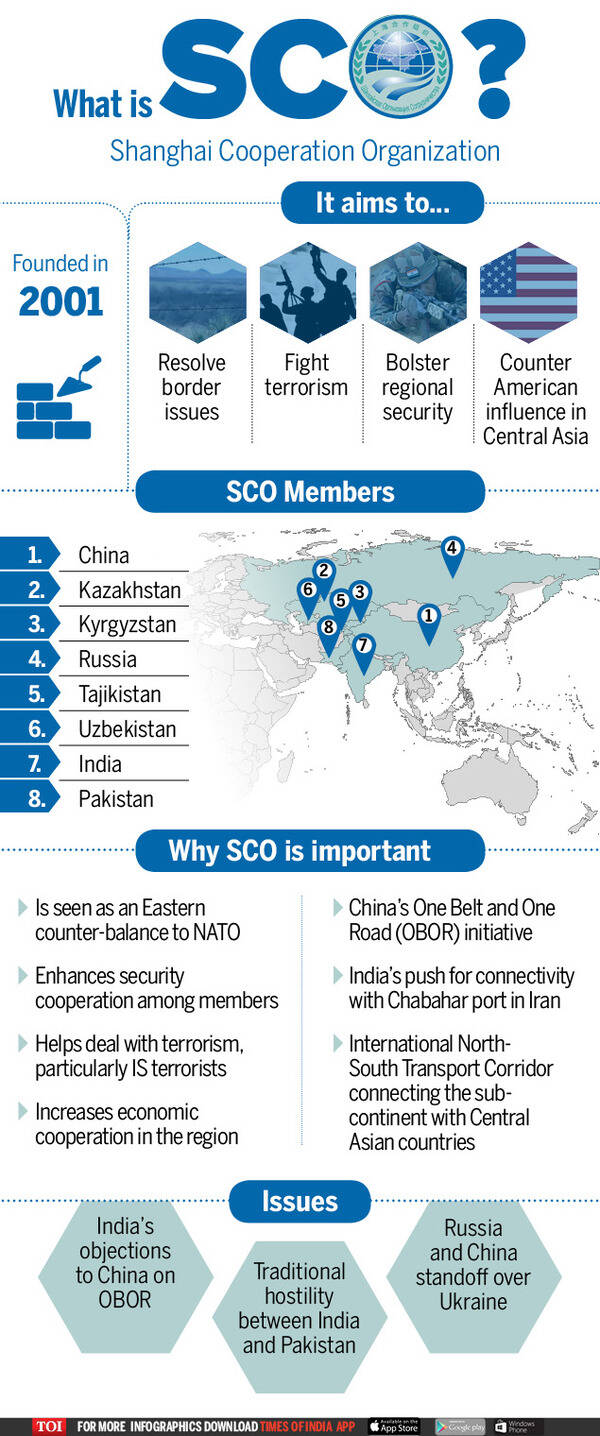
    PM Modi will travel to Samarkand in Uzbekistan to attend the first in-person summit of the SCO (Shanghai Cooperation Organisation) countries since the COVID-19 pandemic.

    What is SCO?

    • After the collapse of the Soviet Union in 1991, the then security and economic architecture in the Eurasian region dissolved and new structures had to come up.
    • The original Shanghai Five were China, Kazakhstan, Kyrgyzstan, Russia and Tajikistan.
    • The SCO was formed in 2001, with Uzbekistan included. It expanded in 2017 to include India and Pakistan.
    • Since its formation, the SCO has focused on regional non-traditional security, with counter-terrorism as a priority.
    • The fight against the “three evils” of terrorism, separatism and extremism has become its mantra. Today, areas of cooperation include themes such as economics and culture.

    India’s entry to the SCO

    • India and Pakistan both were observer countries.
    • While Central Asian countries and China were not in favor of expansion initially, the main supporter — of India’s entry in particular — was Russia.
    • A widely held view is that Russia’s growing unease about an increasingly powerful China prompted it to push for its expansion.
    • From 2009 onwards, Russia officially supported India’s ambition to join the SCO in 2017.
    • China then asked for its all-weather friend Pakistan’s entry.

    Changing the narrative of SCO

    Infographic: Shanghai Cooperation Organisation: An Explainer - Times of India

    • There has been discussion in the international arena that the trend of non-alignment is back.
    • NATO is based on Cold War thinking.
    • The logic of NATO is creating new enemies to sustain its own existence.
    • However, SCO is a cooperative organisation based on non-alignment and not targeting a third party.

    India and SCO: Present status

    • India will host the SCO summit next year, and Varanasi has been selected as the SCO region’s first “Tourism and Cultural Capital”.
    • India will also be chairing the summit.


    UPSC 2023 countdown has begun! Get your personal guidance plan now! (Click here)
  • What is Karoo-Ferrar Large Igneous Province?

    karoo

    A new study shows that a decline in continental plate movement likely controlled the onset and duration of many of the major volcanic events throughout Earth’s history.

    Why is the news?

    • Previous studies have linked major volcanic eruptions with past mass extinctions and disturbances in the global climatic, environmental and the carbon cycle.
    • Large igneous province volcanism, formations due to major volcanic eruptions occurring throughout Earth’s history, released large quantities of greenhouse gasses and toxic compounds into the atmosphere.
    • The sea warmed up by 4°C to 10°C, even at low- to mid-latitudes, the study noted.
    • Increased acidic levels and a lack of oxygen drove major ocean extinctions.
    • Large-scale volcanism took place in southern Africa, Antarctica and Australia. This is known as the Karoo-Ferrar Large Igneous Province.

    About Karoo-Ferrar Large Igneous Province

    • The Karoo and Ferrar Large Igneous Provinces (LIPs) are two large igneous provinces in Southern Africa and Antarctica respectively, collectively known as the Karoo-Ferrar, Gondwana, or Southeast African LIP associated with the initial break-up of the Gondwana supercontinent.
    • Its flood basalt mostly covers South Africa and Antarctica but portions extend further into southern Africa and into South America, India, Australia and New Zealand.
    • Karoo-Ferrar formed just prior to the breakup of Gondwana in the Lower Jurassic epoch, about 183 million years ago.
    • This time corresponds to the early Toarcian anoxic event and the Pliensbachian-Toarcian extinction.


    UPSC 2023 countdown has begun! Get your personal guidance plan now! (Click here)

  • [Joining link inside] How to change your UPSC preparation strategy after failed attempts? Risk zone vs Safe side for UPSC CSE 2023-24 | FREE Webinar by PSC officer, Vikash sir, Senior IAS Mentor.

    [Joining link inside] How to change your UPSC preparation strategy after failed attempts? Risk zone vs Safe side for UPSC CSE 2023-24 | FREE Webinar by PSC officer, Vikash sir, Senior IAS Mentor.

    Join Zoom Meeting

    https://us06web.zoom.us/j/86804374077?pwd=YXJrMisza29oNEdmRUsvektEQ1VrUT09

    Meeting ID: 868 0437 4077

    Passcode: 640595


    Important for UPSC 2023-24 aspirants! Register and discuss 1-1 with Vikash sir


    Preparing for UPSC prelims is like throwing pebbles into a pitcher partially filled with water. (Remember the story of the crow in Panchatantra?) Instant gratification and even a little lack of patience will get you nowhere. But, if you keep dropping those pebbles, you’ll see the water level rising!

    Before everything, knowing and accepting the things that you have been doing in the wrong manner, is the first step towards making the change for eventual success.

    If a pill couldn’t cure your disease, what would you do? Would you change your medicine? Or wait for the worst suffering? 

    Change is the key to success in UPSC CSE
    This was Mourya’s fifth attempt in which he secured an AIR 28

    Even UPSC toppers have failed in the past but it was their ability to evolve and re-orient their strategy as per UPSC’s expectations that helped them succeed. Similarly, at that point, you should change your strategy. But, here you have to be extremely cautious. Because success will come only if your new strategy is better than the old one.

    Ascertaining the need to ensure removing difficulties, the students face, we are conducting an on-demand Webinar by Vikash sir on How to change your UPSC Preparation strategy after a failed attempt?


    Webinar Details: 11th September (Sunday), 7 PM

    Topics to be discussed in the Webinar:

    1. Previous year UPSC CSE trend analysis. How UPSC is changing?
    2. Understanding the changing expectations of UPSC and adapting to it.
    3. Strategy for UPSC Prelims 2023
    4. What are the high potential areas in the UPSC syllabus that you should focus on?
    5. Learning from the mistakes and ‘Unlearning the common bad habits’ learned during previous attempts.
    6. Building the fundamentals for Prelims and Mains – NCERTs, and conceptual understanding.
    7. How to make and update notes from Prelims and Mains perspective?

    The heat of fire turns gold ores into pure gold, and it is your time to shine.

    About Vikash sir

    Vikash Kumar sir is a senior IAS mentor at CivilsDaily. He has attempted 6 UPSC Mains and appeared in 3 UPSC interviews. He has cleared CAPF and UPPSC 2020 final exam. He has a rich experience in UPSC preparation and has been mentoring students for 4 years now. 50 of his students are writing UPSC Mains 2022.

    From one of Vikash sir’s students

    What The Hindu mentioned about Civilsdaily Mentorship

  • Who was Dara Shikoh?

    dara shikoh

    The Vice President has released the Arabic Version of “Majma Ul-Bahrain” of Mughal Prince Dara Shikoh.

    The course of the history of the Indian subcontinent, had Dara Shikoh prevailed over Aurangzeb, has been a matter of some conjecture among historians. Critically analyse.

    Who was Dara Shikoh?

    • Dara Shikoh, who was Mughal emperor Shah Jahan’s son and expected heir, was killed on the orders of his brother Aurangzeb in 1659 after losing the war of succession.
    • He was the eldest son and heir-apparent of the Mughal emperor Shah Jahan.
    • Dara was designated with the title Padshahzada-i-Buzurg Martaba (Prince of High Rank) and was favored as a successor by his father and his older sister, Princess Jahanara Begum.
    • In the war of succession which ensued after Shah Jahan’s illness in 1657, Dara was defeated by his younger brother Prince Muhiuddin (Aurangzeb).
    • He was executed in 1659 on Aurangzeb’s orders in a bitter struggle for the imperial throne.

    His legacy

    • Dara was a liberal-minded unorthodox Muslim as opposed to the orthodox Aurangzeb.
    • He authored the work Majma Ul-Bahrain (The Confluence of the Two Seas), which argues for the harmony of Sufi philosophy in Islam and Vedanta philosophy in Hinduism.
    • It was Dara Shikoh who was responsible for making the Upanishads available to the West as he had them translated.
    • He had commissioned a translation of Yoga Vasistha.
    • A great patron of the arts, he was also more inclined towards philosophy and mysticism rather than military pursuits.
    • He translated the Upanishads and other important works from Sanskrit to Persian. He was convinced that the Upanishads are what the Qur’an calls ‘Al-Kitab Al-Maknoun’ (The Hidden book).

    Try this PYQ:

    Q.Who among the following Mughal Emperors shifted emphasis from illustrated manuscripts to album and individual portrait?

    (a) Humayun

    (b) Akbar

    (c) Jahangir

    (d) Shah Jahan


    Post your answers here.


    UPSC 2023 countdown has begun! Get your personal guidance plan now! (Click here)

  • Vande Bharat production to begin in October: Minister

    vande bharat

    Indian Railways had successfully completed trials of the second generation Vande Bharat train that will come with enhanced passenger comfort and safety features.

    What is Vande Bharat Express?

    • The Vande Bharat Express is a semi-high-speed train designed, developed, and built by the Integral Coach Factory (ICF).
    • Presently there are only two Vande Bharat trains that are running — Delhi to Varanasi and Delhi to Katra.

    Key Features

    • The current Vande Bharat trains have seating only in two classes — chair car and executive chair car. But Railways is planning to upgrade it.
    • The trains have fully sealed gangways for a dust-free environment, modular bio-vacuum toilets, rotating seats in Executive Class, personalized reading lights, automatic entry/exit doors with sliding footsteps, diffused LED lighting, mini pantry, and sensor-based interconnecting doors in each coach.
    • They are self-propelled trains that do not require an engine. This feature is called a distributed traction power system.

    Benefits of Vande Bharat Trains

    • Cuts Travel Time Drastically
    • Energy Efficient
    • Reduce Turnaround Time
    • Faster Acceleration and Deceleration among others.


    UPSC 2023 countdown has begun! Get your personal guidance plan now! (Click here)

  • Three Indian Cities are now in UNESCO Global Network of Learning Cities

    unesco

    Warangal, Nilambur, and Thrissur have joined the UNESCO Global Network of Learning Cities (GNLC).

    What does UNESCO Global Network of Learning Cities mean?

    • An international policy-oriented network, the UNESCO Global Network of Learning Cities is a network of inspiration, know-how and best practices.
    • It is coordinated by the UNESCO Institute for Lifelong Learning (UIL).
    • The Network has member cities that it supports in aspects like promoting policy dialogue and peer learning, documenting effective strategies and best practices; building partnerships; capacity development; and more.

    What is a learning city?

    • According to UNESCO, a learning city is one that
    1. effectively mobilizes its resources in every sector to promote inclusive learning from basic to higher education
    2. revitalizes learning in families and communities
    3. facilitates learning for and in the workplace
    4. extends the use of modern learning technologies
    5. enhances quality and excellence in learning
    6. fosters a culture of learning throughout life
    • In doing so, the city enhances individual empowerment and social inclusion, economic development and cultural prosperity, and sustainable development

    Inclusion of Indian cities

    • The Indian cities, Nilambur and Thrissur in Kerala, and Warangal in Telangana became the nation’s first entrants in the UNESCO Global Network of Learning Cities.
    • As per UNESCO, 77 cities from 44 countries across the globe have joined the UNESCO Global Network of Learning Cities.
    • The group of global cities also includes cities like Beijing, Shanghai, Hamburg, Athens, Incheon, Bristol, and Dublin.
    • The inclusion will foster sharing of ideas with other cities, provide already applied solutions to issues and much more.

    About the cities

    (1) Thrissur – the cultural capital of Kerala

    • Popularly known as the cultural capital of Kerala, Thrissur is home to academic and research institutions.
    • It is also known for its jewellery industry, especially gold.
    • As a member of the UNESCOI GNLC, Thrissur hopes to contribute to the intellectual and peer learning processes, focusing on equitable access to learning for all, digital learning ecosystems and skills for sustainability.
    • Thrissur ticked UNESCO’s check boxes in aspects of good practices, equity and inclusion among other factors.
    • For e.g., the presence of a MSME-Development Institute of India regional centre in Thrissur offers institutional support in promoting decent work and entrepreneurship through upskilling.

    (2) Nilambur, Kerala’s eco-tourism destination

    • Nilambur is an eco-tourism destination in the Kerala.
    • It is a city with various socio-economic patterns marked by an urban and rural mix.
    • The majority of the population depends on agriculture and allied industries.
    • The city offers free healthcare facilities to all citizens and utilizes health volunteers to provide door-to-door treatment for bedded patients.
    • It also promotes first-aid training for students and young citizens.
    • Nilambur aims to promote sustainable development, gender equality, inclusivity and democracy through community ownership.
    • Nilambur also aspires to become a women-friendly city by ensuring equal opportunities in all sectors, promoting capacity-building and reducing harassment.
    • As a learning city, Nilambur aims to work to innovate in agriculture and handicrafts, promote eco-tourism and improve water management.

    (3) Warangal, the tourism spot

    • Warangal has a rich cultural heritage. The city is a major tourism venue, welcoming 3.2 million tourists every year.
    • Warangal’s economy is primarily composed of agricultural, industrial and service sectors.
    • The city promotes equity and inclusion, for which it has implemented several strategies, including Women and Child Welfare policy, Urban Policy etc.
    • Further, it also provides free training to the transgender community which helps in employment opportunities.


    UPSC 2023 countdown has begun! Get your personal guidance plan now! (Click here)

  • Cyborg Cockroaches to help in urban search-rescue missions

    cyborg

    Japanese scientists have devised a system that can create cyborg cockroaches that are part insect and part machine.

    Cyborg cockroaches

    • Cyborg cockroaches’ movements are controlled by tiny integrated circuits.
    • They will be able to conduct surveillance in procedures like urban search and rescue, environmental monitoring and inspection of areas dangerous to humans.
    • By equipping the cockroaches with small wireless control modules, handlers will be able to control the insect’s legs remotely for long periods of time.
    • The team used Madagascar cockroaches, which are not only the largest species of cockroaches, reaching an estimated 6 cm, but are also known for making hissing sounds when disturbed, which they make by expelling air from the openings on their back.

    How is it powered?

    • The researchers also designed the system to be rechargeable, by powering it with a super thin 0.004 mm solar cell module that is installed on the dorsal side of the cockroach’s abdomen.
    • This was done to ensure that the battery remains charged and the cockroach can be controlled for long periods of time, while simultaneously ensuring that the movement remains unhindered.


    UPSC 2023 countdown has begun! Get your personal guidance plan now! (Click here)

  • TB mukt India

    TBContext

    • People’s participation in the ‘TB-Mukt India’ campaign can help eliminate the disease by 2025.

    What is TB?

    • A potentially serious infectious bacterial disease that mainly affects the lungs.

    How TB is caused?

    • Tuberculosis (TB) is caused by a type of bacterium called Mycobacterium tuberculosis. It’s spread when a person with active TB disease in their lungs coughs or sneezes and someone else inhales the expelled droplets, which contain TB bacteria.

    What does TB do to humans?

    • It mainly affects the lungs, but it can affect any part of the body, including the tummy (abdomen), glands, bones and nervous system.

    TBHow long has the TB infected us?

    • TB is as old as humanity itself, infecting us for at least 5,000 years. The infecting agent, a bacterium, was identified way back in 1882, by Robert Koch, signalling one of the landmark discoveries which laid the foundation of modern medicine

    Is TB painful?

    • If TB affects your joints, you may develop pain that feels like arthritis. If TB affects your bladder, it may hurt to go to the bathroom and there may be blood in your urine. TB of the spine can cause back pain and leg paralysis. TB of the brain can cause headaches and nausea.

    Can we get TB if vaccinated?

    • BCG is a vaccine for TB. This vaccine is not widely used in the United States, but it is often given to infants and small children in other countries where TB is common. The BCG vaccine is not very good at protecting adults against TB. We can still get TB infection or TB disease even if you were vaccinated with BCG.

    When do TB symptoms start?

    TB


    • TB disease usually develops slowly, and it may take several weeks before you notice you’re unwell. Your symptoms might not begin until months or even years after you were initially infected. Sometimes the infection does not cause any symptoms. This is known as latent TB.

    Is TB curable permanently?

    • TB can usually be completely cured by the person with TB taking a combination of TB drugs. The only time that TB may not be curable is when the person has drug resistant TB.

    What are drug-resistant tuberculosis?

    • Drug-resistant tuberculosis (DR-TB) is a form of antimicrobial resistance that is difficult and costly to treat. It is caused by TB bacteria that are resistant to at least one of the first-line existing TB medications, resulting in fewer treatment options and increasing mortality rates.

    Risk factors for TB include

    • Poverty
    • HIV infection.
    • Being in jail or prison (where close contact can spread infection)
    • Substance abuse.
    • Taking medication that weakens the immune system.
    • Kidney disease and diabetes.

    TB statistic for mains

    We are home to 1 in 4 of the world’s TB patients.

    Over 2.5 million Indians are infected.

    Government initiatives

    • Nikshay Poshan Yojana: in which TB patients receive Rs 500 every month while on treatment was launched. Nikshay Poshan Yojana ensure that the patients have economic support and nutrition during the required period.
    • TB Harega Desh Jeetega Campaign: was launched to accelerate the efforts to end TB by 2025. The campaign aims to initiate preventive and promotive health approaches.
    • Community-led approach: By applying “multi-sectoral and community-led” approach, the government is building a national movement to end TB by 2025.
    • Ni-kshay Mitra: Any individual or organisation can register as Ni-kshay Mitra on the Ni-kshay 2.0 portal to support people affected by the disease. The initiative intends to provide essential nutritional and social support to people with TB and root out stigma and discrimination against them.

    Some positive suggestions to eliminate TB

    • Sincere efforts need to be made to make our health systems more accessible and reliable.
    • It also required to ensure that those seeking care trust the healthcare system and get the appropriate care for completing treatment.
    • There is a need to create more labs, point of care tests, an assured drug pipeline, access to new drugs.
    • The government should also ensure counselling and support for those affected.
    • Every patient who is diagnosed late and does not receive timely treatment continues to infect others.
    • To break this cycle, government machinery at the field level should work with communities and provide free diagnosis and treatment to every affected individual.

    Conclusion

    • We have ignored TB for too long. It’s time we acknowledge the magnitude of the disease, and work harder at offering individuals equitable healthcare access and resources that the disease warrants.

    Mains question

    Q. Do you think we can eliminate TB by 2025? Discuss the roadmap and give some affirmative actions to be taken by government.

    UPSC 2023 countdown has begun! Get your personal guidance plan now! (Click here)

  • Urban floods mitigation

    floods
    Context

    • Bengaluru floods are alarming us to go for robust disaster management strategies.

    What is flood?

    • Floods are the most frequent type of natural disaster and occur when an overflow of water submerges land that is usually dry. Floods are often caused by heavy rainfall, rapid snowmelt or a storm surge from a tropical cyclone or tsunami in coastal areas.

    Causes of frequent urban floods

    Natural

    • Meteorological Factors:Heavy rainfall, cyclonic storms and thunderstorms causes water to flow quickly through paved urban areas and impound in low lying areas.
    • Hydrological Factors: Overbank flow channel networks, occurrence of high tides impeding the drainage in coastal cities.
    • Climate Change: Climate change due to various anthropogenic events has led to extreme weather events.

    Anthropological

    • Unplanned Urbanization:Unplanned Urbanization is the key cause of urban flooding. A major concern is blocking of natural drainage pathways through construction activity and encroachment on catchment areas, riverbeds and lakebeds.
    • Destruction of lakes: A major issue in India cities. Lakes can store the excess water and regulate the flow of water. However, pollution of natural urban water bodies and converting them for development purposes has increased risk of floods.
    • Unauthorised colonies and excess construction: Reduced infiltration due paving of surfaces which decreases ground absorption and increases the speed and amount of surface flow
    • Poor Solid Waste Management System: Improper waste management system and clogging of storm-water drains because of silting, accumulation of non-biodegradable wastes and construction debris.
    • Drainage System:Old and ill maintained drainage system is another factor making cities in India vulnerable to flooding.
    • Irresponsible steps: Lack of attention to natural hydrological system and lack of flood control measures.

    floodsImpact of the devastation due to floods:

    • On economy: Damage to infrastructure, roads and settlements, industrial production, basic supplies, post disaster rehabilitation difficulties etc.
    • On human population and wildlife:Trauma, loss of life, injuries and disease outbreak, contamination of water etc.
    • On environment:Loss of habitat, tree and forest cover, biodiversity loss and large scale greenery recovery failure.
    • On transport and communication: Increased traffic congestion, disruption in rail services, disruption in communication- on telephone, internet cables causing massive public inconvenience.

    Solutions for effective flood management

    • Improved flood warning systems: effective flood warning systems can help take timely action during natural calamities and can save lives. Pre-planning can significantly reduce the effects of floods, giving people time to migrate to safer locations and stock up essentials.
    • Building flood-resilient housing systems: concreting floors can be very useful during floods. Houses should be water proofed and electric sockets should be placed at higher levels up the walls to reduce the chances of shocks.
    • Constructing buildings above flood levels: buildings should be constructed a metre above from the ground to prevent flood damage and evacuation during floods.
    • Resilience to Climate change: drastic climate changes have increased the frequency of natural disasters in many parts of the world. Governments should bring about environment-friendly policy level changes and eliminate the ones hazardous to the environment to tackle the problem of global warming.
    • Create wetlands and encourage reforestation: creating more and more wetlands can help soak up excessive moisture since wetlands act as sponges. Wooded areas can also slow down heavy water flow, minimizing the effects of floods. Reforesting upstream regions can significantly reduce the effects of flood damage.
    • Improve soil conditions: improper soil management, animal hooves, and machinery can make soil compacted. As a result, instead of holding water in and absorbing moisture, the water runs off immediately. Properly drained soil can absorb large amounts of rainwater and can prevent it from flowing into the rivers.
    • Installing flood barriers: these are flood gates designed to prevent the area behind the barrier from flooding. They can also be kept around buildings to keep floodwaters outside the boundary created.
    • Development of GIS– Geographical Information System (GIS) based National Database: for disaster management. GIS is an effective tool for emergency responders to access information in terms of crucial parameters for disaster-affected areas.
    • Developing a Federal flood management plan: with responsibilities of union and state clearly defined.
    • Creation of 2nd flood commission: (Rashtriya Barh Aayog, created in 1976) to study the flood situation in India under rising challenges of climate change and propose a national-level flood resilience and management plan.

    Way forward

    • Resilience of people: The rapid transformation in rainfall characteristics and flooding patterns demand building people’s resilience.
    • Reconsider projects: Construction projects that impede the movement of water and sediment across the floodplain must be reconsidered.
    • Use of technology: At the same time, climate-imposed exigencies demand new paradigms of early-warning and response systems and securing livelihoods and economies.

    Conclusion

    • We can learn to live with nature, we can regulate human conduct through the state and we can strategically design where we build. We need to urgently rebuild our cities such that they have the sponginess to absorb and release water without causing so much misery and so much damage to the most vulnerable of our citizens.

    Mains question

    Q. We need to urgently rebuild our cities such that they have the sponginess to absorb and release water. Discuss the statement in context of urban flood management strategy in India.

    UPSC 2023 countdown has begun! Get your personal guidance plan now! (Click here)

More posts