Social media platforms have adopted design choices that have led to a proliferation and mainstreaming of misinformation while allowing themselves to be weaponised by powerful vested interests for political and commercial benefit.
Problems created by social media and issues with response to it
The consequent free flow of disinformation, hate and targeted intimidation has led to real-world harm and degradation of democracy in India: Mainstreamed anti-minority hate, polarised communities and sowed confusion have made it difficult to establish a shared foundation of truth.
Political agenda: Organised misinformation (disinformation) has a political and/or commercial agenda.
Apolitical and episodic discourse in India: The discourse in India has remained apolitical and episodic — focused on individual pieces of content and events, and generalised outrage against big tech instead of locating it in the larger political context or structural design issues.
Problematic global discourse: The evolution of the global discourse on misinformation too has allowed itself to get mired in the details of content standards, enforcement, fact-checking, takedowns, de-platforming, etc.
Moderating misinformation vs. safeguarding freedom of expression: Such framework lends itself to bitter partisan contest over individual pieces of content while allowing platforms to disingenuously conflate the discourse on moderating misinformation with safeguards for freedom of expression.
The current system of content moderation is more a public relations exercise for platforms than being geared to stop the spread of disinformation.
Framework to combat disinformation
Consider it as a political problem: The issue is as much about bad actors as individual pieces of content.
Content distribution and moderation are interventions in the political process.
Comprehensive transparency law: There is thus a need for a comprehensive transparency law to enforce relevant disclosures by social media platforms.
Bipartisan political process for content moderation: Content moderation and allied functions such as standard setting, fact-checking and de-platforming must be embedded in the sovereign bipartisan political process if they are to have democratic legitimacy.
Regulatory body should be grounded in democratic principles: Any regulatory body must be grounded in democratic principles — its own and of platforms.
Three approaches to distribution that can be adopted by platforms: 1) Constrain distribution to organic reach (chronological feed);
2) take editorial responsibility for amplified content;
3) amplify only credible sources (irrespective of ideological affiliation).
Review of content creator: The current approach to misinformation that relies on fact-checking a small subset of content in a vast ocean of unreviewed content is inadequate for the task and needs to be supplemented by a review of content creators itself.
Conclusion
Social media cannot be wished away. But its structure and manner of use are choices we must make as a polity after deliberation instead of accepting as them fait accompli or simply being overtaken by developments along the way.
In a case that the SC is currently hearing, the petitioner has challenged a notification issued by the Department of Empowerment for Persons with Disabilities (Department).
About the notification
The impugned notification exempts all categories of posts in the Indian Police Service, the Delhi, Andaman and Nicobar Islands, Lakshadweep, Daman and Diu and Dadra and Nagar Haveli Police Service, as well as the Indian Railway Protection Force Service from the mandated 4 per cent reservation for persons with disabilities under the Rights of Persons with Disabilities Act, 2016 [RPwD Act].
Issues with the notification
1] Against combat and non-combat classification
On the same day as the issuing of the impugned notification, the Department also issued another notification exempting from the purview of reservation under the RPwD Act posts only of “combatant” nature in the paramilitary police.
This classification between combat and non-combat posts was premised on a clear recognition of the fact that persons with disabilities are capable of occupying non-combat posts in the central forces.
The Department has offered no justification as to why this classification would not hold good as regards the services covered in the impugned notification.
2] Against the identification of posts suitable for reservation for the disabled
The Ministry of Social Justice and Empowerment had identified a range of ministerial/civilian posts as being suitable for reservation for the disabled.
The impugned notification goes against this identification exercise, by virtue of its blanket character.
Further, on November 22, 2021, the Union Ministry of Home Affairs released Draft Accessibility Standards/Guidelines for built infrastructure under its purview (police stations, prisons and disaster mitigation centres) and services associated with them.
These Draft Standards state that the police staff on civil duty could be persons with disabilities.
3] Exercise of power
As per the RPwD Act, the grant of any exemption has to be preceded by consultation with the Chief Commissioner for Persons with Disabilities.
However, the office of the chief commissioner has been lying vacant for many years, with the secretary in the Department officiating in that role.
Conclusion
This case presents the SC with the opportunity to rule that the disabled are not a monolithic entity. Every disabled person is different, and it is unfair to paint all disabled people with the same broad brush, based on a stereotypical understanding of what they can do.
The Union Home Ministry has designated Hafiz Talha Saeed, son of Hafiz Mohammad Saeed, chief of the Pakistan-based terror outfit Lashkar-e-Taiba (LeT), as a terrorist under the Unlawful (Activities) Prevention Act (UAPA).
About Unlawful (Activities) Prevention Act (UAPA)
The UAPA is aimed at effective prevention of unlawful activities associations in India.
Its main objective was to make powers available for dealing with activities directed against the integrity and sovereignty of India
It is an upgrade on the Terrorist and Disruptive Activities (Prevention) Act TADA, which was allowed to lapse in 1995 and the Prevention of Terrorism Act (POTA) was repealed in 2004.
It was originally passed in 1967 under the then Congress government led by former Prime Minister Indira Gandhi.
Till 2004, “unlawful” activities referred to actions related to secession and cession of territory. Following the 2004 amendment, “terrorist act” was added to the list of offences.
Designation of Terrorists
The Centre had amended UAPA, 1967, in August 2019 to include the provision of designating an individual as a terrorist.
Before this amendment, only organisations could be designated as terrorist outfits.
Section 15 of the UAPA defines a “terrorist act” as any act committed with intent to threaten or likely to threaten the unity, integrity, security, economic security, or sovereignty of India or with intent to strike terror or likely to strike terror in the people or any section of the people in India or in any foreign country.
The original Act dealt with “unlawful” acts related to secession; anti-terror provisions were introduced in 2004.
Who makes such designation?
The UAPA (after 2019 amendment)seeks to empower the central government to designate an individual a “terrorist” if they are found committing, preparing for, promoting, or involved in an act of terror.
A similar provision already exists in Part 4 and 6 of the legislation for organizations that can be designated as a “terrorist organisations”.
How individuals are declared terrorists?
The central government may designate an individual as a terrorist through a notification in the official gazette, and add his name to the schedule supplemented to the UAPA Bill.
The government is not required to give an individual an opportunity to be heard before such a designation.
At present, in line with the legal presumption of an individual being innocent until proven guilty, an individual who is convicted in a terror case is legally referred to as a terrorist.
While those suspected of being involved in terrorist activities are referred to as terror accused.
What happens when an individual is declared a terrorist?
The designation of an individual as a global terrorist by the United Nations is associated with sanctions including travel bans, freezing of assets and an embargo against procuring arms.
The UAPA, however, does not provide any such detail.
It also does not require the filing of cases or arresting individuals while designating them as terrorists.
Removing the terrorist tag
The UAPA gives the central government the power to remove a name from the schedule when an individual makes an application.
The procedure for such an application and the process of decision-making will is decided by the central government.
If an application filed by an individual declared a terrorist is rejected by the government, the UAPA gives him the right to seek a review within one month after the application is rejected.
The central government will set up the review committee consisting of a chairperson (a retired or sitting judge of a High Court) and three other members.
The review committee is empowered to order the government to delete the name of the individual from the schedule that lists “terrorists”, if it considers the order to be flawed.
Apart from these two avenues, the individual can also move the courts challenging the government’s order.
The RBI’s Monetary Policy Committee (MPC) has proposed to make cardless cash withdrawal facility available at all ATMs, irrespective of banks, through the Unified Payment Interface (UPI).
What is UPI?
UPI is an instant real-time payment system developed by National Payments Corporation of India (NPCI) facilitating inter-bank transactions.
The interface is regulated by the Reserve Bank of India and works by instantly transferring funds between two bank accounts on a mobile platform.
How will cash withdrawals via UPI work?
While the RBI did not disclose specific details on how the process will work, a person having knowledge about the matter said ATMs soon will show an option to withdraw cash using UPI.
Upon selecting that option, a user would have to add the amount they wish to withdraw following which a QR code would be generated on the ATM machine.
The user would then have to scan that code on their UPI app and enter their pin following which the ATM will dispense cash.
Why such move?
Allowing cash withdrawals through UPI would increase the security of such transactions.
The absence of the need for physical cards for such transactions would help prevent frauds such as card skimming and card cloning, among others.
What are the current ways of cardless cash withdrawals at ATMs?
At the moment, a few banks such as ICICI Bank, Kotak Mahindra Bank, HDFC Bank and SBI, allow their users to withdraw cash from their ATMs without a card.
This was a feature introduced in the wake of the Covid-19 pandemic.
However, it is a long-drawn process.
Users have to install apps of their respective banks and first select the option of cardless cash withdrawal on the app, followed by adding beneficiary details and the withdrawal amount.
After confirming the mobile number of a user, the bank will send an OTP and a nine-digit order ID to the beneficiary’s phone.
Post that, the beneficiary would have to visit an ATM and key-in the OTP, order ID, amount for transaction and mobile number to get the cash.
Could this impact debit card usage?
Debit cards are currently the most popular way of cash withdrawals at ATMs.
As of now, there are more than 900 million debit cards in the country, and experts have cautioned that allowing cash withdrawals through UPI could negatively impact debit card usage.
There could be a potential first-order impact on debit cards as this step would reduce the need to carry debit cards.
What’s next in the UPI pipeline?
It is projected that in the next 3-5 years, UPI would be processing a billion transactions a day, and to enable that, a number of initiatives have been introduced.
Chief among these is UPI’s AutoPay feature, which has already seen increased adoption owing to RBI’s disruptive guidelines on recurring mandates.
According to industry experts, the AutoPay feature will be crucial to increasing daily transactions on the platform.
The RBI has also announced UPI123 on feature phones without an Internet connection, which is expected to open up the payments system to more than 40 crore individuals who use such devices.
This will expand digital financial inclusion and add to the number of transactions made on the platform.
The Geosynchronous Satellite Launch Vehicle (GSLV) with improvements added to its cryogenic upper stage (CUS) is expected to be ready in the second half of this year.
What is GSLV?
GSLV is an expendable space launch vehicle designed, developed, and operated by the ISRO to launch satellites and other space objects into Geosynchronous Transfer Orbits.
GSLV is 49.13 m tall and tallest among all other vehicles of ISRO.
It is a three-stage vehicle with a lift-off mass of 420 tonnes.
ISRO first launched GSLV on April 18, 2001 and has made 13 launches since then.
Stages in GSLV
The first stage comprises S139 solid booster with 138-tonne propellant and four liquid strap-on motors, with 40-tonne propellant.
The second stage is a liquid engine carrying 40-tonne of liquid propellant.
The third stage is the indigenously built Cryogenic Upper Stage (CUS) carrying 15-tonne of cryogenic propellants.
Variants in GSLV
GSLV rockets using the Russian Cryogenic Stage (CS) are designated as the GSLV Mk I while versions using the indigenous Cryogenic Upper Stage (CUS) are designated the GSLV Mk II.
All GSLV launches have been conducted from the Satish Dhawan Space Centre in Sriharikota.
Difference between PSLV and GSLV
GSLV has the capability to put a heavier payload in the orbit than the Polar Satellite Launch Vehicle (PSLV).
PSLV can carry satellites up to a total weight of 2000 kg into space and reach up to an altitude of 600-900 km.
GSLV can carry weight up to 5,000 kg and reach up to 36,000 km.
PSLV is designed mainly to deliver earth observation or remote sensing satellites, whereas, GSLV has been designed for launching communication satellites.
GSLV delivers satellites into a higher elliptical orbit, Geosynchronous Transfer Orbit (GTO) and Geosynchronous Earth Orbit (GEO).
Back2Basics: ISRO’s transportation modules
(1) SLV
In the space transportation domain, the commissioning of the Satellite Launch Vehicle-3 (SLV-3) project in the early 1970s was the first indigenous experimental satellite launch vehicle.
As a four stage, all solid, launch vehicle, SLV-3 had its successful launch in July 1980, thrusting India into the select league of six countries with the capability to launch satellites on their own.
The ASLV- Augmented Satellite Launch Vehicle project, in the early 1980s, was the next step of evolution in launch vehicle technology.
(2) PSLV
In mid 80s came the Polar Satellite Launch Vehicle (PSLV) project. PSLV was successfully launched in 1994.
The vehicle has proven to be a workhorse of ISRO, logging over 50 successful missions, launching national as well as foreign satellites.
On 15 February 2017, PSLV created a world record by successfully placing 104 satellites.
The nation embarked upon a highly challenging quest to master the complex cryogenic technology.
Many students from Madhya Pradesh, Uttar Pradesh, West Bengal, Gujarat, and Rajasthan are enrolling for training of Yakshagana theatre.
What is Yakshagana?
Yakshagana is a traditional theater, developed in Dakshina Kannada, Udupi, Uttara Kannada, Shimoga and western parts of Chikmagalur districts, in the state of Karnataka and in Kasaragod district in Kerala.
It emerged in the Vijayanagara Empire and was performed by Jakkula Varu.
It combines dance, music, dialogue, costume, make-up, and stage techniques with a unique style and form.
Towards the south from Dakshina Kannada to Kasaragod of Tulu Nadu region, the form of Yakshagana is called as ‘Thenku thittu’ and towards north from Udupi up to Uttara Kannada it’s called as ‘Badaga Thittu‘.
It is sometimes simply called “Aata” or āṭa (meaning “the play”). Yakshagana is traditionally presented from dusk to dawn.
Its stories are drawn from Ramayana, Mahabharata, Bhagavata and other epics from both Hindu and Jain and other ancient Indic traditions.
Try this question from CSP 2017:
Q.With reference to Manipuri Sankirtana, consider the following statements:
It is a song and dance performance.
Cymbals are the only musical instruments used in the performance.
It is performed to narrate the life and deeds of Lord Krishna.
Which of the statements given above is/are correct?
(a) 1, 2 and 3.
(b) 1 and 3 only
(c) 2 and 3 only
(d) 1 only
[wpdiscuz-feedback id=”t4gdklzgyg” question=”Please leave a feedback on this” opened=”1″]Post your answers here.[/wpdiscuz-feedback]
An Indian researcher has found that it is possible to use light as a fuel to move microbots in real-body conditions with intelligent drug delivery that is selectively sensitive to cancer cells
Microswimmers for drug delivery
Made from the two-dimensional compound poly (heptazine imide) carbon nitride (aka PHI carbon nitride), these microbots are nothing like the miniaturised humans.
They range from 1-10 micrometre (a micrometre is one-millionth of a metre) in size, and can self-propel when energised by shining light.
While carbon nitride is an excellent photo-catalyst, the two-dimensional PHI has a sponge-like structure full of pores and voids and charge storage properties.
The researchers found that the ions in the salty solution passed through the pores of PHI carbon nitride.
Thus, there was little or no resistance from the salt ions.
How do they swim across the blood?
The PHI carbon nitride microparticles are photocatalytic.
Like in a solar cell, the incident light is converted into electrons and holes.
These charges drive reactions in the surrounding liquid. The charges react with the fluid surrounding them.
This reaction, combined with the particle’s electric field, makes the microbots (micro-swimmers) swim.
As long as there is light, electrons and holes are produced on the surface of the swimmers, which in turn react to form ions and an electric field around the swimmer.
These ions move around the particle and cause fluid to flow around the particle.
So this fluid flow causes the micro-swimmers to move.
How does the ion movement occur?
The ions move from the bright surface of the micro-swimmer to the rear end.
The diffusion of the swimming medium in one direction propels the micro-swimmer in the opposite direction.
This is like a boat moving in the direction opposite to the oar strokes.
The particles are nearly spherical, and the incident light illuminates one-half of the sphere, leaving the other dark.
As photocatalysis is light-driven, it occurs only on the brightened hemisphere.
As the ions move from the bright side to the dark side, micro-swimmers march in the direction of the light source.
The current crisis in Ukraine will consolidate BRICS as the group will make further efforts to become a real alternative to the West to create a real multipolar world.
BRICS’ efforts to change world economic system
The group was brought together by geopolitical rather than economic considerations and this can be seen in the strategic interests shared by Russia and China.
Inclusion of non-Western states in international financial institutions: BRICS is actively involved in the efforts to change the world economic system by increasing the number of non-Western states in international financial institutes.
The BRICS countries decided to create the $100 billion BRICS Development Bank and a reserve currency pool worth over another $100 billion to offer an alternative to countries in the non-Western world when it comes to choosing the sources of funding for development or coping with serious economic crises.
Consequences of Ukraine crisis for BRICS
It demonstrates that the West has not abandoned the idea of a unipolar world and will continue building it up by drawing into its foreign policy orbit issues it calls “international” or even “common to mankind.”
Many non-Western states look at this as a new wave of colonialism.
This will increase the desire of non-Western countries to enhance their coordination and perhaps the current conflict is already showing signs in this respect.
The BRICS states are different in many respects and their disagreements with the West are rooted in different historical and political circumstances.
The current crisis in Ukraine will consolidate BRICS as the group will make further efforts to become a real alternative to the West to create a real multipolar world.
RIC controls 22 per cent of the global GDP and 16 per cent of global exports of goods and services.
The fallout from Russia’s alienation from the G-8 group of nations, raises the prospect that — tactically at least — Russia, India, and China might be playing their own triangular integrationist card within BRICS at Moscow’s initiative.
Eurasian integrationist core: This will create a north Eurasian integrationist core within BRICS, whichever way Moscow’s relations with the US and Europe play out.
Implications for India
Both the Asian giants — India and China — may stand to reap the “best of both worlds” as the Ukraine imbroglio plays out.
Investment: This could mean greater industrial and energy cross investments between Russia and India as well as between Russia and China.
Additionally, the proposed arrangement for rupee-ruble cross currency pairing could result in settlement of payments in non-dollar currencies with more countries looking at India’s sovereignFinancial Messaging Systems (SFMS), while also remaining connected with a central system like SWIFT.
Dedicated payment mechanism: This should also anchor India’s quest to build a dedicated payment mechanism for energy-related payments and settlements as a long-haul measure.
This could change the contours of the global payments landscape and benefit the rupee immensely.
Spotlight on India
As the war progresses, New Delhi has been receiving a stream of high-profile visitors from around the world.
This has included delegations from the US, Australia and Japan, India’s partners in the Quad.
The foreign minister of Greece has also been to India and the Israeli prime minister is scheduled to visit soon.
Even traditional rival China is making overtures to India at this time, with Foreign Minister Wang Yi’s visit.
Another suitor is Russia, which is now also becoming a supplier of discounted crude oil to India as Moscow recoils from sanctions enforced by western consumers of its natural gas.
Conclusion
New Delhi is basking in its well-deserved spotlight with well-crafted diplomacy. India could be looking at a new dawn.
Since its inception, UPSC-CSE has had toppers from various academic and socio-economic backgrounds who have cracked the exam with flying colours. It’s clear that one doesn’t have to go to Delhi or a coaching centre to crack UPSC-CSE.
If education, geographical and economic background doesn’t matter, then what does? Attitude, or precisely consistency. If you are persistent and adamant to clear UPSC- CSE and have given more than two attempts till now, then you must replace that with consistency. Because, being persistent might lead you to the door, but it’s consistency that unlocks it.
In last month’s Samanvaya 1-on-1 counselling sessions, our expert Civilsdaily mentors reached out to aspirants to address their concerns regarding UPSC-CSE preparation. These are the responses they often heard from them —
How do I start preparing after a gap of 3-4 months?
It’s easy for me to maintain consistency in GS Preparation but not Revision
I study daily, but can only remain focused for 2-3 hours. How do I improve?
My long working hours don’t allow me to study daily.
Why am I losing interest in completing a subject? It’ s easier to read a new subject everyday.
This week, we have decided to answer all these questions and take additional questions in our personalised & motivational counselling session.
Key-Takeaways from This Week’s Samanvaya, Free 1-on-1 Counselling Session?
If you want to experience the same mentorship as Rishab Sharma, then here’s the good news – your first UPSC mentorship is on us and is absolutely free! All you have to do is confirm your slot now.
This prompted us to reach out to one of our students who is currently an IPS officer, Rishabh Sharma. He cleared the exam in 2020 with AIR 454. After his first attempt, Rishabh had enrolled in Smash Mains program underSajal sir and also attended our free interview program. Cracking the mighty UPSC-CSE the second time, Rishabh explains what consistency means to him —
UPSC doesn’t just test your intellect. It tests your patience, mental strength, your emotions, the very character of yours . As far as the journey of CSE is concerned you might know when to start, but you never know when the journey will come to an end. So be consistent and enjoy the journey.
Every topper follows a plan, a method or strategy that makes it easier for them to study on a daily basis and complete the traget modules of the day. In this free live counselling session, we will explain the many ways you can do to avoid faltering on your preparation.
1. The difference between a consistent study pattern v/s an inconsistent one. How UPSC-CSE becomes easier over time with consistency?
2. Social media distraction. How to avoid spending long hours on social media?
3. Number of ideal breaks everyday. Why is it necessary to reward yourself with a short break from time to time?
4. Best way to plan your timetable in advance? Why daily timetable should not be rigid but yearly timetable should be well defined?
5. How to remain consistent when you are not opting for coaching?
6. What are the practical methods to maintain regularity in studies. Tips to sustain the fire and passion for studies.
7. Why using Public Libraries is a way to remain consistent in UPSC-CSE preparation?
8. What are the 4 factors that determine if you can remain consistent for a year? If not, then why should you work on them first before starting UPSC-CSE preparation?
Get Motivated to Maintain Overall Consistency for UPSC
It’s understandable we are humans and not programmable robots who can maintain the same level of interest everyday. However, maintaining an overall consistency throughout our preparation is neccessary to clear this competitive and vast exam.
Our philosophy behind MENTORSHIP is to get you out of this Snooze cycle. This ensures that you are the BEST VERSION of yourself in this journey. If you are under the impression that mentorship is weekly calls you attend, then you are mistaken, my friend. Trust us, your mentor will be your ‘FRIEND, PHILOSOPHER AND GUIDE’.
TO EACH THEIR OWN – Every aspirant is different. Their strengths and weaknesses are different. Their time availability is also different. Identifying this is important so you don’t end up making unrealistic targets and lose momentum. Your mentor will make sure you start slow but remain consistent to build your confidence. Making your schedule structured based on our experience of working with 2500+ students is our first priority.
TRACK YOUR PROGRESS – When you see yourself grow, it becomes easier to motivate yourself to push boundaries. Tracking your progress can happen in many ways like mentorship calls or chat sessions or by regular tests. The idea is to ensure that you don’t go off track in your preparation, and even if you do, we have your back.
EVOLUTION – A constant guidance is important to bring consistency to your UPSC preparation. Guidance is not about clearing your doubts or asking you to study when you don’t. It is also about the evolution of your preparation. This is where you and your mentor work as a team. A constant effort to PLAN AND BUILD UP YOUR ABILITY to learn in a faster and more efficient way.
TALK IT OUT – The biggest hurdle in achieving your highest level of consistency is the emotional part. Every now and then, you. surround yourself with negative thoughts, you feel scared and depressed. Instead of resolving these emotional issues, you avoid them as it seems like a waste of your precious time. You have to understand that ignoring emotional troubles does not solve them. What your doing is building an emotional time bomb that may burst a week before your mains or prelims! This is where your MENTOR AS A FRIEND comes in. All our mentors have been through this journey. We understand your fears and anxieties. So, TALK IT OUT.
Don’t let inconsistency keep you away from your dreams.
Fill up the SAMANVAYA form given below. Let us know your problems and we will find a solution to it, just like our students say ” TOGETHER WE CAN AND WE WILL”. BOOK YOUR SLOT FOR YOUR FREE 1-0N-1 COUNSELLING SESSION IN THE NEXT 24 HOURS
How has Civilsdaily Mentorship, helped Aspirants become Toppers?
The most difficult challenge faced by EVERY candidate is inconsistency. Be it inconsistency in studies, answer-writing practice, covering the syllabus, or revision, every candidate finds it difficult to cope with. Buthow do successful candidates manage to FIGHT Inconsistency so consistently?
In UPSC 2020, Civilsdaily helped 80+ students secure ranks in their exams. In the top 100, every 3rd ranker was a Civilsdaily student.
A very recent success story would be Vishwa Shah, student of Civilsdaily Mentor, Sukanya Ma’am. Vishwa has cleared the GPSC exam to become the Deputy Superintendent of Police in Gujarat. He has penned a thank-you note yesterday. Heartiest Congratulations to Vishwa!
One of our other Civilsdaily Student, Shubham Nagargojecleared the exams in 2020 to become an IPS Officer. Shubham was gracious enough to let us know how he felt about Civilsdaily Samanvaya Guidance under Parth sir.
To know how all of them cleared the exam with our mentorship, visit the UnherdPodcast.
Now that results are announced for UPSC 2021 Prelims, out of 15 out of 25 students of Santhosh Gupta sir have been recommended to Mains. One such student, Rahul expresses his gratitude and extends his appreciation.
Most of our Mentors like Sudhanshu sir, Sajal sir, Santhosh sir, Pravin sir, Parth Verma sir and Sukanya Ma’am were UPSC aspirants themselves and have attended UPSC Mains more than five times and UPSC Interview more than twice. Hence their mentorship is always a blend of the best test series, comprehensive notes and current affairs knowledge.
All of them dedicate their time weekly to give 1-on-1 mentorship to every student where they discuss last week’s performance and next week’s approach.
Be it Telegram, Whatsapp or Habitiat channels, they are always available and clear student’s doubts in a turnaround time of 24 Hours.
Why Civilsdaily Mentors are the GPS for Your UPSC-CSE Preparation
Remember there is always light at the end of the tunnel and if you want to get out of the tunnel you have to follow the direction of the light! Our mentors’ give you direction which is divided into daily modules. All you have to do is study and complete them on time.
As every year passes by, we don’t get confident by the previous years’ performance and become laidback. Instead, we become more hungry to convert all our students into toppers.REGISTER HERE TO SCHEDULE YOUR FIRST FREE SAMANVAYA COUNSELLING SESSION IN NEXT 24 HOURS
How are Current Civilsdaily Students Gearing up for UPSC-CSE 2022?
Initially, our Civilsdaily student Smriti wasn’t confident about Prelims when she began her preparation. Though she had joined Civilsdaily in 2020, she started studying for UPSC-CSE back in 2019. At that time, Smriti had enrolled in multiple institutes. Though, most of these institutes had promised a personal mentor, she was unable to get in touch with them on a daily basis. Also those mentors never scheduled test-series on a weekly basis. Hence, despite preparing for a year, Smriti had scored only 35 marks out of 200 in her first test series by Civilsdaily.
She then started writing 20-25 test series over the course of UAP 2021 and in her last test, her scores have drastically improved. She now scores in the range of 130-135 marks in prelims’ and 110+ in mains’ papers.
In Smriti’s own words she describes her Samanvaya Mentorship Experience to be —
“Our parents provide us financial and emotional support, friends provide us moral support and the right mentor gives you logistic and logical support for UPSC. There are days when I felt I won’t be able to compete against lakhs of aspirants. That’s when my mentor, Ravi sir reminded me of my improvement and encouraged me that I can crack it with the same consistency. We need someone, who tells us we are performing well especially when we cannot see that ourselves. The mentorship at Civilsdaily helped me become mentally stronger as a person. In other institutes, mentors are allotted only for doubt resolution. But at Civilsdaily, I am getting end-to-end mentorship via value added notes, classes, test series and detailed evaluation.”
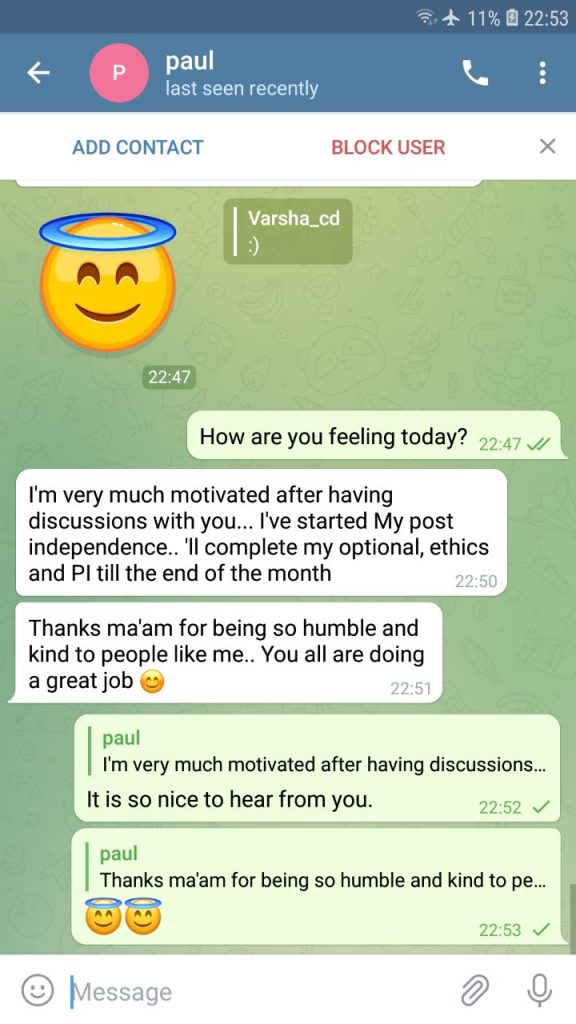
Similarly our another Civilsdaily student, Ashishsums up his Samanvaya experience with Civilsdaily mentor,Pravin Sir, “Because of Pravin sir’s support, I am able to understand a topic in lesser time.”
This is how Pravin sir evaluates Ashish’s Mains Test Series every week. After every test series evaluation, Pravin sir schedules a 1 hour call to discuss how Ashish can improve his marks and the sources he can refer for key topics.
It’s Your Turn Get the Free 40 Min Counselling Session By a CD Mentor
Civilsdaily mentors are so dedicated, consistent and focused for your UPSC goal, that you will eventually become focused into turning your dreams to reality.
At the core of Civilsdaily UPSC mentorship, lies the fact that each one of you will have a unique journey while preparing for the exam. Some will get through on the first attempt without much effort while others will take both more time and more effort.
We want to understand you better to help you optimize your journey so you can focus on the right things and not waste time on the wrong ones. We are asking you to tap into the valuable experiences of mentors who underwent the same grind and realize the pitfalls and understand the shortcuts to make it.
In the first counselling session, we will understand your weaknesses. We then help you to stick to one plan or strategy throughout your preparation. We will then follow up with you on a daily basis to check if you are right on track. TALK TO OUR MENTORS & CLARIFY YOUR DOUBTS NOW