💥UPSC 2026, 2027, 2028 UAP Mentorship (March Batch) + Access XFactor Notes & Microthemes PDF

Search results for: “”

  • Species in news: Amur Falcon

    falcon

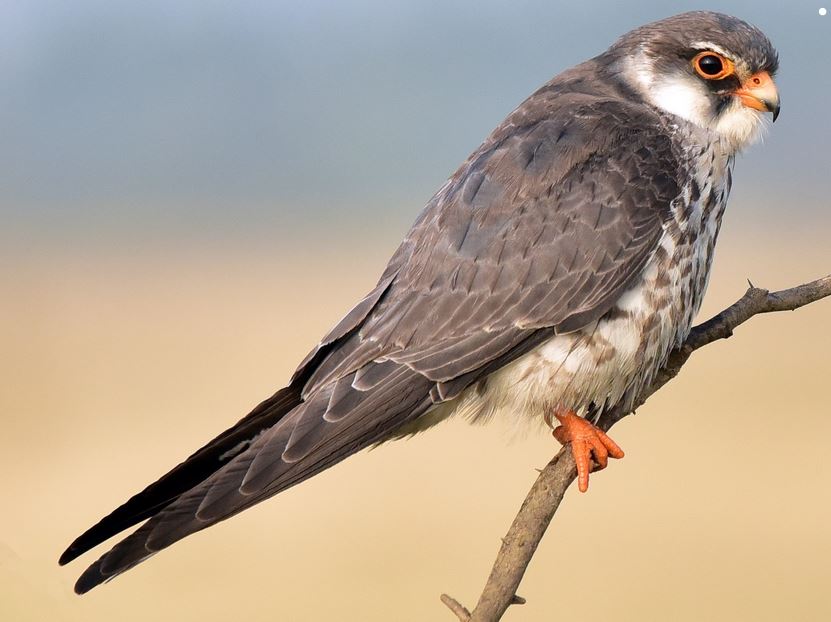
    The Amur falcons have begun to arrive in Manipur after travelling over 20,000 km.

    Amur Falcon

    • The Amur falcon (Falco amurensis) is a small raptor of the falcon family.
    • It breeds in south-eastern Siberia and Northern China before migrating in large flocks across India and over the Arabian Sea to winter in Southern and East Africa.

    How it migrates?

    • Locally known as Akhuipuina, the bird arrives mainly in Manipur and Nagaland on its southbound migration from breeding grounds in North China, Eastern Mongolia and far-east Russia.
    • They travel to Manipur en-route to its wintering grounds in South Africa.
    • The one-way journey via India is about 20,000 km long and the birds do this twice a year.
    • They spend three-four weeks in many parts of Manipur to build fat reserves by preying on termites that emerge around this time.

    Conservation status

    • It is protected under the Wildlife Protection Act 1972 and included under its Schedule IV.
    • It is listed in the IUCN Red list as Least Concern.
    • Hunting of the birds or possessing its meat is punishable with imprisonment up to three years or a fine up to Rs 5,000.
    • In 2018, the forest department started a conservation programme by radio-tagging the birds to study their migratory route.

    Click and get your FREE copy of Current Affairs micro notes

  • Ethics Masterclass 2023 Offline-Online Batches launched | Lectures, tests 1-1 mentorship by Sukanya ma’am. Details inside

    Ethics Masterclass 2023 Offline-Online Batches launched | Lectures, tests 1-1 mentorship by Sukanya ma’am. Details inside

    Now is the perfect time for you to start Ethics.

    Why? First is the time factor. From Jan 2023 you will get engrossed in prelims prep. And you need at least 1.5 – 2 months for GS Paper 4 – Ethics with answer writing practice. The second factor is weightage – 250 marks. You don’t want to ignore it and leave it for your post-prelims plan.

    CivilsDaily is launching Ethics Masterclass 2023 under Sukanya ma’am

    Click here for more details – Ethics Masterclass 2023

    Table of Content


    What is Ethics Masterclass?

    Ethics Masterclass is a Sukanya ma’am-led mentor-driven holistic course for GS Paper 4, i.e. Ethics, Integrity, and Aptitude, by Civilsdaily.

    Program details

    • We will cover the whole GS 4 syllabus and Case studies
    • Weekly Mini tests for revisions
    • Civilsdaily Handholding with 1 on 1 mentorship 
    • Emphasis on application-based studies as derived from Previous year questions
    • Notes – Full Topic wise notes are available on every chapter as PDF.
    • Lectures ppt will also be available
    • Online lectures will be available on the portal till Mains 2023
    • Webinar on doubt clearance till mains 2023 based on demand.

    Ethics Masterclass Details

    Start Date: 7th November

    Duration- 16 Lectures

    Course fee: Rs 8000 + GST 

    Mode: This program is available both Offline and Online

    Offline classes will be held at CivilsDaily’s Delhi Center in Karol Bagh

    LOCATION: 1 LGF, Apsara Arcade, Next to Karol Bagh Metro Stn. (Gate #7), Delhi 110060

    Paper 4 aka Ethics is the most dynamic General studies paper out of the lot. There is no “ONE WAY approach” in ethics. Scoring well in an ethics paper is essential for shortlisting and getting the desired services. Like an essay paper, this paper gives maximum returns. One can get good marks with significantly less effort. Thorough preparation of this paper helps to add a moral dimension to GS Papers – 1, 2, 3 Papers and Essay Paper Answers. It helps to come across as a person with desired qualities of a government employee in the personality test.

    This is an offline effort to combine the cohort based learning with classsroom lectures to provide a complete learning experience. A focused, personalized, and Mentor guided approach will ensure a disciplined and holistic preparation.

    VIDEO LECTURES

    Structured video lectures of Paper 4 for a concrete understanding of the syllabus. Our novel methodology accompanied by an in-depth explanation ensures comprehensive coverage of every topic in the syllabus. Added to this, we have made sure to add that extra element of fun.

    Sukanya Rana Ethics Civilsdaily IAS 2021 upsc 2021

    DOUBT AND DISCUSSION SESSION

    A schedule is created where dedicated days are kept to discuss your doubts regarding each lecture. So, cover the part of the lecture video for the day and clear your doubts the same day. In addition to that, It also provides an opportunity to carry out advanced discussion sessions focused on video lectures. This is additional to the basic level discussion on the Ethics group.

    MINI-TESTS

    A mini-test on the weekend will help to bring together the ideas and concepts learned throughout the week. This is the perfect icing on the cake! Get personalized reviews on your answers by Sukanya ma’am to understand how you can improve and score better.

    CASE STUDIES DISCUSSION

    Scoring in case studies translates into a good score in paper 4. Learn the tips and tricks to master Section B of the ethics paper with discussions and practice questions.

    CIVILSDAILY’S HANDHOLDING

    You’ll be given membership to an exclusive group on Civilsdaily’s Habitat. The group will be headed by Sukanya ma’am herself. From doubt resolution, discussion, and personalized review of the mini-test copies will be done by Sukanya ma’am only. Here you can directly connect with ma’am.

    Below – Ethics discussion on Habitat


    ethics for upsc 2020 2021 ias civilsadaily sukanya rana

    Should you encounter any issues in this process or you have a query, reach out to us at 7303316700 or hello@civilsdaily.com

  • Are there anti-superstition laws in India?

    superstition

    Context

    • The brutal murders of two women as part of “ritualistic human sacrifices” in the Pathanamthitta district of Kerala have left the country in shock. Chilling details of the killings have sparked a debate about the prevalence of superstitious beliefs, black magic and sorcery in Kerala. In the absence of a comprehensive law to counter such acts, the call for a strict anti-superstition law has grown louder.

    superstition

    What is Superstition?

    • Superstition is an irrational belief usually founded on ignorance or fear and characterized by obsessive reverence for omens, charms etc. It is a notion, act or ritual that derives from such belief.

    What is Witchcraft?

    • Black magic is also known as Witchcraft is usage of supernatural power for evil and selfish purposes and to perform malicious practices to destroy someone physically or mentally or financially.
    • Black magic makes humans victims of baseless fears, reverses fortunes and confusions.

    superstition

    What is the status of such killings in India?

    • As per the 2021 report of the National Crime Records Bureau (NCRB), six deaths were linked to human sacrifices, while witchcraft was the motive for 68 killings.
    • In 2020, India saw 88 deaths due to witchcraft and 11 died as part of human sacrifices.
    • The maximum number of witchcraft cases were reported from Chhattisgarh (20), followed by Madhya Pradesh (18) and Telangana (11). Kerala saw two cases of human sacrifice, the NCRB report states.

    What are the laws over superstition in India?

    • No central law: In India, there is no central law that exclusively deals with crimes related to witchcraft, superstition, or occult-inspired activities. In the absence of a nationwide legislation, a few States have enacted laws to counter witchcraft and protect women from deadly ‘witch-hunting’.

    superstition

    Anti-superstition Laws enacted by the states

    • Bihar: Bihar was the first State to enact a law to prevent witchcraft, identification of a woman as a witch and “eliminate torture, humiliation and killing of women.” The Prevention of Witch (Daain) Practices Act came into force in October 1999. Anyone who identifies a person as a “witch” and acts to aid this identification can face a jail term of up to three months, or a fine of ₹1,000, or both.
    • Jharkhand: A similar law was passed in Jharkhand in 2001 the Prevention of Witch (Daain) Practices Act.
    • Chhattisgarh: Even though Chhattisgarh is one of the worst-affected States in terms of witchcraft-related crimes, the State enacted the Chhattisgarh Tonahi (witch) Pratadna Nivaran Act only in 2005. As per the law, a person convicted for identifying someone as a witch can be sentenced to up to three years of rigorous imprisonment with a fine
    • Odisha: Following the directions of the Odisha High Court to frame a law to deal with rising cases of witch-hunting in the State, the Odisha Prevention of Witch-Hunting Bill was passed by the Assembly in 2013. The bill provides penalties for a witch doctor, or a person claiming to be a black magician
    • Maharashtra: In Maharashtra, the Maharashtra Prevention and Eradication of Human Sacrifice and other Inhuman, Evil and Aghori Practices and Black Magic Act, 2013 was passed after the murder of anti-superstition activist Dr. Narendra Dabholkar.
    • Rajasthan: The state of Rajasthan enacted the Rajasthan Prevention of Witch-Hunting Act in 2015 to “provide for effective measures to tackle the menace of witch-hunting and prevent the practice of witchcraft.
    • Assam: The Assam Witch Hunting (Prohibition, Prevention and Protection) Act, 2015, which received the President’s assent in 2018, prohibits witch hunting completely. The law states, no person shall identify, call, stigmatize, defame or accuse any other person as witch by words, or by signs or indications or by conducts or actions or any other manner or instigate, aid or abet such an act or commit witch hunting.
    • Karnataka: The latest law was passed in Karnataka where the Karnataka Prevention and Eradication of Inhuman Evil Practices and Black Magic Act, 2017 came into effect in January 2020. The law bans several practices related to black magic and superstition, like forcing a person to walk on fire at religious festivals and the practice of piercing rods from one side of the jaw to the other.

    Conclusion

    • States governments are doing their best to criminalize the rituals of human sacrifices by enacting stringent laws. There is need to have a concrete nationwide anti-superstition law and as a society every individual should be made a stakeholder in awareness against human sacrifices based on witchcraft and rituals.

    Mains Question

    Q. What is Superstition? Are there any anti-superstition laws in India that criminalizes the rituals such as human sacrifices and witch-hunting? Discuss.

    Click and Get your FREE copy of Current Affairs Micro notes

  • Get 87 paged PDF + recorded session | FREE Masterclass – Write introductions and conclusions to UPSC Mains answers like IAS toppers | Key to 450+ marks in GS Mains | Important Webinar sessions by Sumit and Ranadheer sir

    Get 87 paged PDF + recorded session | FREE Masterclass – Write introductions and conclusions to UPSC Mains answers like IAS toppers | Key to 450+ marks in GS Mains | Important Webinar sessions by Sumit and Ranadheer sir


    1st Nov, 5-8 pm | Get 87 paged Mains Answer Writing PDF document by Sumit sir FREE | Learn and master the skill of writing UPSC intros and conclusions | UPSC GS Paper 1,2,3, and 4 (ethics)


    It’s well said that writing is an art. But, in the case of the IAS exam, Answer writing is a skill rather than an art. Every year lakhs of aspirants sit for the UPSC-IAS exam, but only 0.005% become an IAS/IPS. It doesn’t mean 99% of people lack knowledge. They lack the required skills that an IAS aspirant must have, that is to articulate the knowledge and information that they have.

    Writing an excellent conclusion is more important than an introduction, since that’s the last thing an examiner reads before giving marks for your answer.

    Sajal Singh, Senior Mentor Civilsdaily

    While an introduction to UPSC Mains answer is as important as the Preamble is to the Consitution of India, it is the conclusion of the answer that can have a greater impact on the marks scored in a particular answer.

    Answer copy of a UPSC topper. (AIR 4)

    However, a perfect UPSC Mains answer balances all the elements including the intro and conclusion. And this is in itself a skill that must be learned and practiced.

    CivilsDaily IAS is conducting a FREE webinar-cum-Masterclass focussing on these elements.

    Webinar Details: Master Introductions and Conclusions for UPSC Mains Answers

    Sumit sir and Ranadheer sir will be taking a LIVE webinar on coming Monday. Through a LIVE answer writing session, they will be teaching and helping you master the skills required to formulate amazing introductions and conclusions.

    Webinar on 1st Nov, 5-8 pm – Tuesday

    Session 1: Sumit sir will be taking LIVE Masterclass for UPSC GS Paper 1,2, and 3

    Session 2: Ranadheer sir will join and take LIVE Masterclass for UPSC GS Paper 4 (Ethics)

    Key takeaways from the session

    1. Starting an Answer with crisp Introduction and Writing wholesome conclusions
    2. How to approach a Mains question?
    3. How to structure your answer! Where to insert bullet points! Where and how to insert charts, Etc. will such achieving points will be discussed.
    4. Our step-by-step separate plans for GS papers’ answer writing and Essay writing with our Hall of fame toppers’ rule of thumb skills are also discussed.
    5. How not to get lost in the word limit for unfamiliar questions. How to maintain ‘Accuracy’, ‘Brevity’, and ‘Clarity’ to every answer?
    6. How to identify Opinion-based questions and Fact-based questions. And how not to wait for long for the answers to come out from your mind? 
    7. How to keep ‘Brainstorming, Outlining, Idea/Argument Placement, and Structuring’ within a stipulated time will also be thoroughly discussed in this masterclass.
    8. How to construct your answers with a fitting intro. + Positive-negative combination in body and a well-balanced conclusion.

    Clearing UPSC mains is an art of excellence & can be achieved even by improving 1% a day. All it wants are will and effort, methodical practice, and ultimate guidance. 


    Our step-by-step answer writing strategy enables you to justify not only ‘how to care about the distinguishing answer framework’ but also ‘how to introduce and conclude the answer in mains’ and to develop templates for answers that you can recall at short notice. Here we will be focussing on the body of the Mains answer.

    Register for the webinar. Submit your query and get Telegram group + access to FREE resources. Sumit sir will also share a special PDF with you post-webinar.

    About the Mentors

    What The Hindu mentioned about Civilsdaily Mentorship

    The Hindu has acknowledged the success rate of CD’s Smash mains Mentorship

    Quora Digests:

    Register for the webinar. Submit your query and get Telegram group + access to FREE resources. Sumit sir will also share a special PDF with you post-webinar.

  • The case of “Governor’s pleasure”

    pleasure

    Context

    • A tweet put out recently by the office of the Kerala Governor evoked nationwide attention for all the wrong reasons. It said: “the statements of individual Ministers that lower the dignity of the office of the Governor can invite action including withdrawal of pleasure”. the Governor sent a letter to the Kerala CM asking him to act against the State Finance Minister, who, according to the Governor, had “ceased to enjoy” the Governor’s “pleasure”. The Chief Minister declined to do so.

    Who is a Governor?

    • Parallel to President: The Governors of the states of India have similar powers and functions at the state level as those of the President of India at the Central level.
    • Nominal head: The governor acts as the nominal head whereas the real power lies with the Chief Ministers of the states and her/his councils of ministers.
    • Similar offices: Governors exist in the states while Lieutenant Governors or Administrators exist in union territories including National Capital Territory of Delhi.
    • Non-local appointees: Few or no governors are local to the state that they are appointed to govern.

    Important Constitutional Provisions related to Governor

    • Article 153: It requires a governor to be appointed for every state in India.
    • Article 154: Vests the executive power of the State in the Governor
    • Article 155: Appointment of the Governor
    • Article 156: Term of Office of Governor
    • Article 157: Qualifications for appointment as Governor

    Executive functions of Governor include

    • An important function of the Governor is to appoint the Chief Minister of the State.
    • Other ministers are also appointed by the Governor on the advice of the Chief Minister.
    • The ministers including the Chief Minister hold office during the pleasure of the Governor.
    • The Governor has the constitutional right to know the decisions of the Council of Ministers relating to the administrative affairs of the State and the proposals for legislation.

    What are the contradictory issues with Governor’s office?

    • Bound by the principle: The function of the appointed Governor is always subject to the policies of the elected government, and not vice-versa. This is a foundational theory of India’s constitutional democracy.
    • Contradictory Aid and advise and Discretion: Article 163(1) says that the Council of Ministers must aid and advise the Governor. However, according to Article 163(2), the Governor can act in his discretion in certain matters as permitted by the Constitution
    • Discretion still bounds by cabinet decision: Governor is generally bound by the Cabinet decision except when he has a legitimate right to invoke his discretion, say, for example, in deciding on sanction to prosecute a cabinet minister or in his decisions as Administrator of a Union Territory, as per the orders of the President of India, etc.
    • Apparatus of interaction: There are no provisions laid down for the manner in which the Governor and the state must engage publicly when there is a difference of opinion. The management of differences has traditionally been guided by respect for each other’s boundaries.

    Pleasure

    Issues of “Pleasure” of Governor

    • Constitution Bench judgment of Supreme court in Shamsher Singh vs State of Punjab (1974) case:
    • In Shamsher Singh, for the purpose of comparison, the Supreme Court extracted Dr. B.R. Ambedkar’s introductory statement made on November 4, 1948, in the Constituent Assembly, which said: “The President of the United States is not bound to accept any advice tendered to him by any of his secretaries. The President of the Indian Union will be generally bound by the advice of his Ministers. He can do nothing contrary to their advice nor can he do anything without their advice. The President of the United States can dismiss any Secretary at any time. The President of the Indian Union has no power to do so, so long as his Ministers command a majority in Parliament”.
    • The same principles apply to the Governors as well, since the Union Minister also holds the office “during the pleasure of the President” as in Article 75(2) of the Constitution.
    • “Withdrawal of pleasure”, without advice from the Council of Ministers, as indicated by Raj Bhavan is a misconception.
    • Historical background of Article 264:
    • The draft Constitution, prepared by the Constitutional Adviser in October 1947, contained Article 126, according to which, “Governor’s Ministers shall be chosen and summoned by (the Governor) and shall hold office during his pleasure”.
    • This Article, which was made part of the draft of the erstwhile Article 144, was discussed at length in the Constituent Assembly.
    • The general discretion with the Governor was taken away, and the Cabinet was given the authority to rule. Amendment to the draft Article 144 moved by B.R. Ambedkar resulted in the present constitutional scheme of Articles 163 and 164.
    • According to the Scholar Subhash C. Kashyap:
    • The words ‘during pleasure’ were, always understood to mean that the ‘pleasure’ should not continue when the Ministry had lost the confidence of the majority.
    • the moment the Ministry lost the confidence of the majority, the Governor would use his ‘pleasure’ in dismissing it.

    Conclusion

    • During the deliberations in Constituent Assembly Debates,1949, H.V. Kamath asked if there was any guarantee against abuse of power by the Governor. The immediate reaction by P.S. Deshmukh, another prominent member was: “the guarantee is the Governor’s wisdom and the wisdom of the authority that will appoint the Governor”

    Mains Question

    Q. What is the role of Rajbhavans in the state government’s day to day business. Analyze the constitutional mandate of the governor’s pleasure and accountability of ministers.

    Click and Get your FREE copy of Current Affairs Micro notes

  • Gujarat announces panel to study Uniform Civil Code (UCC)

    The Gujarat government has moved a proposal to constitute a committee to evaluate all aspects of implementing the Uniform Civil Code (UCC).

    What is a Uniform Civil Code (UCC)?

    • A UCC is one that would provide for one personal civil law for the entire country.
    • This would be applicable to all religious communities in their personal matters such as marriage, divorce, inheritance, adoption etc.

    Basis for UCC

    • Article 44, one of the Directive Principles of the Constitution lays down that the state shall endeavour to secure a UCC for the citizens throughout the territory of India.
    • These, as defined in Article 37, are not justiciable (not enforceable by any court) but the principles laid down therein are fundamental in governance.

    Personal Laws And Uniform Civil Code: Timeline

    # British period
    During the British Raj, Personal laws were first framed mainly for Hindu and Muslims citizens.

    # Start of 20th Century
    In the beginning of the twentieth century, the demand for a uniform civil code was first put forward by the women activists. The objective behind this demand was the women’s rights, equality and secularism.

    # 1940 – The Idea of Uniform Civil Code is born
    The idea of Uniform Civil Code was tabled by the National Planning Commission (NPC) appointed by the Congress. There was a subcommittee who was to examine women’s status and recommends reforms of personal law for gender equality.

    # 1947 – Question of UCC as a Fundamental Right
    UCC was sought to be enshrined in the Constitution of India as a fundamental right by Minoo Masani, Hansa Mehta, Amrit Kaur and Dr. B.R Ambedkar.

    # 1948 – Constitution Assembly debated UCC
    Article 44 of the Indian Constitution i.e. Directive Principles of State Policy sets implementation of uniform civil laws which is the duty of the state under Part IV.

    # 1950 – Reformist Bill passed
    Reformist bills were passed which gave the Hindu women the right to divorce and inherit property. Bigamy and child marriages are outlawed. Such reforms were resisted by Dr. Rajendra Prasad.

    # 1951 – Dr. Ambedkar Resigns
    Dr. Ambedkar resigned from the cabinet in 1951 when his draft of the Hindu Code Bill was stalled by the Parliament.

    # 1985 – Shah Bano Case
    In this case, a divorced Muslim woman was brought within the ambit of Section 125 of Code of Criminal Procedure, 1973 by the Supreme Court in which it was declared by the Apex court that she was entitled for maintenance even after the completion ofiddatperiod.

    # 1995- Sarla Mudgal v. Union of India
    In this case, Justice Kuldip Singh reiterated the need for the Parliament to frame a Uniform Civil Code, which would help the cause of national integration by removing contradictions based on ideologies. Therefore, the responsibility entrusted on the State under Article 44 of the Constitution whereby a Uniform Civil Code must be secured has been urged by the Supreme Court repeatedly as a matter of urgency.

    # 2000 – Supreme Court advocates UCC
    The case of Lily Thomas v. Union of India (2000),where the Supreme Court said it could not direct the centre to introduce a UCC.

    # 2015 – The Debate lives through
    The apex court refused to direct the government to take a decision on having a UCC.

    # 2016 – Triple Talaq Debate
    When PM asked the Law Commission to examine the issue.

    # 2017 – Ruling of the Triple Talaq case
    Triple Talaq (Talaq -e- biddat) was declared unconstitutional on August 22, 2017.

    UCC vs. Right to Freedom of Religion

    1. Article 25 lays down an individual’s fundamental right to religion
    2. Article 26(b) upholds the right of each religious denomination or any section thereof to “manage its own affairs in matters of religion”
    3. Article 29 defines the right to conserve distinctive culture

    Reasonable restrictions on the Freedom of Religion

    • An individual’s freedom of religion under Article 25 is subject to “public order, health, morality” and other provisions relating to FRs, but a group’s freedom under Article 26 has not been subjected to other FRs.
    • In the Constituent Assembly, there was division on the issue of putting UCC in the fundamental rights chapter. The matter was settled by a vote.
    • By a 5:4 majority, the fundamental rights sub-committee headed by Sardar Patel held that the provision was outside the scope of FRs and therefore the UCC was made less important.

    Minority Opinion in the Constituent Assembly

    • Some members sought to immunize Muslim Personal Law from state regulation.
    • Mohammed Ismail, who thrice tried unsuccessfully to get Muslim Personal Law exempted from Article 44, said a secular state should not interfere with the personal law of people.
    • B Pocker Saheb said he had received representations against a common civil code from various organizations, including Hindu organizations.
    • Hussain Imam questioned whether there could ever be uniformity of personal laws in a diverse country like India.
    • B R Ambedkar said “no government can use its provisions in a way that would force the Muslims to revolt”.
    • Alladi Krishnaswami, who was in favour of a UCC, conceded that it would be unwise to enact UCC ignoring strong opposition from any community.
    • Gender justice was never discussed in these debates.

    Enacting and Enforcing UCC

    • Fundamental rights are enforceable in a court of law.
    • While Article 44 uses the words “state shall endeavour”, other Articles in the ‘Directive Principles’ chapter use words such as “in particular strive”; “shall in particular direct its policy”; “shall be obligation of the state” etc.
    • Article 43 mentions “state shall endeavour by suitable legislation” while the phrase “by suitable legislation” is absent in Article 44.
    • All this implies that the duty of the state is greater in other directive principles than in Article 44.

    What are more important — fundamental rights or directive principles?

    • There is no doubt that fundamental rights are more important.
    • The Supreme Court held in Minerva Mills (1980): Indian Constitution is founded on the bed-rock of the balance between Parts III (Fundamental Rights) and IV (Directive Principles).
    • To give absolute primacy to one over the other is to disturb the harmony of the Constitution.
    • Article 31C inserted by the 42nd Amendment in 1976, however, lays down that if a law is made to implement any directive principle, it cannot be challenged on the ground of being violative of the FRs under Articles 14 and 19.

    What about Personal Laws?

    • Citizens belonging to different religions and denominations follow different property and matrimonial laws which are an affront to the nation’s unity.
    • If the framers of the Constitution had intended to have a UCC, they would have given exclusive jurisdiction to Parliament in respect of personal laws, by including this subject in the Union List.
    • “Personal Laws” are mentioned in the Concurrent List.

    Various customary laws

    • All Hindus of the country are not governed by one law, nor are all Muslims or all Christians.
    • Muslims of Kashmir were governed by a customary law, which in many ways was at variance with Muslim Personal Law in the rest of the country and was, in fact, closer to Hindu law.
    • Even on registration of marriage among Muslims, laws differ from place to place.
    • In the Northeast, there are more than 200 tribes with their own varied customary laws.
    • The Constitution itself protects local customs in Nagaland. Similar protections are enjoyed by Meghalaya and Mizoram.
    • Even reformed Hindu law, in spite of codification, protects customary practices.

     Why need UCC?

    • UCC would provide equal status to all citizens
    • It would promote gender parity in Indian society.
    • UCC would accommodate the aspirations of the young population who imbibe liberal ideology.
    • Its implementation would thus support the national integration.

    Hurdles to UCC implementation

    • There are practical difficulties due to religious and cultural diversity in India.
    • The UCC is often perceived by the minorities as an encroachment of religious freedom.
    • It is often regarded as interference of the state in personal matters of the minorities.
    • Experts often argue that the time is not ripe for Indian society to embrace such UCC.

    These questions need to be addressed which are being completely ignored in the present din around UCC.

    1. Firstly, how can uniformity in personal laws are brought without disturbing the distinct essence of each and every component of the society.
    2. Secondly, what makes us believe that practices of one community are backward and unjust?
    3. Thirdly, has other uniformities been able to eradicate inequalities which diminish the status of our society as a whole?

    Way forward

    • It should be the duty of the religious intelligentia to educate the community about its rights and obligations based on modern liberal interpretations.
    • A good environment for the UCC must be prepared by the government by explaining the contents and significance of Article 44 taking all into confidence.
    • Social reforms are not overnight but gradual phenomenon. They are often vulnerable to media evils such as fake news and disinformation.
    • Social harmony and cultural fabric of our nation must be the priority.

    Conclusion

    • The purpose behind UCC is to strengthen the object of “Secular Democratic Republic” as enshrined in the Preamble of the Constitution.
    • This provision is provided to effect the integration of India by bringing communities on a common platform on matters which are at present governed by diverse personal laws.
    • Hence UCC should be enforced taking into confidence all the sections of Indian society.


    Click and Get your FREE copy of Current Affairs Micro notes

  • What is the Doctrine of Pleasure?

    The Kerala Governor has sought dismissal of a minister from the Cabinet, declaring that he has withdrawn the pleasure of having him in the Council of Ministers.

    Doctrine of Pleasure: The concept behind

    • The pleasure doctrine is a concept derived from English common law.
    • It says is that a civil servant of the Crown holds office during the pleasure of the Crown.
    • This means his services can be terminated at any time by the Crown, without assigning any reason.

    How is it practised in India?

    • In India, Article 310 of the Constitution says every person in the defence or civil service of the Union holds office during the pleasure of the President.
    • Similarly, every member of the civil service in the States holds office during the pleasure of the Governor.
    • However, Article 311 imposes restrictions on the removal of a civil servant.

    How arbitrary is this doctrine?

    • It provides for civil servants being given a reasonable opportunity for a hearing on the charges against them.
    • There is also a provision to dispense with the inquiry if it is not practicable to hold one, or if it is not expedient to do so in the interest of national security.
    • In practical terms, the pleasure of the President referred to here is that of the Union government, and the Governor’s pleasure is that of the State government.

    Is the governor entitled to exercise his/her displeasure?

    • Under Article 164, the Chief Minister is appointed by the Governor; and the other Ministers are appointed by the Governor on the CM’s advice.
    • It adds that Ministers hold office during the pleasure of the Governor.
    • In a constitutional scheme in which they are appointed solely on the CM’s advice, the ‘pleasure’ referred to is also taken to mean the right of the CM to dismiss a Minister, and not that of the Governor.

    Why in news now?

    Ans. Issue over appointment of Vice-Chancellor

    • The latest controversy has arisen after the Governor sought the resignation of several vice-chancellors following a Supreme Court judgment.
    • The V-C’s appointment of a technical university was contrary to the regulations of the University Grants Commission (UGC).
    • The appointment Committee had identified only one candidate and recommended the name to the Chancellor for appointment.
    • However, under UGC regulations, a panel of three to five names should be recommended so that the Chancellor has a number of options to choose from.

    How is Governor involved in this?

    • The Governor, in his capacity as Chancellor of universities, responded by directing the V-Cs of nine universities to resign the very next day.
    • He contended that the infirmities pointed out by the Supreme Court in one case also vitiated their appointments.


    Click and Get your FREE copy of Current Affairs Micro notes

  • Dolphins return to the Ganga

    dolphin

    Dolphins have started coming back to the Ganga with improvement in the quality of the river water made possible by the Namami Gange Programme.

    About Gangetic Dolphin

    • The Gangetic river system is home to a vast variety of aquatic life, including the Gangetic dolphin (Platanista gangetica).
    • It is one of five species of river dolphin found around the world.
    • It is found mainly in the Indian subcontinent, particularly in Ganga-Brahmaputra-Meghna and Karnaphuli-Sangu river systems.
    • An adult dolphin could weigh between 70 kg and 90 kg. The breeding season of the Gangetic dolphin extends from January to June.
    • They feed on several species of fishes, invertebrates etc.

    Threats to Gangetic dolphins

    • The construction of dams and barrages and increasing pollution has led to a decline in the population of aquatic animals in the rivers in general and of dolphins in particular.
    • Aquatic life is an indicator of the health of river ecosystems.
    • As the Gangetic dolphin is at the top of the food chain, protecting the species and its habitat will ensure

    How are they conserved?

    • Although efforts to save them were started in the mid-1980s, the estimates suggest the numbers have not risen as a result.
    • The Gangetic dolphin remains listed as Endangered by the IUCN.
    • After the launch of Ganga Action Plan in 1985, the government on November 24, 1986, included Gangetic dolphins in the First Schedule of the Indian Wildlife (Protection), Act 1972.
    • This was aimed at checking hunting and providing conservation facilities such as wildlife sanctuaries.
    • For instance, Vikramshila Ganges Dolphin Sanctuary was established in Bihar under this Act.
    • It has been recognized as National Aquatic Animal of India.

    Policy moves for conservation

    • The government had prepared The Conservation Action Plan for the Ganges River Dolphin 2010-2020.
    • The National Mission for Clean Ganga celebrates October 5 as National Ganga River Dolphin Day.
    • There is also Project Dolphin on the lines of Project Tiger, which has helped increase the tiger population.


    Try this PYQ:

    Which one of the following is the national aquatic animal of India?

    (a) Saltwater crocodile

    (b) Olive ridley turtle

    (c) Gangetic dolphin

    (d) Gharial


    Post your answers here.


    Click and Get your FREE copy of Current Affairs Micro notes

  • GI in news: Kalanamak Rice

    kalanamak

    Kalanamak, a traditional variety of paddy is all set to get a new look and name.

    Kalanamak Rice

    • Kalanamak rice is a paddy with black husk and strong fragrance, which is considered a gift from Lord Buddha to the people of Sravasti when he visited the region after enlightenment,
    • It is grown in 11 districts of the Terai region of northeastern Uttar Pradesh and in Nepal.
    • The traditional Kalanamak rice is protected under the Geographical Indication (GI) tag
    • It’s recorded in the GI application that Lord Budhha gifted Kalanamak paddy to the people of Sravasti so that they remembered him by its fragrance.

    What is the upgrade?

    • The traditional paddy has been prone to ‘lodging’, a reason for its low yield.
    • Lodging is a condition in which the top of the plant becomes heavy because of grain formation, the stem becomes weak, and the plant falls on the ground.
    • Addressing the problem, the Indian Agriculture Research Institute (IARI) has successfully developed two dwarf varieties of Kalanamak rice.
    • They have been named Pusa Narendra Kalanamak 1638 and Pusa Narendra Kalanamak 1652.

    Back2Basics:  Geographical Indication

    • A GI is a sign used on products that have a specific geographical origin and possess qualities or a reputation that are due to that origin.
    • Nodal Agency: Department for Promotion of Industry and Internal Trade (DPIIT), Ministry of Commerce and Industry
    • India, as a member of the World Trade Organization (WTO), enacted the Geographical Indications of Goods (Registration and Protection) Act, 1999 w.e.f. September 2003.
    • GIs have been defined under Article 22 (1) of the WTO Agreement on Trade-Related Aspects of Intellectual Property Rights (TRIPS) Agreement.
    • GI is granted for a term of 10 years in India. As of today, more than 300 GI tags has been allocated so far in India (*Wikipedia).
    • The tag stands valid for 10 years.


    Click and Get your FREE copy of Current Affairs Micro notes

  • Privacy Policy

    At Civilsdaily, accessible from www.civilsdaily.com, one of our main priorities is the privacy of our visitors.

    This Privacy Policy describes how we collect, receive, use, store, share, transfer, and process your Personal Data. For the purposes of this Privacy Policy “Personal Data” means any information relating to an identified or identifiable individual. If you do not agree with this Privacy Policy, you must not use our websites, product and services, or any other sites or services that link to this Privacy Policy.

    Information That You Provide:

    We may collect information that you provide when using our website, product and services

    The types of personal information that you provide may include your full name, email address, telephone number, billing address, debit/credit card information, and other contact or identifying information that you choose to provide. We store, process, and maintain files and content that you create and/or upload using our Product and services, as well as other data related to your account in order to provide the Product and services to you.

    We do not store any credit/debit card information we receive except as necessary to complete and satisfy our rights and obligations with regard to such transaction, invoice generations, and/or as otherwise authorized by you.

    Information We Collect:

    We collect usage data when user interact with our Product & Services. Usage data includes metrics and information regarding your use and interaction.

    We may receive information about you or other users from our network of affiliates and partners. We may receive this data from our deal and lead registration process through our partners and social media sites.

    If you participate in a video conference with us, we may record the session and retain the recordings. We will notify you first that the session is being recorded so that you can choose to terminate the meeting. If you participate in a training or product course, we collect completion data.

    Like most websites and technology services delivered over the Internet, we automatically collect and store information about your computer hardware and software when you visit our websites, use our product and services, or visit other sites or services that link to this Privacy Policy. This information can include your IP address, browser type, domain names, internet service provider (ISP), and the files viewed on our websites.

    We use a variety of technologies to collect this information, such as first party and third-party cookies and tracking services that employ cookies and page tags. This data includes usage and user statistics.

    How we use your information

    We use the information we collect in various ways, including to:

    • Provide, operate, and maintain our website
    • Improve, personalize, and expand our website
    • Understand and analyze how you use our website
    • Develop new products, services, features, and functionality
    • Communicate with you, either directly or through one of our partners, including for customer service, to provide you with updates and other information relating to the website, and for marketing and promotional purposes
    • Send you emails
    • Find and prevent fraud

    Information we may share:

    We will never “sell” your personal information. However, we may share your personal information with third parties as follows:

    1. Third Party Service Providers
    We use third party service providers to support our websites, products, and services. For example, we use service providers for data hosting, software application design and development, sales and marketing. We may need to share your information with service providers to provide information about products or services to you. Examples may include hosting course video, PDF on server, analyzing data or performing statistical analysis on interactions on our websites, providing marketing assistance, processing debit and credit card payments, supplementing the information you provide us in order to provide you with better service, developing and improving the product and services, and providing customer service or support. These service providers are prohibited from using your Personal Data except for these purposes, and they are required to maintain the confidentiality of your information. In all cases where we share your information in this way, we explicitly require the third-party service providers to acknowledge and adhere to our privacy and data protection policies and standards.

    2. Business affiliates and partners
    We may share data with trusted affiliates and partners to contact you based on your request to receive such communications, help us perform statistical analysis, or provide sales support, or provide customer support. Partners are prohibited from using your Personal Data except for these purposes, and they are required to maintain the confidentiality of your data.

    3. Change in ownership
    If Civilsdaily is acquired by another company, whether by merger, acquisition, bankruptcy or otherwise, that company would receive all information gathered by Civilsdaily on the websites and the Subscription Service. In this event, you will be notified via email and/or a prominent notice on our website, of any change in ownership, uses of your Personal Data, and choices you may have regarding your Personal Data.

    4. Public Forums
    Our websites may offer publicly accessible message boards, blogs, and community forums . Please keep in mind that if you directly disclose any information through our public message boards, blogs, or forums it may be read, collected and used by any member of the public who accesses these websites. Your posts and certain profile information may remain even after you terminate your account. We urge you to consider the sensitivity of any information you may disclose in this way.

    5. Compelled Disclosure
    We reserve the right to use or disclose your Personal Data if required by law or if we reasonably believe that use or disclosure is necessary to protect our rights, protect your safety or the safety of others, investigate fraud, or comply with a law, court order, or legal process.

    6. Advertising and analytics services provider by others
    We may allow others to provide analytics services and display advertisements for our Product. These providers may use cookies, web beacons, device identifiers, and other tracking technologies that collect information about your use of our Product. This information may be used by us and others to determine the popularity of our Product, deliver advertising and content targeted to your interests in the Product, and on other websites, apps, and other services, and to better understand your online activity.

    Where we store your personal data

    (i) Data Storage: All data you provide through our Product is stored on our server providers. Any payment transactions will be encrypted; all payment data is stored by our payment processor and is never stored on our servers.

    (ii) Data Security: Civilsdaily takes reasonable measures to protect your personal information and your content from loss, misuse, and unauthorized access, disclosure, modification, and destruction and to ensure that your content remains protected and available to you. Unfortunately, the transmission of data via the internet is not completely secure and although we do our best to protect your personal data, we cannot guarantee the security of your data transmitted through the Product. All transmissions are at your own risk.

    (iii) Data Retention: Civilsdaily stores the information we collect for as long as necessary for the purpose for which it was originally collected and in compliance with our legal obligations. We may retain certain information for legitimate business purposes or as required by law.

    Cookies and Other Tracking Technology

    Like any other website, Civilsdaily uses ‘cookies’. These cookies are used to store information including visitors’ preferences, and the pages on the website that the visitor accessed or visited. The information is used to optimize the users’ experience by customizing our web page content based on visitors’ browser type and/or other information.

    Changes to Privacy Policy

    We may update this Privacy Policy to reflect changes to our data practices. If we make any material changes, we will notify you by email (sent to the email address specified in your account) or by means of a notice on our website or in the Product prior to becoming effective. We encourage you to periodically review this page for the latest data on our privacy practices.

    Contact Information

    If you have any questions about this Policy or our practices, please contact us at:

    1 LGF, Apsara Arcade, Next to Karol Bagh Metro Stn. (Gate #7), Delhi 110060

    Email: hello@civilsdaily.com

    Telephone: +917303316700
  • Road to Net Zero Goes Via Green Financing

    financing

    Context

    • Climate finance, or Green Money, remains a critical bottleneck for India in its journey towards the Net Zero 2070 objective and to create a resilient system through climate adaptation and mitigation. The challenge is daunting to make a climate transition for a nation of 1.4 billion people with increasing aggregate national income and individual wealth inequality.

    What is the Present arrangement of external financing for climate change

    • Estimated cost: Finances for climate change were to be channelized through multi-tiered systems in the form of national, regional, and international bodies. It has been estimated that India will need $15 trillion to finance its Net Zero journey.
    • Concessional loans: In most cases, small amounts flowing now into the developing component of the G20 nations are actually in the form of concessional loans rather than grants.
    • Technological support from developed countries: There is no doubt that India will need international financial commitments and technological support from developed countries, who have been erratic with their promised deliveries so far.

    What is green financing?

    • Green finance is a phenomenon that combines the world of finance and business with environment friendly behavior. It may be led by financial incentives, a desire to preserve the planet, or a combination of both.
    • In addition to demonstrating proactive, environment friendly behavior, such as promoting of any business or activity that could be damaging to the environment now or for future generations.

    Green financing through domestic market

    • Status of Green Bonds: As for domestic financial sources, according to an RBI Bulletin from January 2021, green finance in India is still at the nascent stage. Green bonds constituted only 0.7% of all the bonds issued in India since 2018, and bank lending to the non-conventional energy constituted about 7.9% of outstanding bank credit to the power sector as of March 2020.
    • Provision of Green loans: The report also mentioned that the development of green financing and funding of environment-friendly sustainable development is not without challenges, which may include false compliance claims, misuse of green loans, and, most importantly, maturity mismatches between long-term green investments and relatively short-term interests of investors.

    financing

    What are the challenges to green financing?

    • No assessment of climate finance risk: Research report indicates that banks in India, like in many parts of the world, are not prepared to adapt to climate change; and have not yet factored in any climate-related financial risks into their day-to-day decision-making. Some of the criteria used to assess the banks include a commitment to phase out investments in coal, disclosing and verifying direct and indirect emissions, issuing green loans, financing climate mitigation, and Net Zero targets for different types of emissions and their implementation plans.
    • Lack of enthusiasm among bankers: The report is also critical that none of the 34 banks have tested the resilience of their portfolios in the face of climate change. Yet, the bankers’ noise around the green finance topic is euphorically loud, without action.
    • No standard definition of green financing: These banks and financial institutions are also not geared up for financing green transition. India faces the big challenge of “how to define green”, as there is no uniform green definition and green taxonomy.
    • Poor debt market for green finance: The green money is generated through largely debt-based products (green bonds, climate policy performance bonds, debt for climate swaps, etc.), while the fund deployment occurs through debt-based, equity-based, and often, insurance-based instruments, apart from grants and loans. However, the Indian market lacks the depth of its debt markets or the heft of the bond markets.
    • Lack of green data governance: There is an inherent problem with “green data governance” that entails tracking the entire data-chain of a green financing initiative.
    • Unviable green projects: Like many other private sectors funding, the banks look at rates of return that do not really often make financing “public goods” as viable investments. They are even apprehensive about financing projects with long gestation periods with uncertain returns.

    financing

    What is way forward for green financing?

    • Considering social cost of carbon: An economic return alone might not be sufficient to induce green financing. A more holistic rate of return, considering the social cost of carbon, will be appropriate.
    • Return on green investment should include social returns: A longer time horizon will be needed for the cost-benefit analysis and the estimation of the return on investment. This is because, for climate-related projects, the returns increase over time. The extent to which the particular project could result in CO2 reduction and, eventually reduction in the social cost of carbon need to be assessed. As an example, India intends to reduce 1 billion Tonnes of CO2. The present social cost of CO2 (SCC) is $86/tonne. Therefore, the sheer economic gain is to the tune of $86 billion, or 2.1% of the current Indian GDP. Social cost saving is a public good and is enjoyed by all businesses, including the financial institutions.
    • Applying the green taxation: Hence, for a stronger business case for climate finance, experts propose to include in its Return-on-investment calculations the cost-benefit returns of the project through NPVSCC20 the Net Present Value of Social Cost of Carbon over 25 years of the project, a time period that compares well with tenor of infra and sovereign bonds. As an incentive, the government could introduce taxation sops for using NPVSCC25.

    financing

    You may want to know about Net Zero

    • Net zero means cutting greenhouse gas emissions to as close to zero as possible, with remaining emissions re-absorbed by oceans/ forests.
    • China, US, EU and India contribute 75% of total GHG emissions
    • However, per capita GHG emissions for US, EU and China are7,3 and 3 times of India
    • India has set target to achieve net zero emissions by 2070.

    Conclusion

    • The way India finances its journey to Net Zero 2070 could very well be a framework for other nations, for it would need to have contours of social inclusion, economic flexibility, and sustainable financing, while keeping in mind the political compulsions, as well as serving the demographic requirements of creating and sustaining livelihood in decades to come.

    Mains Question

    Q. Green financing is the most crucial part of achieving Net zero target. Comment. What are the India’s efforts to finance its climate action goals?

    UPSC 2023 countdown has begun! Get your personal guidance plan now! (Click here)


  • Reframing the Guidelines of Capital Punishment

    Capital

    Context

    • CJI, Justice Lalit had displayed unique sensitivity to the plight of the condemned ‘death row prisoners’ in Anokhi Lal vs State of M.P. (2019), Irfan vs State of M.P., Manoj and Ors vs State of M.P. (May 2022) and impart corrections in the form of creative directions/guidelines.

    What is capital punishment?

    • Capital punishment, sometimes called death penalty, is execution of an offender sentenced to death after conviction by a court of law for a criminal offense.
    • It should be distinguished from extrajudicial executions carried out without due process of law.
    • The term death penalty is sometimes used interchangeably with capital punishment, though imposition of the penalty is not always followed by execution, because of the possibility of commutation to life imprisonment.

    Capital

    Background of capital punishment

    • Bachan Singh case: In Jagmohan Singh vs State of UP’ (1973), then in ‘Rajendra Prasad vs State of UP’ (1979), and finally in ‘Bachan Singh vs State of Punjab’ (1980) the Supreme Court affirmed the constitutional validity of the death penalty.
    • Punishment according to fair procedure: It said that if capital punishment is provided in the law and the procedure is a fair, just and reasonable one, the death sentence can be awarded to a convict.
    • Rarest of rare case: This will, however, only be in the “rarest of rare” cases, and the courts should render “special reasons” while sending a person to the gallows.

    What is “rarest of rare” case?

    • The principles of what would constitute the “rarest of rare” were laid down by the top court in the landmark judgment in ‘Bachan Singh’.
    • Two prime questions, the top court held, may be asked and answered:
    • First: is there something uncommon about the crime which renders the sentence of imprisonment for life inadequate and calls for a death sentence?
    • Second: are there circumstances of the crime such that there is no alternative but to impose the death sentence even after according to maximum weightage to the mitigating circumstances which speak in favor of the offenders?

    Why existing guidelines are problematic?

    • Arbitrary sentencing: There has long been a judicial crisis in death penalty sentencing on account of unprincipled sentencing, arbitrariness and worrying levels of subjectivity. The crisis has been acknowledged by the Supreme Court, the Law Commission of India, research scholars and civil society groups.
    • Crime-centric nature: Death penalty sentencing has been, by and large, crime-centric. This approach goes against the requirements imposed on sentencing judges by the Supreme Court in Bachan Singh (1980).
    • Nature of crime a dominant consideration: An important reason for the breakdown is that factors relating to the crime the nature of the crime and its brutality are often dominant considerations, and there is barely any consideration of mitigating factors.
    • Little discussion on mitigating factors: There has been very little discussion on bringing the socioeconomic profile of death row prisoners as a mitigating factor into the courtroom.

    capital

    What are new guidelines through recent judgement?

    • Considering Potential mitigating circumstances: The focus here is on reframing ‘Framing Guidelines Regarding Potential Mitigating Circumstances to be Considered While Imposing Death Sentences’, a decision authored by the three judge Bench (the current CJI and Justices Ravindra Bhat and Sudhanshu Dhulia, September 19, 2022).
    • Seeking remedies beyond Legislative and judicial limitation: Such a reference to a larger Bench would constitute yet another step in the direction of death penalty sentencing justice reform such as the legislative limitation flowing from Section 354(3) in the Code of Criminal Procedure; judicial limitation flowing from the ‘rarest of rare’ case; and ‘oral hearing’ after all the remedies to the condemned are exhausted.
    • Mitigating factors are important: Justice Ravindra Bhat did not stop at paying lip service to ‘rarest of rare’ case limitation, but also required the sentencing court to take the trouble of balancing the aggravating factors and mitigating factors, as per the full Bench ruling.
    • The following observations of the Court are significant: “It is also a fact that in all cases where imposition of capital sentence is a choice of sentence, aggravating circumstances would always be on record, and would be part of [the] prosecutor’s evidence, leading to conviction, whereas the accused can scarcely be expected to place mitigating circumstances on the record, for the reason that the stage for doing so is after conviction.
    • Granting real and meaningful opportunity: The three judge Bench decision seems to have gone beyond sentencing incongruities when it observes: “This court is of the opinion that it is necessary to have clarity in the matter to ensure a uniform approach on the question of granting real and meaningful opportunity, as opposed to formal hearing to the accused/convict on the issue of sentence.”

    Conclusion

    • Free, fair and transparent opportunity has been given to accused while awarding the death sentence. Supreme court of India has rightly laid down the guidelines through judgement for sentencing the capital punishment to prevent the arbitrary use and misuse of capital punishment.

    Mains Question

    Q. What are the issues with death penalty guidelines in India? What are the new guidelines by SC regarding capital punishment?

    UPSC 2023 countdown has begun! Get your personal guidance plan now! (Click here)


  • Revitalizing India’s Spectrum Policy

    Spectrum

    Context

    • It is widely acknowledged that spectrum policy in India has had ups and downs, regretfully more downs than ups. Despite the recognized failure, India hosts 800 million internet users and host the second-largest telecommunications network in the world. We wonder what might have been achieved with a more reasonable and transparent spectrum policy.

    Background

    • On September 22, the government released the draft Indian Telecommunication Bill, 2022 seeking to replace the colonial era Indian Telegraph Act, 1885.
    • The draft bill compares spectrum to aatma: “In a way, spectrum is similar to aatma, like aatma, spectrum too does not have any physical form, yet it is omnipresent.” And yet there is one immutable difference in this material world. While the value of aatma is inestimable, spectrum has always had a banal price tag associated with it.

    Spectrum

    What is Draft Indian Telecommunication Bill, 2022?

    • The draft Indian Telecommunication Bill, 2022 is an attempt by the Department of Telecommunications (DoT) to consolidate various legislations presently governing the telecommunication landscape in India.
    • The Bill seeks to replace three laws, the Indian Telegraph Act, 1885, the Indian Wireless Telegraphy Act, 1933 and the Telegraph Wires (Unlawful Possession) Act, 1950.
    • The new regulatory framework is to bring the law at par with technological advancements and remove obsolete provisions from the colonial era laws.

    What is mean by Spectrum?

    • In physics, it’s a word that describes the distribution of something, like energy or atomic particles
    • Spectrum refers to the invisible radio frequencies that wireless signals travel over. Devices such as cell phones and wireline telephones require signals to connect from one end to another.
    • These signals are carried on airwaves, which must be sent at designated frequencies to avoid any kind of interference. The frequencies we use for wireless are only a portion of what is called the electromagnetic spectrum.
    • The Union government owns all the publicly available assets within the geographical boundaries of the country, which also include airwaves.
    • With the expansion in the number of cell phones, wireline telephone and internet users, the need to provide more space for the signals arise from time to time.

    The status of Spectrum policy in India?

    • Host the second largest telecommunications network despite of failures:
    • It is widely acknowledged that spectrum policy in India has had ups and downs, it has for the most part failed to capitalize on the ubiquity of the electromagnetic spectrum to provide meaningful connectivity to all citizens.
    • Despite the recognized failure, we boast of a billion plus mobile subscribers, 800 million internet users and host the second-largest telecommunications network in the world.
    • Ineffective access widening space of digital divide:
    • The intent of the draft bill is to correct past sins so that the benefits of spectrum and technology are better shared, and the quality of access improved for everybody.
    • In other words, since effective access to spectrum has remained a significant barrier to facilitating meaningful connectivity for Indians.
    • Spectrum’s potential is huge but with technical limitations:
    • The draft bill rightly refers to the spectrum as having the characteristics of a public good. It is also an inexhaustible resource. But while spectrum per se is not depletable, there are technical limitations to its optimum utilization at a given point in time.
    • Consequently, it is viewed as a scarce natural resource and what’s more, expensive auctions have made the spectrum dear and arguably exclusionary.
    • High cost of spectrum acquisition:
    • Since 2010, the government has consistently used auctions for spectrum allocation and in only one of the seven auctions held since then, the government was successful in selling 100 per cent of the available spectrum. One reason for this lukewarm response, barring the 2010 auction, is the high cost of spectrum acquisition.
    • High cost of auctions leading to revenue loss for the government:
    • Due to the high reserve price, the most recent auction witnessed spectrum being sold at the reserve price, effectively rendering the basis of an auction moot.
    • If almost all spectrum was sold at its reserve price, and a significant amount goes unsold, it implies that the price was too high, to begin with. It also implies a loss of revenue for the government for spectrum unsold is spectrum squandered.
    • Finally, it results in areas being underserved or unserved affecting quality and quantity.
    • High network charges by operators impacts compromising equal distribution and quality:
    • According to one estimate, at 7.6 per cent of their aggregate revenue, spectrum cost in India is amongst the most expensive in the world.
    • Since network operators incur a significantly higher cost for spectrum compared to other emerging markets, the ability to invest in network upgradation and infrastructure is severely impacted, resulting in uneven distribution of service and poor quality to boot.

    Spectrum

    What Could be the fresh approach?

    • Acknowledging and addressing the issues:
    • It must be recognized that the spectrum needs to be combined with other infrastructure to enable service delivery.
    • The cost of deploying other infrastructure in remote areas is nearly twice as much, while revenue opportunities are far lower, damaging if not destroying the prospects of rural businesses. Plugging the digital divide, therefore, needs a fresh approach.
    • Correcting the cost of spectrum and boosting investment:
    • Since licences and spectrum are typically assigned for service areas that are, for the most part, identified by state boundaries.
    • Since operators predominantly cater to urban markets, the spectrum in remote areas remains under- or in places un-utilized due to a lack of investment in allied infrastructure.
    • Reviving the old and executing the fresh provisions enshrined in draft bill for equitable sharing:
    • The draft bill incorporates practical provisions on the spectrum such as use it, share it, or lose it – an awaited policy that, however, needs innovative support to be successful. The idea of “niche operators” providing services including to telecom operators and manufacturers, introduced in 2005, needs revival in this regard.
    • If licensed operators are unable to utilise the assigned spectrum, the same could be given to local entrepreneurs who understand the needs of rural customers and are better placed to develop a more effective business case more quickly than the larger telcos. Active promotion of the idea of niche operators might just jolt operators out of their lethargy towards rural services.
    • Adopting innovative methods:
    • Alternatively, the government may explore innovative methods of spectrum access such as a non-competitive licensing framework for certain specific use cases.
    • Canada, for instance, has initiated consultations on a non-competitive local licensing framework in the 3900-3980 MHz Band and portions of the 26, 28 and 38 GHz bands to inter alia facilitate broadband connectivity in rural areas.
    • Emphasizing on Transparency and enhancing healthy competition:
    • The government should build an ecosystem that inspires trust so that transparency in assignment can be secured at a reasonable price for operators with strict service obligations without the phantasm of auctions.
    • At the same time, there should be no unsold spectrum. Niche operators should be invoked to engender competition, and government could yet collect revenue for itself.

    Spectrum

    Conclusion

    • The telecom is no longer an end in itself. It exists for user industries much more than ever before. The spill over benefits are far greater than what the sector commands within. Thus, to state the obvious, the vision that is “Digital India” can never be realized if affordable broadband connectivity remains only within the reach of a few.
  • [Burning Issue] China as India’s ‘Frenemy’

    Context

    • China has placed a hold on the proposal to designate Shahid Mahmood as a global terrorist under the 1267 Al Qaeda Sanctions Committee of the UN Security Council. It is the fourth time that China has blocked an India-US proposal in recent months.
    • Some analysts reckon that India and China are fated to remain “frenemies” — entities that share the characteristics of both friends and enemies – and for reasons that have puzzled observers around the world.
    • In this context, in this edition of the burning issue, we will analyze the ‘Frenemy’ relations between the two nations.

    Beginning of India-China Relations

    • The two countries have played up their cultural links-such through the importation of Buddhism into China by wandering Chinese monks more than 1,500 years ago.
    • India and China got independence from the British yoke at the almost same time in the late 1940s. India and China established diplomatic relations on 1st April 1950.
    • India was the first non-socialist country to establish relations with the People’s Republic of China and the catchphrase ‘Hindi Chini Bhai Bhai’ became famous.
    • Both countries attended the Asian-African Conference in which 29 countries participated in Bandung, Indonesia and jointly advocated the Bandung Spirit of solidarity, friendship and cooperation.

    Who is a frenemy?

    • When two countries share interests in multiple arenas such as economic prosperity, regional and global stability, counterterrorism, non-proliferation, energy security, and climate change, but they differ in the ways they pursue those common interests, which creates a constant tension in the relationship, such a pair of countries are called Frenemies in International Relations.
    • For example, India-China, China-Taiwan, China-Japan etc.

    China as a friend: Areas of Cooperation

    Political Relations

    • Border Peace agreement: In 1993, an Agreement on the Maintenance of Peace and Tranquility along the Line of Actual Control (LAC) on the India-China Border Areas was signed to bring stability and substance to bilateral ties. In 2008, the two countries have also extended their strategic and military relations.
    • High-Level Dialogue Mechanism: India and China have also established a High-Level Dialogue Mechanism on Counter-Terrorism and Security.
    • Provincial Leaders Forum: To facilitate exchanges between Indian states and Chinese provinces, States/Provincial Leaders Forum was established.

    Commercial and Economic Relations

    • Investments: China will establish two Industrial Parks in India and expressed its intention to enhance Chinese investment in India. In 2019, Chinese investors invested $6.68 billion in Indian start-ups across 232 deals.
    • Bilateral Trade: The India-China trade is on course to cross USD 100 billion for the second consecutive year as it has gone up to USD 67.08 billion in the first half of this year amid a big surge of Chinese exports.
    • Multiple economic dialogues: Trade and Economic Relationships are shaped through various dialogue mechanisms such as Joint Economic Groups led by the Commerce Ministers of both sides, Strategic Economic Dialogues led by the Vice Chairman of NITI Aayog and the Chairman of National Development and Reform Commission of China.
    • Asian infrastructure and investment bank: India also was a founding member of the China-backed Asian Infrastructure Investment Bank, which plans to be formally established by year’s end and seeks to emulate institutions such as the World Bank and International Monetary Fund. 

    Cultural Relations

    • Movies: India and China have entered into an agreement on the co-production of movies.
    • Kailash yatra ease: MoU was signed to open an additional route for Kailash Mansarovar Yatra through Nathu La.
    • Yoga promotion: Yoga is becoming increasingly popular in China. China was one of the co-sponsors of the UN resolution designating June 21 as the International Day of Yoga

    Education Relations:

    • Education Exchange Programme: India and China signed Education Exchange Programme (EEP), which is an umbrella agreement for educational cooperation between the two countries.
    • Hindi scholarship: Chinese students are also annually awarded scholarships to study Hindi at Kendriya Hindi Sansthan, to learn Hindi

    Indian Community

    • Students and professionals: Presently around 35,500 Indians are staying in China, and students and working professionals form a major part of it.
    • PICFA: Pondicherry India China friendship association is an NGO dedicated to developing people-to-people relations between India and China in the areas of education, culture and tourism.

    Multilateral cooperation

    • BRICS, SCO and RIC grouping: Both are members of the BRICS grouping of emerging economies, which is now establishing a formal lending arm, the New Development Bank. Also, both nations are members of the Shanghai Cooperation Organisation and Russia-India-China informal dialogue minilateral.
    • Voice for Developing nations: both nations serve as the voice of the developing countries at WTO and climate change negotiations.

    China as enemy

    • Arunachal affinity of China: Beijing recently renamed 15 places in Arunachal Pradesh, following the six it had done in 2017. China justifies the renaming as being done based on its historical, cultural and administrative jurisdiction. In January 2022, Beijing’s new land border law came into force, which provides the People’s Liberation Army (PLA) with full responsibility to take steps against “invasion, encroachment, infiltration, provocation” and safeguard Chinese territory.
    • Doklam and Galwan incidents: in 2017, where, for 70 days, Indian and Chinese troops faced off on the doklam plateau, it is that it has led Chinese President Xi Jinping and Indian Prime Minister Narendra Modi to institutionalize their informal summits to avoid a repeat performance of these types of confrontations.
    • Belt Road Initiative: India has objected to this, since its inception on grounds of violating its sovereignty pointing to China Pakistan Economic Corridor.
    • Beijing’s non-reciprocation of goodwill: India’s support to China on global issues has not led to Beijing’s reciprocation for instance: China opposed India’s permanent membership to the UN Security Council and entry into NSG, The U.N. Security Council as a permanent member.
    • UN Blockings: Blocking of U.N. listings of Pakistani terrorists at the UNSC and also bringing resolution in UNSC against India’s Article 370 abrogation move.
    • Huge Trade deficit: India faces a trade imbalance heavily in favor of China. In 2017-18, the trade deficit has gone wide to US$62.9 billion in China’s favor.
    • Border disputes: Two countries failed to resolve their border dispute and steadily established military infrastructure along border areas Indian media outlets have repeatedly reported Chinese military incursions into Indian territory
    • China’s presence in IOR: China has expressed concerns about Indian military and economic activities in the disputed South China Sea. The same way India is also concerned about rising Chinese activities in the Indian Ocean.
    • Pakistan’s all-weather support: China’s strong strategic bilateral relations with Pakistan and other neighboring countries like Nepal and Bhutan are the cause of concern as these countries act as buffer states.

    What are the options for India to ‘manage’ China: Way forward

    • Inevitable Race: The prevailing tension on the China-India border is a symptom of the broader strategic competition between the two Asian neighbors.
    • Quad grouping: Immediately after the clashes, India leaned toward the Quad a grouping of the United States, Australia, Japan, and India with multiple summit meetings and other engagements. Until that point, India was unwilling to refer to the Quad as the Quad, instead using the cumbersome India-Australia-Japan-United States grouping.
    • Equal seriousness: Both sides should treat the military escalation in eastern Ladakh with equal seriousness.
    • Armed coexistence: Even after the resolution of the present standoff in eastern Ladakh, both sides may be in a prolonged period of armed coexistence as a new normal. As the forces on both sides are likely to be relatively balanced, it would be advantageous for both to return to the agreements and understandings from 1993 onward and improve upon them. Clarifying the LAC is a crucial step in this effort.
    • Address trade imbalance: India has flagged the unsustainable trade imbalance at the front and center of the relationship, and this has gone unaddressed. China will need to work on resolving the trade deficit with India. At any rate, decoupling will happen selectively, in the same way, and for the same reasons that China is choosing to decouple from the United States. A balanced trade and economic relationship might lay a solid foundation for future relations, given the size of both economies.
    • Dialogue is necessary: Better understanding of each other’s regional initiatives through open dialogue is important to build trust. The Indo-Pacific vision is as much a developmental necessity for India as the BRI may be for China. Part of building trust must be an open discussion on each other’s intentions in key regions South Asia and the northern Indian Ocean and East Asia and the western Pacific as well as respect for each other’s special positions in the western Pacific and northern Indian Oceans.
    • Protect the core interest: The two sides would need to accommodate the legitimate interests of the other side on key partnerships: China’s with Pakistan and India’s with the United States. These may not be desirable, but in the current circumstances neither will give up its partners, and both India and China could talk through a modus vivendi on the red lines of concern.

    EAM S. Jaishankar’s Suggestion to deal with China

    The External Affairs Minister suggested “Three Mutuals” and “Eight Broad Propositions” as a way forward for the relationship.

    Three mutuals

    • Mutual Respect and Mutual Sensitivity to each other concerns and Mutual Interests to cooperate are the “determining factors” for India-China relations to grow.

    Eight Major propositions

    • Adhering to commitment: The first proposition was that agreements already reached must be adhered to in their entirety, both in letter and in spirit.
    • Respect for LAC: Both sides also needed to strictly observe and respect the LAC, and any attempt to unilaterally change the status quo was completely unacceptable.
    • Maintaining peace and tranquillity: Peace and tranquillity in border areas were the basis for the development of the relationship in other domains. If that was disturbed, he said, the rest of the relationship would be too.
    • Broader partnership: The fourth proposition was that while both remain committed to a multipolar world, they should recognize that a multipolar Asia was one of its essential constituents.
    • Reciprocity: While each state had its interests, concerns and priorities, sensitivities to them could not be one-sided and relations were reciprocal in nature. As rising powers, neither should ignore the other’s set of aspirations.
    • Divergences management: While both sides had made a common cause on development and economic issues and common membership of plurilateral groups was a meeting point, there were divergences when it came to interests and aspirations.
    • Civilizational ties: The last proposition was that as civilizational states, India and China must always take the long view.
    • Cooperation and competition: Even before the events of 2020, the relationship had reflected a duality of cooperation and competition.

    Conclusion

    • India-China relations, though occasionally showing signs of peace and cooperation, have often been afflicted by tension and mistrust. With the potential to make big contributions to regional peace and development, these two Asian powers have, by design or accident, themselves been the sources of regional tension and insecurity to some extent.
    • The two countries are standing at a crossroads, and this might be the final chance to take the path to the coexistence of cooperation and competition. If not, a new phase of antagonistic rivalry may be starting, with the countries sliding into possible confrontation as the strategic periphery of China collides with the strategic backyard of India in the Indian Ocean region.
    • Therefore, China and India should be “Good Neighbors, Good Friends,” as both countries are “important engines of the world economic growth.” By building on that theme, the two countries should “enhance dovetailing of the two countries’ development strategies” to build a “manufacturing partnership.”
    • As Kissinger once said: ‘There are no permanent friends or enemies in international relations, only interests. This is the single most important lesson India should keep in mind if it wants to keep its ‘frenemy’ in check.
  • UAPA gave an impetus to fight against terror: PM

    The Prime Minister has said that Central laws such as the Unlawful Activities (Prevention) Act (UAPA) had given an impetus to the system in a decisive fight against terrorism.

    What is Unlawful (Activities) Prevention Act (UAPA)?

    • The UAPA is aimed at effective prevention of unlawful activities associations in India.
    • Its main objective was to make powers available for dealing with activities directed against the integrity and sovereignty of India
    • It is an upgrade on the Terrorist and Disruptive Activities (Prevention) Act TADA, which was allowed to lapse in 1995 and the Prevention of Terrorism Act (POTA) was repealed in 2004.
    • It was originally passed in 1967 under the then Congress government led by former Prime Minister Indira Gandhi.
    • Till 2004, “unlawful” activities referred to actions related to secession and cession of territory. Following the 2004 amendment, “terrorist act” was added to the list of offences.

    What are Unlawful Activities and Associations?

    • The UAPA lays down the definitions and rules for designating an organisation as an “unlawful association” if it is engaged in certain types of activities.
    • Under Section 3 of the UAPA Act, the government has powers to declare an association “unlawful”.
    • The government can then issue a notification designating such an organisation as a terrorist organisation, if it believes that the organisation is part of “terrorist activities.”

    (1) Unlawful Activites

    • Under section 2(o) of the UAPA, an unlawful activity in relation to an individual or association means – Any action taken by such an individual or association (whether by committing an act or by words, either spoken or written, or by signs or by visible representation or otherwise), –
    1. Works for the Cession of a part of the territory of India or the secession of a part of the territory of India from the Union
    2. Disclaims, questions, disrupts or is intended to Disrupt the sovereignty and territorial integrity of India; or
    3. which causes or is intended to cause Disaffection against India;
    • Related and ancillary acts, including financing, support or promotion of any such activities are also “unlawful activity”.

    (2) Unlawful Association

    The UAPA also defines an “Unlawful Association” under section 2(p) as meaning any association,–

    1. which has for its object any unlawful activity, or which encourages or aids persons to undertake any unlawful activity, or of which the members undertake such activity or
    2. which encourages or aids persons to undertake any such activity, or of which the members undertake any such activity

    Reported abuse of UAPA

    • The PUCL report studied data from the National Crime Records Bureau (NCRB) from 2015 to 2020.
    • It has found per-case conviction rate under the UAPA was 27.57% compared with 49.67% in Indian Penal Code (IPC) cases.
    • The per-arrestee conviction rate was just 2.8% against 22.19% in IPC cases.
    • This is far less to figure of the success of having UAPA.

    Cases registered under UAPA

    • During the check period, 5,924 cases were registered and 8,371 persons arrested.
    • The National Investigation Agency, on its website, had listed 456 cases of which 78% involved UAPA charges.

    Other issues with UAPA

    • Burden of proof: With such high barriers of proof, it is now impossible for an accused to obtain bail, and is in fact a convenient tool to put a person behind bars indefinitely.
    • No interim bail: As a consequence of UAPA being applied, the accused cannot even get bail.
    • Traitor branding: This is being abused by the government, police and prosecution liberally: now, all dissenters are routinely implicated under charges of sedition or criminal conspiracy and under the UAPA.
    • Fake and framed cases: In multiple instances, evidence is untenable, sometimes even arguably planted, and generally weak overall.

    Way forward

    • Even within the constraints of the UAPA, much can be achieved if a responsive and independent judiciary follows the basic principles of natural justice and due process.
    • The governments need to consider the issue of pendency of cases under UAPA and take steps to address the issues by either repealing certain provisions or ensuring speedy trials.

    Conclusion

    • Terrorism is no petty crime.
    • It is sometimes necessary to infringe on due process of a few citizens in order to protect the larger humanity.


    UPSC 2023 countdown has begun! Get your personal guidance plan now! (Click here)

  • PM calls for ‘One Nation, One Uniform’ for Police

    uniform

    Prime Minister has pitched the idea of “One Nation, One Uniform” for Indian police forces.

    One Nation One Uniform

    • PM urged that the identity of police across the country should be the same.
    • This suggestion is in line with his broader attempt to introduce a uniform set of policies across the country.

    How can this be achieved?

    • Law and order is a State Subject.
    • The Indian Constitution puts police forces under the jurisdiction of state governments, and each of the 28 states have their own police force.
    • Both ‘public order’ and the ‘police’ are placed in List II (State List) of the Seventh Schedule of the Constitution, which deals with the division of powers between the Union and States.
    • In the circumstances, it is unclear how the PM’s suggestion, if the government were to take it up seriously, might be implemented.

    Why such move?

    Ans. Inconsistencies in attire

    • While police personnel in India are often associated with the colour khaki, their uniforms do differ in varying degrees in different regions.
    • For example:
    1. Kolkata Police wear white uniforms
    2. Puducherry Police constables wear a bright red cap with their khaki uniforms
    3. Delhi Traffic Police personnel wear white and blue uniforms

    Changes in police uniforms

    Over the years, police departments of various states have made various attempts to reform uniforms for their personnel.

    • Maharashtra: In February 2018, in a bid to prevent colour variation in the uniform of its personnel, the Maharashtra police had decided to provide dope-dyed khaki fabric for its staff. Again, the Maharashtra DGP issued a circular discontinuing the practice of wearing a “tunic uniform” for officers from the rank of Police Sub Inspectors (PSI) to Deputy Superintendent (DySP).
    • Karnataka: In October 2018, the Karnataka Police announced that women personnel would no longer wear khaki saris, rather a khaki shirt and trousers while on duty. This would make it easier for policewomen to do their job and improve their effectiveness in dealing with crime.
    • New Delhi: The Delhi Police had asked the National Institute of Fashion Technology (NIFT) to design fresh uniforms, with an immediate focus on clothing that would be more comfortable.

    Other such moves

    • In August this year, the Ministry of Chemicals and Fertilisers announced that it had implemented the “One Nation One Fertiliser” scheme.
    • The Centre in August 2019 had introduced the “One Nation One Ration Card” scheme.
    • PM has also repeatedly suggested the implementation of “One Nation, One Election”, and adopting a single voter list for all polls.


    UPSC 2023 countdown has begun! Get your personal guidance plan now! (Click here)

  • What is Air Quality Index (AQI)?


    air


    Air Quality Index (AQI)

    • AQI measures how safe the air around you is for breathing. Organizations that report AQI measure the density of various pollutants in the air (such as PM2.5, PM10, nitrogen dioxide, ozone, etc) at different monitoring stations.
    • The widely-used National Air Quality Index (NAQI) given by the Central Pollution Control Board is a 24-hour average.
    • Its unit is micrograms per cubic meter.
    • A particular amount of one pollutant may not be as harmful as the same amount of another pollutant.
    • So, each pollutant’s quantity in the air is adjusted to a common scale (say, 0 to 500) that works for all pollutants.
    • Finally, the pollutant with the worst sub-index determines the AQI for that time and location.

    What are NAAQ standards?

    • The mandate provided to the Central Pollution Control Board (CPCB) under the Air (Prevention and Control of Pollution) Act empowers it to set standards for the quality of air.
    • Hence the current National Ambient Air Quality Standards were notified in November 2009 by the CPCB.
    • Prior to this, India had set Air Quality standards in 1994, and this was later revised in 1998.
    • The 2009 standards further lowered the maximum permissible limits for pollutants and made the standards uniform across the nation.
    • Earlier, less stringent standards were prescribed for industrial zones as compared to residential areas.

    Pollutants covered:

    • Sulphur Dioxide (SO2)
    • Nitrogen Dioxide (NO2),
    • Particulate Matter (size less than 10 µm) or PM 10
    • Particulate Matter (size less than 2.5 µm) or PM2.5
    • Ozone (O3)
    • Carbon Monoxide (CO)
    • Ammonia (NH3)

    (Air Pollutants that most of us NEVER heard of)

    • Lead
    • Benzene (C6H6)
    • Benzo(a)Pyrene (BaP)
    • Arsenic(As)
    • Nickel (Ni)

    What are Initiatives taken by India for Controlling Air Pollution?

    • System of Air Quality and Weather Forecasting and Research (SAFAR) Portal
    • Air Quality Index: AQI has been developed for eight pollutants viz. PM2.5, PM10, Ammonia, Lead, nitrogen oxides, sulphur dioxide, ozone, and carbon monoxide.
    • Graded Response Action Plan
    • For Reducing Vehicular Pollution: BS-VI Vehicles, Push for Electric Vehicles (EVs),Odd-Even Policy as an emergency measure
    • New Commission for Air Quality Management
    • Subsidy to farmers for buying Turbo Happy Seeder (THS) Machine


    UPSC 2023 countdown has begun! Get your personal guidance plan now! (Click here)

  • Arts in news: Tambo Art

    tambo

    Wayanad farmer creates Ashoka Chakra using Tambo art.

    What is Tambo Art?

    • Tambo art is an artistic technique that consists of creating a design with different varieties of rice directly in a rice field.
    • The origin of this art can be traced to Japan where people plant paddy of various varieties and hues to create the desired images.
    • The image of Ashoka Chakra has been created using four varieties of paddy seeds such as Nazar bath, Kala bath, Kaki sala and Ramlee.
    • They will ripen in shades that range from brown to golden, light brown to black, green to black and green to white and black.


    UPSC 2023 countdown has begun! Get your personal guidance plan now! (Click here)

  • 28th Oct| Daily Answer Writing Enhancement

    Topics for Today’s questions:

    GS-1          Important Geophysical phenomena such as earthquakes, Tsunami, Volcanic activity, cyclone. etc., geographical features and their location-changes in critical geographical features (including water-bodies and ice-caps) and in flora and fauna and the effects of such changes. 

    GS-2         Functions and responsibilities of the Union and the States, issues and challenges pertaining to the federal structure

    GS-3        Land reforms in India.

    GS-4        Ethics and Human Interface; Human Values – lessons from the lives and teachings of great leaders, reformers and administrators

    Question 1)


    Q.1 Give an account of the global distribution of volcanoes and explain why they are mainly concentrated along the Pacific Ring of Fire. (10 Marks)


    Question 2)

    Q.2 Despite the constitutional division of powers, Centre-state disputes have been a perennial feature of Indian democracy. Discuss with examples. (10 Marks)

    Question 3)

    Q.3 Digitizing land records will go a long way in ensuring land reforms as well as lessening the burden on the Indian Judiciary. Elaborate. Also, state the measures taken in this context. (10 Marks)

    Question 4)  

    Q.4 Elucidate Swami Vivekananda’s ideas on nationalism. (10 Marks)


    HOW TO ATTEMPT ANSWERS IN DAILY ANSWER WRITING ENHANCEMENT(AWE)?

    1. Daily 4 questions from General studies 1, 2, 3, and 4 will be provided to you.

    2. A Mentor’s Comment will be available for all answers. This can be used as a guidance tool but we encourage you to write original answers.

    3. You can write your answer on an A4 sheet and scan/click pictures of the same.

    4.  Upload the scanned answer in the comment section of the same question.

    5. Along with the scanned answer, please share your Razor payment ID, so that paid members are given priority.

    6. If you upload the answer on the same day like the answer of 11th  February is uploaded on 11th February then your answer will be checked within 72 hours. Also, reviews will be in the order of submission- First come first serve basis

    7. If you are writing answers late, for example, 11th February is uploaded on 13th February , then these answers will be evaluated as per the mentor’s schedule.

    8. We encourage you to write answers on the same day. However, if you are uploading an answer late then tag the mentor like @Staff so that the mentor is notified about your answer.

    *In case your answer is not reviewed, reply to your answer saying *NOT CHECKED*. 

    1. For the philosophy of AWE and payment: 

  • Q.4 Elucidate Swami Vivekananda’s ideas on nationalism. (10 Marks)

    Mentor’s Comments-

    • Briefly introduce the life of Swami Vivekananda.
    • Bring out the various foundations on which his idea of nationalism is based upon.
    • Conclude with the relevance of his views in present-day India.

More posts