💥UPSC 2026, 2027, 2028 UAP Mentorship (March Batch) + Access XFactor Notes & Microthemes PDF

Search results for: “”

  • [Sansad TV] New India Debate | India- Pharmacy of World

    Context

    • The Indian pharma sector supplies over 50 per cent of global demand for various vaccines, 40 per cent of generic demand in the US and 25 per cent of all medicine in the UK.
    • India is the largest provider of generic drugs globally.
    • India is the largest contributor in UNESC with over 50-60% share.

    Feats achieved by India’s Pharma Sector

    • Surplus trade: The Pharma trade balance continues to be in India’s favour. 
    • Worldwide production: India ranks 3rd worldwide for Pharmaceutical production by volume and 14th by value. The current market size is around USD 50 billion. 
    • High competitiveness: Indian pharma companies enabled by their price competitiveness and good quality have made a global mark with 60% of the world’s vaccines and 20% of generic medicines coming from India.   
    • Major destinations: India’s top 5 pharma export destinations are the USA, UK, South Africa, Russia and Nigeria.
    • Regulatory compliance: Around 55 % of our pharma exports from India cater to highly regulated markets. For instance, the largest number of FDA approved plants outside the US is in India.

    India’s Pharma Sector: A Backgrounder

    pharma
    • India enjoys an important position in the global pharmaceuticals sector.
    • The country has a large pool of scientists and engineers with the potential to steer the industry ahead to greater heights.
    • Presently, over 80% of the antiretroviral drugs used globally to combat AIDS (Acquired Immune Deficiency Syndrome) are supplied by Indian pharmaceutical firms.

    Its evolution

    Over the last few decades, the Indian pharmaceutical industry has experienced rapid expansion, which may be divided into four stages:

    1. Foreign domination: The time before 1970 is considered as the first stage of the pharma industry. At that time, the Indian market was dominated by foreign companies.
    2. Rise of domestic companies: The second stage covers 1970 to 1990 when several domestic companies began operations.
    3. LPG reforms: 1990 to 2010 is the third stage, where liberalization led Indian components to launch operations in foreign countries.
    4. Patent assisted boom: The introduction of the patent bill was one of the first advancements in the pharma industry. It allowed the Indian pharmaceutical sector to become less reliant on intellectual property laws in the US.
    5. Rise of OTC drugs: Over-the-counter drugs (bought without prescriptions) constitute the next biggest segment with 21% of the market segment.

    Market Size

    • According to the Indian Economic Survey 2021, the domestic market is expected to grow 3x in the next decade.
    • India’s domestic pharmaceutical market is at US$ 42 billion in 2021 and likely to reach US$ 65 billion by 2024 and further expand to reach ~US$ 120-130 billion by 2030.
    • India’s biotechnology industry comprises biopharmaceuticals, bio-services, bio-agriculture, bio-industry, and bioinformatics.

    Who regulates Indian Pharma Sector?

    • The Drugs and Cosmetics Act, 1940 was the central legislation that regulates India’s drug and cosmetic import, manufacture, distribution and sale.
    • The Act clearly defines the spurious drugs, adulterated drugs and mis-branded drugs.
    • This also established the Central Drugs Standard Control Organization (CDSCO).
    • The Act establishes the regulatory control over the manufacture and sale of drugs.
    • State Health department has to regulate the manufacturing, sales and distribution of drugs.
    • Drug Inspectors will control the implementation at ground level.

    What made India the world’s pharmacy?

    • Low manufacturing costs: Compared to other nations, the cost of manufacturing pharmaceutical goods in India is much lower and more effective.
    • Skilled workforce: India now has a highly-skilled workforce as a result of technological advancements.
    • R&D: India’s pharma industrial sector is also robust. Most pharma labs has turned into incubators.
    • Marketing benefits: With economic liberalization, India’s marketing and distribution system are likewise on the higher side. The sector is additionally strengthened by its diversified ecosystem.
    • Focus on generics: The companies broke into the worldwide market by exploring generic alternatives to costly proprietary medications.

    Various govt. policies

    • FDI relaxation: The government has allowed 100% FDI in Greenfield pharmaceutical projects and 74% FDI in brownfield pharmaceutical projects.   
    • PM Bhartiya Janaushadhi Pariyojana: The government had launched this scheme to supply low-cost pharma drugs to the economically weaker sections.
    • Bulk Drug Parks: In March 2020, the centre approved the establishment of mega ‘Bulk Drug Parks’ to provide common facilities like solvent recovery, effluent treatment, distillation, etc.
    • PLI scheme: The Cabinet also approved the ‘Production Linked Incentive Scheme’ for encouraging domestic manufacturing of drug intermediaries.
    • SPI Scheme: In March 2022, under the Strengthening of Pharmaceutical Industry (SPI) Scheme, a total financial outlay of Rs. 500 crore (US$ 665.5 million) for the period FY 21-22 to FY 25-26 were announced.

    Various challenges

    • FDA mandate in US: The US accounts for more than a quarter of Indian pharmaceutical exports. Every medicine sold in the United States is subject to FDA monitoring and site visits by Indian businesses.
    • Hostile competition: There is stiff competition from firms in countries like China, Israel and Japan. Hostile and negative lobbying by the big players who frequently accuse Indian firms of violating patent laws.
    • Over-dependence on China: The industry is highly dependent on China for pharmaceutical raw materials. Indian drug-makers import around 70% of their total Active Pharmaceutical Ingredients (API) / bulk drug requirements from China.
    • Hollowing out: India today is preferred low-cost producer and exporter of simpler off-patent formulations, the road taken is ‘hollowing out’ manufacturing in raw material: API.
    • Plagiarism: Fake versions of high value and/or high volume brands of the pharma companies are adversely affecting their business performance. It can also create a health hazard.
    • Domestic drug price control: The GoI’s Drug Price Control Order put excessive pressure on product pricing, affecting pharmaceutical companies’ profitability. Small businesses face a danger from the new MRP-based excise duty structure.
    • Low spending on R&D: India’s current public expenditure on R&D consistently remains low, at less than 1% of gross domestic product (GDP).  
    • Burden of new diseases: New diseases, curbing costs, medical infrastructure, and foreign regulations are some of the challenges being faced by the pharma industry.
    • Regulatory lacunae: Many states have an inadequate number of drug inspectors – sometimes even as high as 53% vacancies like in Karnataka. The CDSCO itself suffers from insufficient personnel with 22% vacancies.

    Major contribution of Pharma Sector: Medical Diplomacy

    • Medical diplomacy is the state’s use of essential medicines’ trade and medical personnel’s dispatch to affected countries to improve its international relations.
    • India’s vaccine diplomacy during the pandemic also reaped huge praises all across the world.
    • India has been supplying essential drugs like hydroxychloroquine (HCQ) and paracetamol to different categories of countries ranging from USA, Russia, France and UK to African and Latin American countries like Zambia, Uganda, Niger, Kenya, Colombia and Uruguay.
    • In the neighborhood, the drugs are being supplied to Afghanistan, Bangladesh, Bhutan, Nepal, Maldives, Mauritius, Myanmar and Sri Lanka.
    • While some of these countries received the drugs on a commercial basis, others received it as grants from India.

    Way forward

    • Harnessing global value-chain: Besides the volume share, India now needs to capture value share as well.  
    • R&D boost: India will need to make exponential investments in R&D, manufacturing and digital transformations to become a global pharmaceutical innovation hub.
    • Incentivization: The government needs to urgently explore mechanisms to incentivize investment in R&D and evaluate various funding mechanisms that can help co-research.
    • Focus on API: This is also an opportunity to bring a much larger proportion of manufacturing of APIs back into India, so that the country is not dependent on imports of critical inputs.
    • Rational drug pricing: India needs to rationalize drug price control. Pharma companies must not be loaded with the cost public health.

    UPSC 2023 countdown has begun! Get your personal guidance plan now! (Click here)

  • How Hyderabad became a part of India?

    The Government of India began its year-long celebrations for the ‘Telangana Liberation Day’ on September 17, marking how on the same day in 1948, the state of Hyderabad got its independence from Nizam’s rule, as said in a press release.

    Why in news?

    • From 1911 to 1948, Nizam Mir Usman Ali, the last Nizam of Hyderabad, ruled the state composed of Telangana and parts of present-day Karnataka and Maharashtra (Marathwada).
    • While these states mark the Liberation Day officially, Telangana has never done so.

    Hyderabad’s accession into India: A backgrounder

    (1) Reluctance of Nizam

    • At the time of India’s independence, British India was a mix of independent kingdoms and provinces that were given the options of joining India, Pakistan, or remaining independent.
    • One among those who took a long time to make a decision was the Nizam of Hyderabad.
    • Believed to be one of the richest people in the world at the time, the Nizam was not ready to let go of his kingdom.

    (2) Sufferings for the people

    • Meanwhile, the majority population of Hyderabad state was far from enjoying the same kind of wealth as the Nizam did.
    • The feudal nature of the state at the time caused the peasant population to suffer high taxes, indignities of forced labour, and various other kinds of exploitation at the hands of powerful landlords.

    (3) Lingual friction

    • There was also a demand by the Andhra Jan Sangham for Telugu to be given primacy over Urdu.
    • By the mid-1930s, apart from a reduction in land revenue rates and the abolition of forced labour, introducing Telugu in local courts became another important issue.

    (4) Mass movement

    • Soon after the organisation became the Andhra Mahasabha (AMS), and Communists became associated with it.
    • Together, the two groups built a peasant movement against the Nizam that found local support.

    Who were the Razakars and the Ittehad-ul-Muslimeen?

    • By October 1946, the Nizam banned the AMS.
    • A close aide of the Nizam, Qasim Razvi, leader of the Ittehad-ul-Muslimeen, became closely involved in securing the Nizam’s position.
    • The Ittehad-ul-Muslimeen was a political outfit that sought a greater role for Muslims in the early 20th century, but after Razvi took over the organisation, it became extremist in its ideology.
    • It was under him that a militia of the ‘Razakars’ was formed to suppress the peasant and communist movement, launching a brutal attack.
    • Around this time, the Standstill Agreement was also signed between the Nizam and the Indian government in November 1947, declaring a status quo.
    • This meant that until November 1948, the Nizam could let things be as they were and not finalise a decision as negotiations with the Indian union continued.

    How did the situation escalate to military action?

    • In the first half of 1948, tensions grew as the razakar leaders and the government in Hyderabad began to speak of war with India and began border raids with Madras and Bombay Presidencies.
    • As a response, India stationed troops around Hyderabad and began to ready itself for military intervention.

    India commences Operation Polo

    • With the Nizam importing more arms and the violence of the Razakars approaching dangerous proportions, India officially launched ‘Operation Polo’ on September 9 and deployed its troops in Hyderabad four days later.
    • On September 17, three days after the deployment, the Nizam surrendered and acceded to the Indian Union in November.
    • India has decided to be generous and not punish the Nizam.
    • He was retained as the official ruler of the state and given a privy purse of five million rupees.

    The legacy of Operation Polo

    • It has also been said that the army’s march into Hyderabad did not just target the razakars and the radical extremist forces.
    • A four-member goodwill mission led by Pandit Sunderlal was constituted by the then Prime Minister.
    • At the request of then PM Nehru, a month was spent in Hyderabad in November 1948 where evidence was gathered and at the end, a report was filed.
    • Estimated thousands of people died in communal violence during the military action.

    Why debate now?

    • The debate about whether the day of independence was about integration into the Indian union after months of negotiations, or liberation from an autocratic monarch has continued.
    • Hyderabad’s history continues to affect today’s politics.
    • After Qasim Rizvi left India for Pakistan, the organisation was handed over to Abdul Wahed Owaisi, the grandfather of a present day Parliamentarian.
    • And communal-sectarian politics is storming up the city of Hyderabad leading to religious tensions.


    UPSC 2023 countdown has begun! Get your personal guidance plan now! (Click here)

  • (Download) UPSC Mains 2022: GS-4 Ethics question paper PDF | Almost 90% of Questions in GS-4 directly from CD’s test series & Smash Ethics Program

    (Download) UPSC Mains 2022: GS-4 Ethics question paper PDF | Almost 90% of Questions in GS-4 directly from CD’s test series & Smash Ethics Program

    UPSC Mains 2022 GS-4, Ethics paper is just over and our preliminary analysis reveals that almost 90% of questions were from CivilsDaily’s Mains test series and Samachar Manthan.

    It takes sweatdual-sided determination, and the hard work of both mentors and students. Doing the best in 2021 puts them in the best place for 2022. 

    Yes, 90% of Questions have directly come from Our Test Series & Smash Ethics Program


    GS-4 Question Paper of IAS mains 2022

    Yes, 90% of Questions have directly come from Our Test Series & Smash Ethics Program

    Yes, 90% of Questions have directly come from Our Test Series & Smash Ethics Program


    Download Essay Question Paper:- UPSC-CSE Mains 2022

    (Download) UPSC Mains 2022: GS-1 question paper PDF | 85% of Questions in GS-1 directly from CD’s test series & Samachar Manthan


    Do you know?

    Civilsdaily will be conducting 2 days mega session dissecting UPSC GS Mains 2022 papers I-IV with Sajal sir and Sukanya ma’am. We will be discussing roadmap and strategy for UPSC 2023 aspirants.

    They will be discussing how our Mains Test Series + Samachar Manthan + Smash Ethics helped students to write better answer in 2022 mains. Because almost 90% of questions have been asked in the question papers simultaneously.

    Don’t make resolutions without having a self-mentored action plan. The secret to success is right in your hand


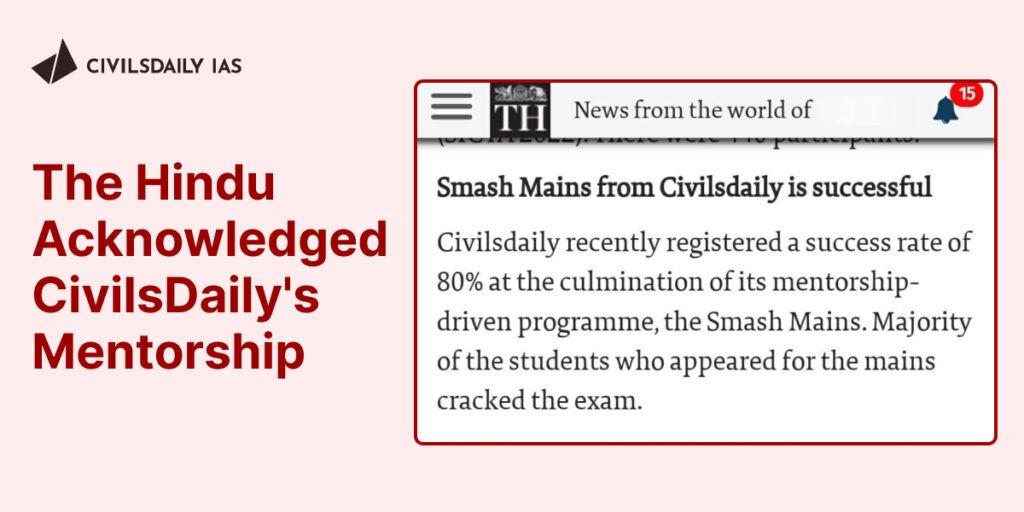
    What The Hindu mentioned about Civilsdaily Mentorship

  • (Download) UPSC Mains 2022: GS-3 question paper PDF | Almost 90% of Questions in GS-3 Mains directly from CD’s test series & Samachar Manthan

    (Download) UPSC Mains 2022: GS-3 question paper PDF | Almost 90% of Questions in GS-3 Mains directly from CD’s test series & Samachar Manthan

    UPSC Mains 2022 GS 3 paper is just over and our preliminary analysis reveals that almost 90% of questions were from CivilsDaily’s Mains test series and Samachar Manthan.

    GS 2 UPSC Mains Paper 2022 can be easily solved by Samachar Manthan itself

    Yashika, CivilsDaily’s Mentorship student

    Do you know?

    Civilsdaily will be conducting a 2-day mega session dissecting UPSC GS Mains 2022 papers I-IV with Sajal sir and Sukanya ma’am. We will be discussing the roadmap and strategy for UPSC 2023 aspirants.

    They will be discussing how our Mains Test Series + Samachar Manthan helped students to write better answer in 2022 mains. Because almost 90% of questions have been asked in the question papers simultaneously.


    GS-3 Question Paper of IAS mains 2022

    1. बुनियादी ढाँचागत परियोजनाओं में सार्वजनिक निजी साझेदारी (पी.पी.पी.) की आवश्यकता क्यों है ? भारत में रेलवे स्टेशनों के पुनर्विकास में पी. पी. पी. मॉडल की भूमिका का परीक्षण कीजिए । (150 शब्दों में उत्तर दीजिए)

    Why is Public Private Partnership (PPP) required in infrastructural projects? Examine the role of PPP model in the redevelopment of Railway Stations in India. (Answer in 150 words)

    2. क्या बाज़ार अर्थव्यवस्था के अन्तर्गत समावेशी विकास संभव है ? भारत में आर्थिक विकास की प्राप्ति के लिए वित्तीय समावेश के महत्त्व का उल्लेख कीजिए । ( 150 शब्दों में उत्तर दीजिए )

    Is inclusive growth possible under market economy? State the significance of financial inclusion in achieving economic growth in India. (Answer in 150 words)

    3. भारत में सार्वजनिक वितरण प्रणाली ( पी. डी. एस.) की प्रमुख चुनौतियाँ क्या हैं ? इसे किस प्रकार प्रभावी तथा पारदर्शी बनाया जा सकता है ? ( 150 शब्दों में उत्तर दीजिए)

    What are the major challenges of the Public Distribution System (PDS) in India? How can it be made effective and transparent? (Answer in 150 words )

    4. भारत में खाद्य प्रसंस्करण उद्योग के कार्यक्षेत्र और महत्त्व का सविस्तार वर्णन कीजिए । (150 शब्दों में उत्तर दीजिए) 

    Elaborate on the scope and significance of the food processing industry in India. ( Answer in 150 words)

    Q5. देश में आयु संभाविता में आई वृद्धि से समाज में नई स्वास्थ्य चुनौतियाँ खड़ी हो गई हैं । यह नई चुनौतियाँ कौन-कौन सी हैं और उनके समाधान हेतु क्या-क्या कदम उठाए जाने आवश्यक हैं ? (150 शब्दों में उत्तर दीजिए)

    The increase in life expectancy in the country has led to newer health challenges in the community. What are those challenges and what steps need to be taken to meet them?  (Answer in 150 words )

    Q6. पृथ्वी की सतह पर प्रति वर्ष बड़ी मात्रा में वनस्पति पदार्थ, सेलुलोस, जमा हो जाता है । यह सेलुलोस किन प्राकृतिक प्रक्रियाओं से गुज़रता है जिससे कि वह कार्बन डाइऑक्साइड, जल तथा अन्य अंत्य उत्पादों में परिवर्तित हो जाता है ? (150 शब्दों में उत्तर दीजिए) 

    Each year a large amount of plant material, cellulose, is deposited on the surface of Planet Earth. What are the natural processes this cellulose undergoes before yielding carbon dioxide, water, and other end products? (Answer in 150 words)

    7. इसके निर्माण, प्रभाव और शमन को महत्त्व देते हुए फोटोकेमिकल स्मॉग की विस्तारपूर्वक चर्चा कीजिए । 1999 के गोथेनबर्ग प्रोटोकॉल को समझाइए । ( 150 शब्दों में उत्तर दीजिए)

    Discuss in detail the photochemical smog emphasizing its formation, effects, and mitigation. Explain the 1999 Gothenburg Protocol. ( Answer in 150 words)

    8. भारतीय उपमहाद्वीप के संदर्भ में बादल फटने की क्रियाविधि और घटना को समझाइए । हाल के दो उदाहरणों की चर्चा कीजिए । ( 150 शब्दों में उत्तर दीजिए)

    Explain the mechanism and occurrence of cloudburst in the context of the Indian subcontinent. Discuss two recent examples. (Answer in 150 words)

    Q9. संगठित अपराधों के प्रकारों की चर्चा कीजिए । राष्ट्रीय और अंतर्राष्ट्रीय स्तर पर मौजूद संगठित अपराध और आतंकवादियों के बीच संबंधों का वर्णन कीजिए । ( 150 शब्दों में उत्तर दीजिए)

    Discuss the types of organized crimes. Describe the linkages between terrorists and organized crime that exist at the national and transnational levels. (Answer in 150 words)

    Q10. भारत में समुद्री सुरक्षा चुनौतियाँ क्या हैं ? समुद्री सुरक्षा में सुधार के लिए की गई संगठनात्मक, तकनीकी और प्रक्रियात्मक पहलों की विवेचना कीजिए । ( 150 शब्दों में उत्तर दीजिए)

    What are the maritime security challenges in India? Discuss the organizational, technical, and procedural initiatives taken to improve maritime security. (Answer in 150 words)

    11. “हाल के दिनों का आर्थिक विकास श्रम उत्पादकता में वृद्धि के कारण संभव हुआ है ।” इस कथन को समझाइए । ऐसे संवृद्धि प्रतिरूप को प्रस्तावित कीजिए जो श्रम उत्पादकता से समझौता किए बिना अधिक रोजगार उत्पत्ति में सहायक हो । ( 250 शब्दों में उत्तर दीजिए )

    “Economic growth in the recent past has been led by increase in labour productivity.” Explain this statement. Suggest the growth pattern that will lead to creation of more jobs without compromising labour productivity. ( Answer in 250 words)

    12. क्या आपके विचार में भारत अपनी ऊर्जा आवश्यकता का 50 प्रतिशत भाग, वर्ष 2030 तक नवीकरणीय ऊर्जा से प्राप्त कर लेगा ? अपने उत्तर के औचित्य को सिद्ध कीजिए । जीवाश्म ईंधनों से सब्सिडी हटाकर उसे नवीकरणीय ऊर्जा स्रोतों में लगाना उपर्युक्त उद्देश्य पूर्ति में किस प्रकार सहायक होगा ? समझाइए । ( 250 शब्दों में उत्तर दीजिए)

    Do you think India will meet 50 percent of its energy needs from renewable energy by 2030? Justify your answer. How will the shift of subsidies from fossil fuels to renewables help achieve the above objective? Explain.  (Answer in 250 words)

    Q13. भारत में कृषि उत्पादों के विपणन की ऊर्ध्वमुखी और अधोमुखी प्रक्रिया में मुख्य बाधाएँ क्या हैं ? (250 शब्दों में उत्तर दीजिए)

    What are the main bottlenecks in the upstream and downstream process of marketing agricultural products in India? (Answer in 250 words)

    Q14. समेकित कृषि प्रणाली क्या है ? भारत में छोटे और सीमांत किसानों के लिए यह कैसे लाभदायक हो सकती है ? (250 शब्दों में उत्तर दीजिए)

    What is Integrated Farming System? How is it helpful to small and marginal farmers in India? (Answer in 250 words)

    Q15. 25 दिसम्बर, 2021 को छोड़ा गया जेम्स वेब अंतरिक्ष टेलीस्कोप तभी से समाचारों में बना हुआ है । उसमें ऐसी कौन-कौन सी अनन्य विशेषताएँ हैं जो उसे इससे पहले के अंतरिक्ष टेलीस्कोपों से श्रेष्ठ बनाती हैं ? इस मिशन के मुख्य ध्येय क्या हैं ? मानव जाति के लिए इसके क्या संभावित लाभ हो सकते हैं ? (250 शब्दों में उत्तर दीजिए)

    Launched on 25th December 2021, James Webb Space Telescope has been much in the news since then. What are its unique features which make it superior to its predecessor Space Telescopes? What are the key goals of this mission? What potential benefits does it hold for the human race? (Answer in 250 words)

    Q16. वैक्सीन विकास का आधारभूत सिद्धांत क्या है ? वैक्सीन कैसे कार्य करते हैं ? कोविड-19 टीकों के निर्माण हेतु भारतीय वैक्सीन निर्माताओं ने क्या-क्या पद्धतियाँ अपनाई हैं ? ( 250 शब्दों में उत्तर दीजिए)

    What is the basic principle behind vaccine development? How do vaccines work? What approaches were adopted by the Indian vaccine manufacturers to produce COVID-19 vaccines? ( Answer in 250 words )

    Q17. ग्लोबल वार्मिंग (वैश्विक तापन) की चर्चा कीजिए और वैश्विक जलवायु पर इसके प्रभावों का उल्लेख कीजिए । क्योटो प्रोटोकॉल, 1997 के आलोक में ग्लोबल वार्मिंग का कारण बनने वाली ग्रीनहाउस गैसों के स्तर को कम करने के लिए नियंत्रण उपायों को समझाइए । (250 शब्दों में उत्तर दीजिए) 

    Discuss global warming and mention its effects on the global climate. Explain the control measures to bring down the level of greenhouse gases which cause global warming, in the light of the Kyoto Protocol, 1997, ( Answer in 250 words )

    Q 18. भारत में तटीय अपरदन के कारणों एवं प्रभावों को समझाइए । ख़तरे का मुकाबला करने के लिए उपलब्ध तटीय प्रबंधन तकनीकें क्या हैं ? (250 शब्दों में उत्तर दीजिए)

    Explain the causes and effects of coastal erosion in India. What are the available coastal management techniques for combating the hazard? ( Answer in 250 words)

    Q19. साइबर सुरक्षा के विभिन्न तत्त्व क्या हैं ? साइबर सुरक्षा की चुनौतियों को ध्यान में रखते हुए समीक्षा कीजिए कि भारत ने किस हद तक एक व्यापक राष्ट्रीय साइबर सुरक्षा रणनीति सफलतापूर्वक विकसित की है । ( 250 शब्दों में उत्तर दीजिए)

    What are the different elements of cyber security? Keeping in view the challenges in cyber security, examine the extent to which India has successfully developed a comprehensive National Cyber Security Strategy. ( Answer in 250 words)

    Q 20. नक्सलवाद एक सामाजिक, आर्थिक और विकासात्मक मुद्दा है जो एक हिंसक आन्तरिक सुरक्षा ख़तरे के रूप में प्रकट होता है। इस संदर्भ में उभरते हुए मुद्दों की चर्चा कीजिए और नक्सलवाद के ख़तरे से निपटने की बहुस्तरीय रणनीति का सुझाव दीजिए। ( 250 शब्दों में उत्तर दीजिए)

    Naxalism is a social, economic, and developmental issue manifesting as a violent internal security threat. In this context, discuss the emerging issues and suggest a multilayered strategy to tackle the menace of Naxalism. ( Answer in 250 words)


    What The Hindu mentioned about Civilsdaily Mentorship

  • (Download) UPSC Mains 2022: GS-2 question paper PDF | Almost 90% of Questions in GS-2 Mains directly from CD’s test series & Samachar Manthan

    (Download) UPSC Mains 2022: GS-2 question paper PDF | Almost 90% of Questions in GS-2 Mains directly from CD’s test series & Samachar Manthan

    UPSC Mains 2022 GS 2 paper is just over and our preliminary analysis reveals that almost 90% of questions were from CivilsDaily’s Mains test series and Samachar Manthan.

    GS 2 UPSC Mains Paper 2022 can be easily solved by Samachar Manthan itself

    Yashika, CivilsDaily’s Mentorship student

    Civilsdaily will be conducting 2 days mega session dissecting UPSC GS Mains 2022 papers I-IV with Sajal sir and Sukanya ma’am. We will be discussing roadmap and strategy for UPSC 2023 aspirants.

    They will be discussing how our Mains Test Series + Samachar Manthan helped students to write better answer in 2022 mains. Because almost 90% of questions have been asked in the question papers simultaneously.


    GS-2 Question Paper of IAS mains 2022

    Q1. भारत में आधुनिक कानून की सर्वाधिक महत्वपूर्ण उपलब्धि सर्वोच्च न्यायालय द्वारा पर्यावरणीय समस्याओं का संबिधानीकरण है।” सुसंगत बाद विधियों की सहायता से इस कथन की विवेचना कीजिए। (150 शब्दों में उत्तर दीजिए)

    The most significant achievement of modern law in India is the constitutionalization of environmental problems by the Supreme Court” Discuss this statement with the help of relevant case laws.(Answer in 150 words)

    Q2 “भारत के सम्पूर्ण क्षेत्र में निवास करने और विचरण करने का अधिकार स्वतंत्र रूप से सभी भारतीय नागरिकों को उपलब्ध है, किन्तु ये अधिकार असीम नहीं है।” टिप्पणी कीजिए । (150 शब्दों में उत्तर दीजिए)

    “Right of movement and residence throughout the territory of India are freely available to the Indian citizens, but these rights are not absolute.” Comment. (Answer in 150 words)

    Q3. आपकी राय में, भारत में शक्ति के विकेन्द्रीकरण ने जमीनी स्तर पर शासन परिदृश्य को किस सीमा तक परिवर्तित किया है ? (150 शब्दों में उत्तर दीजिए)

    To what extent, in your opinion, has the decentralization of power in India changed the governance landscape at the grassroots? (Answer in 150 words)

    Q4. राज्य सभा के सभापति के रूप में भारत के उप-राष्ट्रपति की भूमिका की विवेचना कीजिए । (150 शब्दों में उत्तर दीजिए)

    Discuss the role of the Vice-President of India as the Chairman of the Rajya Sabha (Answer in 150 words)

    Q5. राष्ट्रीय पिछड़ा वर्ग आयोग के सांविधिक निकाय से संवैधानिक निकाय में रूपांतरण को ध्यान में रखने हुए इसकी भूमिका की विवेचना कीजिए। (150 शब्दों में उत्तर दीजिए)

    Discuss the role of the National Commission for Backward Classes in the wake of its transformation from a statutory body to a constitutional body.(Answer in 150 words) 

    Q6. गति-शक्ति योजना को संयोजकता के लक्ष्य को प्राप्त करने के लिए सरकार और निजी क्षेत्र के मध्य सतर्क समन्वय की आवश्यकता है। विवेचना कीजिए। (150 शब्दों में उत्तर दीजिए)

    The Gati-Shakti Yojana needs meticulous coordination between the government and the private sector to achieve the goal of connectivity. Discuss. (Answer in 150 words)

    Q7. दिव्यांगता के संदर्भ में सरकारी पदाधिकारियों और नागरिकों की गहन संवेदनशीलता के बिना दिव्यांगजन अधिकार अधिनियम, 2016 केवल विधिक दस्तावेज़ बनकर रह जाता है । टिप्पणी कीजिए । ( 150 शब्दों में उत्तर दीजिए)

    The Rights of Persons with Disabilities Act, 2016 remains only a legal document without intense sensitization of government functionaries and citizens regarding disability. Comment. (Answer in 150 words)

    Q8. प्रत्यक्ष लाभ अंतरण योजना के माध्यम से सरकारी प्रदेय व्यवस्था में सुधार एक प्रगतिशील क़दम है, किन्तु इसकी अपनी सीमाएँ भी हैं। टिप्पणी कीजिए। ( 150 शब्दों में उत्तर दीजिए)

    Reforming the government delivery system through the Direct Benefit The transfer Scheme is a progressive step, but it has its limitations too. Comment. ( Answer in 150 words) 

    Q9. ‘भारत श्रीलंका का बरसों पुराना मित्र है ।’ पूर्ववर्ती कथन के आलोक में श्रीलंका के वर्तमान संकट में भारत की भूमिका की विवेचना कीजिए । (150 शब्दों में उत्तर दीजिए)

    “India is an age-old friend of Sri Lanka.’ Discuss India’s role in the recent crisis in Sri Lanka in the light of the preceding statement. (Answer in 150 words)

    Q10. आपके विचार में क्या बिमस्टेक (BIMSTEC ) सार्क (SAARC) की तरह एक समानांतर संगठन है ? इन दोनों के बीच क्या समानताएँ और असमानताएँ हैं ? इस नए संगठन के बनाए जाने से भारतीय विदेश नीति के उद्देश्य कैसे प्राप्त हुए हैं ? (150 शब्दों में उत्तर दीजिए)

    Do you think that BIMSTEC is a parallel organization like the SAARC? What are the similarities and dissimilarities between the two? How are Indian foreign policy objectives realized by forming this new organization?( Answer in 150 words) 

    Q11. लोक प्रतिनिधित्व अधिनियम, 1951 के अन्तर्गत संसद अथवा राज्य विधायिका के सदस्यों के चुनाव से उभरे विवादों के निर्णय की प्रक्रिया का विवेचन कीजिए। किन आधारों पर किसी निर्वाचित घोषित प्रत्याशी के निर्वाचन को शून्य घोषित किया जा सकता है ? इस निर्णय के विरुद्ध पीड़ित पक्षको कौन-सा उपचार उपलब्ध है ? वाद विधियों का सन्दर्भ दीजिए । (250 शब्दों में उत्तर दीजिए )

    Discuss the procedures to decide the disputes arising out of the election of a Member of the Parliament or State Legislature under The Representation of the People Act, 1951. What are the grounds on which the election of any returned candidate may be declared void? What remedy is available to the aggrieved party against the decision? Refer to the case laws. ( Answer in 250 words)

    Q12. राज्यपाल द्वारा विधायी शक्तियों के प्रयोग की आवश्यक शर्तों का विवेचन कीजिए । विधायिका के समक्ष रखे बिना राज्यपाल द्वारा अध्यादेशों के पुनः प्रख्यापन की वैधता की विवेचना कीजिए । (250 शब्दों में उत्तर

    दीजिए)

    Discuss the essential conditions for the exercise of the legislative powers by the Governor. Discuss the legality of the re-promulgation of ordinances by the Governor without placing them before the Legislature. (Answer in 250 words)

    Q 13. “भारत में राष्ट्रीय राजनैतिक दल केन्द्रीयकरण के पक्ष में हैं, जबकि क्षेत्रीय दल राज्य-स्वायत्तता के पक्ष में ।” टिप्पणी कीजिए। ( 250 शब्दों में उत्तर दीजिए) “While the national political parties in India favour centralisation, the regional parties are in favor of State autonomy.” Comment. (Answer in 250 words)

    Q14. भारत और फ्रांस के राष्ट्रपति के निर्वाचित होने की प्रक्रिया का आलोचनात्मक परीक्षण कीजिए । (250 शब्दों में उत्तर दीजिए)

    Critically examine the procedures through which the Presidents of India and France are elected. (Answer in 250 words) 

    Q15. आदर्श आचार संहिता के उद्भव के आलोक में, भारत के निर्वाचन आयोग की भूमिका का विवेचन कीजिए । (250 शब्दों में उत्तर दीजिए )

    Discuss the role of the Election Commission of India in light of the evolution of the Model Code of Conduct. (Answer in 250 words) 

    Q16. कल्याणकारी योजनाओं के अतिरिक्त भारत को समाज के वंचित वर्गों और ग़रीबों की सेवा के लिए मुद्रास्फीति और बेरोज़गारी के कुशल प्रबंधन की आवश्यकता है। चर्चा कीजिए । (250 शब्दों में उत्तर दीजिए)

    Besides the welfare schemes, India needs deft management of inflation and unemployment to serve the poor and the underprivileged sections of the society. Discuss. ( Answer in 250 words)

    Q17. क्या आप इस मत से सहमत हैं कि विकास हेतु दाता अभिकरणों पर बढ़ती निर्भरता विकास प्रक्रिया में सामुदायिक भागीदारी के महत्त्व को घटाती है ? अपने उत्तर के औचित्य को सिद्ध कीजिए । (250 शब्दों में उत्तर दीजिए )

    Do you agree with the view that increasing dependence on donor agencies for development reduces the importance of community participation in the development process? Justify your answer. (Answer in 250 words)

    18 स्कूली शिक्षा के महत्त्व के बारे में जागरूकता उत्पन्न किए बिना, बच्चों की शिक्षा में प्रेरणा-आधारित पद्धति के संवर्धन में निःशुल्क और अनिवार्य बाल शिक्षा का अधिकार अधिनियम, 2009 अपर्याप्त है । विश्लेषण कीजिए । (250 शब्दों में उत्तर दीजिए)

    The Right of Children to Free and Compulsory Education Act, 2009 remains inadequate in promoting an incentive-based system for children’s education without generating awareness about the importance of schooling. Analyze. (Answer in 250 words)

    19. I2U2 (भारत, इज़रायल, संयुक्त अरब अमीरात और संयुक्त राज्य अमेरिका) समूहन वैश्विक राजनीति में भारत की स्थिति को किस प्रकार रूपांतरित करेगा ? (250 शब्दों में उत्तर दीजिए) 

    How will I2U2 ( India, Israel, UAE, and the USA) grouping transform India’s position in global politics? (Answer in 250 words)

    20. ‘स्वच्छ ऊर्जा आज की ज़रूरत है ।’ भू-राजनीति के सन्दर्भ में, विभिन्न अन्तर्राष्ट्रीय मंचों में जलवायु परिवर्तन की दिशा में भारत की बदलती नीति का संक्षिप्त वर्णन कीजिए । (250 शब्दों में उत्तर दीजिए)

    ‘Clean energy is the order of the day.’ Describe briefly India’s changing policy towards climate change in various international fora in the context of geopolitics. (Answer in 250 words)


    Download Essay Question Paper:- UPSC-CSE Mains 2022

    (Download) UPSC Mains 2022: GS-1 question paper PDF | 85% of Questions in GS-1 directly from CD’s test series & Samachar Manthan


    What The Hindu mentioned about Civilsdaily Mentorship

  • 100 years of periyar because of whom tamil nadu became modern and progressive

    PeriyarContext

    • We celebrate Periyar E.V. Ramasamy’s birth anniversary (September 17) as Social Justice Day.

    Who is periyar?

    • Erode Venkatappa Ramasamy, revered as Periyar or Thanthai Periyar, was an Indian social activist and politician who started the Self-Respect Movement and Dravidar Kazhagam. He is known as the ‘Father of the Dravidian movement’. He rebelled against Brahminical dominance and gender and caste inequality in Tamil Nadu.

    Who started self-respect movement?

    • The self-respect movement was founded by V.Ramaswamy Naicker, commonly known as Periyar. It was a dynamic social movement aimed at destroying the contemporary Hindu social order in its totality and creating a new, rational society without caste, religion and god.

    PeriyarWhy Periyar is called as vaikom hero?

    • V. Ramasamy Periyar led the famous Vaikom Sathya Graha in 1924, where the people of down trodden community were prohibited to enter into the temple. Finally the Travancore government relaxed such segregation and allowed the people to enter into the temple. Hence periyar was given the title of ‘Vaikom Hero’.

    Leadership at a critical juncture

    • The satyagraha began with the active support of the Kerala Pradesh Congress Committee.
    • Within a week all its leaders were behind bars. George Joseph sought directions from Gandhi and C. Rajagopalachari. He also wrote to Periyar pleading with him to lead the satyagraha.
    • Periyar was in the midst of political work. As he was then the president of the Tamil Nadu Congress Committee, Periyar handed over temporary charge to Rajaji before reaching Vaikom in 1924.
    • From that date to the day of the victory celebrations in 1925, he was in the struggle giving it leadership at a critical juncture.

    PeriyarPeriyar’s role

    • Against violence – Periyar presided over the satyagraha in the face of violence and indignity inflicted by the orthodox and the repression of the police.
    • Mobilising – To mobilise support, he visited villages in and around Vaikom and delivered public speeches in several towns.
    • Gandhi – When the Kerala leaders asked for Gandhi’s permission to make the satyagraha an all-India affair, Gandhi refused saying that volunteers from Tamil Nadu would keep it alive.
    • In reports – the British Resident said in his report to the government of Madras: “In fact, the movement would have collapsed long ago but for the support it has received from outside Travancore…”
    • Historian T.K. Ravindran — observes that Periyar’s arrival gave “a new life to the movement”.

    His Vision for the future

    • Ideas on rationality: When he presented his thoughts, there was nuance, honesty, and an explicitness, which prompted even people practising different faiths to discuss and debate his ideas on rationality and religion.
    • Freedom of expression: Periyar himself said, “Everyone has the right to refute any opinion. But no one has the right to prevent its expression.”
    • Eradication of social evils: Periyar is often referred to as an iconoclast, for the rebellious nature of his ideas and the vigour with which he acted. His vision for the future was a part of all his actions. He did not merely aim at the eradication of social evils; he also wanted to put an end to activities that do not collectively raise standards of society.

    Foundation of rationalism

    • He understood the evolution of political thought: Periyar’s vision was about inclusive growth and freedom of individuals. He was an important ideologue of his day because of the clarity in his political stand. More importantly, he understood the evolution of political thought and was able to glide through time with this.
    • He presented rationalism as a solid foundation: For thinking along these lines. He said, “Wisdom lies in thinking. The spearhead of thinking is rationalism.” Periyar was way ahead of his time.
    • Concern towards poor: “Whomsoever I love and hate, my principle is the same. That is, the educated, the rich and the administrators should not suck the blood of the poor.”
    • Periyar proclaimed that he would always stand with the oppressed: In the fight against oppressors and that his enemy was oppression. There have been several social reformers in Tamil Nadu who shared their revolutionary thoughts with the people in the past century. In that spectrum, Periyar occupies a unique place because he made interactions of multiple worlds possible.

    Periyar said, “Any opposition not based on rationalism or science or experience, will one day or other, reveal the fraud, selfishness, lies, and conspiracies.”

    Conclusion

    • His works against the Bhraminical dominance, oppression of women in Tamil Nadu, caste prevalence are exemplary. Periyar promoted the principles of rationalism, self-respect, women’s rights and eradication of caste. He opposed the exploitation and marginalisation of the people of South India and the imposition of what he considered Indo-Aryan India.

    Mains question

    Q.Discuss the future vision of periyar by discussing his role in vaikom satyagraha. Do you think he has placed foundation of rationalism in Tamil Nadu?

    UPSC 2023 countdown has begun! Get your personal guidance plan now! (Click here)


  • (Download) UPSC Mains 2022: GS-1 question paper PDF | 85% of Questions in GS-1 directly from CD’s test series & Samachar Manthan

    (Download) UPSC Mains 2022: GS-1 question paper PDF | 85% of Questions in GS-1 directly from CD’s test series & Samachar Manthan

    Civilsdaily firmly believes that a dream can’t become reality through magic. It takes sweat, dual-sided determination, and the hard work of both mentors and students. Doing the best in 2021 puts them in the best place for 2022. 

    Today we, the CD mentors team, once again have a claim on 85% of questions that came in the GS-1 paper of the UPSC mains 2022.

    Yes, 85% of Questions have directly come from Our Test Series & Samachar Manthan

    GS-1 Question Paper of IAS mains 2022

    Ques1. स्पष्ट करें कि मध्यकालीन भारतीय मंदिरों की मूर्तिकला उस दौर के सामाजिक जीवन का प्रतिनिधित्व करती है। (150 शब्दों में उत्तर दें)

    Ques 1. How will you explain that medieval Indian temple sculptures represent the social life of those days ? (Answer in 150 words)

    Ques2. अधिकांश भारतीय सिपाहियों वाली ईस्ट इंडिया की सेना क्यों तत्कालीन भारतीय शासकों की संख्याबल में अधिक और बेहतर सुसज्जित सेना से लगातार जीतती रही ? कारण बताएँ । (150 शब्दों में उत्तर दें)

    Why did the armies of the British East India Company – mostly comprising of Indian soldiers – win consistently against the more numerous and better equipped armies of the then Indian rulers ? Give reasons. (Answer in 150 words)

    Ques3. औपनिवेशिक भारत की अठारहवीं शताब्दी के मध्य से क्यों अकाल पड़ने में अचानक वृद्धि देखने को मिलती है ? कारण बताएँ। (150 शब्दों में उत्तर दें)

    Why was there a sudden spurt in famines in colonial India since the mid-eighteenth century? Give reasons. (Answer in 150 words)

    4. प्राथमिक चट्टानों की विशेषताओं एवं प्रकारों का वर्णन कीजिए। (150 शब्दों में उत्तर दें)

    Describe the characteristics and types of primary rocks. ( Answer in 150 words)

    5. भारतीय मौसम विज्ञान विभाग द्वारा चक्रवात प्रवण क्षेत्रों के लिए मौसम-सम्बन्धी चेतावनियों के लिए निर्धारित रंग-संकेत के अर्थ की चर्चा करें। (150 शब्दों में उत्तर दें)

    Discuss the meaning of color-coded weather warnings for cyclone-prone areas given by the India Meteorological Department. ( Answer in 150 words)

    6. ‘दक्कन ट्रैप’ की प्राकृतिक संसाधन-सम्भावनाओं की चर्चा कीजिए । ( 150 शब्दों में उत्तर दें)

    Discuss the natural resource potentials of Deccan Trap’. (Answer in 150 words)

    7. भारत में पवन ऊर्जा की संभावना का परीक्षण कीजिए एवं उनके सीमित क्षेत्रीय विस्तार के कारणों को समझाइए। ( 150 शब्दों में उत्तर दें)

    Examine the potential of wind energy in India and explain the reasons for their limited spatial spread. (Answer in 150 words)

    8. पारिवारिक सम्बन्धों पर ‘वर्क फ्रॉम होम’ के असर की छानबीन तथा मूल्यांकन करें। (150 शब्दों में उत्तर दें)

    Explore and evaluate the impact of ‘Work From Home on family relationships. (Answer in 150 words)

    9. उपभोक्ता संस्कृति के विशेष परिप्रेक्ष्य में नव मध्यवर्ग के उभार से टीयर 2 शहरों का विकास। किस तरह सम्बन्धित है ? (150 शब्दों में उत्तर दें)

    How is the growth of Tier 2 cities related to the rise of a new middle class with an emphasis on the culture of consumption ? (Answer in 150 words)

    10. भारत के जनजातीय समुदायों की विविधताओं को देखते हुए किस विशिष्ट सन्दर्भ के अन्तर्गत उन्हें किसी एकल श्रेणी में माना जाना चाहिए ? (150 शब्दों में उत्तर दें)

    Given the diversities among tribal communities in India, in which specific contexts 10 should they be considered as a single category? (Answer in 150 words)

    11. राज्यों एवं प्रदेशों का राजनीतिक और प्रशासनिक पुनर्गठन उन्नीसवीं शताब्दी के मध्य से निरंतर चल रही एक प्रक्रिया है। उदाहरण सहित विचार करें। (250 शब्दों में उत्तर दें)

    The political and administrative reorganization of states and territories has been a continuous ongoing process since the mid-nineteenth century. Discuss with examples. (Answer in 250 words) 

    12. भारतीय परम्परा और संस्कृति में गुप्त काल और चोल-काल के योगदान पर चर्चा करें । (250 शब्दों में उत्तर दें) 

    Discuss the main contributions of the Gupta period and the Chola period to Indian heritage and culture. (Answer in 250 words) 

    13.  भारतीय मिथक, कला और वास्तुकला में सिंह एवं वृषभ की आकृतियों के महत्व पर विचार करें । (250 शब्दों में उत्तर दें) 

    Discuss the significance of the lion and bull figures in Indian mythology, art, and architecture. (Answer in 250 words) 

    14. समुद्री धाराओं को प्रभावित करने वाली शक्तियों कौन सी हैं ? विश्व के मत्स्य उद्योग में इनके योगदान का वर्णन करें। (250 शब्दों में उत्तर दें) 

    What are the forces that influence ocean currents? Describe their role in the fishing industry of the world. (Answer in 250 words) 

    15. रबर उत्पादक देशों के वितरण का वर्णन करते हुए उनके द्वारा सामना किए जाने वाले प्रमुख पर्यावरणीय मुद्दों को इंगित कीजिए। (250 शब्दों में उत्तर दें)

    Describing the distribution of rubber-producing countries, indicate the major environmental issues faced by them. ( Answer in 250 words)

    16. अंतर्राष्ट्रीय व्यापार में जलसंधि व स्थलसंधि के महत्त्व का उल्लेख कीजिए । (250 शब्दों में उत्तर दें)

    Mention the significance of straits and isthmus in international trade. (Answer in 250 words)

    17. क्षोभमंडल वायुमंडल का एक महत्त्वपूर्ण परत है जो मौसम प्रक्रियाओं को निर्धारित करता है। कैसे ? (250 शब्दों में उत्तर दें)

    Troposphere is a very significant atmospheric layer that determines weather 15 processes. How? (Answer in 250 words)

    18. भारतीय समाज में जाति, क्षेत्र तथा धर्म के समानांतर ‘पंथ’ की विशेषता की विवेचना कीजिए । (250 शब्दों में उत्तर दें) 

    Analyse the salience of ‘sect’ in Indian society vis-a-vis caste, region and religion. (Answer in 250 words)

    19. क्या सहिष्णुता, सम्मिलन एवं बहुलता मुख्य तत्त्व हैं जो धर्मनिरपेक्षता के भारतीय रूप का निर्माण करते हैं ? तर्कसंगत उत्तर दें। (250 शब्दों में उत्तर दें)

    Are tolerance, assimilation, and pluralism the key elements in the making of an Indian form of secularism? Justify your answer. ( Answer in 250 words) 

    20. अपर्याप्त संसाधनों की दुनिया में भूमंडलीकरण एवं नए तकनीक के रिश्ते को भारत के विशेष सन्दर्भ में स्पष्ट करें। (250 शब्दों में उत्तर दें)

    Elucidate the relationship between globalization and new technology in a world of scarce resources, with special reference to India. (Answer in 250 words)


    1


    Civilsdaily is one of the top IAS mentoring Institutions, accredited by the news giant HINDU, Indian Express etc. Year after year thousands of aspirants fulfilled their IAS dream with us.

    Work on your strengths, not your weakness. Our FREE mentorship is open to all. Now it is most crucial to take part in Our Super Mentorship Program

    Don’t make resolutions without having a self-mentored action plan. The secret to success is right in your hand


    What The Hindu mentioned about Civilsdaily Mentorship

  • How lower fertility rate hampers demographic dividend in number of ways

    fertility rateContext

    • Though the Global population, in terms of numbers, has been steadily increasing the average global fertility rate has been consistently declining over the past 70 years.

    What Reports say?

    • Reports suggest that the global population could grow to around 8.5 billion in 2030.
    • According to the World Population Prospects 2022, Average number of children per woman in the reproductive age group has declined by 50%, from an average of five children per woman in 1951 to4 children in 2020.

    What is Fertility?

    • Fertility is the quality or state of being fertile.
    • Fertility is the ability to reproduce through normal sexual interaction. In other words it is the natural capacity to conceive a biological child.
    • Fertilitychanges with age. Both males and females become fertile in their teens following puberty.

    fertility rate What is fertility rate?

    • The number of live births in women over a specific length of time.
    • Total fertility rate is the average number of children born to a woman during her lifetime.

    Recent findings

    The newly released World Population Prospectus notes that the global fertility rate fell from three in 1990 to 2.3 in 2021.

    Overview of fertility dynamics

    • Reason: Speeding up the social phenomenon of demographic transition.
    • Poorer countries: speeding up the Transition a lot faster than the richer ones.
    • Britain: Took 130 years to transition from a fertility rate of five per woman in 1800 to two in 1930, whereas
    • South Korea: Took 20 years from 1965 to 1985 to achieve the same. South Korea reporting the lowest fertility rate, 1.05 children per woman.
    • Most advanced economies: Have their fertility rate below the replacement rate of 2.1.
    • Sub-Saharan African countries: Expected to contribute more than half the population growth after 2050 and grow through 2100. For example, Niger a sub Saharan country with highest fertility rate in the world, estimated to be 91 children per woman.
    • What is Demographic transition: is a long-term trend of declining birth and death rate. It is shift from high birth rates to low birth rates in societies with minimal technology, education (especially of women) and economic development and from high death rates to Low death rates in societies with advanced economies and development.

    fertility rate
    Where India Stands

    • According to National Family Health Survey (NFHS), fertility rate falling below the replacement level for the first time to 2.0 in 2021.dropped from 2.2 to 2.0.
    • only five States have a fertility rate above the replacement rate: Bihar (3), Meghalaya (2.9), Uttar Pradesh (2.4), Jharkhand (2.3), and Manipur (2.2)
    • At the time of Independence, India’s fertility rate was six per woman, and it had taken 25 years to reach five, with the government launching the first ever family planning program in the world in 1952.
    • India’s fertility further declined to four in the 1990s when Kerala became the first State in India to have a fertility rate below replacement l
    • Increased use of contraception, more years of average schooling, better health care, and an increase in the mean marriage age of women are of the reasons behind the steady dip in fertility rate.

    Lower fertility rate as cause and consequences on the economy

    Positive impact:

    • Lower fertility leads to rise in women’s education.
    • Window of time where the ration of working-age population is higher than that of the dependent age groups.
    • This high proportion of people in the workforce boosts income and investment, and higher level of saving.
    • Lower pressure on land, water and other resources and would also contribute to achieving environmental goals.
    • Advanced health care and better nutrition, results in increased life expectancy and productivity of citizens.


    Negative impact:

    • Lower fertility impacts women’s education positively, which in turn lowers the fertility of the next generations.
    • While the income rises with better health care and better infrastructure development, Fertility drops.
    • A fall in fertility rate beyond replacement level would have a negative effect on the proportion of the working population, which in turn will affect output in an economy.
    • After the window of demographic dividend, the huge working age population moves to old age, supported by fewer workers.
    • Japan was the first country to experience the implications of falling fertility rates. Country is now facing fiscal challenges to meet rising social security costs.

    Experiments to deal with fertility decline

    Countries across the globe are experimenting with policies to boost fertility.

    • Germany: found success in boosting births through liberal labour laws, allowing more parental leave and benefits.
    • Denmark: offering state-funded IVF for women below 40 years
    • Hungary: Recently nationalized IVF clinics.
    • Poland: Gives out monthly cash payments to parents having more than two children
    • Russia: Makes one-time payment to parents when their second child is born. Reinstituted the Soviet-era ‘Mother Heroine’ title, who bore and raised more than 10 children amounting to almost a one-time payment of 13 lakh.

    Way ahead

    • Need of the hour is to ensure liberal labor reforms, encourage higher female labor force participation, higher focus on nutrition and health.
    • Although India’s working age population will continue to grow for many more decades, it would need to keep an eye on fertility dips.

    Mains Question

    What are Implications of lower fertility rate on the economy? What steps could be taken to deal with fertility decline? Discuss.

    UPSC 2023 countdown has begun! Get your personal guidance plan now! (Click here)


  • How to prepare for UPSC  2023 even if you’ve just started preparation? | Parth sir’s Masterclass | FREE Preparatory Package & a Detailed Blueprint for the next 8 months

    How to prepare for UPSC 2023 even if you’ve just started preparation? | Parth sir’s Masterclass | FREE Preparatory Package & a Detailed Blueprint for the next 8 months

    Register for the recorded session

    To make this a holistic learning experience we have a special FREE preparatory package for you. Details below.


    UPSC Prelims 2023 is scheduled for May 28th, 2023. That’s just 8 months away. As an aspirant, even if you are a beginner you might have already started preparation, some of you are taking a repeat attempt after a failed one in 2022.

    You must understand the criticality of time. The next 8 months are crucial. Everything that you do must be under a plan, a strategy.

    Time isn’t the main thing, it’s the only thing

    For beginners who are going to have 2023 as their first UPSC attempt, we know you are confused and have a lot of questions in your mind. Not only on the best sources, the best strategy but also on how to execute and go about it.

    You might have consulted numerous websites on the internet regarding your UPSC 2023 preparation, but even then, you end up confused as they only address skin-deep theories about dos and don’ts, generic advice, and all.

    To help you strategize we have planned a Masterclass by senior UPSC Mentor Parth Verma sir.


    UPSC Prelims Masterclass Details: 17th September, (Saturday) at 7 PM.

    Key Takeaways of Masterclass with Parth Verma, Senior Mentor and Core faculty of Civilsdaily. Other than those mentioned above we will be discussing the following points:

    1. Analysing the trend of UPSC and devising an evolving adaptive strategy.

    2. How to cover the syllabus? The syllabus, not the books, must be completed. Focussing on the essentials first.

    3. What are the best books to refer to? Based on a last 10-year UPSC-CSE paper analysis.

    4. Recognize the UPSC requirement. What kinds of test series are useful? Which mock test series should be avoided?

    5. Complete UPSC-CSE Preparation Timeline for a Working Professional

    6. The skill of taking notes. What topics necessitate notes and which do not?

    7. Working hard in the right direction vs. working hard in the wrong direction Is it possible to be successful solely by studying hard?

    8. There are only two consolidated sources for current events. What exactly are they?

    9. Revision techniques that are common, standard, and used frequently. What exactly are they?


    What you’ll get as a part of the Special Preparatory Package?

    As a part of this Masterclass by Parth sir you are entitled to these:

    1. FREE Mentorship session with Senior IAS Mentor on strategy and approach for UPSC 2023
    2. Samachar Manthan’s current week’s module and Mains Questions
    3. Prelims Weekly MCQ PDF
    4. Mains 250+ Value notes
    5. Current month’s Monthly Magazine

    Register for the Masterclass, we’ll email you the above content on registration.

    About Parth Sir

    Our senior most Civilsdaily’s Mentor and core faculty, Parth sir has been mentoring students since 2017. He has an admirable experience of attending UPSC-CSE interviews four times. Parth sir has always scored 400+ in all the 4 GS Mains Subjects. The secret of success according to him is consistency and time-management.

    You will get a chance to discuss 1-1 with Parth sir in the Masterclass.

    What The Hindu mentioned about Civilsdaily Mentorship

  • SC seeks Centre’s reply on issue of Marital Rape

    The Supreme Court has sought a response from the government on appeals to criminalize marital rape.

    Split opinions on Marital Rape

    rape

    • This follows a split decision from the Delhi High Court on whether or not to prosecute husbands for non-consensual intercourse with their wives.

    What is Marital Rape?

    • Marital rape is the act of sexual intercourse with one’s spouse without her consent.
    • It is no different manifestation of domestic violence and sexual abuse.
    • It is often a chronic form of violence for the victim which takes place within abusive relations.

    Status in India

    • Historically considered as right of the spouses, this is now widely classified as rape by many societies around the world.
    • In India, marital rape is not a criminal offense (as protected under IPC section 375).
    • India is one of fifty countries that have not yet outlawed marital rape.

    Reasons for disapproval of this concept

    • The reluctance to define non-consensual sex between married couples as a crime and to prosecute has been attributed to:
    1. Traditional views of marriage
    2. Interpretations of religious doctrines
    3. Ideas about male and female sexuality
    4. Cultural expectations of subordination of a wife to her husband
    • It is widely held that a husband cannot be guilty of any sexual act committed by himself upon his lawful wife their on account of their mutual matrimonial consent.

    Why it must be a crime?

    • Associated physical violence: Rape by a spouse, partner or ex-partner is more often associated with physical violence.
    • Mental harassment: There is research showing that marital rape can be more emotionally and physically damaging than rape by a stranger.
    • Compulsive relationship: Marital rape may occur as part of an abusive relationship.
    • Revengeful nature: Furthermore, marital rape is rarely a one-time event, but a repeated if not frequent occurrence.
    • Obligation on women: In the case of marital rape the victim often has no choice but to continue living with their spouse.

    Violation of fundamental rights

    • Marital rape is considered as the violation of FR guaranteed under Article 14 of the Indian constitution which guarantees the equal protection of laws to all persons.
    • By depriving married women of an effective penal remedy against forced sexual intercourse, it violates their right to privacy and bodily integrity, aspects of the right to life and personal liberty under Article 21.

    Problems in prosecuting marital rape

    • Lack of awareness: A lack of public awareness, as well as reluctance or outright refusal of authorities to prosecute, is common globally.
    • Gender norms: Additionally, gender norms that place wives in subservient positions to their husbands, make it more difficult for women to recognize such rape.
    • Acceptability of the concept: Another problem results from prevailing social norms that exist.

    Present regulations in India

    • Indian Penal Code criminalizes rape in most cases, although marital rape is not illegal when the woman is over the age of 18.
    • However, until 2017, men married to those between 15 and 18 could not be convicted of rape.
    • Marital rape of an adult wife, who is unofficially or officially separated, is a criminal offence punishable by 2 to 7 year in prison; it is not dealt by normal rape laws which stipulate the possibility of a death sentence.
    • According to the Protection of Women From Domestic Violence Act (2005), other married women subject to such crime by their husband may demand for financial compensation.
    • They also have the right to continue to live in their marital household if they wish, or may approach shelter or aid homes.

    However, marital rape is still not a criminal offence in this case and is only a misdemeanor.

    Arguments against criminalization

    • Subjective: It is very subjective and intricate to determine whether consent was acquired or not.
    • Prone to Misuse: If marital rape is criminalized without adequate safeguards it could be misused like the current dowry law by the dissatisfied wives to harass and torture their Husbands.
    • Burden on Judiciary: It will increase the burden of judiciary which otherwise may serve other more important causes.

    Way forward

    • Sanctioning marital rape is an acknowledgment of the woman’s right to self-determination (i.e., control) of all matters relating to her body.
    • In the absence of any concrete law, the judiciary always finds it difficult to decide the matter of domestic rape in the absence of solid evidence.
    • The main purpose of marriage is procreation, and sometimes divorce is sought on the ground of non-consummation of marriage.
    • Before giving a final interpretation, the judiciary must balance the rights and duties of both partners.


    UPSC 2023 countdown has begun! Get your personal guidance plan now! (Click here)

  • Complex issue of Assisted Suicide

    suicide

    A renowned French filmmaker died earlier this week by assisted suicide at the age of 91.

    What is Assisted Suicide?

    • Assisted suicide and euthanasia are practices under which a person intentionally ends their life with active assistance from others.
    • These have long been contentious topics of debate as they involve a complex set of moral, ethical and in some cases, religious questions.
    • Several European nations, some states in Australia and Colombia in South America allow assisted suicide and euthanasia under certain circumstances.

    Difference between assisted suicide and euthanasia

    • Euthanasia is the act of intentionally ending a life to relieve suffering – for example a lethal injection administered by a doctor.
    • Intentionally helping another person to kill themselves is known as assisted suicide.
    • This can include providing someone with strong sedatives with which to end their life or buying them a ticket to Switzerland (where assisted suicide is legal) to end their life
    • Euthanasia can further be divided into active and passive.
    • The practice of passive euthanasia involves simply stopping lifesaving treatment or medical intervention with the consent of the patient or a family member or a close friend representing the patient.
    • Active euthanasia, which is legal in only a few countries, entails the use of substances to end the life of the patient.

    India and Assisted suicide/ Euthanasia

    • In a landmark judgment, the Supreme Court of India legalised passive euthanasia in 2018, stating that it was a matter of ‘living will’.
    • According to the judgment, an adult in his conscious mind is permitted to refuse medical treatment or voluntarily decide not to take medical treatment to embrace death in a natural way, under certain conditions.

    Consideration for ‘living will’

    • In the 538-page judgment, the court laid down a set of guidelines for ‘living will’ and defined passive euthanasia and euthanasia as well.
    • It also laid down guidelines for ‘living will’ made by terminally ill patients who beforehand know about their chances of slipping into a permanent vegetative state.
    • The court specifically stated that the rights of a patient, in such cases, would not fall out of the purview of Article 21 (right to life and liberty) of the Indian Constitution.
    • The SC’s judgment was in accordance with its verdict in March 2011 on a separate plea.
    • While ruling on a petition on behalf of Aruna Shanbaug Case, the court had allowed passive euthanasia for the nurse who had spent decades in a vegetative state.

    Who was Aruna Shanbaug?

    • Shanbaug had become central to debates on the legality of right to die and euthanasia in India.
    • Shanbaug died of pneumonia in March 2015 at the age of 66, 42 years of which she had spent in a room at KEM Hospital in Mumbai, after a brutal rape left her in a permanent vegetative state.

    Recent cases in India

    • In 2018, an old couple from Mumbai wrote to then President Kovind, seeking permission for active euthanasia or assisted suicide.
    • Neither of them suffered from a life-threatening ailment.
    • The couple stated in their plea that they had lived a happy life and didn’t want to depend on hospitals for old age ailments.

    Justification for Euthanasia/Assisted Suicide

    • It provides a way to relieve extreme pain.
    • Euthanasia can save  life  of  many  other  people  by  donation  of  vital organs.

    Issues with such killings

    • Euthanasia can be misused. Many psychiatrists are of the opinion that a terminally ill person or someone who is old and suffering from an incurable disease is often not in the right frame of mind to take a call.
    • Family members deciding on behalf of the patient can also lead to abuse of the law legalizing euthanasia as it can be due to some personal interest.


    UPSC 2023 countdown has begun! Get your personal guidance plan now! (Click here)

  • [Burning Issue] Low Health Expenditure in India- Prospects and Challenges

    health

    Context

    • According to the latest National Health Accounts Report, India’s total health expenditure went down from 3.9 per cent of the Gross Domestic Product (GDP) in 2013-14 to 3.2 per cent in 2018-19.
    • The fact is alarming as it points toward the reducing health expenditure of the government at a time when the Health sector in the country is already under pressure from multiple issues such as poor infrastructure and the burden of the pandemic.
    • In this context, in this edition of the burning issue, we will talk about India’s healthcare sector, issues that ail it and possible solutions to these issues.

    About the National Health Accounts Report

    health
    • India’s National Health Accounts (NHA) estimates report for FY 2018-19 is the sixth in the series of NHA reports prepared by the National Health Systems Resource Centre (NHSRC).
    • The report is based on the globally accepted framework of System of Health Accounts, 2011, which enables cross-comparability of estimates across time along with international comparisons.
    • The NHA report presents two estimates for the expenditure incurred within the health sector during a financial year: Current Health Expenditure (CHE) and total Health Expenditure (THE).
    • CHE includes the recurring expenses corresponding to the final consumption of health goods and services within a financial year. THE, on the other hand, reflects both current and capital expenditure incurred in the health sector within a financial year.

    About the Healthcare Sector in India

    • The Healthcare industry in India comprises hospitals, medical devices, clinical trials, outsourcing, telemedicine, medical tourism, health insurance, and medical equipment.
    • The hospital industry in India accounts for 80% of the total healthcare market. The hospital industry is expected to reach $132 bn by 2023 from $61.8 bn in 2017; growing at a CAGR of 16-17%.
    • In 2020, India’s Medical Tourism market was estimated to be worth $5-6 Bn and is expected to grow to $13 Bn by 2026.
    • The primary care industry is currently valued at $13 bn. The share of the organized sector is practically negligible in this case.
    • ‘Public Health’ subject comes under the state list under the 7th schedule of the constitution.

    Some Data about Healthcare Expenditure in India

    • According to the latest National Health Accounts Report, the current health expenditure(CHE) for the year was Rs 5,40,246 crore or 90.58 percent, while the rest was capital expenditures. Of the government health expenditure, the Union government’s share was 34.3 percent.
    • Out-of-pocket expenditure on healthcare by households has declined by 16 percentage points, from 64.2 per cent to 48.2 per cent in the same period. It was even higher in 2004-2005, at 69.4 per cent. While this is a welcome improvement, the figure remains significantly higher than the global average.
    • The economic burden of healthcare in India is largely borne by households that contribute Rs 3,24,717 crore to the current healthcare expenditure.
    • For 2018-19, the health expenditure for India was estimated to be Rs 4, 470 per capita.
    • Among the different types of healthcare providers, the major share of CHE is incurred at private hospitals (28.7 percent), followed by pharmacies (22.6 percent), and government hospitals (17.3 percent).

    Challenges in the Healthcare sector in India

    (A) Outdated Medical education in India

    • Limited government seats: The number of seats available for medical education in India is far less than the number of aspirants who leave school with the dream of becoming doctors.
    • Lack of skills: Though the institutes are managing to hire professors and lecturers, there is a lack of technical skills. Finding faculties in clinical and non-clinical disciplines is difficult and there are very few faculty development programs for upskilling the existing lot.
    • Lack of digital infrastructure: The gap in digital learning infrastructure is currently the biggest challenge the sector is facing. There is an urgent need to adopt technology and have resources available to facilitate e-learning.
    • Lack of research and innovation: there haven’t been much ground-breaking research in the medical field. The education system needs to focus more on increasing the quality of research. Additionally, since the industry-academia partnership is not available, hence innovation also takes a back seat.
    • No. of doctors-Deficiency: The doctor-patient ratio of 1:1655 in India as against WHO norm of 1:1000 clearly shows the deficit of MBBS.
    • Inadequate capacity of the health system: to cater to the healthcare demands of a large population as evident from multiple months waiting for an operation even at large healthcare centers like AIIMS.

    (B) Suffering from several Paradoxes

    • Healthcare is a fundamental right, but it is not fundamentally right in India: The expenditure on healthcare is one of the lowest in the world. Though our economy has grown robustly post-liberalization, investment in healthcare has consistently hovered around 1% of the GDP. In the 2020-21 Budget, it was 1.02% of overall expenditure.
    • The sector attracts investments, but delivery remains contentious: India’s healthcare sector has attracted a steady stream of investments. Lack of penetration, inflated billing, opaqueness in diagnosis, and poor quality of service has ensured that most Indians get treated below the standards prescribed by the WHO.
    • Among the cheapest in the world, yet unaffordable for most locally: Healthcare in India is cheap. Yet India has one of the world’s highest rates of out-of-pocket spending in healthcare. Millions in India cannot afford these procedures in their own country.
    • Less health infrastructure, but medical tourism booms: There is a dearth of medical schools and clinicians. Most hospitals in India are overburdened, understaffed, and ill-equipped. However, all this has not prevented the private healthcare sector to establish sophisticated medical tourism facilities on the plank of ‘world-class service at low cost’.

    (C) Rising Burden of Non-Communicable Diseases

    • According to the study report ‘India State-Level Disease Burden Initiative’ in 2017 by the Indian Council of Medical Research (ICMR), it is estimated that the proportion of deaths due to Non-Communicable Diseases (NCDs) in India has increased from 37.9% in 1990 to 61.8% in 2016.

    (D) Inadequate Mother and Child Healthcare

    • Maternal mortality causes 56,000 deaths every year in India, accounting for 20 percent of maternal deaths around the world.
    • The inadequate healthcare system and lack of healthcare facilities in most regions have elevated the number of maternal mortality cases in India. 

    (E) Receding government from the health sector

    • Currently, government hospitals are having only a 30% share of the total number of hospital beds available in India.
    • Also, 70% of new beds added in hospitals are coming from private hospitals rather than government hospitals. This disproportionately impacts poor people more.
    • India’s rich and middle classes have opted out of public health completely, leaving the poor with unconscionably meager services.

    How pandemic has further exposed the Healthcare sector in India?

     (1) Poor Infrastructure

    • In the 2019 Global Health Security Index, which measures pandemic preparedness for countries based on their ability to handle the crisis, India ranked 57, lower than the US at 1, the UK at 2, Brazil at 22, and Italy at 31.
    • As per the OECD data available for 2017, India reportedly has only 0.53 beds available per 1,000 people as against 0.87 in Bangladesh, 2.11 in Chile, 1.38 in Mexico, 4.34 in China, and 8.05 in Russia.

    (2) Fewer doctors per thousand

    • The WHO mandates that the doctor-to-population ratio should be 1:1,000, while India had a 1:1,404 ratio as of February 2020.
    • In rural areas, this doctor-patient ratio is as low as 1:10,926 doctors as per National Health Profile 2019.

    (3) Denial of healthcare by Private hospitals

    • Despite private hospitals accounting for 62 percent of the total hospital beds as well as ICU beds and almost 56 percent of the ventilators, they are handling only around 10 percent of the workload.
    • Private hospitals are reportedly denying treatment to the poor. Cases of overcharging patients are also being reported in private hospitals.

     (4) Negligence for mental healthcare

    • Mental health problems were already a major contributor to the burden of illness in India which usually gets unnoticed.
    • The widespread anxiety due to the lockdown has frustrated the laborers, farmers, and various vulnerable sections to a great extent due to the fear of impoverishment and loss of livelihoods.

    Ayushman Bharat- A Game Changer Scheme

    • Ayushman Bharat Scheme was launched in 2018, as a step toward Universal Health Coverage (UHC) and would provide quality health services to eligible patients and protect them from financial hardship.
    • It aims to provide 110 million “poor, deprived rural families” with an annual family health insurance cover of up to Rs 5 lakh in Secondary and tertiary healthcare.

    Outcomes of the scheme

    Positive outcomes

    • More than 20.8 lakh people from marginalized sections received health treatment worth Rs. 5000 crores in the initial 200 days of the scheme.
    • The portability of the scheme helped several migrant workers access health benefits in the state of migration during COVID times irrespective of their home states.

    Negative outcomes

    • One of the primary objectives of this scheme is to decrease the out-of-pocket (OOP) expenditure on health in India. Multiple research studies suggest that insurance schemes for the poor in India have failed to provide the much-needed relief, with OOP figures higher for those using insurance schemes, compared to those who do not. Predominant reasons are shoddy implementation, lack of infrastructure and corruption.
    • As per the latest data available, over 12.5 crore Ayushman cards have been issued and about 1.23 crore people have availed the benefit of this scheme (merely 2 percent of the 50 crore target beneficiaries).
    • In addition, Ayushman beneficiaries are denied benefits they were previously entitled to under other schemes—a pregnant woman below-poverty line beneficiary of AB-PMJAY scheme, going for institutional delivery no longer receives the assistance of Rs 1,500 under Janani Surakhsa Yojana.

    Some achievements in the Healthcare sector

    • Out-of-pocket expenditure on healthcare by households has declined by 16 percentage points, from 64.2 per cent to 48.2 per cent in the same period. It was even higher in 2004-2005, at 69.4 per cent. The decreasing share of OOPE signals the declining incidence of financial hardships faced by households while accessing healthcare in India.
    • The increasing share of social security expenditure on health from 6 per cent in 2013-14 to 9.6 per cent of THE in 2018-19, indicates the increasing reach of social security measures in the country. This kind of payment mechanism enables risk protection thus preventing households from incurring catastrophic health expenditure.
    • More than half of the government’s current expenditure (55 per cent) has been on strengthening primary healthcare centers. This not only ensures quality services at the grassroots level but also reduces the chances of ailments requiring secondary or tertiary health care services.
    • Increasing health insurances– Health insurance contributes 20% to the non-life insurance business, making it the 2nd largest portfolio. The gross direct premium income underwritten by health insurance grew 17.16% year on year to reach $6.87 bn in FY20

    Models to improve the healthcare system in India

    (A) Concept of Family Health Teams: 

    • Instead of passive design of NHM, we need Family Health Teams (FHT) like in Brazil, accountable for the health and wellbeing of a dedicated population, say 2,000 families.

     (B) Move beyond doctor-led systems:

    • India needs to move beyond the doctor-led system. Instead of wasting gynecologists in CHCs midwives (nurses with a BSc degree and two years of training in midwifery) can provide equally good services except surgical, and can be positioned in all CHCs and PHCs.

    (C) National Health Service:

    • It is based on the UK’s health model. It is similar to creating an All India Service on the lines IAS and IPS for the healthcare services in India. It would help bring uniformity in structure and services related to healthcare in India.

    Other Possible solutions

     (1) Promote Universal health coverage

    • As part of the SDGs, all countries have pledged to deliver universal health coverage (UHC) by 2030.
    • This includes India. But, sadly, nearly 50 percent of the world’s population lacks essential health services.

     (2) Increasing healthcare professionals in numbers

    • Considering the rise in the population, new diseases and infections, India is in dire need of more medical staff and amenities.
    • If India wants to achieve a 1:1,000 ratio, it will need an additional 2.07 million doctors by 2030. For this, the government needs to increase its spending on the health sector.

     (3) Revamping medical education

    • There is a needs to rapidly build medical institutions and increase the number of doctors.
    • It needs to aid attempts at constructing new medical institutes, hospitals, Primary health centers and New AIIMS.

     (4) Helping the downtrodden

    • Rather than dumping them on government hospitals only, the private hospitals should be held accountable to take on their treatment.
    • They can make up for the loss by cross-subsidizing treatments of patients with premium insurance policies.

    (5) Enhancing future pandemic preparedness

    • This can be done by strengthening the disease surveillance system, Primary health centers, and the Pharmaceutical industry for rapid production of essential medicines and testing kits.

     (6) Optimum use of technology

    • The COVID-19 crisis has elevated the importance of digital tools and e-health.
    • There is a growing use of mobile apps, online consultations, e-pharmacies, and other tools such as NetMeds, Dhani App and telemedicine.

     (7) Looping-in private players

    • For too long, India has allowed the private health sector to grow, with little regulation.
    • The lack of alignment between the public and private sectors has been exposed to COVID-19 testing and treatment in India.
    • The time is ripe to loop in private players and promote the industrialization of the health sector.

    (8) Review of the existing system: 

    • Bringing such a transformative health system will require a comprehensive review of the existing training institutions, standardizing curricula and the qualifying criteria.
    • Improving Federal cooperation in the health sector as health is a state subject.

    Conclusion

    • India’s healthcare system is too small for such a large population. There seems to be a long battle ahead. The public healthcare system cannot be improved overnight. 
    • The country needs all hands on deck-both public and private sectors- working together and delivering the best healthcare services for all citizens.
    • Ultimately, the onus of governance always rests with the government, which needs to set standards, invest resources, ensure quality, and strategically purchase services from the private sector, as needed.
  • Eklavya Schools get short shrift in teacher recruitments

    The Ministry of Tribal Affairs has so far been unable to fix the teacher shortage faced across 378 of Eklavya model residential schools (EMRS) that are currently functional.

    Eklavya Model Residential Schools (EMRS)

    • EMRS started in the year 1997-98 to impart quality education to Scheduled Tribes (ST) children in remote areas in order.
    • It aims to enable them to avail of opportunities in high and professional educational courses and get employment in various sectors.
    • The schools focus not only on academic education but on the all-round development of the students.
    • Each school has a capacity of 480 students, catering to students from Class VI to XII.
    • Hitherto, grants were given for construction of schools and recurring expenses to the State Governments under Grants under Article 275 (1) of the Constitution.
    • Eklavya schools are on par with Navodaya Vidyalaya and have special facilities for preserving local art and culture besides providing training in sports and skill development.

    Features of Eklavya Schools

    • Admission to these schools will be through selection/competition with suitable provision for preference to children belonging to Primitive Tribal Groups, first-generation students, etc.
    • Sufficient land would be given by the State Government for the school, playgrounds, hostels, residential quarters, etc., free of cost.
    • The number of seats for boys and girls will be equal.
    • In these schools, education will be entirely free.

    Where are the Eklavya schools located?

    • It has been decided that by the year 2022, every block with more than 50% ST population and at least 20,000 tribal persons, will have an EMRS.
    • Wherever density of ST population is higher in identified Sub-Districts (90% or more), it is proposed to set up Eklavya Model Day Boarding School (EMDBS) on an experimental basis.
    • They aim for providing additional scope for ST Students seeking to avail school education without residential facility.


    UPSC 2023 countdown has begun! Get your personal guidance plan now! (Click here)

  • Highlights of India Discrimination Report, 2022

    Oxfam India’s latest ‘India Discrimination Report 2022’ finds women in India despite their same educational qualifications and work experience as men will be discriminated in the labour market due to societal and employers’ prejudices.

    About the report

    • The Oxfam India report refers to unit-level data from:
    1. 61st round National Sample Survey (NSS) data on employment-unemployment (2004-05)
    2. Periodic Labour Force Survey in 2018-19 and 2019-20 and
    3. All India Debt and Investment Survey by the government

    Key highlights

    (1) Decline of women in workforce

    • As per the Union Ministry of Statistics & Programme Implementation (MoSPI), LFPR for women in India was only 25.1 percent in 2020-21 for urban and rural women.
    • This is considerably lower than Brazil, Russia, China and South Africa as per the latest World Bank estimates.
    • The LFPR for women in India has rapidly declined from 42.7 percent in 2004-05 to mere 25.1 percent in 2021 showing the withdrawal of women from the workforce.

    (2) Earning Gap

    • There is also a significant gap in the earnings between men and women in the case of regular and self-employment in urban areas.
    • The average earning is INR 15,996 for men and merely INR 6,626 for women in urban areas in self-employment.
    • The men’s average earning is nearly 2.5 times that of the earnings of women

    (3) Communal aspects of discrimination

    • Oppressed communities such as Dalits and Adivasis along with religious minorities such as Muslims also continue to face discrimination in accessing jobs, livelihoods, and agricultural credit.
    • The mean income for SCs or STs persons in urban areas who are regular employed is INR 15,312 as against INR 20,346 for persons belonging to the General Category.
    • The rural SC and ST communities are facing increase in discrimination in casual employment, the report shows.
    • The data shows that the unequal income among urban SC and ST casual wage work is because of 79 percent discrimination in 2019-20.

    (4) Muslims and economic backwardness

    • Muslims continue to face multidimensional challenges in accessing salaried jobs and income through self-employment as compared to non-Muslims.
    • In rural areas, the sharpest increase of 17 percent in unemployment was for Muslims as compared to non-Muslims during the first quarter of the COVID-19 pandemic.
    • 6 percent of the urban Muslims population aged 15 and above were engaged in regular salaried jobs whereas 23.3 percent of non-Muslims are in regular salaried jobs in 2019-20.
    • The lower employment for urban Muslims attributes 68.3 percent to discrimination in 2019-20.
    • The report shows that the discrimination faced by Muslims in 2004-05 was 59.3 percent, indicating an increase in discrimination by 09 percent over the last 16 years.

    Recommendations from the report

    • Actively enforce effective measures for the implementation of the right to equal wages and work for all women.
    • Work to actively incentivise the participation of women in workforce including enhancements in pay, upskilling, job reservations and easy return-to-work options after maternity.
    • Work to actively challenge and change societal and caste/religion-based norms, around women’s’ participation in labour markets.
    • Strengthen civil society’s engagement in ensuring a more equitable distribution of household work and childcare duties between women and men and facilitating higher participation of women in labour market
    • Implement “living wages” as opposed to minimum wages, particularly for all informal workers and formalise contractual, temporary and casual labour as much as possible.
    • Extend priority lending and credit access to all farmers, regardless of social groups and penalize biased lending.

    Back2Basics: Labour Force Participation Rate (LFPR)

    • It is the percentage of the population which is either working (employed) or seeking for work (unemployed).
    • According to the International Labour Organisation (ILO), the LFPR is a ‘measure of the proportion of a country’s working-age population that engages actively in the labour market, either by working or looking for work’.
    • The breakdown of the labour force (formerly known as economically active population) by sex and age group gives a profile of the distribution of the labour force within a country.
    • As per the ministry of statistics and programme implementation, LFPR for women in India was only 25.1% in 2020-21.


    UPSC 2023 countdown has begun! Get your personal guidance plan now! (Click here)

  • Why Should India choose manufacturing over services?

    ManufacturingContext

    • Manufacturing can create higher productivity jobs.

    What is service sector?

    • The service sector, also known as the tertiary sector, is the third tier in the three-sector economy. Instead of product production, this sector produces services maintenance and repairs, training, or consulting. Examples of service sector jobs include housekeeping, tours, nursing, and teaching.

    What is called manufacturing sector?

    • Manufacturing is the making of goods by hand or by machine that upon completion the business sells to a customer. Items used in manufacture may be raw materials or component parts of a larger product. The manufacturing usually happens on a large-scale production line of machinery and skilled labor.

    ManufacturingShould India focus on manufacturing over services?

    • Services sector failed to create more jobs: So far, in services, we have certainly developed some advantage and we are doing rather well. Services’ share of the economy has gone up to over 50% of the GDP. However, this sector has not been able to create enough jobs in a commensurate manner. The result is that agriculture still continues to sustain nearly half of India’s workforce, which means that 15% of GDP is supporting some 45% of the workforce.
    • Manufacturing can provide productive jobs: We need more productive job opportunities for the workforce to shift away from agriculture. We need to focus attention on the manufacturing sector because of the direct and indirect jobs that it can create.
    • Empirical fact: It is an empirical fact that manufacturing of all productive sectors has the highest backward and forward linkages.
    • Significant potential: So, all together, there is significant potential for the manufacturing sector to create higher productivity jobs for people stuck in agricultural activities. That is the future for India.

    ManufacturingWhat is PLI Scheme?

    • As the name suggests, the scheme provides incentives to companies for enhancing their domestic manufacturing apart from focusing on reducing import bills and improving the cost competitiveness of local goods.
    • PLI scheme offers incentives on incremental sales for products manufactured in India.
    • The scheme for respective sectors has to be implemented by the concerned ministries and departments.

    Criteria laid for the scheme

    • Eligibility criteria for businesses under the PLI scheme vary based on the sector approved under the scheme.
    • For instance, the eligibility for telecom units is subject to the achievement of a minimum threshold of cumulative incremental investment and incremental sales of manufactured goods.
    • The minimum investment threshold for MSME is Rs 10 crore and Rs 100 crores for others.
    • Under food processing, SMEs and others must hold over 50 per cent of the stock of their subsidiaries, if any.
    • On the other hand, for businesses under pharmaceuticals, the project has to be a green-field project while the net worth of the company should not be less than 30 per cent of the total committed investment.

    What are the incentives offered?

    • An incentive of 4-6 per cent was offered last year on mobile and electronic components manufacturers such as resistors, transistors, diodes, etc.
    • Similarly, 10 percent incentives were offered for six years (FY22-27) of the scheme for the food processing industry.
    • For white goods too, the incentive of 4-6 per cent on incremental sales of goods manufactured in India for a period of five years was offered to companies engaged in the manufacturing of air conditioners and LED lights.

    Benefits of PLI

    • The scheme has a direct employment generation potential of over 2,00,000 jobs over 5 years.
    • It would lead to large scale electronics manufacturing in the country and open tremendous employment opportunities. Indirect employment will be about 3 times of direct employment as per industry estimates.
    • Thus, the total employment potential of the scheme is approximately 8,00,000.

    Conclusion

    • In order to integrate India as a pivotal part of this modern economy, there is a strong need to step up our manufacturing capabilities.

    Mains question

    Q.Should India focus on manufacturing over services for job creation? Discuss the role Production Linked Incentive Scheme could play in boosting manufacturing in India.

    UPSC 2023 countdown has begun! Get your personal guidance plan now! (Click here)


  • Eastern Economic Forum (EEF)

    eef

    Russia hosted the seventh Eastern Economic Forum- EEF Vladivostok from September 5 to 8. The four-day forum is a platform for entrepreneurs to expand their businesses into Russia’s Far East (RFE).

    What is the Eastern Economic Forum-EEF?

    • The EEF was established in 2015 aiming to encourage foreign investments in the RFE to display:
    1. Economic potential
    2. Suitable business conditions and
    3. Investment opportunities in the region
    • Focus areas: The agreements focus on infrastructure, transportation projects, mineral excavations, construction, industry and agriculture.
    • With EEF, Russia is trying to attract the Asian economies in investing and developing the Far East.
    • This year, the Forum aimed at connecting the Far East with the Asia-Pacific

    What does the EEF aim for?

    eef

    • FDI inflows: The primary objective of the EEF is to increase the Foreign Direct Investments in the RFE.
    • Natural resource exploitation: The region encompasses one-third of Russia’s territory and is rich with natural resources such as fish, oil, natural gas, wood, diamonds and other minerals.
    • Demographic revamp: The sparse population living in the region is another factor for encouraging people to move and work in the Far East.
    • Unleashing economic potential: The region’s riches and resources contribute to five percent of Russia’s GDP.

    Success of EEF

    • Agreements signed at the EEF increased from 217 in 2017 to 380 agreements in 2021, worth 3.6 trillion roubles.
    • As of 2022, almost 2,729 investment projects are being planned in the region.
    Who are the major actors in the EEF?
    • China is the biggest investor in the region as it sees potential in promoting the Chinese Belt and Road Initiative and the Polar Sea Route in the RFE.
    • China’s investments in the region account for 90% of the total investments.
    • South Korea has invested in shipbuilding projects, manufacturing of electrical equipment, gas-liquefying plants, agricultural production and fisheries.
    • Japan is another key trading partner. In 2017, its investments through 21 projects amounted to $16 billion.

    How does Russia see Chinese investment in EEF?

    • Russia has been welcoming Chinese investments since 2015; more now than ever due to the economic pressures caused by the war in Ukraine.
    • The Trans-Siberian Railway has further helped Russia and China in advancing trade ties.
    • The countries share a 4000-km-long border, which enables them to tap into each other’s resources with some infrastructural assistance.
    • China is also looking to develop its Heilongjiang Province which connects with the RFE.
    • Both nations have invested in a fund to develop connectivity between the cities of Blagoveshchensk and Heihe.

    India and Russia’s Far East

    • India seeks to expand its influence in the RFE.
    • In 2019, India also offered a $1 billion line of credit to develop infrastructure in the region.
    • During the forum, PM Modi expressed the country’s readiness in expanding trade, connectivity and investments in Russia.
    • India is keen to deepen its cooperation in energy, pharmaceuticals, maritime connectivity, healthcare, tourism, the diamond industry and the Arctic.

    Strategic significance of EEF for Russia

    • Gateway to Asia: The RFE is geographically placed at a strategic location; acting as a gateway into Asia.
    • Negating the Ukrainian war impact: The Ukraine war is a worrying issue as it affects the economic growth of the country.
    • Surviving sanctions: Although, the EEF is an annual gathering, the forum comes at an opportune time for Russia who is dealing with the impact of the sanctions.
    • Supply chain resilience: The IPEF will also play a key role in building resilient supply chains.

    Will India be able to strike a balance between the EEF and IPEF?

    • Both are incomparable: The US-led Indo-Pacific Economic Framework for Prosperity (IPEF) and the EEF are incomparable based on its geographic coverage and the partnership with the host-countries.
    • India values both: India has not shied away from investing in the Russia-initiated EEF despite the current international conditions.
    • India is firm for its purpose: At the same time, India has given its confirmation and acceptance to three of the four pillars in the IPEF.

    Conclusion

    • India understands the benefits of being involved in the development in the RFE but it also perceives the IPEF as a vital platform to strengthen its presence in the Indo-Pacific region.
    • India’s participation in the forum will help in disengaging from supply chains that are dependent on China and will also make it a part of the global supply chain network.


    Also read:

    [Sansad TV] Perspective: Russia’s Far East- Opportunities for India


    UPSC 2023 countdown has begun! Get your personal guidance plan now! (Click here)

  • IAS Mains Essay Paper 2022 | UPSC-CSE Mains 2022

    Hi Guys, Friday (16th September 2022) IAS Mains Essay Paper 2022 is over. All the Civilsdaily students found the topics came as per the expected line. They are happy and satisfied that CD programs had already discussed most of the topics. Let’s have a look.


    IAS Mains Essay paper 2022

    Write two essays, choosing one topic from each of Sections A and B, in about 1000-1200 words each :

    Section A

    1. Forests are the best case studies for economic excellence.
    2. Poets are the unacknowledged legislators of the world
    3. History is a series of victories won by the scientific man over the romantic man
    4. A ship in harbour is safe, but that is not what a ship for

    Section B

    1. The time to repair the roof is when the Sun is shining
    2. You cannot stop step twice in the same river
    3. A smile is the chosen vehicle for all ambiguities
    4. Just because you have a choice, it does not mean that any of them has to be right

    Question paper

  • Centre cites law to deny medical seats to Ukraine-returnees

    medical

    The Centre has told the Supreme Court that the law does not allow undergraduate medical students, who fled the “war-like situation” in Ukraine, to be accommodated in Indian medical colleges.

    Which laws is the govt talking about?

    • There are no provisions either under the Indian Medical Council Act, 1956, or the National Medical Commission Act, 2019 to accommodate or transfer medical students.
    • Till now, no permission has been given by the National Medical Commission to transfer or accommodate any foreign medical students in any Indian medical institute/university.

    Why foreign undergraduates are not permitted?

    • Absence of law: The extant regulations in India do not permit migration of students from foreign universities to India.
    • No backdoor entry: The public notice cannot be used as a back door entry into Indian colleges offering undergraduate courses.
    • Merit issue: The students had left for foreign universities for two reasons, poor marks in the National Eligibility cum Entrance Test (NEET) and affordability of medical education in foreign countries.
    • High cost: Besides, these students, if admitted in Indian colleges, would again face the problem of affordability.

    Why do Indians go abroad for medical studies?

    • According to estimates from Ukraine, reported in the media, around 18,000 Indian students are in Ukraine (before Operation Ganga).
    • Most of them are pursuing medicine.
    • This war has turned the spotlight on something that has been the trend for about three decades now.

    Preferred countries for a medical degree

    • For about three decades now, Indian students have been heading out to Russia, China, Ukraine, Kyrgyzstan, Kazakhstan, and Philippines to pursue a medical degree.

    Hype of becoming a Doctor

    • Prestige: The desire to study medicine still holds a lot of value in the Indian community (the other is becoming an IAS officer).
    • Shortages of Doctor: In many rural areas, people still look at doctors as god’s incarnate.
    • Rarity of opportunity: The lack of equal opportunities exacerbated by the caste factor in the Indian context, has a great deal of impact on the prestige still associated with being a doctor.
    • Social upliftment ladder: For years, certain communities were denied the opportunities, and finally they do have a chance at achieving significant educational status.

    Why do Indians prefer going abroad?

    • No language barrier: The medium of education for these students is English, a language they are comfortable with.
    • Affordability: The amount spent on living and the medical degree are far more affordable than paying for an MBBS seat in private medical colleges in India.
    • Aesthetics and foreign culture: People are willing to leave their home to study far away in much colder places and with completely alien cultures and food habits.
    • Practice and OPD exposure: It broadens students’ mind and thinking, expose them to a whole range of experiences, and their approach to issues and crises is likely to be far better.

    Doesn’t India have enough colleges?

    (a) More aspirants than seats

    • There are certainly far more MBBS aspirants than there are MBBS seats in India.
    • In NEET 2021, as per a National Testing Agency press release, 16.1 lakh students registered for the exam, 15.4 lakh students appeared for the test, and 8.7 lakh students qualified.
    • As per data from the National Medical Commission (NMC), in 2021-22, there were 596 medical colleges in the country with a total of 88,120 MBBS seats.
    • While the skew is in favour of Government colleges, it is not greatly so, with the number of private medical institutions nearly neck-to-neck with the state-run ones.

    (b) Fees structure

    • That means over 50% of the total seats are available at affordable fees in Government colleges.
    • Add the 50% seats in the private sector that the NMC has mandated must charge only the government college fees.
    • In fully private colleges, the full course fees range from several lakhs to crores.

    (c) Uneven distribution of colleges

    • These colleges are also not distributed evenly across the country, with States such as Maharashtra, Karnataka, Tamil Nadu and Kerala having many more colleges.

    What about costs?

    • The cost factor on both sides of an MBBS degree is significant.
    • The costs of an MBBS degree in a Government college tot up to a few lakhs of rupees for the full course, but in a private medical college, it can go up to ₹1 crore for the five-year course.
    • In case it is a management seat, capitation fees can inflate the cost by several lakhs again.
    • Whereas, an MBBS course at any foreign medical university in the east and Eastern Europe costs far less (upto ₹30lakh-₹40 lakh).

    Way forward

    • While PM Modi emphasised that more private medical colleges must be set up in the country to aid more people to take up MBBS, medical education experts have called for pause on the aspect.
    • If the aim is to make medicine more accessible to students of the country, the path ahead is not in the private sector, but in the public sector, with the Central and State governments’ involvement.
    • Starting private medical colleges by reducing the strict standards set for establishing institutes may not actually be the solution to this problem, if we think this is a concern.

    Conclusion

    • Creating more medical colleges will be beneficial for the country, if access and availability can be ensured.
    • This will not be possible by resorting to private enterprise only.
    • The State and Central governments can start more medical colleges, as recommended by NITI Aayog, by utilising district headquarters hospitals, and expanding the infrastructure.
    • This way, students from the lower and middle socio-economic rung, who are otherwise not able to access medical seats, will also benefit.


    UPSC 2023 countdown has begun! Get your personal guidance plan now! (Click here)

  • Tamil Nadu’s new Breakfast Scheme in Schools

    breakfast

    Tamil Nadu CM has launched the Chief Minister’s Breakfast Scheme for students of Class I to V in government schools.

    CM’s Breakfast Scheme

    • The scheme covers around 1.14 lakh students in 1,545 schools which include 417 municipal corporation schools, 163 municipality schools and 728 taluk and village panchayat-level schools.
    • The inauguration of the scheme marks an important milestone in the State’s history of providing free meals to school students.

    How has the idea evolved?

    (a) Pre-independence

    • In November 1920, the Madras Corporation Council approved a proposal for providing tiffin to the students of a Corporation School at Thousand Lights at a cost not exceeding one anna per student per day.
    • Theagaraya Chetty, the then President of the Corporation and one of the stalwarts of the Justice Party, said the boys studying at the school were poor, which affected the strength of the institution ‘greatly’.
    • The scheme, which was extended to four more schools and facilitated higher enrollment of students.

    (b) Post-independence

    • The concept saw a Statewide application in 1956 when the then CM K. Kamaraj decided to provide free noon meal to poor children in all primary schools across the State.
    • The Budget for 1956-57 contained a provision for supplying mid-day meals to schoolchildren for 200 days a year, initially covering 65,000 students in 1,300 feeding centres.
    • In July 1982, it was left to the then CM MG Ramachandran to extend the programme to children in the 2-5 age group in Anganwadis and those in 5-9 age group in primary schools in rural areas.
    • Subsequently, the scheme now called Puratchi Thalaivar MGR Nutritious Meal Programme — was extended to urban areas as well.
    • Since September 1984, students of standards VI to X have been covered under the scheme.

    Beneficiaries of the programme

    • As of now, there are nearly 7 lakh beneficiaries spread over 43,190 nutritious meal centres.
    • This includes around 3,500 students of National Child Labour Project (NCLP) special schools.
    • Besides, as a consequence of the collaborative implementation of the Integrated Child Development Scheme (ICDS) and the nutritious meal programme, around 15.8 lakh children in the age group of 2+ to 5+ years receive nutritious meals.

    Impact on school education

    • Rise in enrolment: After the improved version of the mid-day meal scheme in 1982, the Gross Enrollment Ratio (GER) at primary level (standards I to V) went up by 10% during July-September, 1982 as compared to the corresponding period in 1981.
    • Girls’ enrolment: The rise in boys’ enrollment was 12% and in the case of girls, 7%, according to a publication brought out by the Tamil Nadu government on the occasion of the launch of the Scheme.
    • Increase in attendance: Likewise, attendance during July-September 1982 rose by 33% over the previous year’s figure.

    Focus areas programme

    • Anaemia is a major health problem in Tamil Nadu, especially among women and children, says the 2019-21 National Family Health Survey (NFHS)-5’s report.
    • From 50% during the period of the 2015-16 NFHS-4, the prevalence of anaemia in children now went up to 57%.
    • This and many other health issues can be addressed through the combined efforts of the departments of School Education, Public Health and Social Welfare and Women Empowerment.
    • Besides, a continuous and rigorous review of the progress of the scheme and nutritious meal programme should be carried out in a sustained manner.


    UPSC 2023 countdown has begun! Get your personal guidance plan now! (Click here)

  • 16th September 2022| Daily Answer Writing Enhancement(AWE)

    Topics for Today’s questions:

    GS-1       Post-independence consolidation and reorganization within the country.

    GS-2       Issues relating to development and management of Social Sector/Services relating to Health, Education, Human Resources.

    GS-3        Awareness in the fields of IT, Space, Computers, robotics, nano-technology, bio-technology 

    GS-4        Case Studies

    Question 1)


    Q.1 Post-independent environmental movements in India have been a result of both ecological concerns as well as unfulfilled socio-economic aspirations. Discuss with relevant examples. (15 Marks)


    Question 2)

    Q.2 “Every second adolescent girl has anaemia. Every second woman of reproductive age is anaemic.” Highlighting the reasons for prevalence of anaemia in India, mention some suggestions to improve the situation. (10 Marks)

    Question 3)

    Q.3 Biotechnology is often seen as a revolutionary intervention, but the applications of biotechnology have had mixed socio-economic implications. Examine. (10 Marks)

    Question 4)  

    Q.4 Garima has joined Flexible Industries Limited, a reputed manufacturing company. She has just passed out of engineering college. It has been her dream to work at the shop floor of a production company and she is very excited for her new job. Her friends call her gearhead because of her love for machines. She desires to prove her worth and has been working diligently for it. During the training period, she has expressed a desire to work in the production department. But the gender attitude especially of blue-collar workers in the production department is not considered conducive for women. Traditionally, shop floors have been dominated by men. With no immediate gains in sight, the managers consider it an unfeasible burden to undertake any change among the workers relating to their attitude towards women. The Human resources department has communicated to Garima that after her probation period is over, she might be offered roles in ‘Research & Development’ department or ‘Marketing’ which have more women employees. Garima meets her HR manager and tells him again that she wants to work in the production department. Her manager tells her that the assembly line in production functions 24×7 and every worker in the production line works at least two night shifts a week. He further explains that workers in the production line are not much educated and are reluctant to take orders from female engineers. Job in the production line is physically demanding and not suitable for a girl. Garima is not satisfied with the answer of her HR manager. Garima is feeling frustrated at her capabilities and aspirations not being appreciated enough only because of her gender. Seeing limited opportunities for her talent, she is thinking about resigning from the job to prepare for the civil services examination. You are Garima’s best friend who happens to be a civil service aspirant. Garima calls you and asks for your advice. What advice would you give to her? According to you, what are the attributes of a good work culture? How can workplaces be made gender sensitive? (20 Marks)


    HOW TO ATTEMPT ANSWERS IN DAILY ANSWER WRITING ENHANCEMENT(AWE)?

    1. Daily 4 questions from General studies 1, 2, 3, and 4 will be provided to you.

    2. A Mentor’s Comment will be available for all answers. This can be used as a guidance tool but we encourage you to write original answers.

    3. You can write your answer on an A4 sheet and scan/click pictures of the same.

    4.  Upload the scanned answer in the comment section of the same question.

    5. Along with the scanned answer, please share your Razor payment ID, so that paid members are given priority.

    6. If you upload the answer on the same day like the answer of 11th  February is uploaded on 11th February then your answer will be checked within 72 hours. Also, reviews will be in the order of submission- First come first serve basis

    7. If you are writing answers late, for example, 11th February is uploaded on 13th February , then these answers will be evaluated as per the mentor’s schedule.

    8. We encourage you to write answers on the same day. However, if you are uploading an answer late then tag the mentor like @Staff so that the mentor is notified about your answer.

    *In case your answer is not reviewed, reply to your answer saying *NOT CHECKED*. 

    1. For the philosophy of AWE and payment: 

More posts