The Reserve Bank of India has announced an arrangement for the country’s traders to settle imports and exports in rupees.
This move is aimed at promoting growth of global trade with emphasis on exports from India and to support the increasing interest of the global trading community in the Indian Rupee.
Background: Russia-Ukraine War
India is a trade deficit country, meaning it imports more than it exports.
This forces the country to maintain large forex reserves since world trade still occurs in US dollars.
This is not the first time that the RBI has allowed international trade in rupees – the sanctions on Iran a few years ago resulted in the two countries trading in rupees instead of dollars.
The Russia-Ukraine war and the subsequent sanctions have provided RBI with another opportunity to push for trading in rupees.
US Dollar: The Global Currency
The U.S. dollar has been the world’s dominant currency since the end of World War II.
Roughly half of the international trade, international loans, and global debt securities are denominated in USD.
The USD became the official reserve currency of the world in 1944. The decision was made by a delegation from 44 Allied countries called the Bretton Woods Agreement.
Despite the challenges faced by the US economy due to fiscal and external deficits of the 1980s, the dollar’s share of global reserves remained steady and reserves even grew as time progressed.
The dominance of the dollar is backed by strong and highly credible institutions, deep markets and the fact that it is freely convertible.
Almost 40% of the world’s debt is issued in dollars. As a result, foreign banks need a lot of dollars to conduct business. This became evident during the 2008 financial crisis.
What is the Rupee Settlement System?
Banks acting as authorized dealers for such transactions would have to take prior approval from the regulator to facilitate this.
All exports and imports under the invoicing arrangement may be denominated and invoiced in Rupee.
Exchange rate between the currencies of the two trading partner countries may be market determined.
Exporters and importers can now use a Special Vostro Account linked to the correspondent bank of the partner country for receipts and payments denominated in rupees.
These accounts can be used for payments for projects and investments, import or export advance flow management, and investment in Treasury Bills subject to Foreign Exchange Management Act, 1999 (FEMA).
Also, the bank guarantee, setting-off export receivables, advance against exports, use of surplus balance, approval process, documentation, etc., related aspects would be covered under FEMA rules.
Nostro and Vostro Accounts: Nostro and vostro are terms used to describe the same bank account; the terms are used when one bank has another bank’s money on deposit.They are used to differentiate between the two sets of accounting records kept by each bank.Nostro comes from the Latin word for “ours,” as in “our money that is on deposit at your bank.”Vostro means “yours,” as in “your money that is on deposit at our bank.”
Why such a move?
Trade facilitation: This will also facilitate trade with countries like Russia which are facing sanctions.
FOREX savings: India imports more than it exports so the country will also save foreign currency under the new arrangement.
Rupee appreciation: The rupee is at a historic low against the dollar. It will also help stabilize rupee.
Mitigating war impact: Payments had become a pain point for exporters immediately after the Russia-Ukraine war broke out, especially after Russia was cut off from the SWIFT payment gateway.
Convertibility easing: We see this as a first step towards 100% convertibility of rupee.
Energy security: It will also help buy discounted crude oil from Russia, which now accounts for 10% of all imported crude.
Export promotion: As such, the new mechanism will help India promote its exports.
Which countries would prefer this system?
War mongering Russia: For now, it looks like trade settlements in rupee will be limited to countries like Russia and Iran who are facing sanctions from the West
Bankrupt Sri Lanka: SL is going through economic turmoil and India has been consistently extending lines of credit to SL.
Immediate neighbors: Other countries may include immediate neighbors of India.
Rupees over Dollars: Why countries would prefer Rupees?
At a very simplistic level, this is like two Indians deciding to use an alternative mode of exchange that they have come up with, instead of using rupees.
In other terms, this is similar to the barter system.
The main reason for countries to want to trade with India in rupees is this:
USD has been going through a phase of strength against most currencies in the world
Strong USD performance has essentially made imports expensive for most countries
Sri Lanka, which is going through one of its worst economic crises in decades, is a glaring example of a country in which the economy has come to a halt due to a drastic fall in forex reserves
While the Sri Lankan Rupee has declined over 83 percent against the US Dollar, its fall against the Indian Rupee has been lower at 70 percent.
So instead of paying 83 percent more to make purchases in USD, Sri Lanka can pay in Indian Rupees and save some money.
Challenges
Trade surplus countries’ preference: The question that RBI and the Indian government will have to answer is this – why would countries with a trade surplus with India want to trade in rupees?
Negative trade balance: China had a $73-billion trade surplus with India in 2021-22 – that is, Indian imports from China exceeded its exports to China by $73 billion.
Idle money lying useless: If China were to trade with India in rupees, it would have Indian rupees worth $73 billion (about ₹5.77 lakh crore) sitting idle in its Rupee Vostro accounts in an Indian bank.
Few countries interested: Countries whose exports to India are more than imports, will not be too enthusiastic to trade in rupees, especially if the difference is huge as in the case of China.
Way forward
In a multipolar world where Free Trade Agreements (FTAs) are frequent, undermining the dollar’s dominance seems prominent.
This has been the dream of governments that have looked uneasily at US global primacy, and formed coalitions.
It is predicted that the sanctions against Russia has foreshadowed the decline of the dollar as the reserve currency.
Conclusion
No doubt! This move wouldn’t kill the dollar.
A currency’s dominance depends on demand of the currency and India would need to export stuff to create that demand.
If all the nations in the world stop using dollars only then it would fall.
The United Nations latest report, “Population Prospects” forecasts that India will surpass China’s population by 2023, reaching 1.5 billion by 2030 and 1.66 billion by 2050.
Poverty eradication: Lessons from China
China’s story since 1978 is unique – the country has achieved the fastest decline in poverty.
Its experiences hold some important lessons for India, especially because in 1978, when China embarked on its economic reforms, its per capita income at $156.4 was way below that of India at $205.7.
Today, China is more than six times ahead of India in terms of per capita income – China’s per capita income in 2021 was $12,556, while that of India was $1,933 in 2020.
China started its economic reforms in 1978 with a primary focus on agriculture.
Contribution of agriculture: It broke away from the commune system and liberated agri-markets from myriad controls.
Increase in agri-GDP: As a result, during 1978-84, China’s agri-GDP grew by 7.1 per cent per annum and farmers’ real incomes grew by 14 per cent per annum with the liberalisation of agri-prices.
Creation of demand: Enhanced incomes of rural people created a huge demand for industrial products, and also gave political legitimacy for pushing further the reform agenda.
The aim of China’s manufacturing through Town and Village Enterprises (TVEs) was basically to meet the surging demand from the hinterlands.
Population factor: China introduced the one-child per family policy in September 1980, which lasted till early 2016.
It is this strict control on population growth, coupled with booming growth in overall GDP over these years, that led to a rapid increase in per capita incomes.
Chinese population growth today is just 0.1 per cent per annum compared to India’s 1.1 per cent per annum.
Growth story of Indian agriculture
Over a 40-year period, 1978-2018, China’s agriculture has grown at 4.5 per cent per annum while India’s agri-GDP growth ever since reforms began in 1991 has hovered at around 3 per cent per annum.
Market and price liberalisation in agriculture still remains a major issue, and at the drop of any hint of food price rise, the government clamps down exports, imposes stock limits on traders, suspends futures markets, and pushes other measures that strangle markets.
Implicit taxation of farmers: The net result of all this is reflected in the “implicit taxation” of farmers to favour the vocal lobby of consumers, especially the urban middle class.
Way forward
Population control: The only way is through effective education, especially that of the girl child, open discussion and dialogue about family planning methods and conversations about the benefits of small family size in society.
Effective education: As per the National Family Health Survey-5 (2019-21), of all the girls and women above the age of 6 years, only 16.6 per cent were educated for 12 years or more.
Based on unit-level data of NFHS5 (2019-21), it is found that women’s education is the most critical determinant of the status of malnutrition amongst children below the age of five.
Unless a focused and aggressive campaign is launched to educate the girl child and provide her with more than 12 years of good quality education, India’s performance in terms of the prosperity of its masses, and the human development index may not improve significantly for many more years to come
If government can take up this cause in sync with state governments, this will significantly boost the labour participation rate of women, which is currently at a meagre 25 per cent, and lead to “double engine” growth.
Nutrition interventions: The NFHS-5 data shows that more than 35 per cent of our children below the age of five are stunted, which means their earning capacity will remain hampered throughout life. They will remain stuck in a low-level income trap.
Conclusion
From a policy perspective, if there is any subsidy that deserves priority, it should be for the education of the girl child. This policy focus can surely bring a rich harvest, politically and economically, for many years to come.
Recently, the Indian Institute for Human Settlements (IIHS) analysed data from 80 urban local bodies (ULBs) across 24 States between 2012-13 and 2016-17 to understand ULB finance and spending, and found some key trends.
Health of municipal finances
The 74th Constitution Amendment Act was passed in 1992 mandating the setting up and devolution of powers to urban local bodies (ULBs) as the lowest unit of governance in cities and towns.
Constitutional provisions were made for ULBs’ fiscal empowerment.
Challenges in fiscal empowerment: Three decades since, growing fiscal deficits, constraints in tax base expansion, and weakening of institutional mechanisms that enable resource mobilisation remain challenges.
Revenue losses after implementation of the Goods and Services Tax (GST) and the pandemic have exacerbated the situation.
Analysing the trends in municipal finances
Recently, the Indian Institute for Human Settlements (IIHS) analysed data from 80 ULBs across 24 States between 2012-13 and 2016-17 to understand ULB finance and spending, and found some key trends.
1] Own sources of revenue less than half of total revenue
Key sources of revenue: The ULBs’ key revenue sources are taxes, fees, fines and charges, and transfers from Central and State governments, which are known as inter-governmental transfers (IGTs).
Important indicator of financial health: The share of own revenue (including revenue from taxes on property and advertisements, and non-tax revenue from user charges and fees from building permissions and trade licencing) to total revenue is an important indicator of ULBs’ fiscal health and autonomy.
The study found that the ULBs’s own revenue was 47% of their total revenue.
Of this, tax revenue was the largest component: around 29% of the total.
Property tax, the single largest contributor to ULBs’ own revenue, accounted for only about 0.15% of the GDP.
Figures for developing countries: The corresponding figures for developing and developed countries were significantly higher (about 0.6% and 1%, respectively) indicating that this is not being harnessed to potential in India.
2] High dependence on IGTs
Most ULBs were highly dependent on external grants — between 2012-13 and 2016-17, IGTs accounted for about 40% of the ULBs’ total revenue.
Transfers from the Central government are as stipulated by the Central Finance Commissions and through grants towards specific reforms, while State government transfers are as grants-in-aid and devolution of State’s collection of local taxes.
3] Tax revenue is largest revenue for larger cities, while smaller cities are more dependent on grants
here are considerable differences in the composition of revenue sources across cities of different sizes.
Class I-A cities (population of over 50 lakh) primarily depend on their own tax revenue, while Class I-B cities and Class I-C cities (population of 10 lakh-50 lakh and 1 lakh-10 lakh, respectively) rely more on IGTs.
Own revenue mobilisation in Class I-A cities increased substantially.
It was primarily driven by increases in non-tax revenue
4] Increasing operations and maintenance (O&M) expenses
Operations and maintenance (O&M) expenses are on the increase but still inadequate.
While the expenses were on the rise, studies (such as ICRIER, 2019 and Bandyopadhyay, 2014) indicate that they remained inadequate.
For instance, O&M expenses incurred in 2016-17 covered only around a fifth of the requirement forecast by the High-Powered Expert Committee for estimating the investment requirements for urban infrastructure services.
O&M expenses should ideally be covered through user charges, but total non-tax revenues, of which user charges are a part, are insufficient to meet current O&M expenses.
The non-tax revenues were short of the O&M expenditure by around 20%, and this shortfall contributed to the increasing revenue deficit in ULBs.
Way forward
Improving own revenue: It is essential that ULBs leverage their own revenue-raising powers to be fiscally sustainable and empowered and have better amenities and quality of service delivery.
Stability in IGT: Stable and predictable IGTs are particularly important since ULBs’ own revenue collection is inadequate.
O&M expenses: Increasing cost recovery levels through improved user charge regimes would not only improve services but also contribute to the financial vitality of ULBs.
Measures need to be made to also cover O&M expenses of a ULB for better infrastructure and service.
Tapping into property taxes, other land-based resources and user charges are all ways to improve the revenue of a ULB.
Conclusion
The health of municipal finances is a critical element of municipal governance which will determine whether India realises her economic and developmental promise.
With inflation at unprecedented levels in many countries, concerns over energy security have gained centre stage.
National Coal Index to factor in the increased price of imported coal
This index was created to provide a benchmark for revenue-sharing contracts being executed after the auctions for commercial mining of coal.
The NCI had to be introduced as the wholesale price index (WPI) for coal has no component of imported coal.
For the last six months, the WPI for Coal has been stable at around 131.
Over the same period, the NCI has jumped from about 165 to about 238 reflecting the sharp increase in international coal prices.
Needs to increase domestic coal production
High prices of coal and coal-based generation will only encourage imported coal and expose the country to price risks from international energy prices.
The domestic coal industry has responded to increasing internation prices with an increase of over 30 per cent in coal production from April to June this year.
Anticipating these problems, a big effort toward permitting commercial mining has been made to get the private sector to produce more coal.
Gradual transition: Looking at coal from a singular focus on GHG emissions will give a myopic view of energy requirements for a growing economy like India.
The path to achieving 500 GW of renewables needs to be gradual, ensuring an orderly transition as coal is unavoidable in the near future.
Reducing coal imports and increasing domestic production of coal needs focused attention
Suggestions to increase domestic production of coal
1] Sensitising the financial community
The financial community has to be sensitised to the need of increasing domestic coal production to meet the growing energy demand.
The draft National Electricity Policy released in May 2021, recognised the need to increase coal-based generation.
This policy has not yet been finalised.
It should clearly articulate the importance of domestic coal-based generation.
Holistic approach in ESG criteria: Apart from the government, the industry should also take up this issue with the financial community in adopting a more holistic approach toward environmental, social, and governance (ESG) criteria.
2] The regulator needs to facilitate greater role of private sector
There is the need for a regulator to address the issues arising from a greater role of the private sector.
The current arrangements were put in place at a time when the public sector dominated.
There are several issues where new private commercial miners would need help.
Single point of contact: A single point of contact for the industry in the form of a dedicated regulator would give great comfort to private players and would help to overcome problems that could arise in due course.
3] Diversifying the production base
Increasing domestic production of coal and diversifying the production base are both needed.
This must be complemented with efforts to improve the quality of the coal produced.
4] Remove financial burden due to cross subsidies
The undue financial burden on the coal sector due to various cross subsidies needs attention.
The regime needs to be reformed.
Conclusion
Action on the issues discussed above will only help to deepen and strengthen these reforms which are needed to overcome the challenges that have resurfaced over the past few months.
HOW TO ATTEMPT ANSWERS IN DAILY ANSWER WRITING ENHANCEMENT(AWE)?
Daily 4 questions from General studies 1, 2, 3, and 4 will be provided to you.
A Mentor’s Comment will be available for all answers. This can be used as a guidance tool but we encourage you to write original answers.
You can write your answer on an A4 sheet and scan/click pictures of the same.
Upload the scanned answer in the comment section of the same question.
Along with the scanned answer, please share your Razor payment ID, so that paid members are given priority.
If you upload the answer on the same day like the answer of 11th February is uploaded on 11th February then your answer will be checked within 72 hours. Also, reviews will be in the order of submission- First come first serve basis
If you are writing answers late, for example, 11th February is uploaded on 13th February , then these answers will be evaluated as per the mentor’s schedule.
We encourage you to write answers on the same day. However, if you are uploading an answer late then tag the mentor like @Staff so that the mentor is notified about your answer.
*In case your answer is not reviewed, reply to your answer saying *NOT CHECKED*.
In the intro, mention the sense of fear created in Europe due to Russian aggression.
In the body, mention revival of NATO and sense of unity in Euro as a result of invasion. In the next part, mention weakening of trust in globalisation and the UN. These changes will result in Euro-centric world order.
Conclude by mentioning that these changes could will result in EU setting the standards that rest of the world will have to follow.
After over two years of the COVID-19-induced lockdown, Bhutan will open its doors to tourists on September 23 with a new expensive policy for Indians and other foreign tourists.
India-Bhutan Relations: A backgrounder
India and Bhutan have had long-standing diplomatic, economic and cultural relations
Bhutan and India relations are governed by a friendship treaty that was renegotiated only in 2007, subjecting the Himalayan nation’s security needs to supervision.
Treaty of Friendship in 2007, which brought into the India-Bhutan relationship “an element of equality.”
The Treaty provides for perpetual peace and friendship, free trade and commerce, and equal justice to each other’s citizens.
What is the Treaty of Friendship?
On August 8, 1949, Bhutan and India signed the Treaty of Friendship, calling for peace between the two nations and non-interference in each other’s internal affairs.
India re-negotiated the 1949 treaty with Bhutan and signed a new treaty of friendship in 2007.
The new treaty replaced the provision requiring Bhutan to take India’s guidance on foreign policy with broader sovereignty and not require Bhutan to obtain India’s permission over arms imports.
Under the 2007 India-Bhutan Friendship Treaty, the two sides have agreed to “cooperate closely with each other on issues relating to their national interests.”
Neither Government shall allow the use of its territory for activities harmful to the national security and interest of the other
Various facets of ties
(1) Commercial Relations
India is Bhutan’s largest trading partner.
India and Bhutan have signed an Agreement on Trade, Commerce and Transit on in 2016, which provides for a free trade regime between the two countries.
Tourism is another point of convergence.
(2) Energy Cooperation
A scheme titled “Comprehensive Scheme for Establishment of Hydro-meteorological and Flood Forecasting Network on rivers Common to India and Bhutan” is in operation.
The network consists of 32 Hydro-meteorological/ meteorological stations located in Bhutan and being maintained by the Royal Government of Bhutan with funding from India.
The data received from these stations are utilized in India for formulating flood forecasts.
Significance of Bhutan to India
Buffer to China: Bhutan is a buffer state between India and China. Bhutan shares a 470 km long border with China.
Vital connectivity through chicken’s neck: The Chumbi Valley is situated at the tri-junction of Bhutan, India and China and is 500 km away from the “Chicken’s neck” in North Bengal.
Security in North-East: Bhutan has in the past cooperated with India and helped to flush out militant groups in NE.
Chinese inroad in Bhutan: China is interested in establishing formal ties with Thimphu, where it does not yet have a diplomatic mission.
China factor in ties: China predates on small neighbours
Bhutan is strategically important for both India and China. Chinese territorial claims in western Bhutan are close to the Siliguri Corridor.
Beijing is reportedly insisting on Bhutan establishing trade and diplomatic relations as a quid pro quo for a border settlement.
Bhutan is currently India’s only neighbour who has stayed away from joining China’s Belt and Road Initiative (BRI), but that may change if India can’t make itself an attractive ally and neighbour.
Why does India need Bhutan?
Bhutan has always been India’s most trusted ally in South Asia and has often put India’s security at the forefront.
Come to think of it, in December 2003, Bhutan’s fourth king personally led the army to throw out Indian militants living in Bhutan’s jungles.
Bhutan was also the only South Asian country besides India not to attend China’s Belt and Road Initiative forum in May 2017.
In other words, land-locked Bhutan has held its end of the bargain.
Various cooperation developments
Maitri Initiative: Bhutan is the first country to receive the Covishield vaccines under India’s Vaccine Maitri Initiative.
Financial connectivity: It has touched new heights through the launch of the RuPay card and the BHIM app.
Start-Up ecosystem: Both nations successfully linked up the Start-Up systems of our two countries via structured workshops; through the National Knowledge Network & the Druk-REN connection.
E-Library project: It has opened up new vistas of education and knowledge sharing between two countries.
Irritants in ties
India has not invested in significantly in Bhutan and other smaller neighbours that modicum of trust which is critical in building genuine goodwill.
This means not only increasing people-to-people contact but also being sensitive to Bhutan’s desire for a wider engagement beyond India’s borders. This means respecting Bhutan as an equal, sovereign nation-state.
Conclusion
The Indo-Bhutan friendship is built on shared values and aspirations, trust and mutual respect.
Bhutan’s foreign policy framework holds the relationship with India as being integral to its national interest.
The Indian approach to Bhutan has necessarily to be tailored while being sensitive to the growing Bhutanese aspirations of being considered equal.
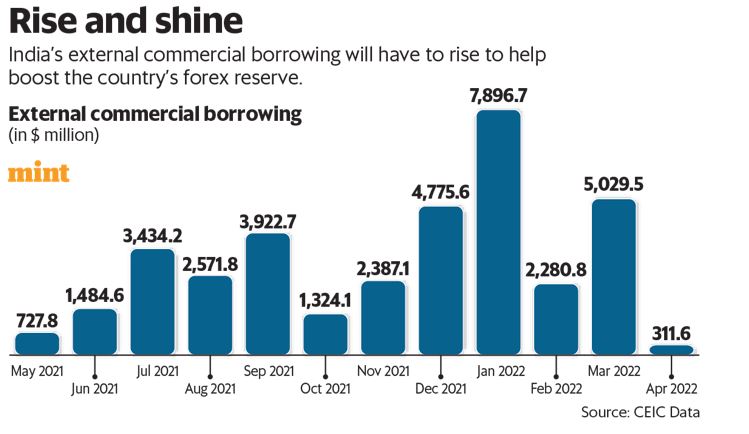
The Reserve Bank of India has relaxed norms for companies raising external commercial borrowings (ECBs), as part of a set of measures to stem the slide in the rupee.
What are ECBs taken by Indian companies?
ECBs are commercial loans that eligible resident entities can raise from outside India, i.e. from a recognized non-resident entity.
ECBs can be buyer’s credit, supplier’s credit, foreign currency convertible bonds, foreign currency exchangeable bonds, loans etc.
ECBs can be raised via the automatic route where cases are examined by the Authorized Category Dealer, or the approval route where borrowers are mandated to forward their request to RBI through their authorized dealers.
Borrowers must follow norms on minimum maturity period, maximum all-in-cost ceiling, end-uses etc.
What is the relaxation offered by the RBI?
RBI earlier had raised borrowing limit under the automatic route from $750 million or its equivalent per financial year to $1.5 bn up till up to 31 December, 2022.
Why such move?
The objective was to increase the supply of foreign exchange reserves.
This in turn would thereby prevent the fast depreciation of the rupee witnessed over the last few months.
What clarity do foreign lenders want from RBI?
Lenders want to know whether the investment grade needs to be rated by domestic or international agencies.
If it is only by global agencies, it would limit the number of potential borrowers.
This is because companies which might be rated high domestically might not necessarily have made the investment grade when rated by international agencies.
Why do Indian firms go for ECBs?
Low cost: ECBs give companies the benefit of borrowing abroad at lower interest rates.
Long term repayment: They are also an avenue to borrow a large volume of funds for a relatively long period of time.
Surpassing exchange fluctuation: Also, borrowing in foreign currencies enables companies to pay for their machinery import etc., thereby nullifying the impact of varying exchange rate.
Long term profitability: ECBs can help diversify the investor base and funds available at lower cost, helping improve profitability of companies.
Better credit ratings: ECB interest rates are also a function of their ratings in the international market.
What are the risks for firms raising ECBs?
Though companies get attracted to ECBs due to lower interest rates, the comfort level of the borrower depends on how stable the rate of exchange is.
Depreciation of the rupee will raise debt servicing burden as compared to what has been worked out at the time of availing of the ECB facility.
Thus, the companies might need to incur hedging costs (amount equal to the aggregate costs, fees, and expenses) to cover the exchange rate risk.
This article provides a quick summary of what has been happening in the global economy. These are few key terms that one is likely to hear repeatedly in the coming days and weeks:
Yield Inversion
Soft-landing and
Reverse Currency War
Here’s a quick look at what they mean and why they are significant at present.
(1) Bond Yield Inversion
What is Bond Yeild?
Bonds are essentially an instrument through which governments (and also corporations) raise money from people.
Typically government bond yields are a good way to understand the risk-free interest rate in that economy.
This 2019 piece provides an introduction to government bonds and explains how yields are calculated.
What is Yield Curve?
The yield curve is the graphical representation of yields from bonds (with an equal credit rating) over different time horizons.
In other words, if one was to take the US government bonds of different tenures and plot them according to the yields they provide, one would get the yield curve.
The chart below provides a sense of the different types of yield curves one could have.
How to see this?
Under normal circumstances, any economy would have an upward sloping yield curve.
That is to say, as one lends for a longer duration — or as one buys bonds of longer tenure — one gets higher yields. This makes sense.
If one is parting with money for a longer duration, the return should be higher.
Moreover, a longer tenure also implies that there is a greater risk of failure.
An inversion of the yield curve essentially suggests that investors expect future growth to be weak.
Inversion of bond yield
However, there are times when this bond yield curve becomes inverted.
For instance, bonds with a tenure of 2 years end up paying out higher yields (returns/ interest rate) than bonds with a 10 year tenure.
Such an inversion of the yield curve essentially suggests that investors expect future growth to be weak.
Here’s how to make sense of this?
When investors feel buoyant about the economy they pull the money out from long-term bonds and put it in short-term riskier assets such as stock markets.
In the bond market, the prices of long-term bonds fall, and their yield (effective interest rate) rises.
This happens because bond prices and bond yields are inversely related.
However, when investors suspect that the economy is heading for trouble, they pull out money from short-term risky assets (such as stock markets) and put them in long-term bonds.
This causes the prices of the long-term bonds to rise and their yields to fall.
Why use inversion curve?
Over the years, inversion of the bond yield curve has become a strong predictor of recessions. Of course, for it to be taken seriously, such an inversion has to last for several months.
Over the past few weeks, such inversion is happening repeatedly in the US, suggesting to many that a recession is in the offing.
In the current instance, the US Fed (their central bank) has been raising short-term interest rates, which further bumps up the short-end of the yield curve while dampening economic activity.
(2) Soft-Landing
The process of monetary tightening that the US is currently unveiling involves not just reducing the money supply but also increasing the cost of money (that is, the interest rate).
US is doing this to contain soaring inflation.
Ideally, the US Fed or any central bank doing this would like to bring about monetary tightening in such a manner that slows down the economy but doesn’t lead to a recession.
When a central bank is successful in slowing down the economy without bringing about a recession, it is called a soft-landing — that is, no one gets hurt.
But when the actions of the central bank bring about a recession, it is called hard-landing.
(3) Reverse Currency War
A flip side of the US Fed’s action of aggressively raising interest rates is that more and more investors are rushing to invest money in the US.
This, in turn, has made the dollar become stronger than all the other currencies. That’s because the dollar is more in demand than yen, euro, yuan etc.
On the face of it, this should make all other countries happier because a relative weakness of their local currency against the dollar makes their exports more competitive.
For instance, a Chinese or an Indian exporter gets a massive boost.
In fact, in the past the US has often accused other countries of manipulating their currency (and keeping its weaker against the dollar) just to enjoy a trade surplus against the US.
This used to be called the currency war.
What explains this reverse currency war unfolding at the moment?
The important thing to understand is that a stronger dollar has had a key benefit — importing cheaper crude oil.
A currency which is losing value to the dollar, on the other hand, finds that it is getting costlier to import crude oil and other commodities that are often traded in dollars.
But raising the interest rate is not without its own risks.
Just like in the US, higher interest rates will decrease the chances of a soft-landing for any other economy.
A major political party has declared that West Bengal Governor Jagdeep Dhankhar would be the candidate for the post of Vice-President.
About Vice President of India
The VP is the deputy to the head of state of the Republic of India, the President of India.
His/her office is the second-highest constitutional office after the president and ranks second in the order of precedence and first in the line of succession to the presidency.
The vice president is also a member of the Parliamentas the ex officio Chairman of the Rajya Sabha.
Qualifications
As in the case of the president, to be qualified to be elected as vice president, a person must:
Be a citizen of India
Be at least 35 years of age
Not hold any office of profit
Unlike in the case of the president, where a person must be qualified for election as a member of the Lok Sabha, the vice president must be qualified for election as a member of the Rajya Sabha.
This difference is because the vice president is to act as the ex officio Chairman of the Rajya Sabha.
Roles and responsibilities
When a bill is introduced in the Rajya Sabha, the vice president decides whether it is a money bill or not.
If he is of the opinion that a bill introduced in the Rajya Sabha is a money bill, he shall refer it to the Speaker of the Lok Sabha.
The vice president also acts as the chancellor of the central universities of India.
Election procedure
Article 66 of the Constitution of India states the manner of election of the vice president.
The vice president is elected indirectly by members of an electoral college consisting of the members of both Houses of Parliament and NOT the members of state legislative assembly.
The election is held as per the system of proportional representation using single transferable votes.
The voting is conducted by Election Commission of India via secret ballot.
The Electoral College for the poll will comprise 233 Rajya Sabha members, 12 nominated Rajya Sabha members and 543 Lok Sabha members.
The Lok Sabha Secretary-General would be appointed the Returning Officer.
Political parties CANNOT issue any whip to their MPs in the matter of voting in the Vice-Presidential election.
Removal
The Constitution states that the vice president can be removed by a resolution of the Rajya Sabha passed by an Effective majority (majority of all the then members) and agreed by the Lok Sabha with a simple majority( Article 67(b)).
But no such resolution may be moved unless at least 14 days’ noticein advance has been given.
Notably, the Constitution does not list grounds for removal.
No Vice President has ever faced removal or the deputy chairman in the Rajya Sabha cannot be challenged in any court of law per Article 122.
Customers will have to pay a 5% Goods and Services Tax (GST) on pre-packed, labelled food items such as atta, paneer and curd, besides hospital rooms with rents above ₹5,000.
What is GST?
GST launched in India on 1 July 2017 is a comprehensive indirect tax for the entire country.
It is charged at the time of supply and depends on the destination of consumption.
For instance, if a good is manufactured in state A but consumed in state B, then the revenue generated through GST collection is credited to the state of consumption (state B) and not to the state of production (state A).
GST, being a consumption-based tax, resulted in loss of revenue for manufacturing-heavy states.
What are GST Slabs?
In India, almost 500+ services and over 1300 products fall under the 4 major GST slabs.
There are five broad tax rates of zero, 5%, 12%, 18% and 28%, plus a cess levied over and above the 28% on some ‘sin’ goods.
The GST Council periodically revises the items under each slab rate to adjust them according to industry demands and market trends.
The updated structure ensures that the essential items fall under lower tax brackets, while luxury products and services entail higher GST rates.
The 28% rate is levied on demerit goods such as tobacco products, automobiles, and aerated drinks, along with an additional GST compensation cess.
Why rationalize GST slabs?
From businesses’ viewpoint, there are just too many tax rate slabs, compounded by aberrations in the duty structure through their supply chains with some inputs taxed more than the final product.
These are far too many rates and do not necessarily constitute a Good and Simple Tax.
Multiple rate changes since the introduction of the GST regime in July 2017 have brought the effective GST rate to 11.6% from the original revenue-neutral rate of 15.5%.
Merging the 12% and 18% GST rates into any tax rate lower than 18% may result in revenue loss.
Anayoottu, an annual ritual at the Sree Vadakkunnathan Temple, Thrissur was recently held.
Why in news?
There is a history behind this annual ritual at the temple.
Kerala’s elephant pooram was selected, along with other cultural forms of the country, for display at the opening ceremony of the Asian Games held in Delhi in 1982.
Elephants were transported all throughout the country to New Delhi.
What is Anayoottu?
The Aanayoottu (gaja pooja/ feeding of elephants) is a festival held in the precincts of the Vadakkunnathan temple in City of Thrissur, in Kerala.
The festival falls on the first day of the month of Karkkidakam (timed against the Malayalam calendar), which coincides with the month of July.
It involves a number of unadorned elephants being positioned amid a multitude of people for being worshipped and fed.
Crowds throng the temple to feed the elephants.
Mythology behind
It is believed that offering poojas and delicious feed to the elephants is a way to satisfy Lord Ganesha—the god of wealth and of the fulfillment of wishes.
The Vadakkunnathan temple, which is considered to be one of the oldest Shiva temples in southern India, has hosted the Aanayottoo event for the past few years.
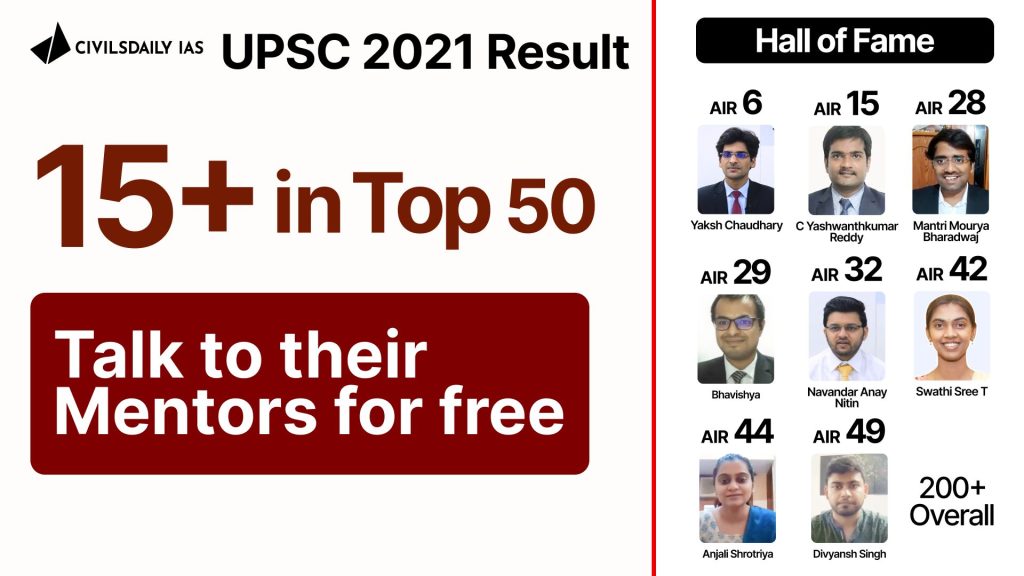
Divyansh Singh, AIR 49, UPSC 2021. Civilsdaily Mentorship Student
Divyansh Singh was one of CD’s mentorship students under Sajal sir, Sukanya ma’am, and other mentors under the Smash Mains program. Divyansh was determined about improving himself. He improved his marks in GS-2 and GS-4 2021 in 2021 Mains.
He filled A-to-Z Preparation Gaps under the Guidance of Sajal Sir
A-Awareness Gap
B-Behavioral gap
C- Confidence gap
D-Delivery Gap
E-Excessiveness/Exclusiveness Gap
F-Focus gap
G-Generic approach gap
H-Herd mentality gap
I-Introvert nature gap
J-Juggling multiple things
K-Knowledge gap
L- Learning Gap
M- Mentoring Gap
N- Narrative Gap
O-Objectivity gap
P-Practice gap
Q-Quantification gap
R-Revision gap
S-Smartwork gap
T-Testing gap
U- Understanding gap
V-Vanity issue gap
W- Wrong attitude gap
X-X-Factor gap
Y-Yardstick approach gap
Z-Zealous approach gap
This was Divyansh’s 4th attempt and in the 2nd attempt in 2019, he secured 484, in the 3rd attempt his rank was 425. Divyansh’s optional was Chemistry.
In a candid interview with Siddharth Sir, Divyansh revealed how he improved his All India Rank to 49.
Divyansh is an engineer by education. After graduation, he joined Microsoft. But soon he realized that UPSC is the right career for him. He started pursuing leaving his corporate job.
In 2020, after joining Smash Mains Program, Divyansh Singh received the remedial studies he had been looking for for 3 years. He attributed his success to Sajal Sir and Sukanya Ma’am.
He said that Sajal Sir was like his best friend throughout his entire journey. He helped Divyansh to improve his marks in GS 2 and GS 4 efficiently.
In GS-2 he scored 119 and according to him, it wasn’t possible without Sajal Sir’s remedial mentorship.
In GS-4, Ethics paper, he scored 117. He said that Sukanya Ma’am’s 1-1 mentorship worked for him. in 2020, he scored only 86 in GS-4. But he improved by 31 marks in 2021. And thus he secured 49 All India Rank.
Program’s focus is on conceptual clarity, simplicity, relevance, and making interlinkages between current affairs and the basic/static part of the syllabus.
Sajal Sir’s guidance got him 10 times more likely to prepare for current affairs linking with the static part in a very short time.
Next-level evaluation of answers helped him a lot to fetch more scores in all GS papers.
CA Resource consolidation on Prelims and Mains’ Preparation.
An ecosystem for co-learning and active learning.
Many more…
Before getting to CD’s Mentorship Program under Sajal Sir in 2020, he had been securing below ranks consistently. He said that he couldn’t figure out the necessary things which are highly required to work on.
Divyansh has made us proud by securing AIR 49 in UPSC 2021 exam. It is yet another validation of CivilsDaily’s vision and approach to personalized mentorship.
Anay has inspired us and we wish him all the best. He’s going to be an administrator of great integrity!
Guys, successful and unsuccessful people do not vary greatly in their abilities. They vary in their desires to reach their goal. Disrobe your failure. Civilsdaily senior mentors team are happy to fulfill your IAS dream.Talk to Us
Are you a staunch aspirant of UPSC IAS exam? if yes, you should keep in mind that Civilsdaily provides the best 1-1 mentorship program on UPSC CSE preparation. In 2021 merit list, 200+ selections are from our mentorship program.
The Hindu has acknowledged the success rate of our mentorship program
Civil Services Aptitude Test is a part of UPSC CSE prelims. There is no such paper in UPSC Mains. It is a qualifying paper. Candidates have to score 33% to clear the paper.
Total Number of questions: 80
Full marks: 200
Time: 2 hours
Though it is qualifying in nature, it plays a crucial role in passing prelims.
The objective of the CSAT is to judge the aspirants on their reading, analytical & reasoning skills.
It proves a little challenging to many students because of its standard level.
But, if you prepare it with a concrete strategy under the guidance of a senior IAS mentor, you can easily score 33%+.
Quantitative Aptitude has been gaining prominence over the years.
The number of logical reasoning is getting less.
The number of comprehensions is stable.
How to deal with CSAT?
As it’sa qualifying paper, too much time investing is not feasible.
Prepare in any of these ways.
Make your quant. Strong enough. We already found that even if a student just attempts the quant section errorlessly, he/she can pass the paper easily.
Work on both Quantitative aptitude and Logical reasoning with the same focus if you feel a little weaker in maths. Because the reasoning questions are very easy and scoring.
Reading comprehension is one of the most difficult sections. If you are a master of English, you can invest time in it.
You are doing previous question papers. And that’s appreciated. But, have you ever thought that all the aspirants are also doing the same? Then how our ‘Hall of Fame’ toppers distinguished themselves on the final merit list!
To gain more accuracy, speed, and performance and To save time, money & energy, they used to attend Online workshops on IAS prep strategy with senior IAS mentors.
UPSC Previous year papers are those sets of questions that went before in time and order. Like all other exams, there are copies of UPSC-CSE PYQs exist. You can download PDFs of PYQs from the Civilsdaily. And analyze what types of questions are asked in Civil Service Examination.
How many previous year papers are required?
Previous year’s papers are the core and essence of the UPSC preparation. But, how many previous questions really play an important role!
After mentoring 5000+ IAS aspirants, the Civilsdaily senior IAS mentors team has made a list of essential previous question papers, an IAS aspirant must do.
UPSC prelims
GS-1
GS-2 (CSAT)
Past 10 years’ questions are needful
Past 5 years’ questions are needful
UPSC Mains
Essay
Previous 5 years
GS – I
Previous 10 years
GS – II
Previous 10 years
GS – III
Previous 3 years
GS – IV
Previous 6 years
Optional Subject
Previous 12 years
Importance of previous questions
From toppers to Mentors, none can deny the significance of the previous year’s question papers. They are important from different angles.
Every exam is unique in itself. So, the exam patterns also differ from one another. To know the Ques. pattern, the role of PYQs is undeniable.
They help us know the difficulty level of the questions. And in how much depth we should maintain while preparing the subjects.
Previous Years’ questions let us know those pet topics of the exams.
To know the dynamic trends, PYQs are incomparable.
PYQs work as the pieces of equipment for a fence. You can have a grip on the entire syllabus following them.
How to do them
If you wish to start UPSC Preparation without coaching, make previous years’ question papers your mentor.
Read and analyze the previous years’ question papers in the following ways so that it means a lot to you.
Previous Years’ Question Papers (UPSC Prelims)
Previous 10 Years Question papers of GS-1
Previous 5 Years Question Papers of GS-2 (CSAT – A qualifying paper)
Now, start investing 30 days to 45 days to analyze them fully and comprehensively.
Take a note of the weightage of the topic and subject-wise questions.
Try to comprehend how UPSC connected current affairs with static.
In CSAT, start solving papers one by one from the second day.
Try to find out offbeat questions. And the way how UPSC designed such questions.
Every question has its unique demand. Identify them.
Take a note of whether the trend of a question from a particular chapter has been going towards an easier level or a more difficult level.
Always do the pet chapters in 360 degrees.
Supplementary materials
It’s undeniable fact that UPSC preparation starts with previous question papers but gets velocity with essential books, Daily MCQs, Test Series, Daily answer writing, etc.
All the question papers mentioned above are co-related. If you miss one, others may not help you.
Online Workshop on UPSC previous question papers strategy
You are doing previous question papers. And that’s appreciated. But, have you ever thought that all the aspirants are also doing the same? Then how our ‘Hall of Fame’ toppers distinguished themselves on the final merit list!
To gain more accuracy, speed, and performance and To save time, money & energy, they used to attend Online workshops on IAS prep strategy with senior IAS mentors.
The civil services examination (CSE) is a National level competitive examination. The exam is conducted by the UPSC almost every year.
CSE is also widely known as the IAS exam.
CSE is for the recruitment of bureaucrats (Civil Servants/HIgher Govt. officials) for 3 services under the Government of India
All India Services
Group A Services or Central Services
Group B services or State services
Every year millions of Indian youths start preparing for the exam. But a handful of candidates can clear the exam because it is the toughest exam in the country and is unpredictable too.
What services are there under UPSC CSE?
All India Services:
Indian Administrative Service
Indian Foreign Service
Indian Police Service
Group A Services or Central Services
Indian Audit and Accounts Service
Indian Civil Accounts Service
Indian Corporate Law Service
Indian Defence Accounts Service
Indian Defence Estates Service
Indian Information Service, Junior Grade
Indian Postal Service, Group
Indian P&T Accounts and Finance Service
Indian Railway Protection Force Service
Indian Revenue Service (Customs & Indirect Taxes)
Indian Revenue Service (Income Tax)
Indian Trade Service
Group B services or State services
Armed Forces Headquarters
Delhi, Andaman, and the Nicobar Islands, Lakshadweep, Daman & Diu, and Dadra & Nagar Haveli Civil Service (DANICS)
Delhi, Andaman, and the Nicobar Islands, Lakshadweep, Daman & Diu, and Dadra & Nagar Haveli Police Service (DANIPS).
Pondicherry Civil Service (PONDICS)
UPSC-CSE Salary
All the posts start in the level 10 pay matrix and the pay band is between Rs. 56,100 and Rs. 1,77,500.
Eligibility:
Nationality:
For the Indian Administrative Service, the Indian Foreign Service, and the Indian Police Service, a candidate must be a citizen of India.
(2) For other services, a candidate must be either:—
(a) a citizen of India or (b) a subject of Nepal
(c) a subject of Bhutan
(d) a Tibetan refugee who came over to India before 1st January 1962 intending to permanently settle in India
(e) a person of Indian origin who has migrated from Pakistan, Burma, Sri Lanka, East African countries of Kenya, Uganda, the United Republic of Tanzania, Zambia, Malawi, Zaire, Ethiopia, and Vietnam intending to permanently settle in India. Provided that a candidate belonging to categories (b), (c), (d) and (e) shall be a person in whose favour a certificate of eligibility has been issued by the Government of India. A candidate in whose case a certificate of eligibility is necessary may be admitted to the examination but the offer of appointment may be given only after the necessary eligibility certificate has been issued to him/her by the Government of India.
Minimum Educational Qualification:
A candidate must hold a Graduate degree from any of the Universities incorporated by an Act of the central or State Legislature in India or other educational institutions established by an Act of Parliament or declared to be deemed as a University under Section 3 of the University Grants Commission Act, 1956 or possess an equivalent qualification.
Age:
(1) A candidate must have attained the age of 21 years and must not have attained the age of 32 years
(2) The upper age limit prescribed above will be relaxable:
(a) up to a maximum of five years if a candidate belongs to a Scheduled Caste or a Scheduled Tribe;
(b) up to a maximum of three years in the case of candidates belonging to Other Backward Classes who are eligible to avail of reservation applicable to such candidates;
(c) up to a maximum of three years in the case of Defence Services Personnel, disabled in operations during hostilities with any foreign country or in a disturbed area and released as a consequence thereof;
(d) up to a maximum of five years in the case of ex-servicemen including Commissioned Officers and Emergency Commissioned Officers (ECOs)/ Short Service Commissioned Officers (SSCOs) who have rendered at least five years of Military Service
(e) up to a maximum of five years in the case of ECOs/SSCOs who have completed an initial period of assignment of five years of Military Service
(f) up to a maximum of 10 years in the case of candidates belonging to Persons with Benchmark Disabilities (PwBD) categories viz. (i) blindness and low vision; (ii) deaf and hard of hearing; (iii) locomotor disability including cerebral palsy, leprosy cured, dwarfism, acid attack victims and muscular dystrophy; (iv) autism, intellectual disability, specific learning disability, and mental illness; (v) multiple disabilities from amongst person under clauses (i) to (iv) including deaf-blindness
Number of Attempts:
Every candidate appearing at the examination, who is otherwise eligible, shall be permitted six (6) attempts at the CSE. However, relaxation in the number of attempts will be available to the SC/ST/OBC and PwBD category candidates who are otherwise eligible. The number of attempts available to such candidates as per relaxation is as under:
Fees:
Candidates (excepting Female/SC/ST/Persons with Benchmark Disability Candidates who are exempted from payment of fee) are required to pay a fee of Rs. 100/- (Rupees One Hundred only)
Guys, though we have provided above the most comprehensive details for your CSE preparation, we would like to recommend you to have a personalized mentor. Because UPSC CSE is a hard nut to crack.
Guys, successful and unsuccessful people do not vary greatly in their abilities. They vary in their desires to reach their goal.
Getting confused? connect with us. We will help you to make out.